Isosceles Triangles [Including Inequalities]
10.1 Introduction & Basic Concepts
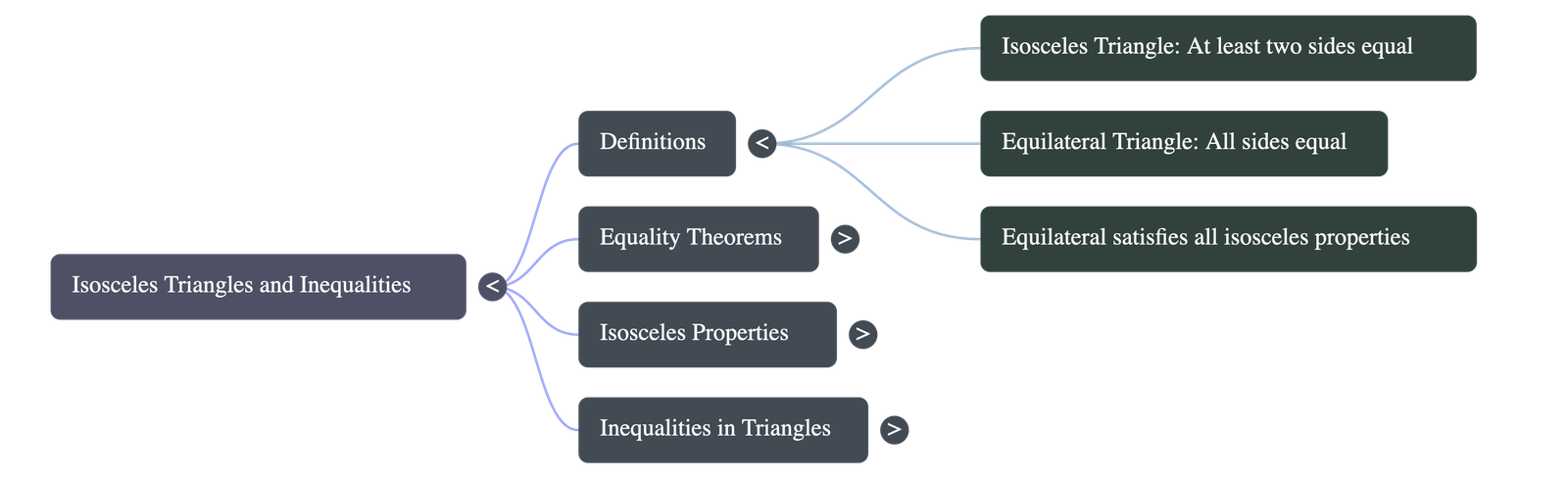
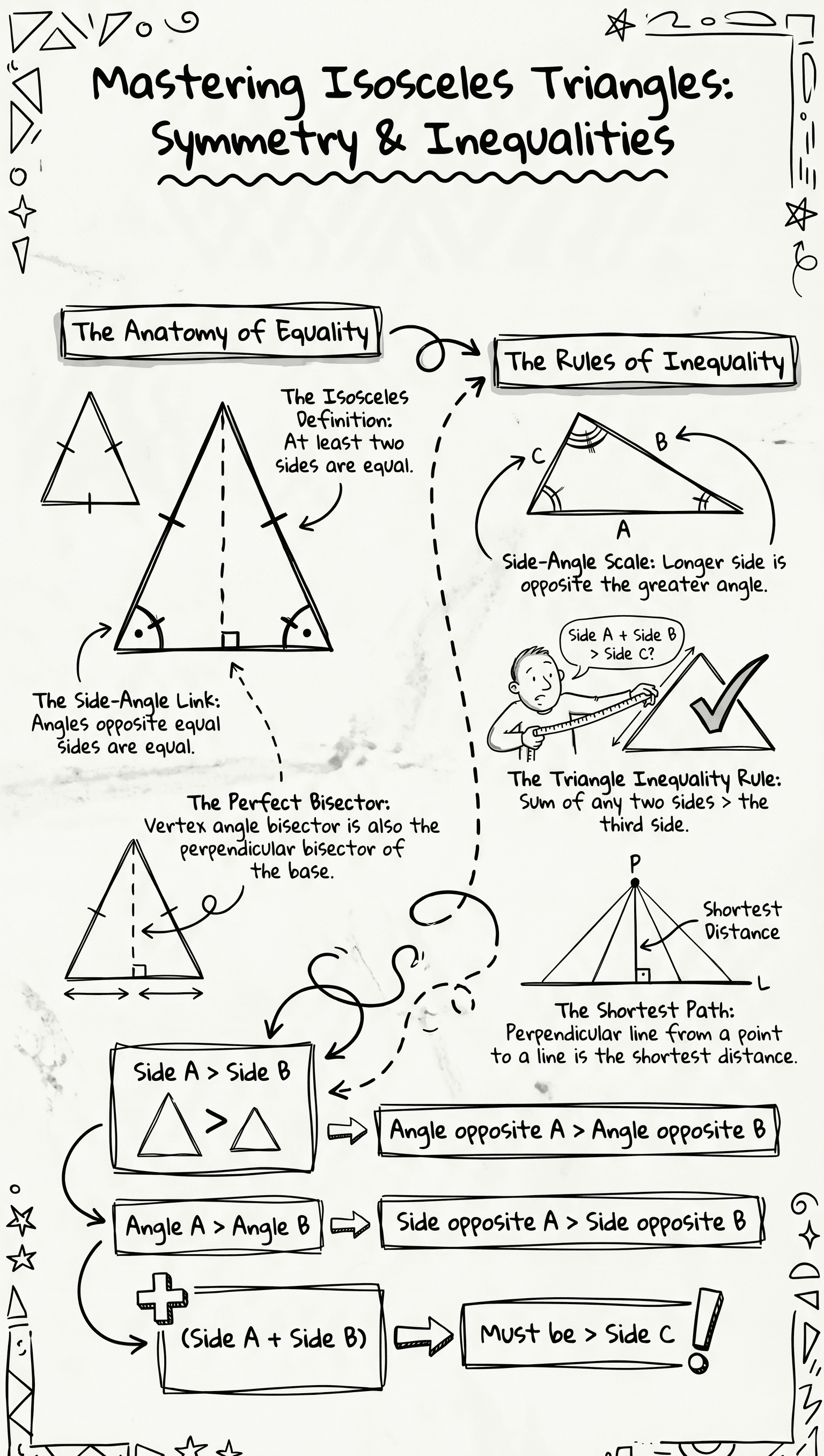
- Isosceles Triangle: A triangle that has at least two equal sides is called an isosceles triangle.
- Equilateral Triangle: A triangle in which all three sides are equal to each other is known as an equilateral triangle.
- Relationship: An equilateral triangle satisfies all the properties of an isosceles triangle. However, it is not necessary for an isosceles triangle to satisfy all properties of an equilateral triangle.
Fundamental Theorems of Isosceles Triangles
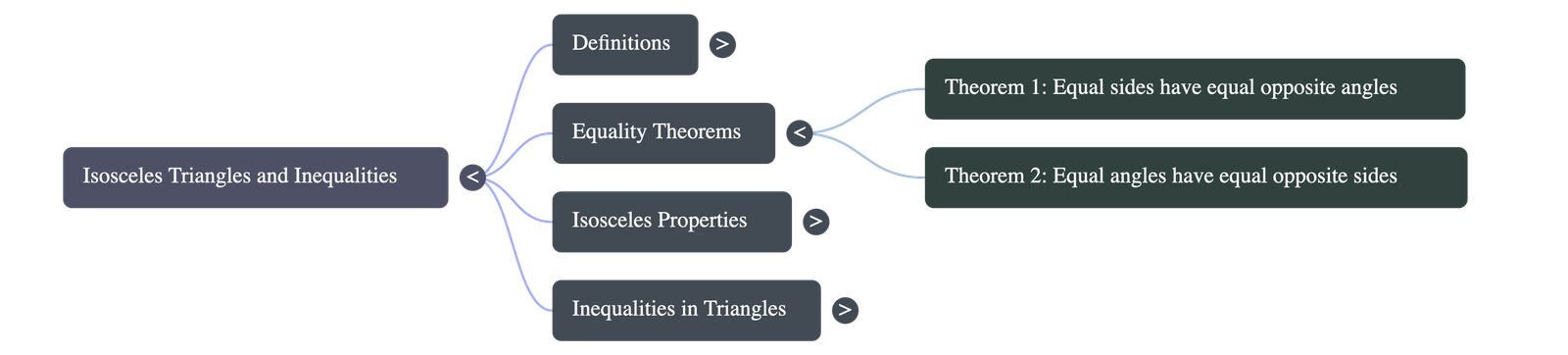
Theorem 1
If two sides of a triangle are equal, the angles opposite to them are also equal.
Theorem 2 (Converse)
If two angles of a triangle are equal, the sides opposite to them are also equal.
Key Deductions and Properties
Based on the above theorems, several important properties hold true for isosceles triangles:
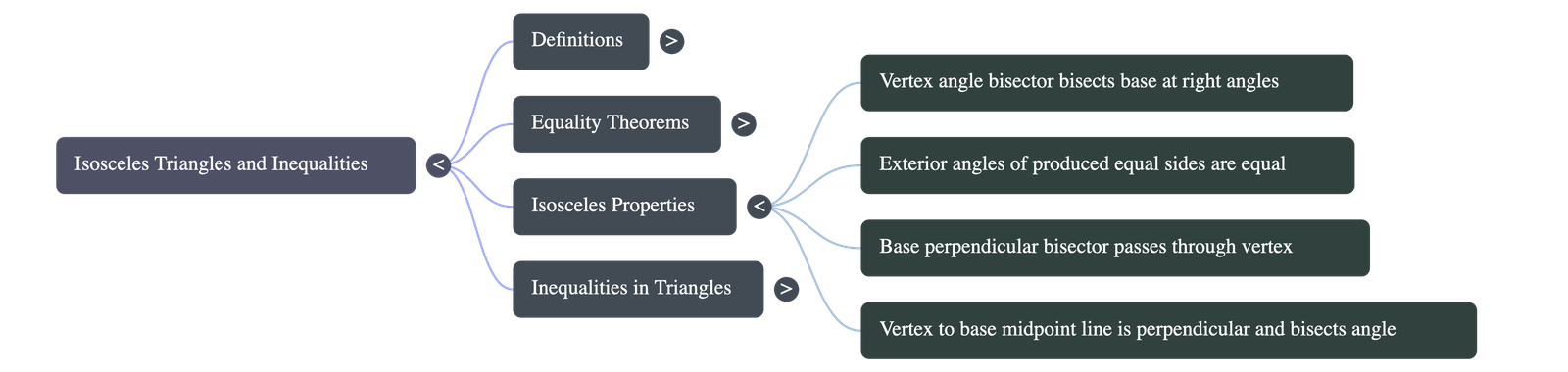
- The bisector of the angle at the vertex of an isosceles triangle bisects the base at right angles.
- If the equal sides of an isosceles triangle are extended outward, the exterior angles formed are always equal.
- The perpendicular bisector of the base of an isosceles triangle perfectly passes through the vertex of the triangle.
- The straight line joining the mid-point of the base to the opposite vertex is perpendicular to the base and successfully bisects the vertex angle.
10.2 Inequalities in Triangles
When studying triangles where sides or angles are not equal, we use inequality signs: > (greater than) and < (less than).
Theorem 3
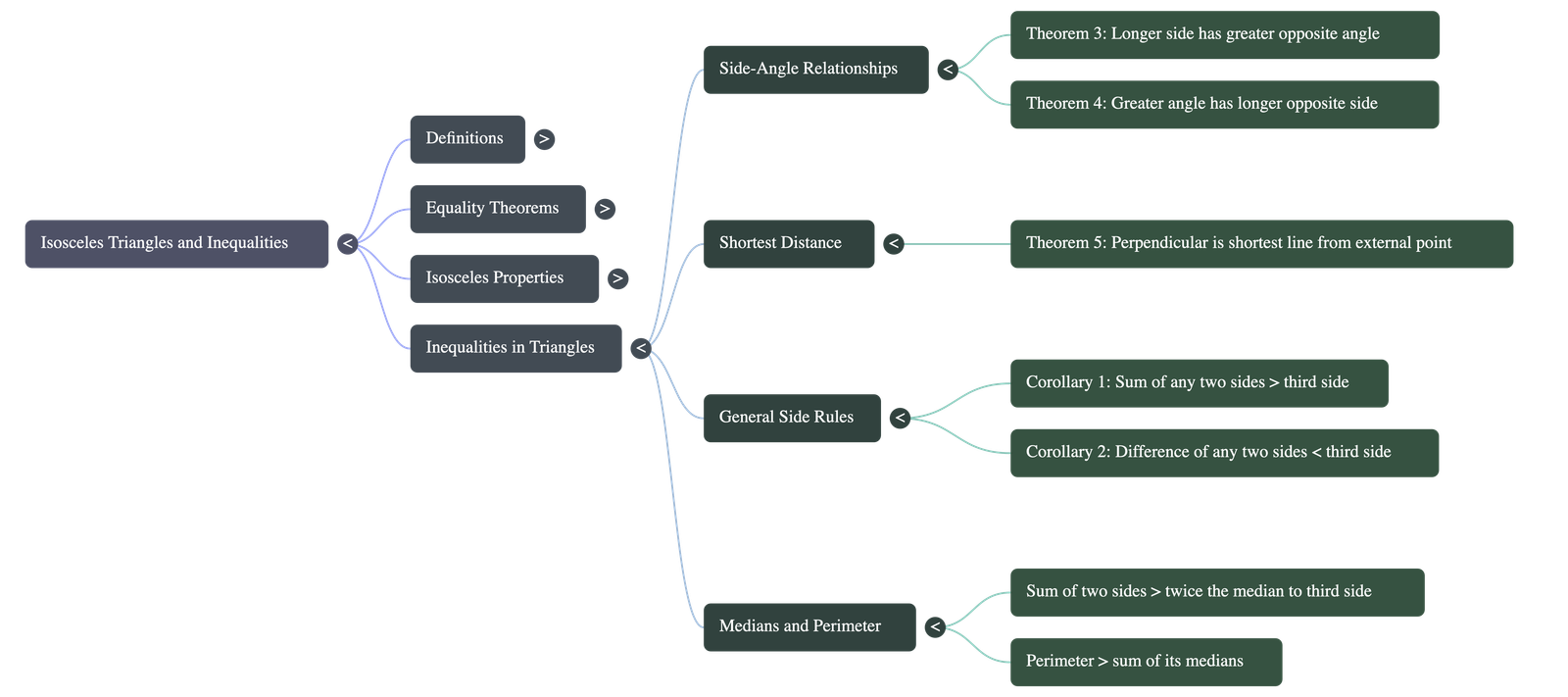
If two sides of a triangle are unequal, the longer side has the greater angle opposite to it.
Theorem 4 (Converse of Theorem 3)
If two angles of a triangle are unequal, the greater angle has the larger side opposite to it.
Theorem 5
Of all the line segments that can be drawn to a given straight line from a given point outside it, the perpendicular line segment is the shortest.
Important Corollaries on Side Lengths
- Sum of Sides Rule (Corollary 1): The sum of the lengths of any two sides of a triangle is always greater than the length of the third side.
- Difference of Sides Rule (Corollary 2): The difference between the lengths of any two sides of a triangle is always less than the length of the third side.
Do checkout all questions & answers of this chapter.