Triangles [Congruency in Triangles]
9.1 Introduction
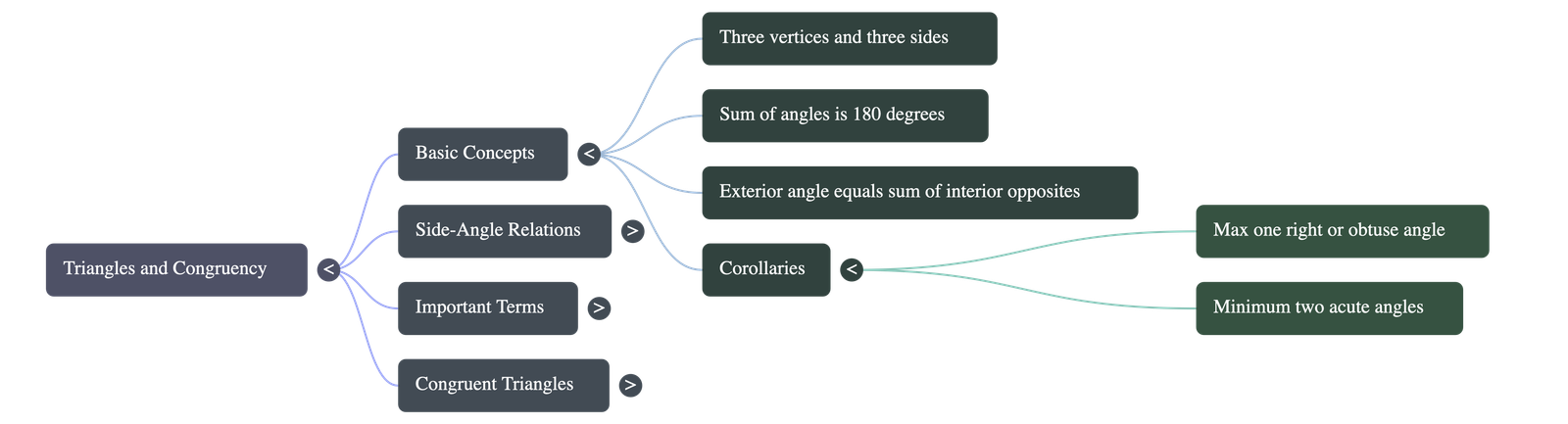
- → A triangle is a closed plane figure bounded by exactly three straight line segments.
- → Every triangle is fundamentally made up of three vertices (the corner points) and three sides.
9.2 Relation Between Sides and Angles of Triangles
The lengths of the sides of a triangle dictate the measure of its angles and vice versa:
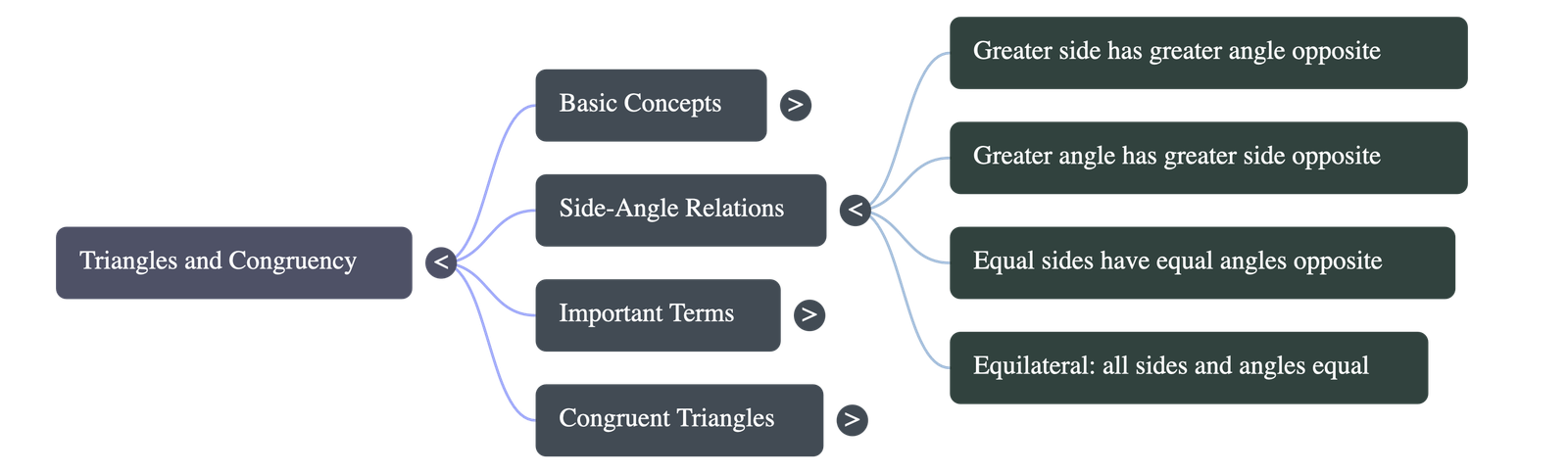
- ✓ Unequal Sides and Angles: If all sides of a triangle are of different lengths, their opposite angles will also be of different measures. The greatest side always has the greatest angle opposite to it.
- ✓ Conversely: If all angles are of different measures, the sides will be of different lengths, with the greatest angle having the greatest side opposite to it.
- ✓ Isosceles Property: If any two sides of a triangle are equal, the angles opposite to them are also equal. The reverse is also true: equal angles mean their opposite sides are equal.
- ✓ Equilateral Property: If all three sides are equal, all three angles are equal. Conversely, if all three angles are equal, all three sides are equal.
9.3 Some Important Terms & Properties
Key Geometric Lines
-
•
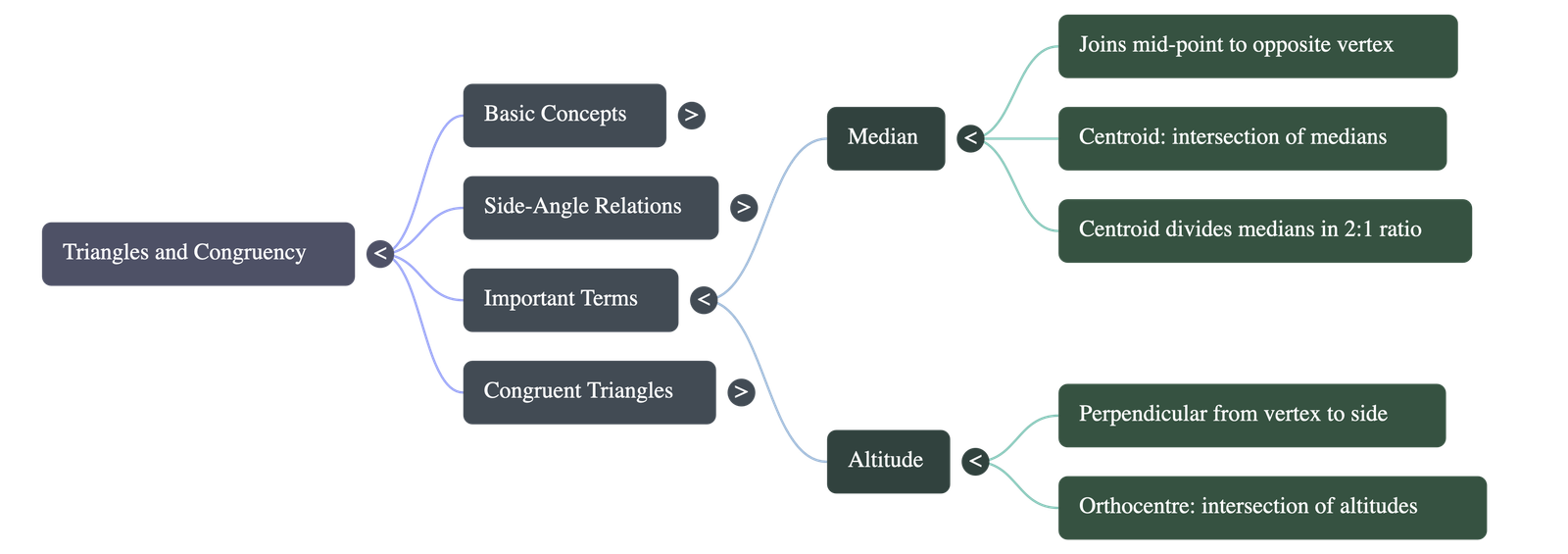
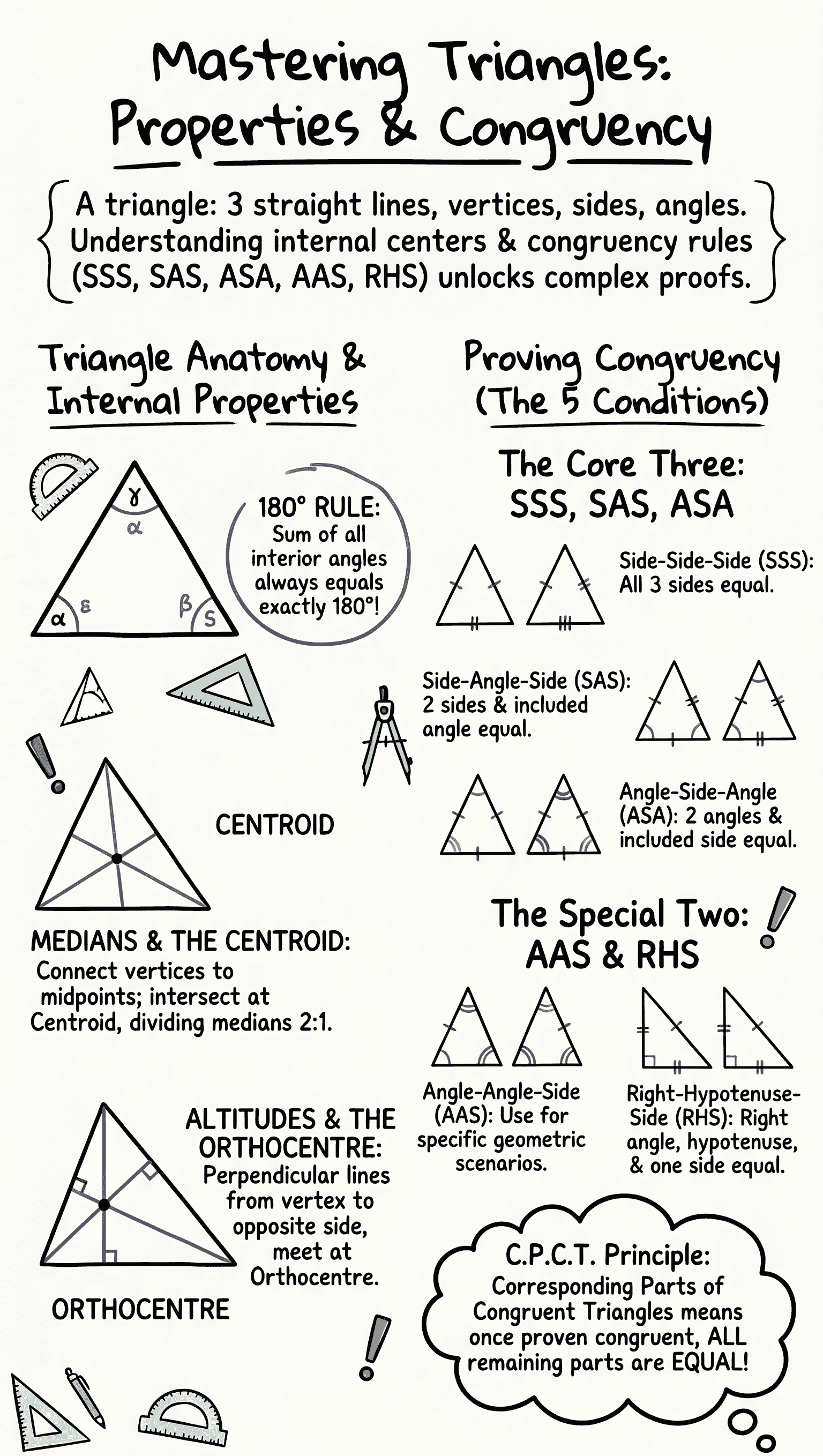
Median: A line joining the mid-point of a side to the opposite vertex. A triangle has three medians which are concurrent (intersect at one point).
Centroid: The point where the three medians intersect. It uniquely divides each median in a 2 : 1 ratio. -
•
Altitude: The perpendicular length drawn from a vertex to the opposite side. A triangle has three concurrent altitudes.
Orthocentre: The point of intersection of the three altitudes.
Fundamental Angle Properties (Corollaries)
- The sum of all interior angles of a triangle is exactly 180°.
- If one side is produced outwards, the exterior angle formed is equal to the sum of the two interior opposite angles.
- An exterior angle is always greater than either of the interior opposite angles.
- A triangle cannot have more than one right angle (90°) or more than one obtuse angle.
- In a right-angled triangle, the sum of the remaining two acute angles is exactly 90°.
- Every triangle has at least two acute angles.
- If two angles of one triangle are equal to two angles of another triangle, their third angles must also be equal.
9.4 Congruent Triangles
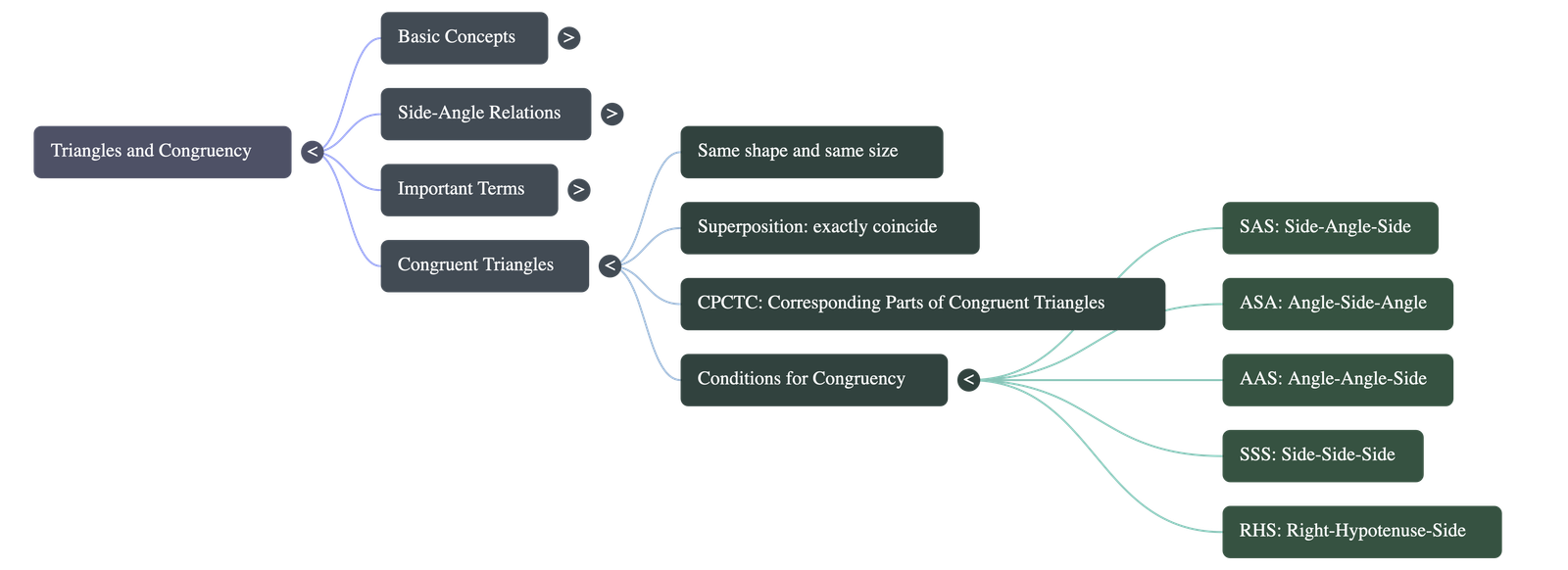
- ★ Definition: Two triangles are congruent if they coincide exactly when placed one over the other (superposition).
- ★ Shape and Size: Congruent triangles have exactly the same shape (all corresponding angles are equal) and the same size (all corresponding sides are equal).
- ★ Symbol: The symbol for congruency is ≅ (read as "is congruent to").
- C.P.C.T.C. Rule: This stands for Corresponding Parts of Congruent Triangles are Congruent. This means in congruent triangles, sides opposite to equal angles are equal, and angles opposite to equal sides are equal. Order matters when writing the names of congruent triangles!
9.5 Conditions for Congruency of Triangles
To prove two triangles are congruent, you do not need to show all six parts (3 sides and 3 angles) are equal. You only need to fulfill one of the following five conditions:
1. S.A.S. (Side-Angle-Side)
If two sides and the included angle of one triangle are equal to two sides and the included angle of the other triangle, the triangles are congruent. (Note: The angle must be between the two given sides).
2. A.S.A. (Angle-Side-Angle)
If two angles and the included side of one triangle are equal to two angles and the included side of the other triangle, the triangles are congruent.
3. A.A.S. (Angle-Angle-Side)
If two angles and one non-included side of a triangle are equal to two corresponding angles and the corresponding side of another triangle, they are congruent.
Precaution: The equal sides must be opposite to the equal angles in both triangles. (This is just an extension of A.S.A because if two angles are equal, the third angle is automatically equal).
4. S.S.S. (Side-Side-Side)
If all three sides of one triangle are equal to all three corresponding sides of the other triangle, the triangles are congruent.
5. R.H.S. (Right angle-Hypotenuse-Side)
Only applicable for right-angled triangles. If the hypotenuse and one side of a right-angled triangle are equal to the hypotenuse and the corresponding side of another right-angled triangle, they are congruent.
Practice & Exercises
The chapter wraps up the theoretical concepts with comprehensive application through Exercise 9(A), Exercise 9(B), and a Test Yourself section. These sections are filled with:
- Multiple Choice Questions testing the conditions of congruency.
- Geometric proof problems requiring the application of SAS, ASA, AAS, SSS, and RHS conditions alongside C.P.C.T.C.
- Higher Order Thinking Skills (HOTS) questions involving complex shapes like parallelograms, squares, and intercepting lines.
- A Case-Study Based Question to apply congruency axioms practically.
Do checkout all questions & answers of this chapter.