Quick Navigation:
| | | |
Area and Perimeter of Plane Figures
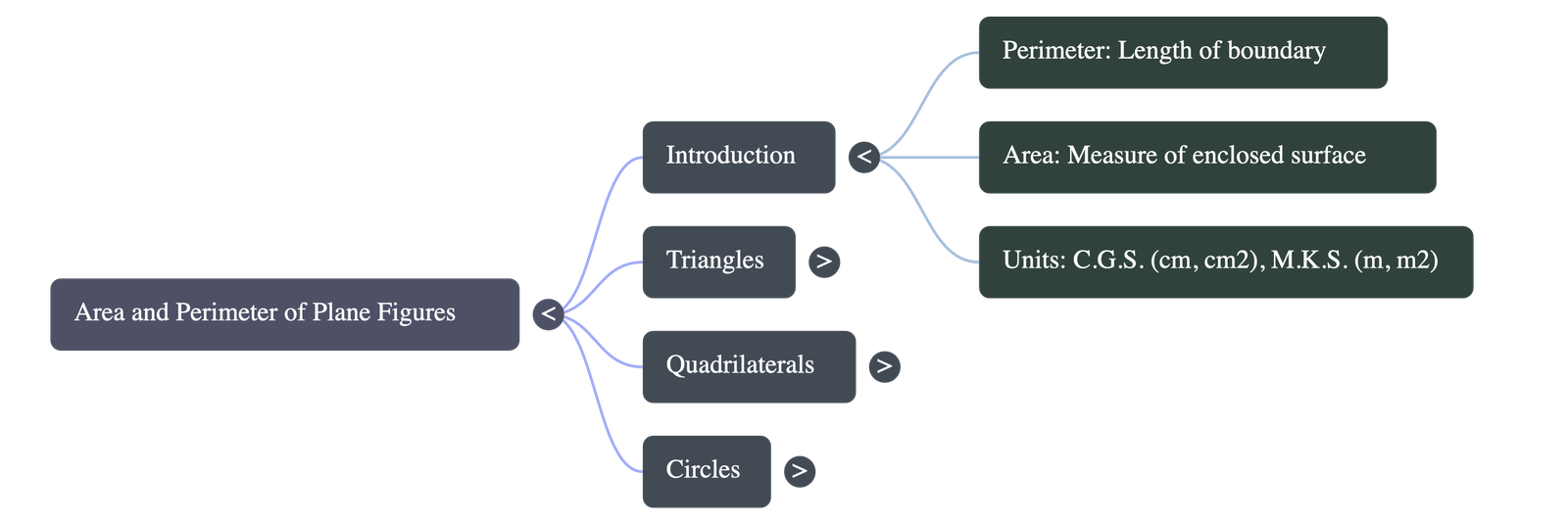
19.1 Introduction
- Perimeter: The total length of the boundary of a plane figure. The unit of perimeter is the same as the unit of length (e.g., cm, m).
- Area: The measure of the flat surface enclosed by a figure's boundary. The unit of area is squared (e.g., cm², m²).
- Important Distinction: "Square metre" refers to the unit of area, whereas "metre square" refers to a physical square shape whose sides are that many metres long.
19.2 Area and Perimeter of Triangles
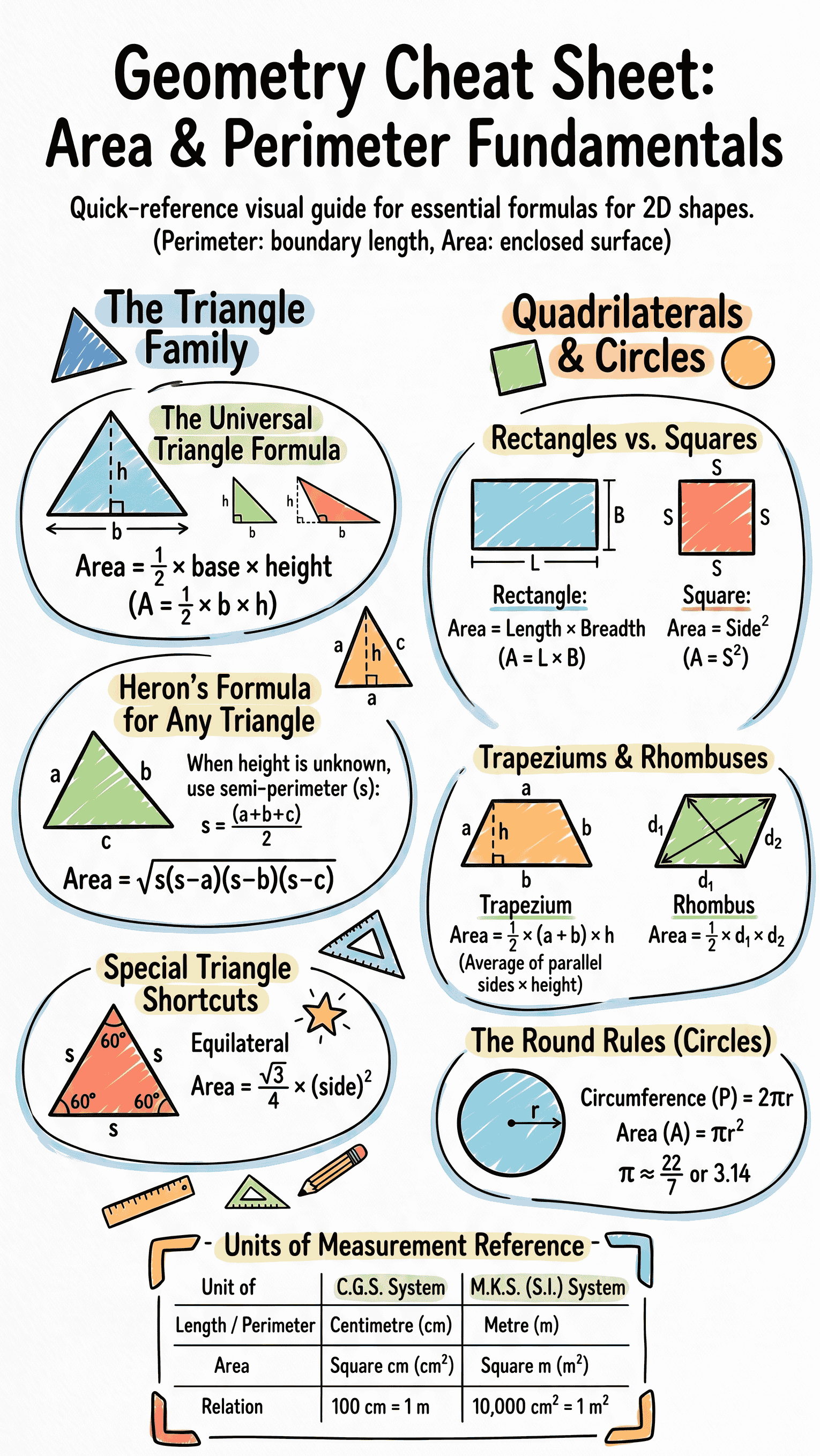
- Basic Formula: The area of any triangle is calculated as ½ × base × corresponding height (altitude).
- Base and Height: Any of the three sides can be taken as the base. The corresponding height is the perpendicular distance from the opposite vertex to that chosen base.
- Heron's Formula: Used when all three side lengths (a, b, and c) are given.
- First, find the semi-perimeter (s), which is half of the total perimeter: s = (a + b + c) / 2.
- Then, calculate the Area using the square root of: s × (s - a) × (s - b) × (s - c).
19.3 Some Special Types of Triangles
- Equilateral Triangle: A triangle where all three sides are equal.
- Perimeter = 3 × side.
- Area = (√3 / 4) × (side)².
- The area is also equal to ½ × base × height, where the perpendicular bisects the base.
- Isosceles Triangle: A triangle with two equal sides.
- A perpendicular drawn from the vertex connecting the equal sides to the unequal base bisects the base.
- This forms two right-angled triangles, allowing the use of Pythagoras theorem to find the height, and subsequently the area.
- Right-angled Triangle: A triangle containing a 90° angle.
- Area = ½ × (product of the two sides containing the right angle).
19.4 Area and Perimeter of All Types of Quadrilaterals
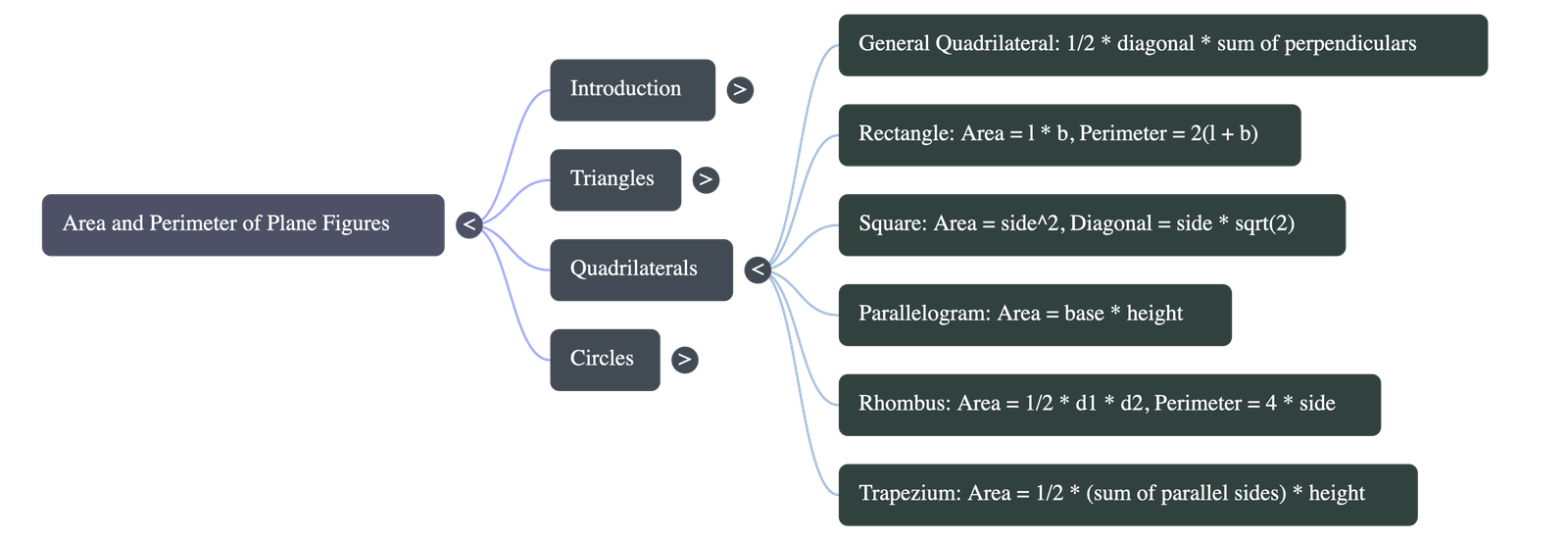
- General Quadrilateral: If one diagonal is known, and perpendiculars are drawn to it from the remaining two vertices, the Area = ½ × (the diagonal) × (sum of the lengths of the two perpendiculars).
- Perpendicular Diagonals: When the two diagonals of a quadrilateral intersect each other at exactly 90 degrees (right angles), the Area = ½ × (product of the diagonals).
19.5 Some Special Types of Quadrilaterals
- Rectangle: Area = length × breadth. Perimeter = 2 × (length + breadth). Diagonal length is found using Pythagoras theorem on the length and breadth.
- Square: Area = (side)². Perimeter = 4 × side. Diagonal = √2 × side. Area can also be found directly from the diagonal: Area = ½ × (diagonal)².
- Parallelogram: Area = base × height. The height is the perpendicular distance between the chosen base and the side opposite to it.
- Rhombus: All sides are equal (Perimeter = 4 × side). Diagonals bisect each other at right angles. Area = ½ × (product of diagonals).
- Trapezium: A figure with one pair of parallel sides. Area = ½ × (sum of parallel sides) × (perpendicular distance between the parallel sides).
19.6 Circumference of a Circle
- Definition: The circumference is the length of the outer boundary of the circle.
- The Constant Pi (π): The ratio of any circle's circumference to its diameter is always constant. This constant is represented by the Greek letter π (approximately 22/7 or 3.14).
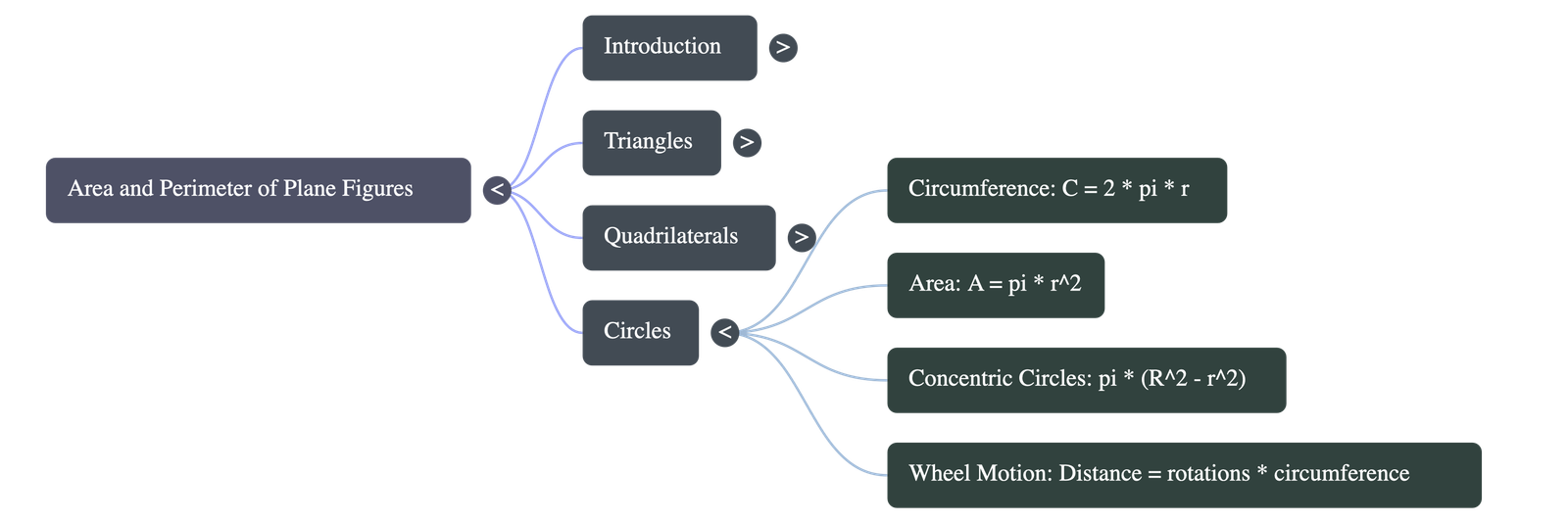
- Formulas: Circumference = π × diameter. Since diameter is twice the radius, it is also written as Circumference = 2 × π × radius (2πr).
19.7 Area of a Circle
- Basic Area Formula: The surface enclosed by a circle is calculated as Area = π × (radius)².
- Concentric Circles (Circular Ring): If two circles share the same center, the area of the ring between them is the outer circle's area minus the inner circle's area. Formula: π(R² - r²), where R is outer radius and r is inner radius.
- Wheel Rotations:
- The distance covered by a wheel in 1 complete rotation equals its circumference (2πr).
- Total distance covered = (Circumference of the wheel) × (Number of rotations).
Do checkout all questions & answers of this chapter.
Quick Navigation:
| | | |
1 / 1
Quick Navigation:
| | | |