Quick Navigation:
| | | |
Area Theorems [Proofs and Uses]
A Comprehensive Summary for Class 9
15.1 Introduction
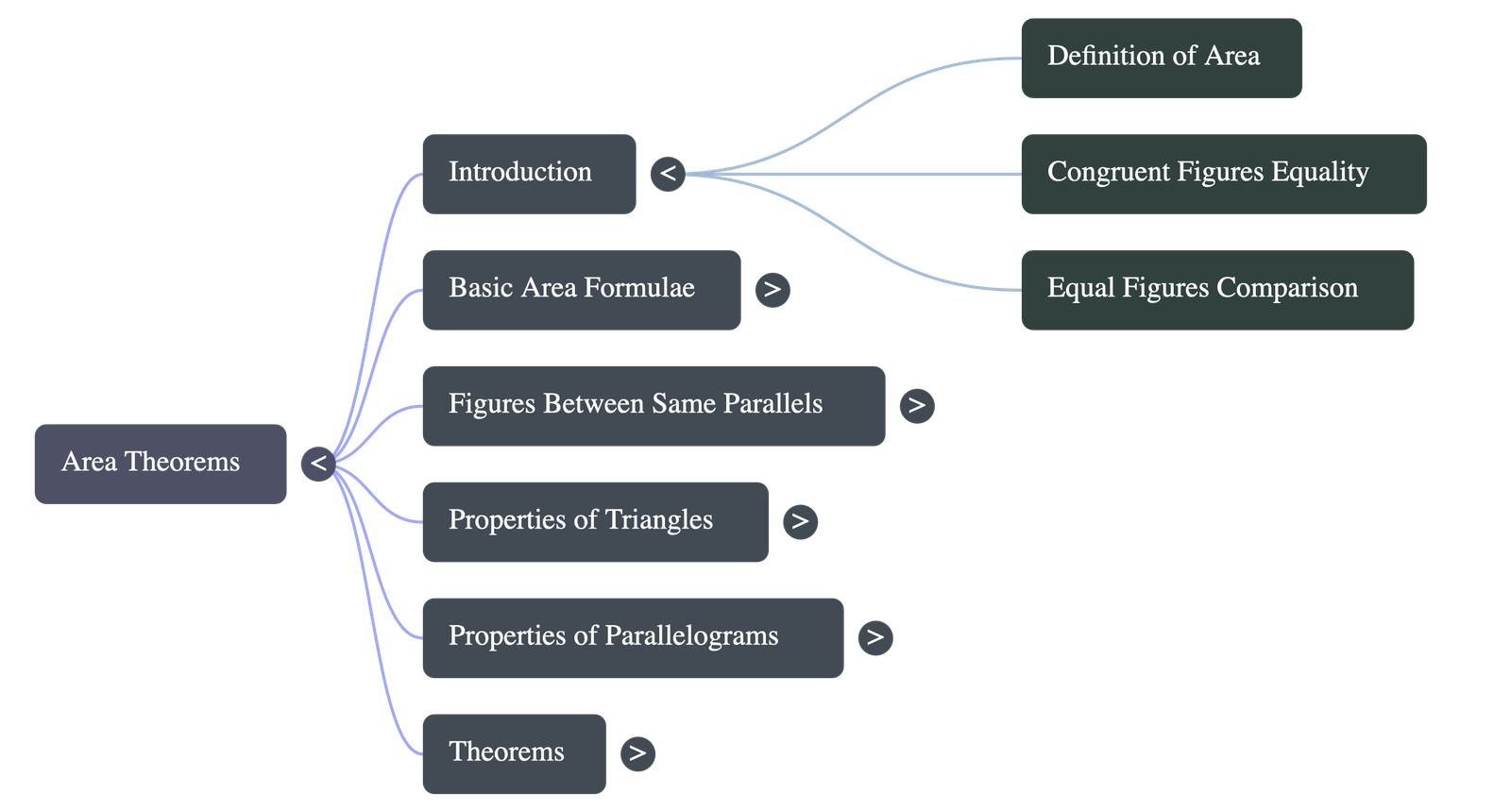
- Concept of Area: The area of a plane figure is defined as the actual region bounded by the figure.
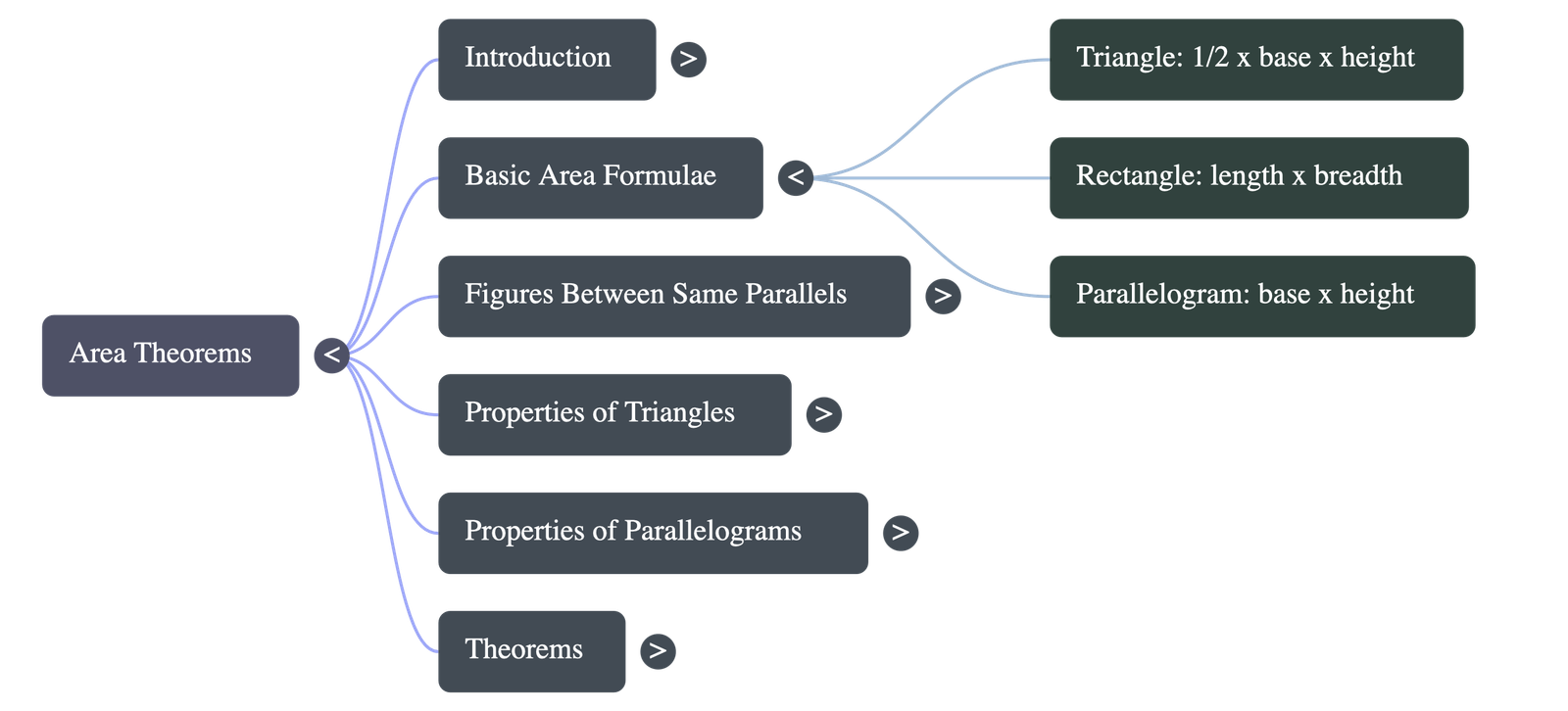
- Basic Formulae Recap:
- Area of a triangle = ½ × base × height
- Area of a rectangle = length × breadth
- Area of a parallelogram = base × height
- Equal Figures vs. Congruent Figures:
- "Equal figures" specifically means the figures are equal in area.
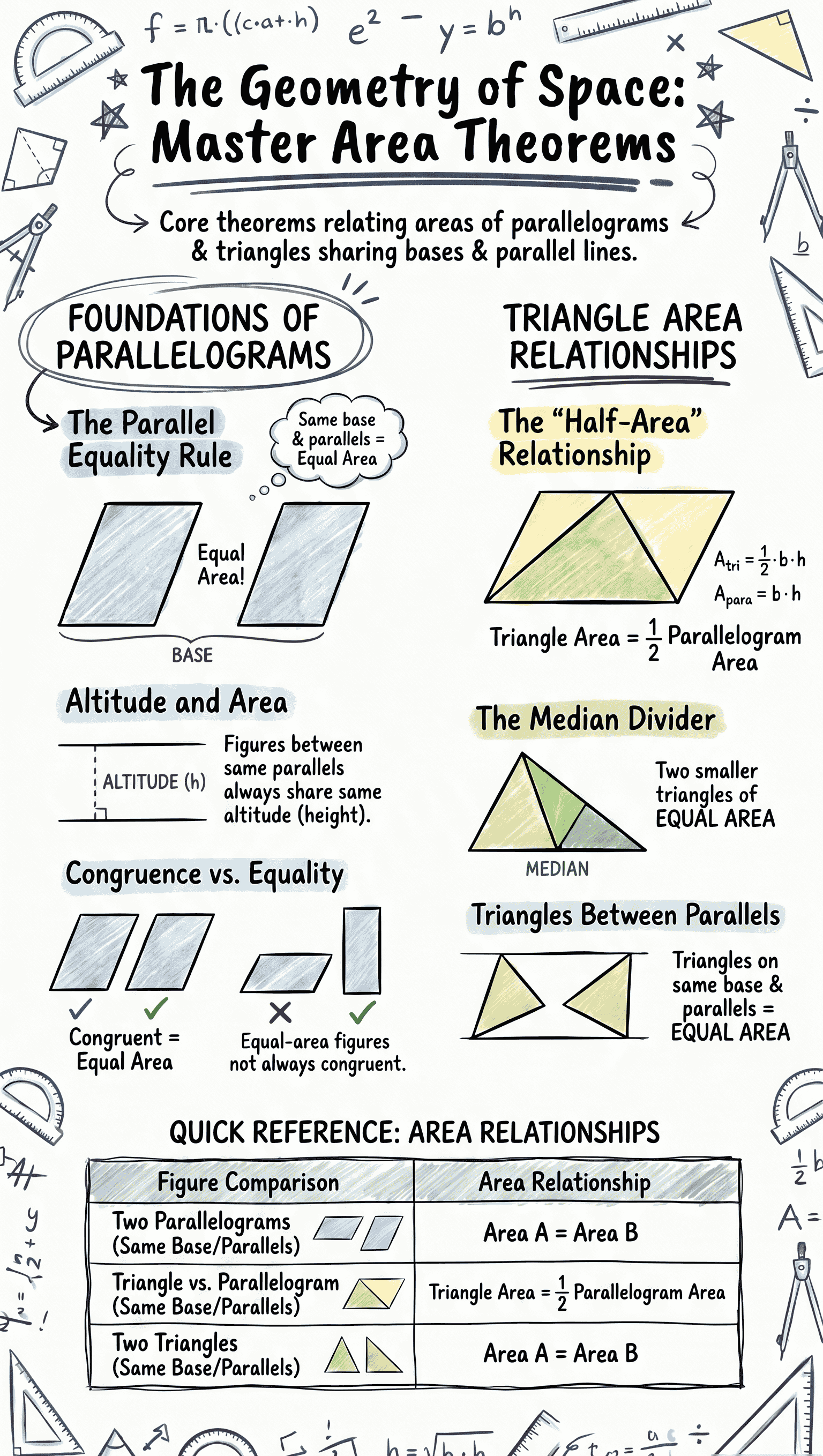
- Important Rule: Congruent figures are always equal in area, but the converse is not always true (figures with the same area do not have to be exactly the same shape).
15.2 Figures Between the Same Parallels
- Definition: If shapes (like a parallelogram, rectangle, or triangle) have their bases on one straight line and their opposite vertices on another parallel straight line, they are said to be "between the same parallels."
- Key Observation: Any parallelogram, rectangle, or triangle that lies between the exact same parallel lines will naturally share the same altitude (height).
Core Theorems
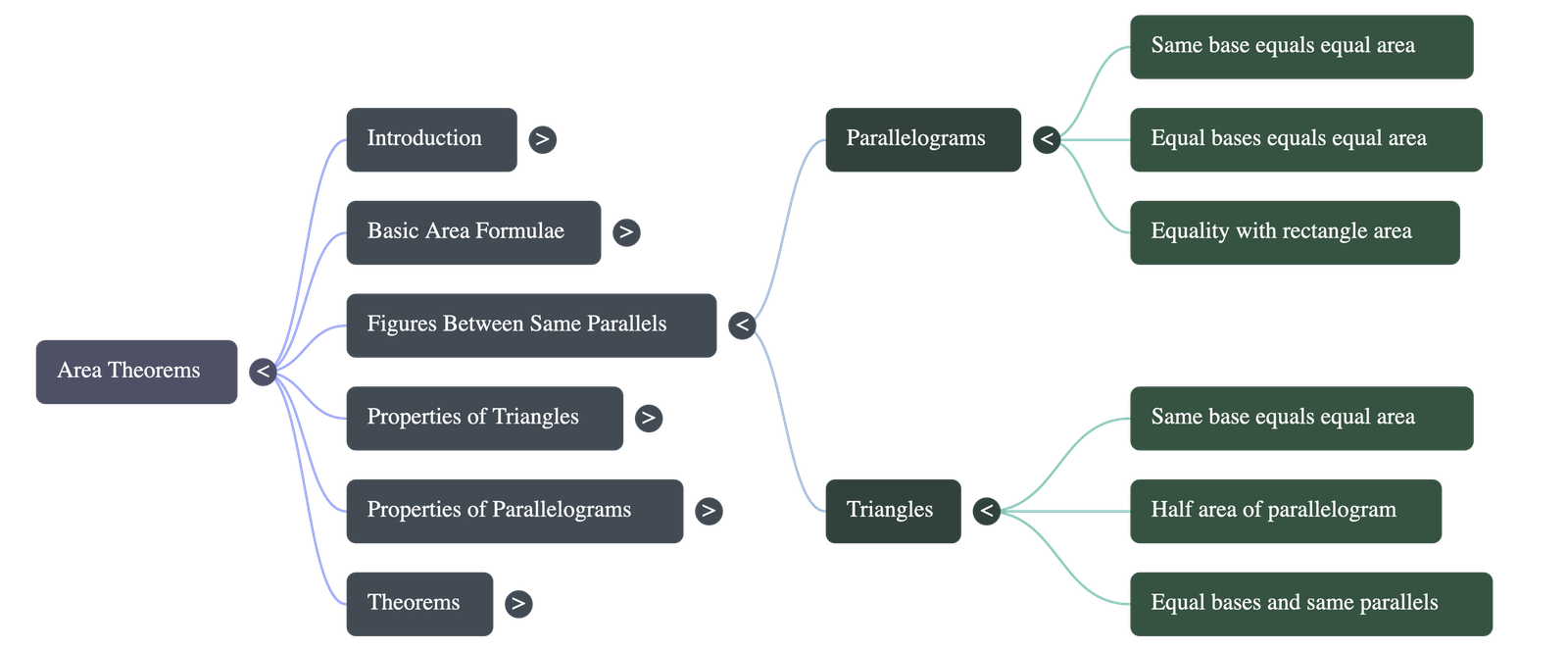
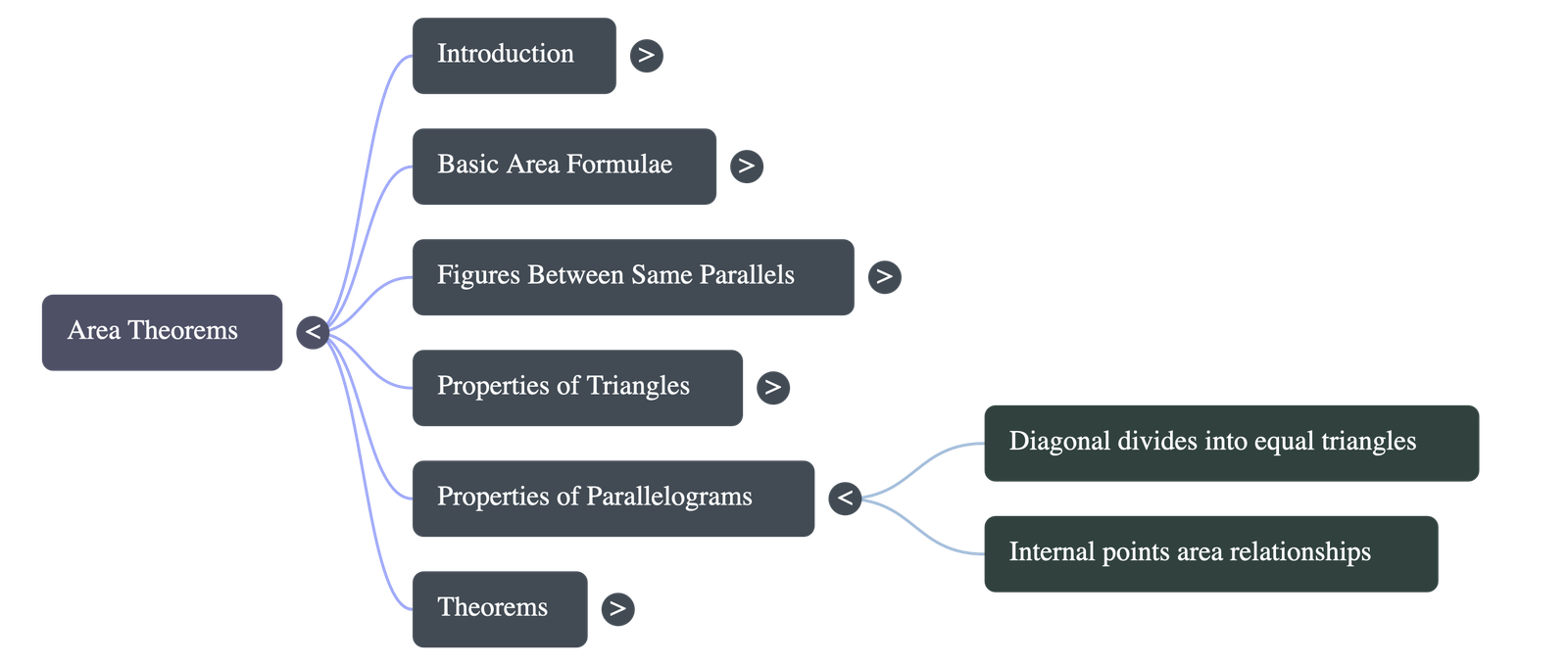
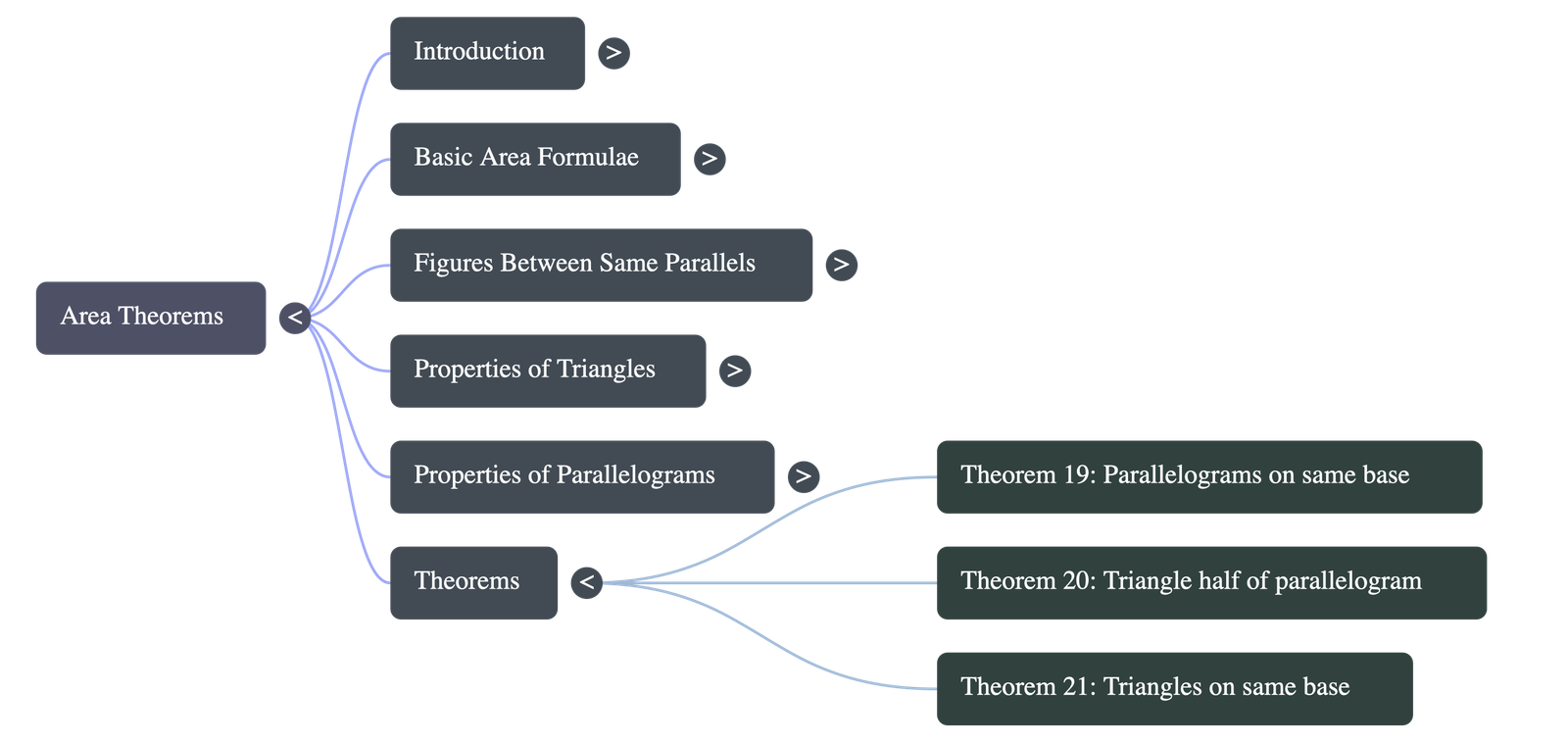
- Theorem 19: Parallelograms that rest on the same base and are between the same parallel lines are absolutely equal in area.
- Corollary: Because a rectangle is a type of parallelogram, the area of a parallelogram is equal to the area of a rectangle that is on the same base and between the same parallels.
- Theorem 20: The area of a triangle is exactly half the area of a parallelogram if they share the same base and lie between the same parallel lines.
- Theorem 21: Triangles that are on the same base and are between the same parallels are equal in area.
- Corollary 1: This rule also applies to equal bases. Parallelograms or triangles on equal bases (not just the exact same shared base) and between the same parallels are equal in area.
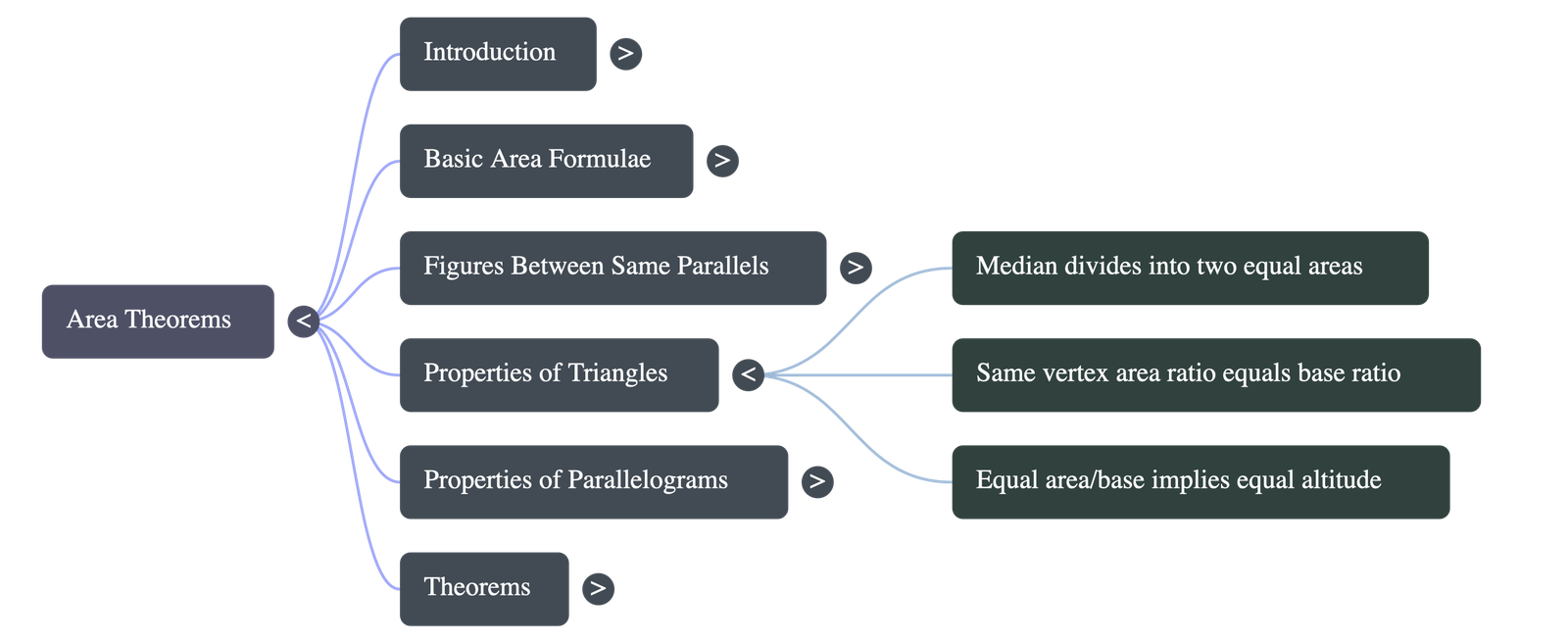
- Corollary 2: If two triangles have the same area and sit on the same (or equal) base, their corresponding altitudes (heights) must be equal.
The Median Property
- Crucial Problem-Solving Tool: A median of a triangle (a line drawn from a vertex to the midpoint of the opposite side) divides the original triangle into two smaller triangles of equal area.
15.3 Triangles with the Same Vertex and Bases Along the Same Line
- Shared Height: If multiple triangles share a single common top vertex, and all their bottom bases lie flat along the exact same straight line, then all these triangles have the same height.
- Area Ratio Rule: In such cases, because the height is identical for all of them, the ratio of the areas of these triangles is directly equal to the ratio of the lengths of their bases.
- Application: If a point divides the base of a triangle in a ratio of $m:n$, the line joining the opposite vertex to this point will divide the area of the full triangle into two smaller triangles whose areas are also in the exact ratio of $m:n$.
Do checkout all questions & answers of this chapter.
Quick Navigation:
| | | |
1 / 1
Quick Navigation:
| | | |