Quick Navigation:
| | | |
Distance Formula
25.1 Introduction
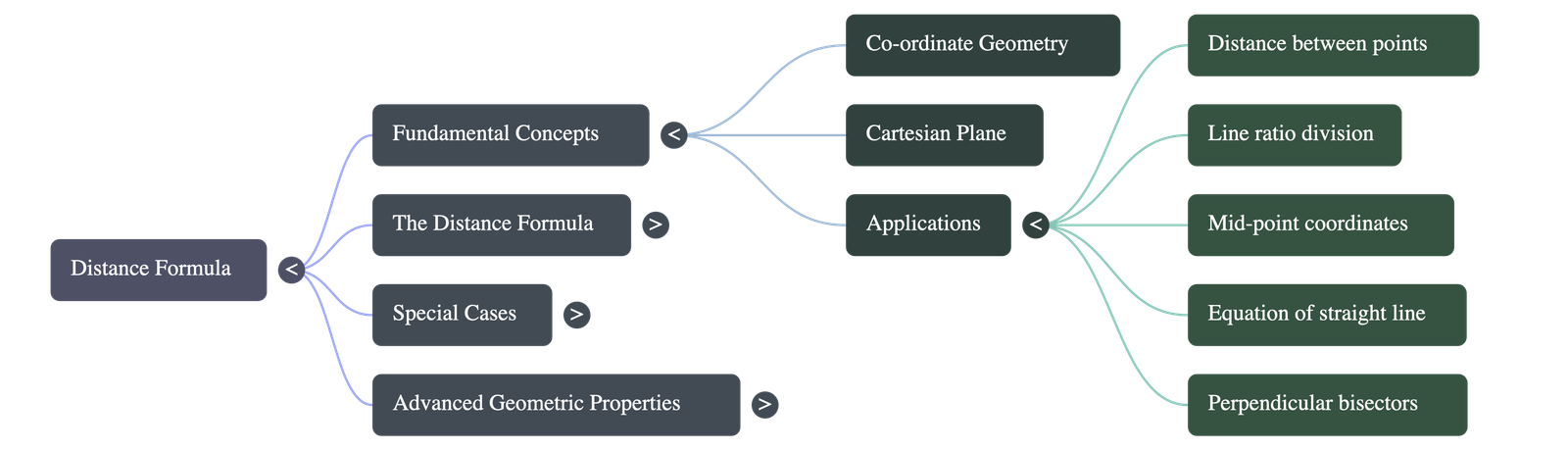
In a co-ordinate (Cartesian) plane, knowing the exact positions of two given points is a powerful tool. In coordinate geometry, we can use these points to figure out several important things:
- The exact distance between the given points.
- The co-ordinates of a new point that divides the line joining the original points in a specific ratio.
- The co-ordinates of the exact mid-point of the line segment connecting them.
- The equation of a straight line that passes directly through the points.
- The equation of the perpendicular bisector of the line segment.
25.2 The Distance Formula
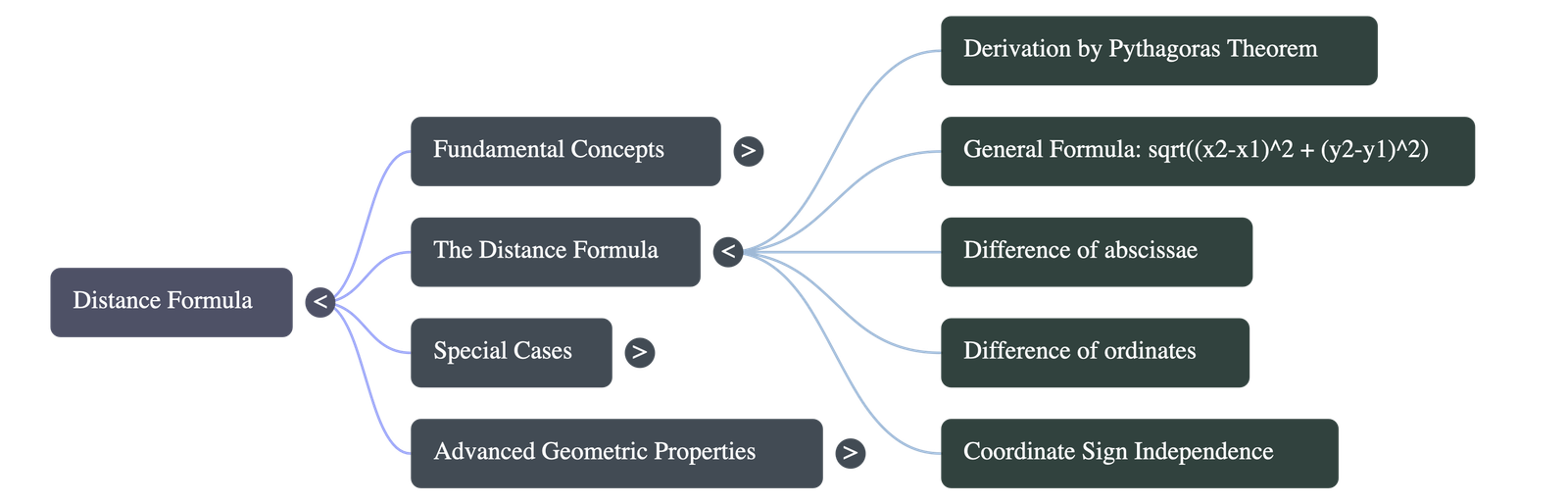
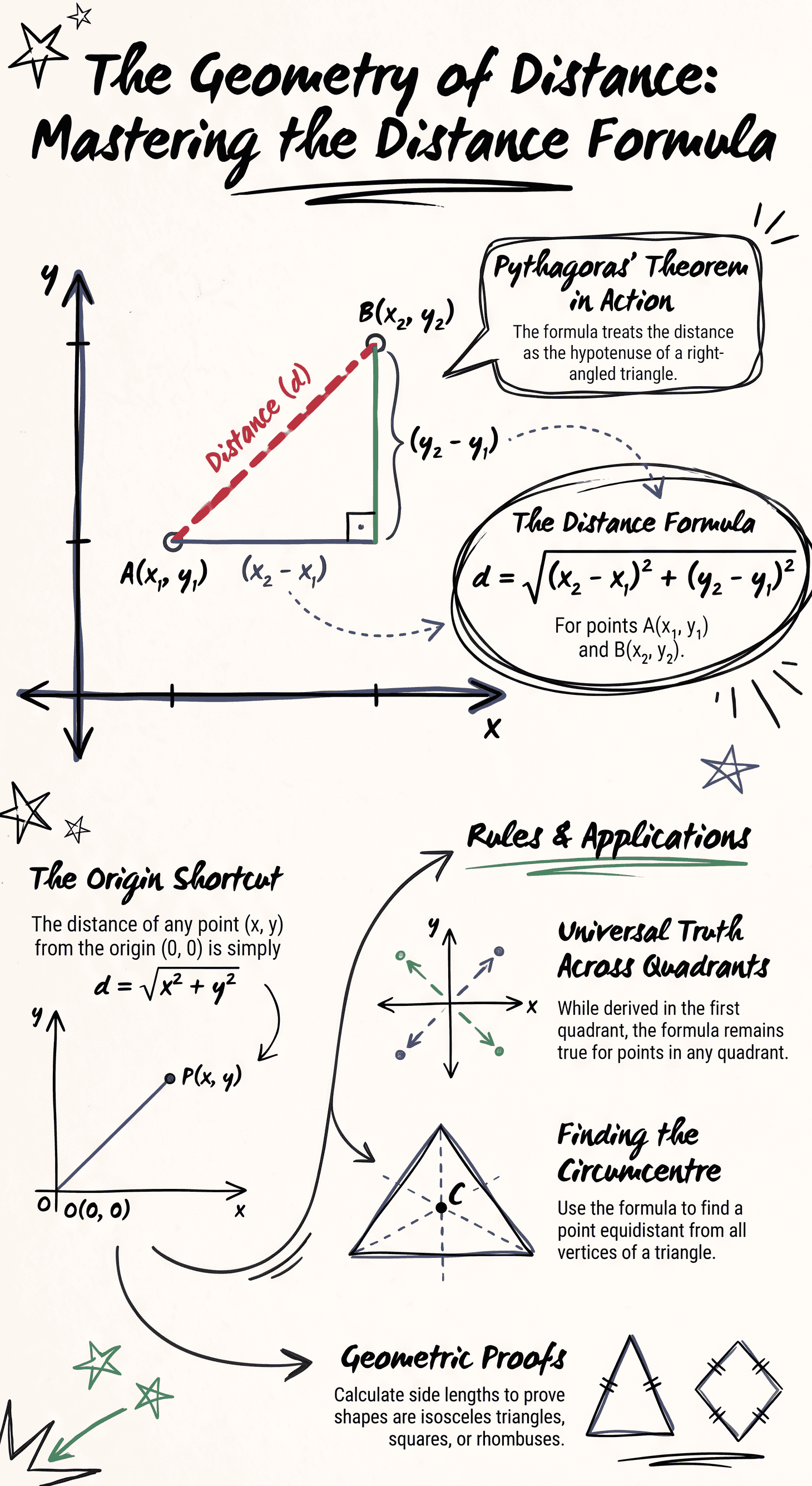
This is the core concept of the chapter. It teaches us how to find the length of the straight line connecting two points on a graph, say Point A (x₁, y₁) and Point B (x₂, y₂).
- How it works: The formula is derived using Pythagoras' Theorem on a right-angled triangle formed by the two points.
- The horizontal distance is the difference between their x-coordinates (abscissae): (x₂ - x₁).
- The vertical distance is the difference between their y-coordinates (ordinates): (y₂ - y₁).
Main Formula: Distance AB = √[ (x₂ - x₁)² + (y₂ - y₁)² ]
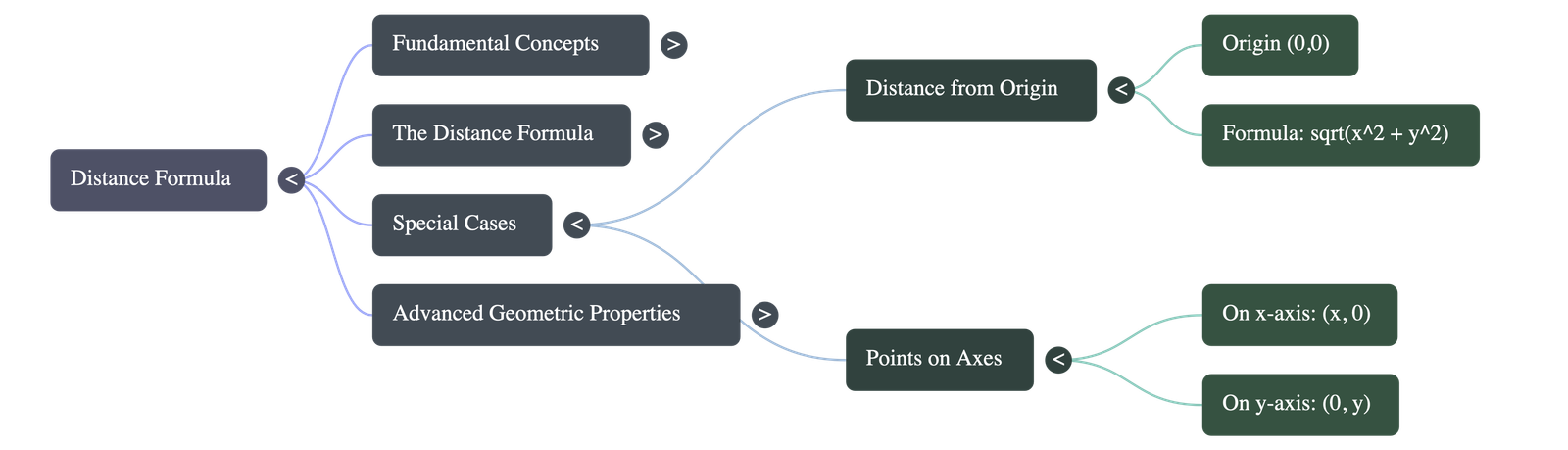
- Distance from the Origin: If you want to find the distance of any point (x, y) from the origin (0, 0), the formula simplifies easily to √(x² + y²).
💡 Important Rules to Remember:
- Because squaring a number always makes it positive, (x₁ - x₂)² is exactly the same as (x₂ - x₁)².
- The formula works perfectly in any quadrant. You just need to be careful to plug in the correct positive or negative signs for your coordinates.
- If a point lies on the x-axis, its y-coordinate is always zero. It will look like (x, 0).
- If a point lies on the y-axis, its x-coordinate is always zero. It will look like (0, y).
25.3 Circumcentre of a Triangle
This section applies the distance formula to a specific geometric property of triangles.
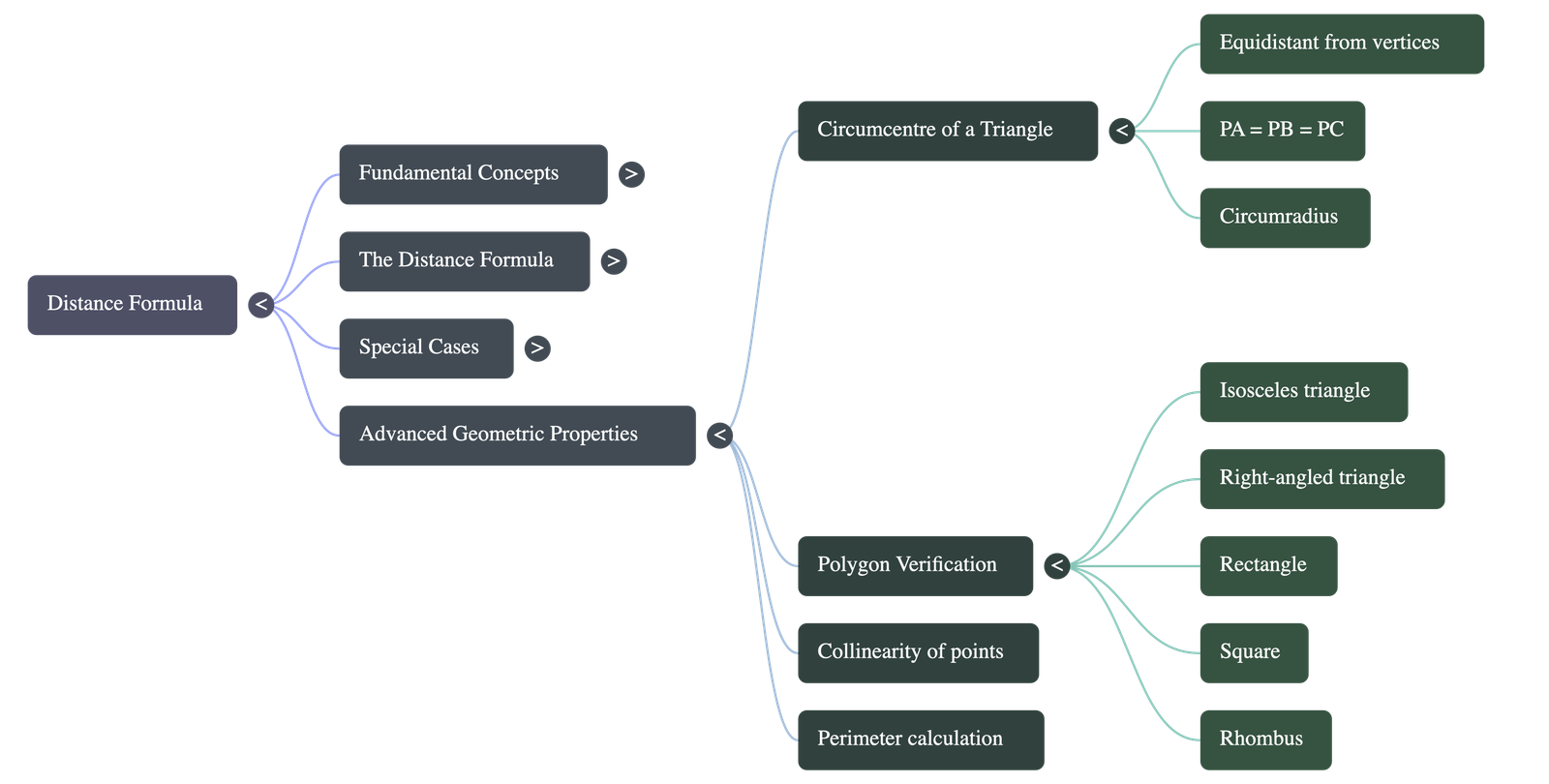
- Definition: The circumcentre is a special point that is at an exactly equal distance from all three corners (vertices) of a triangle.
- If Point P is the circumcentre of Triangle ABC, then the distances from P to each vertex are equal: PA = PB = PC.
- This equal distance is called the Circumradius.
- Visualizing it: If you draw a circle using Point P as the center and the Circumradius as the size, that circle will perfectly touch all three vertices of the triangle!
- To find the co-ordinates of the circumcentre, you set up equations using the distance formula (PA = PB and PA = PC) and solve them simultaneously.
Chapter Exercises & Applications
The exercises in this chapter test your ability to apply the distance formula to various mathematical and real-world problems:
- Proving Shapes: Calculating the lengths of sides and diagonals to prove if a set of points forms an isosceles triangle, a square, or a rectangle.
- Finding Missing Values: Working backward to find a missing coordinate (like 'x' or 'y') when the final distance is already given.
- Finding Equidistant Points: Locating points on the x-axis or y-axis that are exactly the same distance from two other given points.
- Real-Life Case Studies: Using coordinate geometry on grids to calculate distances between real-world objects like villages, highways, or students at a picnic!
Do checkout all questions & answers of this chapter.
Quick Navigation:
| | | |
1 / 1
Quick Navigation:
| | | |