Quick Navigation:
| | | |
Co-ordinate Geometry
23.1 Introduction
- Definition: Co-ordinate Geometry is a branch of mathematics where the position of a point is represented by a pair of numbers (called co-ordinates) with respect to two mutually perpendicular number lines (called co-ordinate axes).
- It combines the exact location of points with their relationship to various geometrical figures.
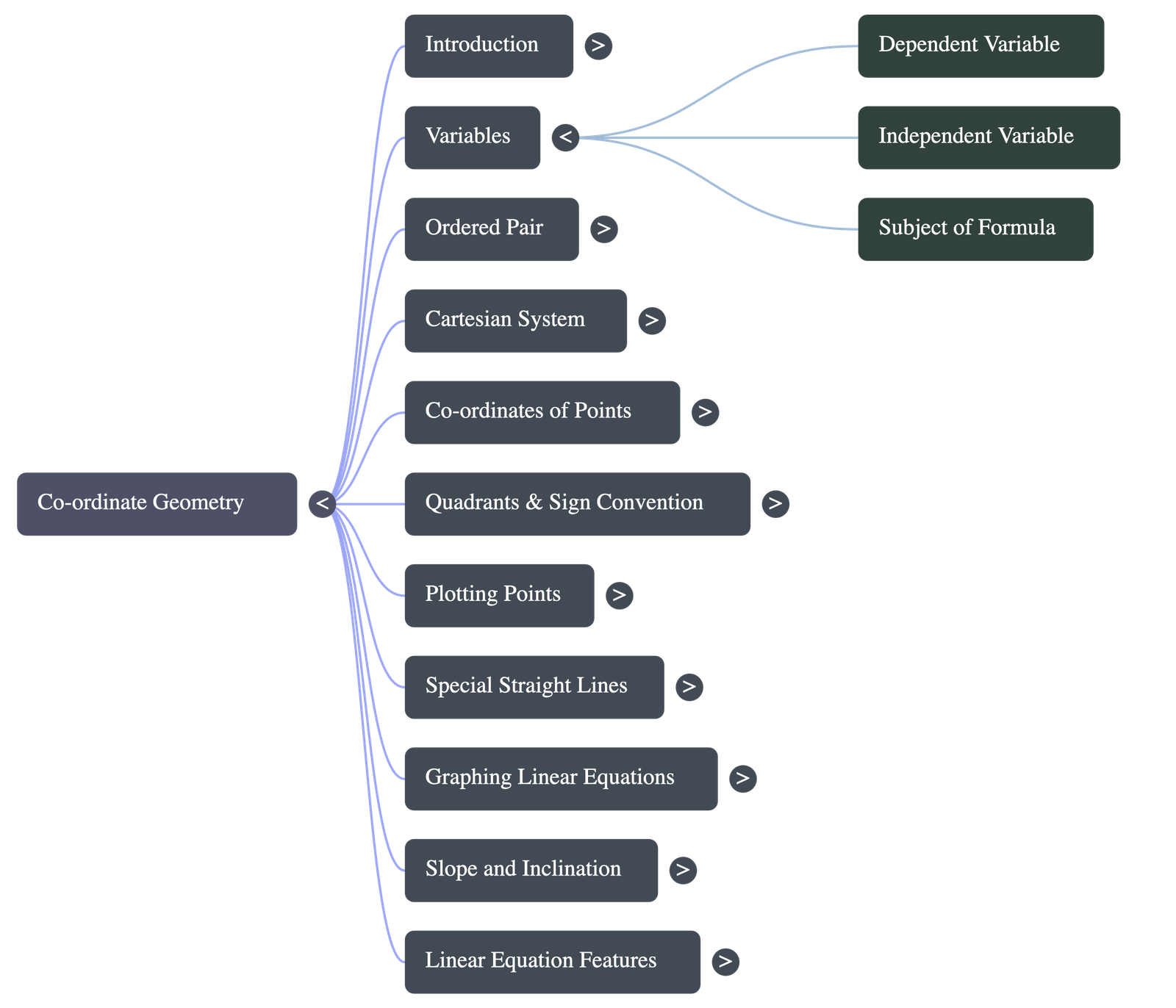
23.2 Dependent and Independent Variables
- In linear equations (like 3x + 4y = 5), letters like 'x' and 'y' act as variables.
- y as the subject: If an equation is written in the form y = 3x - 6, then 'y' is the dependent variable (its value depends on x) and 'x' is the independent variable.
- x as the subject: If an equation is written in the form x = 5y + 7, then 'x' is the dependent variable and 'y' is the independent variable.
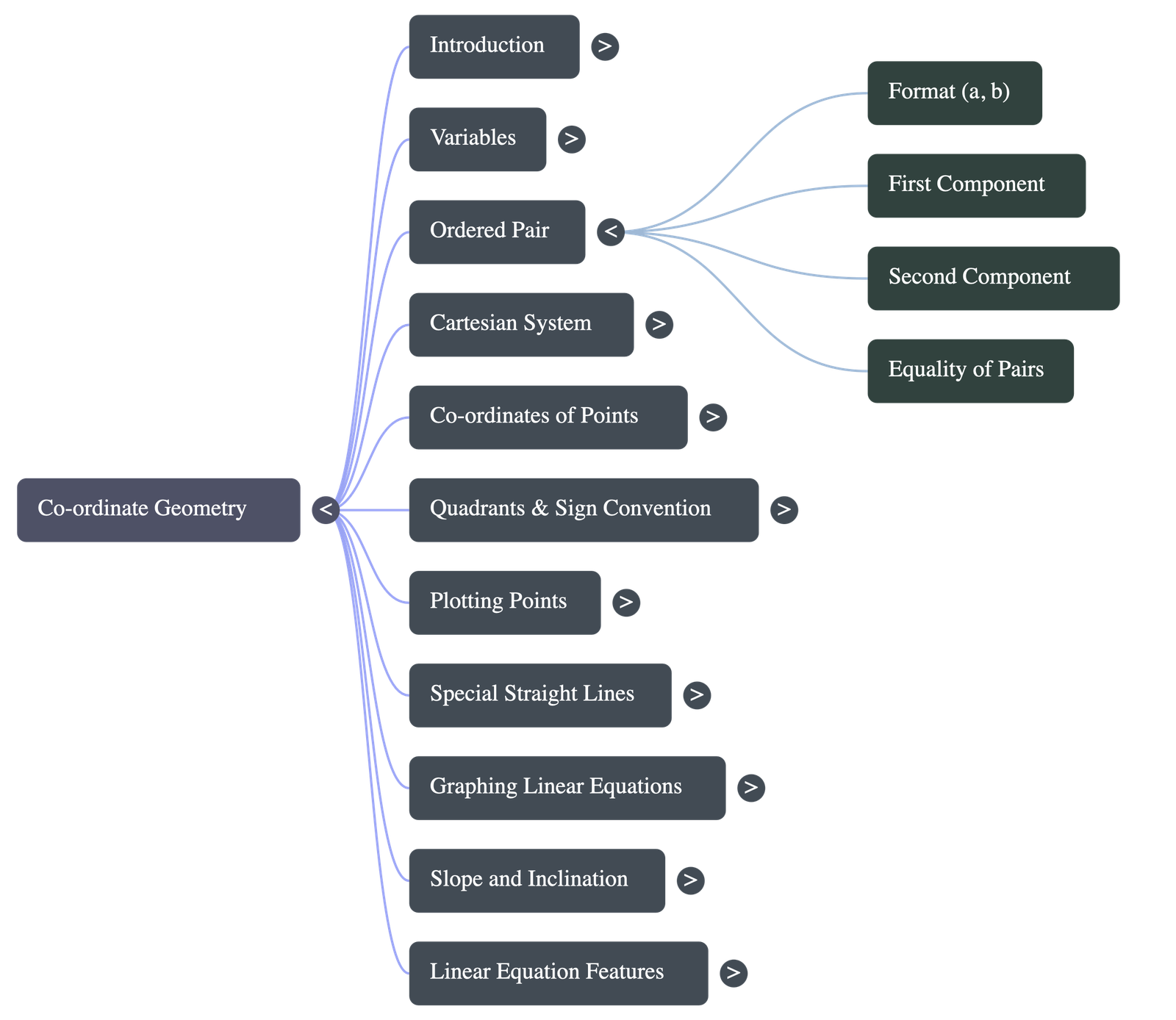
23.3 Ordered Pair
- An ordered pair is a pair of numbers written in a specific order, separated by a comma, and enclosed in round brackets, e.g., (a, b).
- In the pair (a, b), 'a' is the first component and 'b' is the second component.
- Order Matters: The ordered pair (5, 7) is NOT the same as (7, 5).
- Equality: If two ordered pairs are equal, i.e., (a, b) = (c, d), it strictly means that a = c and b = d.
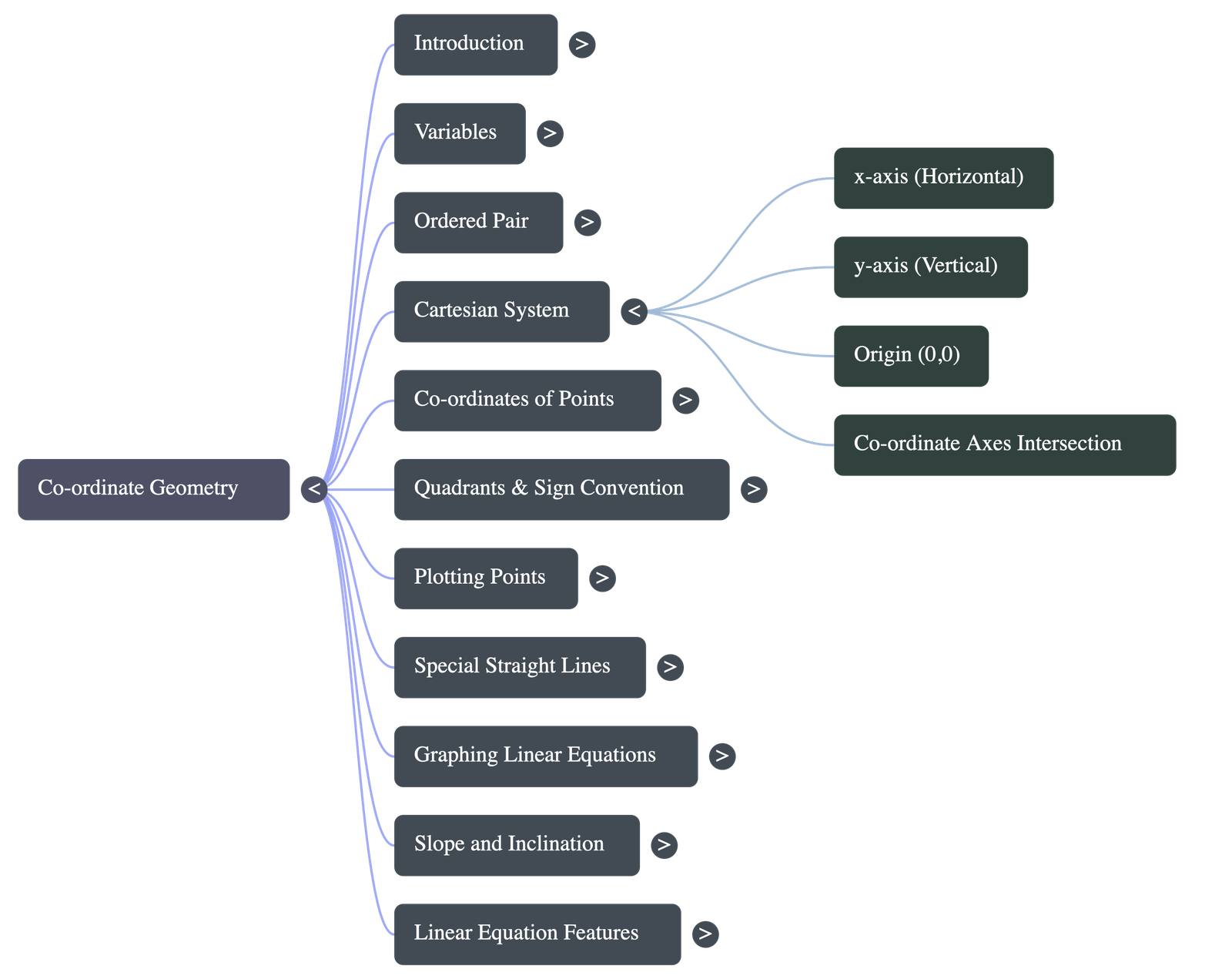
23.4 Cartesian Plane
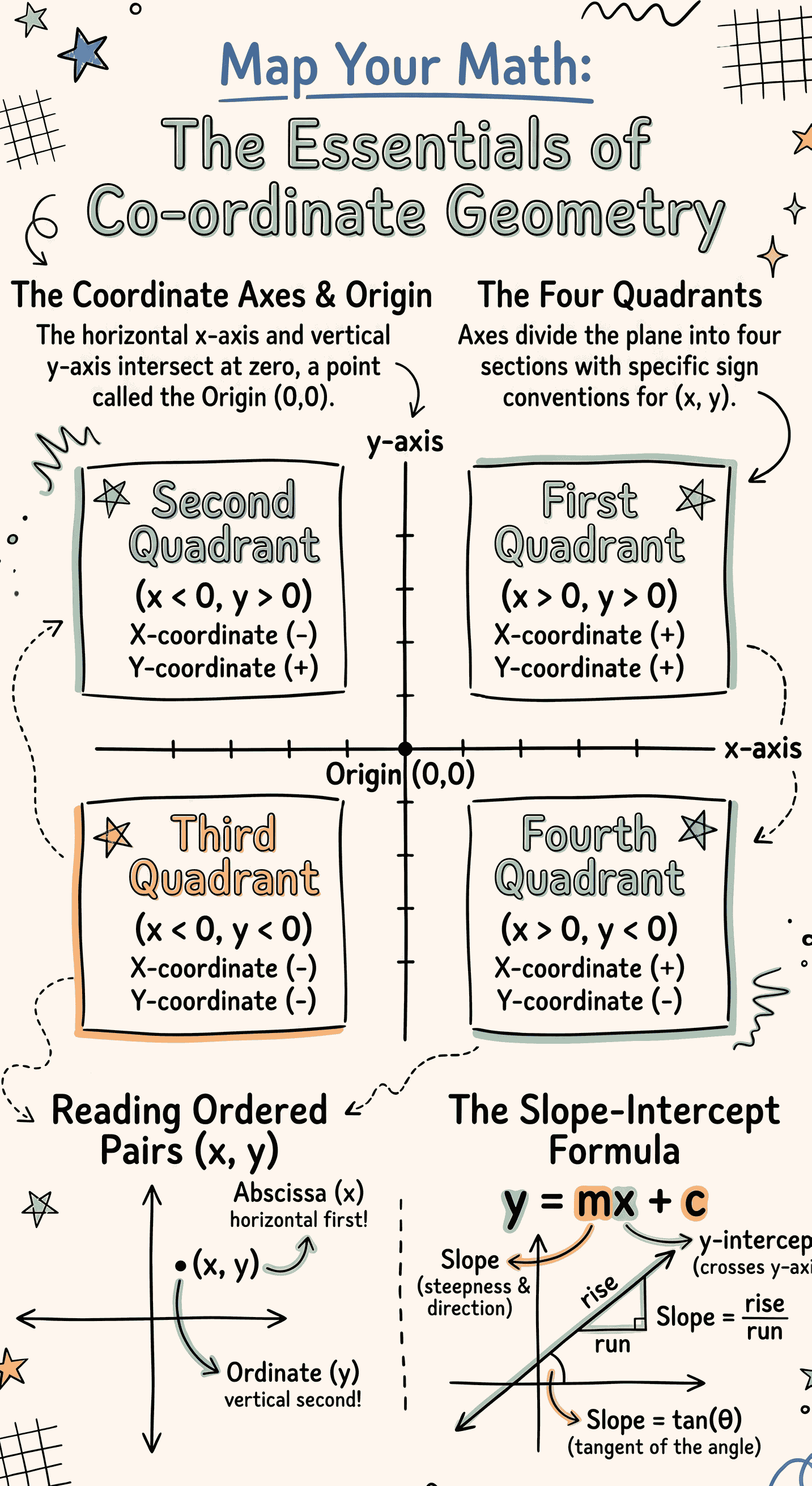
- A Cartesian plane consists of two mutually perpendicular number lines that intersect each other at their zero point.
- x-axis: The horizontal number line (XOX').
- y-axis: The vertical number line (YOY').
- Origin: The point of intersection 'O', which is zero for both axes.
23.5 Co-ordinates of Points
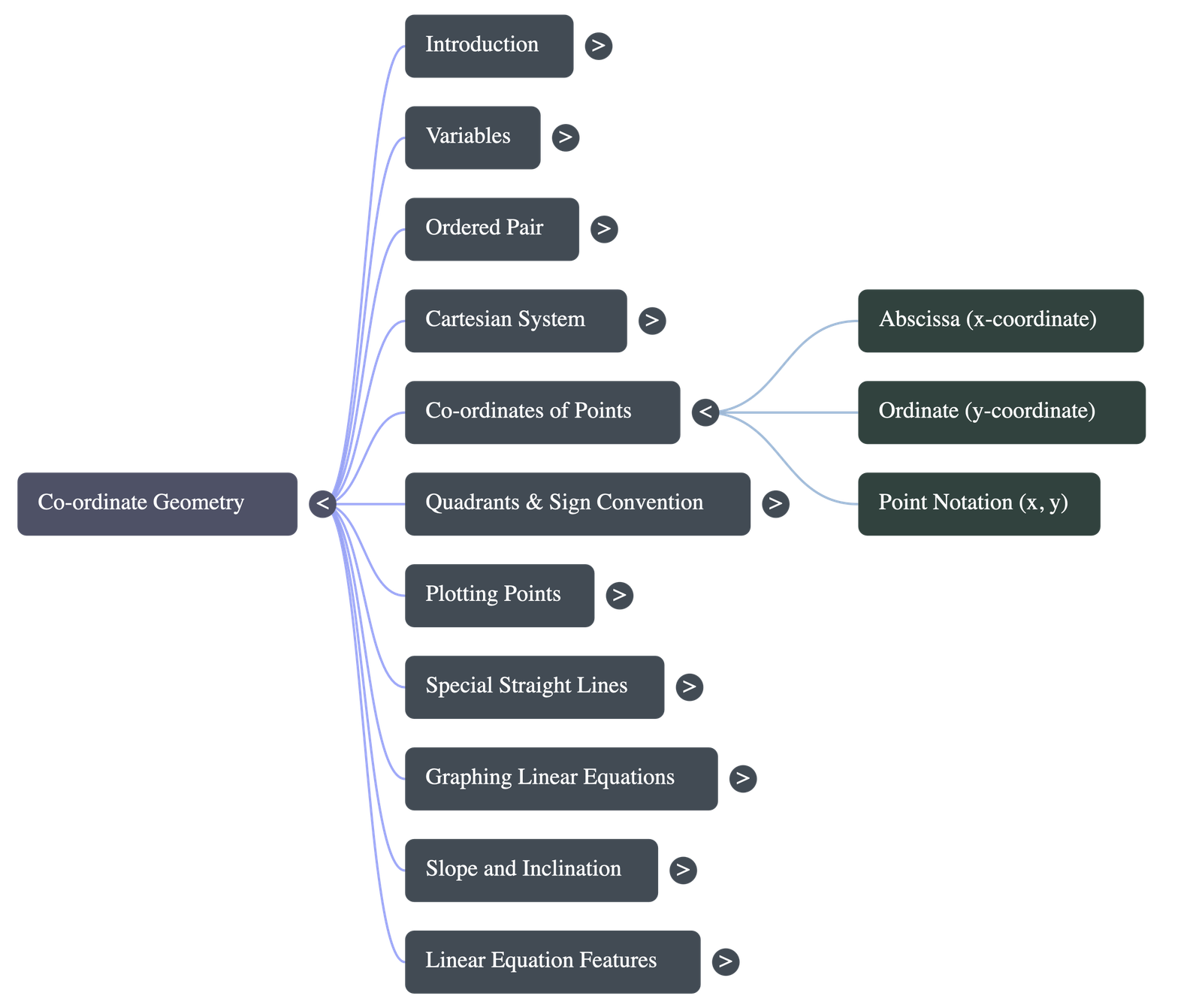
- The position of any point on a plane is determined by an ordered pair (x, y).
- Abscissa (x-coordinate): The distance of the point measured along the x-axis, starting from the origin. It is written first.
- Ordinate (y-coordinate): The distance of the point measured along the y-axis, starting from the origin. It is written second.
- Co-ordinates of a point are always stated as (abscissa, ordinate).
23.6 Quadrants and Sign Convention
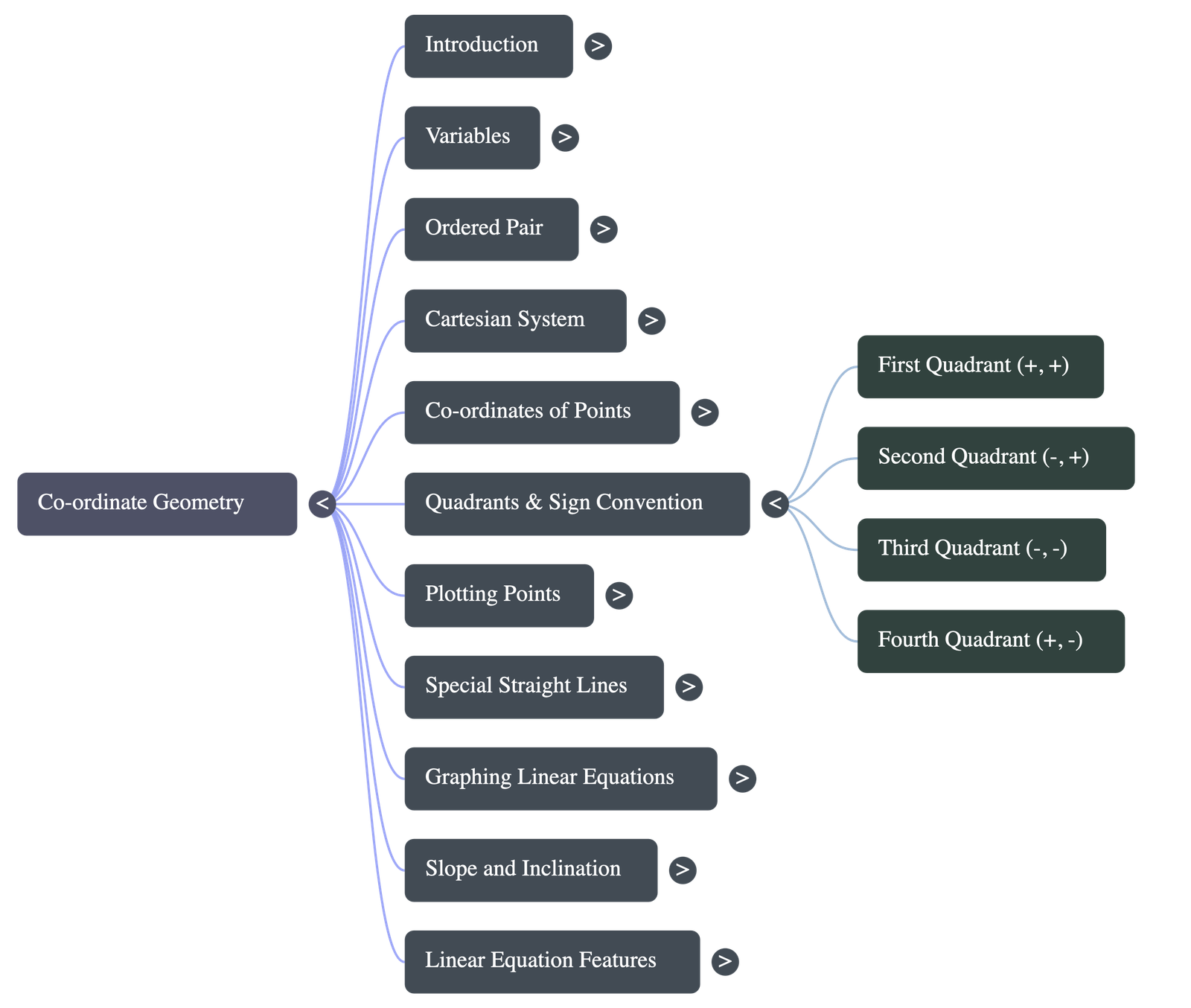
- Quadrants: The x and y axes divide the entire plane into four distinct parts known as quadrants, numbered anti-clockwise starting from the positive x-axis.
- First Quadrant (XOY): Both abscissa and ordinate are positive (+, +).
- Second Quadrant (X'OY): Abscissa is negative, ordinate is positive (-, +).
- Third Quadrant (X'OY'): Both abscissa and ordinate are negative (-, -).
- Fourth Quadrant (XOY'): Abscissa is positive, ordinate is negative (+, -).
23.7 Plotting of Points
- Plotting Step 1: Start from the origin O, move along the x-axis according to the abscissa value (right for positive, left for negative).
- Plotting Step 2: From that reached spot on the x-axis, move parallel to the y-axis according to the ordinate value (up for positive, down for negative), and place a dot.
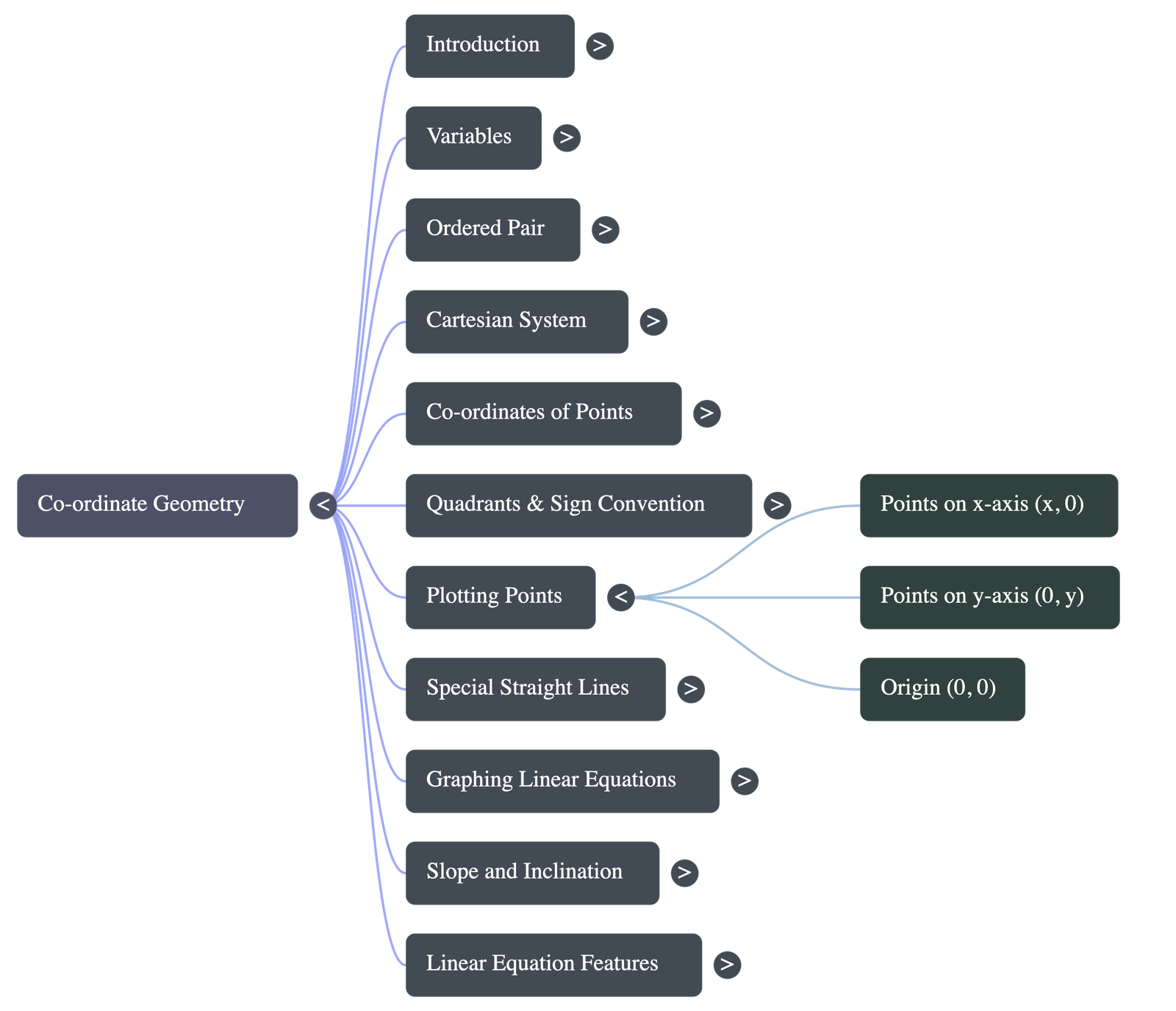
- The co-ordinates of the Origin are always (0, 0).
- For any point lying exactly on the x-axis, its ordinate is always zero (x, 0).
- For any point lying exactly on the y-axis, its abscissa is always zero (0, y).
23.8 Graphs of x = 0, y = 0, x = a, y = a, etc.
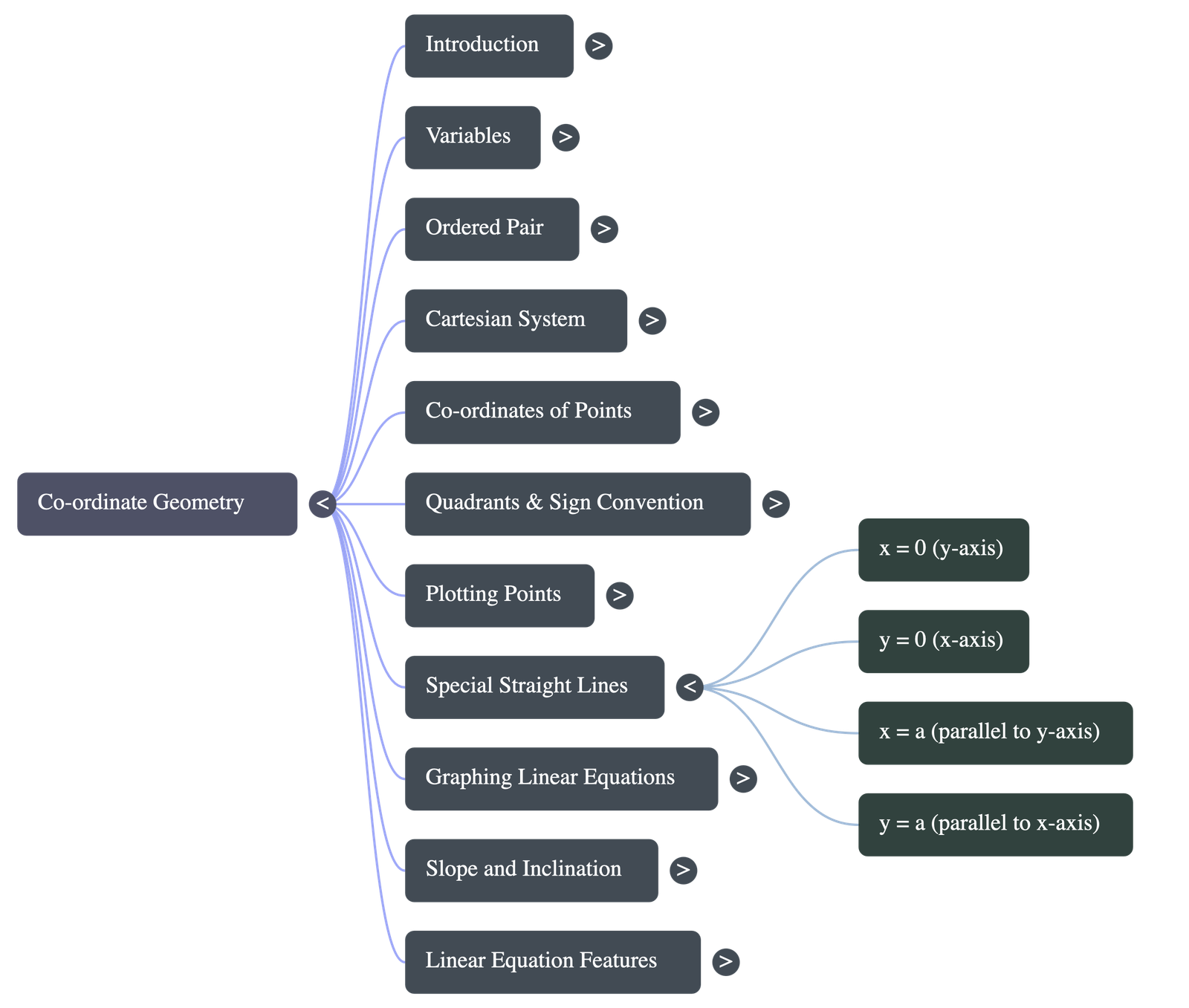
- x = 0 is the specific equation representing the entire y-axis.
- x = a represents a line that is strictly parallel to the y-axis, positioned at a distance of 'a' units from it.
- y = 0 is the specific equation representing the entire x-axis.
- y = a represents a line that is strictly parallel to the x-axis, positioned at a distance of 'a' units from it.
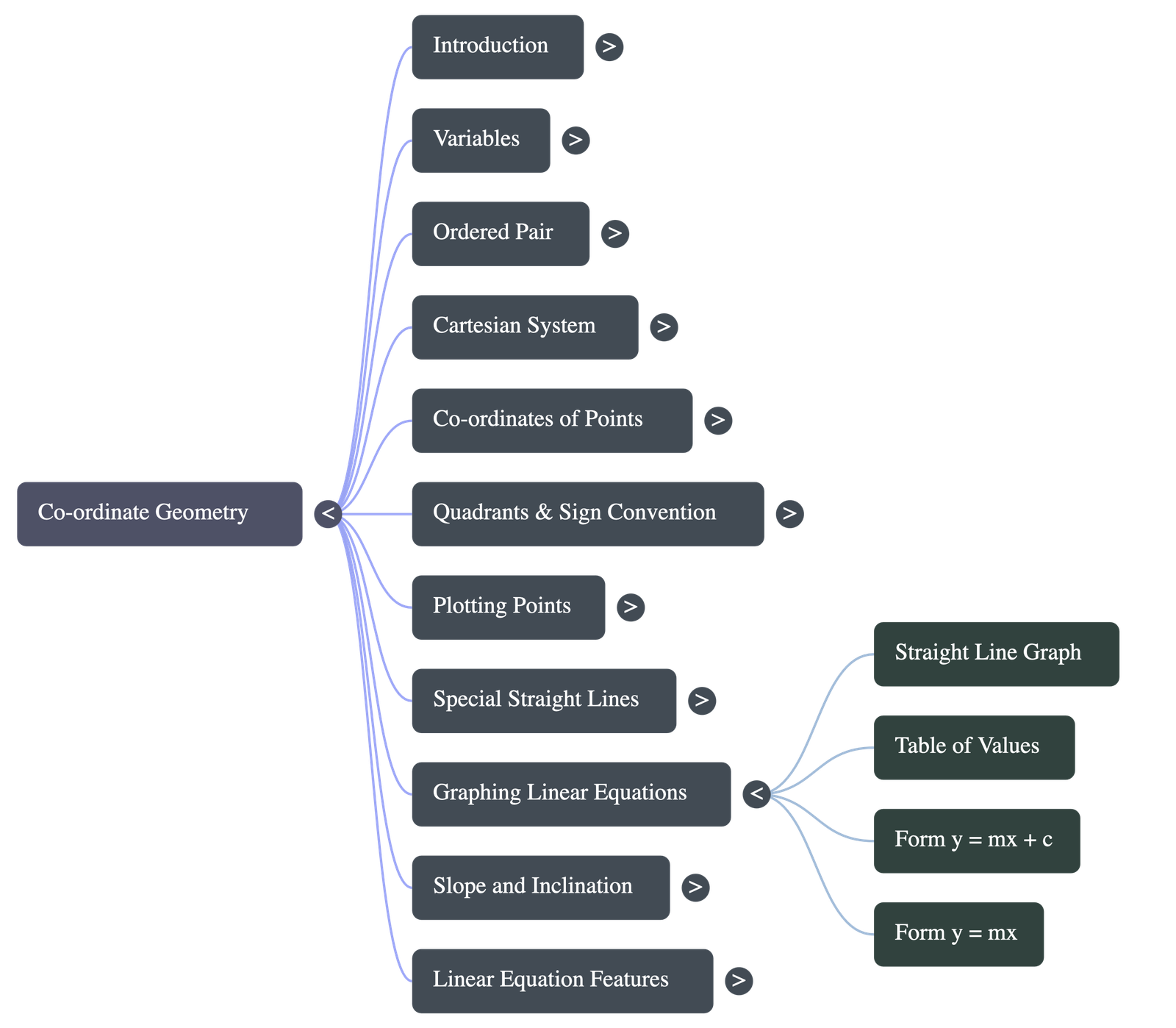
23.9 Graphing a Linear Equation
- Any equation whose graph results in a perfectly straight line is known as a linear equation.
- To draw its graph, find a few points (typically three) that satisfy the equation, plot them, and draw a straight line passing through them.
- Type 1 (y = mx): Equations in this form always pass directly through the origin (0, 0).
- Type 2 (y = mx + c): Where 'c' is a rational number but not zero; these lines do not pass through the origin.
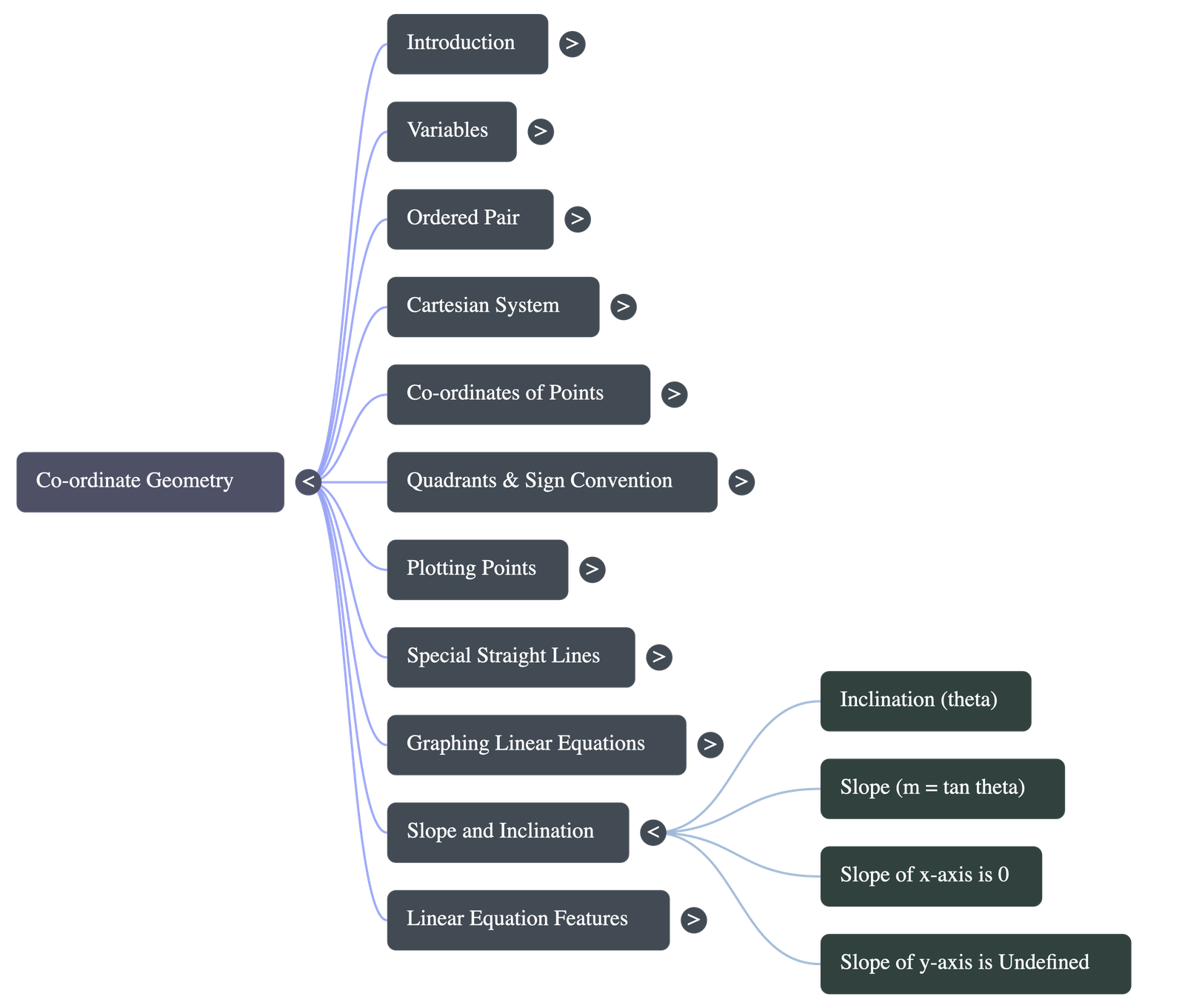
23.10 Inclination and Slope
- Inclination (θ): It is the angle that a straight line makes with the positive direction of the x-axis, measured in the anti-clockwise direction.
- For the x-axis or any line parallel to it, the inclination θ = 0°.
- For the y-axis or any line parallel to it, the inclination θ = 90°.
- Slope (Gradient): Denoted by 'm'. It is calculated as m = tan θ.
- The slope of the x-axis (or lines parallel to it) is tan 0° = 0.
- The slope of the y-axis (or lines parallel to it) is tan 90° = infinity (not defined).
23.11 Y-Intercept
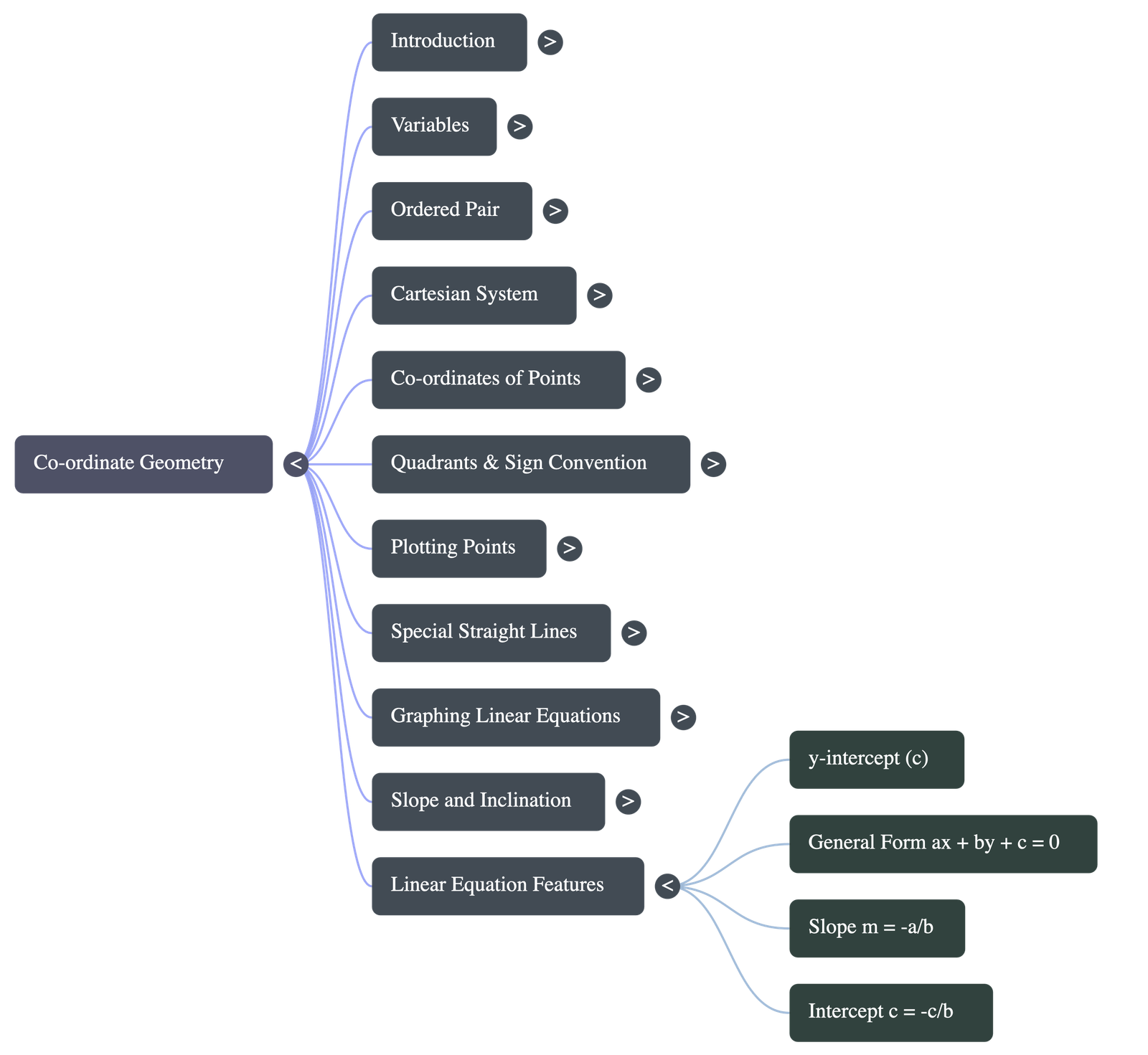
- If a straight line intersects the y-axis at a specific point, the physical distance of this point from the origin is called the y-intercept, commonly denoted by 'c'.
- For the x-axis, the y-intercept is exactly 0.
- For every line parallel to the y-axis, the y-intercept is considered 0.
- The y-intercept is positive if the line crosses the y-axis above the origin, and negative if it crosses below the origin.
23.12 Finding the Slope and the Y-Intercept of a Given Line
- The general standard form of the equation of a line is ax + by + c = 0.
- To find the slope and y-intercept easily, convert the equation into the form y = mx + c by making 'y' the subject.
- From ax + by + c = 0, rearranging gives: y = (-a/b)x - (c/b).
- Once converted into the y = mx + c format, the coefficient of x (m) is the slope and the constant term (c) is the y-intercept.
Do checkout all questions & answers of this chapter.
Quick Navigation:
| | | |
1 / 1
Quick Navigation:
| | | |
Quick Navigation:
| | | |