Expansions
4.1 Introduction
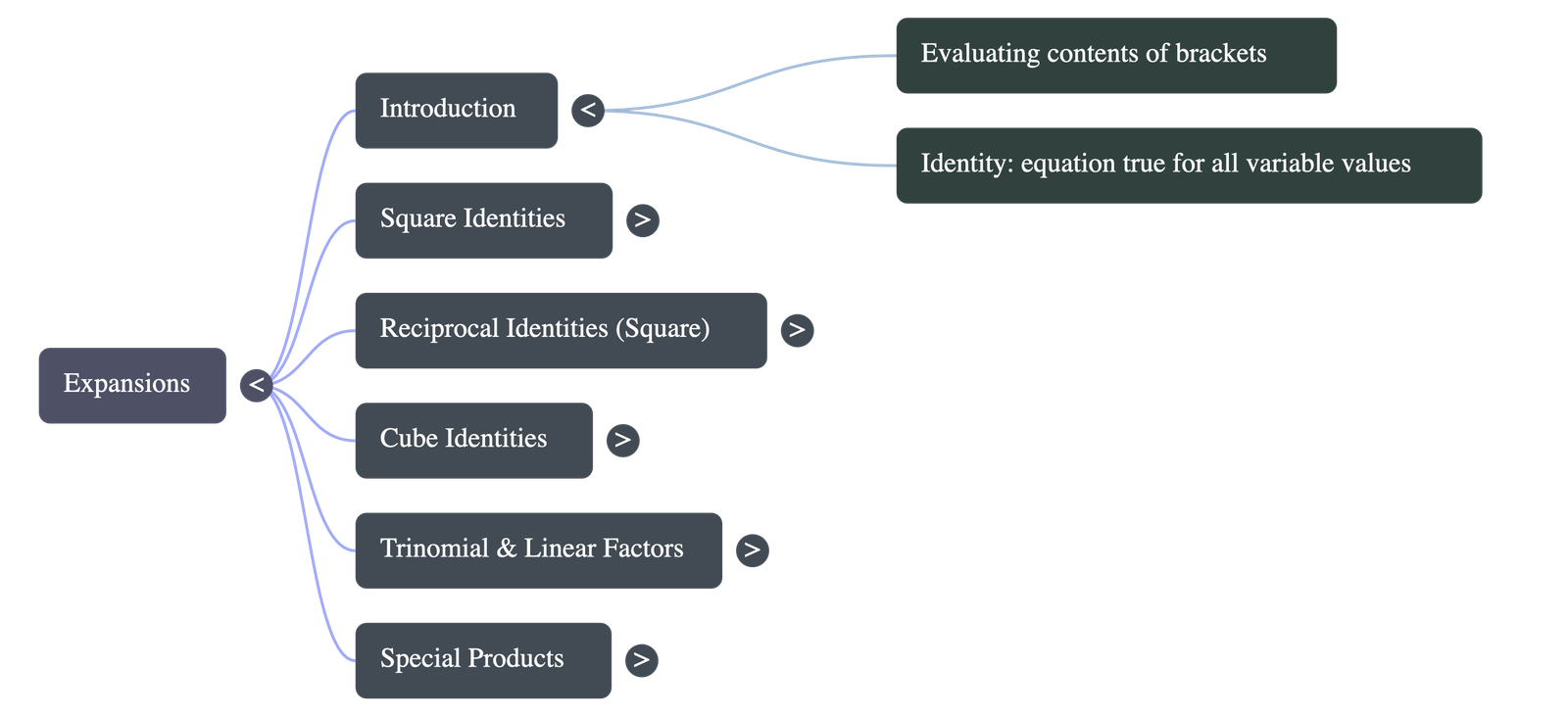
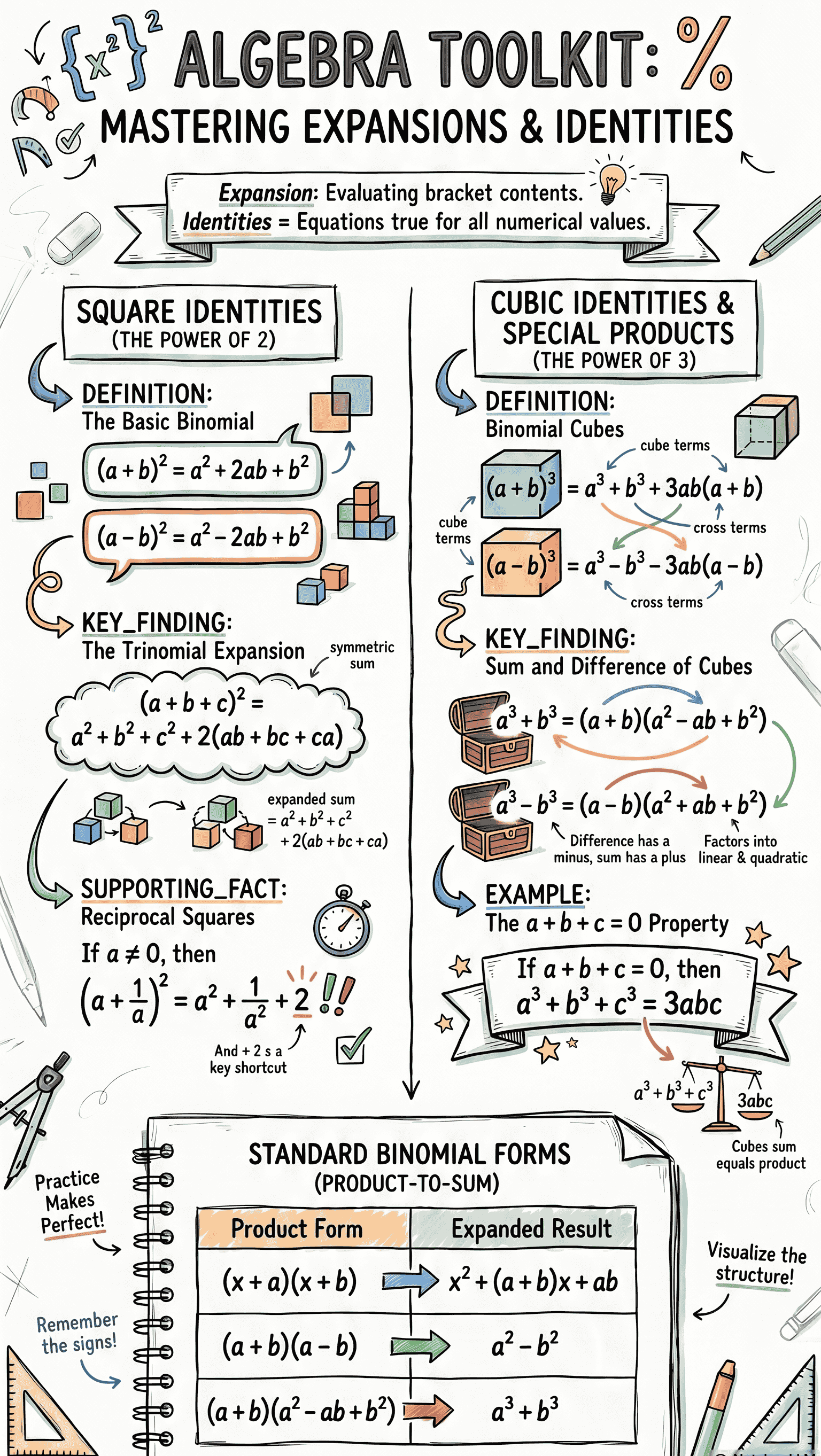
- Definition: Expansion is the process of evaluating the contents of brackets in algebraic expressions.
-
Basic Squared Expansions:
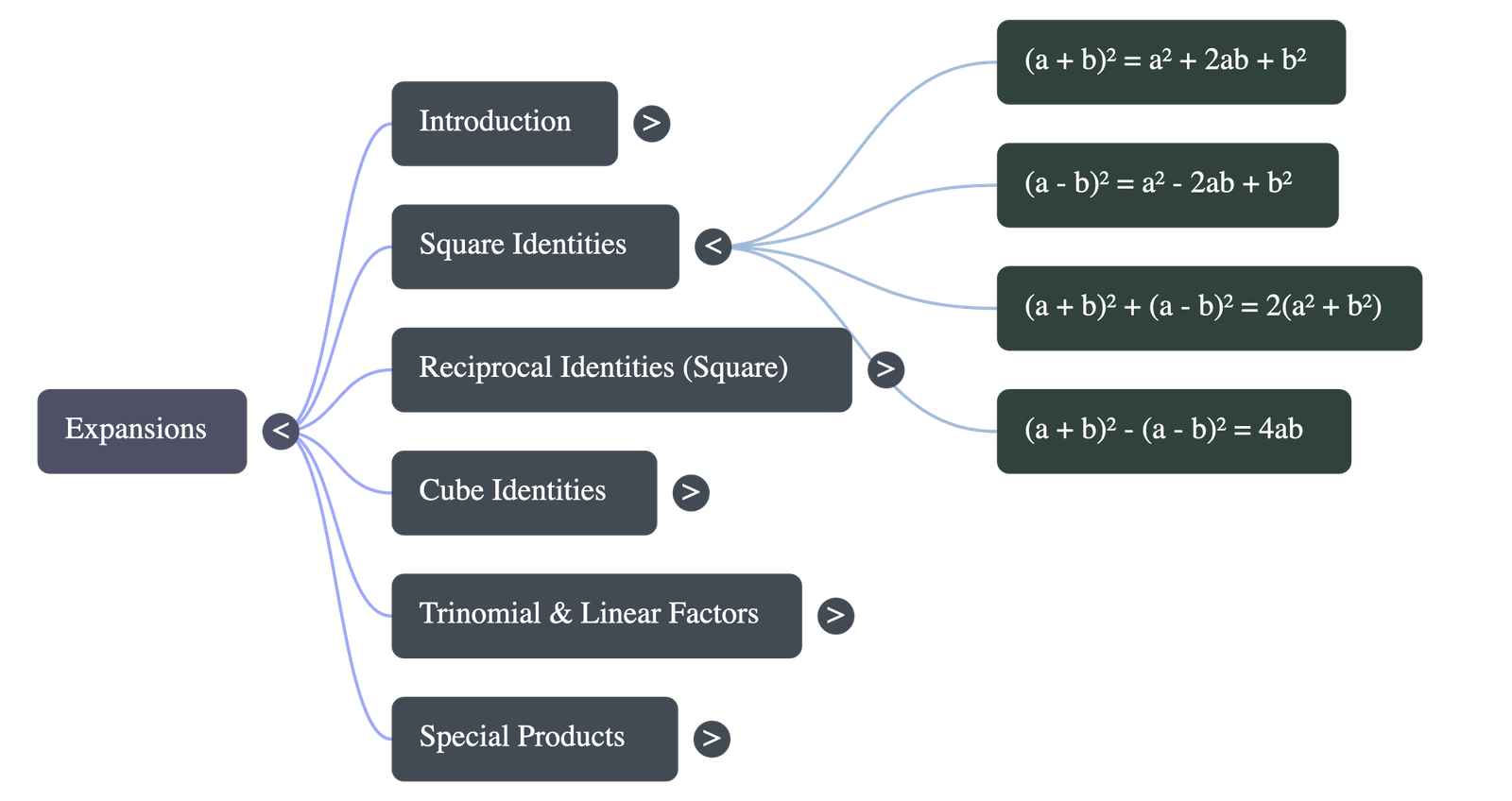
• (a + b)2 = a2 + 2ab + b2
• (a - b)2 = a2 - 2ab + b2 -
Combining the Basic Expansions:
• On adding: (a + b)2 + (a - b)2 = 2(a2 + b2)
• On subtracting: (a + b)2 - (a - b)2 = 4ab -
Expansions with Reciprocals (where a ≠ 0):
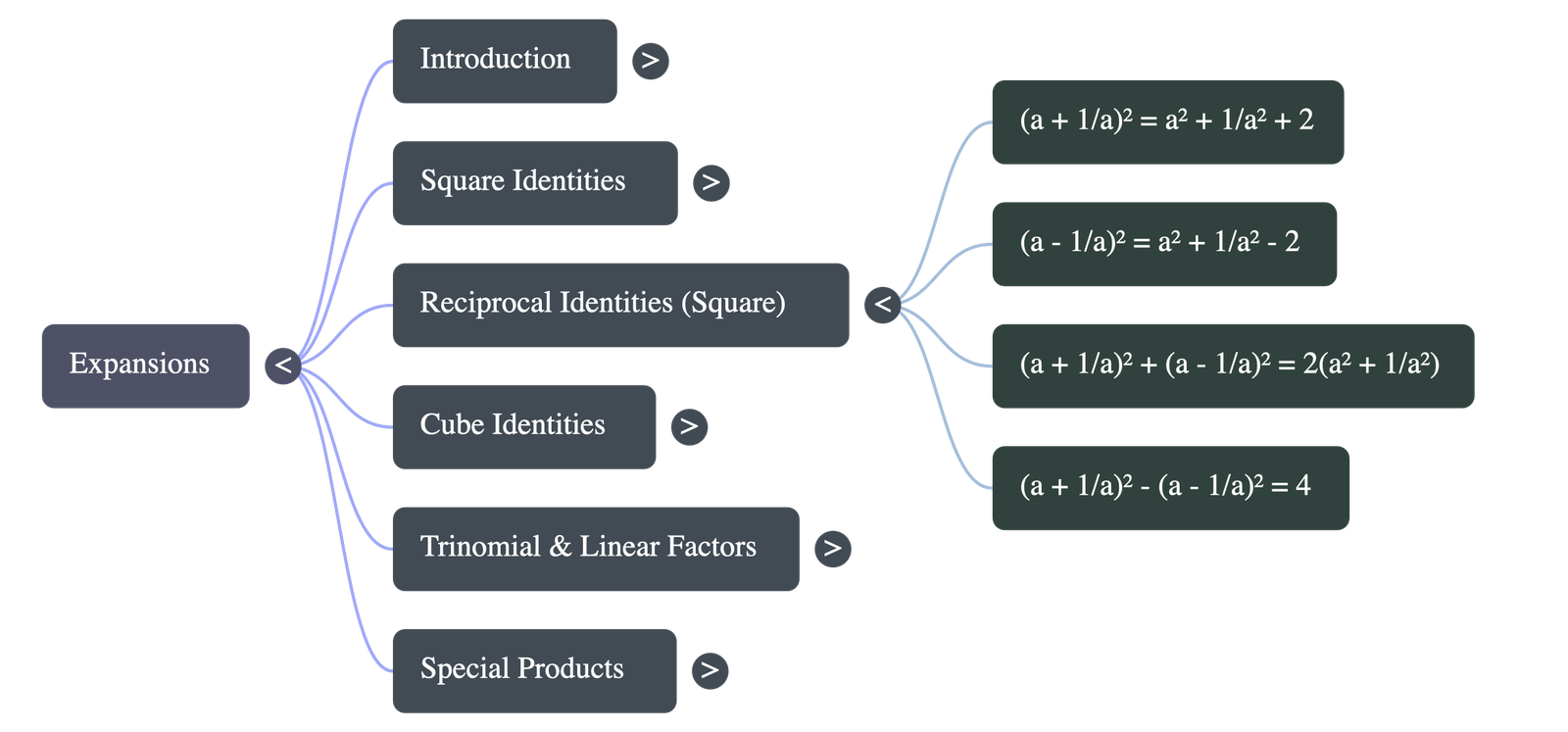
• (a + 1/a)2 = a2 + 1/a2 + 2
• (a - 1/a)2 = a2 + 1/a2 - 2
• (a + 1/a)2 + (a - 1/a)2 = 2(a2 + 1/a2)
• (a + 1/a)2 - (a - 1/a)2 = 4
4.2 Identities
- Concept of Identity: An equation that holds true for all possible values of its variables is known as an identity.
- Every expansion formula listed in the introduction section is considered a universal algebraic identity.
- These identities allow us to quickly calculate squares of numbers and solve algebraic equations simply by substituting values into the pre-established formulas.
4.3 Expansions of (a ± b)³
-
Sum of Cubes Expansions:
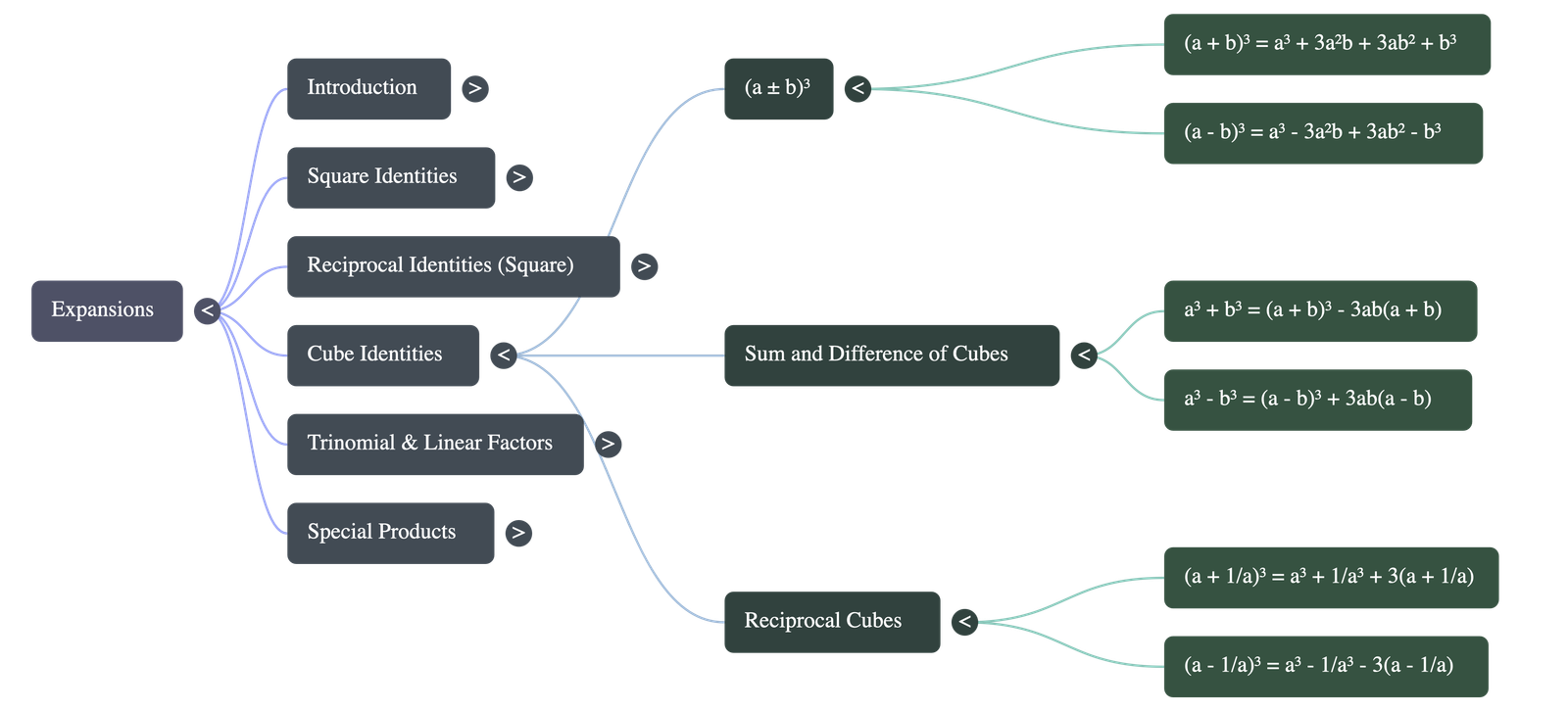
• (a + b)3 = a3 + 3a2b + 3ab2 + b3
• This can be rewritten as: a3 + b3 = (a + b)3 - 3ab(a + b) -
Difference of Cubes Expansions:
• (a - b)3 = a3 - 3a2b + 3ab2 - b3
• This can be rewritten as: a3 - b3 = (a - b)3 + 3ab(a - b) -
Cubic Expansions with Reciprocals (where a ≠ 0):
• (a + 1/a)3 = a3 + 1/a3 + 3(a + 1/a)
• (a - 1/a)3 = a3 - 1/a3 - 3(a - 1/a) -
Special Conditional Property:
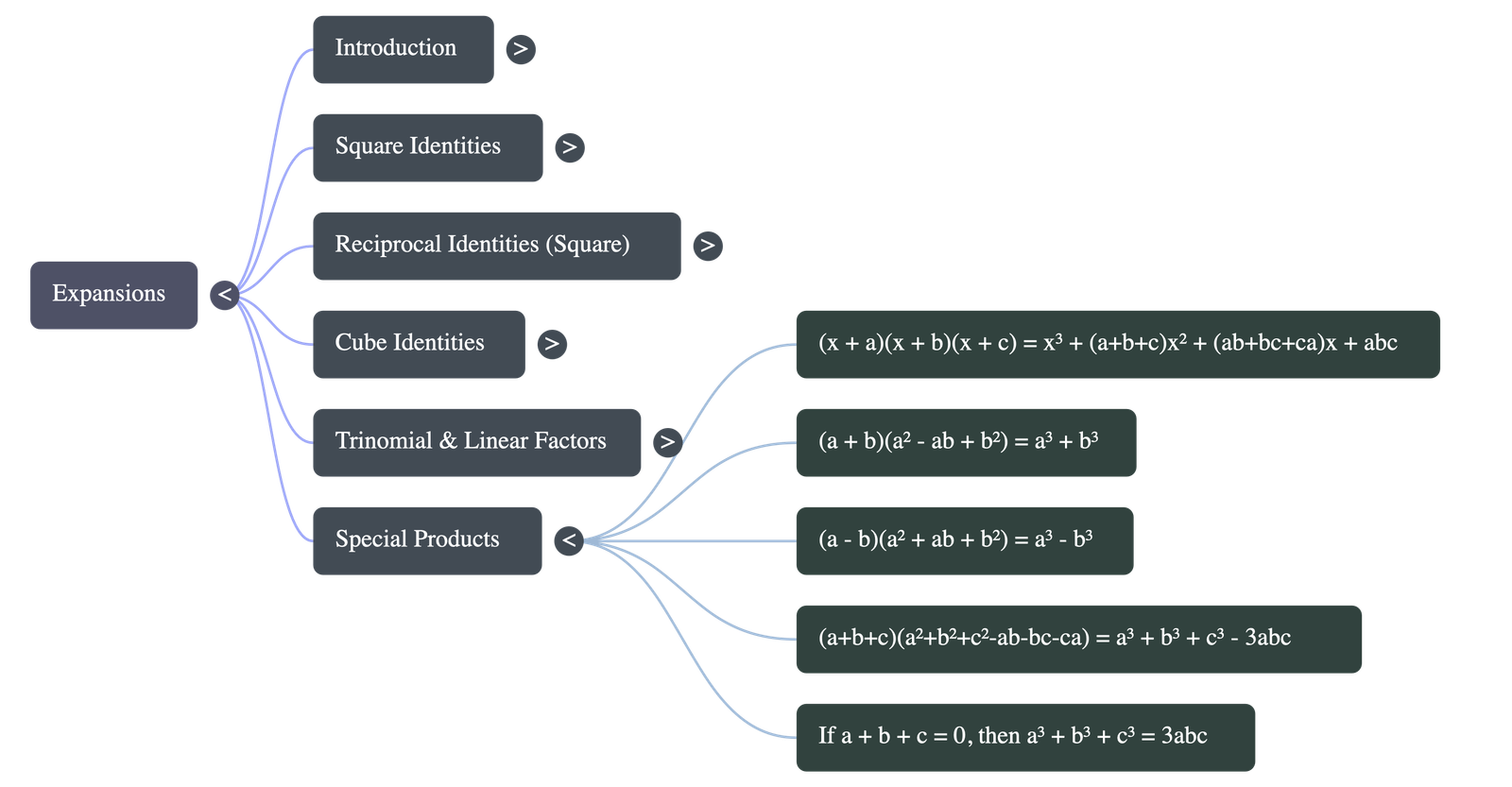
• If a + b + c = 0, then a3 + b3 + c3 = 3abc
4.4 Expansion of (x ± a)(x ± b)
-
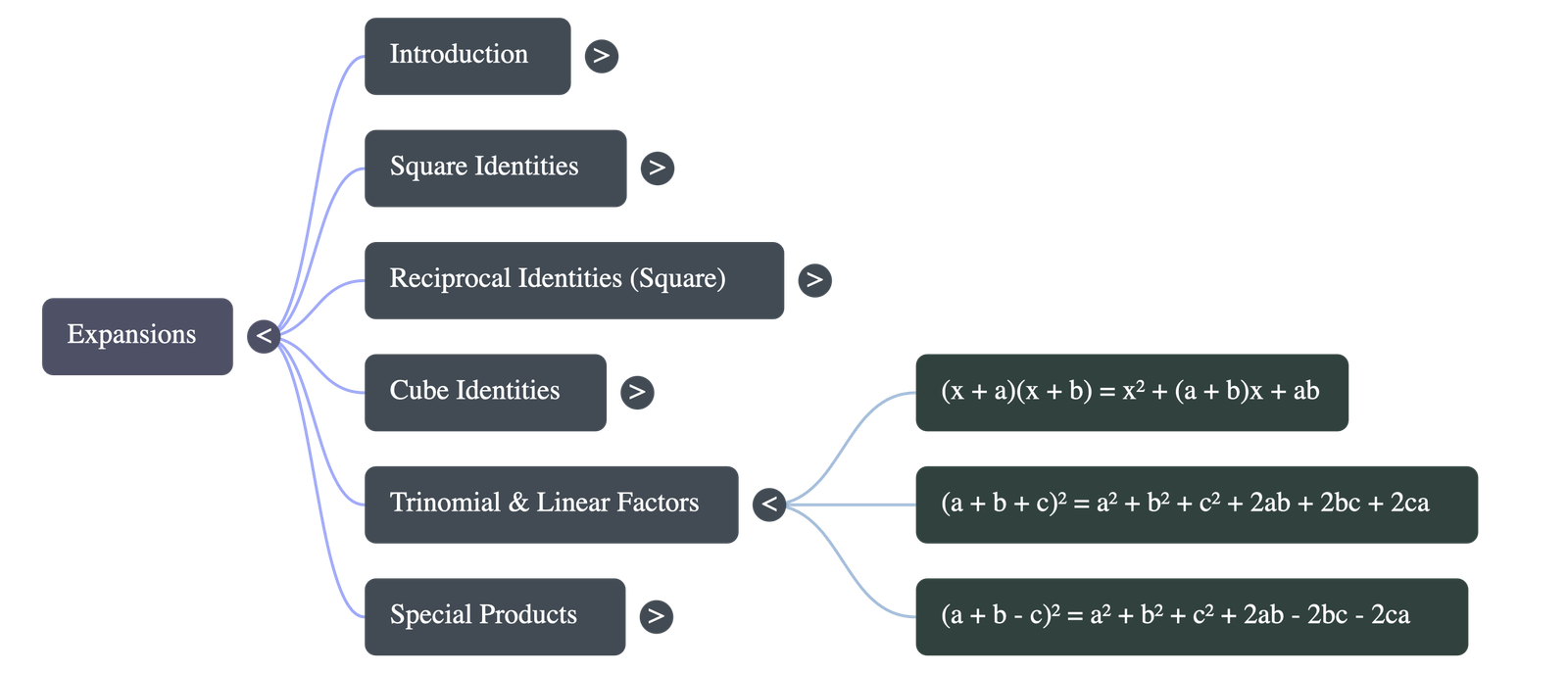
Multiplying two binomials with a common first term results in a quadratic polynomial. The four sign variations are:
• (x + a)(x + b) = x2 + (a + b)x + ab
• (x + a)(x - b) = x2 + (a - b)x - ab
• (x - a)(x + b) = x2 - (a - b)x - ab
• (x - a)(x - b) = x2 - (a + b)x + ab
4.5 Expansion of (a ± b ± c)²
-
Squaring a trinomial creates a pattern of squared individual terms plus double the product of paired terms. The sign changes depending on the original terms:
• (a + b + c)2 = a2 + b2 + c2 + 2ab + 2bc + 2ca
• (a + b - c)2 = a2 + b2 + c2 + 2ab - 2bc - 2ca
• (a - b + c)2 = a2 + b2 + c2 - 2ab - 2bc + 2ca
• (a - b - c)2 = a2 + b2 + c2 - 2ab + 2bc - 2ca
4.6 Using Expansions
- Practical Application: Expansion identities are used heavily to bypass tedious multiplication.
- Finding Coefficients: Formulas allow you to target and find specific coefficients (e.g., extracting the coefficient of x2 or the constant term directly out of a complex polynomial multiplication).
- Establishing Relationships: They help find the relationship between algebraic constants or evaluate unknown algebraic expressions when given partial sums or products (e.g., given x+y and x3+y3, one can find x2+y2).
4.7 Special Products
-
Product of Three Binomials:
• (x + a)(x + b)(x + c) = x3 + (a + b + c)x2 + (ab + bc + ca)x + abc -
Factored Forms of Sum/Difference of Cubes:
• (a + b)(a2 - ab + b2) = a3 + b3
• (a - b)(a2 + ab + b2) = a3 - b3 -
Major Cubic Trinomial Identity:
• (a + b + c)(a2 + b2 + c2 - ab - bc - ca) = a3 + b3 + c3 - 3abc
(This is the foundational formula for the conditional property discussed in section 4.3).
Study Guide: Algebraic Expansions and Identities
Part 1: Core Concept Review
Understanding Expansions: Expansion is the fundamental algebraic process of evaluating and removing brackets from mathematical expressions. By mastering expansions, you can bypass tedious step-by-step multiplication and directly arrive at simplified polynomials.
Algebraic Identities: An identity is a special type of equation that remains true for absolutely any value substituted into its variables. Standard expansion formulas, such as the square of a binomial or the cube of a binomial, act as universal identities that allow us to quickly calculate squares and cubes of complex terms.
Key Formulas to Master:
- Basic Squares: (a ± b)2 = a2 ± 2ab + b2
- Basic Cubes: (a ± b)3 = a3 ± b3 ± 3ab(a ± b)
- Trinomial Squares: (a + b + c)2 = a2 + b2 + c2 + 2ab + 2bc + 2ca
- Reciprocal Relationships: Formulas adapt neatly when a term and its reciprocal (like a and 1/a) are expanded, often canceling out the middle variable completely.
- Special Conditional Identity: If a + b + c = 0, it creates a unique mathematical scenario where the sum of their individual cubes (a3 + b3 + c3) is perfectly equal to three times their product (3abc).
Part 2: Short-Answer Quiz
- What defines an algebraic identity compared to a regular equation?
(Write your answer here) - Explain what happens to the middle term when you expand the square of a variable and its reciprocal, such as (a + 1/a)2.
(Write your answer here) - Describe the fundamental difference between the expansions of (a + b)2 and (a - b)2.
(Write your answer here) - What is the final result when you subtract the expansion of (a - b)2 from the expansion of (a + b)2?
(Write your answer here) - How can the formula for (a + b)3 be rewritten to isolate the sum of two cubes (a3 + b3)?
(Write your answer here) - State the condition required for the identity a3 + b3 + c3 = 3abc to be true.
(Write your answer here) - When multiplying two binomials with a common first term, like (x + a)(x + b), how are the coefficient of x and the constant term formed?
(Write your answer here) - Identify the pattern of terms produced when you square a trinomial expression like (a + b + c)2.
(Write your answer here) - What is the factored form of the difference of two cubes, a3 - b3?
(Write your answer here) - How do expansion identities serve as practical shortcuts for numerical calculations?
(Write your answer here)
Part 3: Quiz Answer Key
- An algebraic identity is an equation that is universally true for all possible values of its variables. Unlike a standard equation which only holds true for specific values, an identity relies on established mathematical principles that do not change.
- When you expand (a + 1/a)2, the middle term involves multiplying the two terms together alongside the number 2. Because a and 1/a are reciprocals, they cancel each other out, leaving only the constant integer 2 as the middle term.
- Both expansions produce the exact same squared terms: a2 and b2. The only difference lies in the sign of the middle product term, which is +2ab for addition and -2ab for subtraction.
- Subtracting (a - b)2 from (a + b)2 causes the squared variables (a2 and b2) to cancel each other out entirely. The result leaves only the difference of the middle terms, combining to give 4ab.
- By expanding (a + b)3, you get a3 + b3 + 3ab(a + b). By rearranging this equation to isolate the cubes on one side, it rewrites as a3 + b3 = (a + b)3 - 3ab(a + b).
- For the sum of three cubes to perfectly equal three times the product of their base numbers, the base numbers themselves must add up to zero. Specifically, the condition is that a + b + c = 0.
- The coefficient of the middle x term is formed by adding the two distinct constants (a + b). The final constant term of the quadratic expression is formed by multiplying those two distinct constants (ab).
- Squaring a trinomial results in the sum of the individual squares of all three terms (a2 + b2 + c2). This is followed by double the product of every possible pair of those terms (2ab + 2bc + 2ca).
- The difference of two cubes factors into a binomial multiplied by a trinomial. The exact factored form is (a - b)(a2 + ab + b2).
- Identities allow you to calculate complex numerical powers, like (104)3, without doing long multiplication. By rewriting the number as a binomial like (100 + 4)3, you can apply the identity formula for much faster mental or scratchpad arithmetic.
Part 4: Essay Format Questions & Detailed Solutions
Question 1: Given that a + 1/a = 5, carefully calculate the values of both a2 + 1/a2 and a3 + 1/a3. Show all steps of your derivation.
Detailed Working:
Part A: Finding squares
1. Start with the given equation: a + 1/a = 5
2. Square both sides to utilize the identity: (a + 1/a)2 = 52
3. Expand using the reciprocal identity: a2 + 1/a2 + 2 = 25
4. Subtract 2 from both sides to isolate the variables: a2 + 1/a2 = 25 - 2
Answer A: a2 + 1/a2 = 23
Part B: Finding cubes
1. Start again with the given equation: a + 1/a = 5
2. Cube both sides: (a + 1/a)3 = 53
3. Expand using the cubic reciprocal identity: a3 + 1/a3 + 3(a + 1/a) = 125
4. Substitute the known value of (a + 1/a) which is 5: a3 + 1/a3 + 3(5) = 125
5. Simplify the arithmetic: a3 + 1/a3 + 15 = 125
6. Subtract 15 from both sides: a3 + 1/a3 = 125 - 15
Answer B: a3 + 1/a3 = 110
Question 2: Demonstrate mathematically that if a + b + c = 0, then a3 + b3 + c3 = 3abc must be true.
Detailed Working:
1. We are given the condition that a + b + c = 0.
2. By moving c to the opposite side of the equation, we can rewrite this as: a + b = -c
3. Next, we cube both sides of this new equation: (a + b)3 = (-c)3
4. We expand the left side using the standard cubic identity: a3 + b3 + 3ab(a + b) = -c3
5. From step 2, we know that (a + b) is exactly equal to -c. We substitute -c back into the parenthesis: a3 + b3 + 3ab(-c) = -c3
6. Multiply out the terms: a3 + b3 - 3abc = -c3
7. Finally, rearrange the terms by moving -c3 to the left and -3abc to the right: a3 + b3 + c3 = 3abc.
Conclusion: The relationship is mathematically proven.
Question 3: Expand the trinomial expression (3x - 2y + 5z)2 using the appropriate algebraic identity, ensuring all sign variations are tracked.
Detailed Working:
1. The relevant identity is (a + b + c)2 = a2 + b2 + c2 + 2ab + 2bc + 2ca.
2. Let us map the given terms to the identity variables: a = 3x, b = -2y, and c = 5z.
3. Apply the individual squares: (3x)2 + (-2y)2 + (5z)2
4. Apply the paired double products: + 2(3x)(-2y) + 2(-2y)(5z) + 2(5z)(3x)
5. Evaluate the squares: 9x2 + 4y2 + 25z2
6. Evaluate the double products, paying close attention to negative signs:
2(3x)(-2y) = -12xy
2(-2y)(5z) = -20yz
2(5z)(3x) = +30zx
7. Combine all the evaluated parts together into a single expanded polynomial.
Answer: 9x2 + 4y2 + 25z2 - 12xy - 20yz + 30zx
Question 4: Evaluate the numerical expression (104)3 strictly by using a suitable expansion identity rather than direct multiplication.
Detailed Working:
1. First, split the number 104 into a simple binomial sum: (100 + 4)3.
2. We will apply the identity for the sum of a cube: (a + b)3 = a3 + b3 + 3ab(a + b).
3. Here, map a = 100 and b = 4.
4. Substitute the numbers into the formula: (100)3 + (4)3 + 3(100)(4)(100 + 4).
5. Evaluate the individual parts:
1003 = 1,000,000
43 = 64
3(100)(4) = 1,200
(100 + 4) = 104
6. Calculate the final product portion: 1,200 × 104 = 124,800.
7. Add all the parts together: 1,000,000 + 64 + 124,800 = 1,124,864.
Answer: 1,124,864
Question 5: If x + y = 5 and the sum of their cubes (x3 + y3) is 35, find the sum of their squares (x2 + y2).
Detailed Working:
1. We are given x + y = 5 and x3 + y3 = 35. Our goal is to find x2 + y2.
2. First, we need to find the value of xy. We use the modified cubic identity: x3 + y3 = (x + y)3 - 3xy(x + y).
3. Substitute the known values: 35 = (5)3 - 3xy(5).
4. Simplify: 35 = 125 - 15xy.
5. Rearrange to solve for xy: 15xy = 125 - 35, which gives 15xy = 90. Therefore, xy = 6.
6. Now, to find x2 + y2, we use the modified square identity: x2 + y2 = (x + y)2 - 2xy.
7. Substitute the known value of (x + y) and our derived value of xy: x2 + y2 = (5)2 - 2(6).
8. Simplify the arithmetic: 25 - 12 = 13.
Answer: The sum of their squares is 13.
Part 5: Glossary of Key Terms
- Algebraic Expression: A mathematical phrase that can contain ordinary numbers, variables (like x or y), and operators (like add, subtract, multiply, and divide).
- Binomial: An algebraic expression consisting of exactly two distinct terms separated by a plus or minus sign (e.g., a + b).
- Coefficient: A numerical or constant quantity placed before and multiplying the variable in an algebraic expression (e.g., the 3 in 3xy).
- Expansion: The mathematical process of evaluating an expression by removing brackets through systematic multiplication.
- Identity: An equation that is true for all possible values of the variables it contains.
- Reciprocal: A mathematical expression or function related to another so that their product is one; for a variable a, the reciprocal is 1/a.
- Trinomial: An algebraic expression consisting of exactly three distinct terms (e.g., a + b + c).
Do checkout all questions & answers of this chapter.