Factorisation
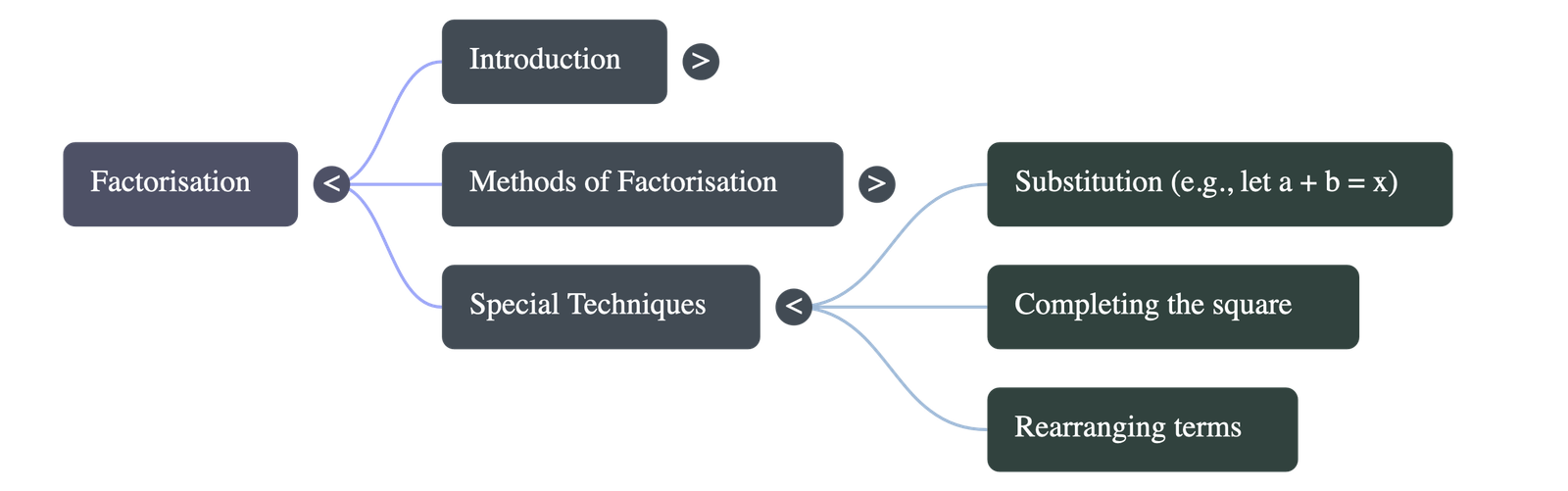
5.1 Introduction
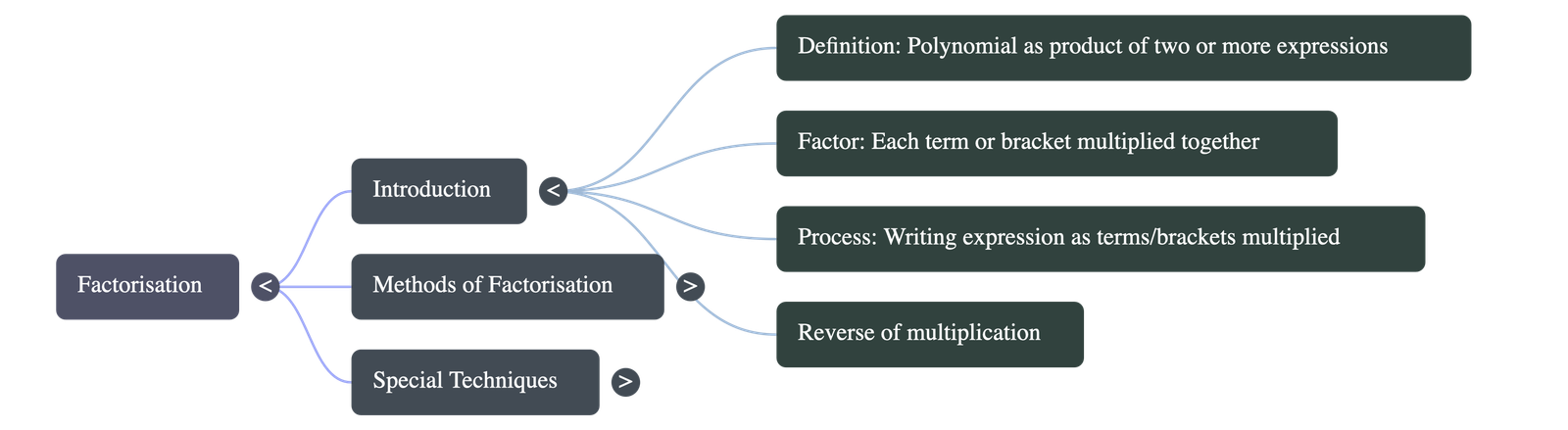
- ➔What is a Factor? When a polynomial (algebraic expression) is expressed as the product of two or more expressions, each of these individual expressions is called a factor of the polynomial.
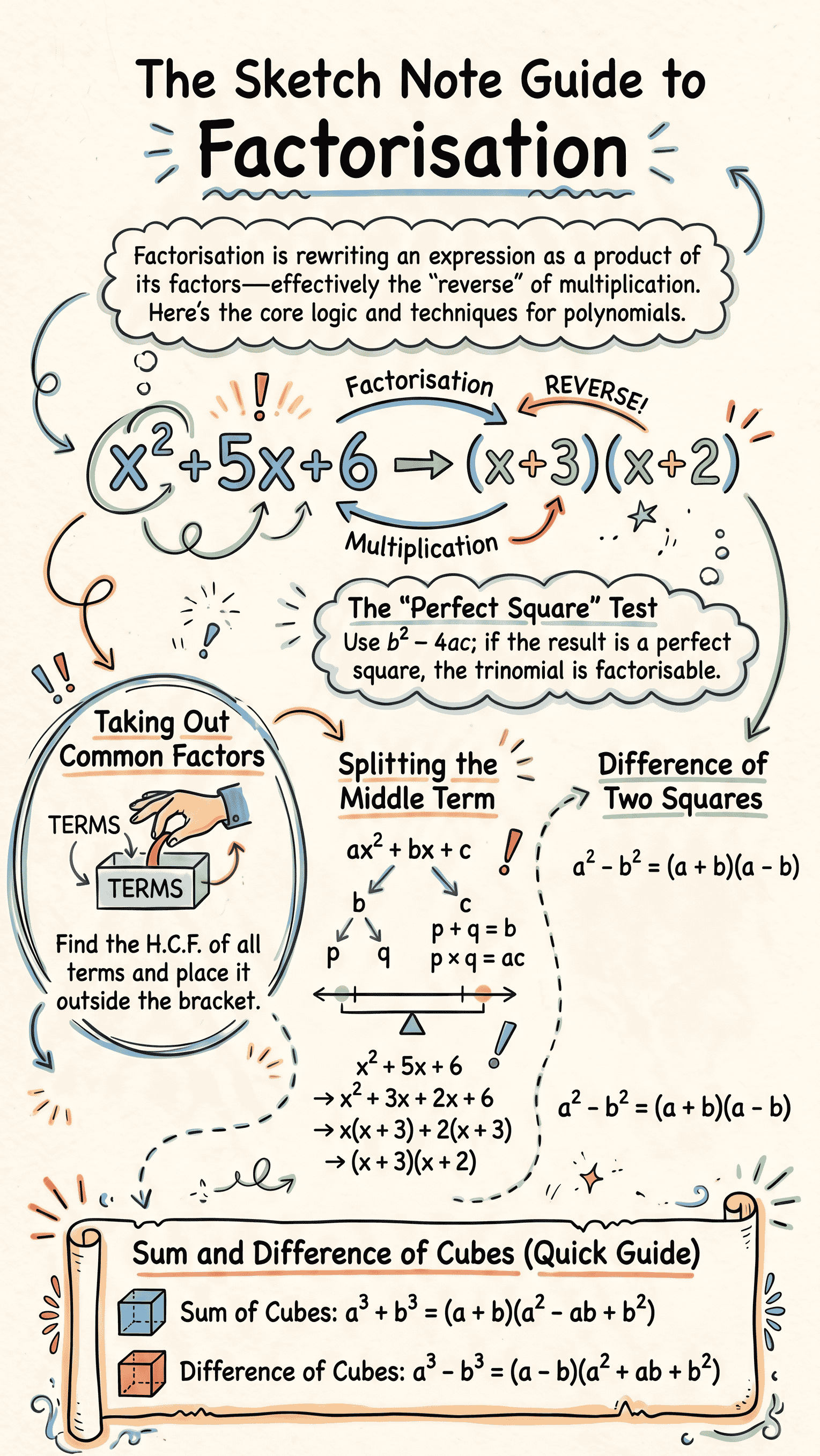
- ➔What is Factorisation? The process of writing an expression in the form of terms or brackets multiplied together is known as factorisation.
- ➔Key Concept: Factorisation is exactly the reverse process of multiplication.
5.2 Methods of Factorisation
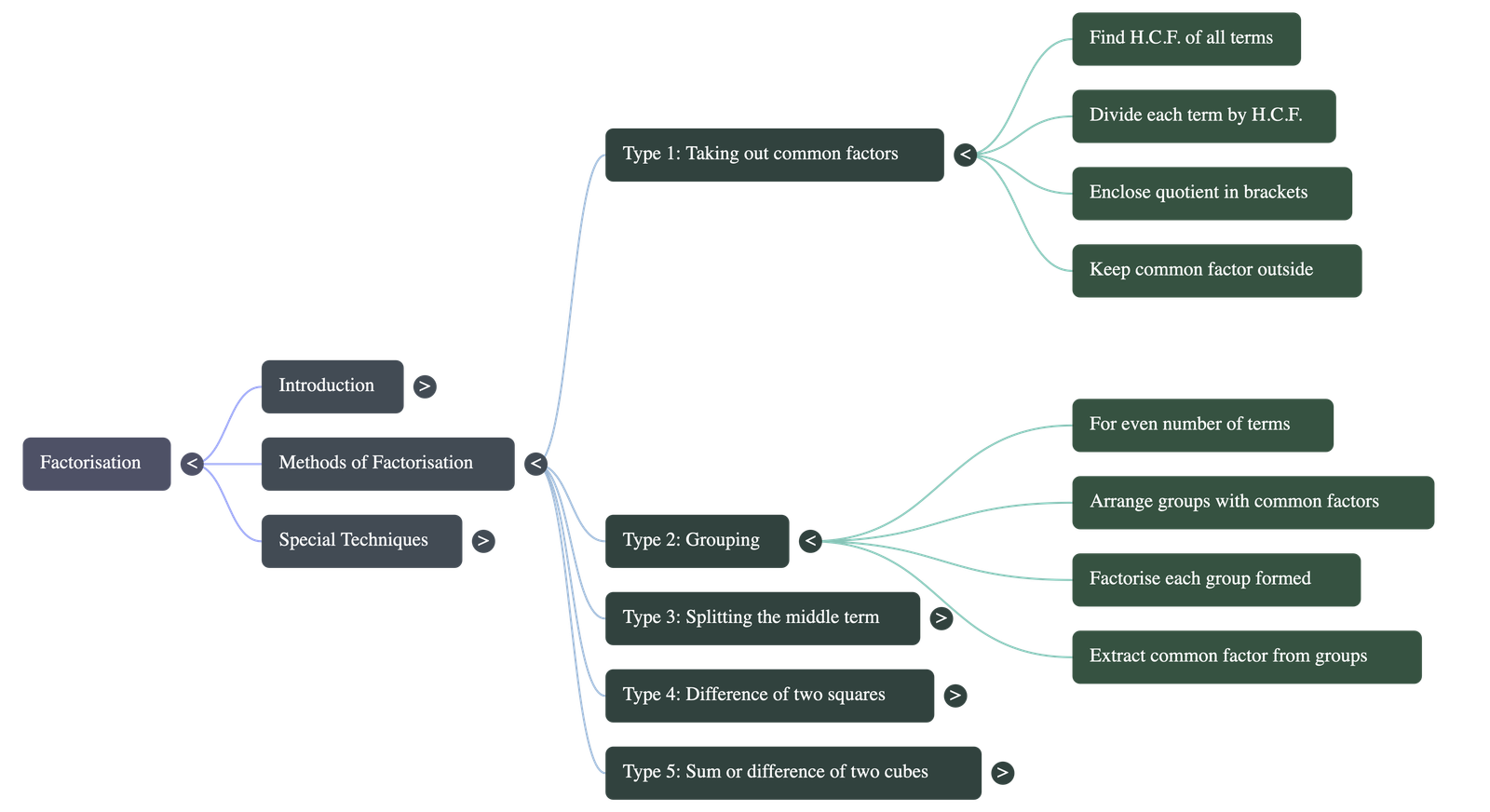
Type 1: Taking out the common factors
- Used when every term of a given expression contains a common factor.
- Procedure: First, find the Highest Common Factor (H.C.F.) of all the terms present in the expression.
- Divide each term by this H.C.F. and enclose the resulting quotients within brackets, keeping the common H.C.F. outside the bracket.
Type 2: Grouping
- Typically applied to expressions that have an even number of terms.
- Procedure: Arrange and group the terms of the expression in such a way that each individual group shares a common factor.
- Factorise each newly formed group separately by taking out its common factor.
- Finally, take out the new common factor that appears across the resulting groups.
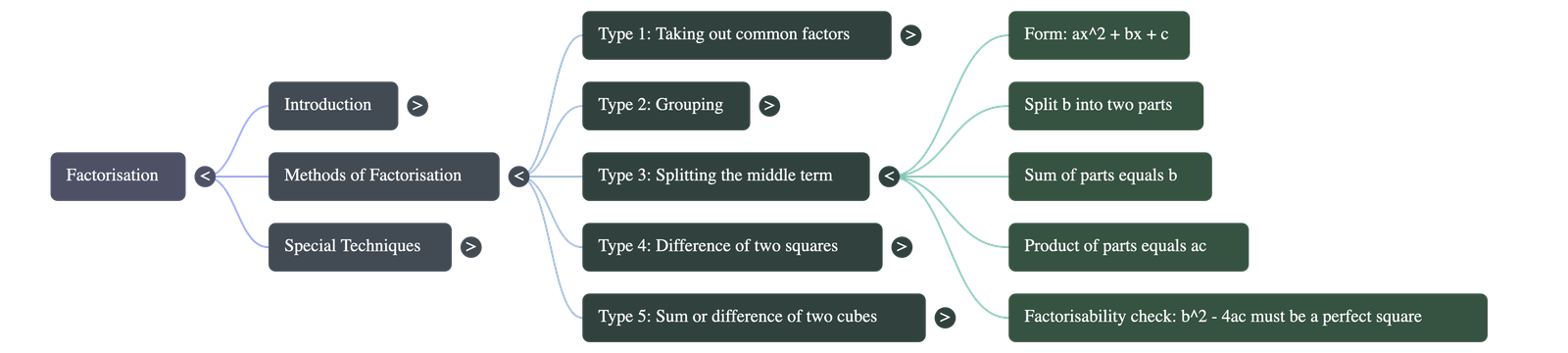
Type 3: Trinomial of the form ax² + bx + c (Splitting the middle term)
- This method involves splitting the middle term's coefficient (b) into two separate parts.
- Rule: The sum of these two parts must equal b, and the product of these two parts must equal the product of a and c.
- After successfully splitting the middle term, factorise the resulting expression using the Grouping method (Type 2).
- Condition for Factorisability: To check if a quadratic trinomial can be factorised, calculate b² - 4ac. If this resulting value is a perfect square, the trinomial is factorisable; otherwise, it is not.
Type 4: Difference of two squares
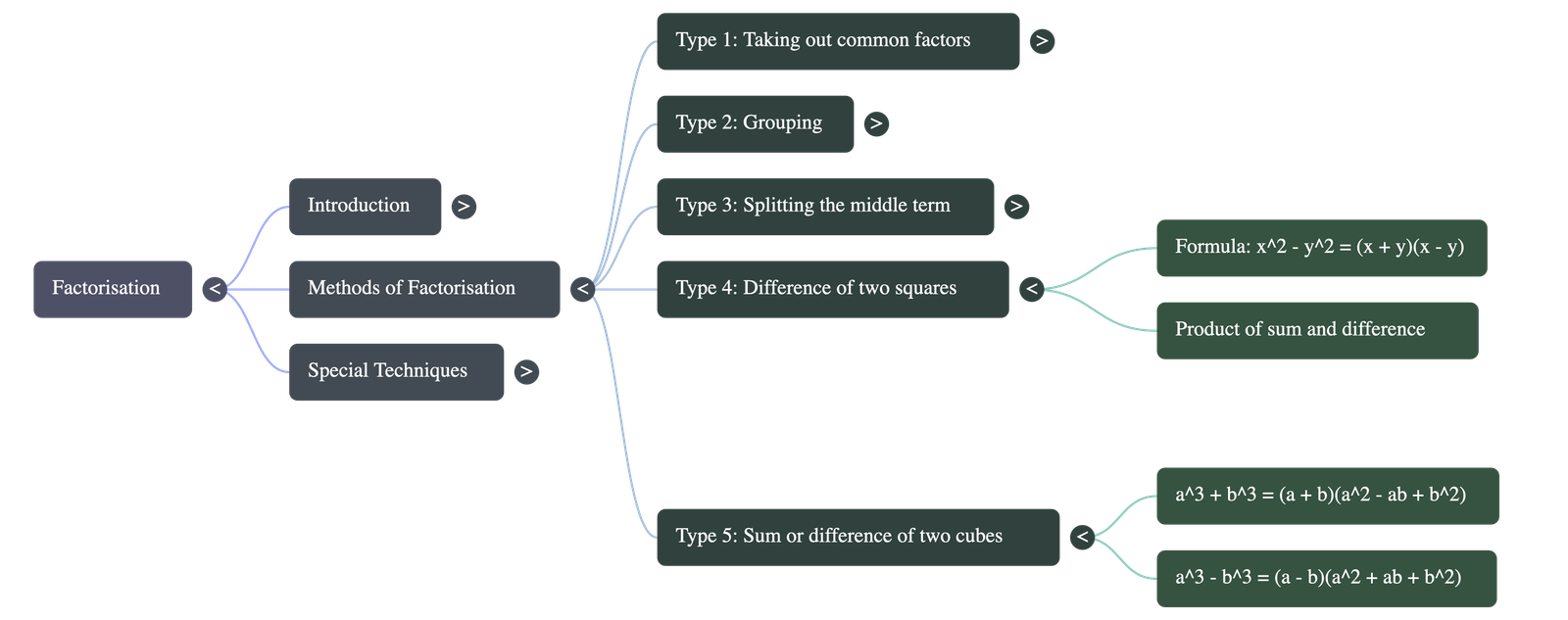
- Based on the algebraic rule: the product of the sum and difference of two terms gives the difference of their squares.
- Identity Used: x² - y² = (x + y)(x - y)
Type 5: The sum or difference of two cubes
- Used for expressions representing the sum or the difference of two perfect cubes.
- Sum of cubes identity: a³ + b³ = (a + b)(a² - ab + b²)
- Difference of cubes identity: a³ - b³ = (a - b)(a² + ab + b²)
Study Guide: Principles of Factorisation
1. Comprehensive Review of the Source
Introduction to Factorisation
When an algebraic expression (or polynomial) is expressed as the product of two or more expressions, each of those individual expressions is known as a factor of the polynomial. Factorisation is the exact process of writing an expression in the form of terms or brackets multiplied together. It is fundamentally the reverse process of multiplication.
Methods of Factorisation
Type 1: Taking out the common factors
Used when every term of a given expression contains a common element. First, find the Highest Common Factor (H.C.F.) of all the terms. Then, divide each term by this H.C.F. and enclose the resulting quotients within brackets, keeping the common H.C.F. outside.
Type 2: Grouping
This method is best for expressions with an even number of terms. You arrange and group the terms so that each group has a common factor. After factorising each group separately, a new common bracket will emerge across the groups, which can then be factored out entirely.
Type 3: Trinomials (Splitting the middle term)
For a trinomial of the form ax² + bx + c, you must split the middle coefficient (b) into two parts. The sum of these two parts must equal b, and their product must equal the product of a and c.
Factorisability Test: To check if such a trinomial is factorisable, calculate the value of b² - 4ac. If the result is a perfect square, the trinomial can be factorised.
Type 4: Difference of two squares
This technique uses the fundamental algebraic identity: x² - y² = (x + y)(x - y). It applies when an expression represents a perfect square subtracted from another perfect square.
Type 5: Sum or difference of two cubes
Used for expressions containing perfect cubes. It relies on two specific identities:
- Sum of cubes: a³ + b³ = (a + b)(a² - ab + b²)
- Difference of cubes: a³ - b³ = (a - b)(a² + ab + b²)
2. Short-Answer Quiz
- What is a factor of a polynomial?
- Define factorisation and explain its relationship to multiplication.
- Explain the steps for factorising by taking out common factors.
- Under what condition is the grouping method typically applied?
- What is the mathematical rule for splitting the middle term in a trinomial?
- How can you mathematically prove whether a quadratic trinomial can be factorised?
- Write the identity used for factorising the difference of two squares.
- Provide the identity for the sum of two perfect cubes.
- Provide the identity for the difference of two perfect cubes.
- Why must you find the Highest Common Factor (H.C.F.) specifically when taking out common factors?
Quiz Answer Key
- When an algebraic expression is written as the product of two or more expressions, each individual expression is called a factor. It is a part that multiplies to form the whole polynomial.
- Factorisation is the process of writing an expression in the form of terms or brackets multiplied together. It is considered the exact reverse process of multiplication.
- First, find the Highest Common Factor (H.C.F.) of all the terms. Then, divide each term by this H.C.F. and enclose the quotients within brackets, keeping the common H.C.F. outside.
- The grouping method is typically applied to expressions that have an even number of terms. The terms are arranged in groups such that each group contains a common factor.
- To split the middle term b in the trinomial ax² + bx + c, it must be divided into two parts. The sum of these two parts must equal b, and their product must equal the product of a and c.
- To determine if a quadratic trinomial is factorisable, evaluate the expression b² - 4ac. If the resulting value is a perfect square, the trinomial can be factorised.
- The identity used for the difference of two squares is x² - y² = (x + y)(x - y). It states the difference of their squares is the product of their sum and difference.
- The identity for the sum of two cubes is a³ + b³ = (a + b)(a² - ab + b²).
- The identity for the difference of two cubes is a³ - b³ = (a - b)(a² + ab + b²).
- Finding the H.C.F. ensures that the maximum possible common value is extracted from the expression. This guarantees the terms left inside the bracket are fully simplified and have no remaining common factors.
3. Essay-Format Problem Solving
Review the detailed step-by-step working for these advanced factorisation problems.
Question 1: Determine if the trinomial 5x² + 17x + 6 is factorisable. If yes, provide the detailed step-by-step factorisation.
1. Compare 5x² + 17x + 6 with standard form ax² + bx + c.
a = 5, b = 17, and c = 6.
2. Check condition b² - 4ac:
b² - 4ac = (17)² - 4 × 5 × 6
= 289 - 120
= 169
3. Since 169 is a perfect square (13²), the trinomial is factorisable.
4. Factorise by splitting the middle term (sum = 17, product = 5 × 6 = 30):
The numbers are 15 and 2.
5x² + 17x + 6 = 5x² + 15x + 2x + 6
= 5x(x + 3) + 2(x + 3)
= (x + 3)(5x + 2)
Final Answer: (x + 3)(5x + 2)
Question 2: Factorise the complex expression 12 - (x + x²)(8 - x - x²) thoroughly by using algebraic substitution.
1. Substitute a common grouping to simplify. Let a = x + x².
2. Rewrite the expression in terms of a:
12 - (x + x²)[8 - (x + x²)] becomes 12 - a(8 - a)
3. Expand and rearrange into a standard trinomial:
12 - 8a + a² = a² - 8a + 12
4. Factorise the trinomial (sum = -8, product = 12 -> numbers are -6 and -2):
a² - 6a - 2a + 12 = a(a - 6) - 2(a - 6)
= (a - 6)(a - 2)
5. Substitute (x + x²) back in place of a:
= (x + x² - 6)(x + x² - 2)
6. Factorise both resulting quadratic trinomials:
First part: x² + x - 6 = x² + 3x - 2x - 6 = x(x + 3) - 2(x + 3) = (x + 3)(x - 2)
Second part: x² + x - 2 = x² + 2x - x - 2 = x(x + 2) - 1(x + 2) = (x + 2)(x - 1)
7. Combine the factors:
= (x - 2)(x + 3)(x - 1)(x + 2)
Final Answer: (x - 2)(x + 3)(x - 1)(x + 2)
Question 3: Using the properties of cubes, mathematically show that 15³ - 8³ is divisible by 7.
1. Use the identity for the difference of two cubes: a³ - b³ = (a - b)(a² + ab + b²)
2. Let a = 15 and b = 8.
3. Substitute these values into the identity:
15³ - 8³ = (15 - 8)(15² + 15 × 8 + 8²)
4. Simplify the first bracket:
15 - 8 = 7
5. Therefore, the expression becomes:
7 × (225 + 120 + 64) = 7 × 409
6. Because the final evaluated form contains '7' as a multiplication factor, the entire product is perfectly divisible by 7.
Final Answer: 15³ - 8³ equals 7 × 409, verifying it is completely divisible by 7.
Question 4: Factorise the high-order polynomial a⁶ - 26a³ - 27 completely.
1. Reduce the degree by substitution. Let a³ = x. Thus, a⁶ = x².
2. The expression becomes a quadratic trinomial: x² - 26x - 27
3. Factorise by splitting the middle term (sum = -26, product = -27 -> numbers are -27 and 1):
x² - 27x + 1x - 27
= x(x - 27) + 1(x - 27)
= (x - 27)(x + 1)
4. Substitute a³ back in place of x:
= (a³ - 27)(a³ + 1)
5. Recognize these as difference and sum of cubes: (a³ - 3³) and (a³ + 1³)
6. Expand both brackets using cube identities:
a³ - 3³ = (a - 3)(a² + 3a + 9)
a³ + 1³ = (a + 1)(a² - a + 1)
7. Combine all factors:
= (a - 3)(a² + 3a + 9)(a + 1)(a² - a + 1)
Final Answer: (a - 3)(a² + 3a + 9)(a + 1)(a² - a + 1)
Question 5: Factorise the algebraic expression x⁴ + y⁴ - 23x²y² using the completing the square method.
1. The expression is x⁴ + y⁴ - 23x²y². To make a perfect square with x⁴ + y⁴, we need + 2x²y².
2. Add and subtract 2x²y² to the expression:
x⁴ + y⁴ + 2x²y² - 2x²y² - 23x²y²
3. Group the first three terms as a perfect square, and combine the remaining terms:
= (x⁴ + y⁴ + 2x²y²) - 25x²y²
4. Write as the difference of two squares:
= (x² + y²)² - (5xy)²
5. Apply the difference of two squares identity [a² - b² = (a + b)(a - b)]:
Here, a = (x² + y²) and b = 5xy.
= (x² + y² + 5xy)(x² + y² - 5xy)
Final Answer: (x² + y² + 5xy)(x² + y² - 5xy)
4. Comprehensive Glossary of Key Terms
- Polynomial
- An algebraic expression consisting of variables and coefficients, involving operations of addition, subtraction, multiplication, and non-negative integer exponents.
- Factor
- When a polynomial is expressed as the product of two or more algebraic expressions, each individual expression is defined as a factor of the original polynomial.
- Factorisation
- The mathematical process of breaking down an expression into a product of simpler terms or brackets. It serves as the exact reverse process of multiplication.
- Highest Common Factor (H.C.F.)
- The largest or highest degree algebraic term that divides two or more terms completely without leaving a remainder.
- Trinomial
- A specific type of algebraic expression that consists of exactly three terms, such as ax² + bx + c.
- Perfect Square
- A number or expression that can be expressed as the product of a rational number or expression multiplied by itself.
- Identity
- An equality relation stating that two mathematical expressions are equal for all possible values of their variables (e.g., x² - y² = (x + y)(x - y)).
Do checkout all questions & answers of this chapter.