Quick Navigation:
| | | |
Mid-Point Theorem and Its Converse [Including Intercept Theorem]
This chapter explores the foundational geometrical properties of triangles, quadrilaterals, and parallel lines. By understanding how mid-points connect, we can discover hidden parallel lines and calculate unknown lengths. Below is a detailed, section-by-section breakdown designed for easy revision.
11.1 Mid-Point Theorem (Proof, Simple Applications, and Its Converse)
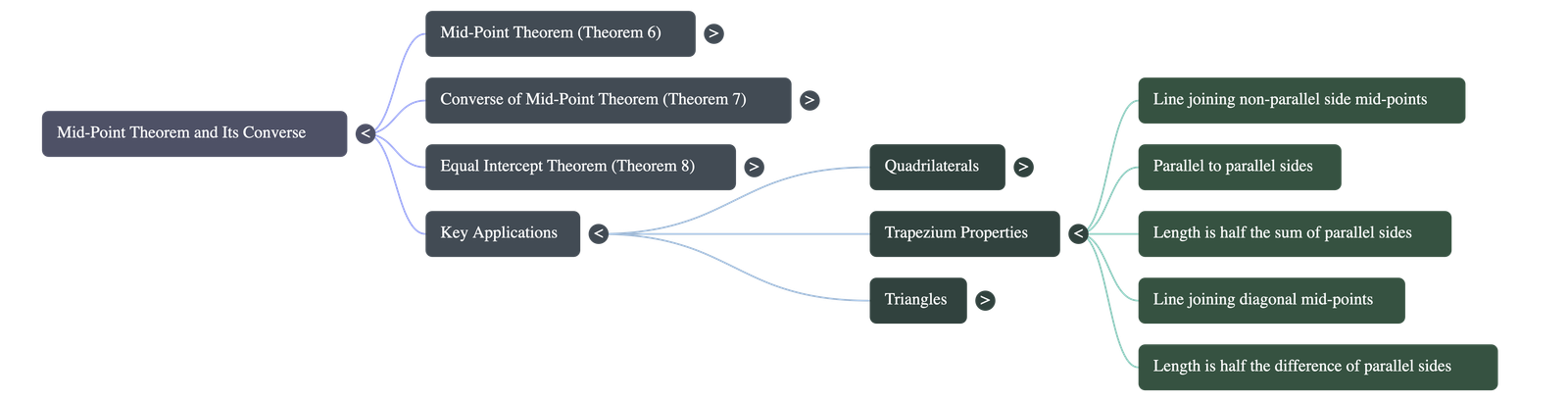
The Mid-Point Theorem (Theorem 6)
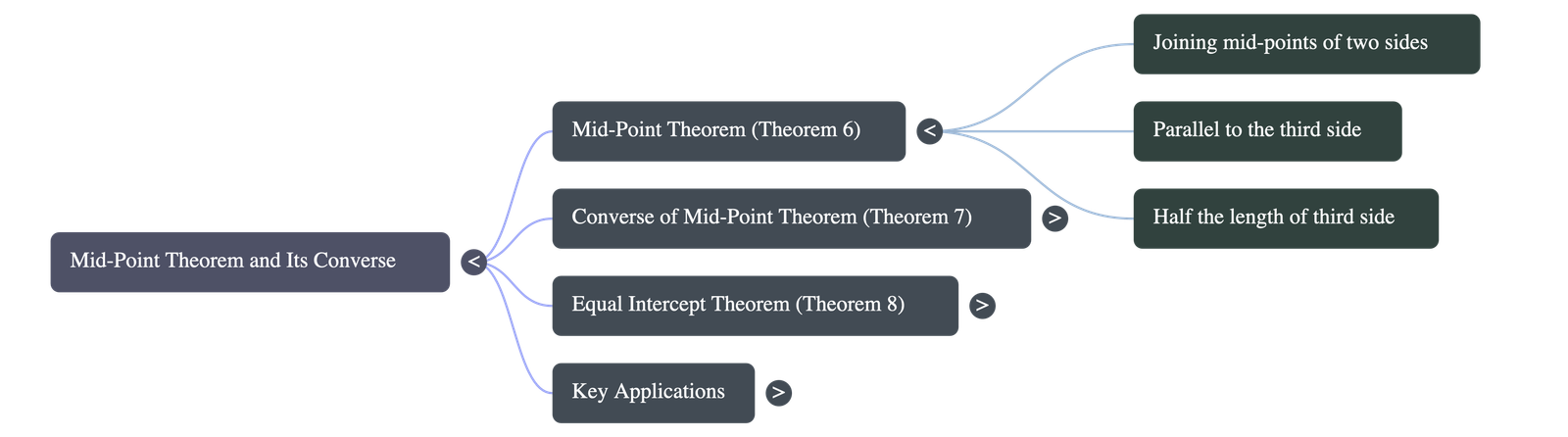
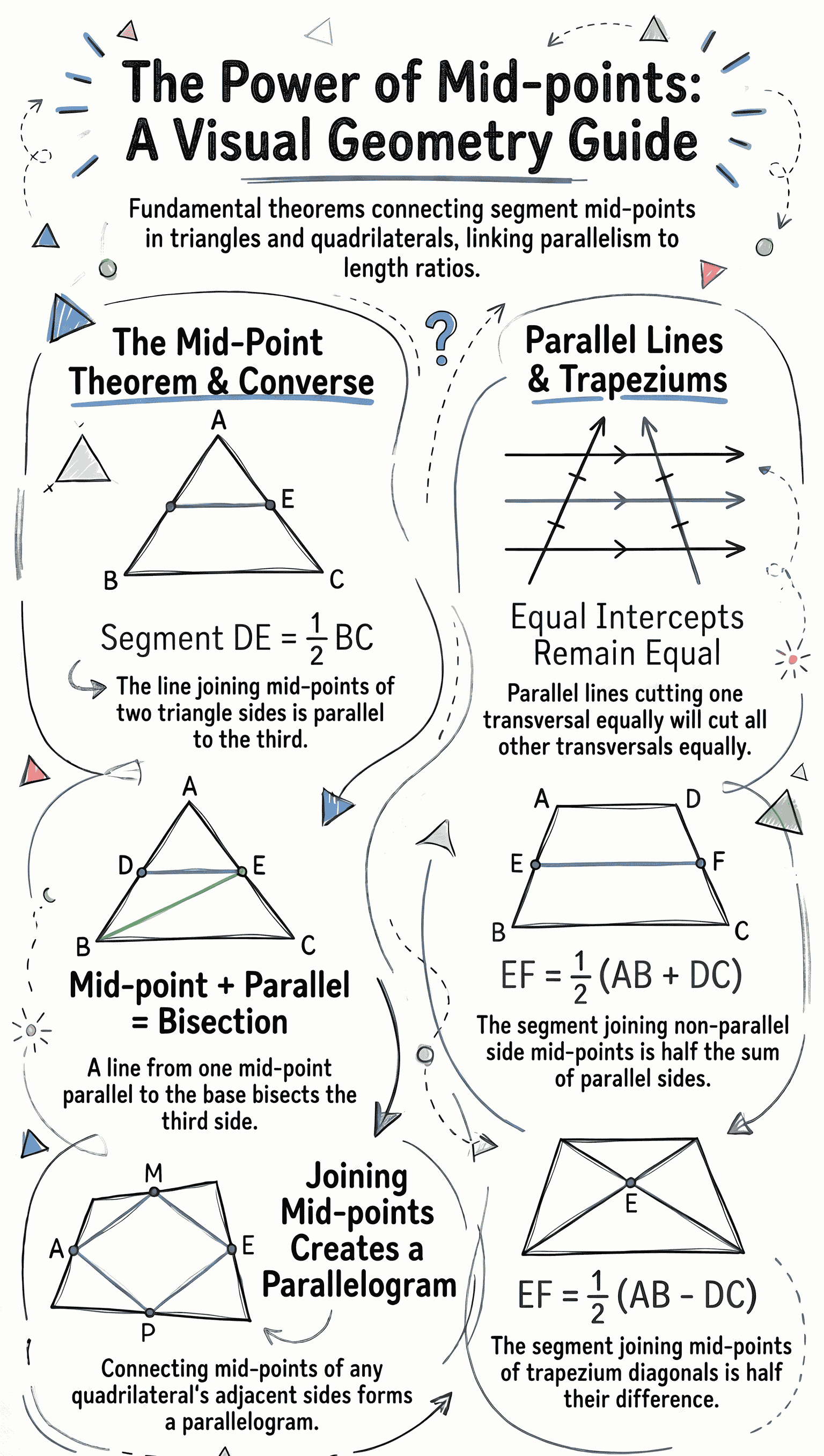
- Core Statement: The line segment joining the mid-points of any two sides of a triangle is parallel to the third side, and is equal to half of its length.
- Simple Explanation: If you take a triangle and connect the exact middle points of its left and right sides, the new horizontal line created will never intersect the bottom base (because it is completely parallel) and it will be precisely 50% of the base's length.
Converse of the Mid-Point Theorem (Theorem 7)
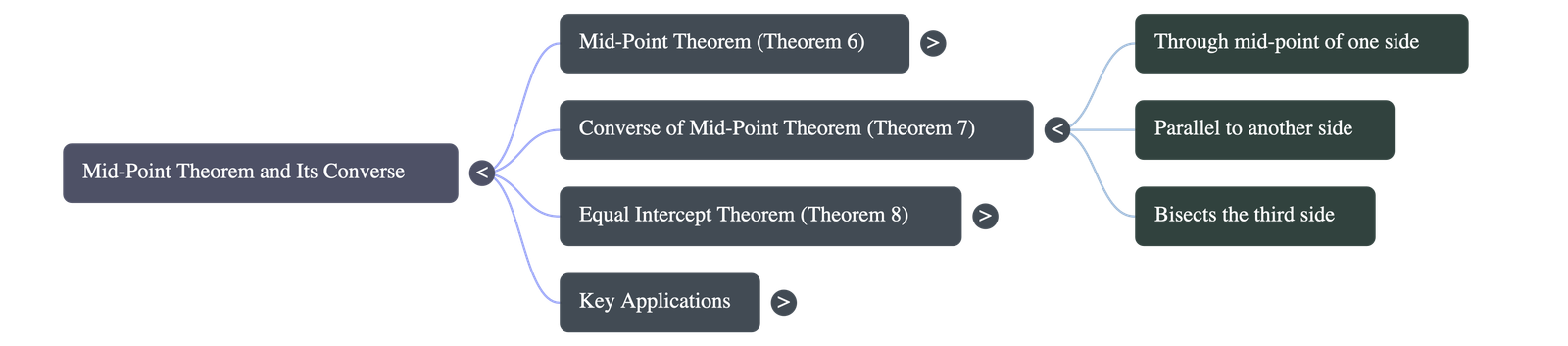
- Core Statement: The straight line drawn through the mid-point of one side of a triangle parallel to another side, bisects the third side.
- Simple Explanation: If you start at the exact middle of one side of a triangle and draw a line straight across so that it is parallel to the bottom base, it is mathematically guaranteed to hit the exact middle point of the opposite side.
Key Discoveries & Applications
By using these two theorems, the chapter proves several exciting geometrical facts:
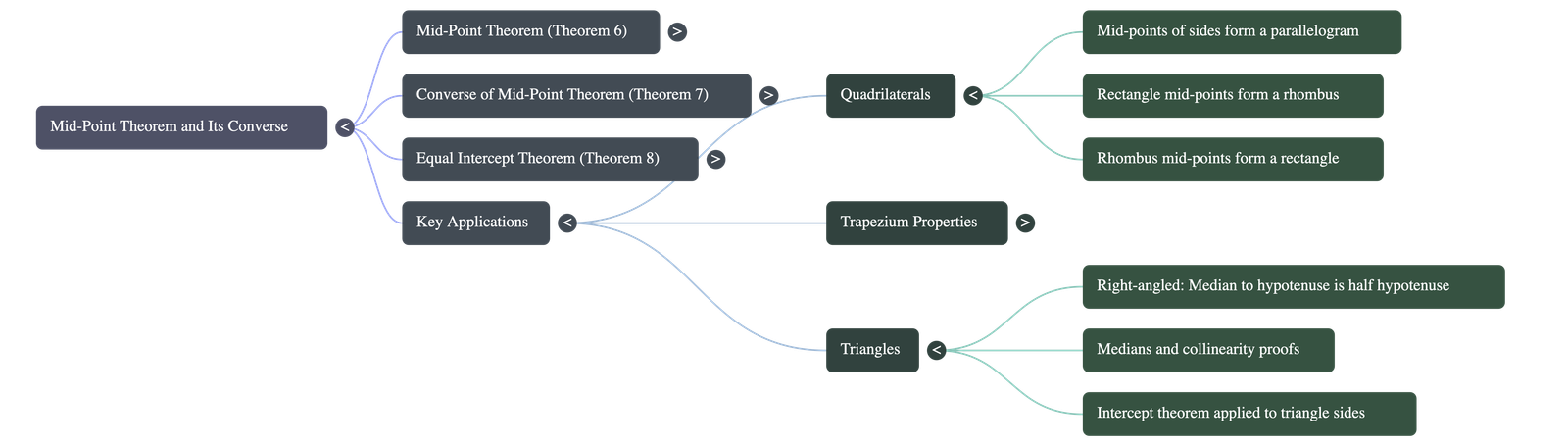
- Creating Parallelograms: If you join the mid-points of the adjacent sides of any quadrilateral in order, the resulting inner figure is always a parallelogram.
- Trapezium Properties (Non-Parallel Sides): In a trapezium, the length of the line joining the mid-points of its non-parallel sides is equal to half the sum of the lengths of its parallel sides.
- Trapezium Properties (Diagonals): The line segment joining the mid-points of the diagonals of a trapezium is parallel to the parallel sides and is exactly equal to half the difference between them.
- Right-Angled Triangles: In a right-angled triangle, if you join the mid-point of the hypotenuse to the 90-degree corner, the length of that line is exactly half the length of the hypotenuse.
11.2 Equal Intercept Theorem (Proof and Simple Application)
The Equal Intercept Theorem (Theorem 8)
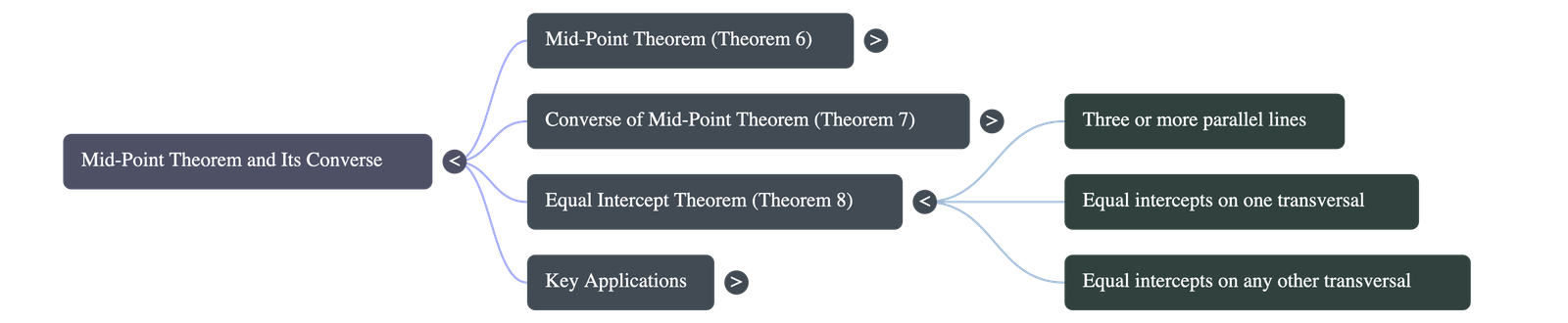
- Core Statement: If a transversal (a line crossing other lines) makes equal intercepts on three or more parallel lines, then any other line cutting them will also make equal intercepts.
- Simple Explanation: Imagine three parallel roads. If a slanted walking path crosses them and the distance between the first and second road is exactly equal to the distance between the second and third road along that path, then any other path drawn across those same three roads will also be chopped into equal lengths.
Key Applications
- Proving the Converse: The Intercept Theorem is used to elegantly prove the Converse of the Mid-Point Theorem.
- Solving Complex Figures: It allows students to solve complex diagrams involving parallelograms cut by multiple transversals, effortlessly proving that certain lines bisect others.
Exercises and Real-World Applications
The chapter sections and the final "Test Yourself" segment challenge students to apply these theorems practically:
- Logical Proofs: Students must prove that specific inner shapes formed by connecting mid-points become exact rectangles, squares, or rhombuses.
- Numerical Calculations: Calculating the perimeters of inner triangles and parallelograms by applying the "half-length" property of the mid-point theorem.
- Assertion & Reason: Multiple-choice questions that test conceptual clarity by evaluating statements logically against the theorems.
- Case-Study Based Learning: Practical applications, such as a school designing a triangular garden. Students use the theorems to find the length of a walking path connecting the mid-points of the garden's edges, and to deduce the special names of the resulting quadrilaterals.
End of Chapter Summary
Do checkout all questions & answers of this chapter.
Quick Navigation:
| | | |
1 / 1
Quick Navigation:
| | | |