Rectilinear Figures
Quadrilaterals: Parallelogram, Rectangle, Rhombus, Square and Trapezium
13.1 Introduction
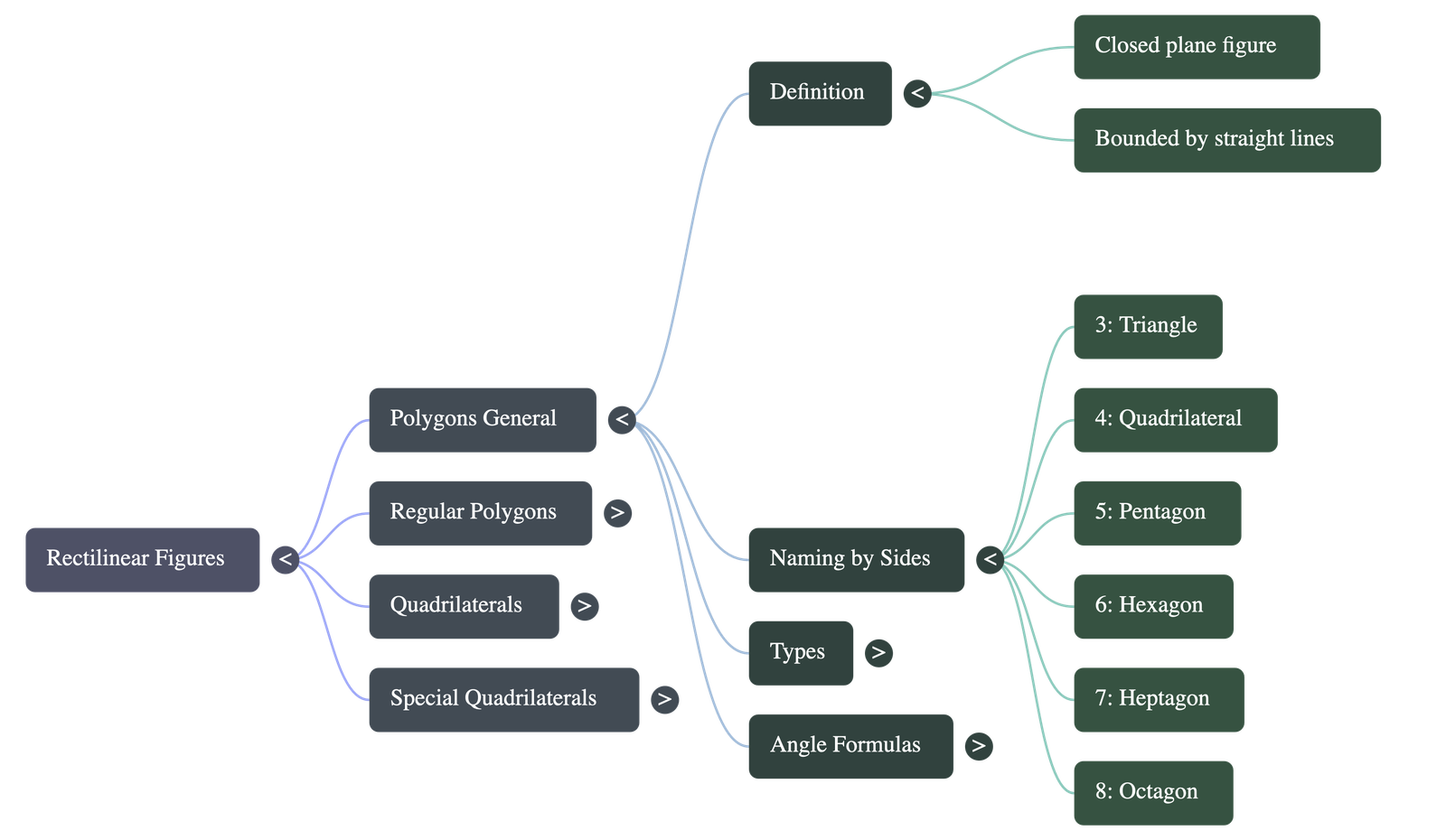
- Rectilinear: Means along a straight line or forming a straight line.
- Rectilinear Figure: A plane figure that is completely bounded by straight lines.
- Polygon: A closed plane figure bounded by at least three straight line segments.
13.2 Names of Polygons
Polygons are named based on their number of sides:
- 3 sides: Triangle
- 4 sides: Quadrilateral
- 5 sides: Pentagon
- 6 sides: Hexagon
- 7 sides: Heptagon
- 8 sides: Octagon
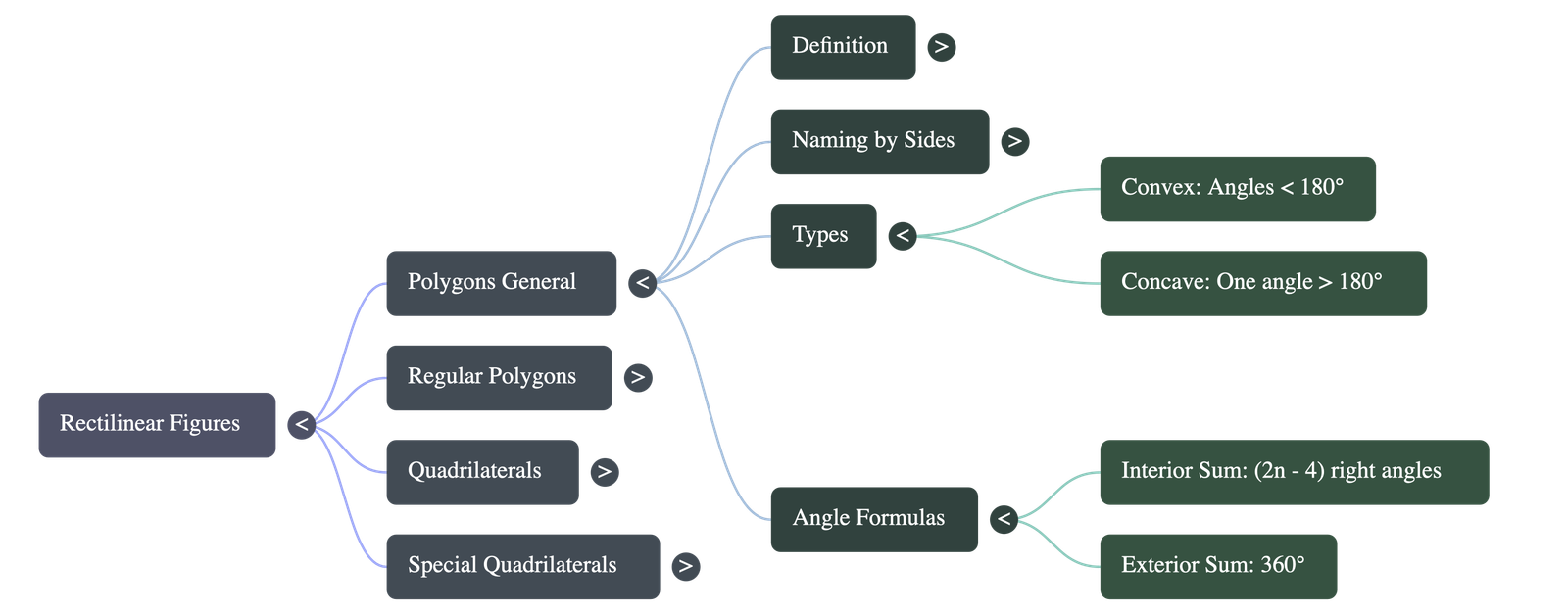
Types of Polygons:
- Convex Polygon: A polygon where each interior angle is less than 180°. (Unless stated otherwise, "polygon" refers to a convex polygon).
- Concave Polygon: A polygon where at least one interior angle is greater than 180° (reflex angle).
Key Angle Properties:
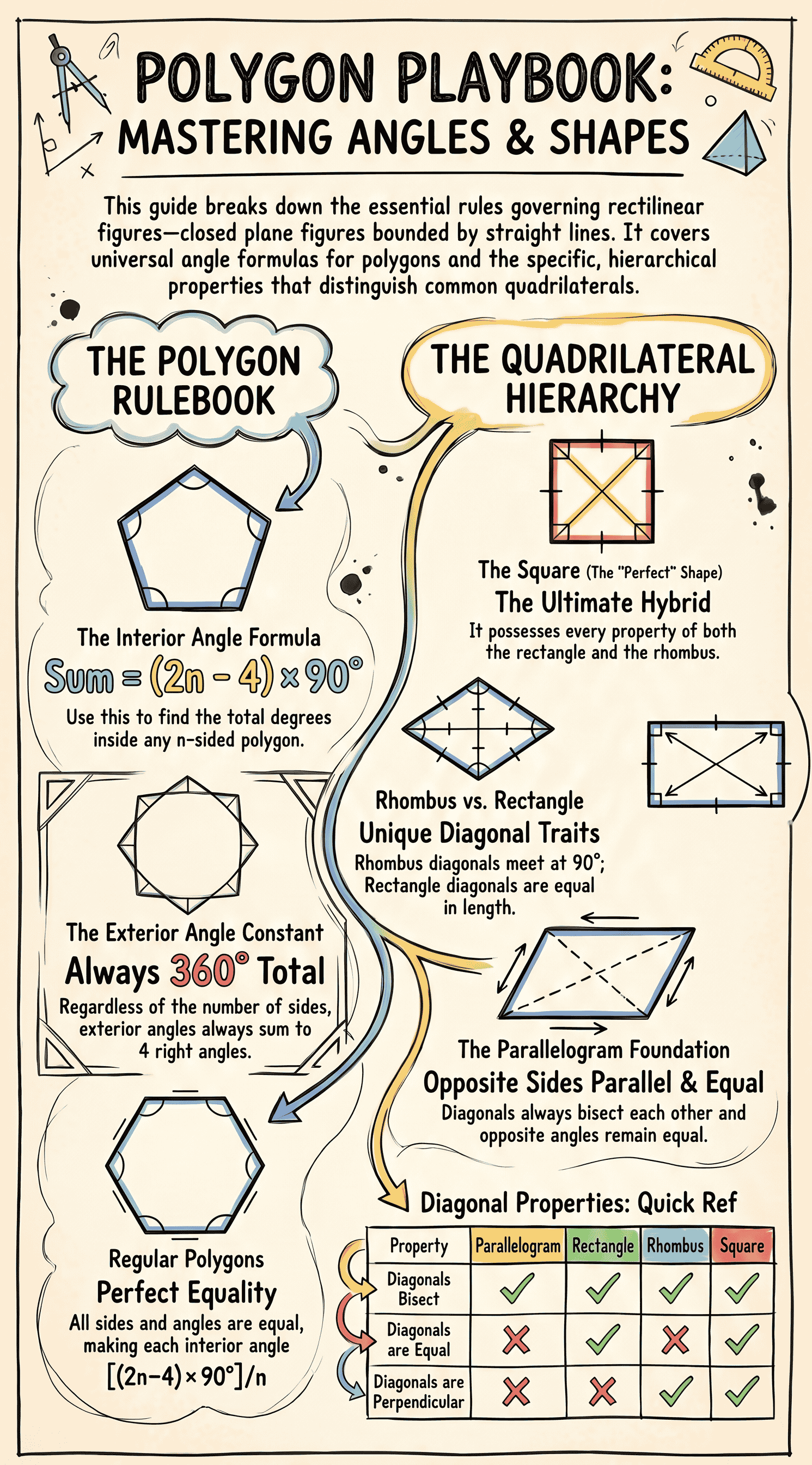
- The sum of the interior angles of an n-sided polygon is equal to (2n - 4) right angles [or (2n - 4) × 90°].
- If the sides are produced in order (all clockwise or all anti-clockwise), the sum of the exterior angles formed is always 4 right angles (360°), regardless of the number of sides.
13.3 Regular Polygon
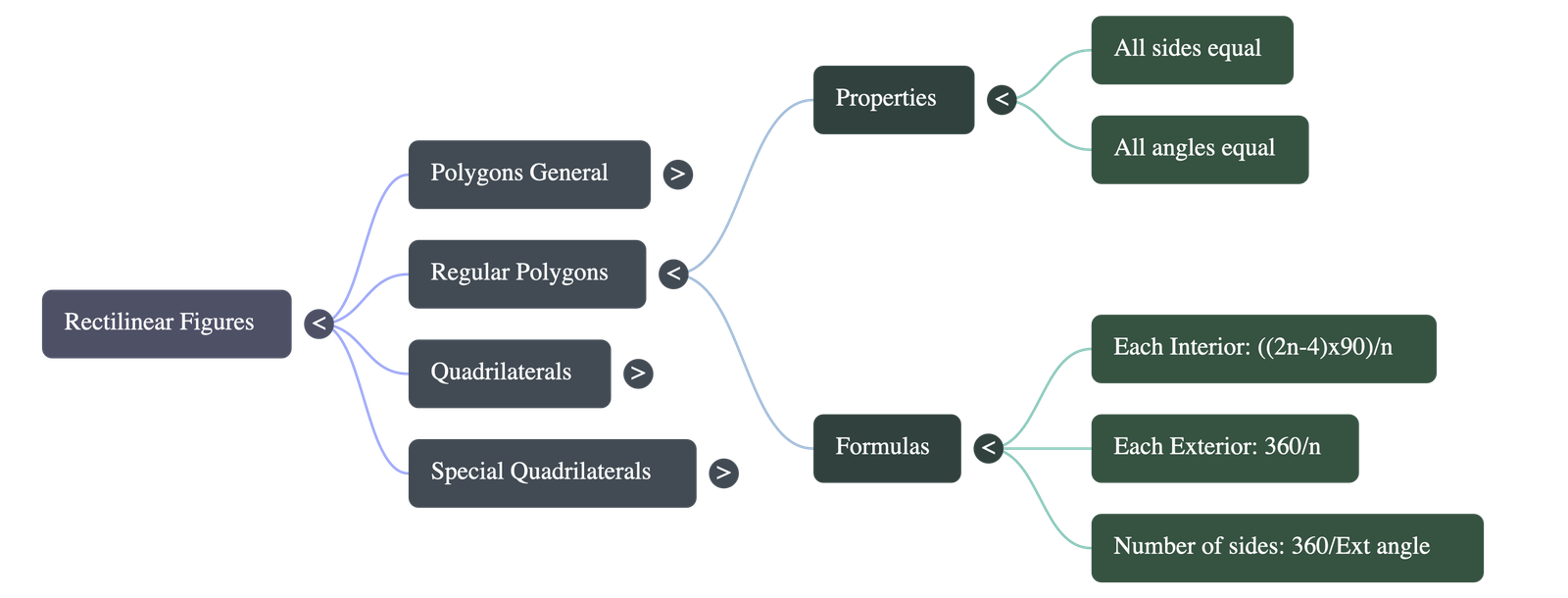
A Regular Polygon is a polygon that has all its sides equal to each other AND all its interior/exterior angles equal to each other.
- At each vertex of any polygon: Exterior angle + Interior angle = 180°.
- Each exterior angle of an n-sided regular polygon = 360° / n.
- Each interior angle of an n-sided regular polygon = ((2n - 4) × 90°) / n.
- Important Rule: The greater the number of sides in a regular polygon, the larger the interior angle and the smaller the exterior angle.
13.4 Quadrilaterals
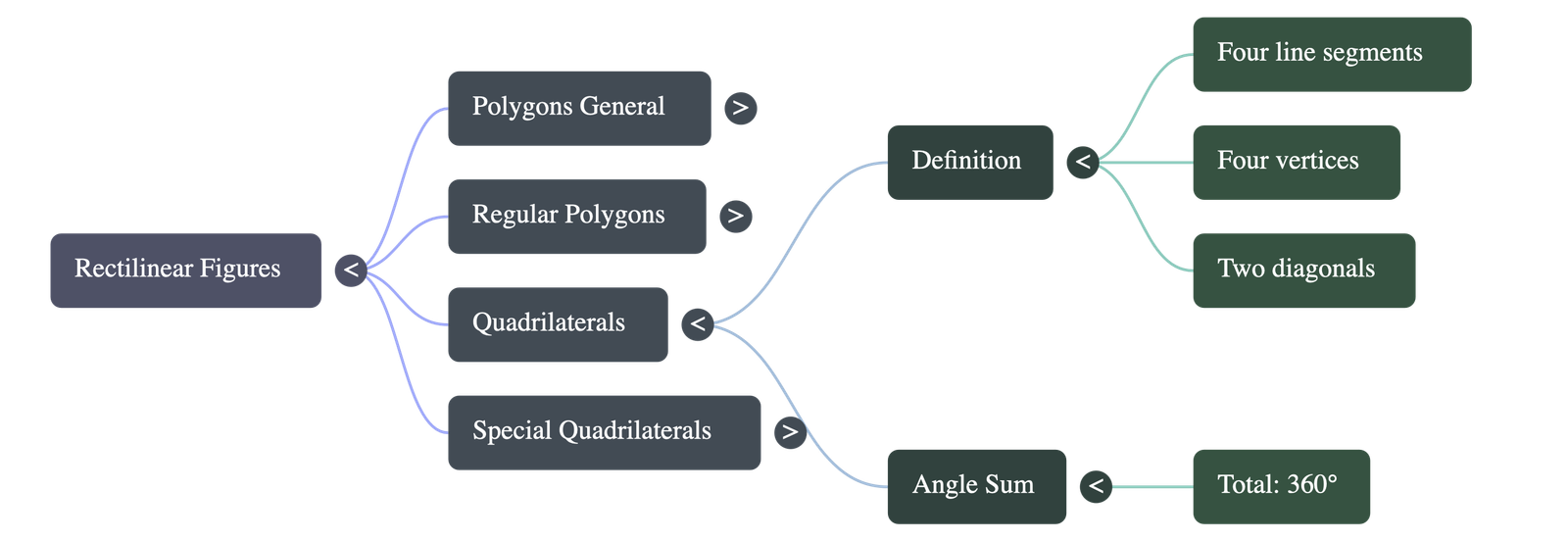
- A closed plane figure bounded by four line segments is called a quadrilateral.
- It consists of four sides, four vertices, and two diagonals (lines joining opposite vertices).
- The sum of all interior angles in any quadrilateral is exactly 360°.
13.5 Special Kinds of Quadrilaterals
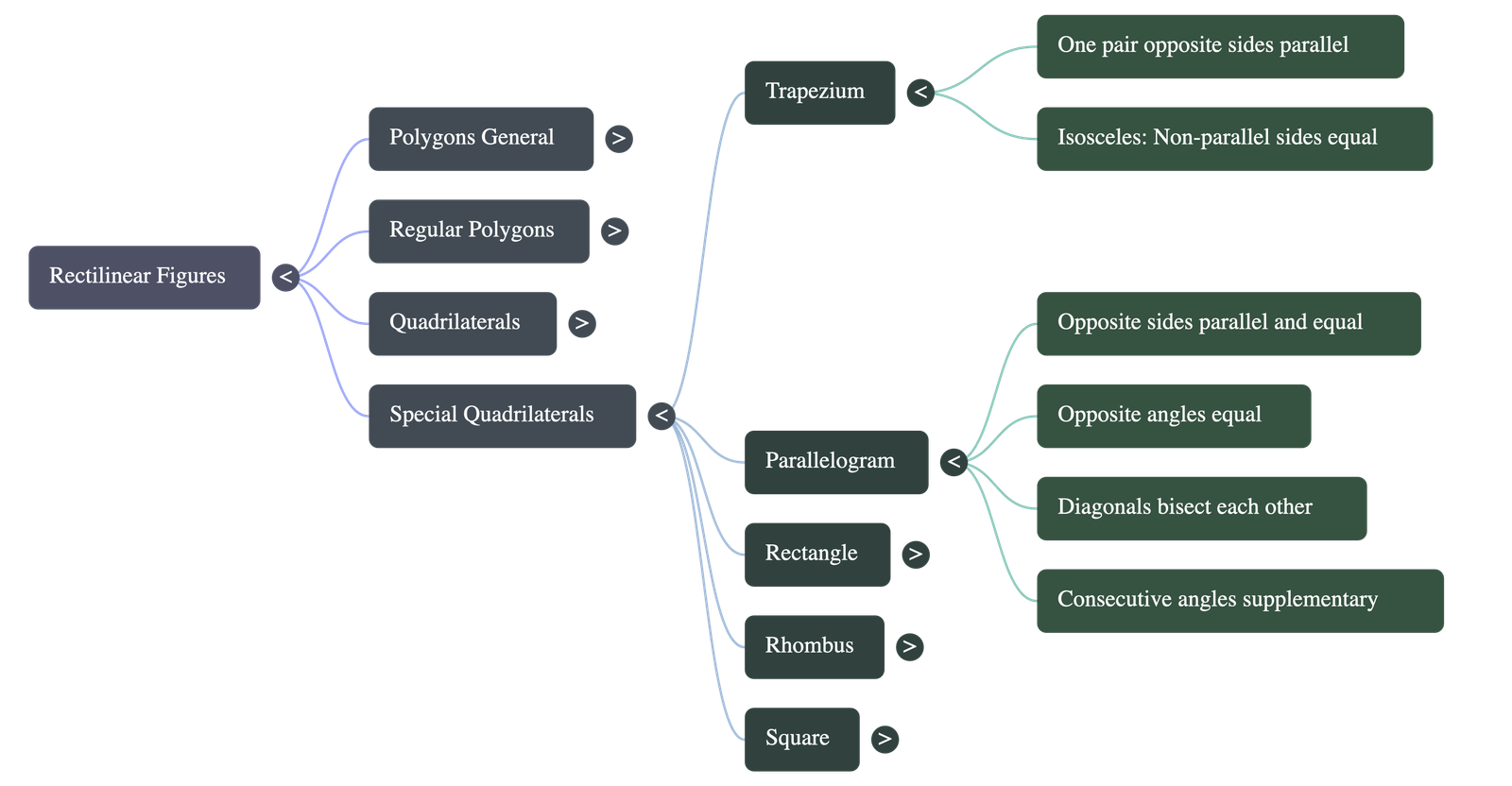
1. Trapezium
A quadrilateral in which exactly one pair of opposite sides is parallel, while the other pair is non-parallel.
- Isosceles Trapezium: A special case where the non-parallel sides are equal in length. In this case, the base angles are equal, and the diagonals are also equal to each other.
2. Parallelogram
A quadrilateral in which both pairs of opposite sides are parallel.
Key Properties (Proven via Theorems 11-15):
- Opposite sides are parallel and equal.
- Opposite angles are equal.
- Consecutive angles are supplementary (add up to 180°).
- Diagonals bisect each other (cut each other exactly in half).
- Each diagonal divides the parallelogram into two congruent triangles.
3. Rectangle
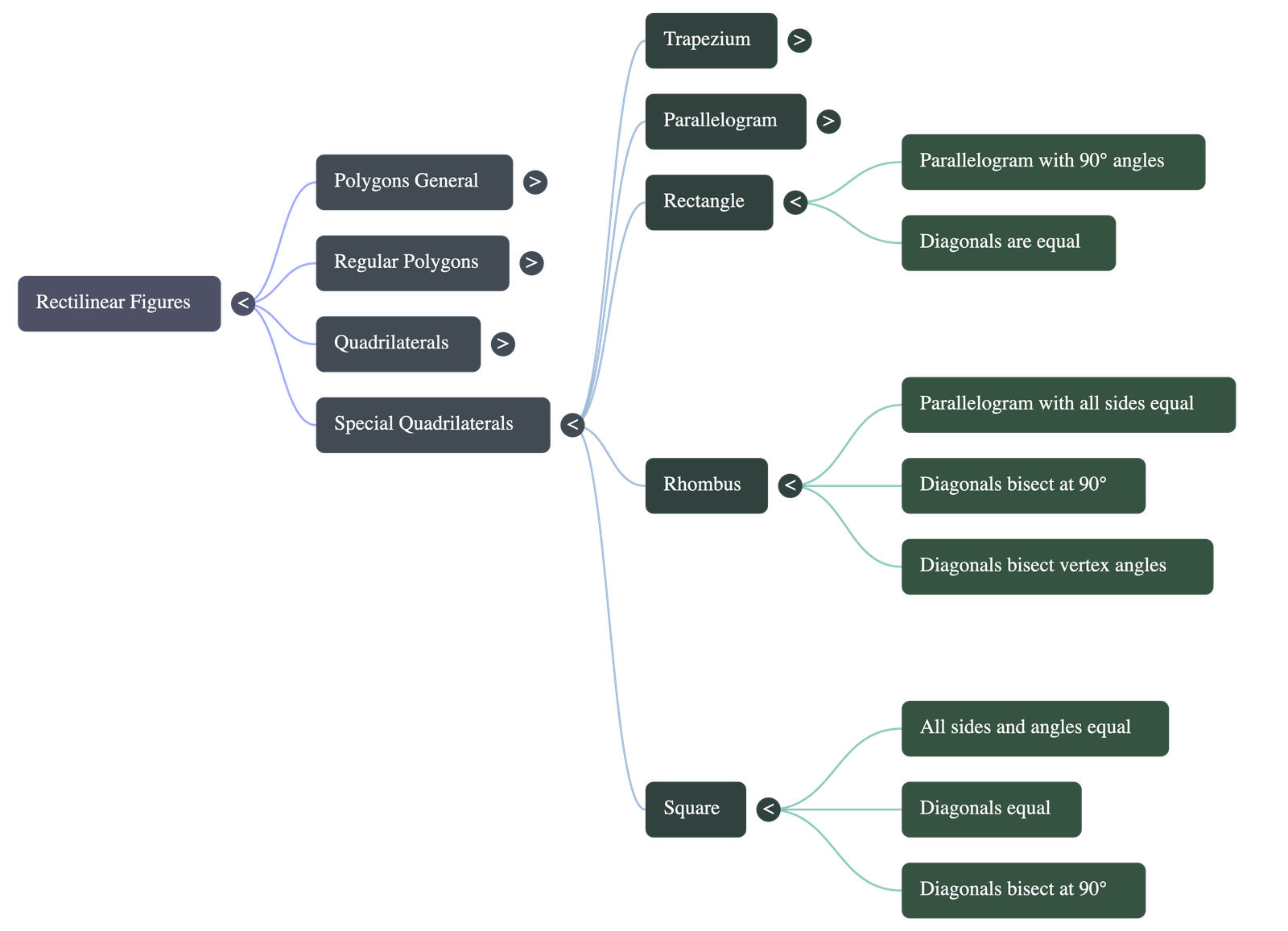
A special parallelogram where each interior angle is a right angle (90°).
- Has all the properties of a parallelogram.
- Diagonals are equal in length (Theorem 17).
- Diagonals bisect each other.
4. Rhombus
A parallelogram in which all four sides are equal.
- Has all the properties of a parallelogram.
- Diagonals bisect each other at right angles (90°) (Theorem 16).
- Each diagonal bisects the interior angles at the vertices it connects.
5. Square
A parallelogram where all sides are equal AND all angles are 90°. It combines the properties of a rectangle and a rhombus.
- All sides are equal, and each angle is 90°.
- Diagonals are equal AND they bisect each other at right angles (90°) (Theorem 18).
- Diagonals bisect the vertex angles.
Summary of Diagonal Properties
- Bisect each other: Parallelogram, Rectangle, Rhombus, Square.
- Are equal in length: Rectangle, Square.
- Bisect each other at 90°: Rhombus, Square.
- Bisect the vertex angles: Rhombus, Square.
Do checkout all questions & answers of this chapter.