Quick Navigation:
| | | |
Solids [Surface Area and Volume of 3-D Solids]
20.1 Introduction
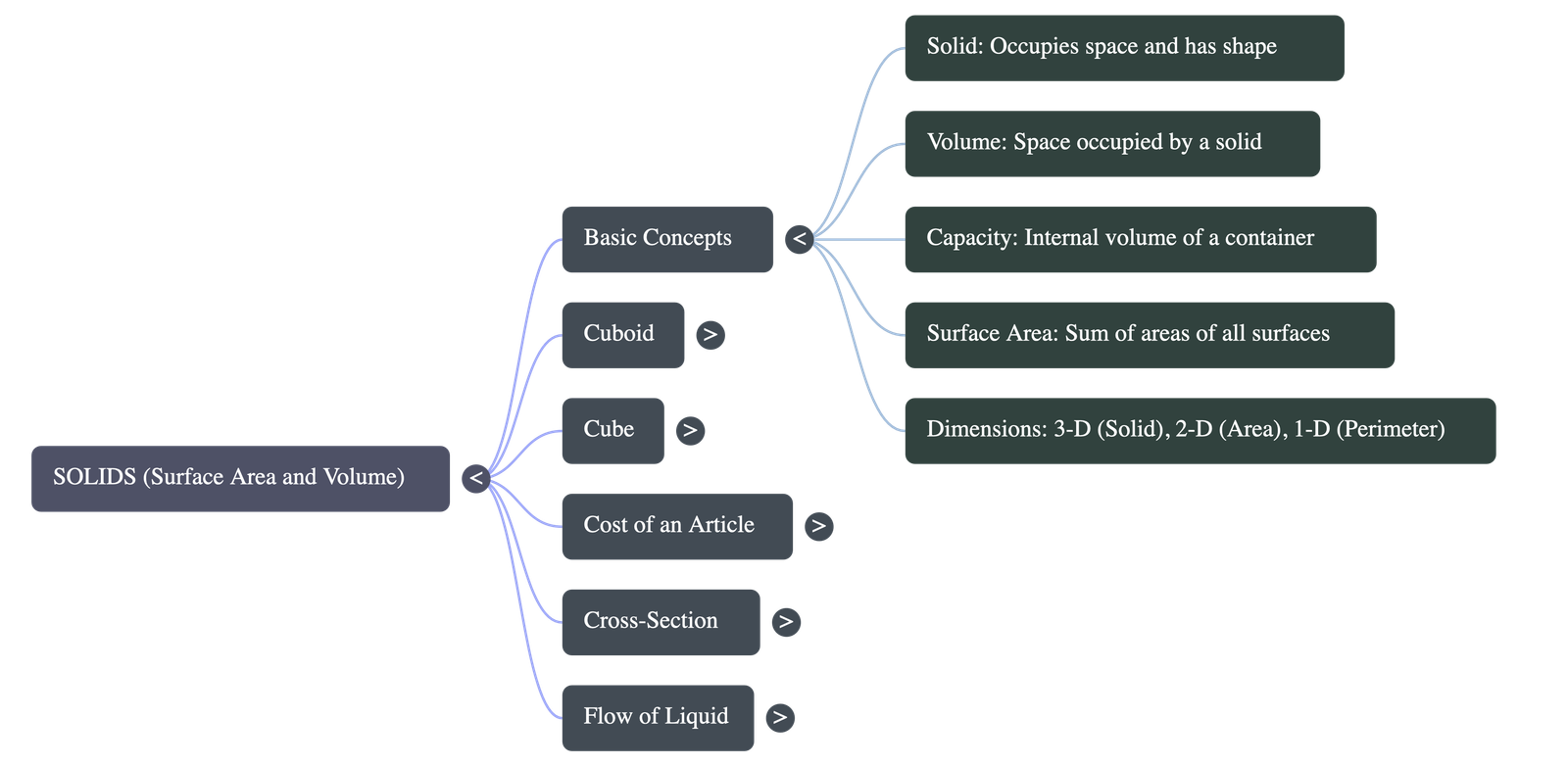
- Solid: Anything that occupies space and has a definite shape is known as a solid. Solids are three-dimensional (3-D) figures having length, breadth, and height.
- Volume: The amount of space occupied by a solid.
- Capacity of a container refers to its internal volume.
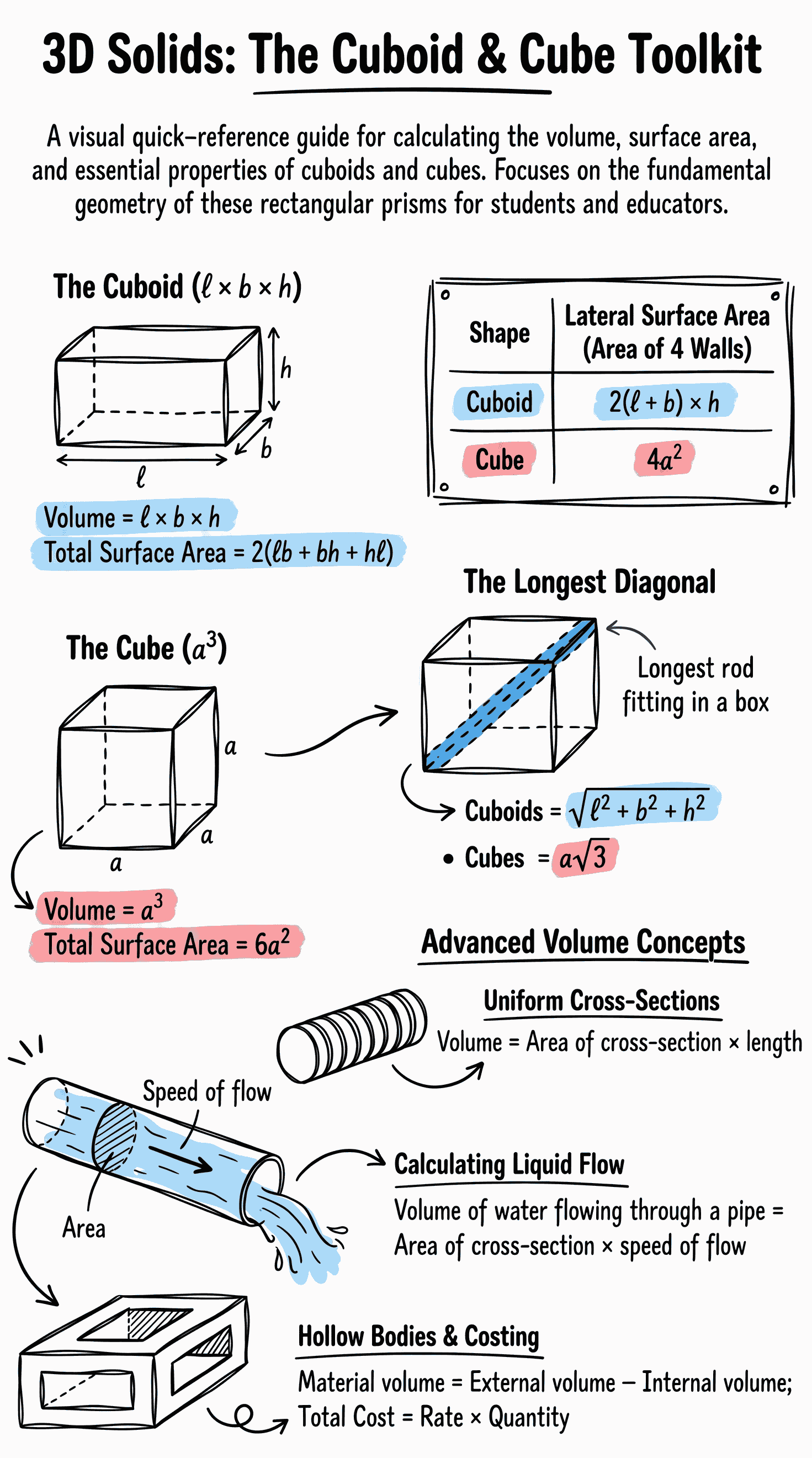
- Volume of material in a hollow body is the difference between its external volume and its internal volume.
- Surface Area: The total sum of the areas of all the surfaces of a solid.
- Dimensional Differences: A solid is 3-D, an area is a 2-D figure (length and breadth), and a perimeter is a 1-D figure (only length).
20.2 Cuboid
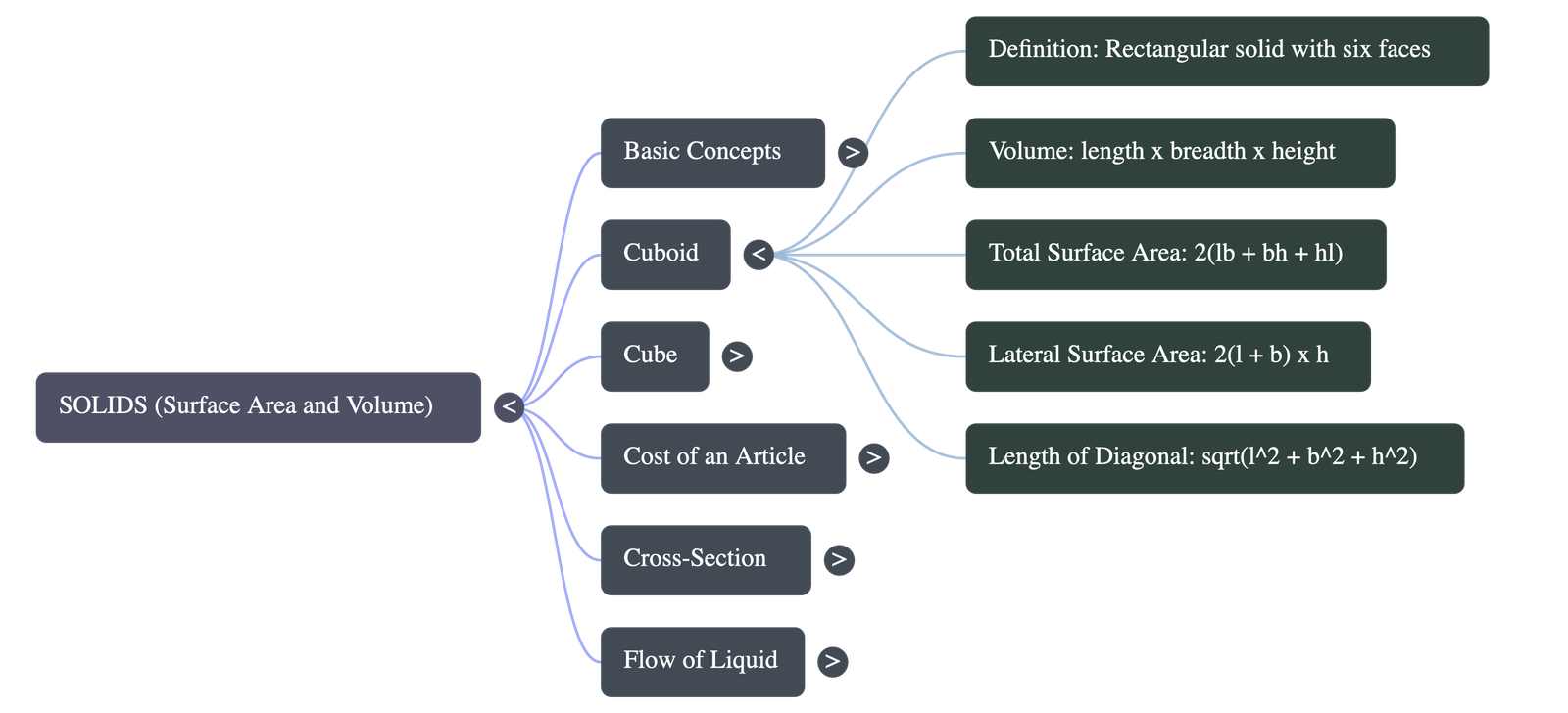
A rectangular solid consisting of six faces, where each face is a rectangle, is called a cuboid. Every cuboid has 4 diagonals.
- Volume: Length × Breadth × Height (l × b × h)
- Total Surface Area: 2(lb + bh + hl)
- Lateral Surface Area: The sum of the areas of the four vertical walls, calculated as 2(l + b) × h.
- Length of Diagonal: √(l² + b² + h²). This formula is also used to find the length of the longest rod that can be placed inside a rectangular room or box.
20.3 Cube
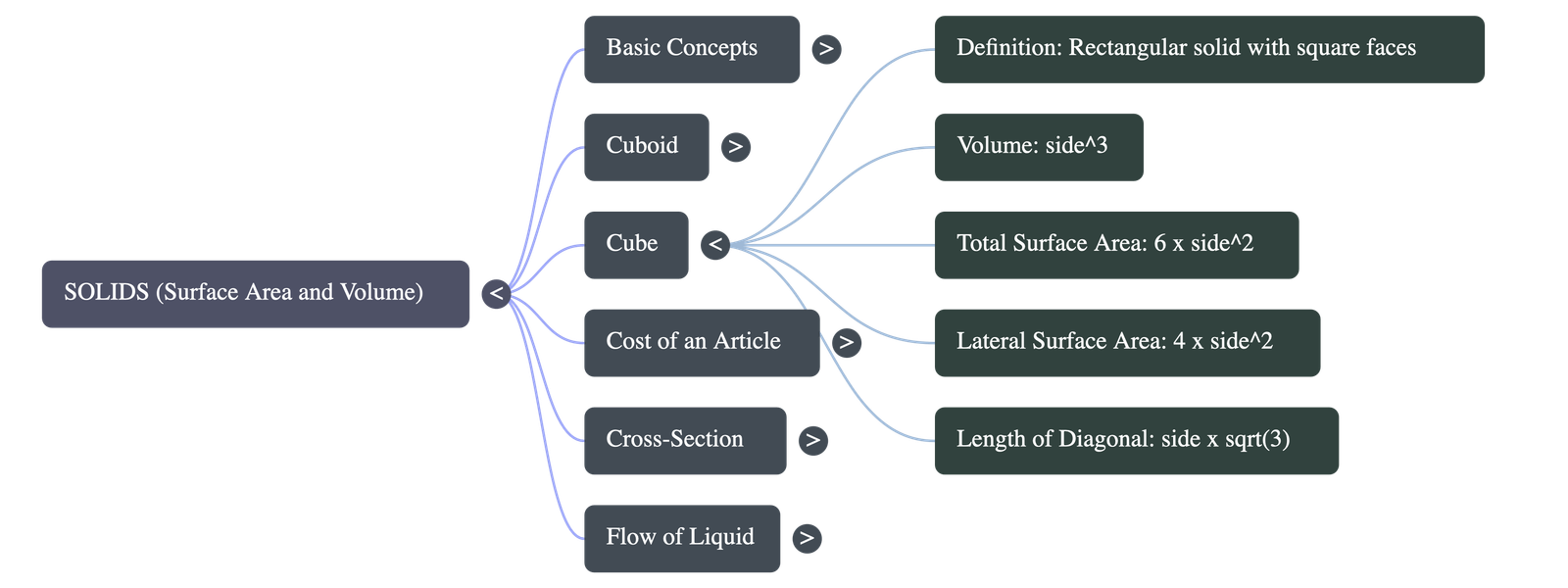
A rectangular solid in which every face is a square is called a cube. All its edges are equal (length = breadth = height = a).
- Volume: a × a × a = a³ (Edge cubed)
- Total Surface Area: 6a²
- Lateral Surface Area: 4a²
- Length of Diagonal: √(a² + a² + a²) = a√3
20.4 Cost of an Article
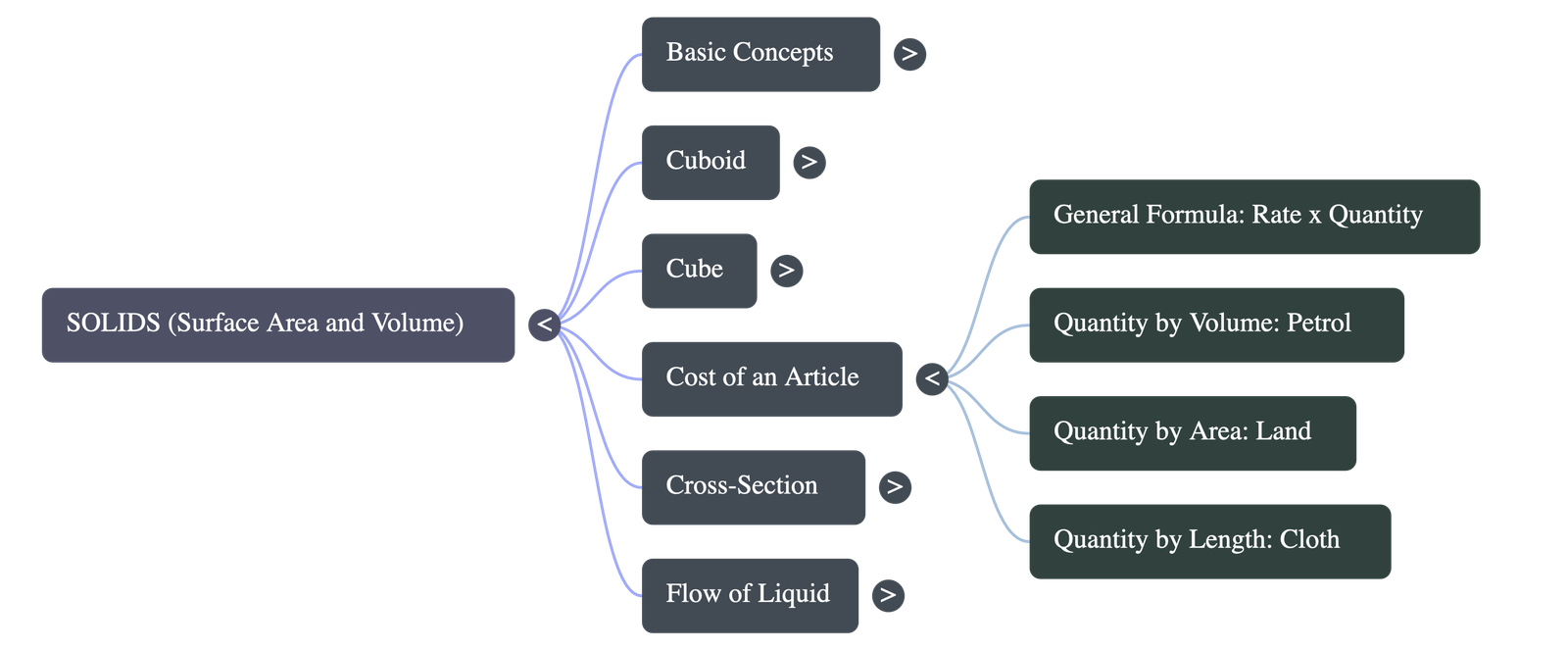
To find the total cost of an article, multiply its known quantity by its given rate.
Total Cost = Rate × Quantity
- Fluids (like petrol): Bought by volume (Quantity = Volume).
- Land/Plots: Bought by surface area (Quantity = Area).
- Materials (like cloth): Bought by length (Quantity = Length).
20.5 Cross-Section
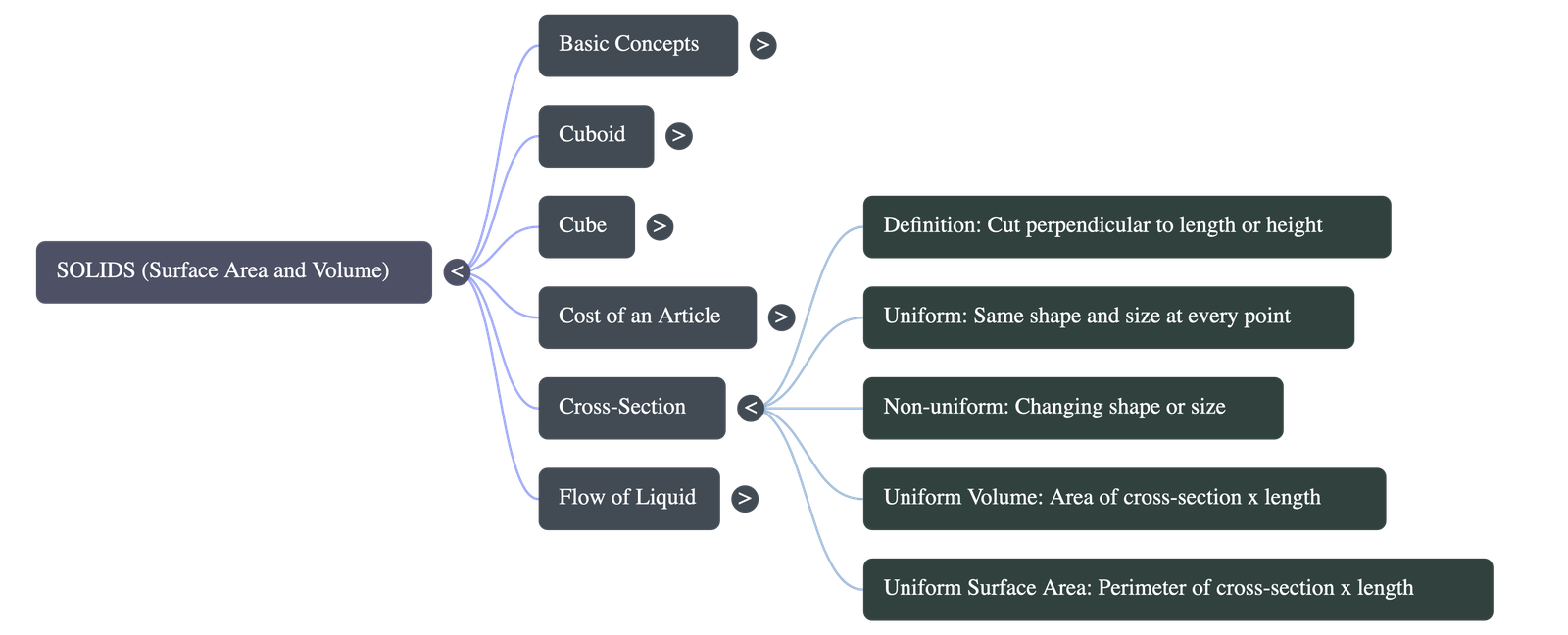
- Definition: A cut made through a solid perpendicular to its length (or height) is called its cross-section.
- Uniform Cross-Section: A solid has a uniform cross-section if the perpendicular cut yields the exact same shape and size at any point along its length. (e.g., A cylinder or a cuboid has a uniform cross-section, whereas a cone does not).
- Formulas for Uniform Cross-Section Solids:
- Volume: Area of cross-section × Length
- Surface Area (excluding the cross-sectional ends): Perimeter of cross-section × Length
20.6 Flow of Water (Or Any Other Liquid)
This section applies the concept of cross-sections to moving liquids like water flowing through a pipe or canal of a uniform cross-section.
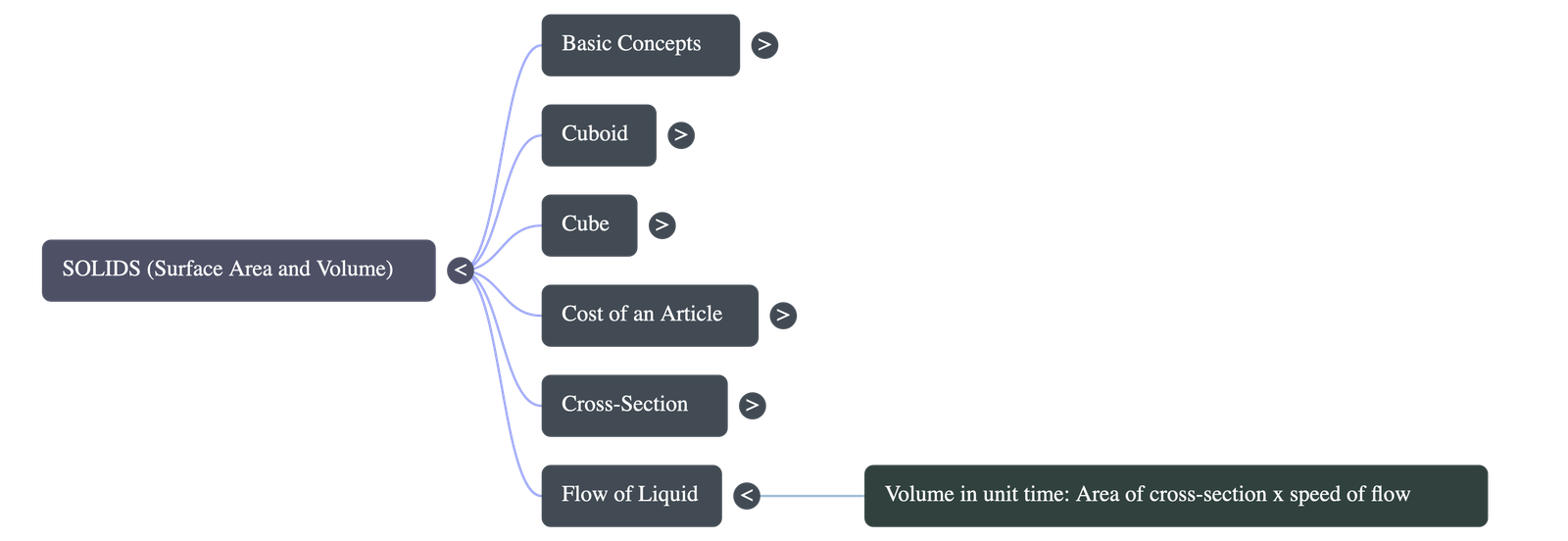
Volume of water flowing in unit time = Area of cross-section × Speed of water flow
Exercises and Assessments
The chapter concludes with extensive practice material to help students apply these formulas in different scenarios:
- Exercise 20: Features varied numerical problems including multiple-choice questions, calculating dimensions, volume, surface area, and capacities of real-world objects (tanks, rooms, walls).
- Test Yourself: Contains advanced assessment questions including Assertion and Reason (A/R) format questions comparing volumes and surface areas of spheres, cylinders, and cuboids.
- Case-Study Based Questions: Practical application problems designed around real-life scenarios, such as finding the maximum volume of cartons in a warehouse, or calculating dimensions and materials needed for a wooden study table.
Do checkout all questions & answers of this chapter.
Quick Navigation:
| | | |
1 / 1
Quick Navigation:
| | | |