Quick Navigation:
| | | |
Trigonometrical Ratios
21.1 Introduction
- The word 'Trigonometry' literally translates to the measurement of triangles.
- This chapter specifically deals with understanding the mathematical relationships between the sides and the angles of right-angled triangles.
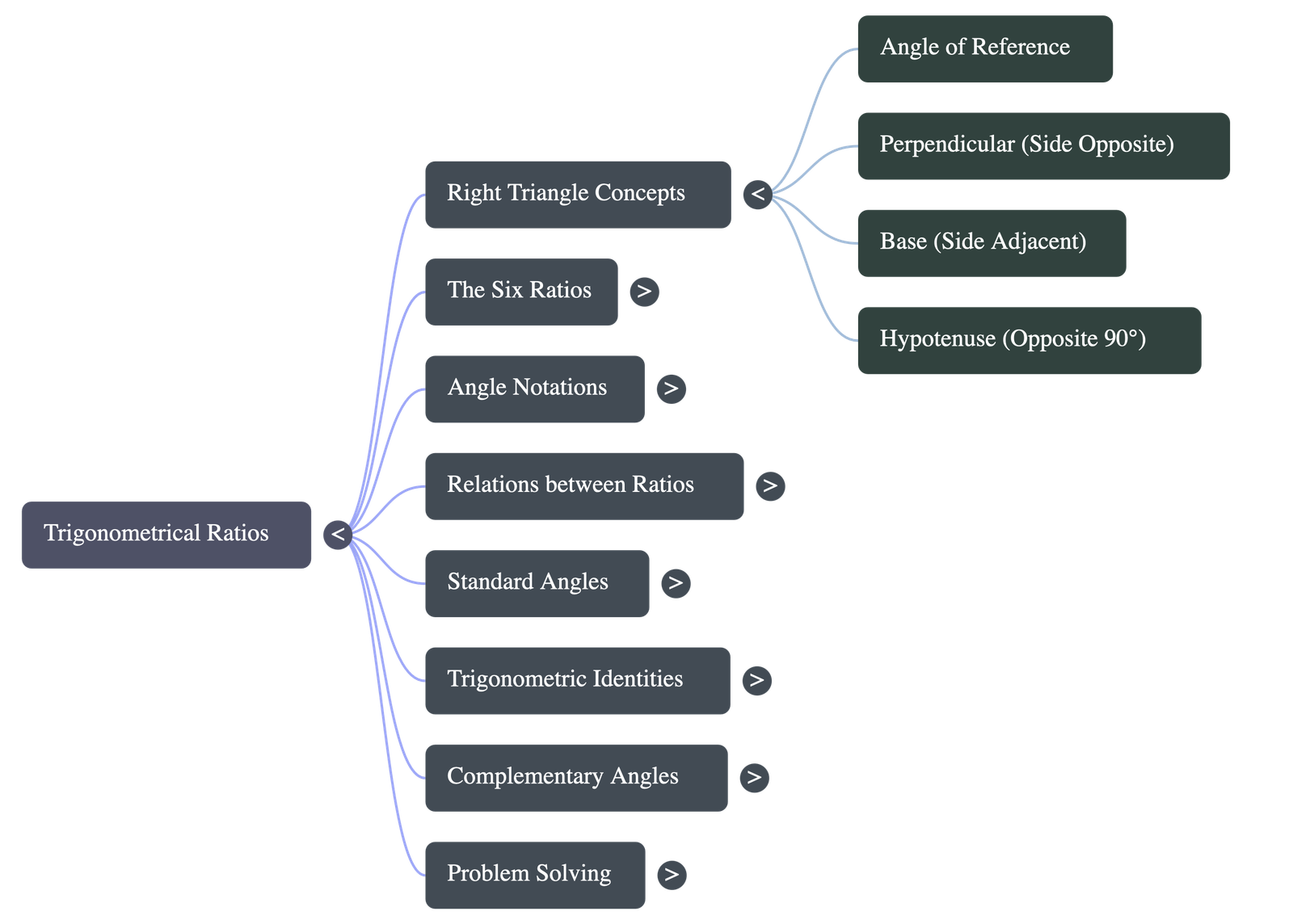
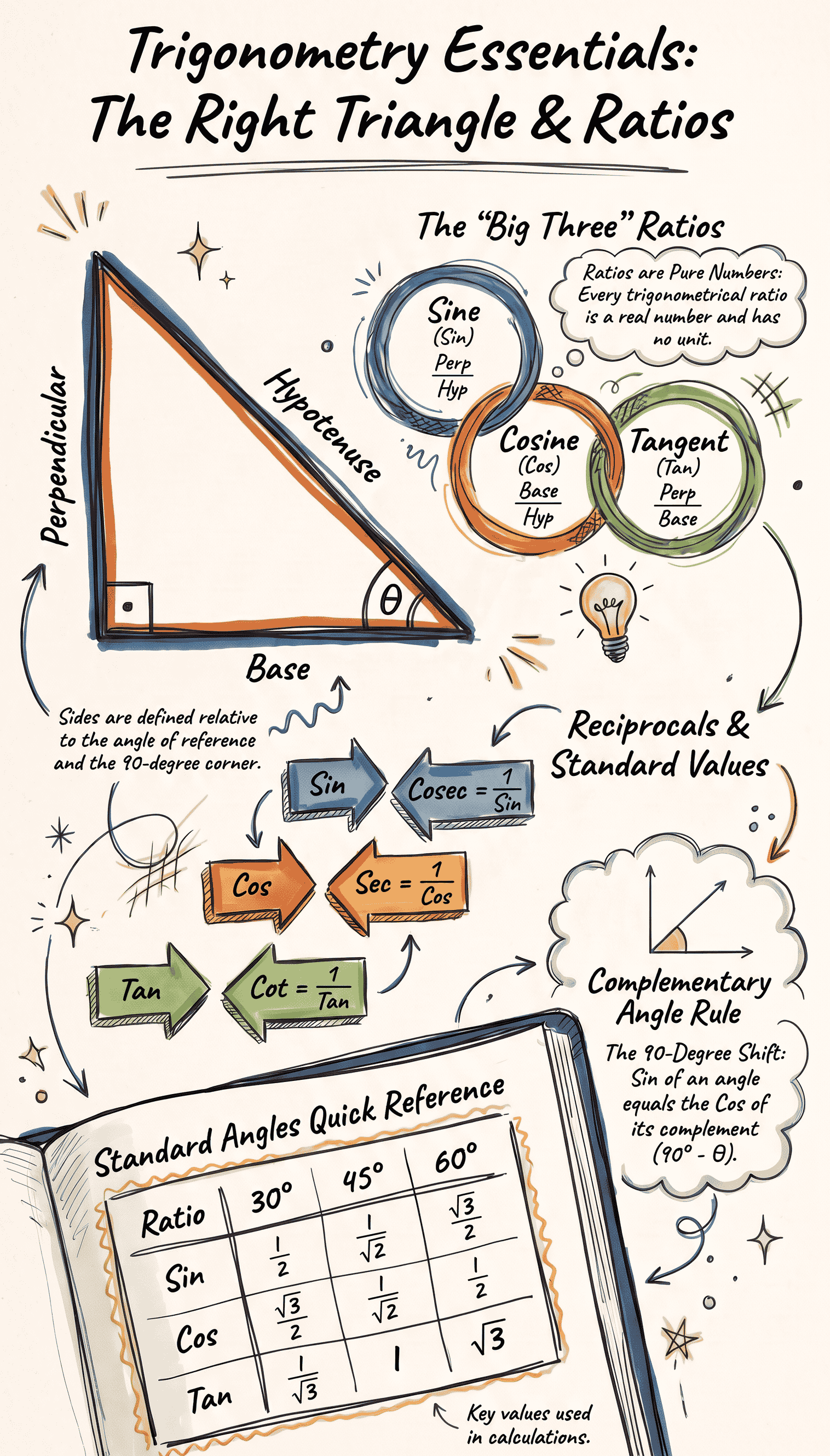
21.2 Concept of Perpendicular, Base and Hypotenuse in a Right Triangle
- To identify the sides, you first pick an acute angle called the angle of reference.
- Perpendicular: The side directly opposite to your chosen acute angle.
- Base: The side adjacent (next to) the chosen acute angle.
- Hypotenuse: The longest side of the triangle, which is always directly opposite the 90° (right) angle.
21.3 Notation of Angles
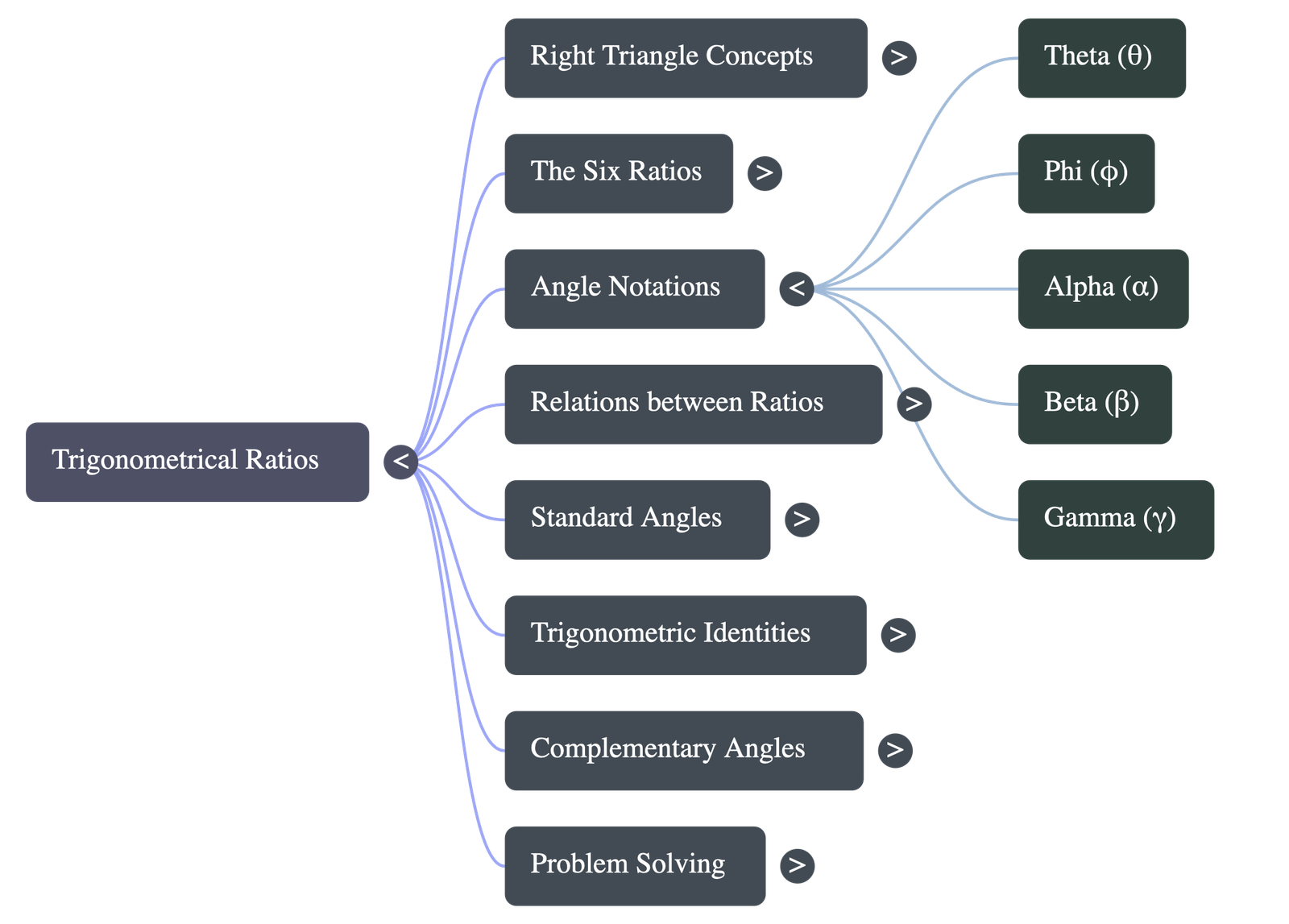
- Angles can be named using standard English alphabet letters (like A, B, or C).
- In trigonometry, it is very common to represent angles using Greek letters such as θ (theta), φ (phi), α (alpha), β (beta), and γ (gamma).
21.4 Trigonometrical Ratios
- A trigonometrical ratio is the ratio between the lengths of any pair of two sides in a right-angled triangle.
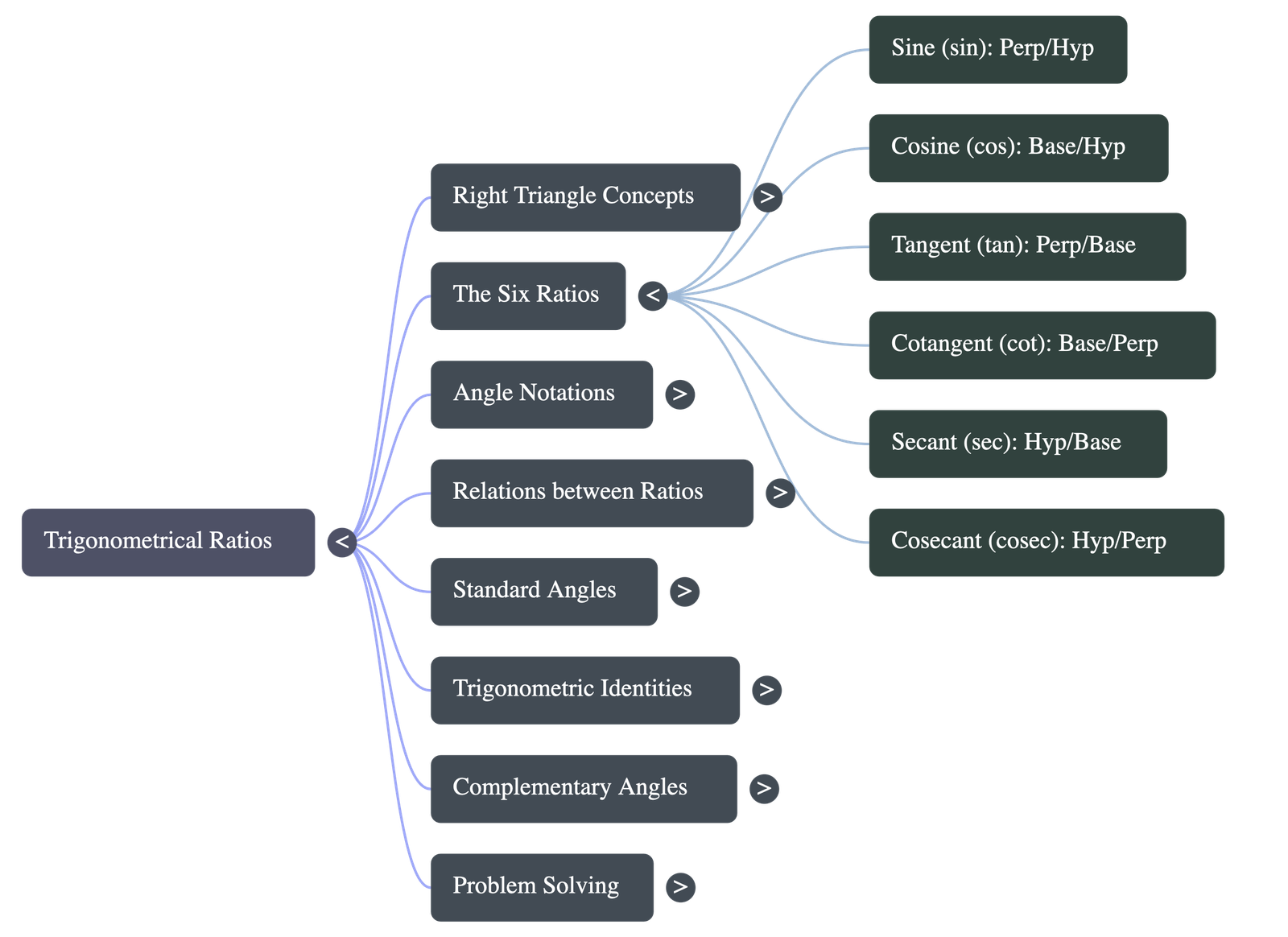
- There are exactly six trigonometric ratios:
- sine (sin): Perpendicular / Hypotenuse
- cosine (cos): Base / Hypotenuse
- tangent (tan): Perpendicular / Base
- cotangent (cot): Base / Perpendicular
- secant (sec): Hypotenuse / Base
- cosecant (cosec): Hypotenuse / Perpendicular
- Important Rule: Every trigonometrical ratio is a real number and has no unit of measurement (like cm or meters) because it is a ratio of two lengths.
21.5 Reciprocal Relations
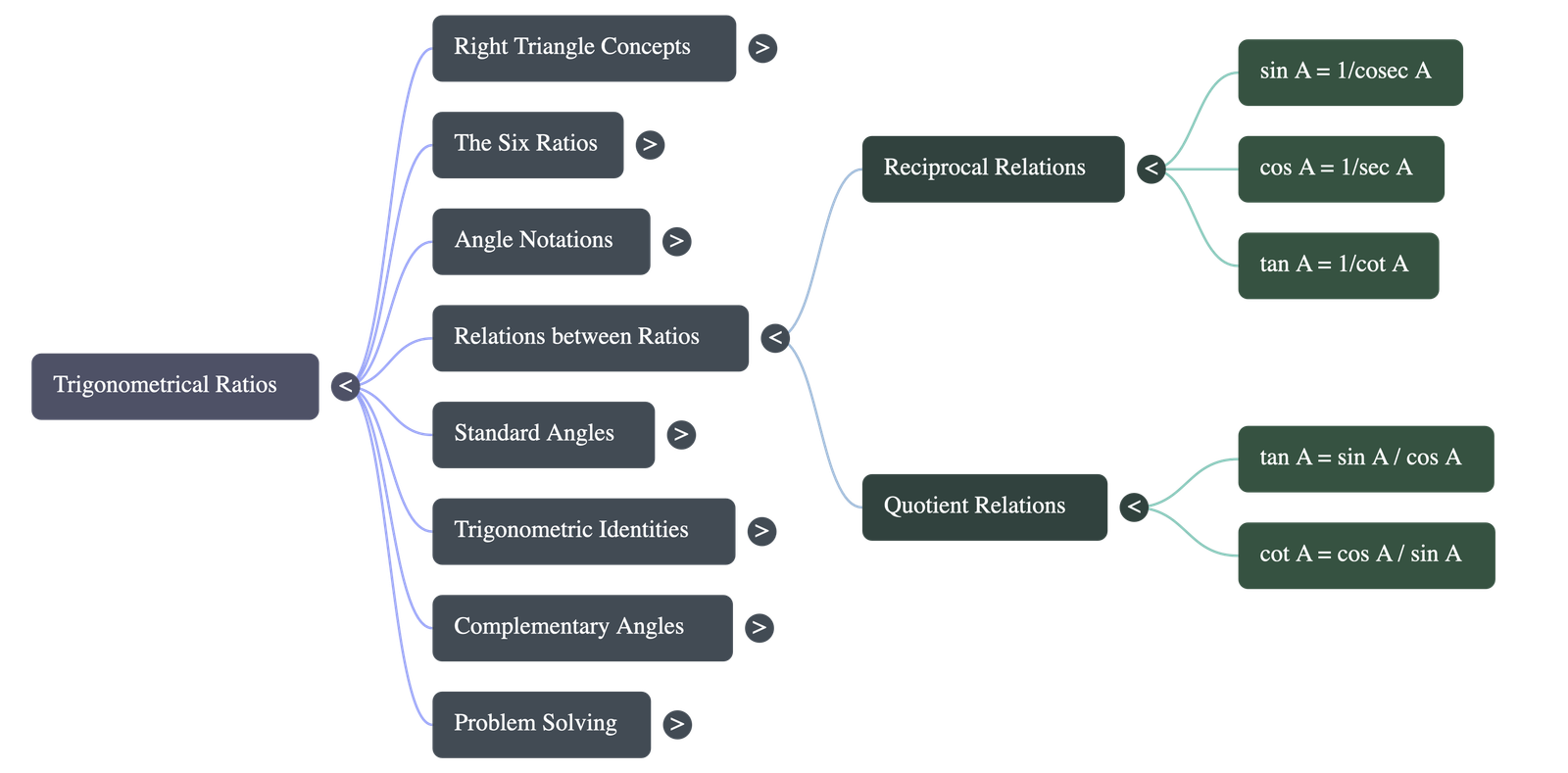
- Three of the ratios are direct opposites (reciprocals) of the other three:
- sin A and cosec A are reciprocals (sin A = 1 / cosec A).
- cos A and sec A are reciprocals (cos A = 1 / sec A).
- tan A and cot A are reciprocals (tan A = 1 / cot A).
- Additionally, tangent and cotangent can be formed by combining sine and cosine:
- tan A = sin A / cos A
- cot A = cos A / sin A
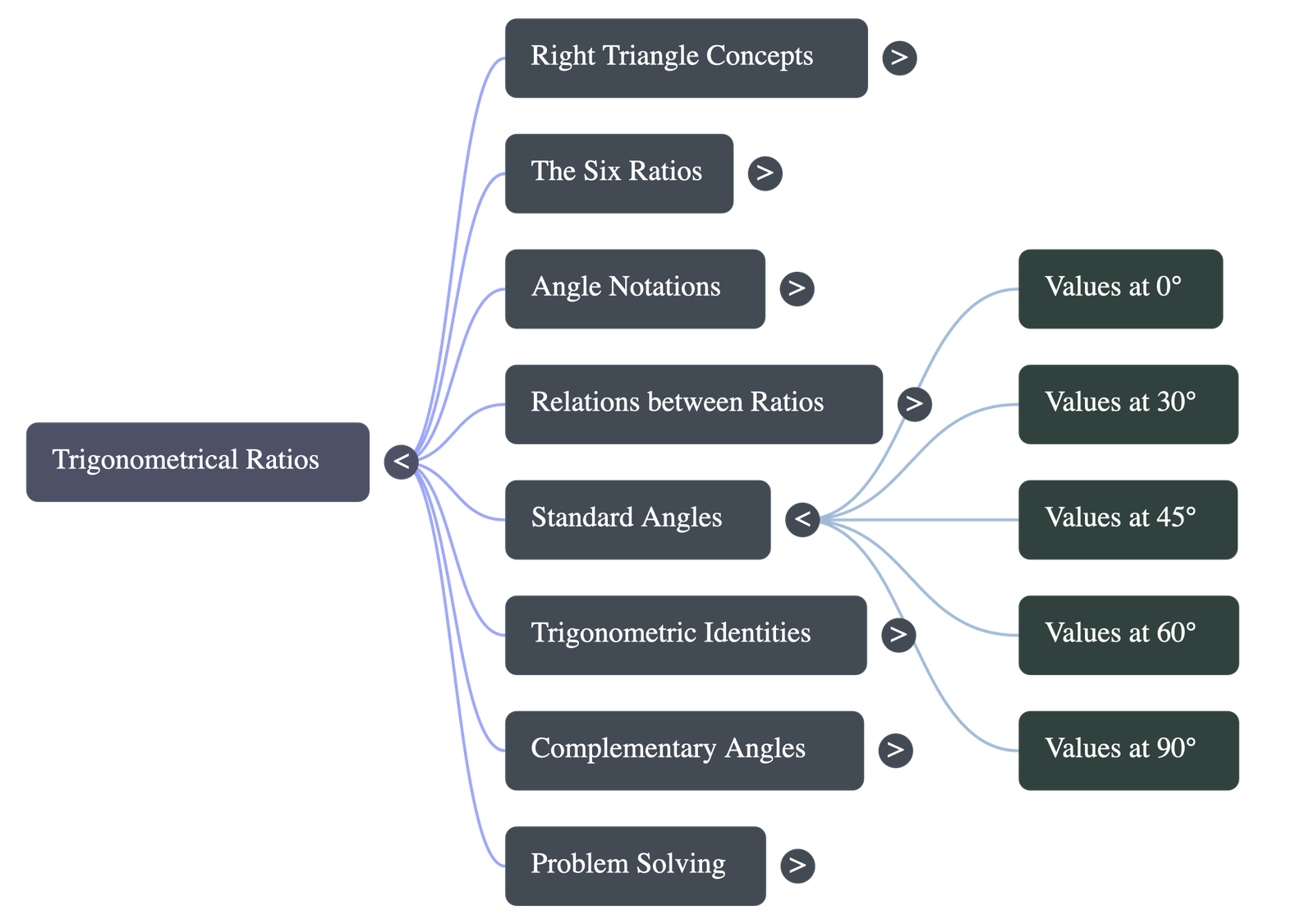
21.6 Trigonometrical Ratios of Angles 30° and 60°
- The exact values for the trigonometric ratios of 30° and 60° angles are derived mathematically by dropping a perpendicular line inside an equilateral triangle.
21.7 Trigonometrical Ratios of Angle 45°
- The values for 45° angles are found using a right-angled isosceles triangle (where the base and perpendicular are of equal length).
- Key Patterns (from 0° to 90°):
- The value of sin increases from 0 to 1.
- The value of cos decreases from 1 to 0.
- The value of tan increases from 0 to infinity (not defined at 90°).
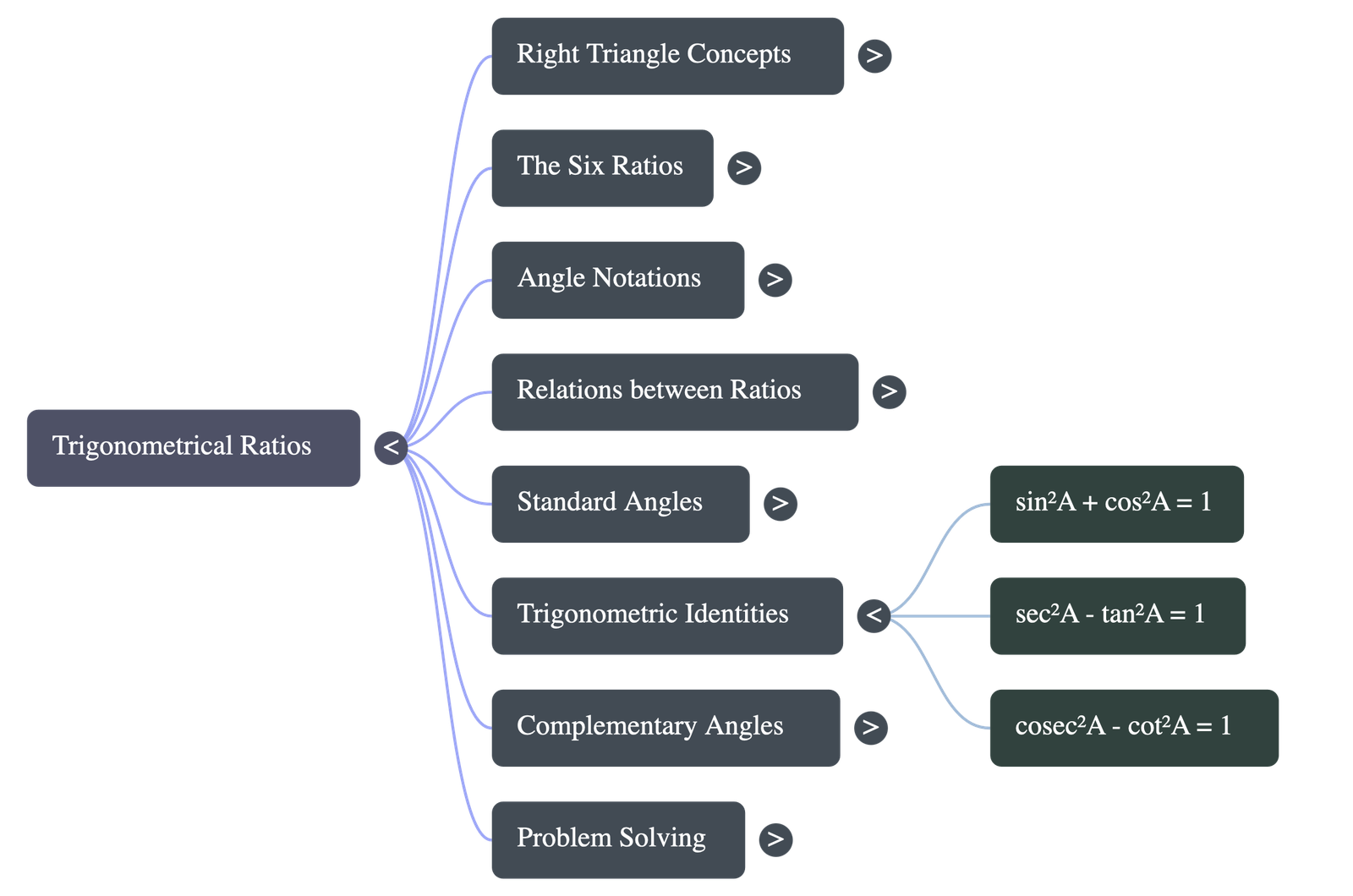
- Three Fundamental Identities:
- sin²A + cos²A = 1
- sec²A − tan²A = 1
- cosec²A − cot²A = 1
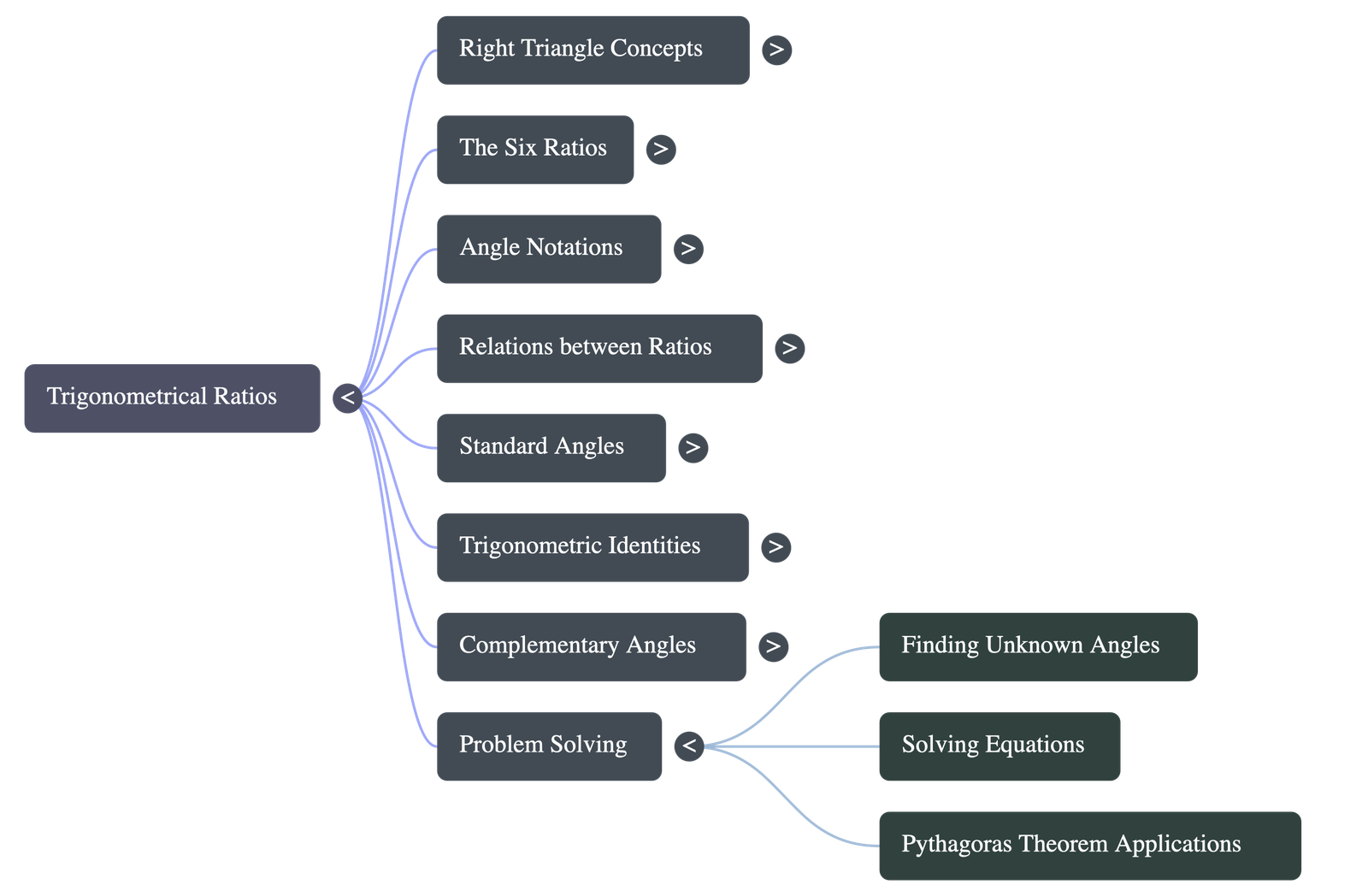
21.8 Solving a Trigonometric Equation
- Solving a trigonometric equation simply means finding the specific measurement of the unknown angle (like finding the value of A or θ) that makes the given equation correct.
21.9 Trigonometric Ratios of Complementary Angles
- Two acute angles are called complementary if their sum is exactly 90°. (For example, 30° and 60° are complementary).
- In a right triangle, the two non-right angles are always complementary to each other.
21.10 Complementary Angles for Sine (sin) and Cosine (cos)
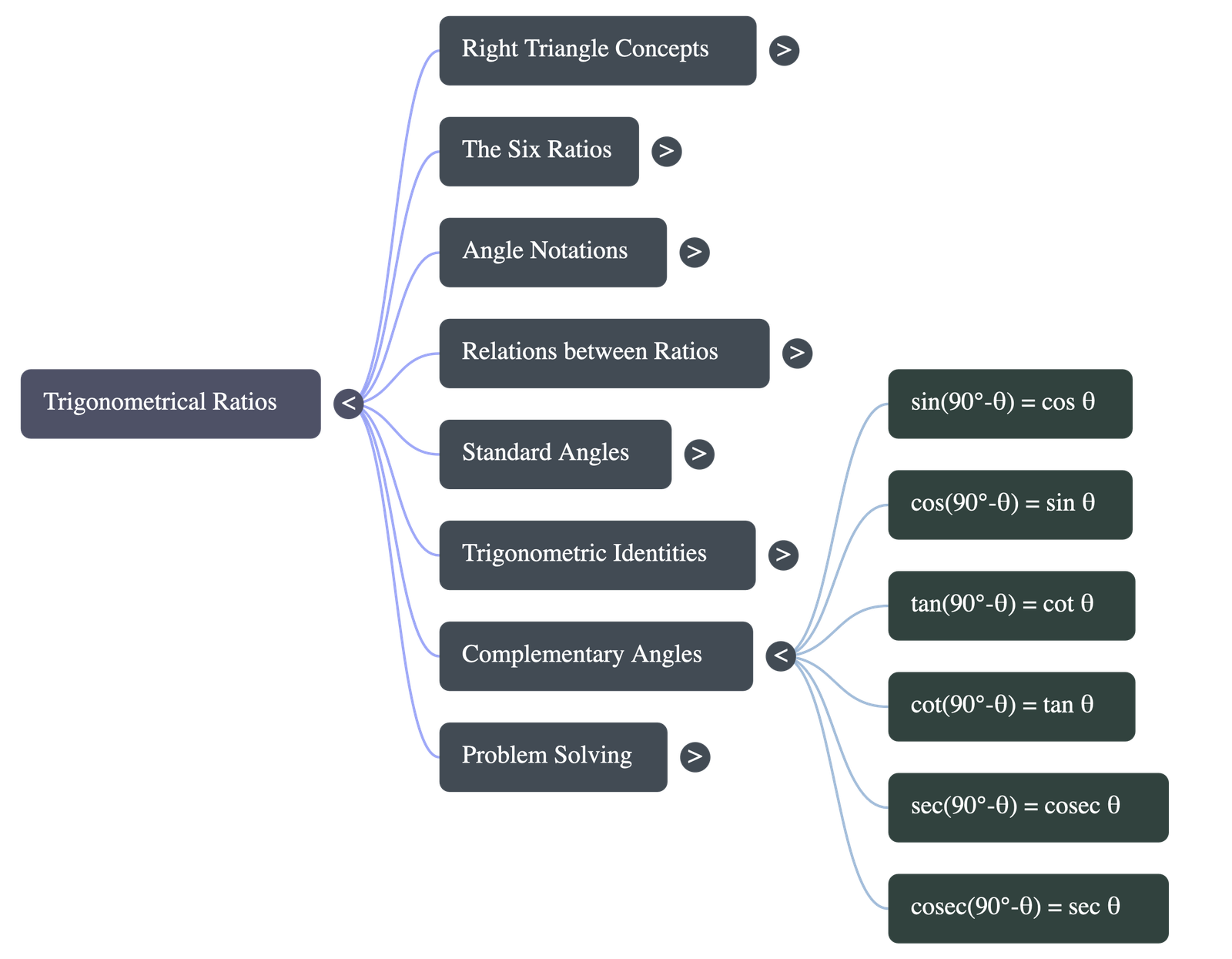
- Sine and Cosine change into each other when you subtract the angle from 90°:
- sin(90° − θ) = cos θ
- cos(90° − θ) = sin θ
21.11 Complementary Angles for Tangent (tan) and Cotangent (cot)
- Tangent and Cotangent switch roles for complementary angles:
- tan(90° − θ) = cot θ
- cot(90° − θ) = tan θ
21.12 Complementary Angles for Secant (sec) and Cosecant (cosec)
- Secant and Cosecant share the same relationship for complementary angles:
- sec(90° − θ) = cosec θ
- cosec(90° − θ) = sec θ
Do checkout all questions & answers of this chapter.
Quick Navigation:
| | | |
1 / 1
Quick Navigation:
| | | |