Compound Interest [Basic Concepts]
1. Introduction to Basic Financial Terms
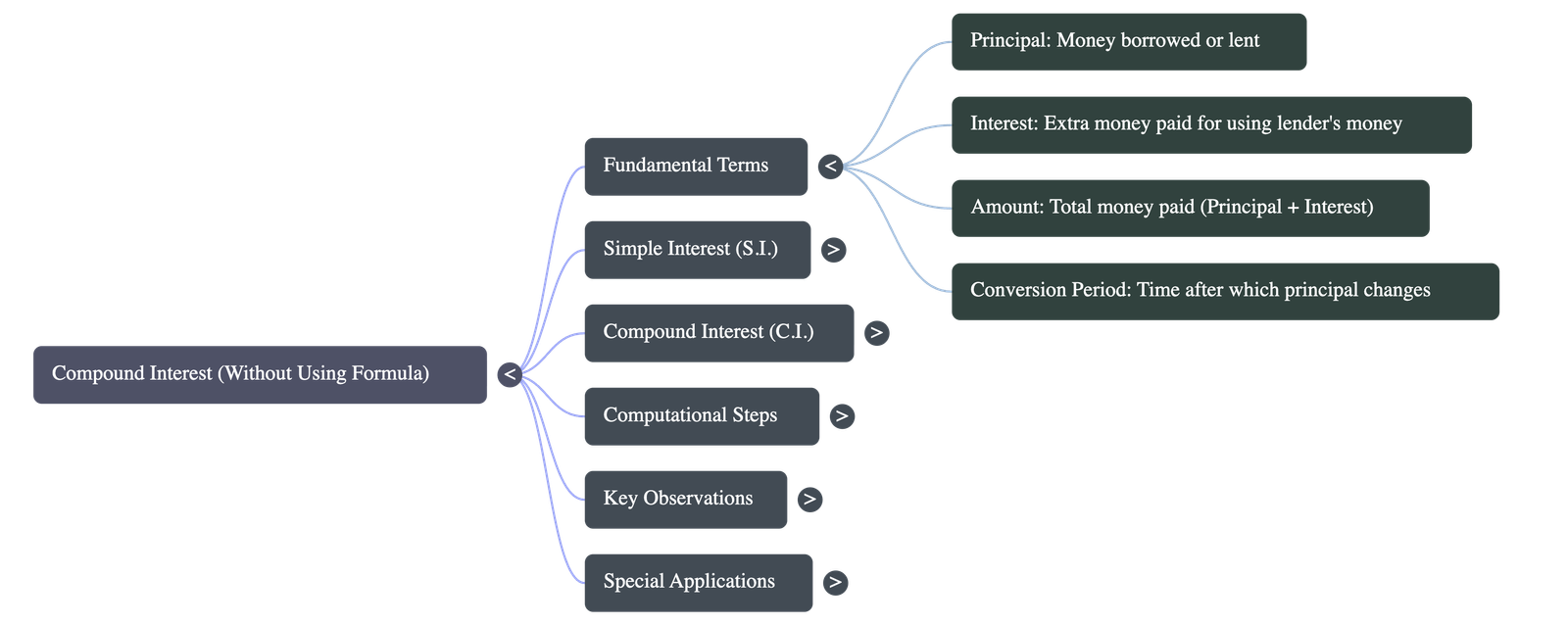
- ✦ Principal: The original sum of money borrowed from a bank or lender for a specified period.
- ✦ Interest: The additional money paid by the borrower for the privilege of utilizing the lender's money.
-
✦
Amount: The total money returned to the lender at the end of the specified period.
Amount = Principal + Interest (A = P + I)
2. Understanding Simple Interest (S.I.)
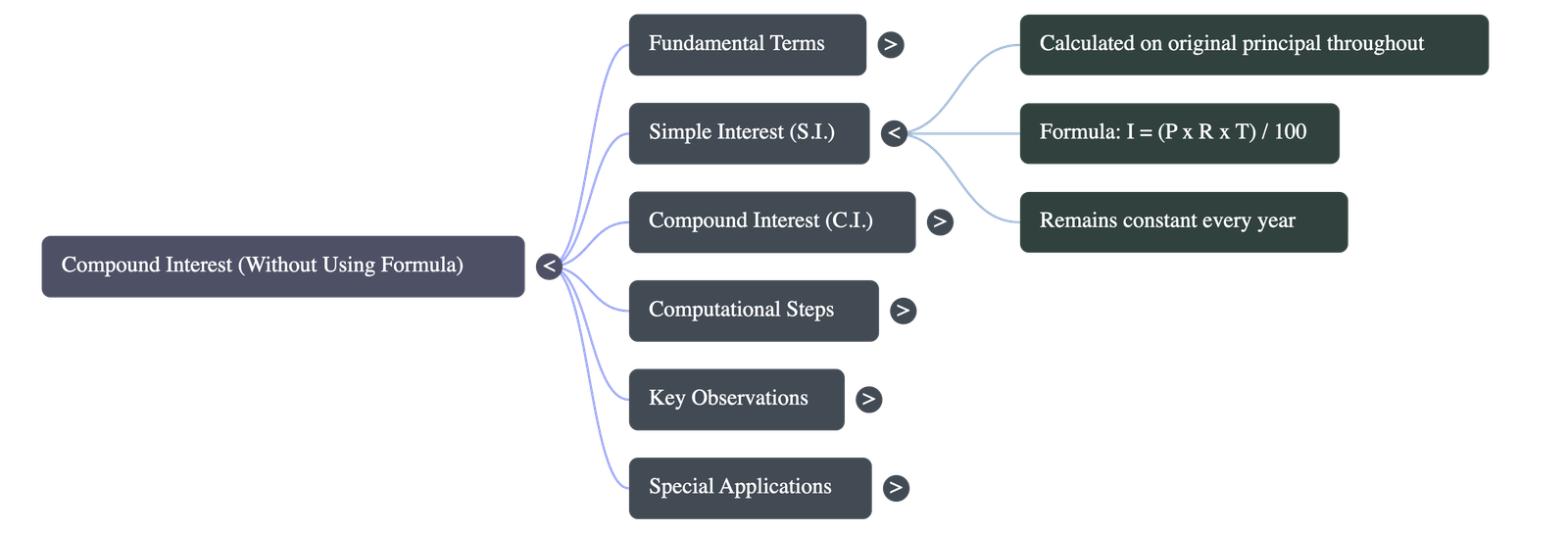
- ✦ Interest is considered "simple" when it is calculated strictly on the original principal throughout the entire duration of the loan.
- ✦ If a problem merely uses the word "interest" without specifying the type, it inherently refers to simple interest.
-
✦
Formula:
S.I. = (Principal × Rate × Time) / 100
3. Mechanics of Compound Interest (C.I.)
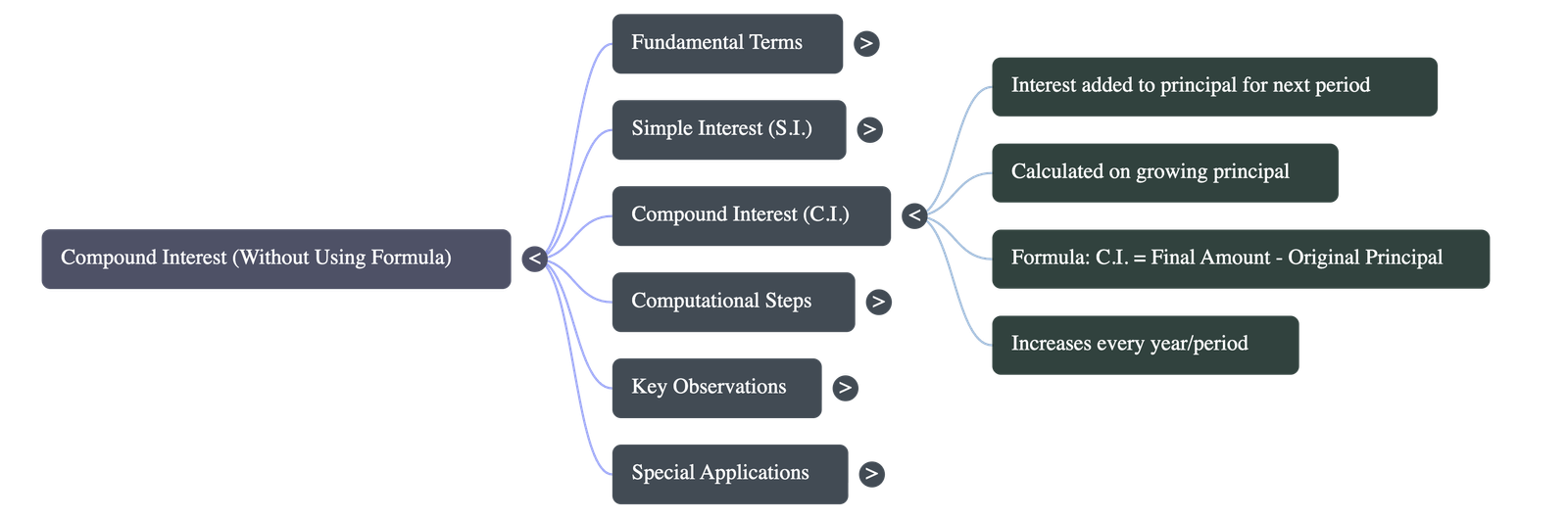
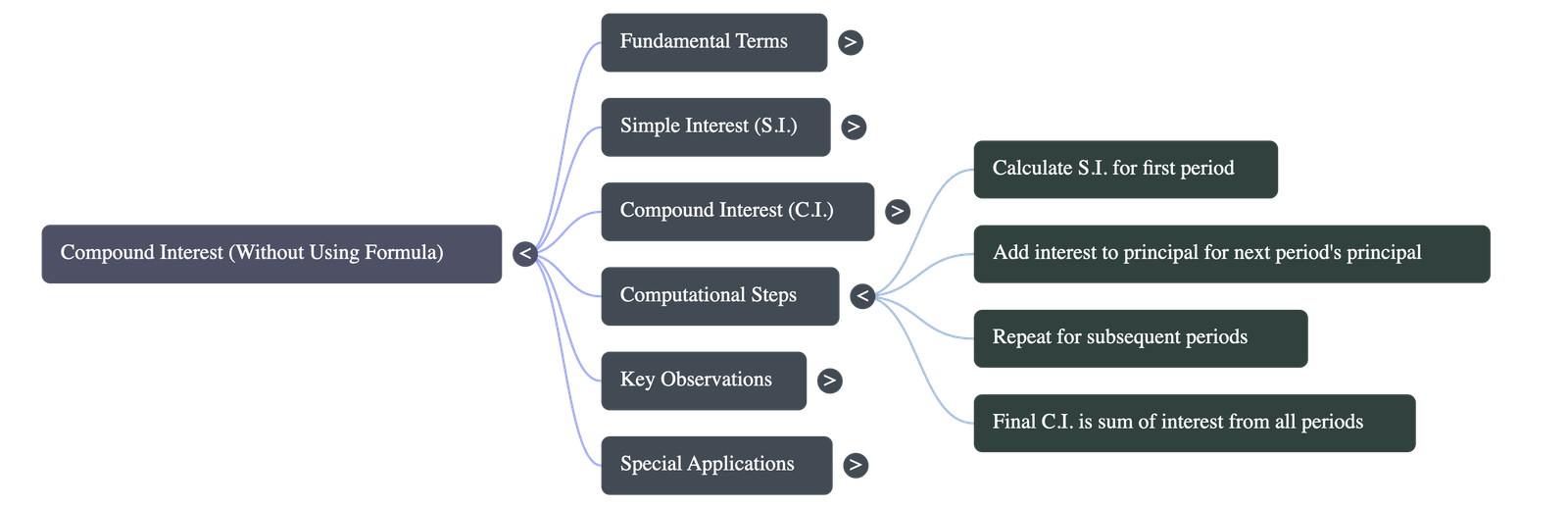
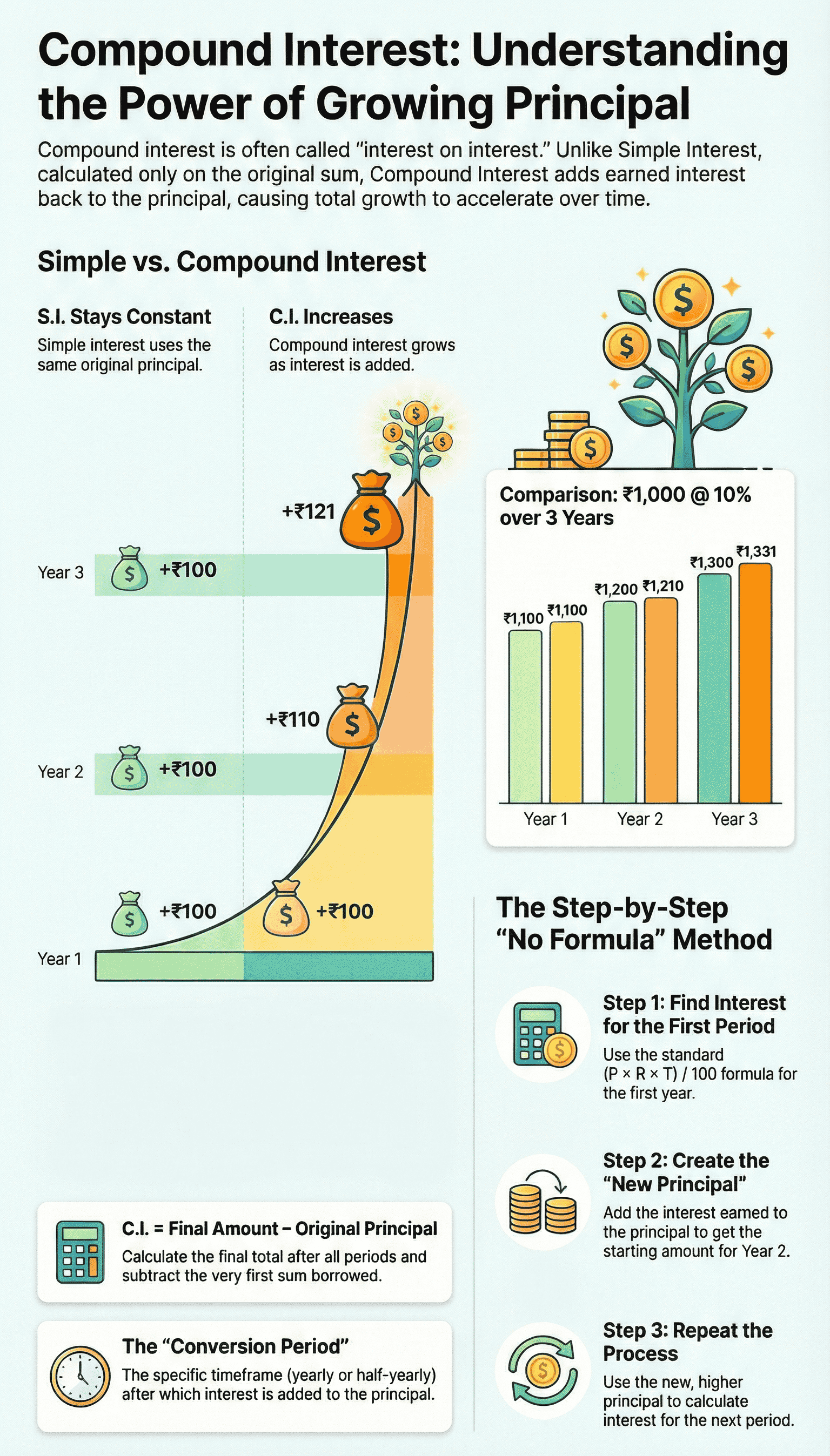
- ✦ The Core Concept: Money is lent at compound interest when the interest due at the end of a fixed period is not paid immediately but is added directly to the principal.
- ✦ A Growing Principal: The total amount obtained at the end of one period becomes the new principal for the next period. This process repeats until the final period concludes.
-
✦
Calculation of C.I.:
Compound Interest = Final Amount - Original Principal - ✦ Total Compound Interest over several years can also be determined by calculating the individual compound interests for each year sequentially and adding them together.
4. The Conversion Period
- ✦ The conversion period is the specific duration after which the principal changes (increases).
- ✦ Compounded Yearly: The principal increases every year, making the conversion period one year.
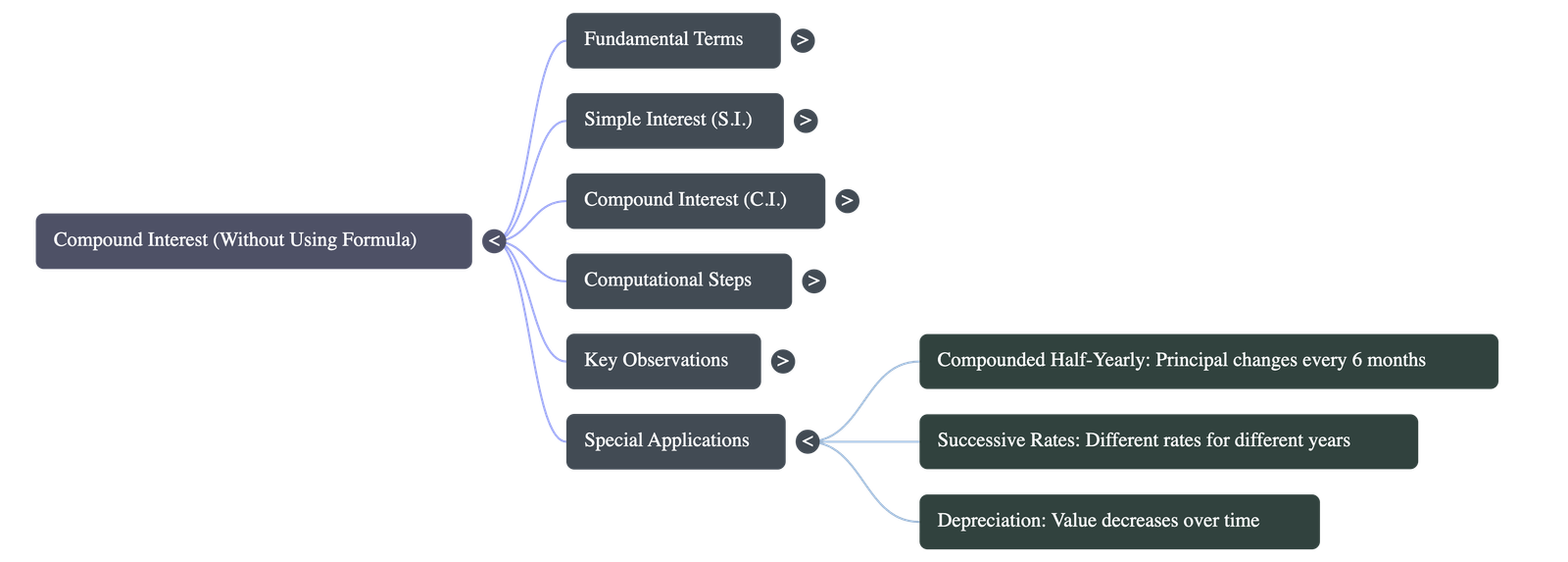
- ✦ Compounded Half-Yearly: The principal increases every six months, making the conversion period a half-year.
5. Important Properties of Compound Interest
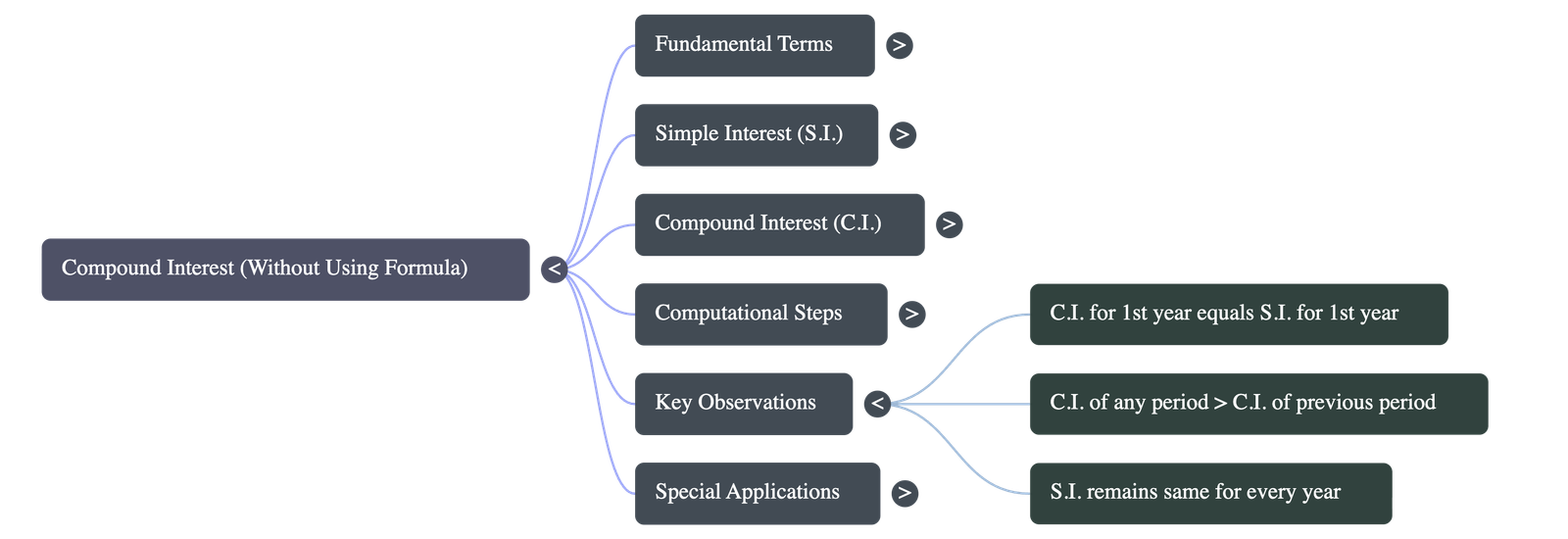
- ✦ Increasing Interest: For a given principal and interest rate, the C.I. for any subsequent period is always greater than the C.I. of the preceding period (e.g., C.I. of 2nd year > C.I. of 1st year).
- ✦ Difference in Consecutive Interests: The difference between the compound interests for any two consecutive conversion periods equals the interest calculated for one period on the C.I. of the preceding period.
- ✦ Difference in Consecutive Amounts: Similarly, the difference between the accumulated amounts for any two consecutive conversion periods equals the interest calculated for one period on the amount of the preceding period.
6. Relationship Between S.I. and C.I.
- ✦ The First Period Equality: Simple Interest and Compound Interest are absolutely identical for the first year (or first conversion period) provided the principal and rate are the same.
- ✦ Constant vs. Growing: Simple interest remains exactly the same every year, whereas compound interest increases progressively.
-
✦
Predicting the Next Period's C.I.: If the Compound Interest of the 1st period is denoted as x, the C.I. for the next period will be:
x + (Interest on x for one period) -
✦
Predicting the Next Period's Amount: If the Amount at C.I. in a particular period is denoted as x, the Amount for the next period will be:
x + (Interest on x for one period)
Study Guide: Compound Interest
Comprehensive Review, Quiz, Essay Problems & Glossary
Part 1: Short-Answer Quiz
Instructions: Answer each of the following questions in 2-3 sentences based on the fundamental concepts of commercial mathematics.
- What is the fundamental difference between simple interest and compound interest?
- How is the amount at the end of a conversion period calculated when dealing with compound interest?
- Explain what a "conversion period" is in the context of compound interest.
- What happens to the principal amount at the beginning of each new conversion period in a compound interest scenario?
- State the relationship between simple interest and compound interest for the first conversion period.
- If the interest rate is compounded half-yearly, how are the annual rate and the time adjusted in the standard formula?
- How can you calculate the compound interest for the second year if you already know the compound interest of the first year?
- What formula is used to calculate the final amount if the rates of interest for successive years are different?
- How is the mathematical concept of compound interest applied to the depreciation of a machine's value?
- How can you determine the rate of interest if you are given the compound interest amounts for two consecutive years?
Part 2: Quiz Answer Key
- Answer: In simple interest, interest is calculated solely on the original principal throughout the entire loan period. In compound interest, the interest generated in a period is added to the principal, meaning you earn or pay interest on previously accumulated interest.
- Answer: The amount is calculated by adding the interest accrued during that specific period to the principal of that period. This total amount then becomes the new principal for the subsequent period.
- Answer: A conversion period is the specific time interval after which the interest is calculated and added to the principal to form the new principal. Common conversion periods include yearly, half-yearly, or quarterly.
- Answer: At the beginning of each new conversion period, the principal increases because the interest earned in the previous period has been added to it. The final amount of the preceding period acts as the starting principal for the new one.
- Answer: For the very first conversion period (such as the first year), the simple interest and compound interest are exactly the same. This holds true as long as the initial sum and the rate of interest are identical.
- Answer: When compounding half-yearly, the annual interest rate is divided by two to find the rate per half-year. Correspondingly, the number of years is multiplied by two to determine the total number of half-year conversion periods.
- Answer: The compound interest for the second year is equal to the compound interest of the first year plus the simple interest calculated on that first-year interest. You are essentially adding the "interest on the interest" for one year.
- Answer: When rates differ by year, the formula used is A = P(1 + r₁/100)(1 + r₂/100)... and so on. Here, P is the principal, and r₁, r₂ are the distinct interest rates for the successive years.
- Answer: Depreciation works similarly to compound interest, but the value strictly decreases over time. Instead of adding a percentage to the principal, a specified percentage is subtracted each year to form the reduced principal value for the next year.
- Answer: The rate of interest can be found by calculating the difference between the compound interests of the two consecutive years. You then divide this difference by the interest of the preceding year and multiply by 100%.
Part 3: Essay Format Problems (With Detailed Working)
Review the step-by-step methodology for solving advanced compound interest problems.
Problem 1: Half-Yearly Compounding
Calculate the amount and the compound interest on ₹ 10,000 at 8 per cent per annum in 1 year; interest being compounded half-yearly.
Given:
Principal (P) = ₹ 10,000
Annual Rate = 8% p.a.
Time = 1 year
Since interest is compounded half-yearly:
Rate per conversion period (r) = 8% / 2 = 4% per half-year
Number of conversion periods (n) = 1 year × 2 = 2 half-years
Using the Formula: A = P(1 + r/100)ⁿ
A = 10,000 × (1 + 4/100)²
A = 10,000 × (104/100)²
A = 10,000 × (26/25)²
A = 10,000 × (676/625)
A = 16 × 676 = ₹ 10,816
Compound Interest (C.I.) = Amount (A) - Principal (P)
C.I. = 10,816 - 10,000 = ₹ 816
Problem 2: Successive Rates of Interest
Calculate the compound interest accrued on ₹ 16,000 in 3 years, when the rates of interest for successive years are 10%, 12% and 15% respectively.
Given:
Principal (P) = ₹ 16,000
r₁ = 10%, r₂ = 12%, r₃ = 15%
Using the formula for successive rates:
Amount (A) = P(1 + r₁/100)(1 + r₂/100)(1 + r₃/100)
A = 16,000 × (1 + 10/100) × (1 + 12/100) × (1 + 15/100)
A = 16,000 × (110/100) × (112/100) × (115/100)
A = 16,000 × (11/10) × (28/25) × (23/20)
A = 16 × 11 × (28/25) × 115 (simplifying fractions)
A = ₹ 22,668.80
Compound Interest (C.I.) = Amount (A) - Principal (P)
C.I. = 22,668.80 - 16,000 = ₹ 6,668.80
Problem 3: Finding Rate from Consecutive Interests
A sum of money is invested at C.I. payable annually. The amounts of interest in two successive years are ₹ 2,700 and ₹ 2,880. Find the rate of interest.
Given:
C.I. of 1st year = ₹ 2,700
C.I. of 2nd year = ₹ 2,880
Difference between the C.I. of two successive years:
Difference = 2,880 - 2,700 = ₹ 180
Concept: The difference in C.I. between two consecutive periods is exactly the interest of one period calculated on the C.I. of the preceding period.
Therefore, ₹ 180 is the interest on ₹ 2,700 for one year.
Rate = (Interest × 100) / (Principal × Time)
Rate = (180 × 100) / (2,700 × 1)
Rate = 18000 / 2700 = 180 / 27
Rate = 20 / 3 = 6 ⅔ % p.a.
Problem 4: Difference between C.I. and S.I.
Calculate the difference between the compound interest and the simple interest on ₹ 4,000 at 8 per cent per annum and in 2 years.
Given: P = ₹ 4,000; R = 8%; T = 2 years
Step 1: Calculate Simple Interest (S.I.)
S.I. = (P × R × T) / 100
S.I. = (4,000 × 8 × 2) / 100 = ₹ 640
Step 2: Calculate Compound Interest (C.I.)
Amount (A) = P(1 + R/100)ⁿ
A = 4,000 × (1 + 8/100)²
A = 4,000 × (108/100)² = 4,000 × (27/25)²
A = 4,000 × (729/625) = ₹ 4,665.60
C.I. = A - P = 4,665.60 - 4,000 = ₹ 665.60
Step 3: Calculate the Difference
Difference = C.I. - S.I. = 665.60 - 640 = ₹ 25.60
Problem 5: Depreciation using C.I. Concepts
During every financial year, the value of a machine depreciates by 10%. Find the original value (cost) of a machine which depreciates by ₹ 2,250 during the second year.
Let the original cost of the machine = ₹ 100
Depreciation during 1st year = 10% of 100 = ₹ 10
Value of the machine at the beginning of 2nd year = 100 - 10 = ₹ 90
Depreciation during 2nd year = 10% of 90 = ₹ 9
By unitary method:
When depreciation during 2nd year is ₹ 9, original cost = ₹ 100
When depreciation during 2nd year is ₹ 2,250, original cost = (100 / 9) × 2,250
Original cost = 100 × 250 = ₹ 25,000
Part 4: Glossary of Key Terms
- Principal (P)
- The original sum of money borrowed from a lender or bank, or the initial amount of money invested.
- Interest (I)
- The additional money paid by a borrower to a lender for the privilege of using the lender's money, or the money earned on an investment.
- Amount (A)
- The total money paid back to the lender at the end of the specified period. It is the sum of the Principal and the Interest (A = P + I).
- Simple Interest (S.I.)
- Interest that is calculated only on the original principal throughout the entire loan period, regardless of the length of the period. For a constant rate, S.I. is the same for every year.
- Compound Interest (C.I.)
- A system of calculating interest where the interest due at the end of a period is not paid to the lender but is added to the principal. This new combined sum becomes the principal for calculating interest in the next period.
- Conversion Period
- The specific time interval (e.g., one year, half-year) after which the principal changes because the accumulated interest is added to it.
- Successive Rates
- Different interest rates that are applied to consecutive conversion periods. For example, charging 10% in the first year, 12% in the second year, and 15% in the third year.
- Depreciation
- The decrease in the value of an asset (like machinery or vehicles) over time. In mathematics, it is often calculated using a similar mechanism to compound interest, but the value is reduced rather than increased.
Do checkout all questions & answers of this chapter.