Quick Navigation:
| | | |
Circle
16.1 Introduction
- Many common objects around us, like the wheel of a bicycle or a car, are circular in shape.
- The continuous path traced by the tip of the minute-hand of a wall clock is a real-life example of a circle.
16.2 Circle
- Definition: A circle is a closed curve formed by joining all points in a plane that are at a constant, fixed distance from a specific fixed point in that same plane.
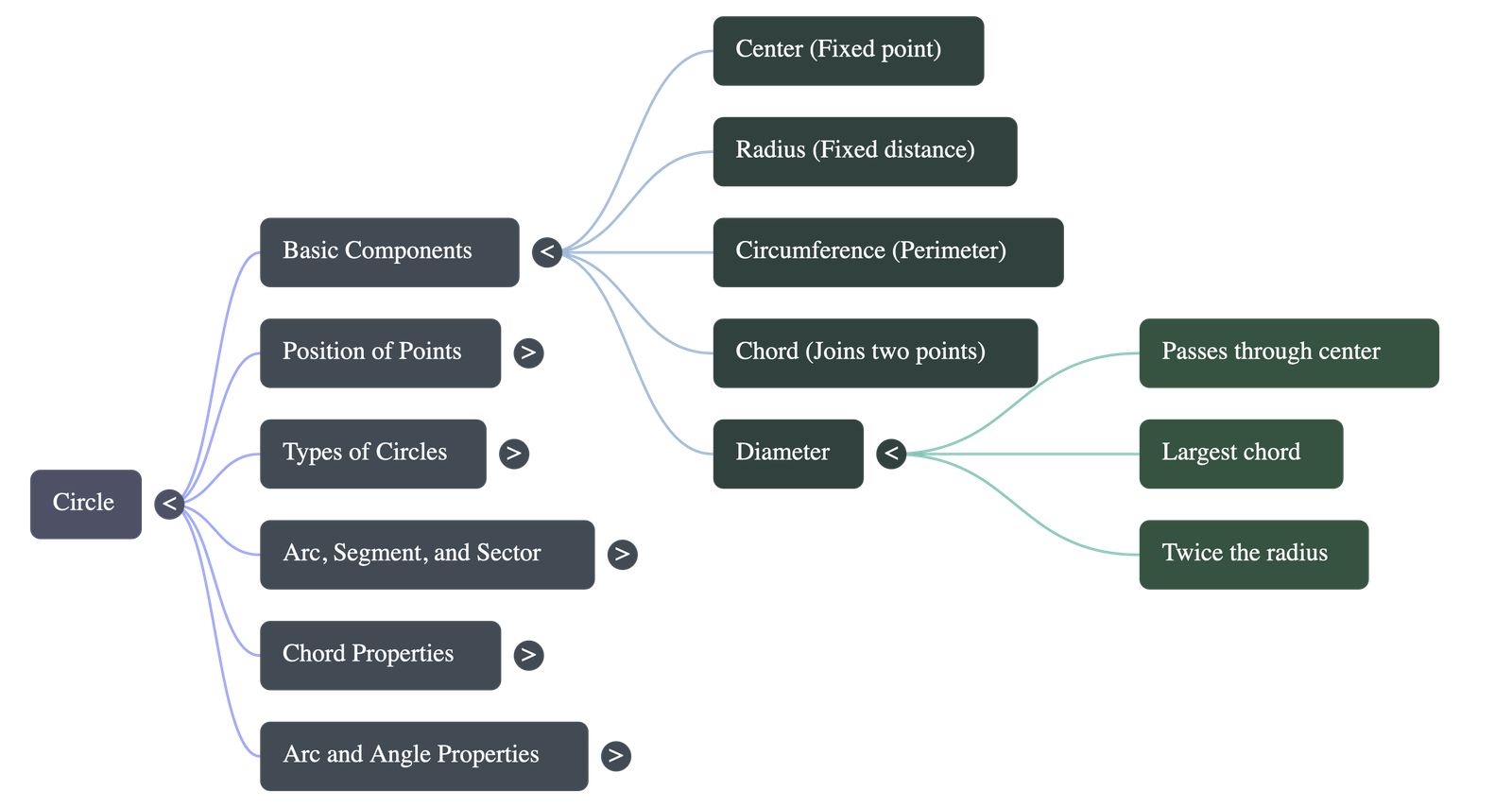
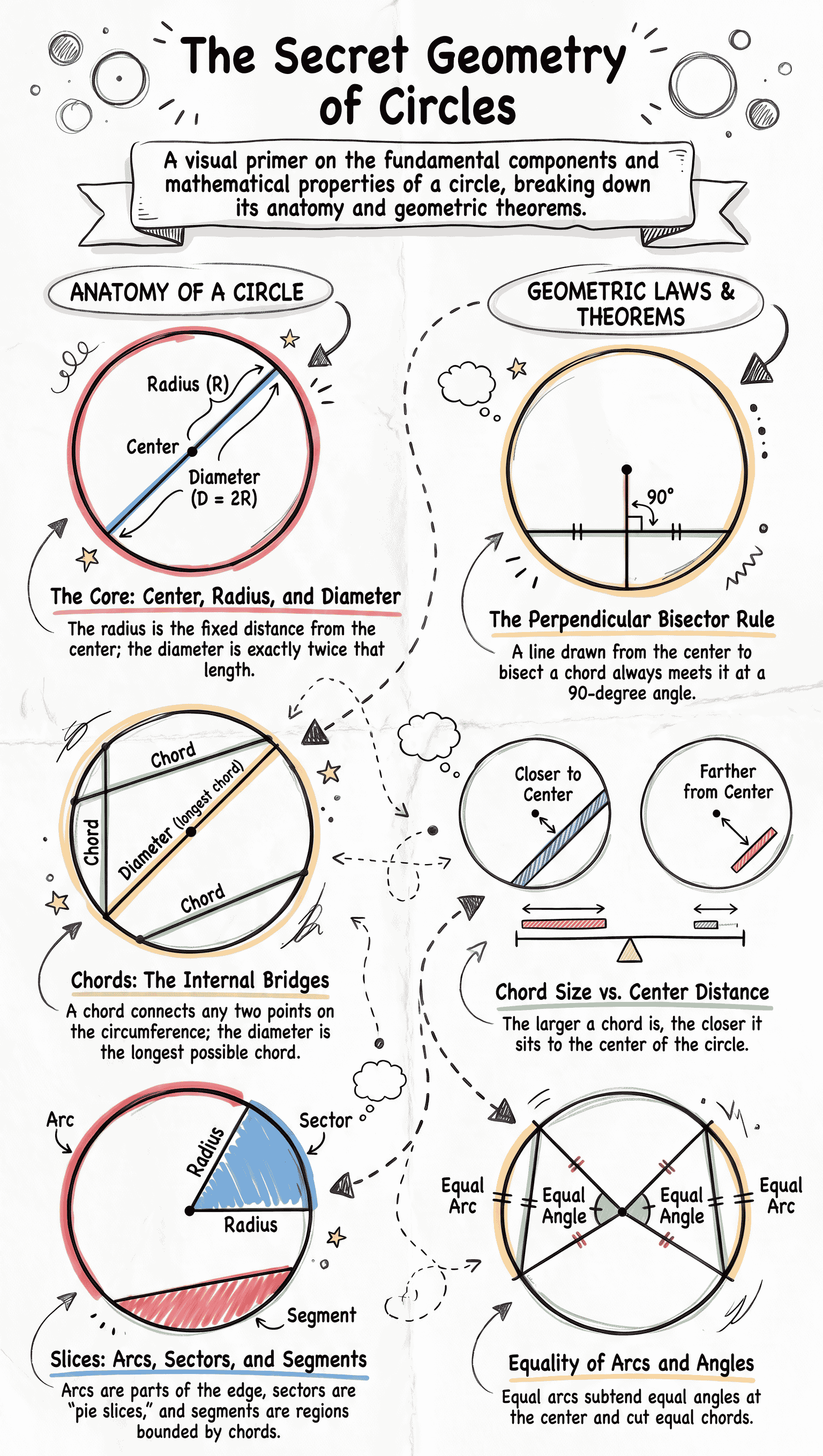
- Centre & Radius: The fixed point is called the centre, and the constant distance is called the radius.
- Circumference: The perimeter (outer boundary) of the circle.
- Chord: A straight line segment joining any two points lying on the circumference.
- Diameter: A chord that passes straight through the centre. It is the largest chord of a circle and its length is exactly twice the radius.
16.3 More About Circle
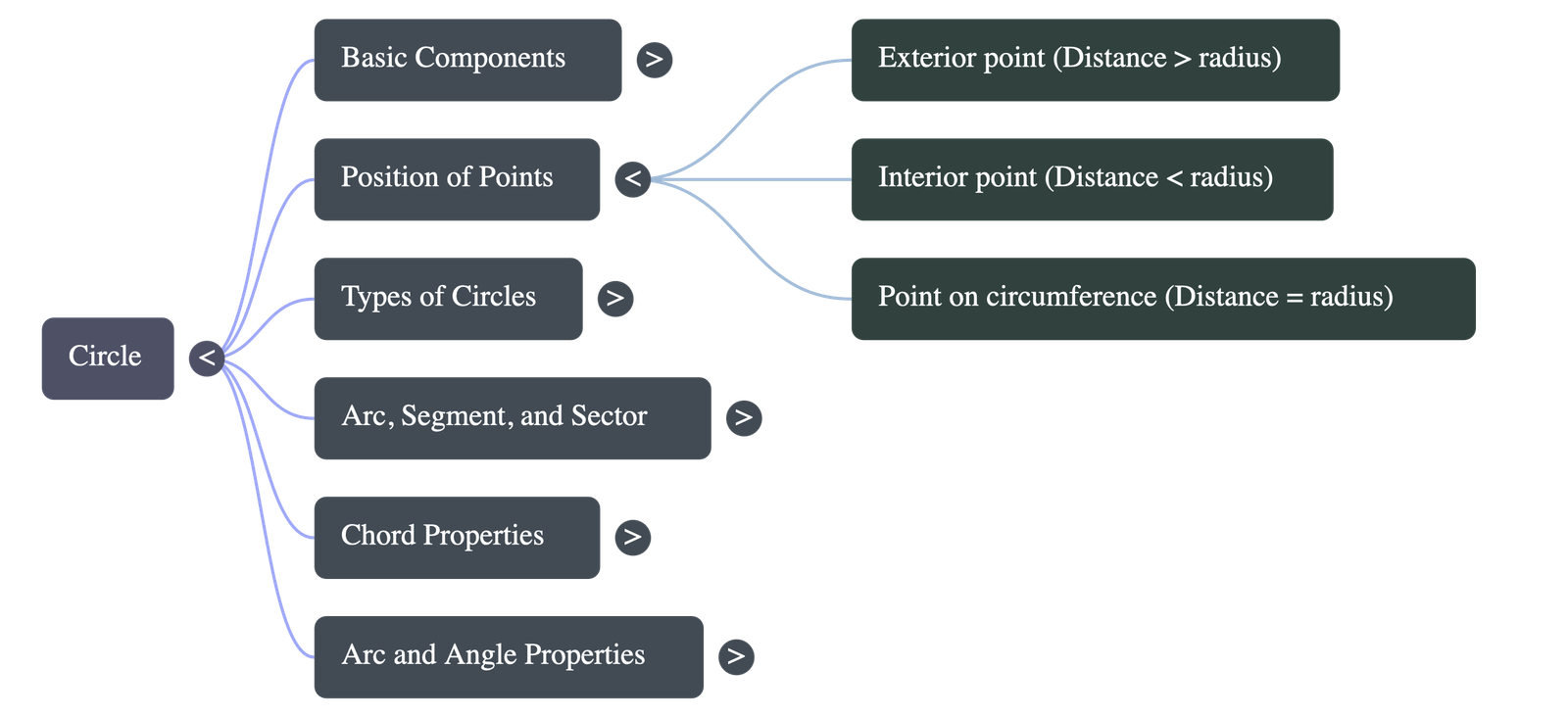
- Exterior Point: A point whose distance from the centre is greater than the radius.
- Interior Point: A point whose distance from the centre is less than the radius.
- Point on the Circumference: A point whose distance from the centre is exactly equal to the radius.
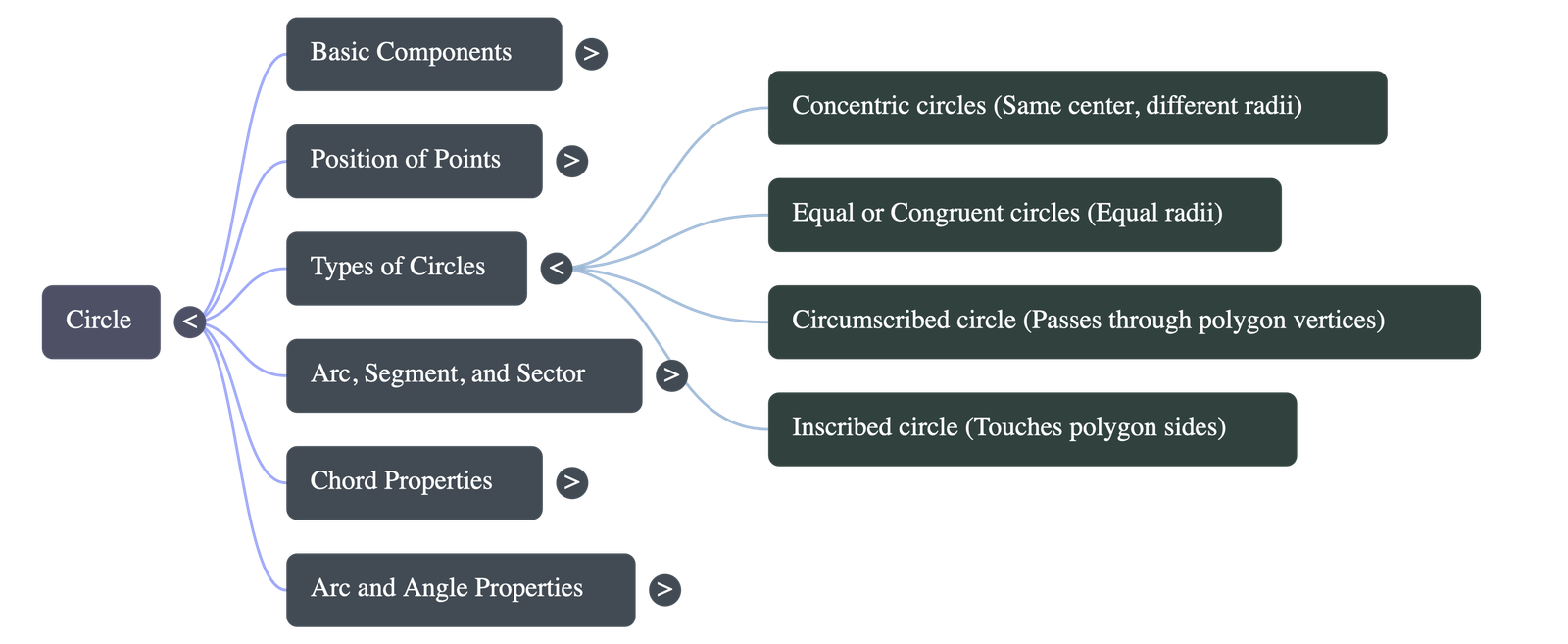
- Concentric Circles: Two or more circles that share the same centre but have different radii.
- Equal (Congruent) Circles: Circles that have perfectly equal radii.
- Circumscribed Circle: A circle passing through all the vertices of a polygon. Its centre is the circumcentre, and the polygon is called an inscribed polygon.
- Inscribed Circle: A circle that touches all the sides of a polygon (also called an in-circle). Its centre is the incentre, and the polygon is a circumscribed polygon.
16.4 Arc, Segment and Sector
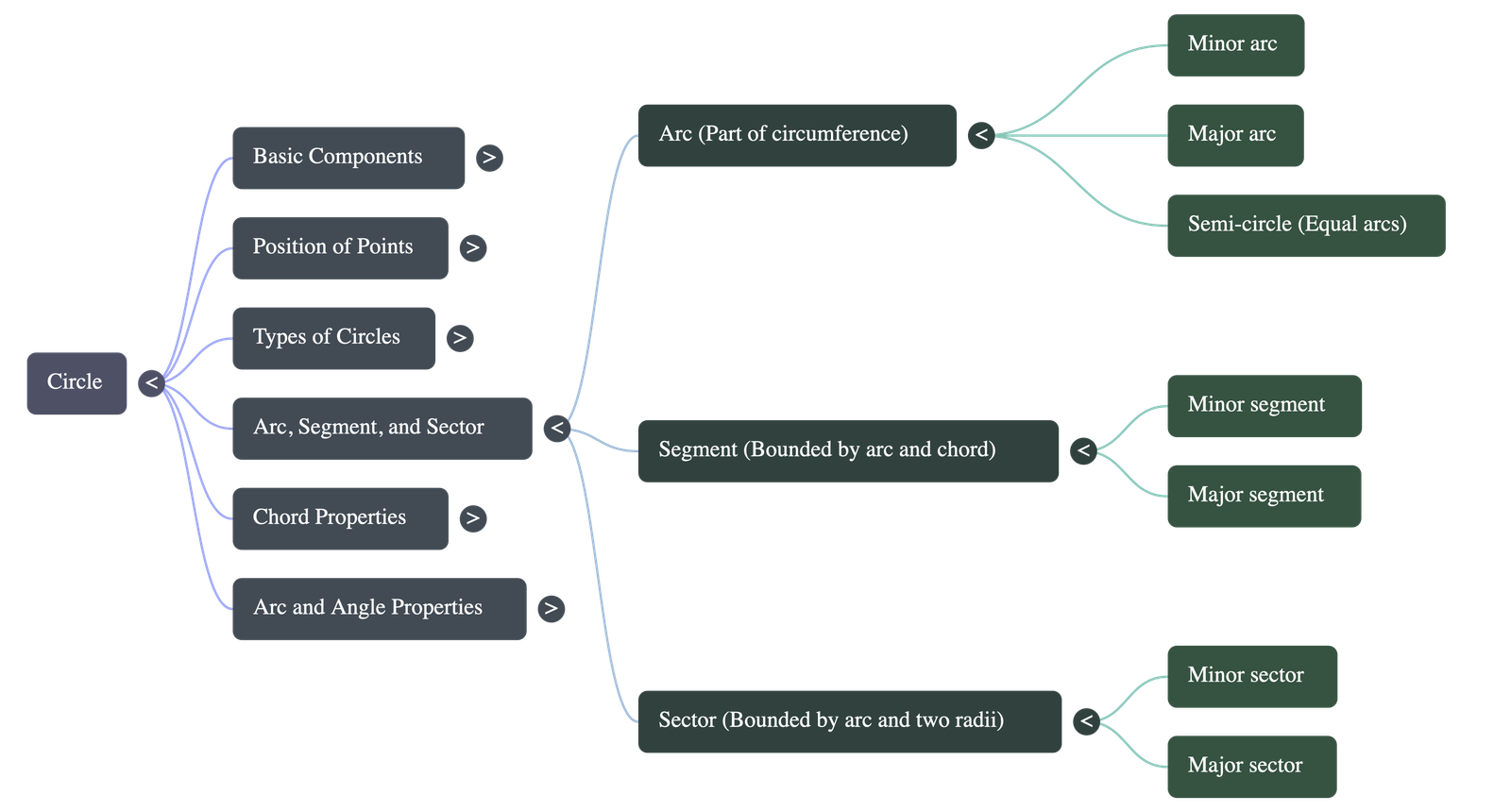
- Arc: Any continuous part of the circumference. A chord divides the circle into two arcs:
- Minor Arc: The smaller part.
- Major Arc: The bigger part.
- Semi-circle: Created when the chord is a diameter, making both arcs equal.
- Segment: The region bounded by an arc and a chord.
- Minor Segment: Smaller than a semi-circle.
- Major Segment: Larger than a semi-circle (the centre of the circle always lies in the major segment).
- Sector: The region bounded by an arc and the two radii joining the centre to the endpoints of the arc.
- A minor arc creates a minor sector, and a major arc creates a major sector.
- When the arcs are equal, the regions become identical semi-circles.
16.5 Properties of Chord
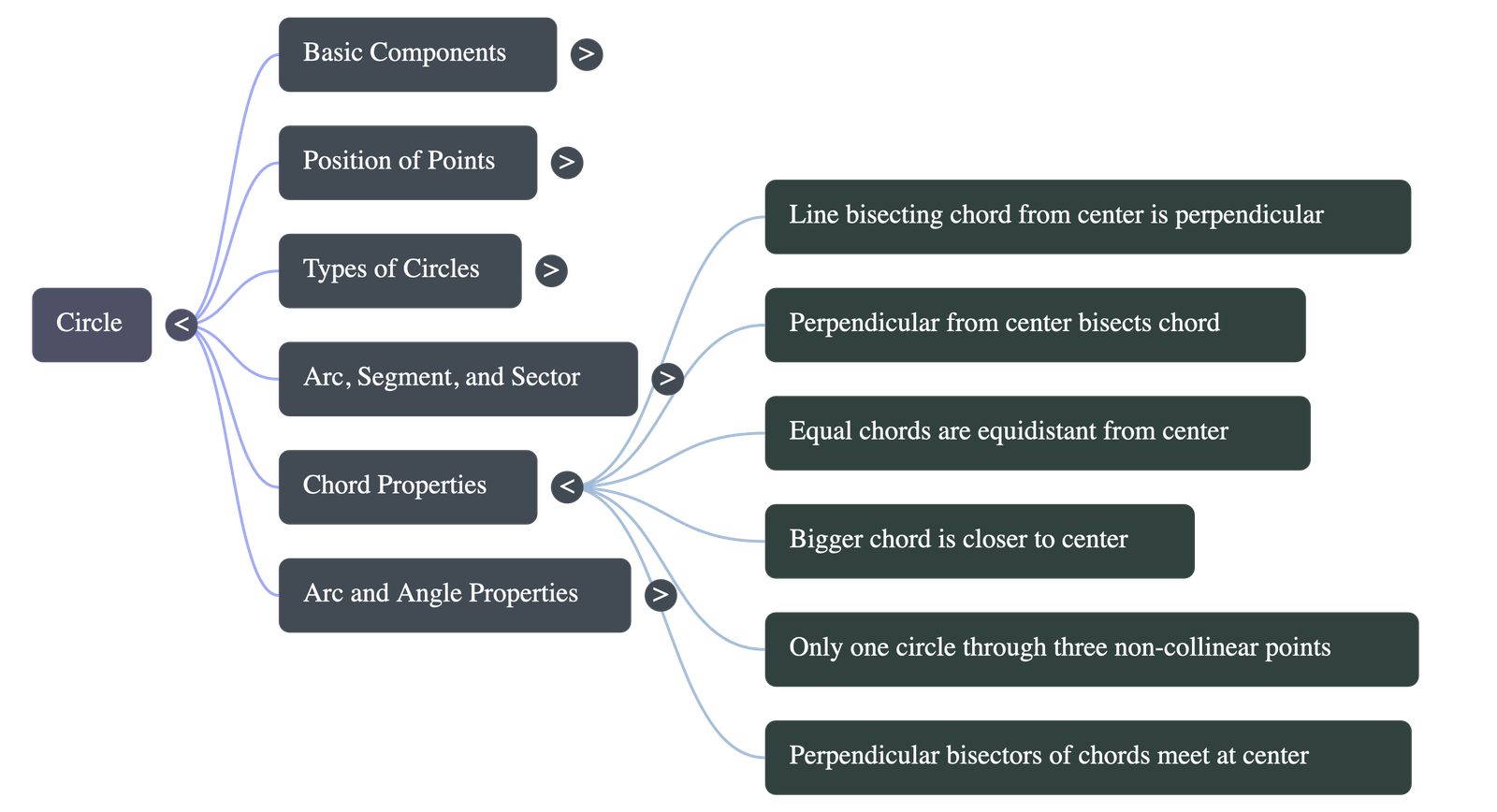
- Theorem 22: A straight line drawn from the centre of a circle to bisect a chord (which is not a diameter) is at right angles (perpendicular) to the chord.
- Theorem 23 (Converse of Thm 22): The perpendicular drawn to a chord from the centre of the circle bisects the chord.
- Important Rule: The greater the size of a chord, the smaller its distance from the centre (and vice-versa).
- Theorem 24: Equal chords of a circle are equidistant (at the same distance) from the centre.
- Theorem 25 (Converse of Thm 24): Chords of a circle that are equidistant from the centre are equal in length.
- Theorem 26: There is one and only one circle which passes through three given non-collinear points (points not in a straight line).
- Note: The perpendicular bisector of every chord always passes through the circle's centre.
- Note: The perpendicular bisectors of any two chords intersect exactly at the centre of the circle.
16.6 Arc and Chord Properties
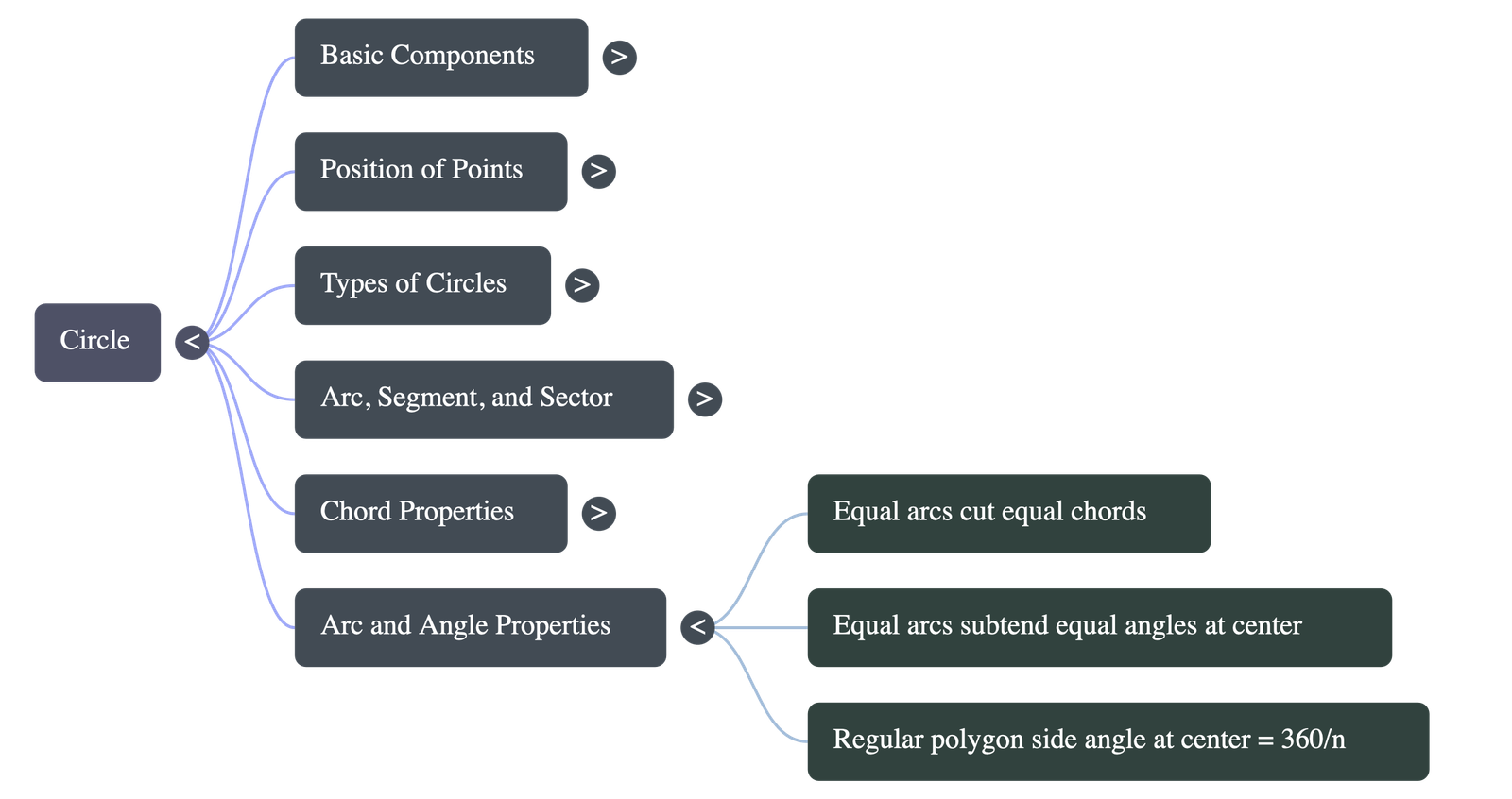
- Basic Principle: In the same circle, equal arcs cut equal chords, and conversely, equal chords cut equal arcs. (This is also true for congruent circles).
- Theorem 27: If two arcs of the same circle subtend equal angles at the centre, then the arcs are equal in length.
- Theorem 28 (Converse of Thm 27): If two arcs of a circle are equal in length, they subtend equal angles at the centre.
- Important Polygon Formula: If an n-sided regular polygon is inscribed in a circle, the angle subtended by each side of this polygon at the centre of the circle is exactly 360° / n.
Do checkout all questions & answers of this chapter.
Quick Navigation:
| | | |
1 / 1
Quick Navigation:
| | | |