Quick Navigation:
| | | |
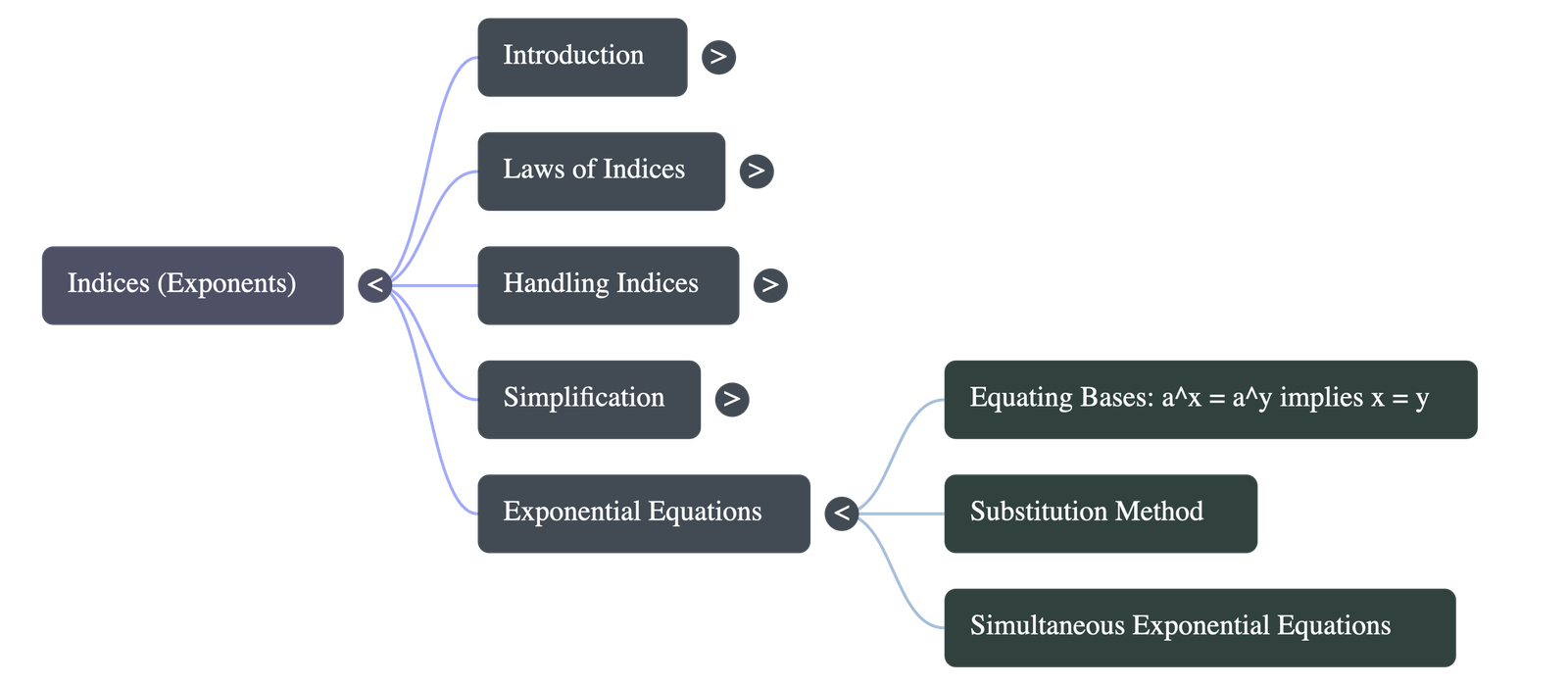
Indices [Exponents]
7.1 Introduction
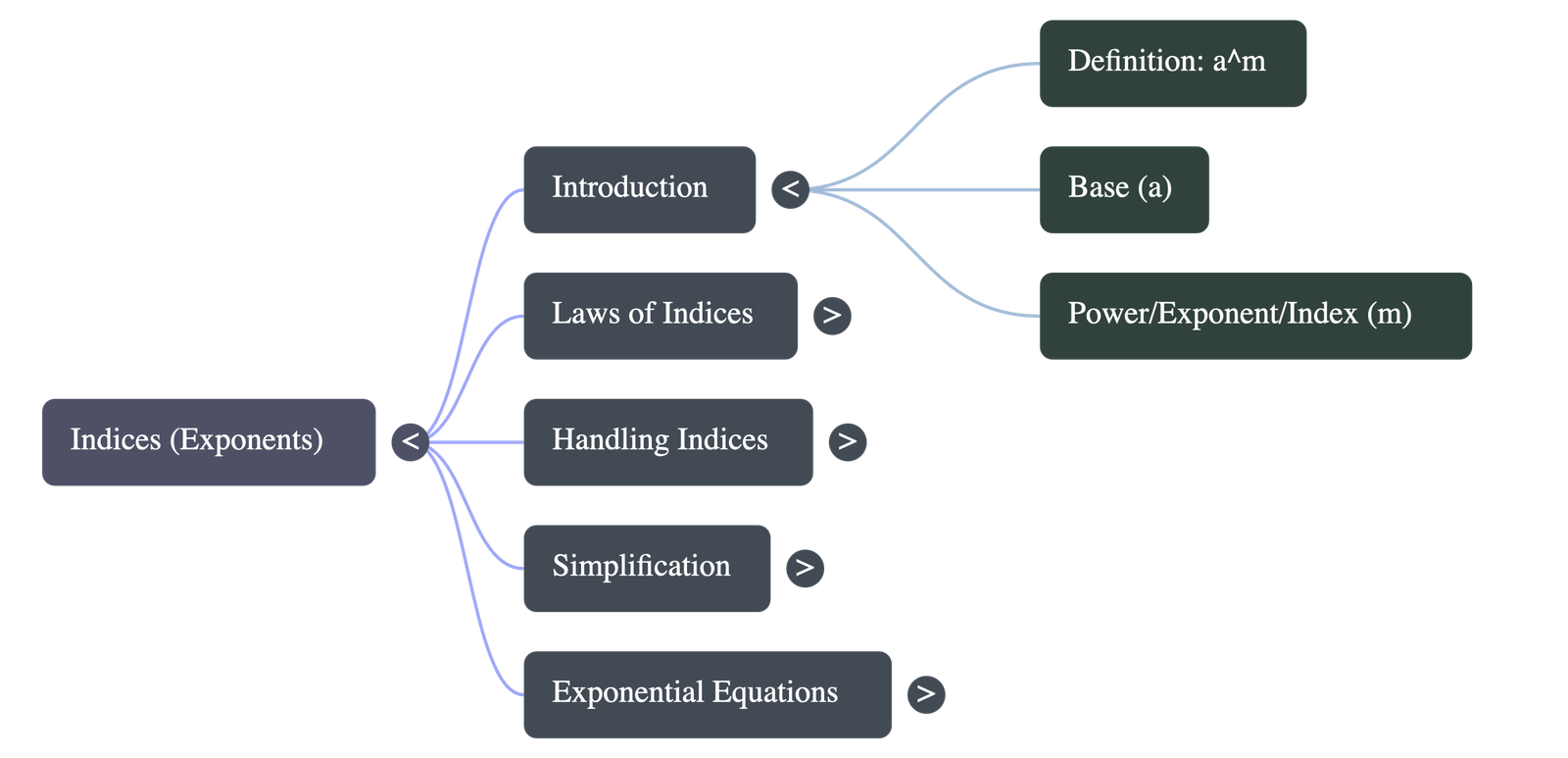
- • When a positive integer m is used to multiply a number a by itself m times (a × a × a ... up to m terms), it is written mathematically as am.
- • In the expression am, the number 'a' is called the base, and 'm' is called the power, exponent, or index.
- • This expression is generally read aloud as "a power m" or "a raised to the power m".
7.2 Laws of Indices
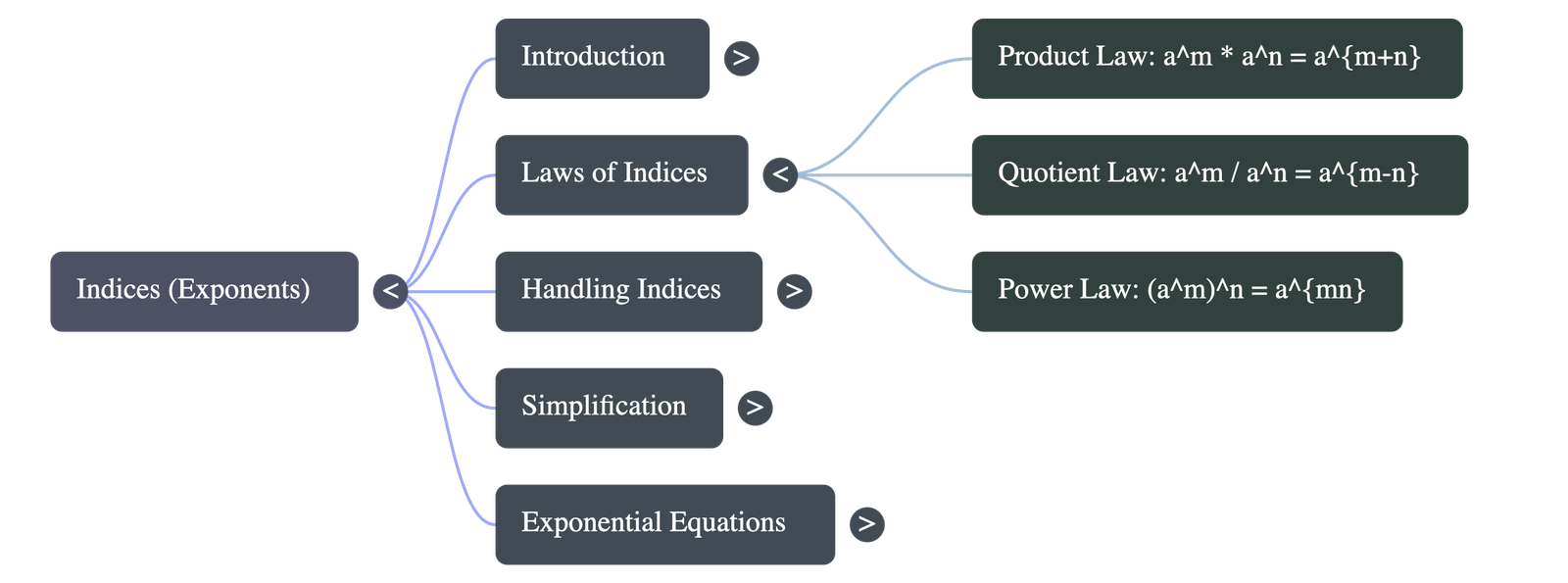
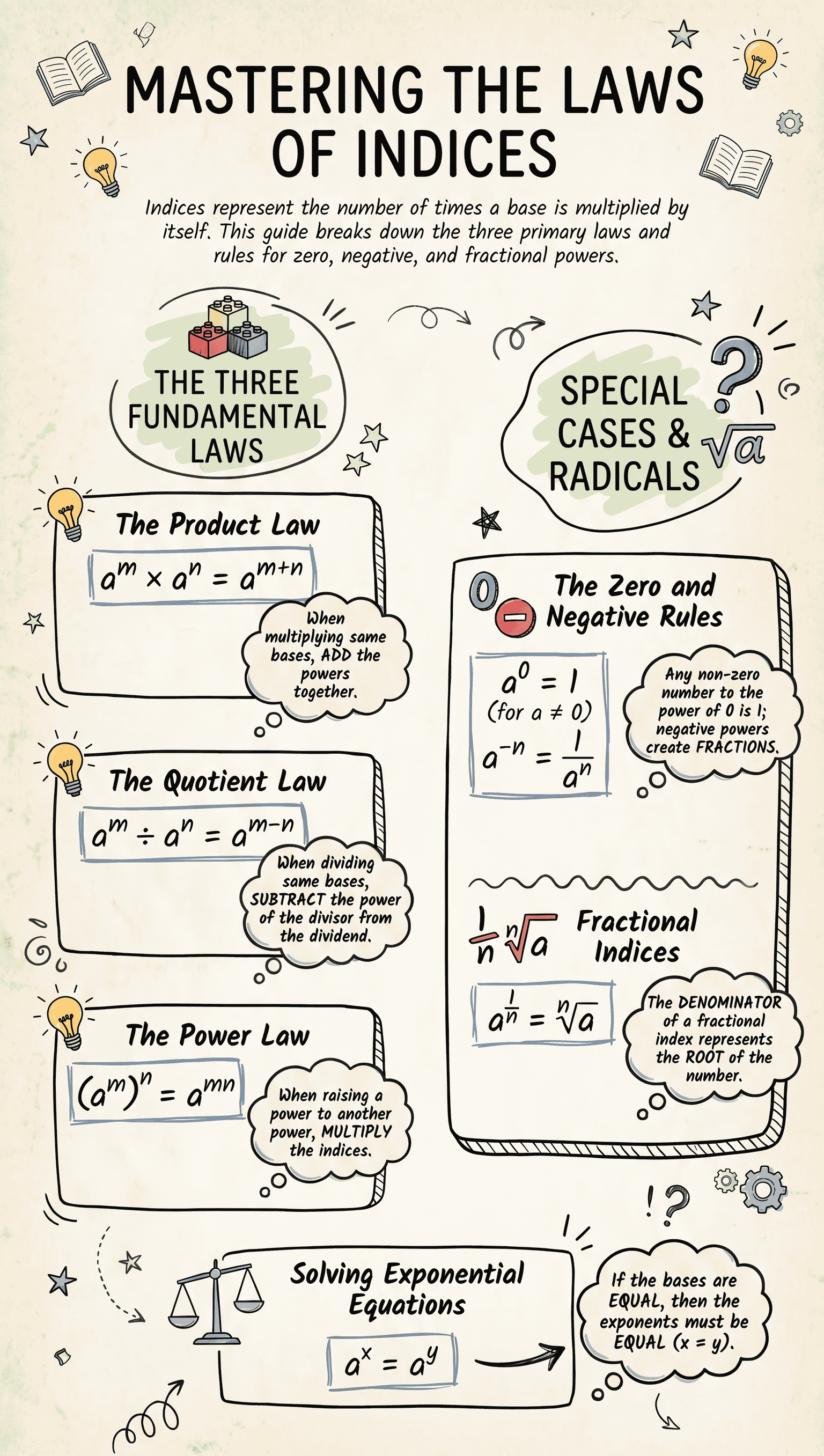
There are three fundamental laws used to calculate and simplify mathematical expressions involving exponents:
-
1st Law (Product Law):
When multiplying two expressions that share the exact same base, you keep the base and add their powers together.
am × an = am + n -
2nd Law (Quotient Law):
When dividing two expressions with the same base, you keep the base and subtract the power of the denominator from the power of the numerator.
am ÷ an = am - n -
3rd Law (Power Law):
When a number raised to a power is enclosed in brackets and raised to another power, the two exponents are multiplied together.
(am)n = amn
7.3 Handling Positive, Fractional, Negative and Zero Indices
-
1.
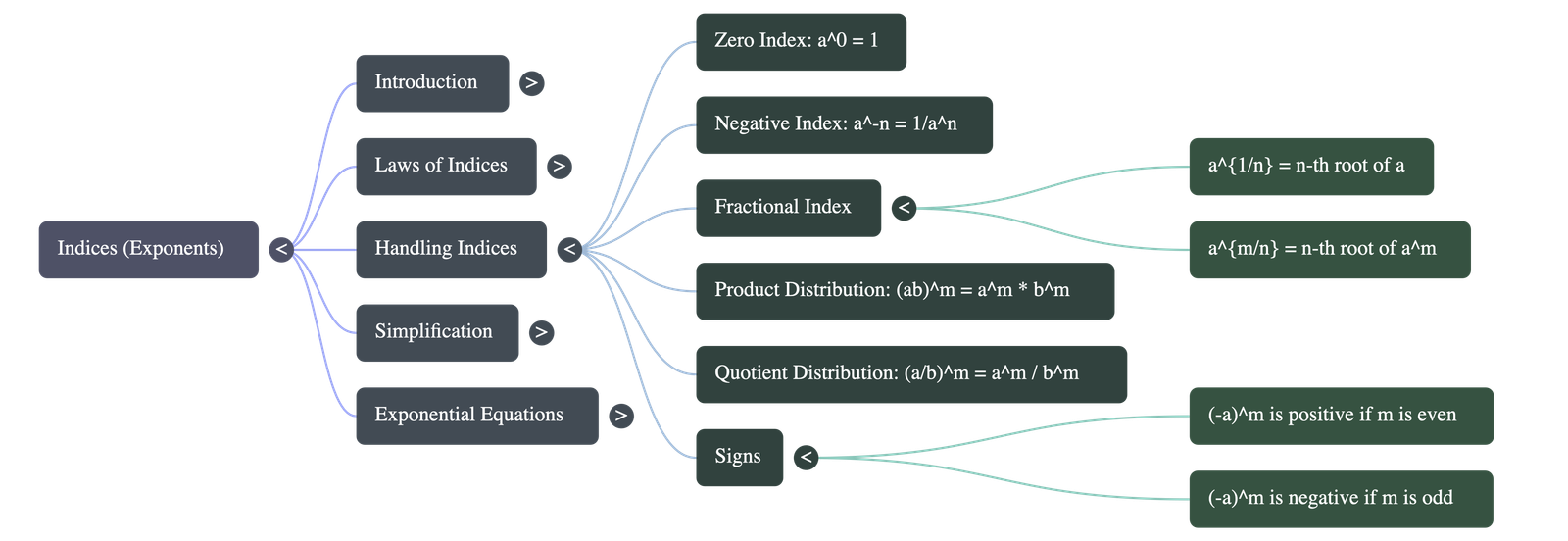
Power of a Product and Quotient: An exponent placed outside a bracket applies to all individual terms inside the bracket.
(a × b)m = am × bmand(a / b)m = am / bm -
2.
Fractional Indices (Roots): A fractional exponent translates to a root. The denominator of the fraction is the root, and the numerator is the power.
a1/n = n√a. Similarly,am/n = n√(am) -
3.
Negative Indices: A negative exponent means taking the reciprocal of the base raised to the positive version of that exponent.
a-n = 1 / anand1 / a-n = an -
4.
Zero Index: Any non-zero base raised to the power of zero is always exactly equal to unity (1).
a0 = 1(where a ≠ 0). -
5.
Negative Bases Rule:
• If a negative number is raised to an even number power, the final result is positive:(-a)m = am
• If a negative number is raised to an odd number power, the final result remains negative:(-a)m = -am
7.4 Simplification of Expressions
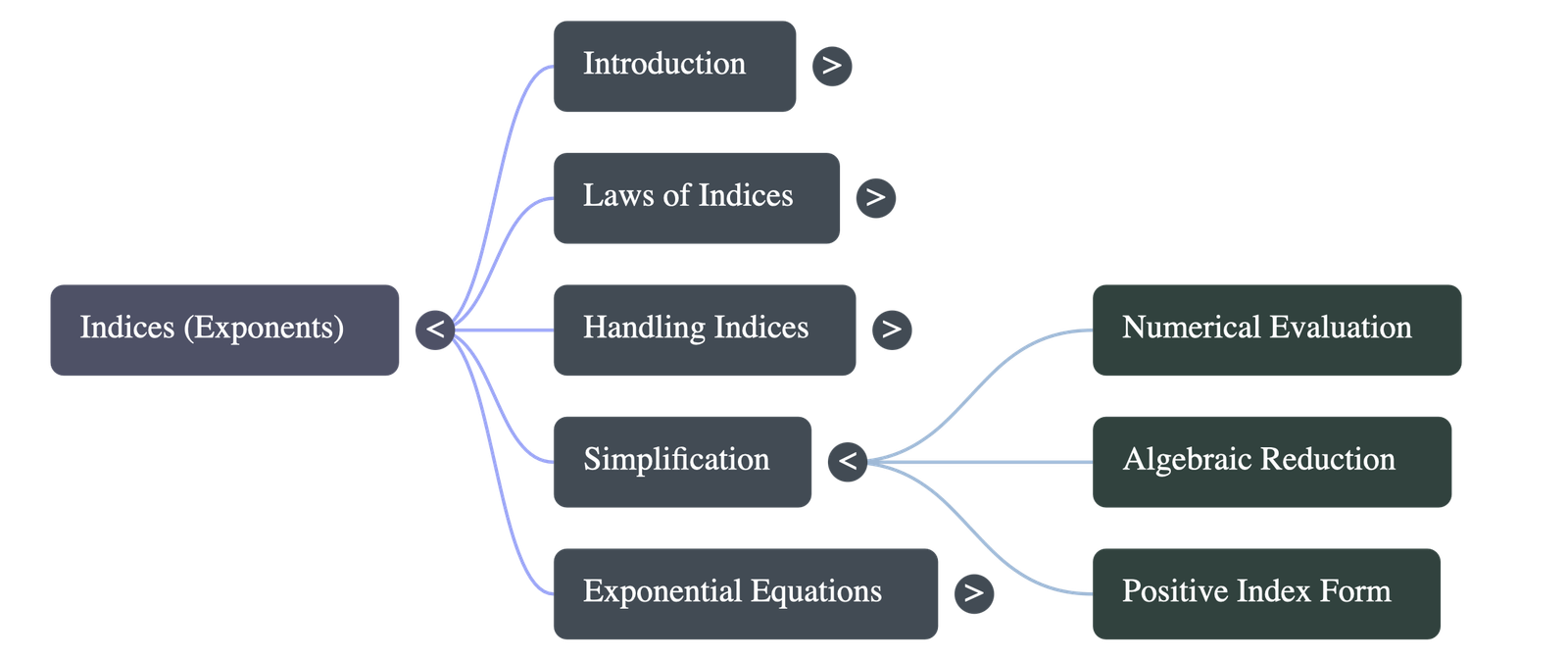
- ✓ This section demonstrates how to apply the laws learned above to evaluate and simplify mixed algebraic expressions and numbers.
- ✓ Key Strategy: The general approach is to break down composite numbers into their prime factors, distribute any external powers using the power law, and then combine the terms with identical bases by adding or subtracting their exponents (using the product and quotient laws).
7.5 Solving Exponential Equations
- → An exponential equation is an equation where the unknown variable (like x) appears as an exponent.
- → Core Solving Principle: To solve these equations, you must manipulate the equation so that both sides have the exact same base.
-
→
Once the bases on both sides of the equals sign match, you drop the bases and set their exponents equal to each other.
Rule: If ax = ay ⇒ x = y - → Some complex equations may require substituting a term (e.g., let 2x = y) to form a quadratic equation, which is then factorized to find the solution.
Chapter Exercises and Tests Summary
The chapter concludes with comprehensive practice sections:
- Exercise 7 (A) & 7 (B): Features multiple-choice questions, numeric evaluations, simplification tasks, and "Show That" proof questions.
- Test Yourself: An advanced practice section testing conceptual clarity through Assertion-Reasoning statements, True/False statements, and a real-world Case-Study Based Question involving financial distribution using exponential parts.
Do checkout all questions & answers of this chapter.
Quick Navigation:
| | | |
1 / 1
Quick Navigation:
| | | |