Compound Interest [Applications]
1. Introduction to the Formula Method
- Calculating compound interest step-by-step using repeated simple interest formulas becomes extremely tedious as the number of conversion periods (years, half-years, etc.) increases.
- Standardized formulas are utilized to make calculations direct, fast, and easy.
2. Primary Formulas for Yearly Compounding
-
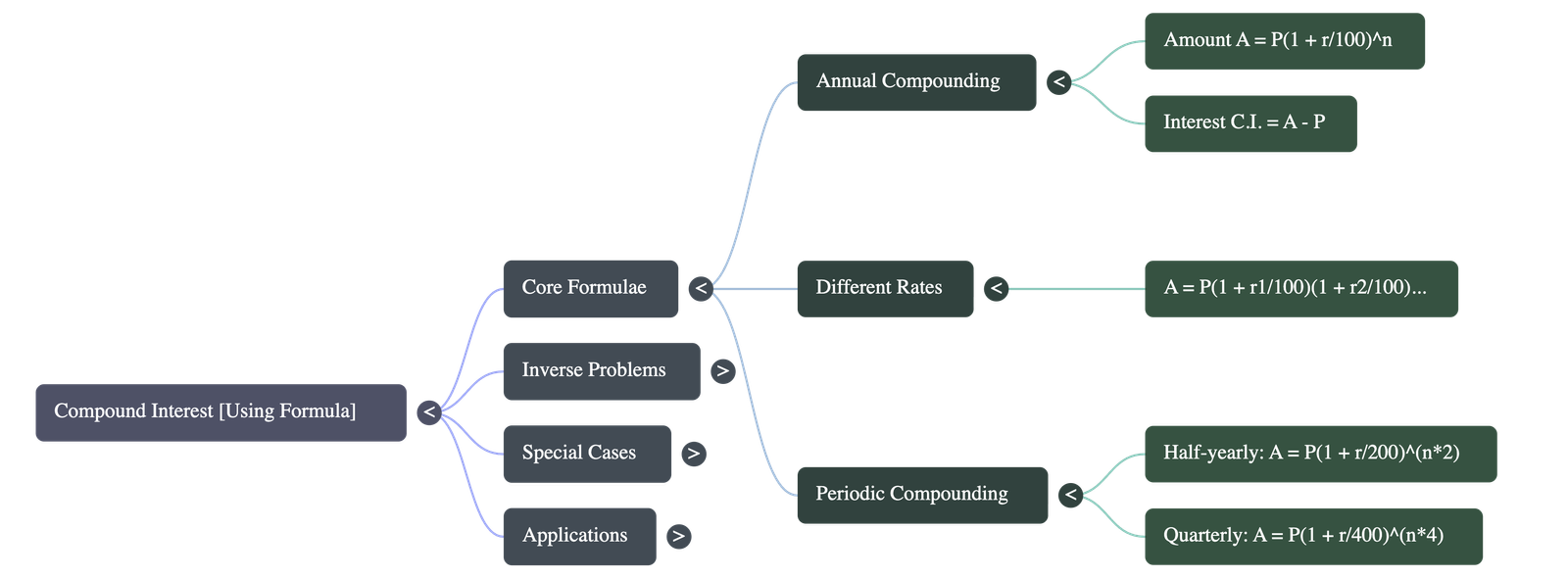
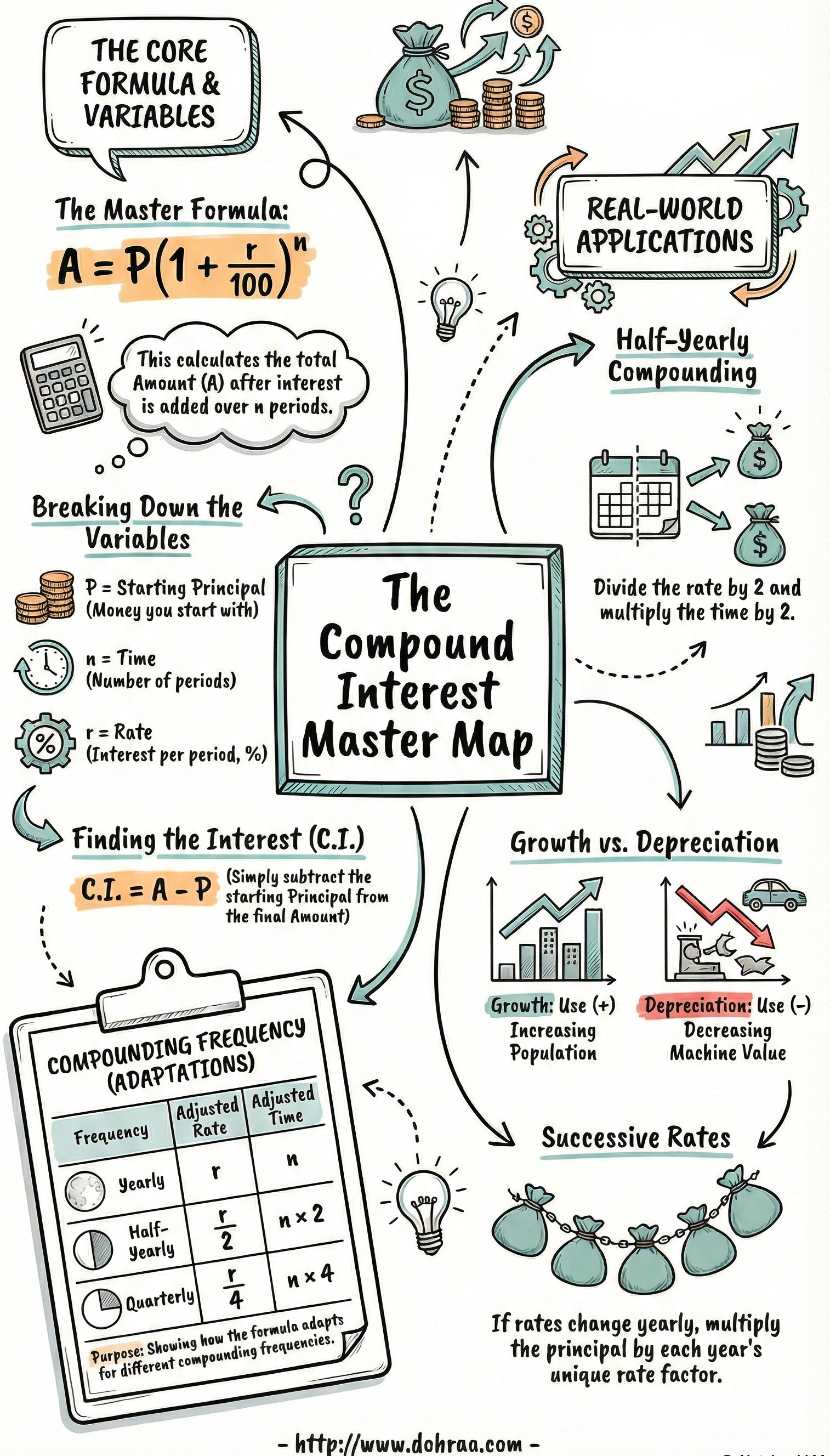
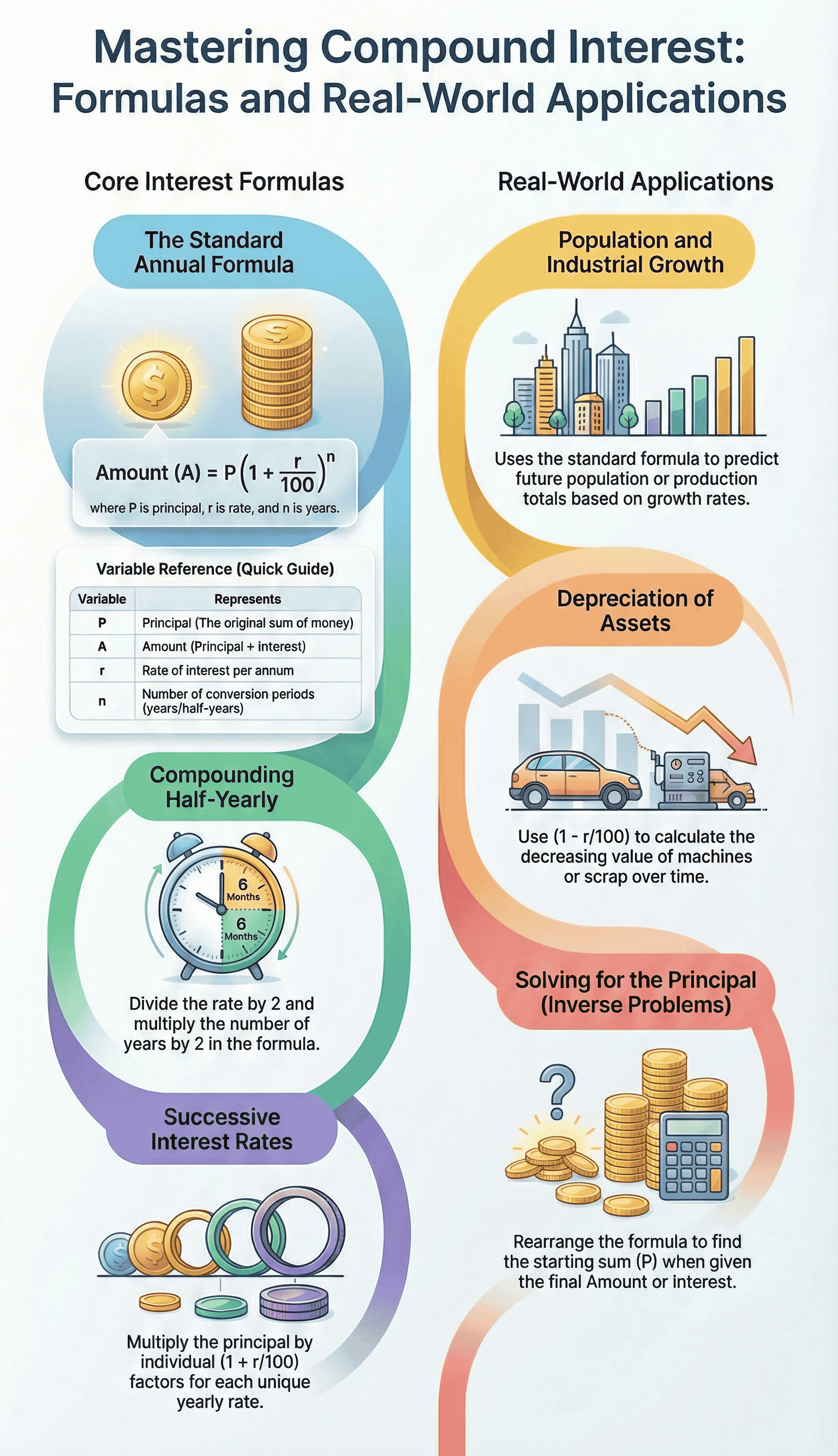
Finding the Amount (A): When interest is compounded yearly, the formula is:
A = P(1 + r⁄100)n
(Where A = Amount, P = Principal, r = Rate of interest compounded yearly, and n = Number of years) -
Direct Method for Compound Interest (C.I.):
C.I. = A - P or C.I. = P[ (1 + r⁄100)n - 1 ] -
Successive Years with Different Rates: If the rates of interest for successive years are different (e.g., r1%, r2%, r3%), the formula expands to:
A = P(1 + r1⁄100)(1 + r2⁄100)(1 + r3⁄100)...
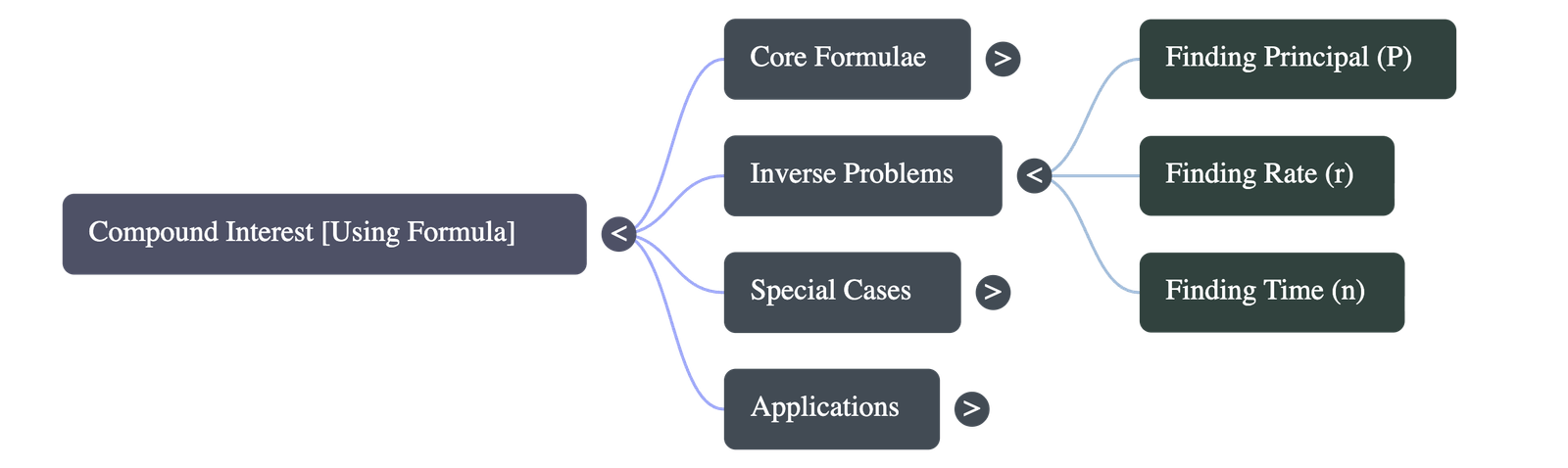
3. Solving Inverse Problems
- The standard formula can be rearranged to find unknown variables when the Amount is given.
- Finding the Principal (P): Calculate the base sum required to reach a specific amount over a given time and rate.
- Finding the Rate Percent (r): Used when the Principal, Amount, and Time are known. It often involves finding the n-th root of the given values.
- Finding the Time (n): Used when Principal, Amount, and Rate are known. This requires equating the bases to solve for the exponent n.
- Miscellaneous Problems: The formulas can also be combined to find the principal when the difference between Compound Interest and Simple Interest for a certain duration is provided.
4. Different Compounding Frequencies & Time Periods
-
Half-Yearly Compounding: The rate percent is halved (divided by 2) and the number of conversion periods is doubled (years multiplied by 2).
A = P(1 + r⁄2 × 100)n × 2 -
Quarterly Compounding: The rate percent is divided by 4, and the number of years is multiplied by 4.
A = P(1 + r⁄4 × 100)n × 4 -
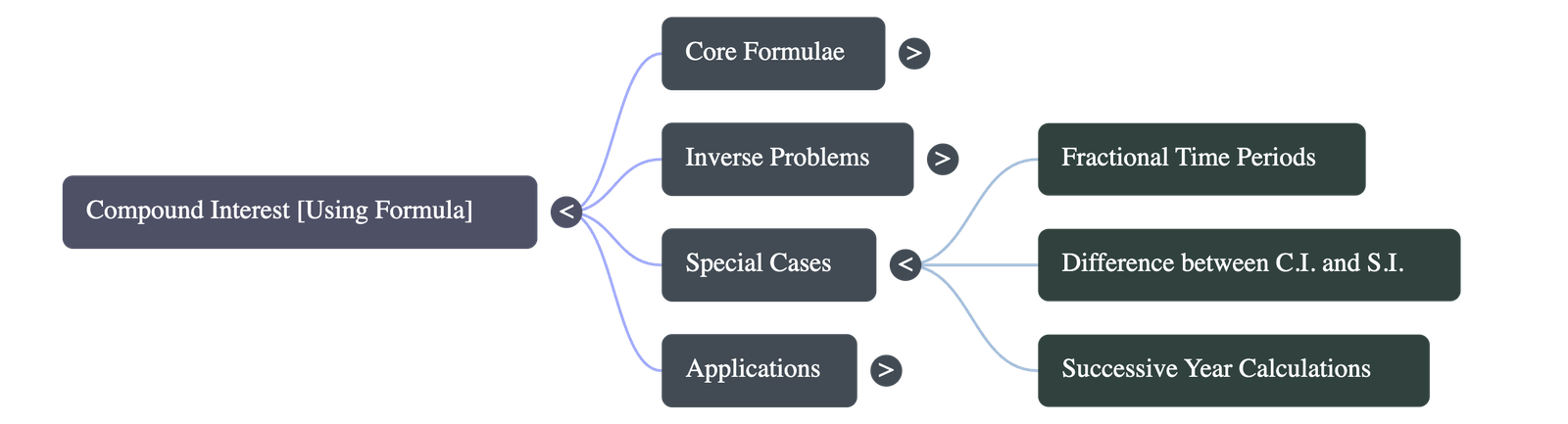
Fractional Years: When time is not an exact number of years (e.g., 2½ years) and compounding is yearly, the formula can be split. For 2½ years, it takes the form:
A = P(1 + r⁄100)2 × (1 + r⁄2 × 100)
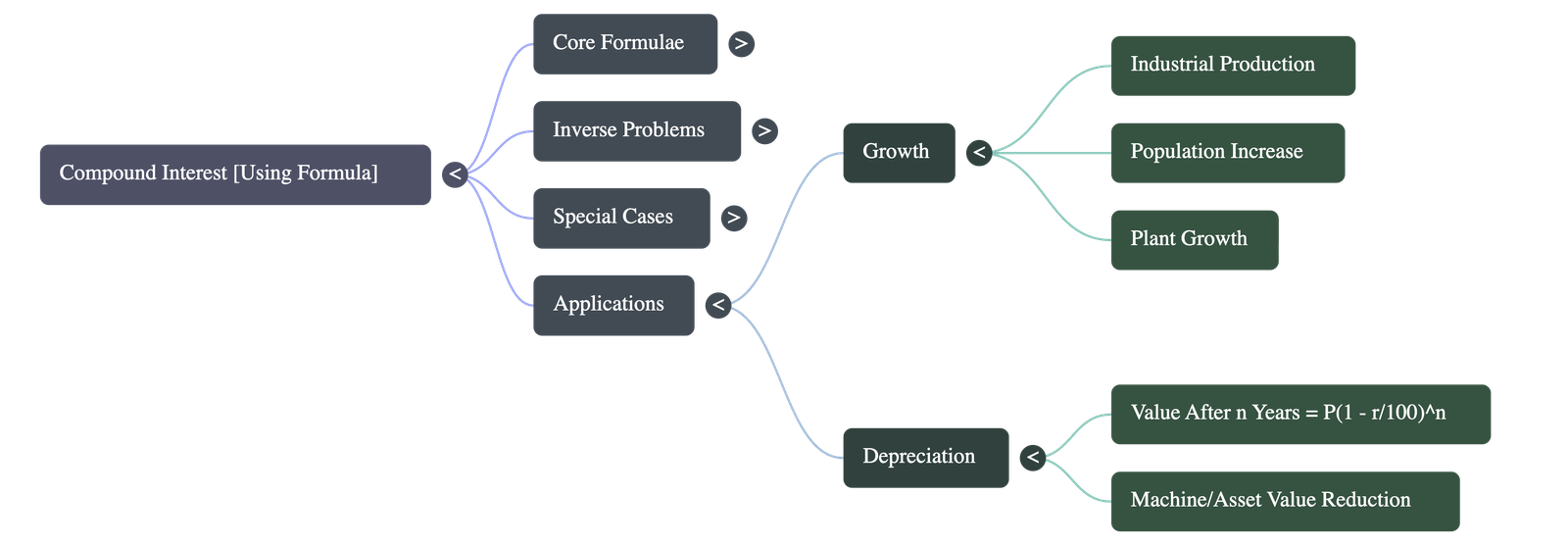
5. Practical Applications of the Formula
-
Growth (Industries, Inflation, Plants): Treated exactly like standard compound interest.
- Production after n years = Initial Production × (1 + r⁄100)n
- Present Production = Production n years ago × (1 + r⁄100)n
-
Population Problems: Modeled using the same growth mechanics when the population of a town/village increases at a certain rate per year.
- Population after n years = Present Population × (1 + r⁄100)n
-
Depreciation: Used when the value of an asset (like a machine) decreases by r% every year. The plus sign changes to a minus sign.
- Value after n years = Present Value × (1 - r⁄100)n
- Present Value = Value n years ago × (1 - r⁄100)n
Study Guide: Compound Interest Applications
Part 1: Concept Review Quiz
Answer the following ten questions in 2-3 sentences each to test your foundational understanding.
- What is the direct formula to calculate the amount under compound interest, and what do the respective variables represent?
- How do you determine the actual compound interest once the final accumulated amount is known?
- How must the compound interest formula be adjusted if the rate of interest changes for each successive year?
- Explain the specific numerical modifications made to the standard compound interest formula when interest is compounded half-yearly instead of annually.
- What logical steps should be followed to calculate the final amount when the time period is a fraction (such as 2½ years) and compounding is strictly yearly?
- How is the mathematical concept of compound interest applied to predict future population sizes?
- Describe how depreciation of an asset is handled using the compound interest framework. What structural change is made to the formula?
- If you are given the numerical difference between simple interest and compound interest for a certain period, how can you go about finding the original principal?
- In inverse problems where the goal is to find the time period, what mathematical strategy is used after simplifying the ratio of Amount to Principal?
- How can you find the original historical value of a machine from several years ago if its current depreciated value and the constant rate of depreciation are known?
Quiz Answer Key
- Answer: The direct formula is A = P(1 + r/100)n. In this formula, A stands for the final Amount, P is the Principal sum, r is the rate of interest per annum, and n is the number of years.
- Answer: Compound interest is calculated by subtracting the original principal invested from the final accumulated amount. The algebraic formula used is C.I. = A - P.
- Answer: Instead of using a single exponent for the years, the principal is multiplied by separate growth factors for each specific year. For example, for three years with different rates, the formula is A = P(1 + r1/100)(1 + r2/100)(1 + r3/100).
- Answer: When compounded half-yearly, the annual rate (r) is divided by 2, and the time period in years (n) is multiplied by 2 to represent the total number of compounding cycles. The adjusted formula becomes A = P(1 + r/(2 × 100))2n.
- Answer: First, calculate the amount for the whole number of years using the standard compound interest formula. Next, use that newly calculated amount as the principal to find the simple interest for the remaining fractional year, and add the two together.
- Answer: Population growth is treated exactly like compound interest, where the initial population acts as the principal sum. The formula used is Population after n years = Present Population × (1 + r/100)n.
- Answer: Depreciation represents a steady decrease in value over time, so the plus sign in the standard growth formula is replaced with a minus sign. The resulting formula is Value = Present Value × (1 - r/100)n.
- Answer: You must create algebraic expressions for both Compound Interest (C.I.) and Simple Interest (S.I.) using P as the unknown variable. Then, subtract the S.I. expression from the C.I. expression, set the result equal to the given numerical difference, and solve for P.
- Answer: After dividing the final Amount by the Principal to isolate the base factor, you express the resulting fraction as a power of the base (1+r/100). By equating the bases on both sides of the equation, you can directly equate and solve for the exponent n.
- Answer: You use the depreciation formula and work backwards by treating the unknown past value as the starting principal. The formula used is Present Value = Value n years ago × (1 - r/100)n, which is solved by isolating the past value variable.
Part 2: Essay Format & Complex Problem Solving
Review the detailed mathematical workings for the following applied scenarios.
Question 1: Changing Interest Rates
Calculate the amount and the compound interest on ₹ 12,000 in 3 years when the rates of interest for successive years are 8%, 10% and 15% respectively.
Detailed Working:
Given: P = ₹ 12,000; r1 = 8%, r2 = 10%, r3 = 15%
Formula: A = P(1 + r1/100)(1 + r2/100)(1 + r3/100)
A = 12,000 × (1 + 8/100) × (1 + 10/100) × (1 + 15/100)
A = 12,000 × (108/100) × (110/100) × (115/100)
A = 12,000 × 1.08 × 1.10 × 1.15
A = ₹ 16,394.40
To find Compound Interest (C.I.): C.I. = A - P
C.I. = 16,394.40 - 12,000
Answer: Amount = ₹ 16,394.40; Compound Interest = ₹ 4,394.40
Question 2: Finding Time (Inverse Problem)
In how many years will ₹ 2,000 amount to ₹ 2,662 at 10 percent C.I. compounded annually?
Detailed Working:
Given: A = ₹ 2,662; P = ₹ 2,000; r = 10%
Formula: A = P(1 + r/100)n
2,662 = 2,000(1 + 10/100)n
2,662 / 2,000 = (11/10)n
1,331 / 1,000 = (11/10)n
(11/10)3 = (11/10)n
Answer: By equating the powers, n = 3 years.
Question 3: Difference between CI and SI
The difference between the C.I. and the S.I. on ₹ 8,400 for two years is ₹ 21 at the same rate of interest per year. Find the rate of interest.
Detailed Working:
Let the rate of interest be r%. Given P = ₹ 8,400, Time = 2 years.
Calculate S.I.: S.I. = (P × R × T) / 100 = (8,400 × r × 2) / 100 = 168r
Calculate C.I.: C.I. = A - P = 8,400(1 + r/100)2 - 8,400
Given C.I. - S.I. = 21
8,400[1 + r2/10,000 + 2r/100] - 8,400 - 168r = 21
8,400 + 84r2/100 + 168r - 8,400 - 168r = 21
84r2/100 = 21
r2 = (21 × 100) / 84 = 2,100 / 84 = 25
Answer: r = 5%. The rate of interest is 5% per annum.
Question 4: Compounded Half-Yearly
A sum of ₹ 6,400 earns a compound interest of ₹ 1,008.80 in 18 months, when the interest is reckoned half-yearly. Find the rate of interest.
Detailed Working:
Given: P = ₹ 6,400; C.I. = ₹ 1,008.80; Time = 18 months = 3/2 years.
Amount (A) = P + C.I. = 6,400 + 1,008.80 = ₹ 7,408.80
Since compounded half-yearly, periods (n) = (3/2) × 2 = 3. Rate is halved to r/2.
Formula: A = P(1 + r/200)n
7,408.80 = 6,400(1 + r/200)3
7,408.80 / 6,400 = (1 + r/200)3
740,880 / 640,000 = 9,261 / 8,000 = (1 + r/200)3
(21/20)3 = (1 + r/200)3
21/20 = 1 + r/200 ⇒ 1/20 = r/200
Answer: r = 10%. The rate of interest is 10% per annum.
Question 5: Asset Depreciation
The value of a machine depreciates every year at the rate of 20% of its value at the beginning of the year. The machine was purchased for ₹ 2,50,000 when new, and the scrap value realised when sold was ₹ 1,28,000. Find the number of years that the machine was used.
Detailed Working:
Given: Present Value (Original) = ₹ 2,50,000; Future Value = ₹ 1,28,000; Rate of depreciation (r) = 20%.
Formula for depreciation: Value after n years = Present Value × (1 - r/100)n
1,28,000 = 2,50,000 × (1 - 20/100)n
1,28,000 / 2,50,000 = (1 - 1/5)n
128 / 250 = (4/5)n
64 / 125 = (4/5)n
(4/5)3 = (4/5)n
Answer: By equating the powers, n = 3 years.
Comprehensive Glossary of Key Terms
- Principal (P)
- The original sum of money borrowed or invested before any interest has been applied or calculated.
- Amount (A)
- The total accumulated value over a specific period, which includes both the original principal and the accumulated interest.
- Compound Interest (C.I.)
- The interest calculated on the initial principal, which also includes all of the accumulated interest from previous periods (interest on interest).
- Simple Interest (S.I.)
- Interest calculated solely on the principal portion of a loan or investment, without compounding any previously accumulated interest.
- Rate of Interest (r)
- The percentage of the principal charged by a lender or earned by an investor over a specific period, typically stated as an annual percentage.
- Compounding Period
- The frequency at which accumulated interest is formally added to the principal balance (e.g., annually, half-yearly, or quarterly).
- Depreciation
- The steady mathematical decrease in the value of an asset over time due to factors such as wear and tear or technological obsolescence.
- Inverse Problem
- A type of mathematical problem where the final outcome (like Amount or Compound Interest) is known, and the formula is used backward to solve for an original starting variable (Principal, Rate, or Time).
Do checkout all questions & answers of this chapter.