Simultaneous (Linear) Equations [Including Problems]
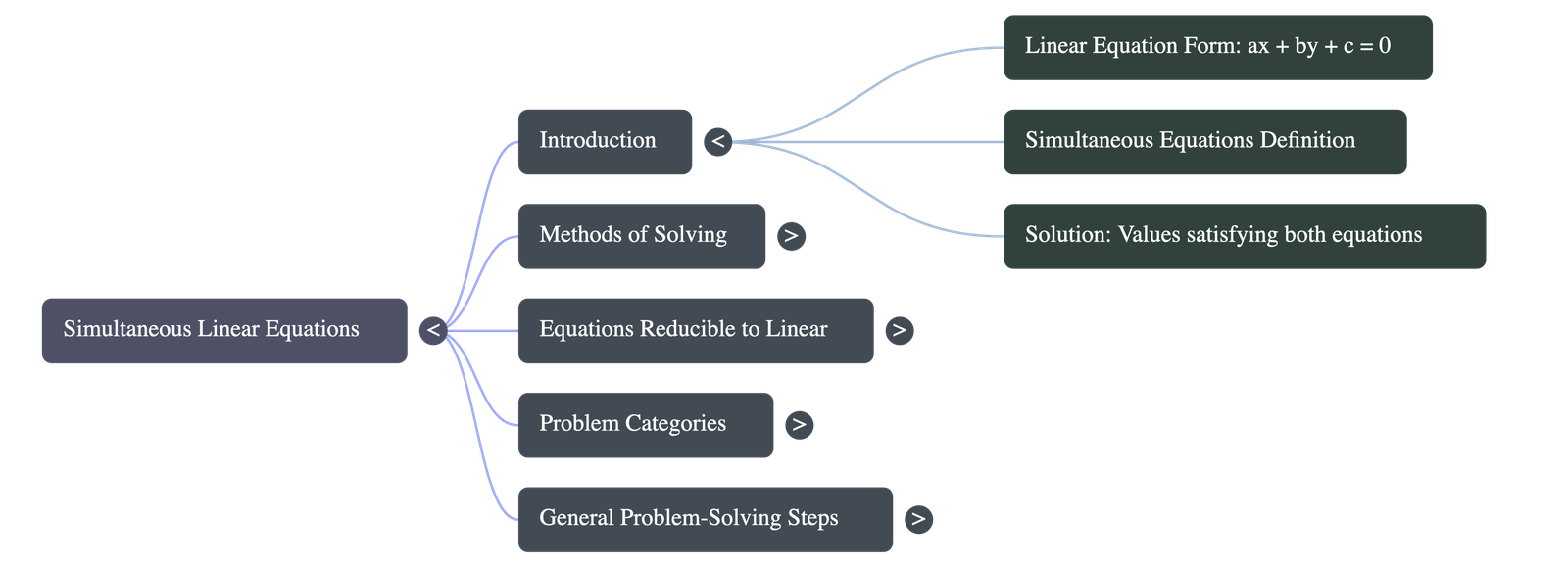
6.1 Introduction
- Linear Equation in Two Variables: An equation taking the form ax + by + c = 0, where a, b, and c are real number constants, and x and y are variables, each with a highest power (degree) of 1.
- Simultaneous Linear Equations: When two linear equations contain the exact same two variables (like x and y), they are considered together as a system.
- Solution: The solution to a pair of simultaneous equations is a specific set of values for the variables (e.g., x = 3 and y = 5) that successfully satisfies both equations at the same time.
6.2 Methods of Solving Simultaneous Equations
Solving these equations means finding the numerical values of the unknown variables. The chapter focuses on three primary algebraic methods:
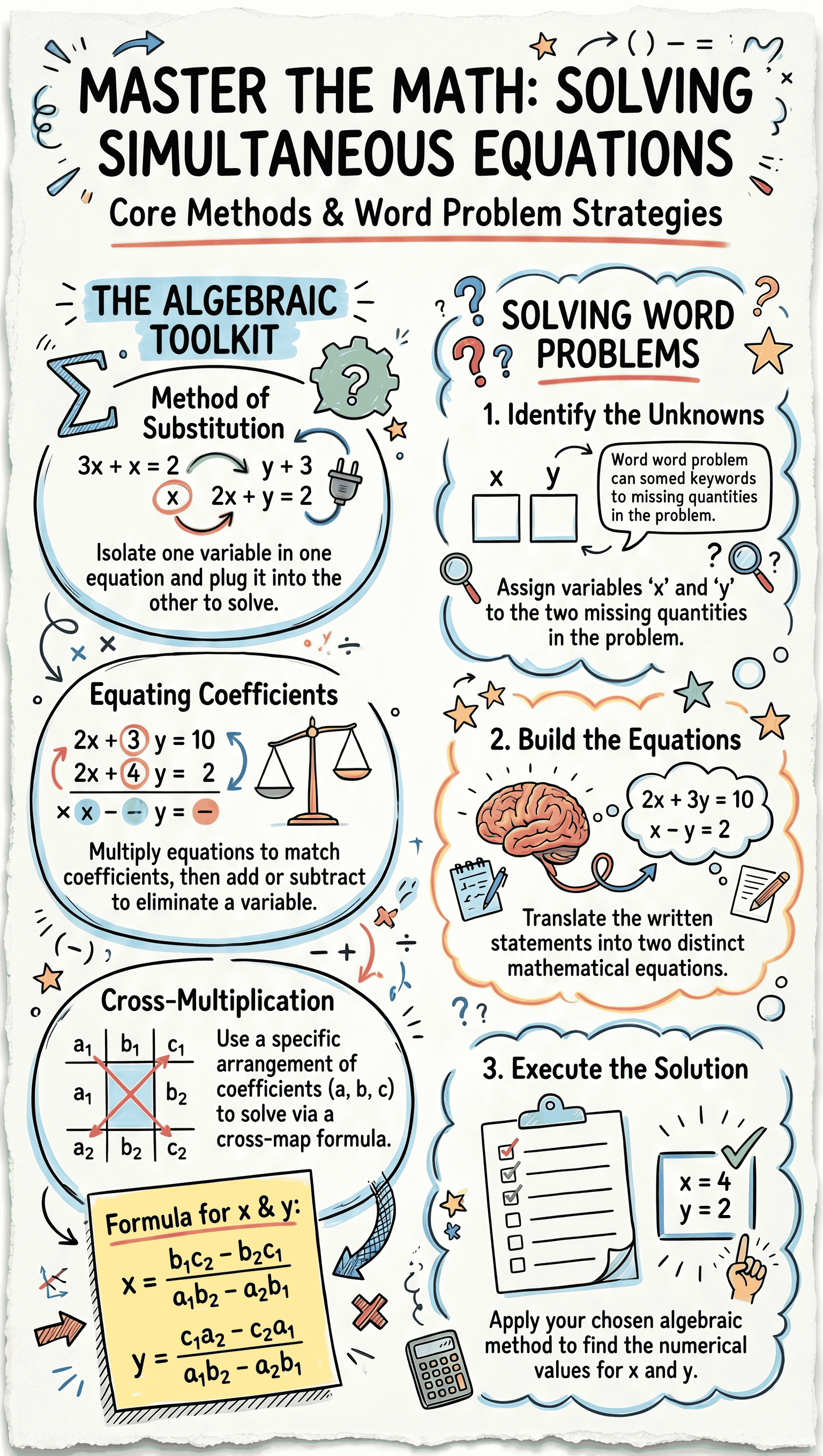
- Method of elimination by substitution.
- Method of elimination by equating coefficients.
- Method of cross-multiplication.
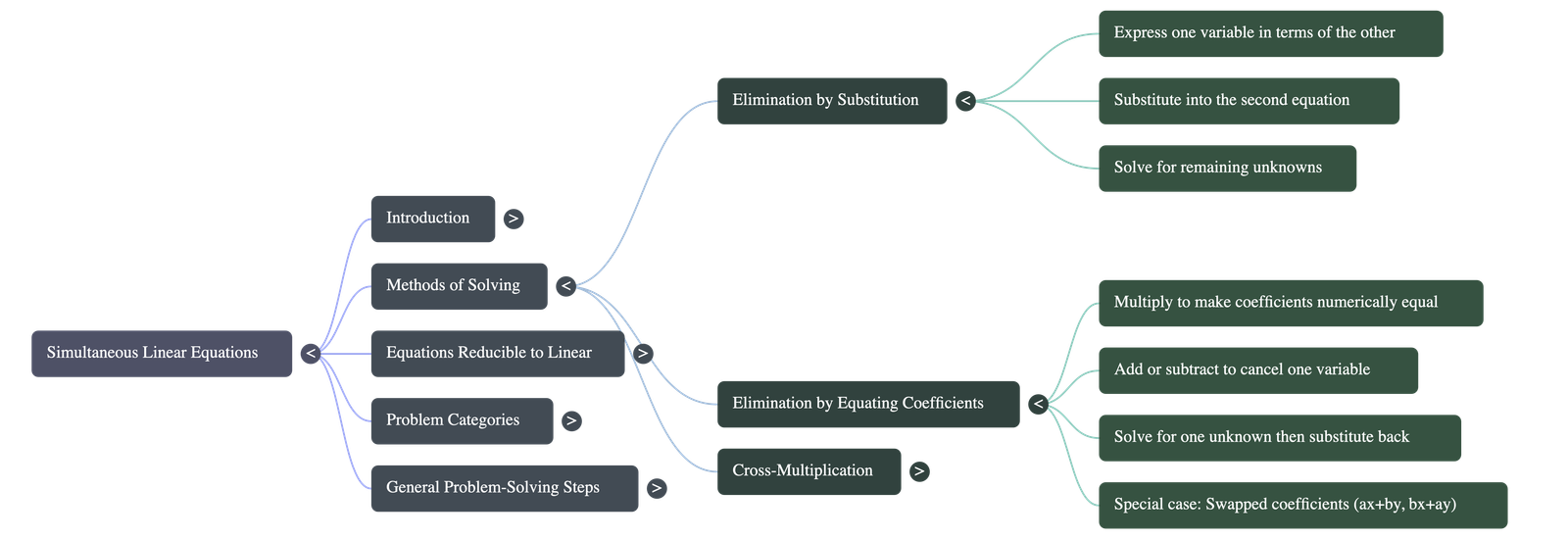
6.3 Method of Elimination by Substitution
This method involves isolating one variable to "substitute" it out of the equations. The steps are:
- Step 1: Choose one of the two given equations and isolate one variable (express its value in terms of the other variable). For example, finding y in terms of x.
- Step 2: Substitute this newly found expression into the second equation. This creates a new equation with only one variable, which you can easily solve.
- Step 3: Take the numerical value obtained in Step 2 and substitute it back into the expression from Step 1 to find the value of the remaining unknown variable.
6.4 Method of Elimination by Equating Coefficients
This method focuses on making the numbers attached to the variables (coefficients) identical so they can cancel each other out.
- Step 1: Multiply one or both equations by carefully chosen numbers so that the coefficient of either x or y becomes numerically equal in both equations.
- Step 2: Add or subtract the two new equations. If the equal coefficients have the same sign, you subtract; if they have opposite signs, you add. This completely eliminates one variable.
- Step 3: Solve the resulting single-variable equation to find the value of that unknown.
- Step 4: Substitute this numerical value into any of the original equations to solve for the second variable.
- Special Case for Interchanged Coefficients: If the equations look like ax + by = c and bx + ay = d (the coefficients of x and y are swapped), solve them by first adding the two equations to get a simpler equation (like x + y = value), then subtracting them to get another simple equation (like x - y = value). Finally, solve these two new, much simpler equations.
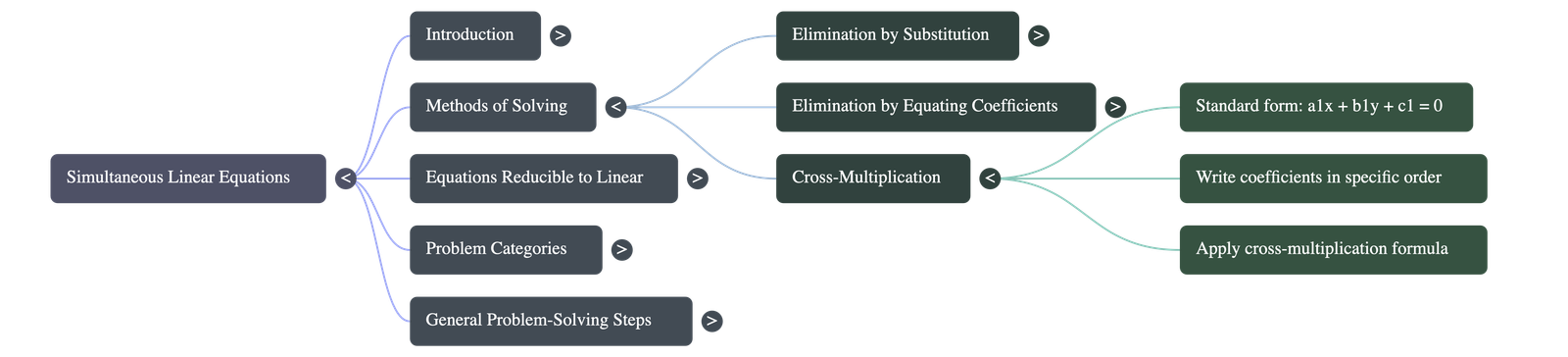
6.5 Method of Cross-Multiplication
This is a formula-based approach using the coefficients of the standard form equations.
- Standard Form: Ensure both equations are written as a₁x + b₁y + c₁ = 0 and a₂x + b₂y + c₂ = 0. (Everything must be on one side, equaling zero).
- The Formula: The variables can be directly found using the relation:
x / (b₁c₂ - b₂c₁) = y / (c₁a₂ - c₂a₁) = 1 / (a₁b₂ - a₂b₁) - Arrow Diagram Technique: Write the coefficients in columns (b, c, a, b). Draw downward arrows (multiply and keep the sign) and upward arrows (multiply and subtract the product). This visual trick helps students perfectly recall the complex formula without memorizing it.
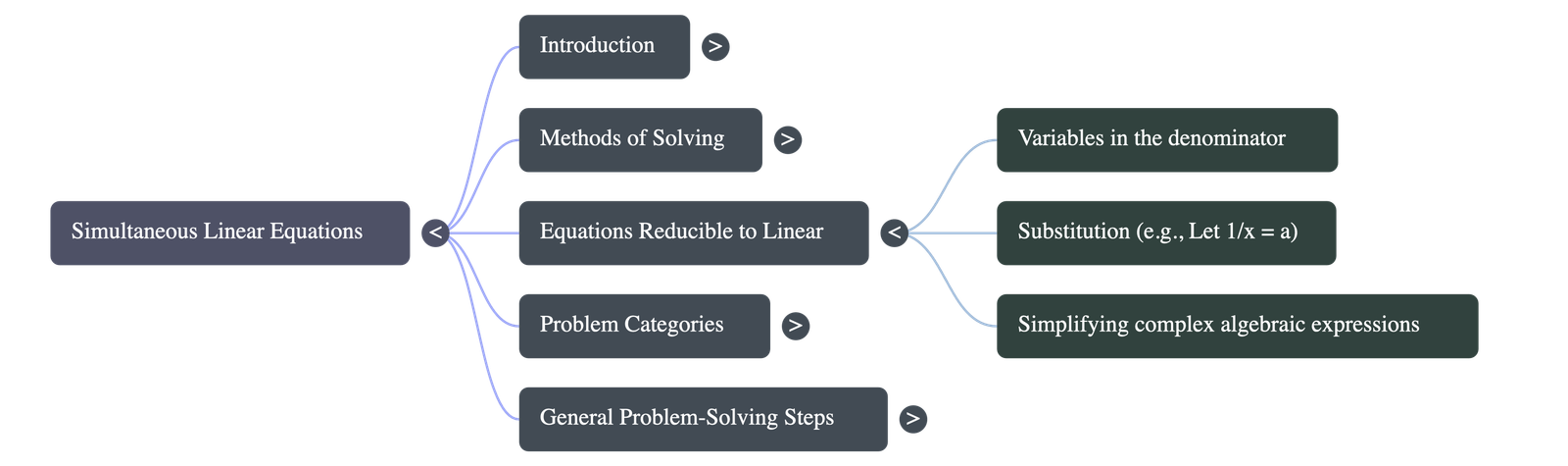
6.6 Equations Reducible to Linear Equations
Sometimes equations don't look linear initially, especially when variables are located in the denominator (e.g., 7/x + 8/y = 2).
- Direct Approach: You can solve these directly without taking the Lowest Common Multiple (LCM) of the denominators, treating terms like 1/x as a single unit.
- Substitution Approach: A highly recommended alternative is to temporarily replace the fraction with a new variable. For example, let 1/x = a and 1/y = b. This transforms the complex equation into a standard linear equation (e.g., 7a + 8b = 2). After finding a and b, simply take their reciprocals to find the final answers for x and y.
6.7 Problems Based on Simultaneous Equations (Word Problems)
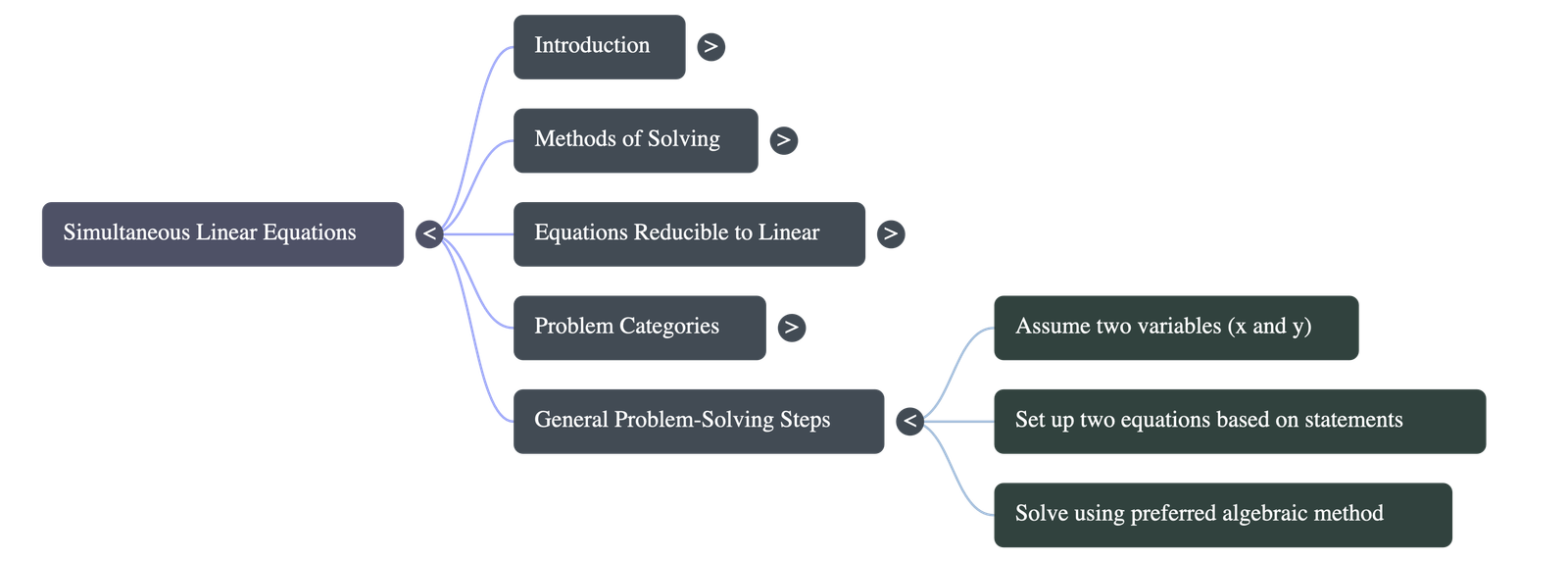
This section applies the mathematical methods to real-world scenarios. The standard steps are: (1) Assume the two unknown quantities as x and y, (2) Translate the given statements into two mathematical equations, and (3) Solve them using any of the three methods.
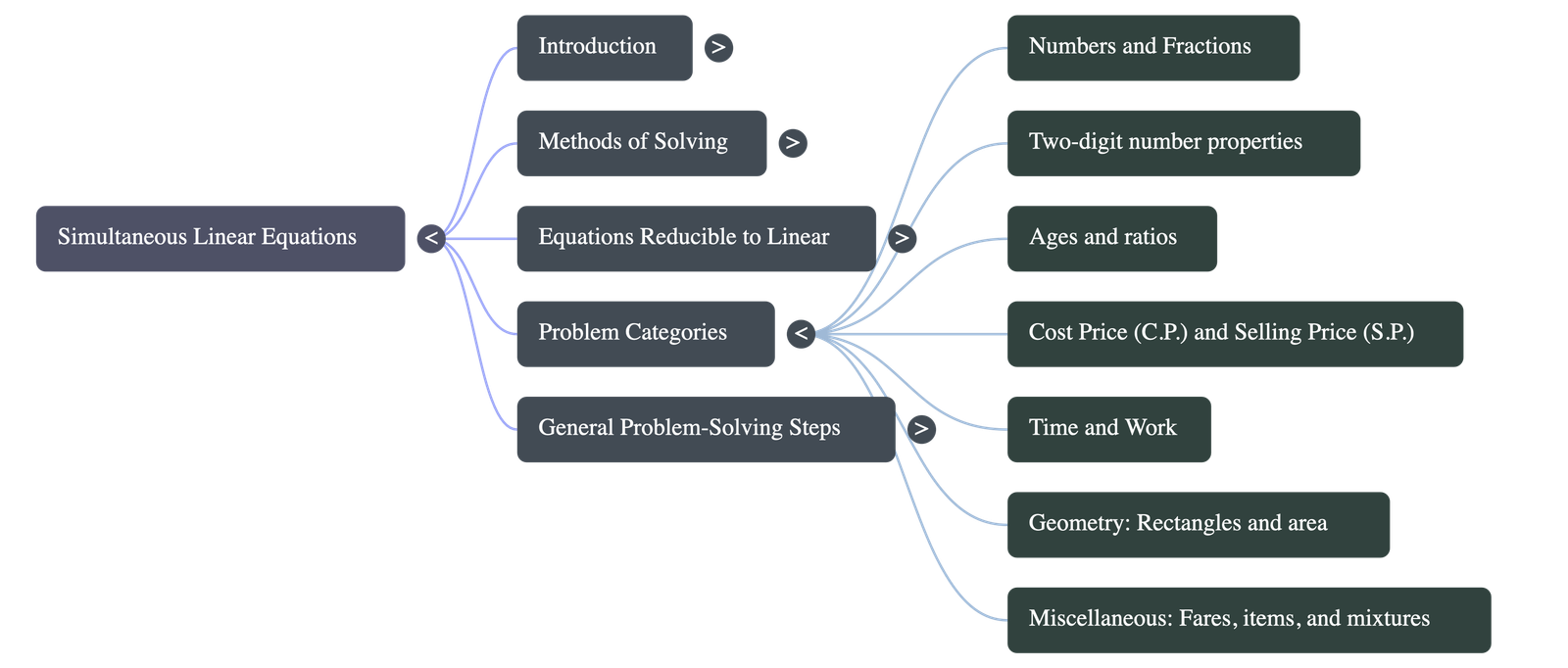
The chapter categorizes these word problems into specific types:
- A. Based on Numbers: Problems involving the sum, difference, or ratios of two distinct unknown numbers.
- B. Based on Fractions: Problems where adding or subtracting numbers from a numerator (x) and denominator (y) changes the overall value of the fraction to a new given ratio.
- C. Based on Two-Digit Numbers: Very important concept where a two-digit number is expressed algebraically as 10x + y (where x is the tens digit and y is the units digit). Reversing the digits makes the number 10y + x.
- D. Based on Ages: Relates the present ages of two individuals (x and y) to conditions in the past (subtracting years) or in the future (adding years).
- E. Based on Cost Price (C.P.) and Selling Price (S.P.): Commercial math problems calculating profit/loss percentages and finding original cost prices of items using two variables.
- F. Based on Time and Work: Problems calculating how long individuals take to complete tasks. If A does a job in x days, A's 1-day work is represented as 1/x.
- G. Miscellaneous Problems: Covers a variety of real-life situations, such as calculating fixed and variable taxi fares, finding dimensions (length and breadth) of rectangles based on changes in area, or exchanging items (like passing oranges back and forth).
Do checkout all questions & answers of this chapter.