Rational and Irrational Numbers
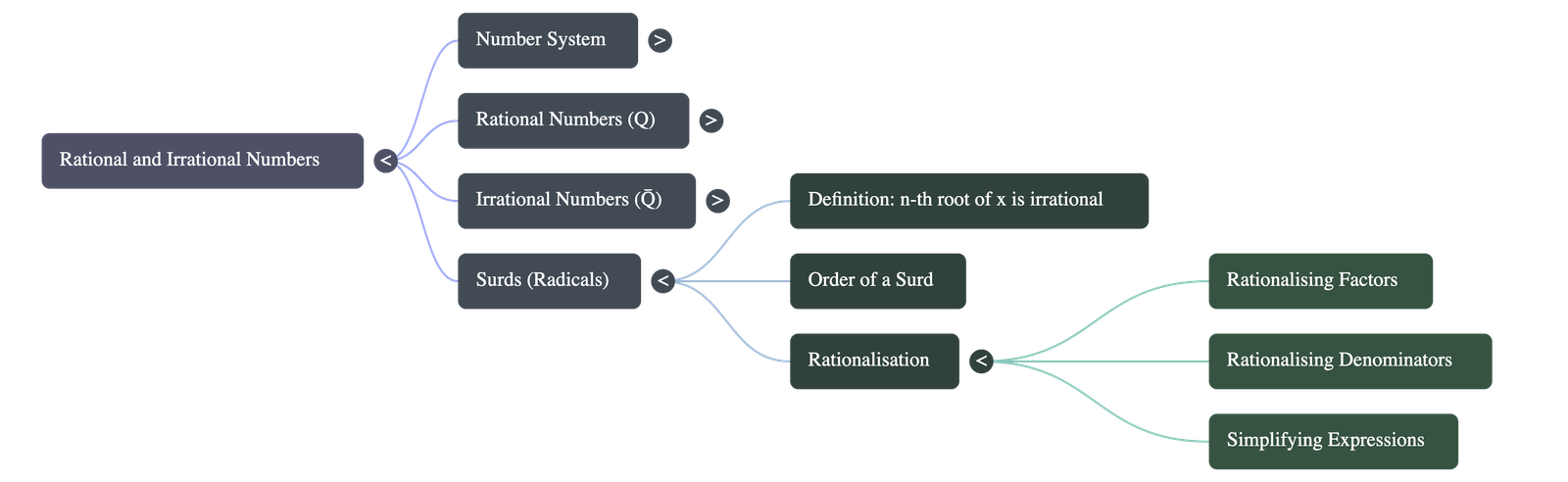
1. Introduction to the Number System
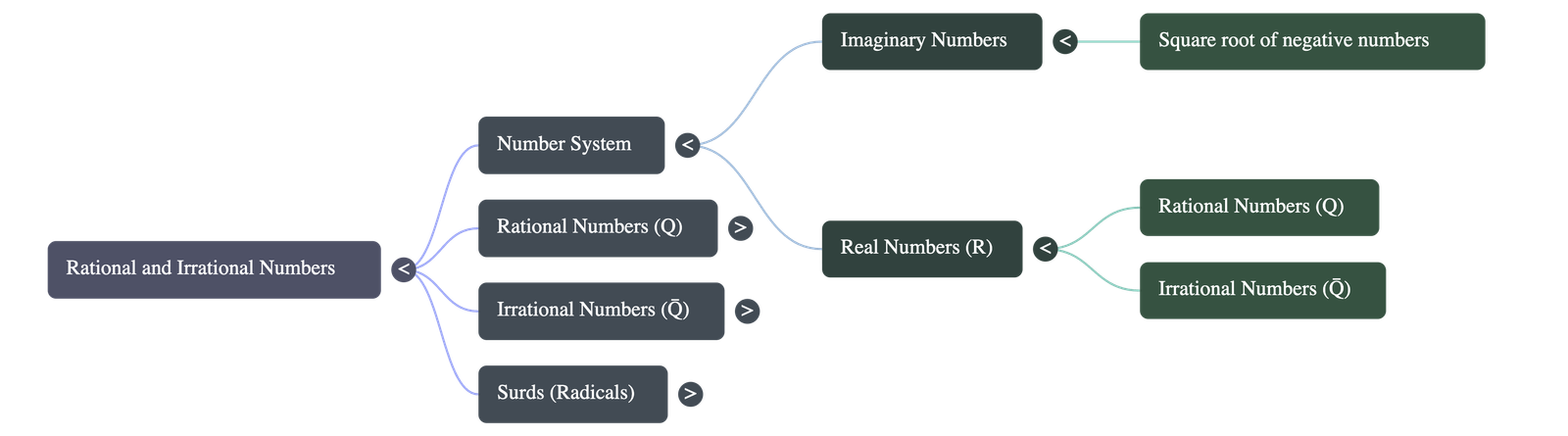
- The complete number system is divided into two main categories: Imaginary numbers (e.g., the square root of negative numbers) and Real numbers.
- Real Numbers consist of Rational Numbers and Irrational Numbers.
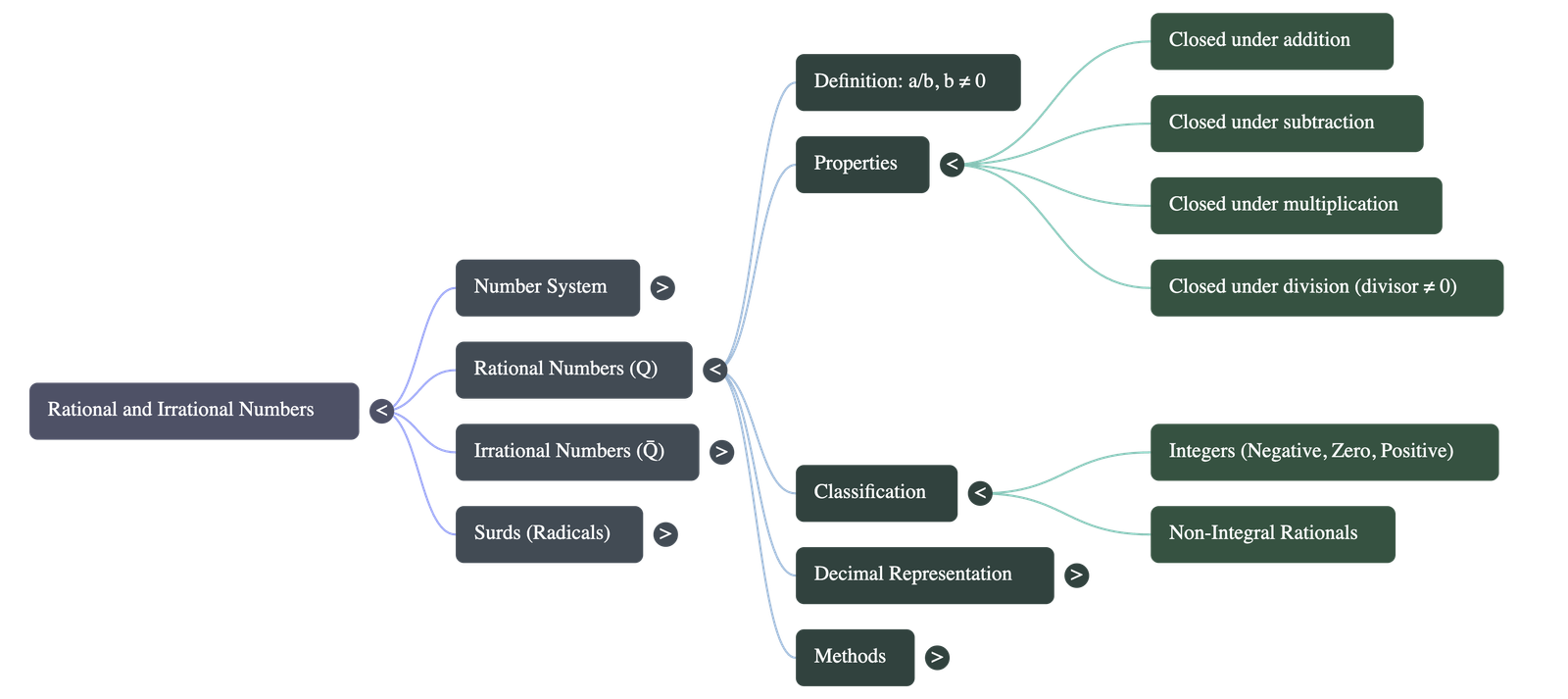
- Rational numbers further branch into Integers (Positive, Negative, and Zero) and Non-Integral Rationals (fractions).
2. Rational Numbers (Q)
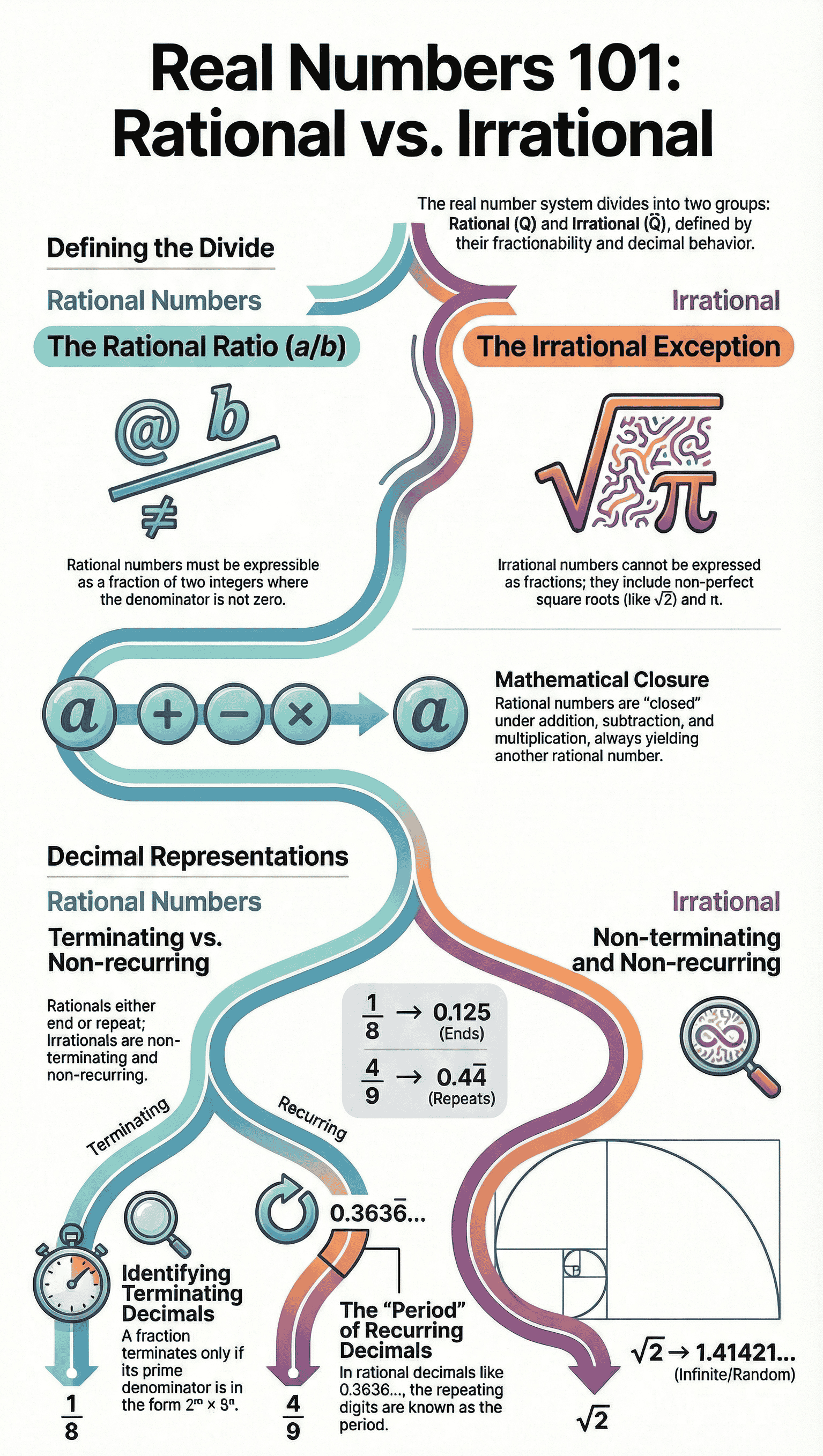
- A rational number is any number that can be expressed in the form a/b, where 'a' and 'b' are integers and 'b' is not equal to zero.
- Every integer and every decimal number is a rational number.
- For standard rational numbers, 'a' and 'b' are co-primes (no common factor other than 1), and 'b' is usually positive.
- Two rational numbers a/b and c/d are equal if and only if a × d = b × c.
- There are infinitely many rational numbers between any pair of rational numbers. A simple way to find one rational number between 'a' and 'b' is to use the formula (a + b) / 2.
3. Finding Multiple Rational Numbers Between Two Given Numbers
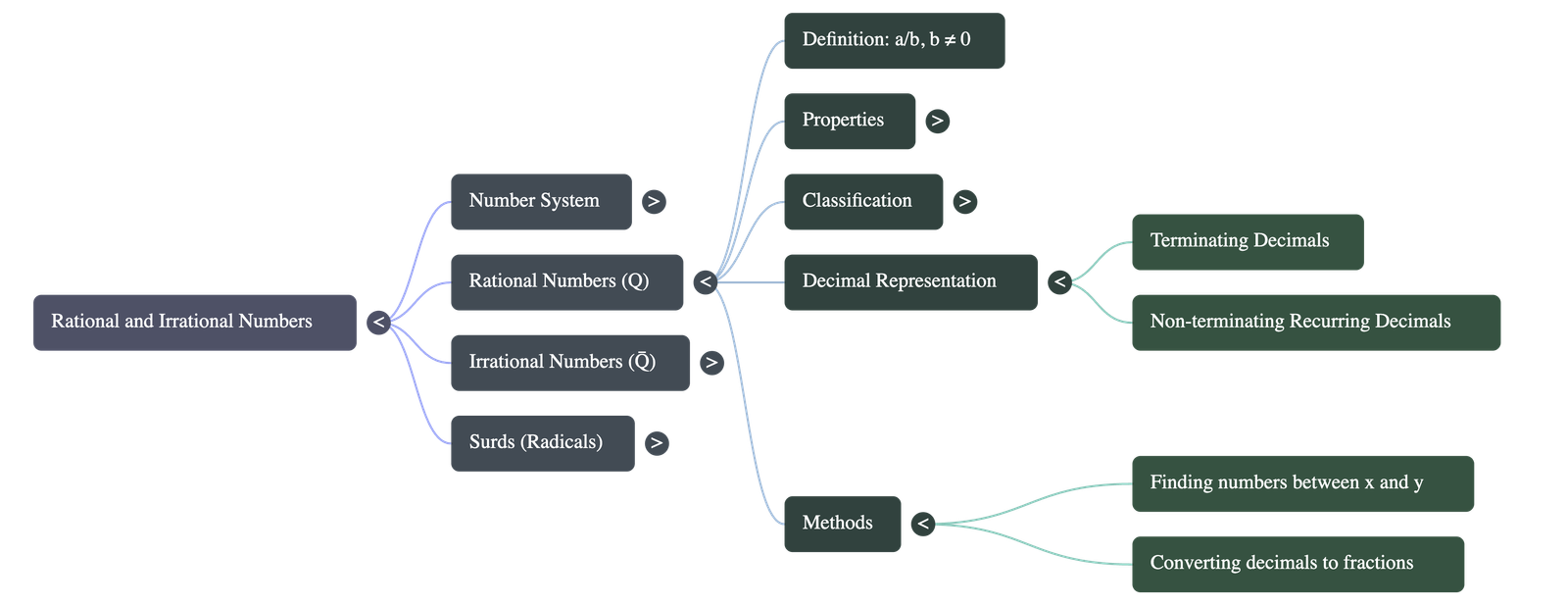
- To find 'n' rational numbers between 'x' and 'y' (where x < y), first calculate a common difference d = (y - x) / (n + 1).
- The required rational numbers will then be x + d, x + 2d, x + 3d, ..., x + nd.
- Alternative Method: Make the denominators of the given fractions equal by finding the L.C.M., and then multiply both the numerator and denominator by (n + 1) to create enough spacing to easily pick numbers between them.
4. Properties of Rational Numbers
- The sum, difference, and product of two or more rational numbers is always a rational number (This is known as the closure property).
- The division of a rational number by a non-zero rational number is always a rational number.
5. Decimal Representation of Rational Numbers
- Every rational number can be expressed either as a terminating decimal or a non-terminating recurring decimal.
- Terminating Decimals: Occur when the division is exact (no remainder). A rational number can be expressed as a terminating decimal if its denominator (in lowest form) can be prime factored strictly into powers of 2 and 5 (i.e., 2m × 5n).
- Non-Terminating Recurring Decimals: Occur when the division never ends, but a digit or set of digits repeats continuously (the "period"). Indicated by a dot or bar over the repeating digits.
- Conversion: To convert a recurring decimal back to a fraction, set it to an equation (let x = ...), multiply by powers of 10 to shift the decimal point past the repeating parts, and subtract the equations to solve for x.
6. Irrational Numbers
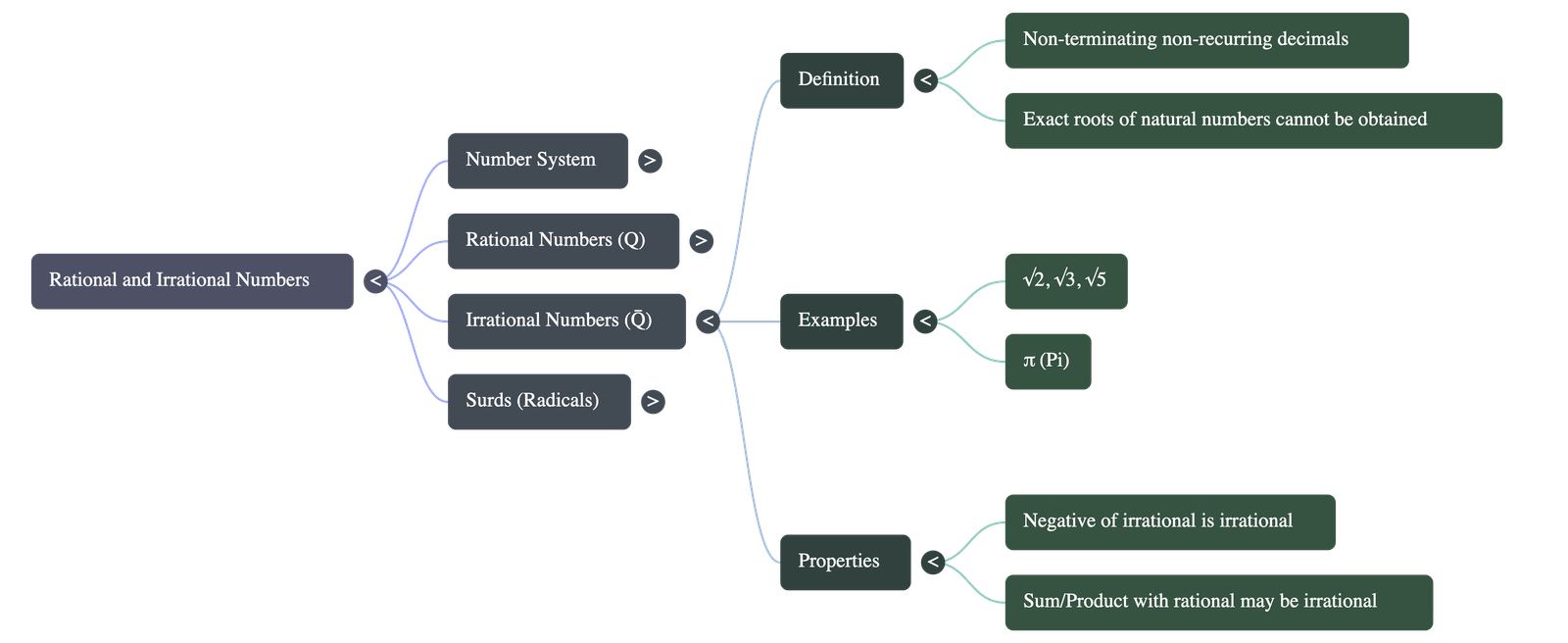
- Irrational numbers include the square roots, cube roots, etc., of natural numbers whose exact values cannot be obtained (e.g., √2, √3).
- They are represented by non-terminating and non-recurring decimals.
- The mathematical constant π is an irrational number (22/7 is merely an approximate rational value used for calculation).
- To find an irrational number between two positive numbers 'a' and 'b' (where their product is not a perfect square), use the formula √(ab).
- The sum, difference, or product of two irrational numbers may or may not be irrational. However, the product of a non-zero rational number and an irrational number is always irrational.
7. Real Numbers
- The Real Numbers (R) system is simply the union of the set of rational numbers and the set of irrational numbers.
8. Surds (Radicals)
- If 'x' is a positive rational number and 'n' is a positive integer greater than 1, such that the nth root of x (n√x) is irrational, it is called a surd or radical of order n.
- Key Rule: Every surd is an irrational number, but every irrational number is not necessarily a surd (for example, π is irrational but not a surd).
9. Rationalisation
- Concept: When two surds are multiplied together to produce a rational number, they are called rationalising factors of each other.
- Rationalising the Denominator: To simplify an expression with a surd in the denominator, you multiply both the numerator and the denominator by the lowest rationalising factor of the denominator. (e.g., multiply by √2 / √2 to remove a √2 from the bottom).
Mastering Rational & Irrational Numbers
Comprehensive Study Guide, Quiz, & Glossary
Part 1: Detailed Study Guide
1. The Number System Hierarchy
- Real Numbers form the parent category for both rational and irrational numbers.
- Rational Numbers (Q) can be expressed as a/b (where b ≠ 0). They branch into integers and non-integral rationals (fractions).
- Integers (I or Z) encompass negative integers, zero, and positive integers (Natural Numbers). When zero is added to Natural Numbers, they become Whole Numbers.
2. Rational Numbers & Their Properties
- Closure: Adding, subtracting, multiplying, or dividing (by a non-zero) two rational numbers always yields a rational number.
- Decimal Representation: Rationals take two forms when converted to decimals:
- Terminating: The division ends exactly (e.g., 1/8 = 0.125). This happens if the denominator's prime factors are only 2s and/or 5s.
- Non-Terminating Recurring: The division never ends, but a digit or block of digits repeats continuously (e.g., 4/9 = 0.444...).
- Finding Midpoints: To find a rational number exactly between two others (a and b), use the formula: (a + b) / 2.
3. Irrational Numbers
- Defined as numbers that cannot be represented as simple fractions. Their decimals are strictly non-terminating and non-recurring.
- Common examples include the square roots of non-perfect squares (like √2, √3) and the number π. Note: 22/7 is only an approximate value of π.
- Unlike rational numbers, the sum, difference, product, or quotient of two irrational numbers is not necessarily irrational; it can sometimes be rational (e.g., √3 × √3 = 3).
4. Number Line Representation & Surds
- Plotting Irrationals: Irrational roots like √2 are plotted on a number line using geometric construction based on the Pythagoras theorem (using a right triangle of base 1 and height 1 to create a hypotenuse of √2, then drawing an arc).
- Surds: A surd is a root of a positive rational number that gives an irrational result (e.g., √5). While all surds are irrational, not all irrational numbers are surds (e.g., π).
- Rationalization: The mathematical process of removing a surd from the denominator of a fraction by multiplying both numerator and denominator by its rationalizing factor.
Part 2: Concept Quiz
- What is the fundamental difference between a rational and an irrational number in terms of their decimal representations?
- How can you determine if a rational fraction will result in a terminating decimal without performing the actual division?
- Explain why π (Pi) is considered an irrational number, even though we frequently use 22/7 to represent it in calculations.
- Are all surds irrational numbers? Are all irrational numbers surds? Provide a brief explanation.
- What happens when you multiply two rationalizing factors together? Give a simple example.
- Briefly describe the geometrical method used to represent √2 on a standard number line.
- Is the sum of two irrational numbers always an irrational number? Justify your answer.
- What is the primary purpose of rationalizing the denominator of a fraction?
- When proving irrationality by contradiction, what specific assumption is initially made regarding the factors of the numerator 'a' and denominator 'b'?
- If you are given two distinct rational numbers, how can you calculate a rational number that sits exactly halfway between them?
Part 3: Quiz Answer Key
- Rational numbers possess decimal expansions that either terminate or form a non-terminating repeating pattern. In contrast, irrational numbers have decimal expansions that never terminate and never form a repeating pattern.
- You examine the prime factors of the fraction's denominator when it is in its simplest form. If the prime factorization contains only 2s, only 5s, or a combination of both, the fraction will convert to a terminating decimal.
- π is irrational because its exact value cannot be written as a simple fraction, and its decimal expansion continues infinitely without repeating. The fraction 22/7 is merely a convenient approximation used for standard math problems, not the exact value of π.
- Yes, every true surd (like √5) is an irrational number by definition. However, not all irrational numbers are surds; for example, π is irrational but is not considered a surd because it is not derived from extracting the root of a rational number.
- When two rationalizing factors are multiplied together, their product is always a rational number. For instance, multiplying the surd √3 by its rationalizing factor √3 results in the rational number 3.
- You draw a right-angled triangle directly on the number line starting at zero, with both the base and the perpendicular height measuring 1 unit. According to the Pythagoras theorem, the hypotenuse is exactly √2, which you then use a compass to swing down and mark on the number line.
- No, the sum of two irrational numbers is not always irrational. If you add an irrational number to its negative counterpart, such as (3 + √5) and (3 - √5), the irrational parts cancel out, resulting in the rational number 6.
- The primary purpose is to remove any square roots (surds) from the bottom portion of the fraction. This simplifies the expression, making it equivalent but much easier to compute and handle in further equations.
- The proof starts by assuming the number is rational, meaning it can be written as a/b. Critically, it assumes that 'a' and 'b' are co-primes, meaning they have been simplified fully and share no common factor other than 1.
- You simply add the two given rational numbers together and divide the sum by 2. The formula used is (a + b) / 2.
Part 4: Essay Format Questions & Detailed Working
Question 1: Prove that √2 is an irrational number using the alternative method of contradiction.
Detailed Answer & Working:
Let us assume the opposite: Assume that √2 is a rational number.
If it is rational, it can be written in its simplest fractional form a/b, where a and b are integers, b ≠ 0, and a and b are co-primes (they have no common factor other than 1).
Therefore: √2 = a / b
Squaring both sides:
2 = a2 / b2
a2 = 2b2 (Equation I)
This means a2 is an even number divisible by 2. If a square of a number is divisible by 2, the number itself must also be divisible by 2. So, a is divisible by 2.
Let a = 2c (where c is some integer).
Substitute a = 2c into Equation I:
(2c)2 = 2b2
4c2 = 2b2
b2 = 2c2
This implies b2 is divisible by 2, which means b must also be divisible by 2.
Since both a and b are divisible by 2, they share a common factor of 2. This directly contradicts our initial assumption that a and b are co-primes (having no common factor other than 1).
Therefore, our assumption is wrong, and √2 is an irrational number.
Question 2: Simplify the following expression by rationalizing its denominator: 1 / (3 - √7)
Detailed Answer & Working:
To rationalize the denominator, we must multiply the numerator and the denominator by the rationalizing factor of the denominator.
The denominator is (3 - √7), so its rationalizing factor is its conjugate, (3 + √7).
Expression: [ 1 / (3 - √7) ] × [ (3 + √7) / (3 + √7) ]
Numerator becomes: 1 × (3 + √7) = 3 + √7
Denominator becomes: (3 - √7)(3 + √7)
Using the algebraic identity (x - y)(x + y) = x2 - y2:
Denominator = (3)2 - (√7)2
Denominator = 9 - 7 = 2
Final simplified answer: (3 + √7) / 2
Question 3: If x = 2 + √3, mathematically determine the value of (x2 + 1/x2).
Detailed Answer & Working:
First, find the value of 1/x:
1/x = 1 / (2 + √3)
Rationalize 1/x by multiplying the top and bottom by (2 - √3):
1/x = [ 1 / (2 + √3) ] × [ (2 - √3) / (2 - √3) ]
Numerator = 2 - √3
Denominator = (2)2 - (√3)2 = 4 - 3 = 1
Therefore, 1/x = 2 - √3
Now, calculate (x + 1/x):
x + 1/x = (2 + √3) + (2 - √3)
x + 1/x = 4
To find x2 + 1/x2, square both sides of the equation (x + 1/x) = 4:
(x + 1/x)2 = (4)2
x2 + (1/x)2 + 2(x)(1/x) = 16
x2 + 1/x2 + 2(1) = 16
x2 + 1/x2 = 16 - 2
Final Answer: x2 + 1/x2 = 14
Question 4: Find the values of 'a' and 'b' if:
(2√3 + 3√2) / (2√3 - 3√2) = a + b√6
Detailed Answer & Working:
Rationalize the left-hand side (LHS) denominator by multiplying top and bottom by (2√3 + 3√2).
LHS = [ (2√3 + 3√2) / (2√3 - 3√2) ] × [ (2√3 + 3√2) / (2√3 + 3√2) ]
Numerator = (2√3 + 3√2)2
= (2√3)2 + (3√2)2 + 2(2√3)(3√2)
= (4 × 3) + (9 × 2) + 12√6
= 12 + 18 + 12√6 = 30 + 12√6
Denominator = (2√3)2 - (3√2)2
= 12 - 18 = -6
Putting it together:
LHS = (30 + 12√6) / -6
Divide both terms by -6:
LHS = -5 - 2√6
Set LHS equal to RHS:
-5 - 2√6 = a + b√6
By comparing rational and irrational parts, we find:
a = -5 and b = -2
Question 5: Insert exactly one rational number and one irrational number between the integers 3 and 4.
Detailed Answer & Working:
Rational Number:
To find a rational number exactly halfway between two rational numbers a and b, use the formula (a + b) / 2.
Rational number between 3 and 4 = (3 + 4) / 2 = 7 / 2 = 3.5
Irrational Number:
To find an irrational number between two positive numbers a and b (where their product is not a perfect square), use the formula √(ab).
Product = 3 × 4 = 12.
Irrational number = √12 = 2√3
Alternative approach for irrational number:
Express 3 and 4 as square roots: 3 = √9 and 4 = √16.
Any non-perfect square root between √9 and √16 is irrational.
Therefore, √10, √11, √13, √14, or √15 are all perfectly valid irrational numbers between 3 and 4.
Part 5: Comprehensive Glossary of Key Terms
- Imaginary Numbers
- Numbers whose square is negative (e.g., √-4). These fall outside the scope of real numbers.
- Real Numbers (R)
- The complete set consisting of the union of all rational numbers and all irrational numbers.
- Rational Numbers (Q)
- Any number that can be expressed as a fraction a/b, where a and b are both integers and b is not zero. They have terminating or non-terminating recurring decimal expansions.
- Irrational Numbers
- Numbers that cannot be written as simple fractions. Their decimal expansions are non-terminating and non-recurring (e.g., √2, π).
- Integers (I or Z)
- The set of whole numbers and their negatives {...-2, -1, 0, 1, 2...}. Every integer is a rational number.
- Natural Numbers (N)
- Positive integers starting from 1 (1, 2, 3...).
- Whole Numbers (W)
- The set of Natural Numbers with the addition of zero (0, 1, 2, 3...).
- Terminating Decimal
- A decimal that ends, resulting from a division that leaves a remainder of zero (e.g., 1/8 = 0.125).
- Recurring (Periodic) Decimal
- A non-terminating decimal in which a single digit or a specific sequence of digits repeats continuously forever.
- Surd (Radical)
- The root of a positive rational number that results in an irrational number (e.g., √5). All surds are irrational, but not all irrationals are surds.
- Rationalization
- The mathematical process of removing a surd from an expression (most commonly the denominator of a fraction) by multiplying it by a suitable factor.
- Rationalizing Factor
- A surd that, when multiplied by another surd, yields a rational product. For example, the rationalizing factor of (3 - √7) is (3 + √7).
Do checkout all questions & answers of this chapter.