Quick Navigation:
| | | |
Pythagoras Theorem
[Proof and Simple Applications with Converse]
12.1 Introduction
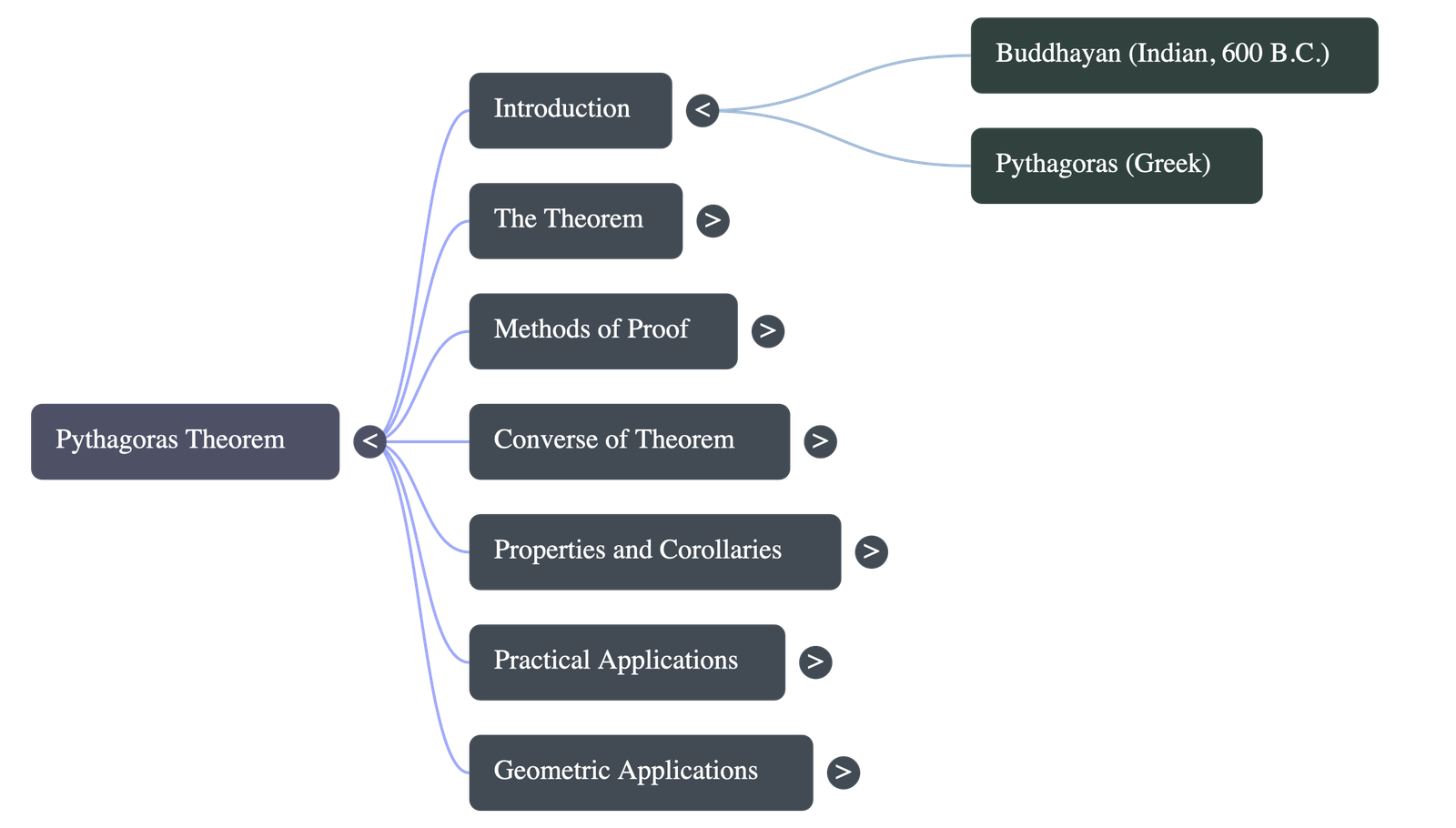
- Historical Origins: The core relationship between the sides of a right-angled triangle was originally developed by an Indian Mathematician named Buddhayan around 600 B.C.
- Naming Credit: The theorem in its present mathematical form is credited to the ancient Greek Mathematician Pythagoras, hence it is universally known as the Pythagoras Theorem.
12.2 Pythagoras Theorem & Proofs
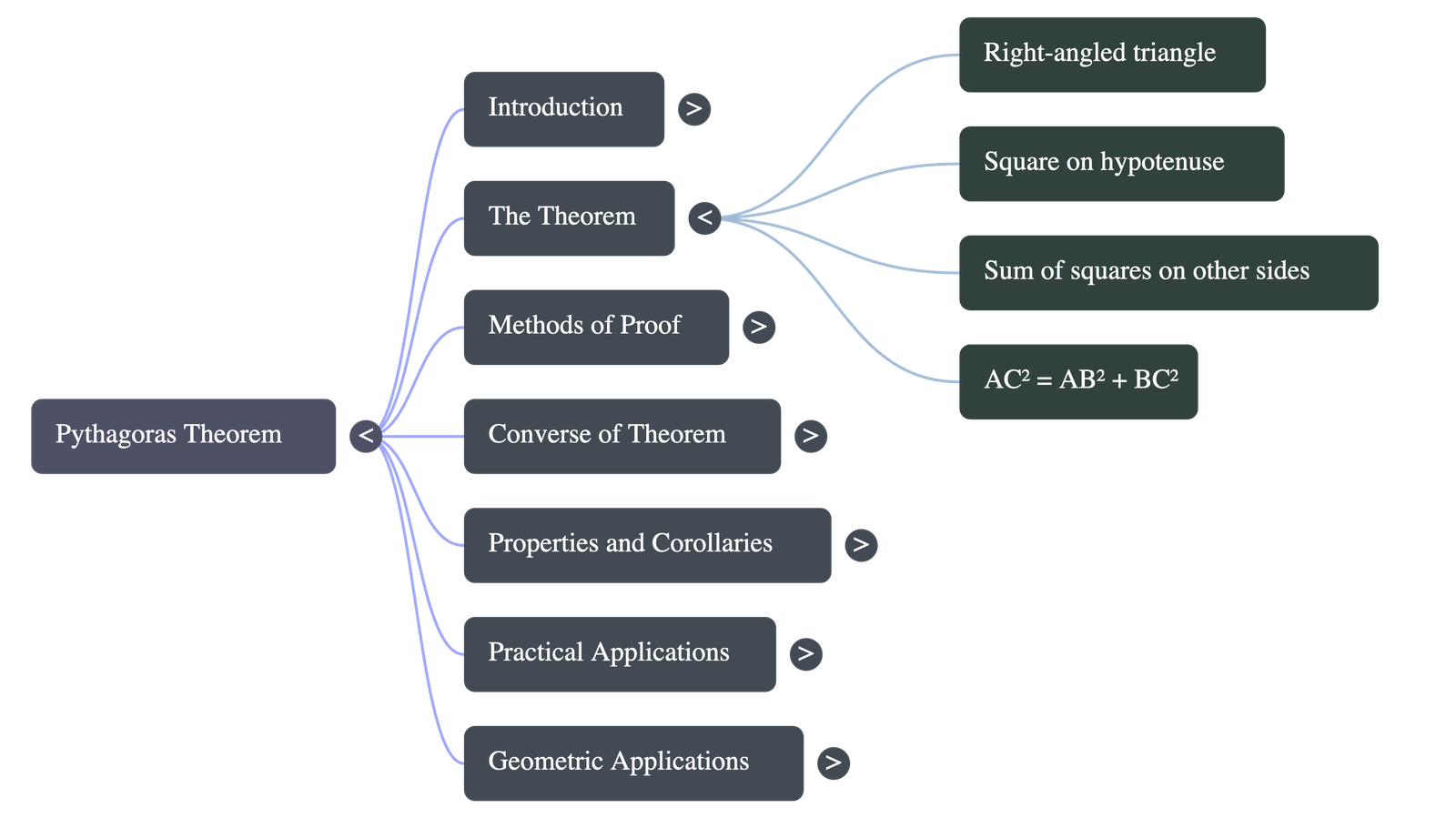
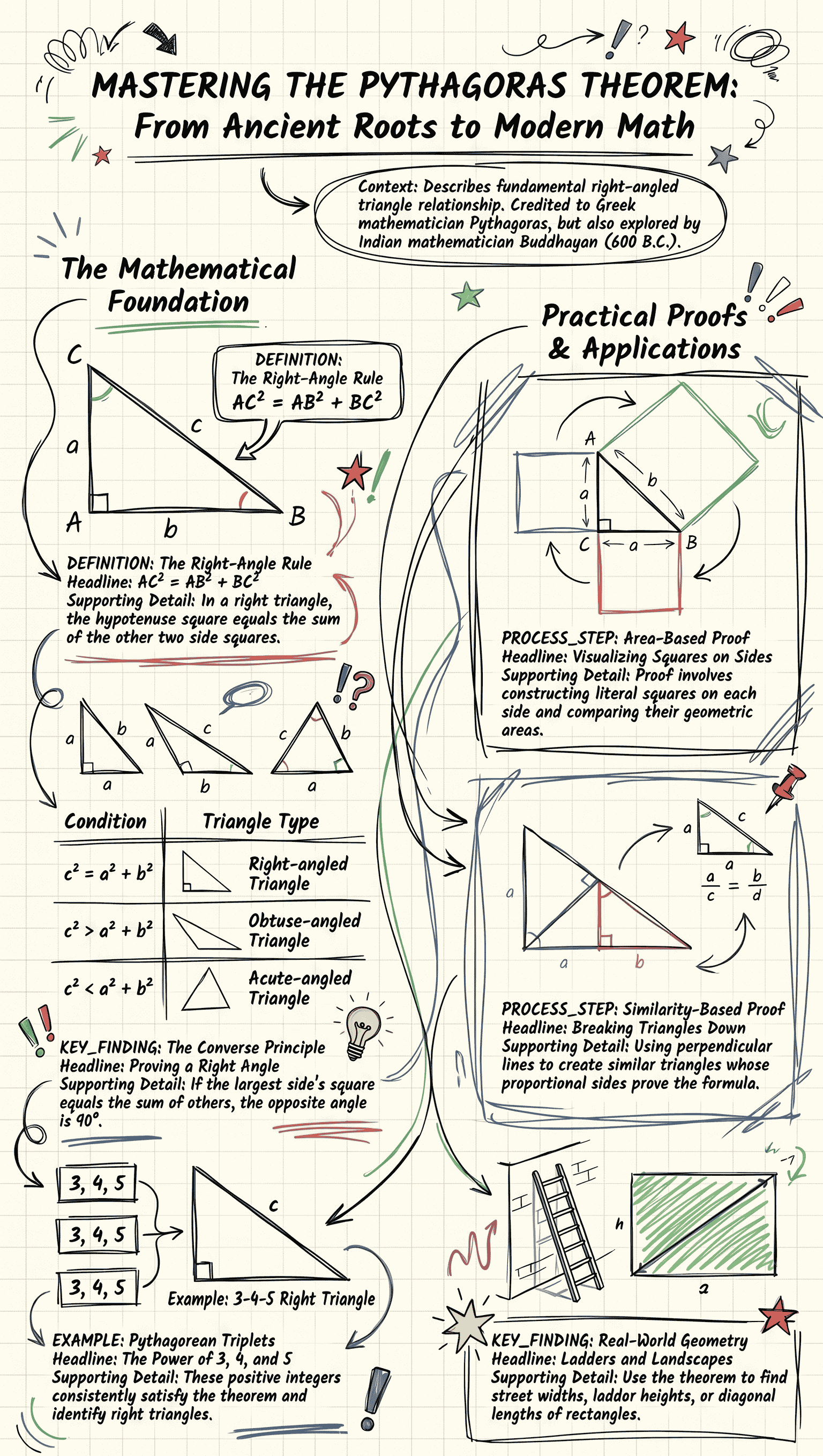
- Statement of the Theorem: In a right-angled triangle, the square of the hypotenuse (the longest side) is exactly equal to the sum of the squares of the remaining two sides. (i.e., AC2 = AB2 + BC2).
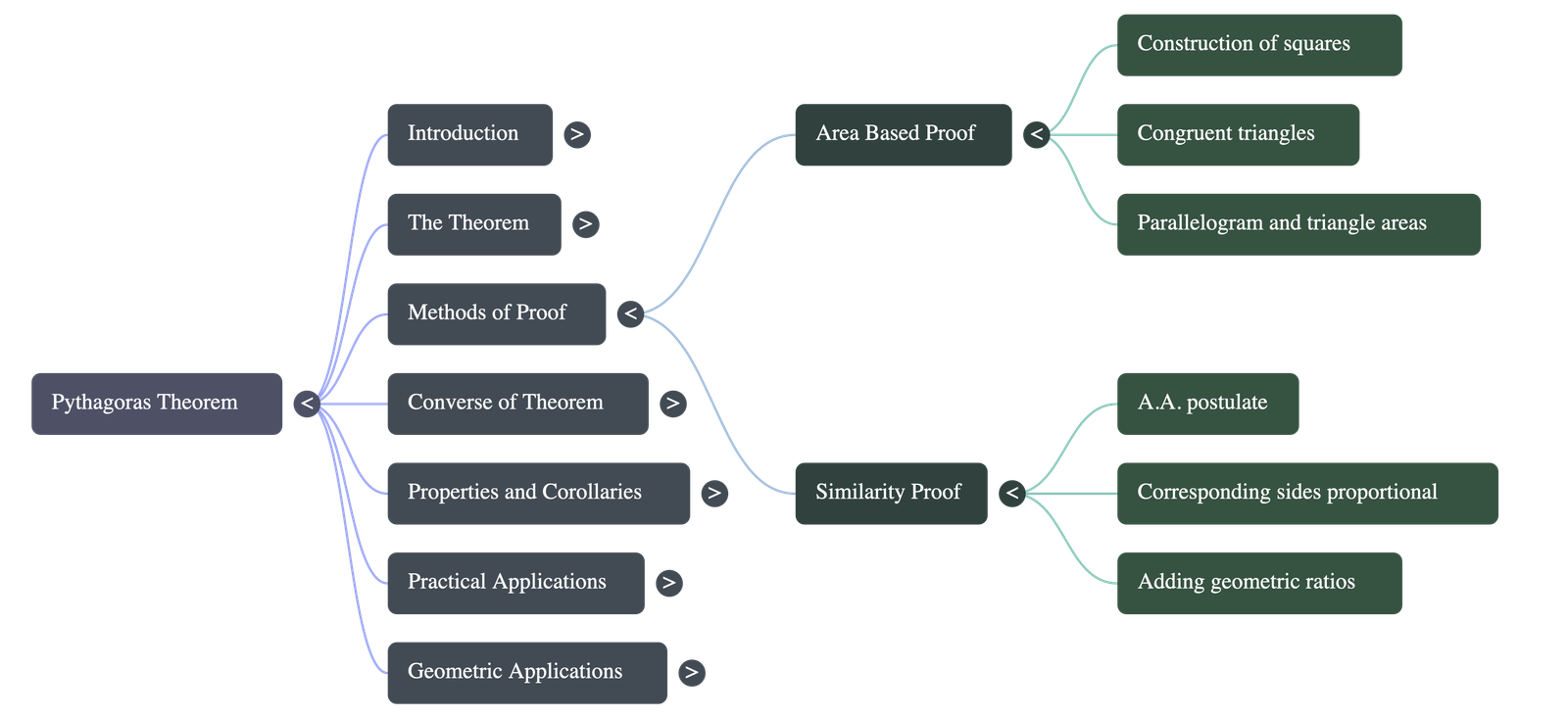
- Theorem 9 (Area-Based Proof): This geometric proof involves drawing squares on all three sides of the right-angled triangle. By drawing perpendiculars and proving that specific triangles are congruent (using Side-Angle-Side criteria), it is shown that the area of the square on the hypotenuse equals the combined area of the squares on the other two sides.
- Theorem 10 (Alternative Proof using Similarity): A simpler proof is provided using the concept of similar triangles. By dropping a perpendicular from the 90-degree angle to the hypotenuse, the original triangle is divided into two smaller triangles. Proving these smaller triangles are similar to the whole triangle allows us to use proportional sides to prove that AC2 = AB2 + BC2.
Converse of Pythagoras Theorem & Triangle Deductions
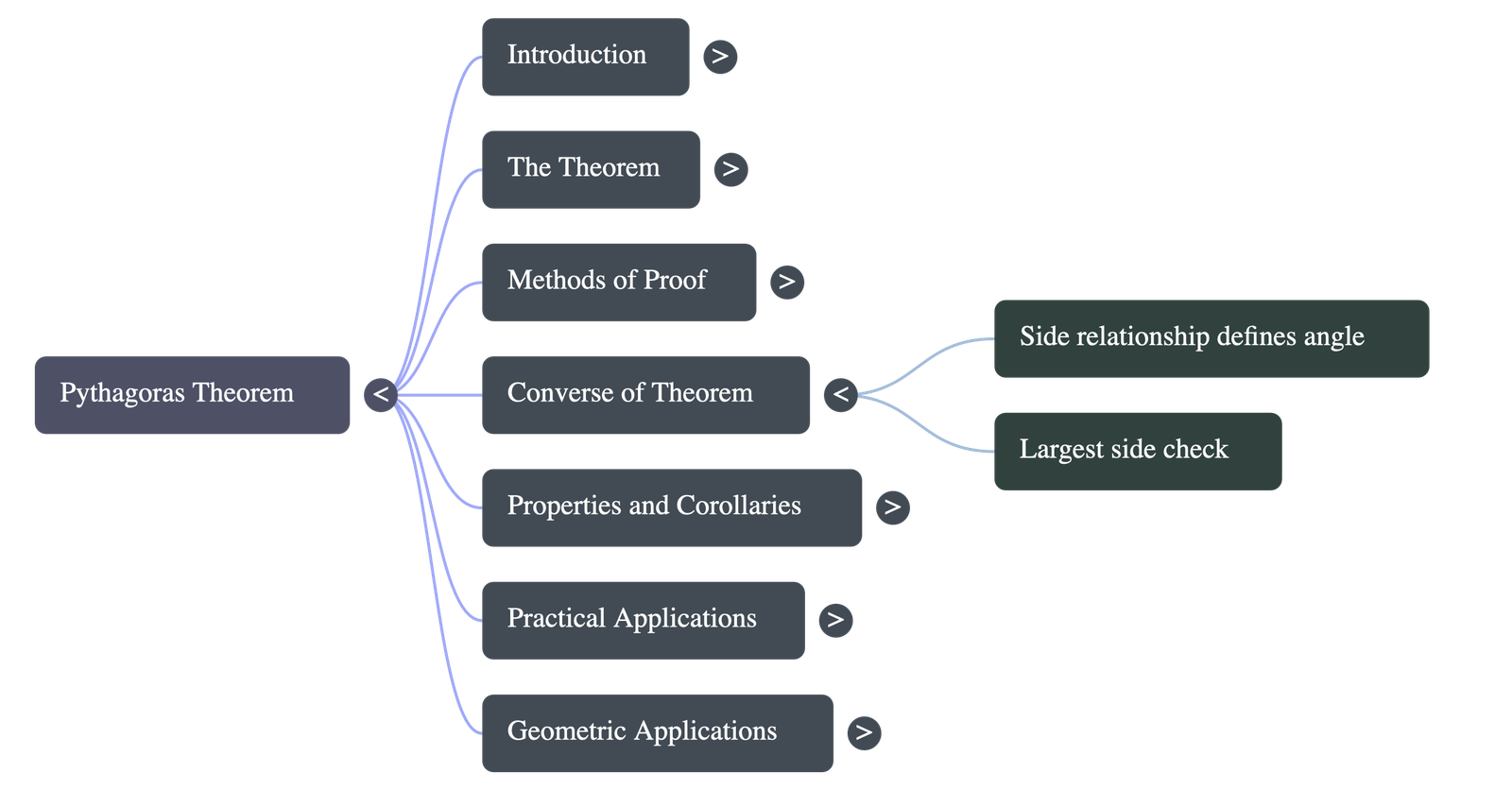
- The Converse: If the square of the longest side of a triangle is equal to the sum of the squares of the other two sides, then the triangle is definitively a right-angled triangle, and the angle opposite the longest side is 90 degrees.
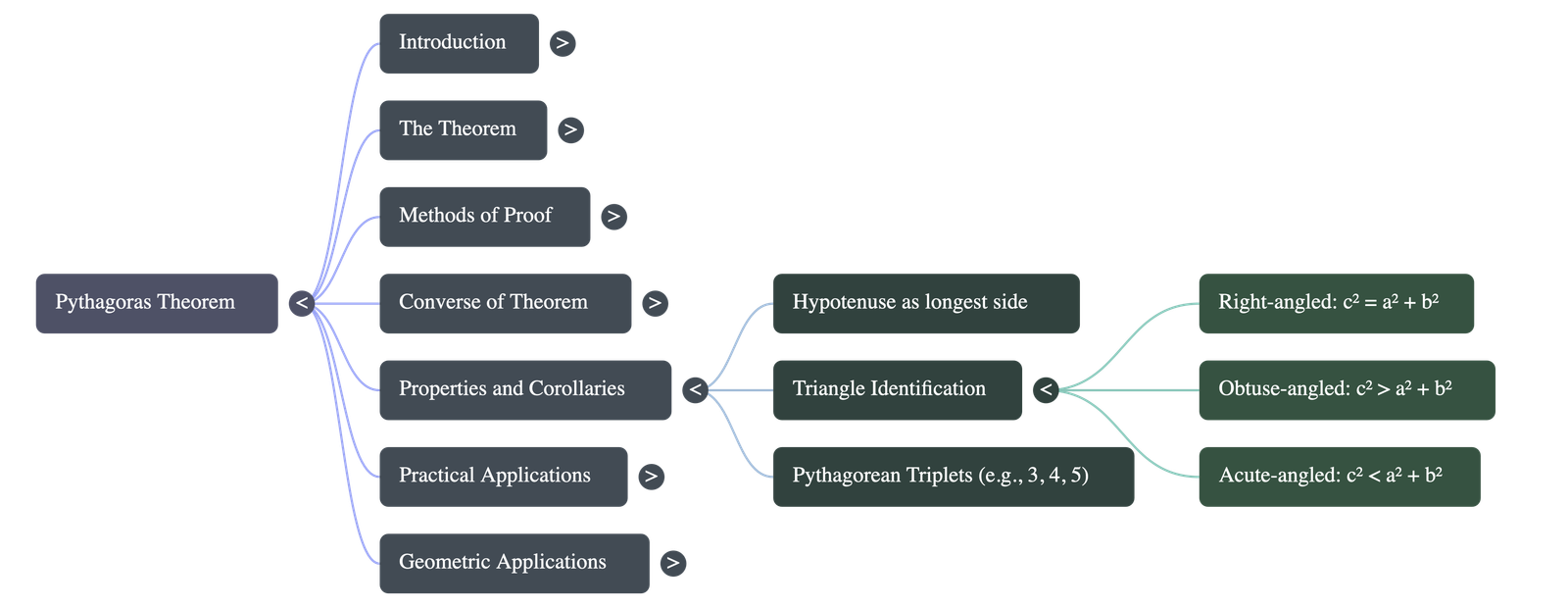
- Identifying Triangle Types by Sides: Let AB be the longest side of triangle ABC:
- If AB2 = AC2 + BC2, it is a Right-angled triangle.
- If AB2 > AC2 + BC2, it is an Obtuse-angled triangle (angle is greater than 90 degrees).
- If AB2 < AC2 + BC2, it is an Acute-angled triangle (angle is less than 90 degrees).
Pythagorean Triplets
- Definition: A set of three positive numbers (a, b, and c) are called Pythagorean triplets if the sum of the squares of the two smaller numbers equals the square of the largest number (a2 + b2 = c2).
- Common Example: The numbers 3, 4, and 5 form a Pythagorean triplet because 32 + 42 = 52 (9 + 16 = 25).
Applications & Solved Examples
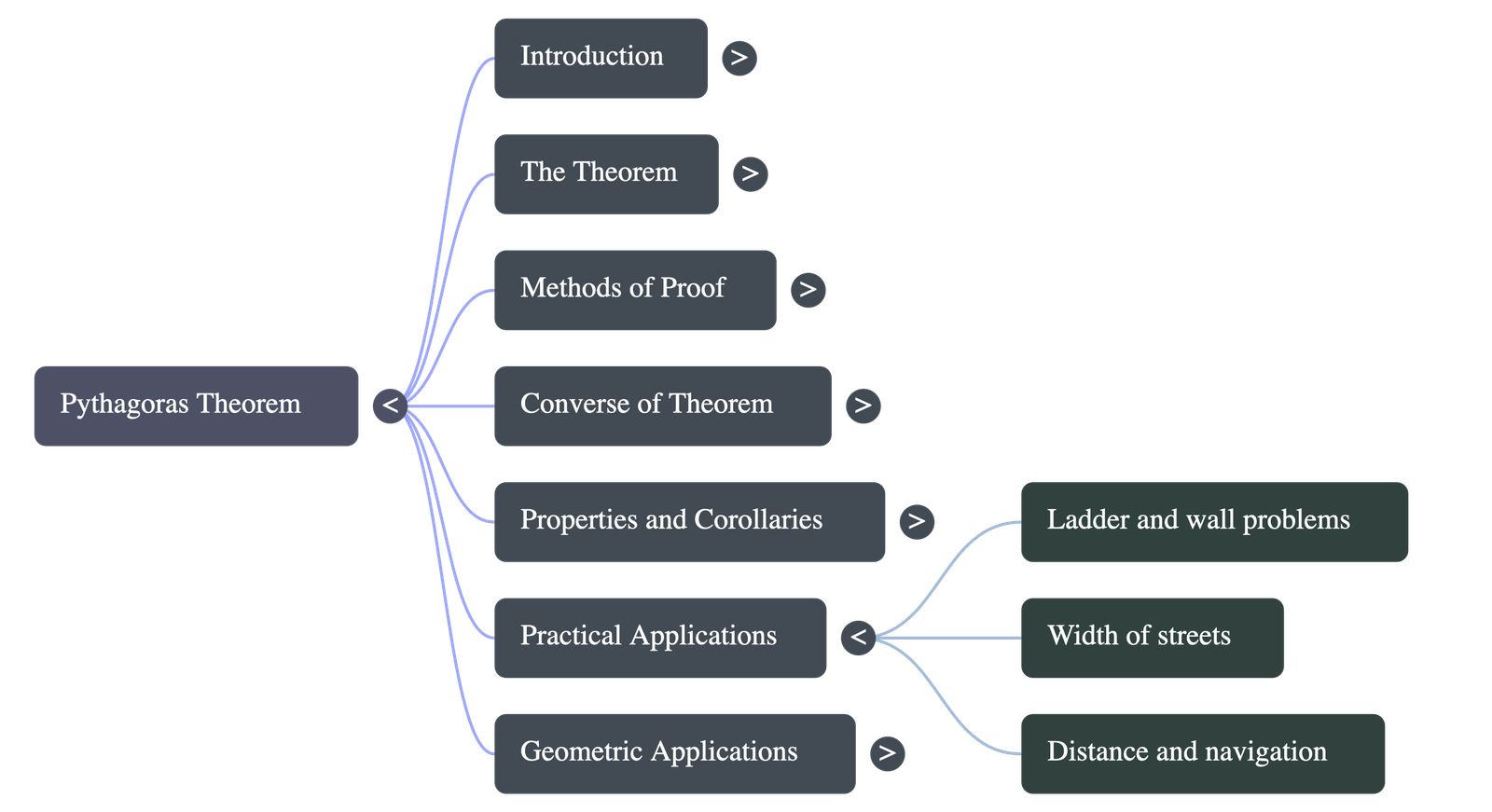
- Practical Measurements: The theorem is applied to find unknown distances, such as calculating the width of a street using a ladder leaning against walls on opposite sides.
- Directional Problems: Solving distance problems based on compass directions (e.g., finding the shortest distance from the starting point when someone travels North then West).
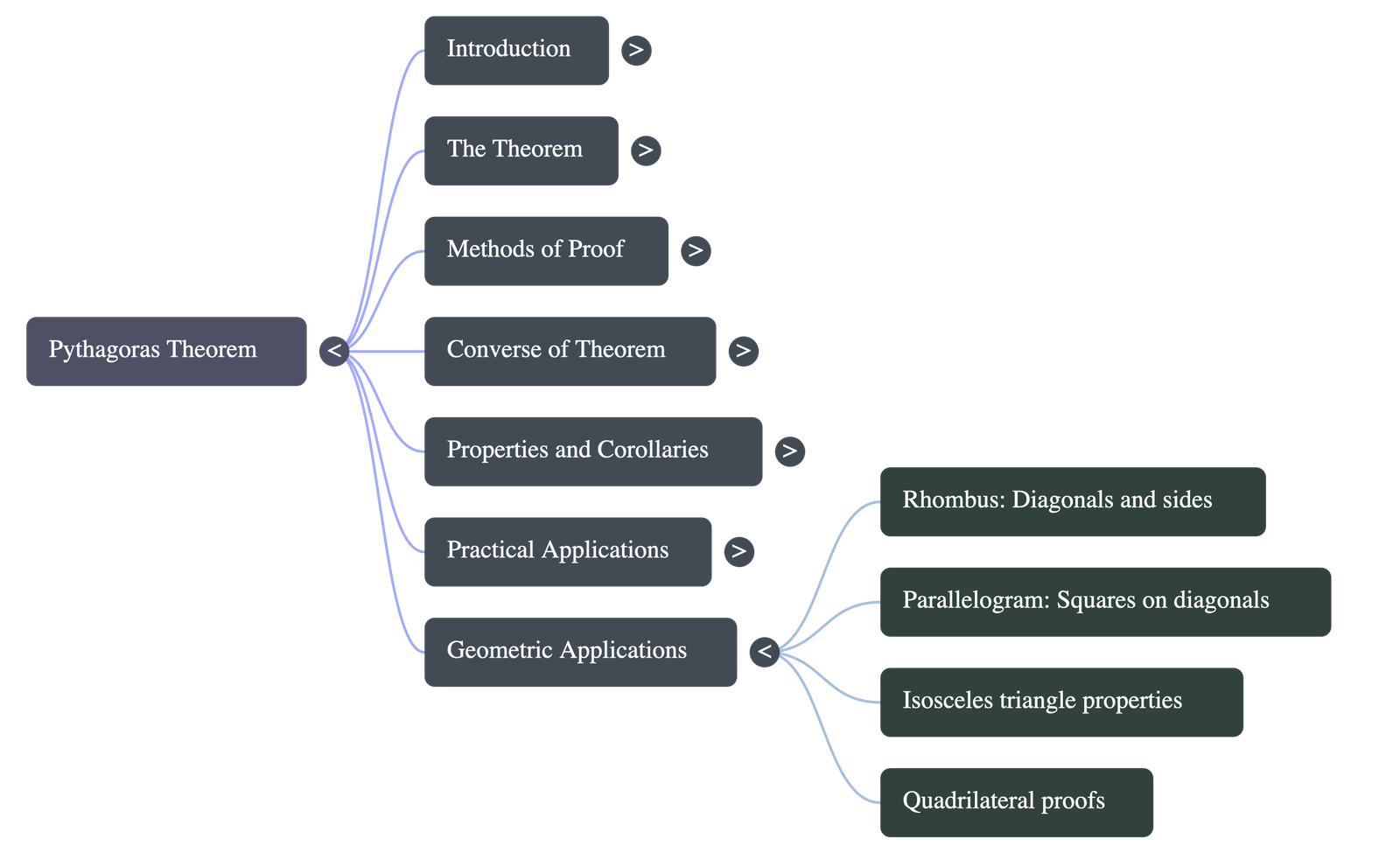
- Geometric Shapes: Using the theorem to prove properties within other quadrilaterals. For example, proving that the sum of the squares of the diagonals of a parallelogram or rhombus is equal to the sum of the squares of its sides.
- Algebraic Proofs in Geometry: Many examples show how to substitute algebraic values into the Pythagorean formula to prove complex geometric relations, such as relationships involving medians or perpendiculars dropped onto the bases of various triangles.
Exercises and Case Study Focus
- Comprehensive Exercises (12A & 12B): Provide extensive practice ranging from straightforward multiple-choice questions about side ratios and perimeters to high-order thinking proofs involving complex diagrams.
- Test Yourself Module: Includes assertion-reasoning type questions and real-world scenario questions to ensure a deep conceptual grasp.
- Real-Life Case Study: The chapter concludes with a practical problem involving a cheese sandwich cut diagonally. Students apply the theorem to find the length of the longest side of the sandwich, its perimeter, and calculate the exact area of silver foil needed to wrap it.
This summary provides a foundational understanding of the Pythagoras Theorem, designed to help Class 9 students master geometric proofs and real-world mathematical applications.
Do checkout all questions & answers of this chapter.
Quick Navigation:
| | | |
1 / 1
Quick Navigation:
| | | |