Quick Navigation:
| | | | |
Quick Navigation:
| | | | |
1. Fundamental Definitions
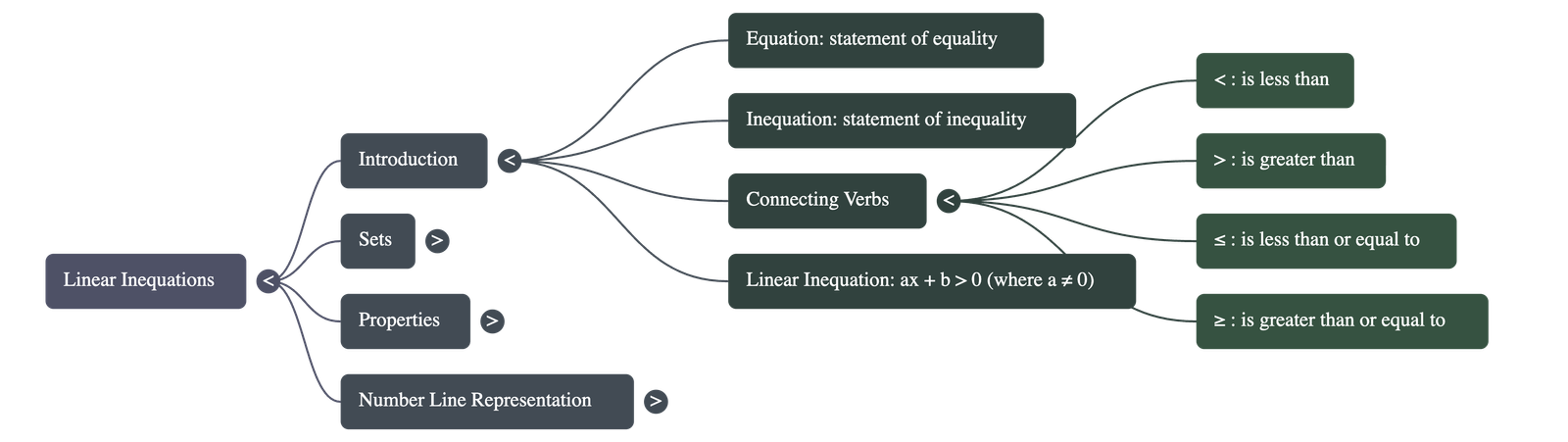
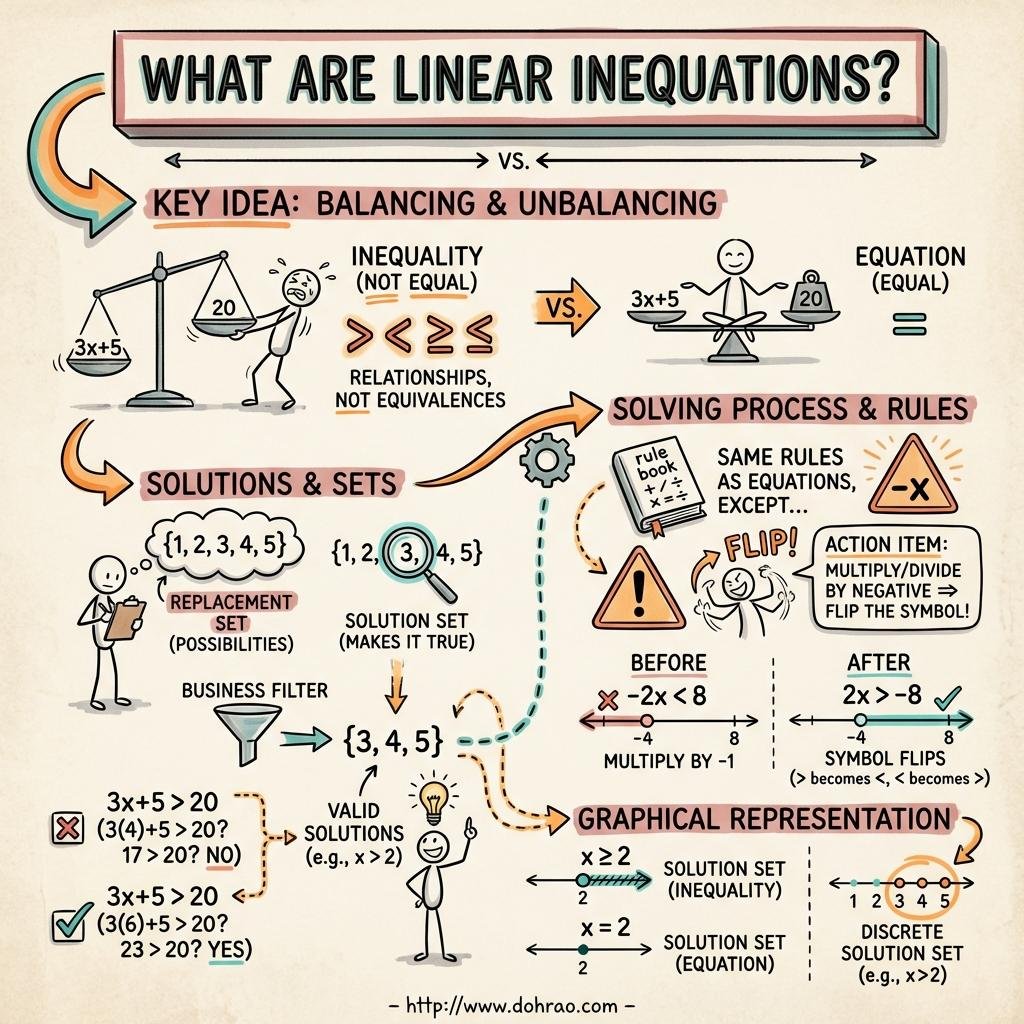
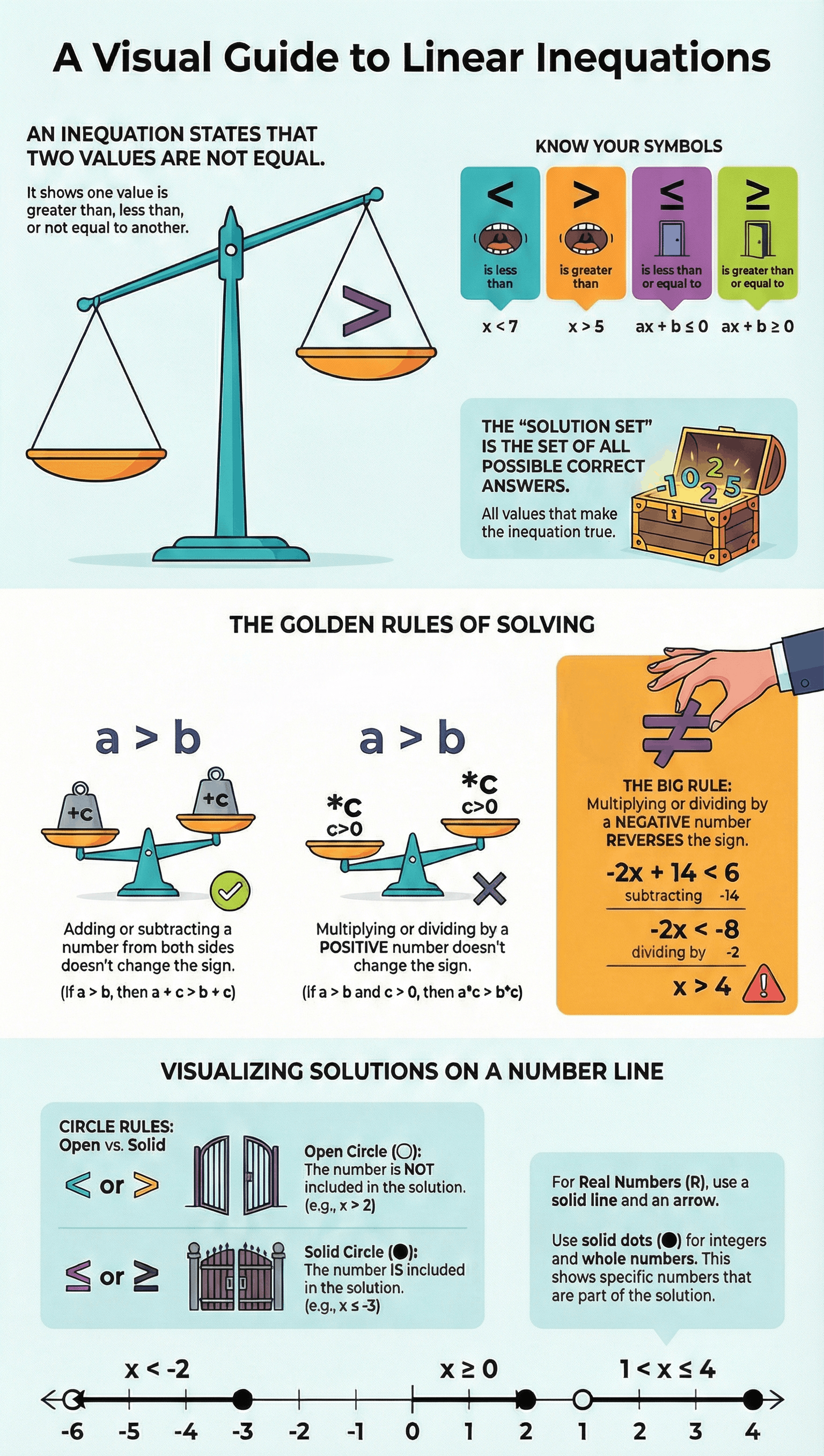
- Equation vs. Inequation: While an equation is a statement of equality (e.g., x = 5), an inequation is a statement showing that one thing is not equal to another, being either greater than or lesser than (e.g., x < 7 or x > 5).
- Connecting Verbs: These are the symbols used to show the relationship between values:
- < : is less than
- > : is greater than
- ≤ : is less than or equal to
- ≥ : is greater than or equal to
- Linear Inequation: If a and b are real numbers (and a is not zero), expressions like ax + b > 0 or ax + b ≤ 0 are defined as linear inequations.
2. Sets and Solutions
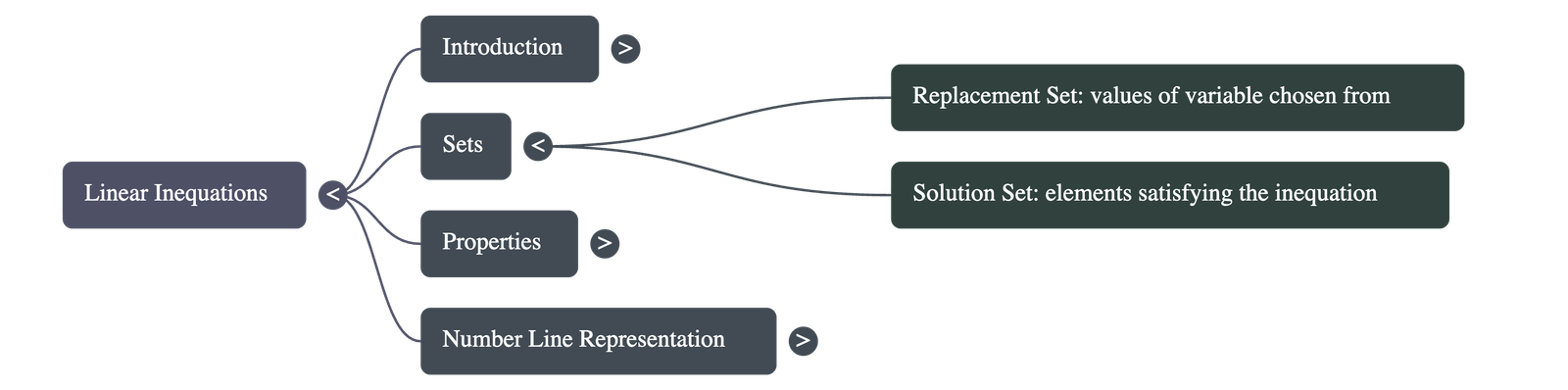
- Replacement Set: Also known as the universal set, this is the set of values from which the variable x is chosen.
- Solution Set: Also known as the truth set, this consists of only the elements from the replacement set that satisfy the given inequation.
- Variable Nature: The solution set changes depending on whether the replacement set consists of Natural numbers (N), Whole numbers (W), Integers (Z), or Real numbers (R).
3. Properties of Inequations
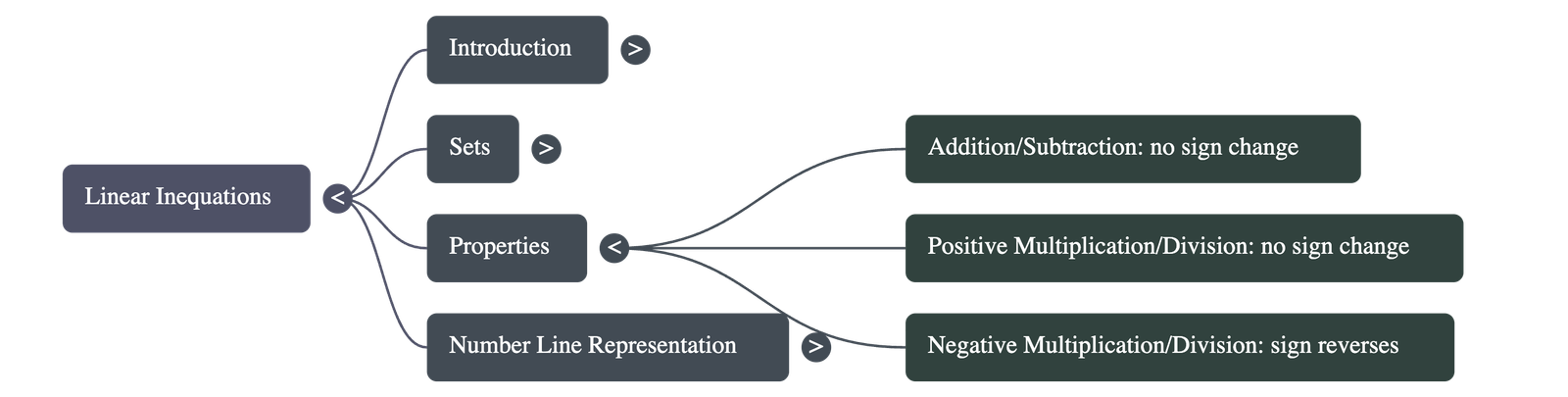
- Addition and Subtraction: Adding or subtracting the same number from both sides of an inequation does not change the sign of inequality.
- Positive Multiplication/Division: Multiplying or dividing each side by a positive number does not change the sign of inequality.
- Negative Multiplication/Division: Multiplying or dividing each side by a negative number reverses the sign of inequality (e.g., > becomes <).
4. Representation on a Number Line
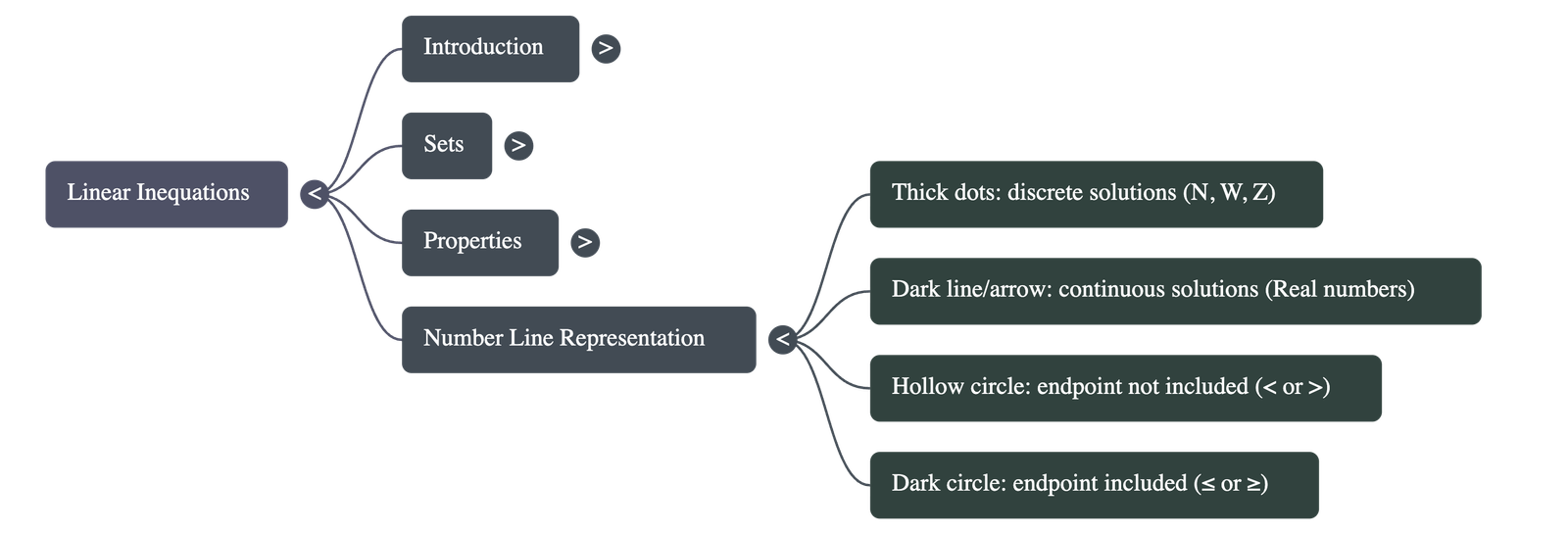
- Discrete Solutions: For sets like Natural numbers or Integers, the solution is represented by thick dots on the specific numbers that satisfy the inequation.
- Real Number Solutions: When x is a real number, the solution is represented by a dark line.
- A dark circle indicates that the end-point is included (used for ≤ or ≥).
- A hollow circle indicates that the end-point is excluded (used for < or >).
- Infinite Solutions: A dark arrow on either end of the number line indicates that the solution set continues infinitely in that direction.
Key Insight: Unlike a linear equation in one variable which usually has exactly one solution, a linear inequation typically has a set of multiple solutions or an entire range of values.
Do checkout all questions & answers of this chapter.
Quick Navigation:
| | | | |
1 / 1
Quick Navigation:
| | | | |