Quick Navigation:
| | | |
Rocks
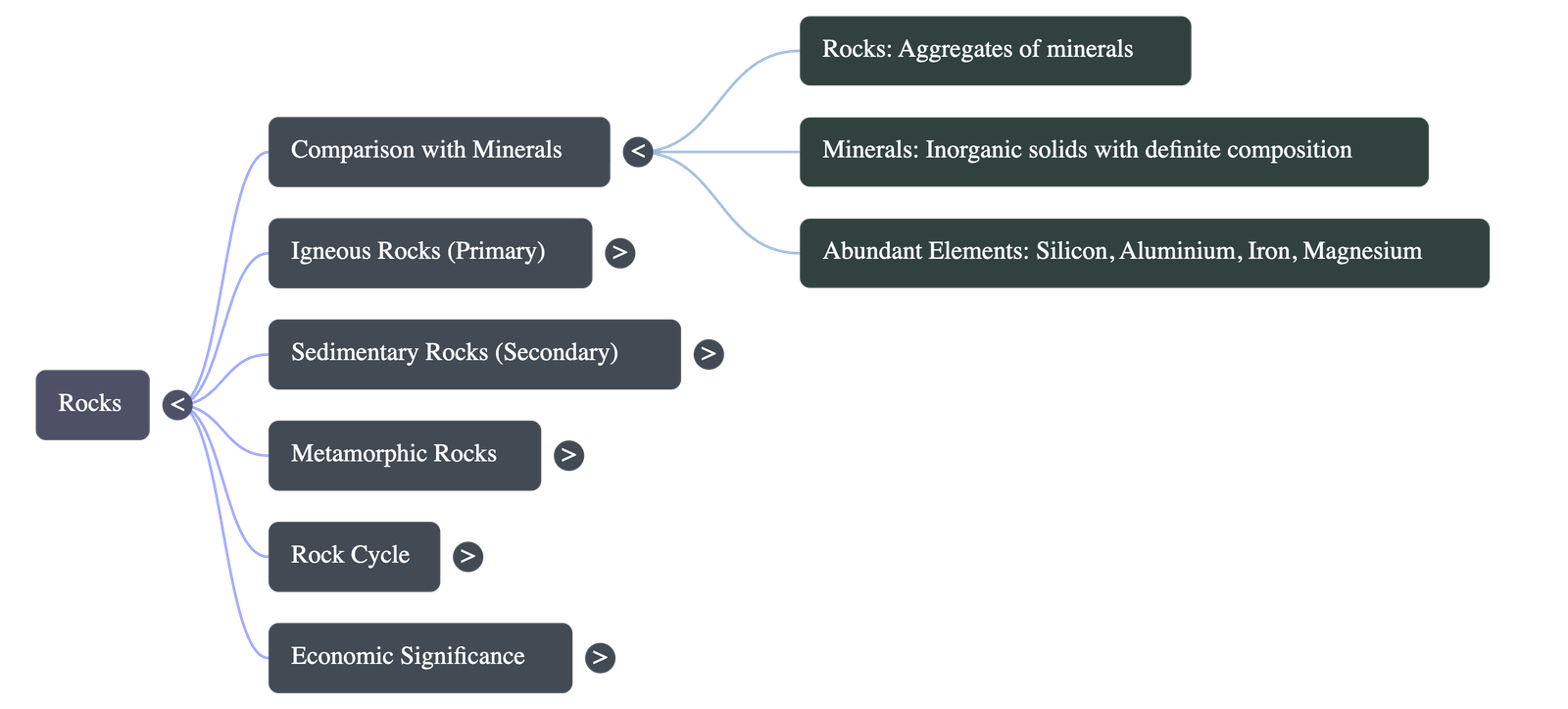
1. Introduction: Rocks vs. Minerals
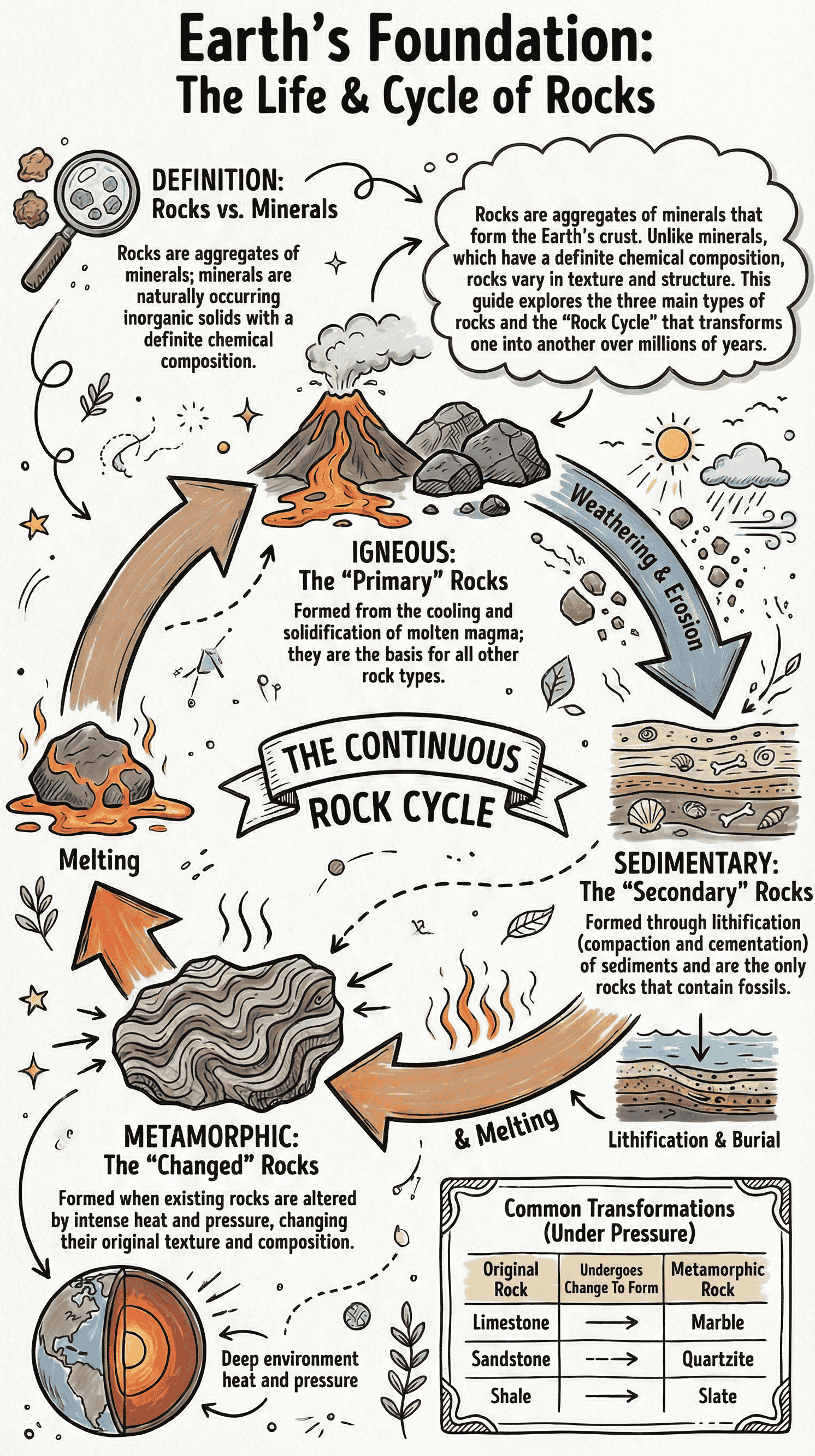
- • Rocks: Defined as aggregates of one or more minerals forming the Earth's crust. They do not have a definite chemical composition. The term includes hard solid matter (like granite) as well as soft and loose particles (like sand, silt, and clay).
- • Minerals: Naturally occurring, solid inorganic substances that have a definite chemical composition and a crystalline structure. Rocks are composed of minerals, but minerals are elements organized to form pure compounds.
- • Abundance: The most abundant mineral elements in the Earth's crust are silicon, aluminium, iron, magnesium, calcium, potassium, and sodium.
2. Igneous Rocks (Primary Rocks)
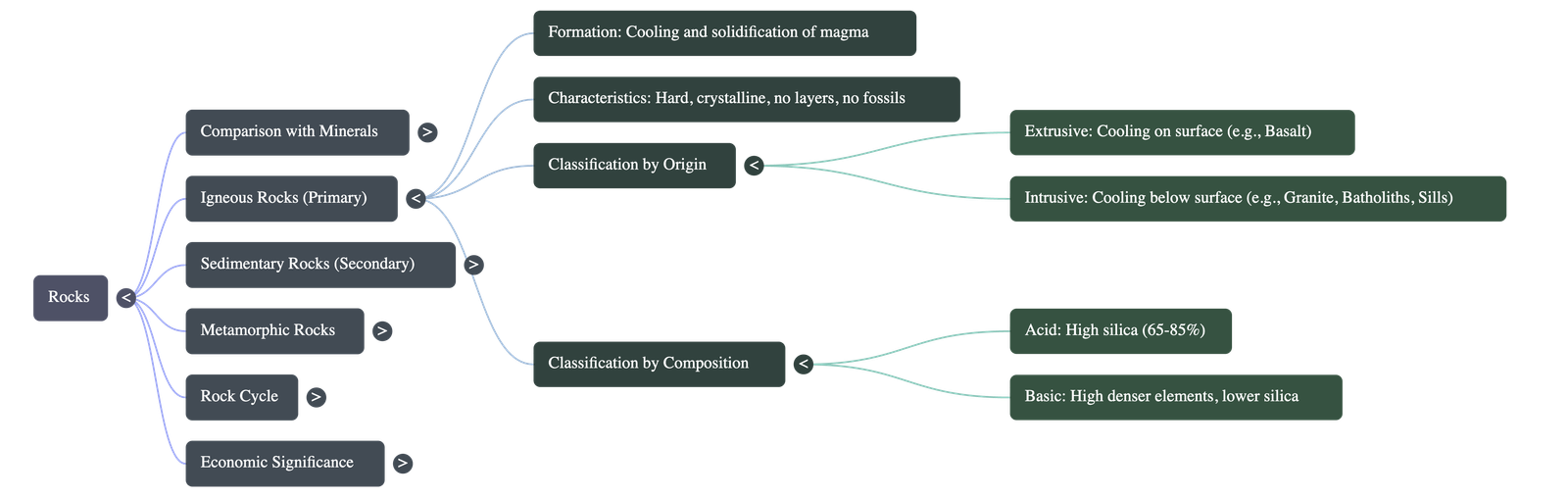
- ► Formation: Derived from the Latin word 'ignis' meaning fire. Formed by the cooling, solidification, and crystallization of hot molten magma found deep within the Earth. They are the basis for all other rock types.
- ► Key Characteristics: Hard, compact, granular, and crystalline. They lack layers (strata), do not contain fossils, consist mostly of silicates, and are less affected by chemical weathering due to their impermeability.
-
►
Classification by Origin:
- Extrusive (Volcanic) Rocks: Formed when magma cools rapidly on the Earth's surface, resulting in smooth, fine-grained crystals (e.g., Basalt).
- Intrusive (Plutonic) Rocks: Formed when magma cools slowly deep below the surface, forming coarse-textured rocks with large crystals (e.g., Granite). Creates structures like batholiths, laccoliths, sills, and dykes.
- Hypobyssal Rocks: Formed when magma cools at intermediate depths.
-
►
Classification by Chemical Composition:
- Acid Igneous Rocks: Contain 65% to 85% silica and generally lack iron and magnesium (e.g., Granite).
- Basic Igneous Rocks: Have higher percentages of denser elements with a silica content between 40% and 60%. They are heavy and dark in color (e.g., Basalt, Gabbro).
3. Sedimentary Rocks (Secondary Rocks)
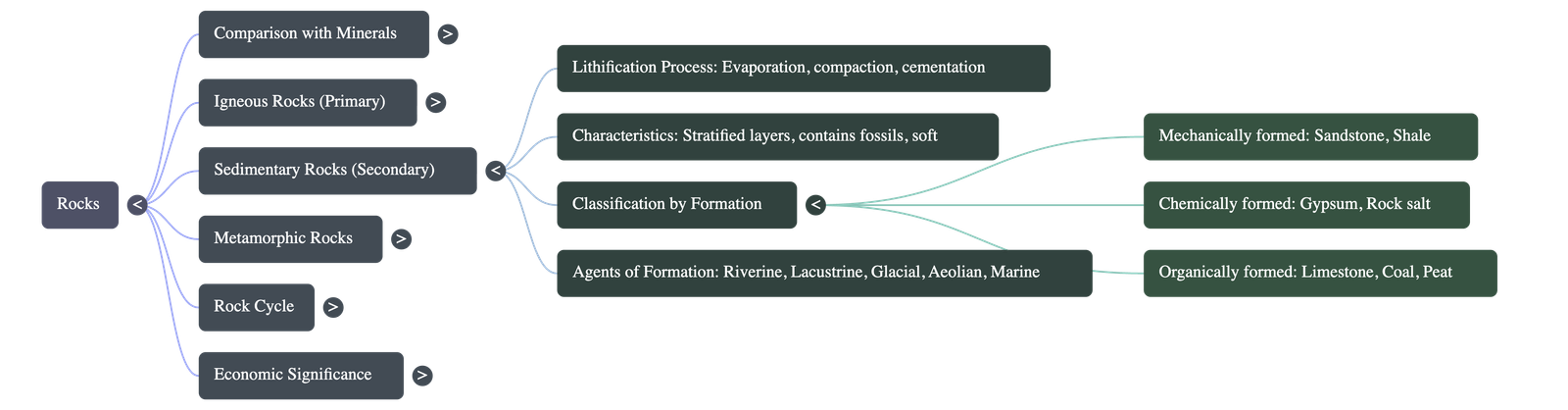
- ► Formation & Lithification: Formed from materials derived from other rocks as well as plant and animal remains. Loose sediments are turned into solid rock (lithification) through three main processes: Evaporation, Compaction (squeezed by overlying weight), and Cementation (bonded by natural compounds like silica and iron).
- ► Key Characteristics: They are the most widespread on the Earth's surface (covering about 75%). They are generally softer, occur in layers (stratified), and uniquely contain preserved remains of plants and animals known as fossils.
-
►
Classification by Formation:
- Mechanically Formed (Clastic): Formed from fragments of older rocks broken down by wind, water, or glaciers (e.g., Sandstone, Shale).
- Chemically Formed: Formed by the direct precipitation of mineral matter from solutions, often via evaporation (e.g., Rock Salt, Gypsum).
- Organically Formed: Formed from the remains of dead plants and animals. Includes calcareous rocks (Limestone, Chalk) and carbonaceous rocks (Coal, Peat, Lignite).
- ► Classification by Agents of Formation: Can be Riverine (streams), Lacustrine (lake beds), Glacial (moraines/debris), Aeolian (wind-blown sand/loess), or Marine (ocean floor deposition).
4. Metamorphic Rocks
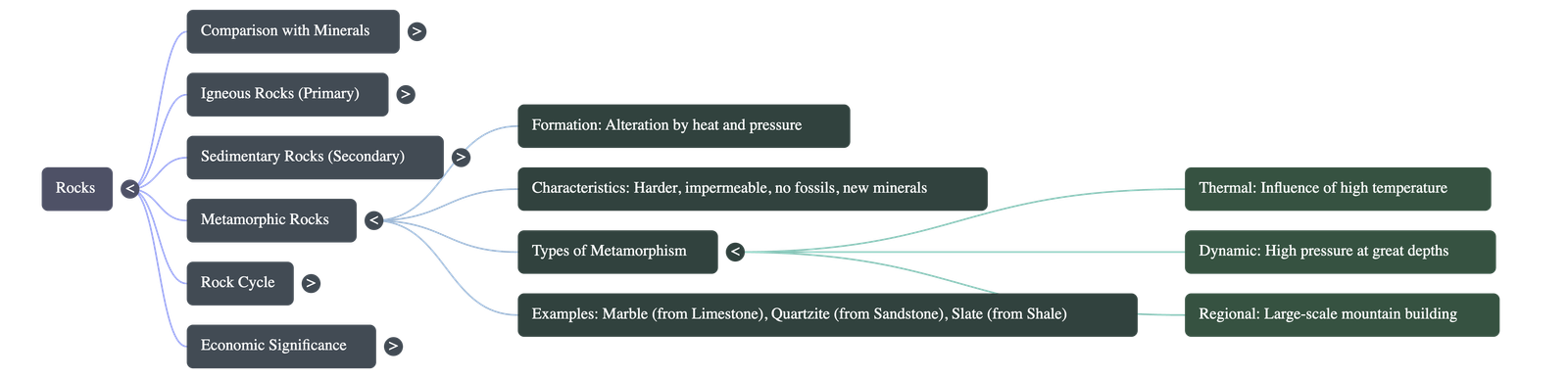
- ► Formation: The word means "change in form." Formed when pre-existing igneous or sedimentary rocks undergo structural or chemical alteration due to intense heat, extreme pressure, or chemically active fluids.
- ► Key Characteristics: They are harder, more compact, and largely impermeable compared to their original forms. Fossils present in original sedimentary rocks are destroyed during metamorphism, and new minerals are often formed.
-
►
Types of Metamorphism:
- Thermal Metamorphism: Transformation driven primarily by high temperature (e.g., Clay to Slate; Coal to Graphite).
- Dynamic Metamorphism: Transformation driven by extreme pressure at great depths, often arranging minerals into bands (foliation).
- Regional Metamorphism: Caused by large-scale earth movements (mountain building) involving both intense heat and pressure.
- Contact/Local Metamorphism: Occurs in a small area when hot magma directly touches and bakes surrounding rock layers.
- ► Common Examples: Limestone changes to Marble, Sandstone to Quartzite, Shale to Slate, and Granite to Gneiss.
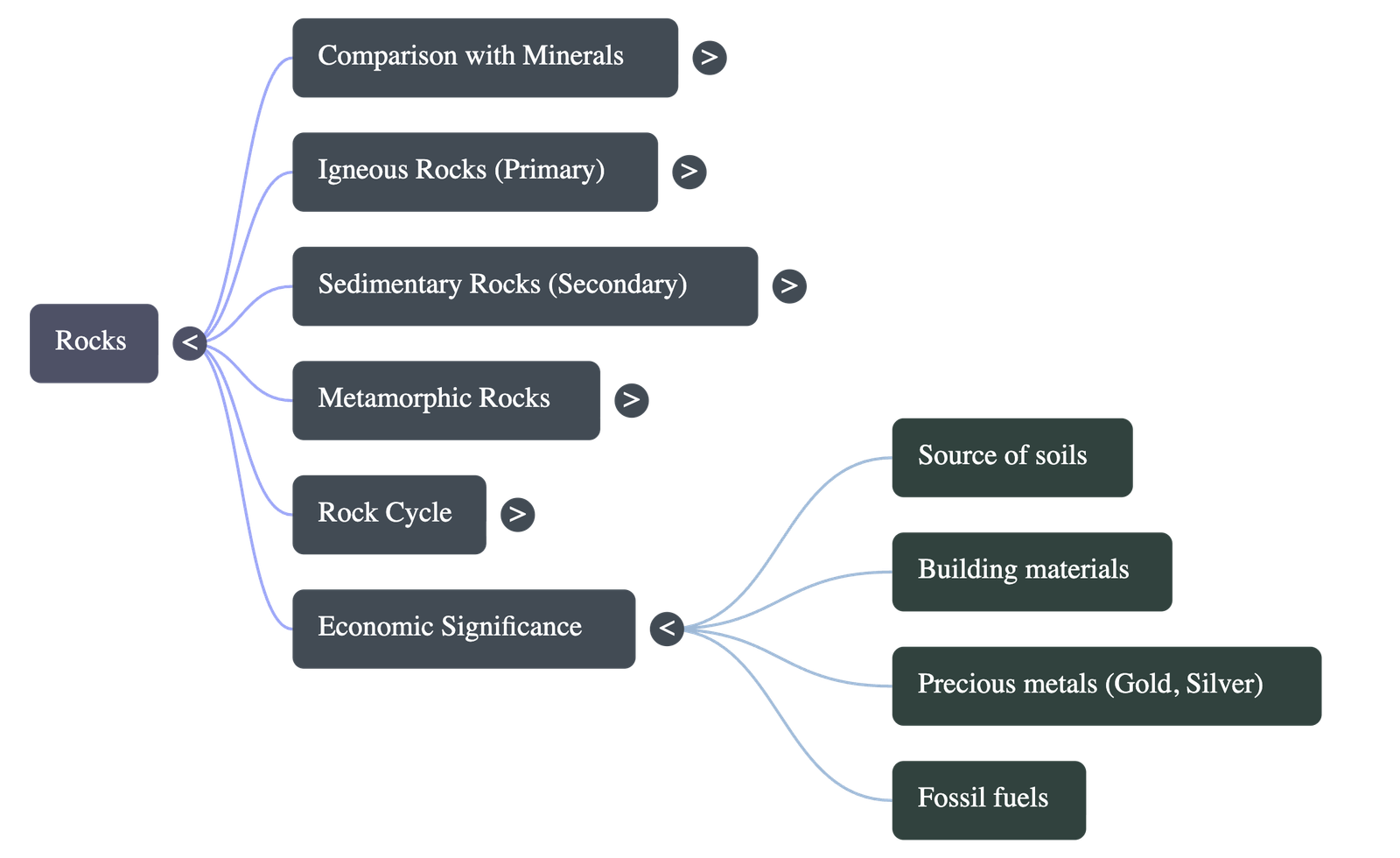
5. Economic Significance of Rocks
- ✔ They hold immense resource value and are the primary source of essential soils derived through weathering.
- ✔ Rocks provide almost all building materials for houses, roads, and bridges.
- ✔ They are the major source of precious metals (gold, silver, platinum) and fossil fuels (coal, petroleum).
- ✔ Even rock wastes are heavily utilized in the manufacturing of various industrial articles.
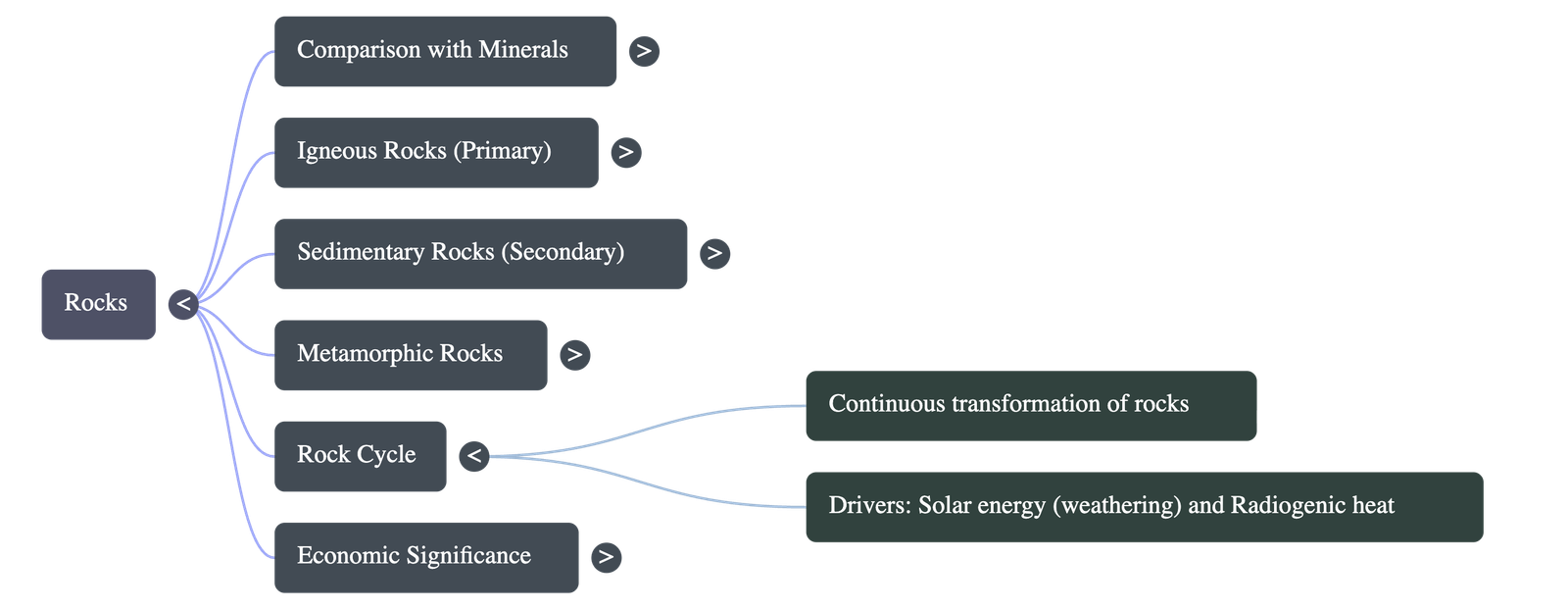
6. The Rock Cycle
The Earth is approximately 4.5 billion years old and undergoes continuous, cyclic transformation where old rocks are broken down and formed into new ones. This endless loop is known as the Rock Cycle.
- ➤ Primary igneous rocks form from cooling magma.
- ➤ Surface rocks are weathered, eroded, transported, and deposited in water bodies where they undergo lithification to become sedimentary rocks.
- ➤ Deep burial forces these rocks under extreme heat and pressure, metamorphosing them into metamorphic rocks.
- ➤ Extreme heat can melt these rocks back into magma, restarting the cycle.
- ➤ This ongoing operation keeps the Earth "young" and maintains a dynamic balance across its various crustal elements.
Do checkout all questions & answers of this chapter.
Quick Navigation:
| | | |
1 / 1
Quick Navigation:
| | | |