Quick Navigation:
| | | |
Earth As a Planet
Introduction to Earth
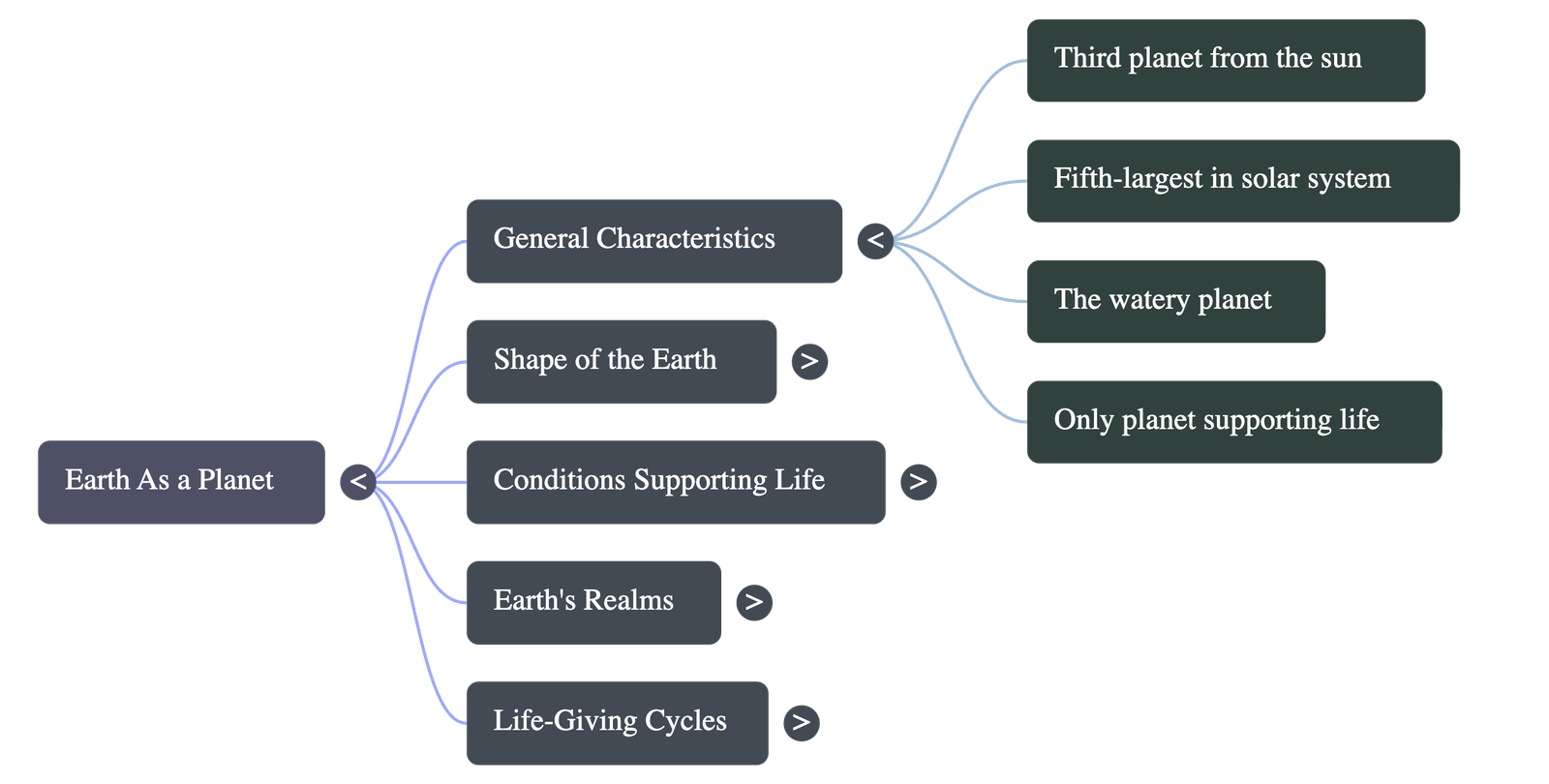
- Position and Size: Earth is the third planet from the sun and the fifth-largest planet in the solar system.
- The Watery Planet: About 70% of Earth's total area is covered by water, making it look blue from space and earning it the nickname "the watery planet."
- Unique Status: It is currently the only known planet that supports life.
The Shape of the Earth
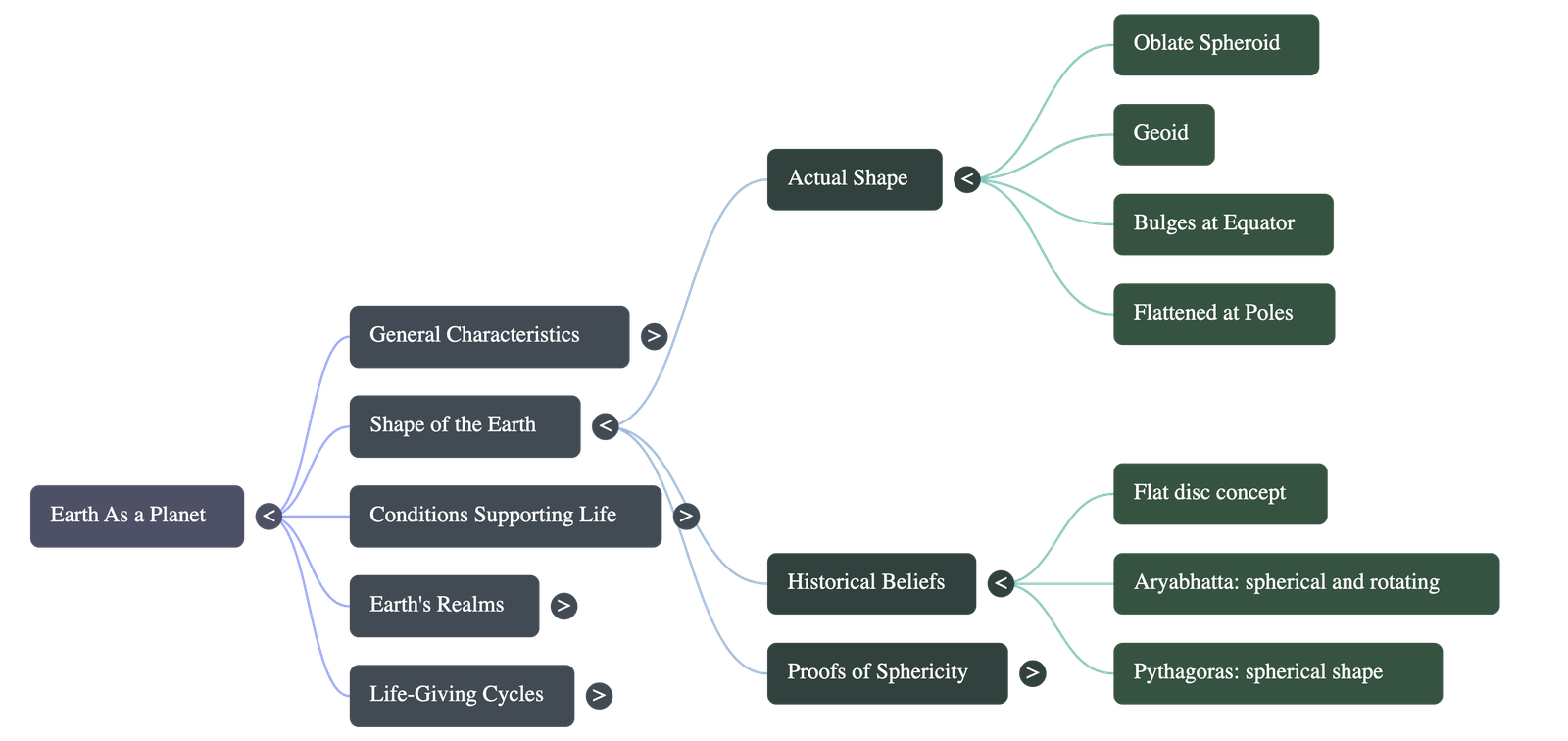
- Historical Beliefs: In ancient times, the Earth was thought to be a flat disc. However, scholars like the 5th-century Indian astronomer Aryabhatta and the 6th-century Greek philosopher Pythagoras correctly stated that the Earth is spherical.
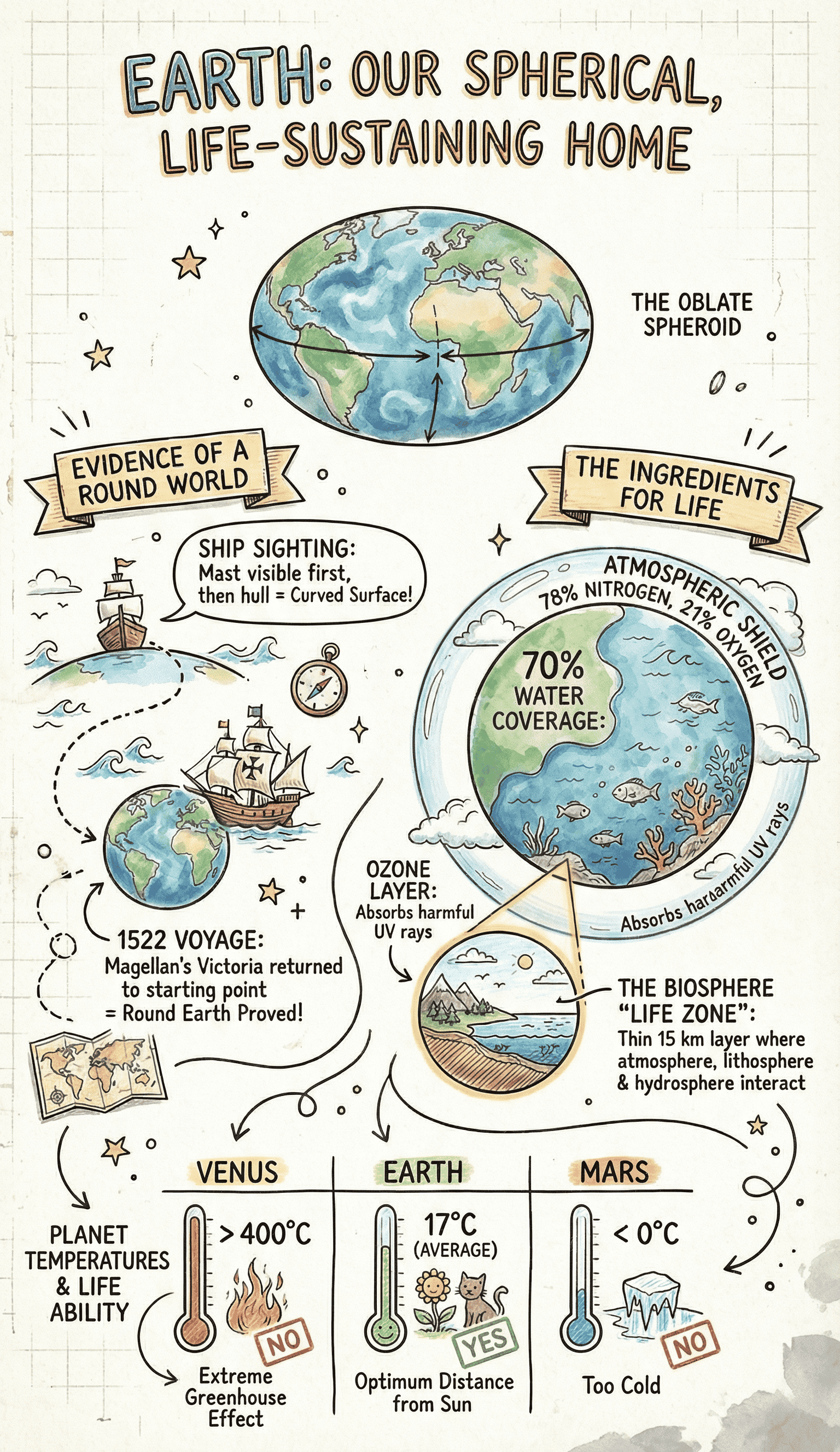
- Actual Shape (Oblate Spheroid / Geoid): The Earth is not a perfect sphere. It bulges at the equator and is flattened at the poles due to the centrifugal force of its high-speed rotation. Its equatorial diameter is 12,756 km, while its polar diameter is slightly smaller at 12,714 km.
Proofs of Earth's Spherical Shape
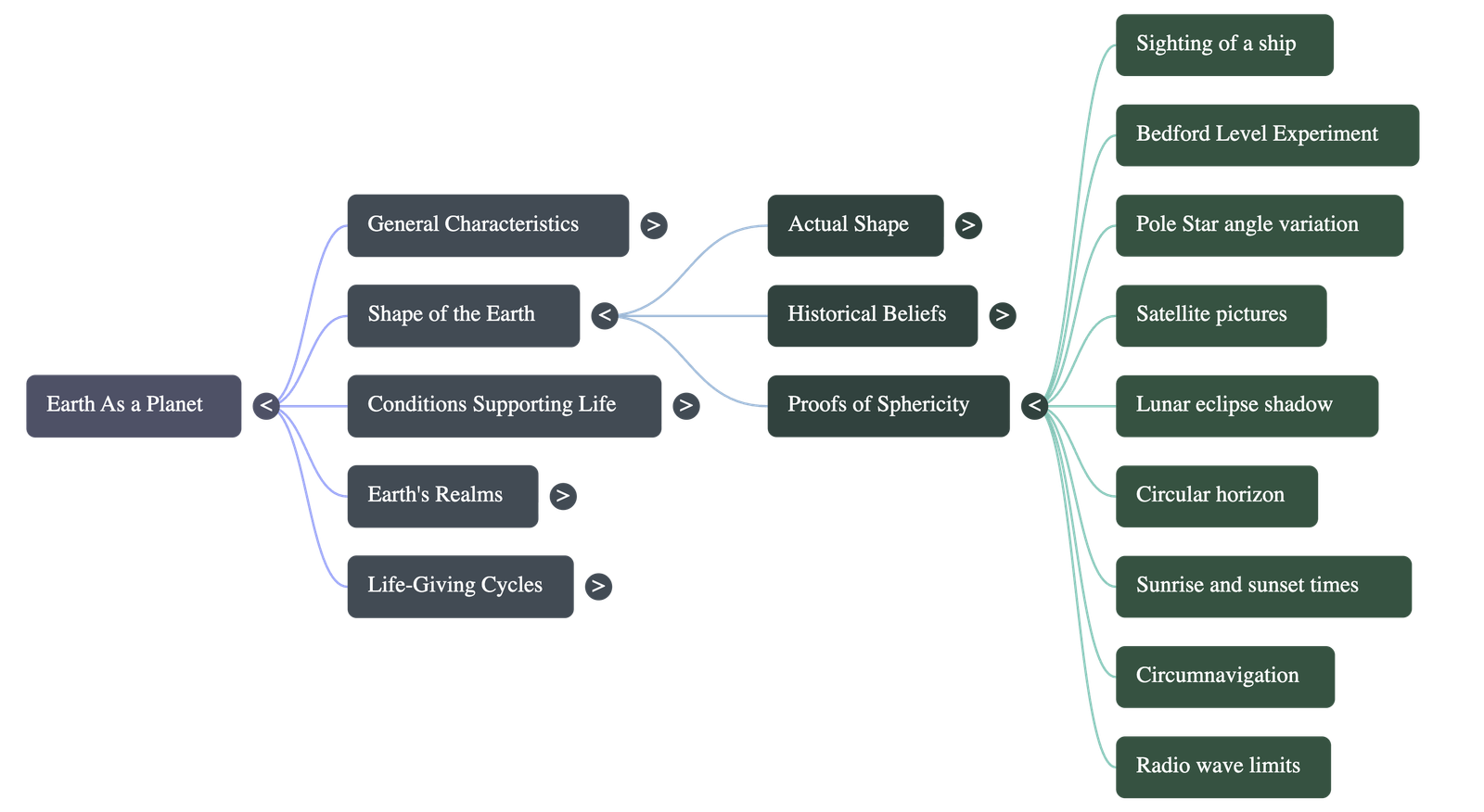
- Sighting of a Ship: When a ship approaches the shore, an observer first sees the mast, then the deck, the funnel, and finally the hull, which proves the Earth's surface is curved.
- The Bedford Level Experiment: Three poles of equal height were placed 5 km apart in a canal. When viewed from one end, the middle pole appeared higher, demonstrating surface curvature.
- Position of the Pole Star: The angle of the Pole Star is 90° at the North Pole and gradually decreases to 0° at the Equator, which is only mathematically possible on a spherical arc.
- Satellite Pictures: Modern photographs taken from space provide conclusive visual evidence of Earth's spherical shape and flattened poles.
- Lunar Eclipse: During a lunar eclipse, the shadow cast by the Earth onto the moon is always completely circular.
- Circular Horizon: The visible horizon from higher altitudes appears circular and widens as one ascends.
- Sunrise and Sunset: Because the Earth rotates from west to east, the sun rises and sets at different times in different locations. If Earth were flat, sunrise and sunset would happen simultaneously everywhere.
- Circumnavigation: In 1522, Ferdinand Magellan's ship, the Victoria, sailed continuously around the globe and returned to its starting point in Spain.
- Planetary Observation: All other planets in our solar system are spherical due to continuous rotation; Earth is no exception.
Earth as the Home of Humankind
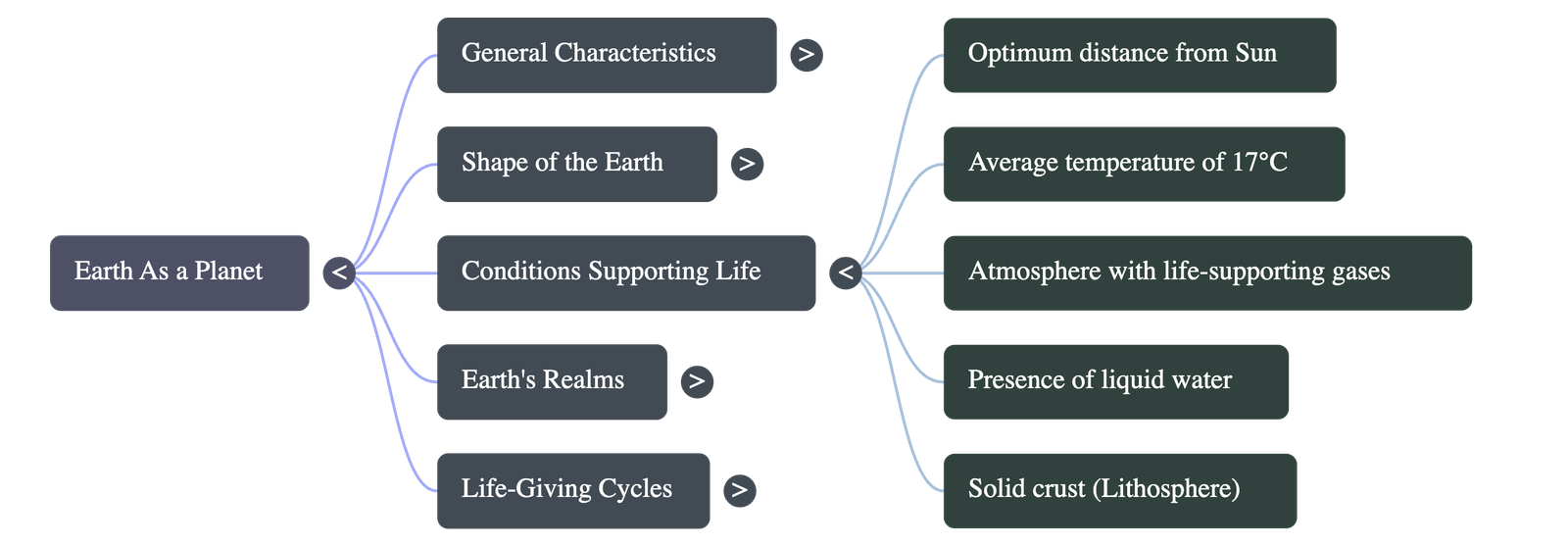
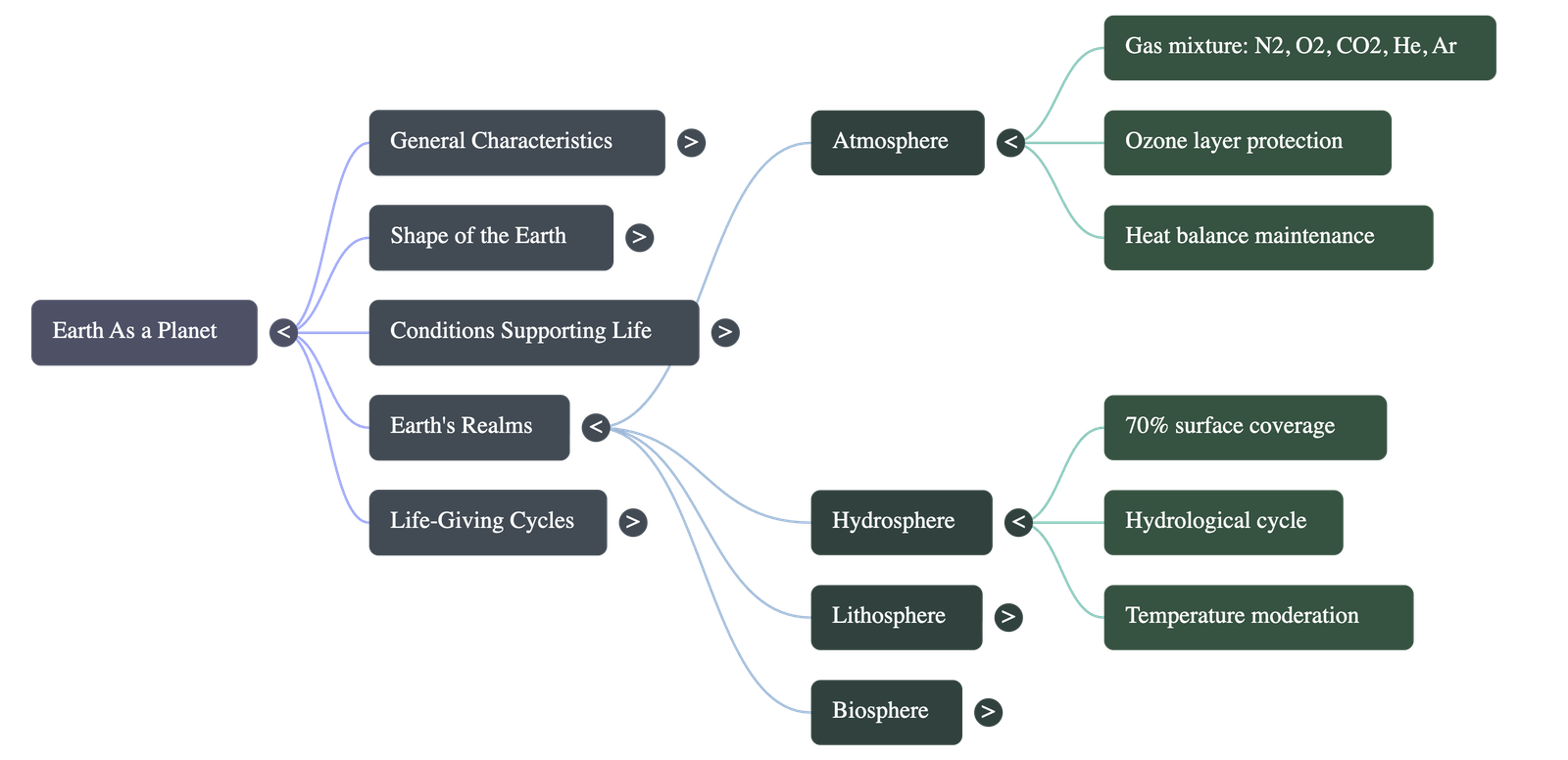
- Optimum Distance from the Sun: Earth is positioned perfectly so that it is neither freezing cold nor blisteringly hot, preventing life from burning up or freezing.
- Favorable Temperature: The planet maintains an average temperature of 17°C, which is ideal for life. Other terrestrial planets like Mercury and Venus reach over 400°C, while distant planets are well below freezing.
- Atmosphere: Earth is enveloped by an atmosphere composed mainly of Nitrogen (78%) and Oxygen (21%), along with trace gases like Carbon Dioxide and Argon. It contains an Ozone layer to block harmful UV rays and regulates the planet's heat.
- Water (Hydrosphere): Covering 70% of the planet, water helps moderate the global climate and surface conditions. Water bodies absorb vast amounts of heat during the day and release it at night, preventing extreme temperature shifts.
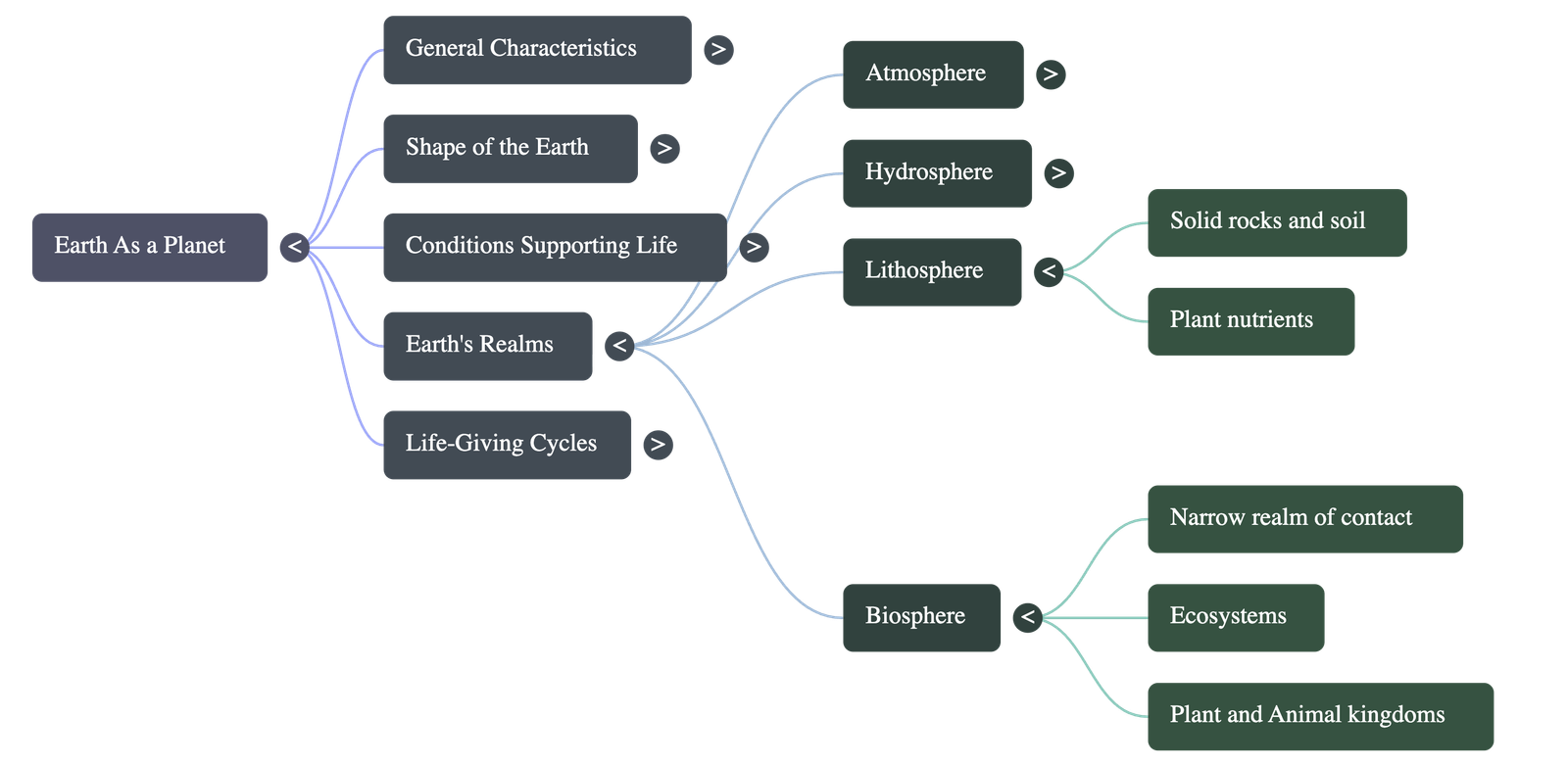
- Solid Crust (Lithosphere): The weathering of rocks creates soil, providing essential nutrients for plant growth, which in turn supports all animal life.
- Biosphere: A narrow 15 km thick zone where the atmosphere, lithosphere, and hydrosphere interact. It is the "life zone" containing all ecosystems, providing light, heat, water, and food for all living species.
Life-Giving Cycles in Nature
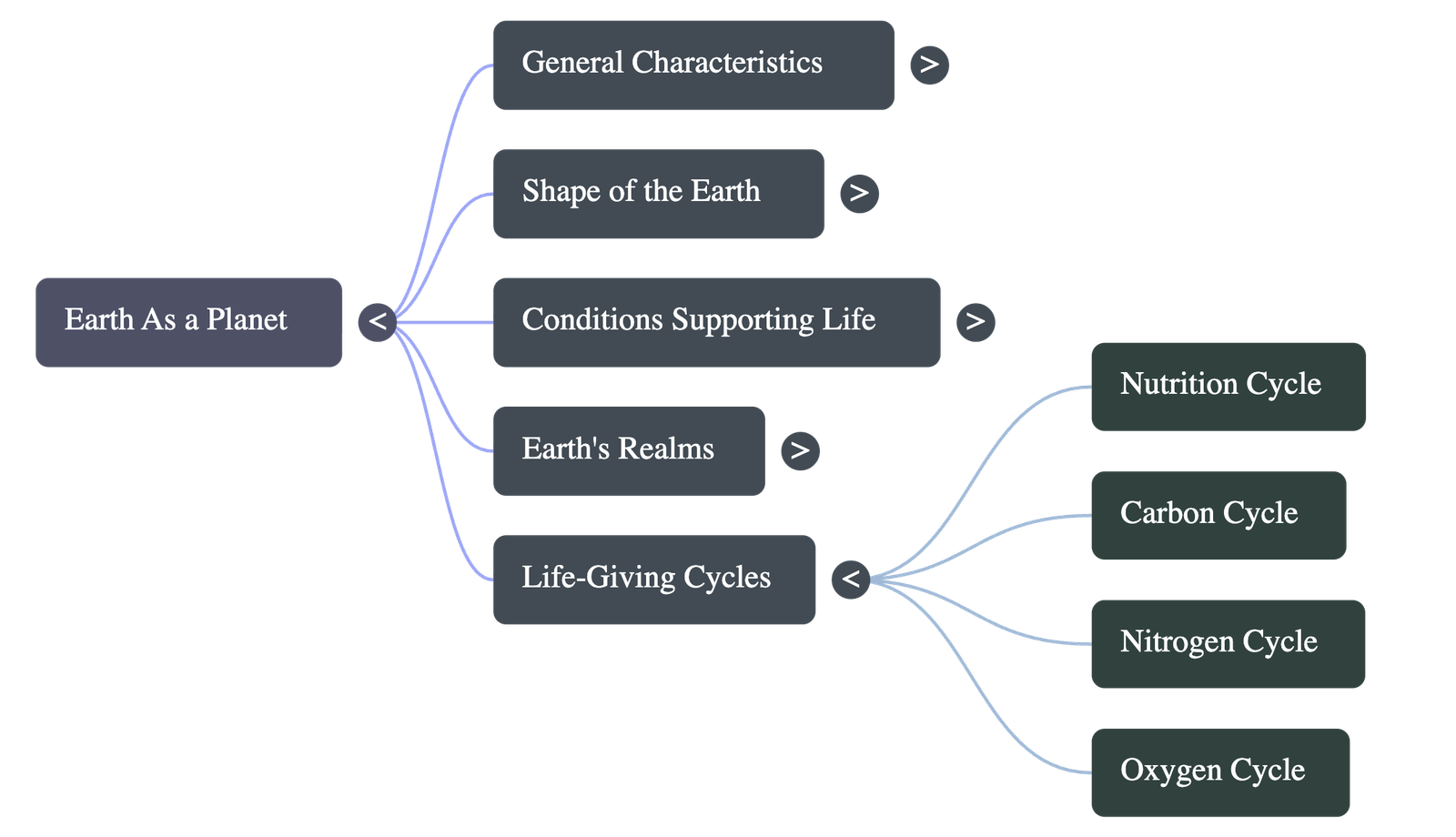
- Nutrition Cycle: Shows the interdependence of all life through food chains. It involves producers (plants utilizing photosynthesis), consumers (herbivores and carnivores), and decomposers (organisms that break down dead matter).
- Carbon Cycle: Carbon is fixed by plants through photosynthesis. It passes through the food chain and is returned to the atmosphere as CO2 via respiration, decomposition, and the burning of fossil fuels. Imbalances in this cycle lead to global warming.
- Nitrogen Cycle: Though the atmosphere is 78% free nitrogen, plants absorb it as nitrates from the soil. It moves through the food chain and returns to the soil via animal waste and organic decomposition.
- Oxygen Cycle: Living things consume oxygen for energy and bodily functions. Green plants constantly replenish the atmosphere's oxygen supply as a byproduct of photosynthesis.
Notable Historical Contributions: Aryabhatta
During the Gupta Period, the renowned Indian mathematician and astronomer Aryabhatta made revolutionary observations long before modern science. He calculated Earth's circumference to be 39,968 km (only 0.2% less than the actual figure) and its rotation time as 23 hrs, 56 min, and 4.1 seconds. He famously challenged prevalent beliefs by asserting that the Earth was spherical and rotated on its axis to create day and night.
Do checkout all questions & answers of this chapter.
Quick Navigation:
| | | |
1 / 1
Quick Navigation:
| | | |