Quick Navigation:
| | | |
Natural Regions of the World
Introduction to Natural Regions
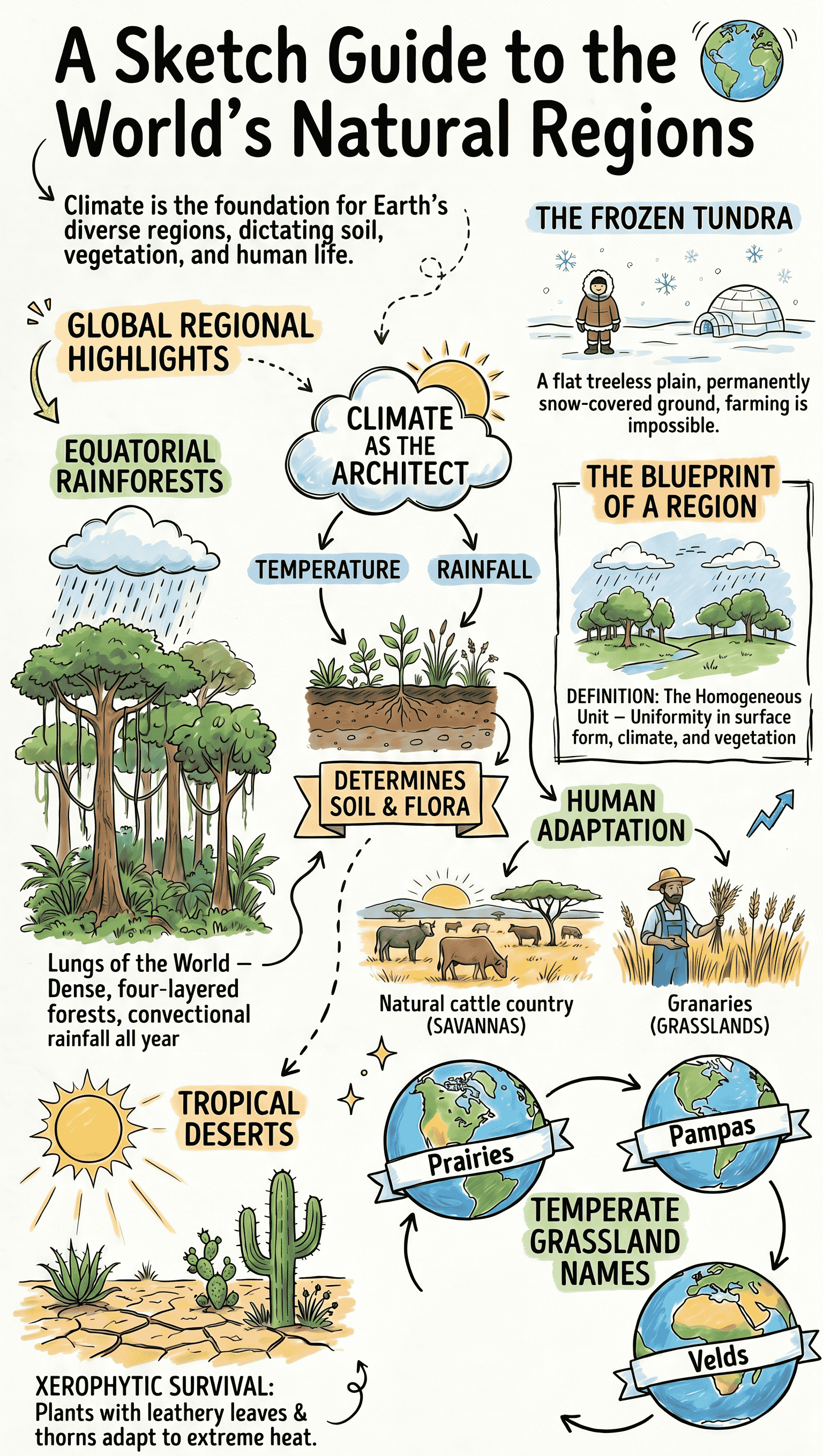
- Definition: A Natural Region is a part of the Earth's surface characterized by a comparatively high degree of uniformity in structure, surface form, and climate.
- Homogeneity: These regions possess relatively uniform climatic conditions, soils, natural vegetation, and human activities, though slight variations can exist within them.
- Basis of Classification: The primary factor dividing the world into major natural regions is climate. Regions are frequently named after the predominant climate or vegetation type.
- Key Climatic Elements: Classification depends on temperature, pressure, winds, humidity, landforms, water run-off, and their effects on weathering, soils, vegetation, and wildlife.
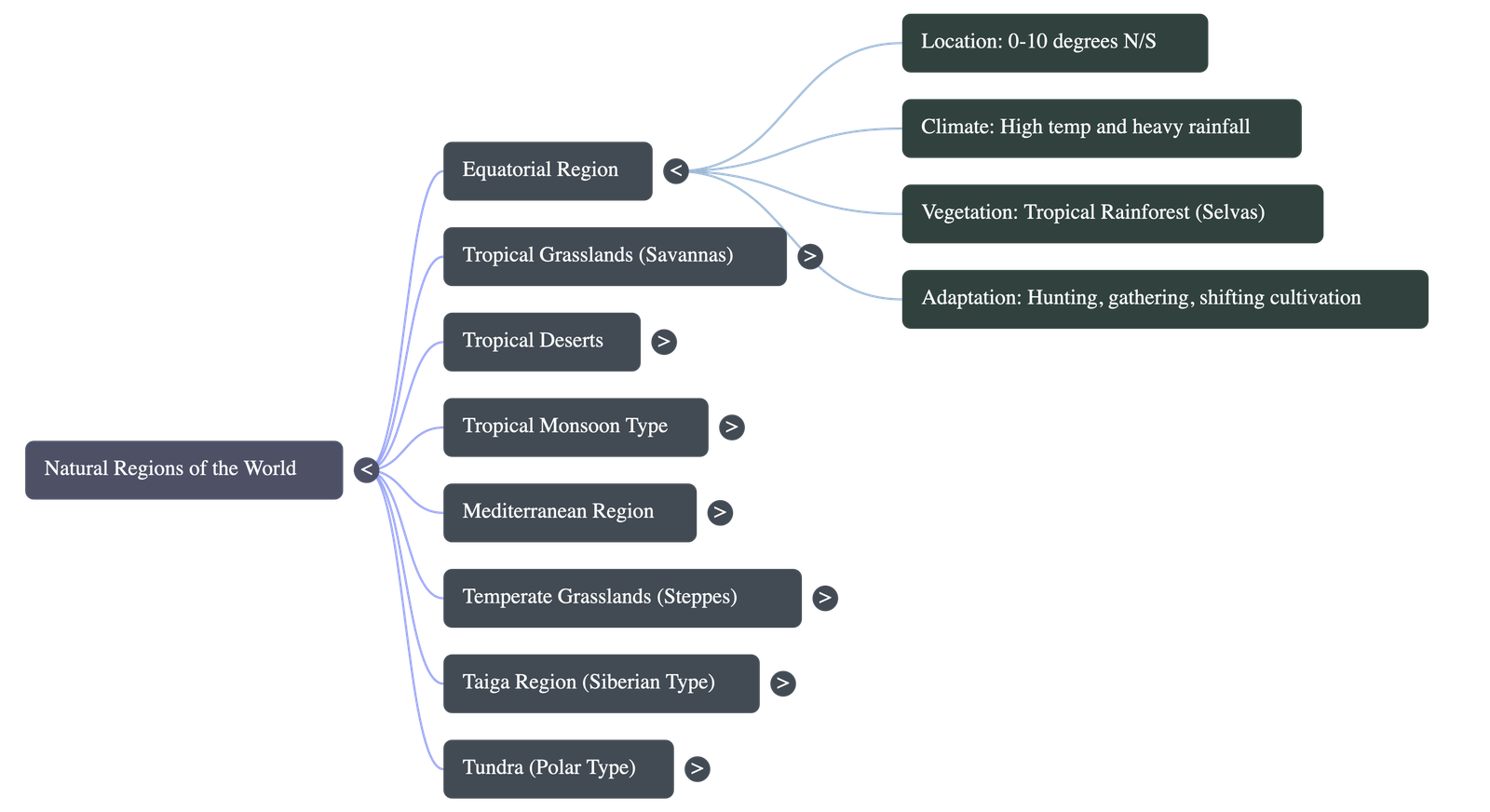
1. Equatorial Region
- Location: Extends between 0 to 10 degrees North and South of the Equator (e.g., Amazon Basin, Zaire Basin, Indonesia, Malaysia).
- Climate: Characterized by high temperatures throughout the year and heavy convectional rainfall, usually occurring in the afternoon. There is no distinct winter or dry season.
- Vegetation: Features dense, evergreen Tropical Rainforests (also called "Lungs of the World"). The forests have distinct layers: emergent layer, canopy, understorey, and forest floor. Trees have broad leaves and include mahogany, ebony, and rubber.
- Wildlife: Dominated by arboreal (tree-dwelling) animals like monkeys, apes, and snakes due to dark conditions on the forest floor. Brightly colored birds like parrots and hornbills are common.
- Human Adaptation: Traditional activities include hunting, gathering, and shifting cultivation. Modern adaptations heavily involve plantation agriculture for natural rubber, cocoa, bananas, and coconuts.
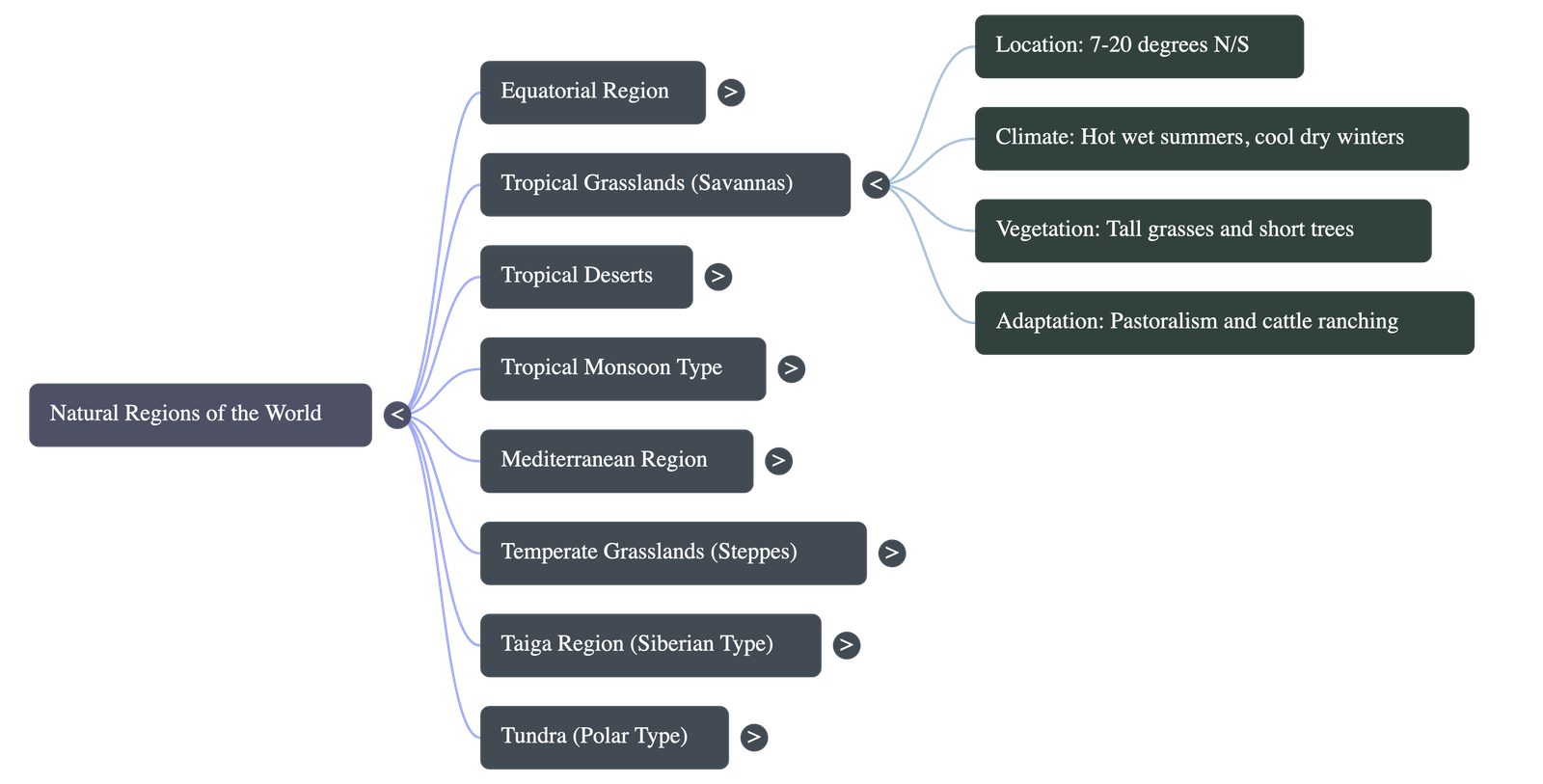
2. Tropical Grasslands (Savannas)
- Location: Lie roughly between 7 to 20 degrees North and South of the Equator (e.g., Llanos and Campos in South America, vast parts of Africa, Northern Australia).
- Climate: Characterized by hot, wet summers and cool, dry winters. They experience a distinct drop in temperature during the rainy season.
- Vegetation: Known for tall, coarse grass and short, scattered deciduous trees with long roots. Trees like baobabs have broad trunks to store water.
- Human Adaptation: Often called "natural cattle country." Inhabitants are traditionally pastoralists keeping large herds. Cattle ranching is highly developed, alongside plantation agriculture for crops like cotton, sugarcane, and coffee.
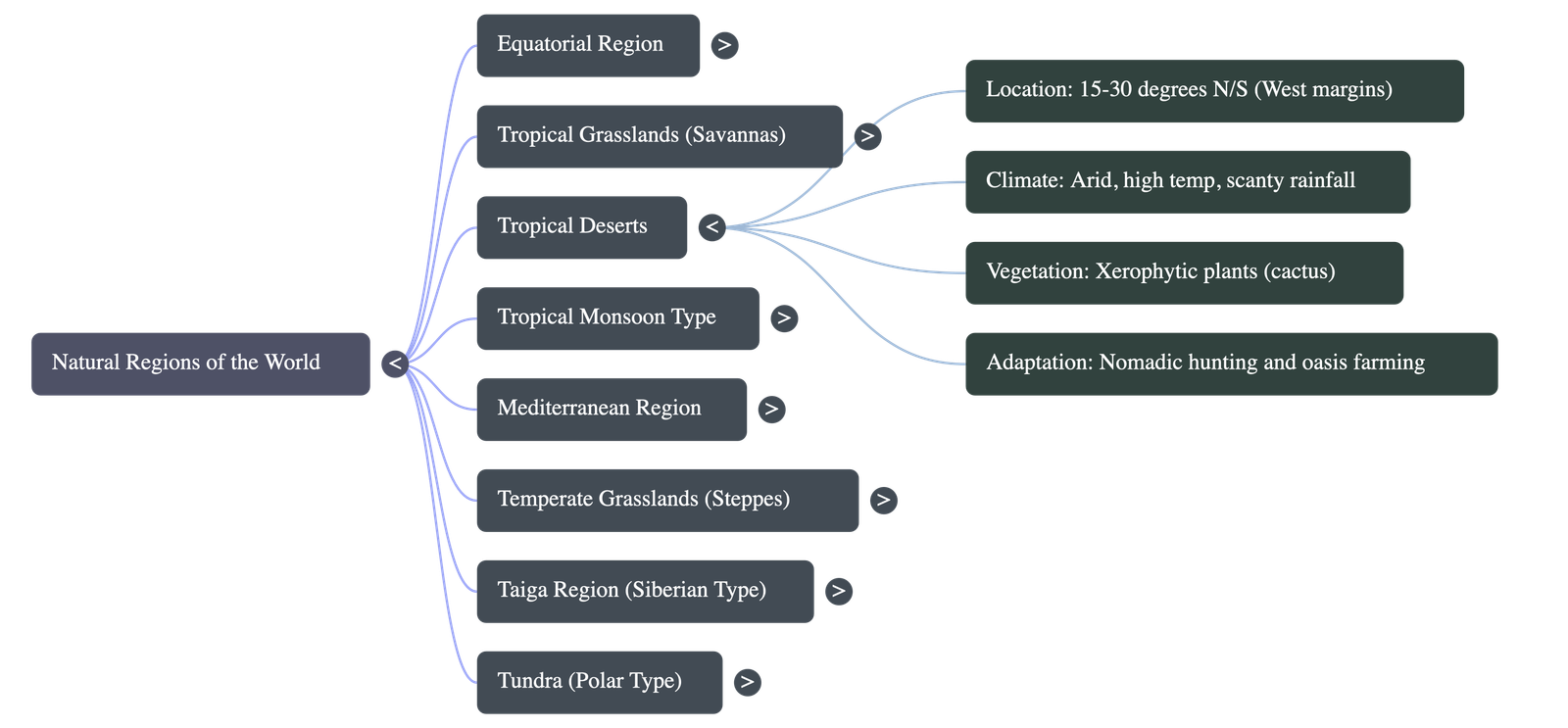
3. Tropical Deserts
- Location: Found between 15 to 30 degrees North and South latitudes, generally on the western margins of continents (e.g., Sahara, Kalahari, Arabian, Thar, Atacama, and Great Australian Deserts).
- Climate: Extremely hot summers and cool winters with significant temperature extremes. Rainfall is very scanty due to offshore dry Trade Winds.
- Vegetation: Supports xerophytic plants like cacti and prickly pears, adapted to arid conditions with deep roots, fleshy stems for storing water, and thorns instead of leaves.
- Wildlife: Animals are adapted to extreme heat; many are burrowers or nocturnal, including lizards, rodents, jackals, and camels.
- Human Adaptation: Harsh conditions lead to sparse populations. Traditional inhabitants include nomadic hunter-gatherers. Agriculture is only possible with irrigation near oases or rivers.
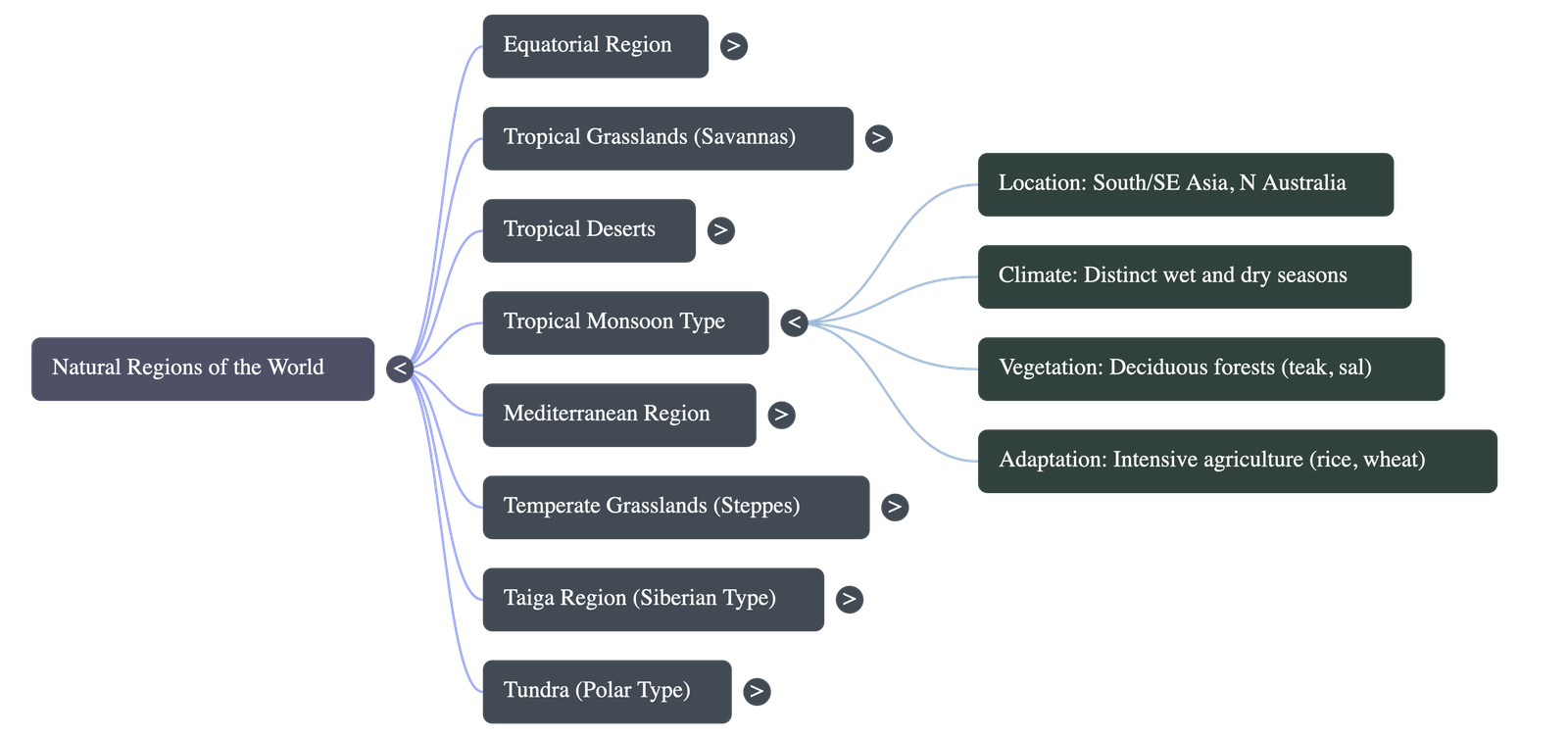
4. Tropical Monsoon Type Climate
- Location: Dominant in Southern Asia (India, Pakistan, Bangladesh), parts of Southeast Asia, and Northern Australia.
- Climate: Features hot summers and cool winters with distinct seasons. Characterized by onshore wet monsoons in summer and offshore dry monsoons in winter.
- Vegetation: Consists largely of Tropical Deciduous Forests where trees shed leaves during the dry season to preserve moisture. Common trees include teak, sal, sandalwood, and bamboo.
- Human Adaptation: Agriculture is the main occupation, highly dependent on natural rainfall and supported by a massive labor force. Major crops include rice, wheat, maize, sugarcane, cotton, and tea.
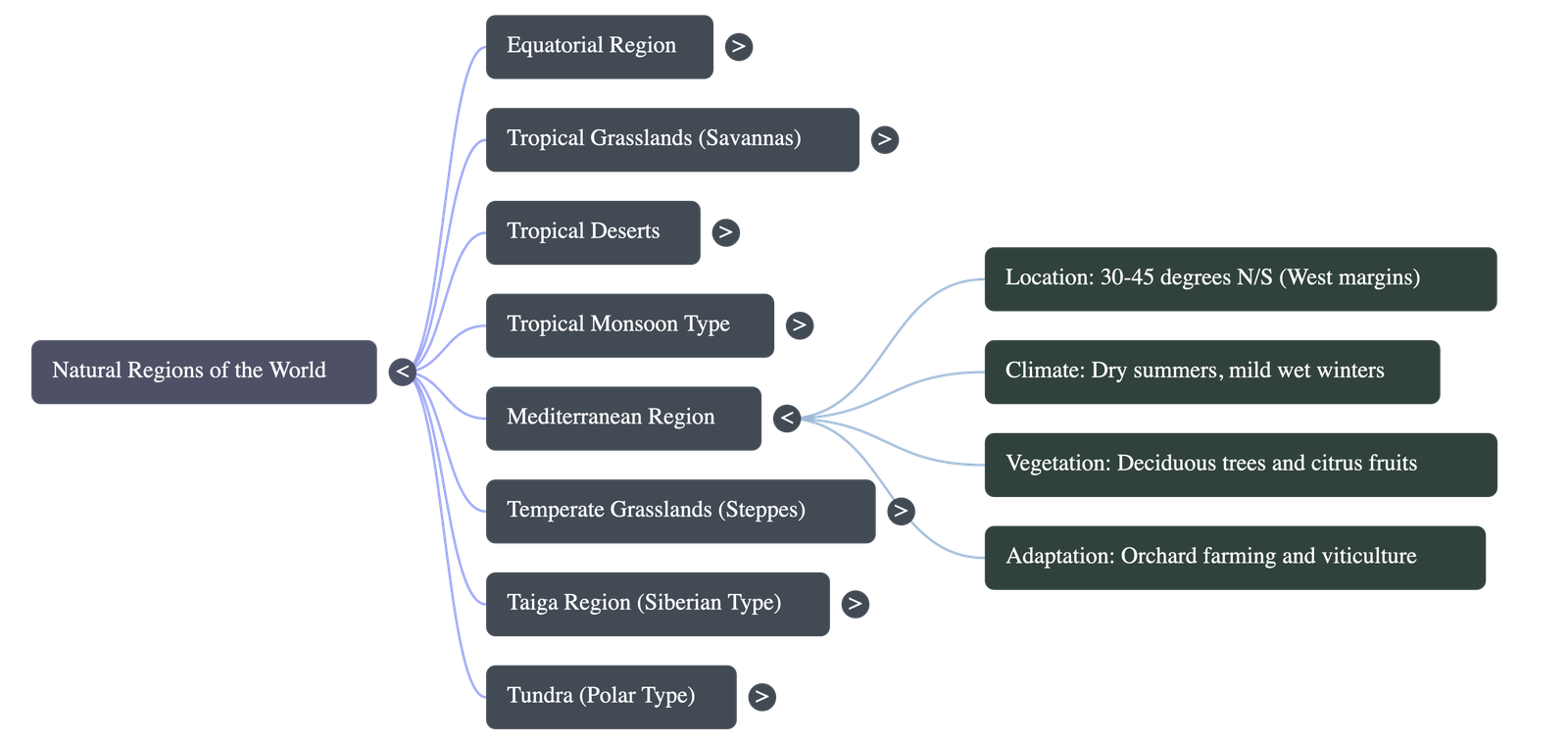
5. Mediterranean Region
- Location: Located on the western margins of continents between 30 to 45 degrees North and South (e.g., Southern Europe, coastal California, Central Chile, Cape Town region, southwestern Australia).
- Climate: Distinguished by warm, dry summers and cool, wet winters. Rainfall is brought by Westerlies during the winter season.
- Vegetation: Broad-leaved evergreen and deciduous trees adapted to summer droughts. Trees typically have long roots and thick barks. Common species include olive, oak, laurel, and eucalyptus.
- Human Adaptation: Very favorable for human habitation and heavily associated with orchard farming. The region produces the majority of the world's citrus fruits (oranges, lemons) alongside olives, grapes, and walnuts.
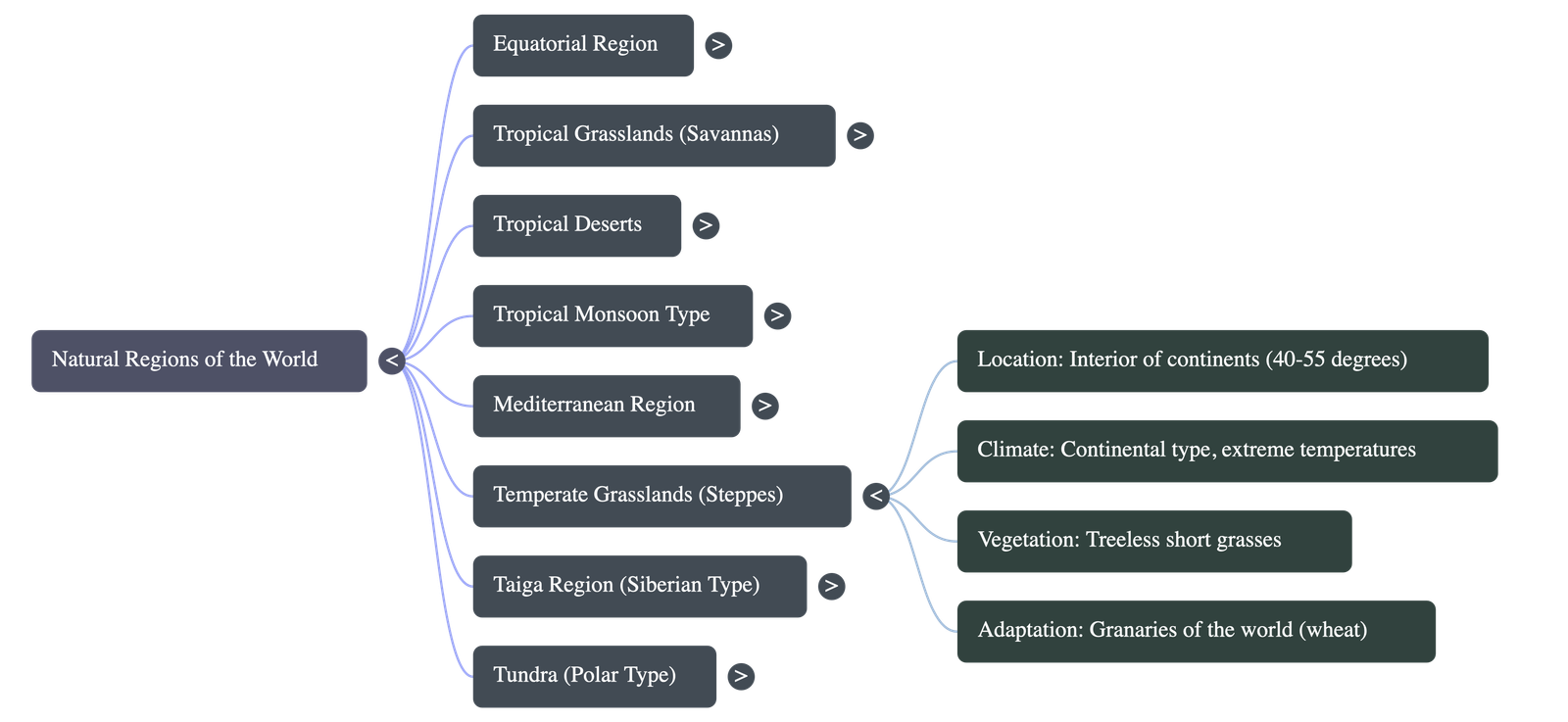
6. Temperate Grasslands
- Location: Situated in the interior of continents in the mid-latitudes between 40 to 55 degrees North and South. Known locally as Steppes (Eurasia), Prairies (North America), Pampas (South America), Velds (Africa), and Downs (Australia).
- Climate: Continental climate characterized by significant temperature variations—hot summers and severely cold winters (especially in the Northern Hemisphere). Rainfall is generally low and occurs mostly in summer.
- Vegetation: Predominantly treeless, covered with short and soft grasses.
- Human Adaptation: Known as the "granaries of the world." These regions are ideal for extensive, mechanized wheat cultivation.
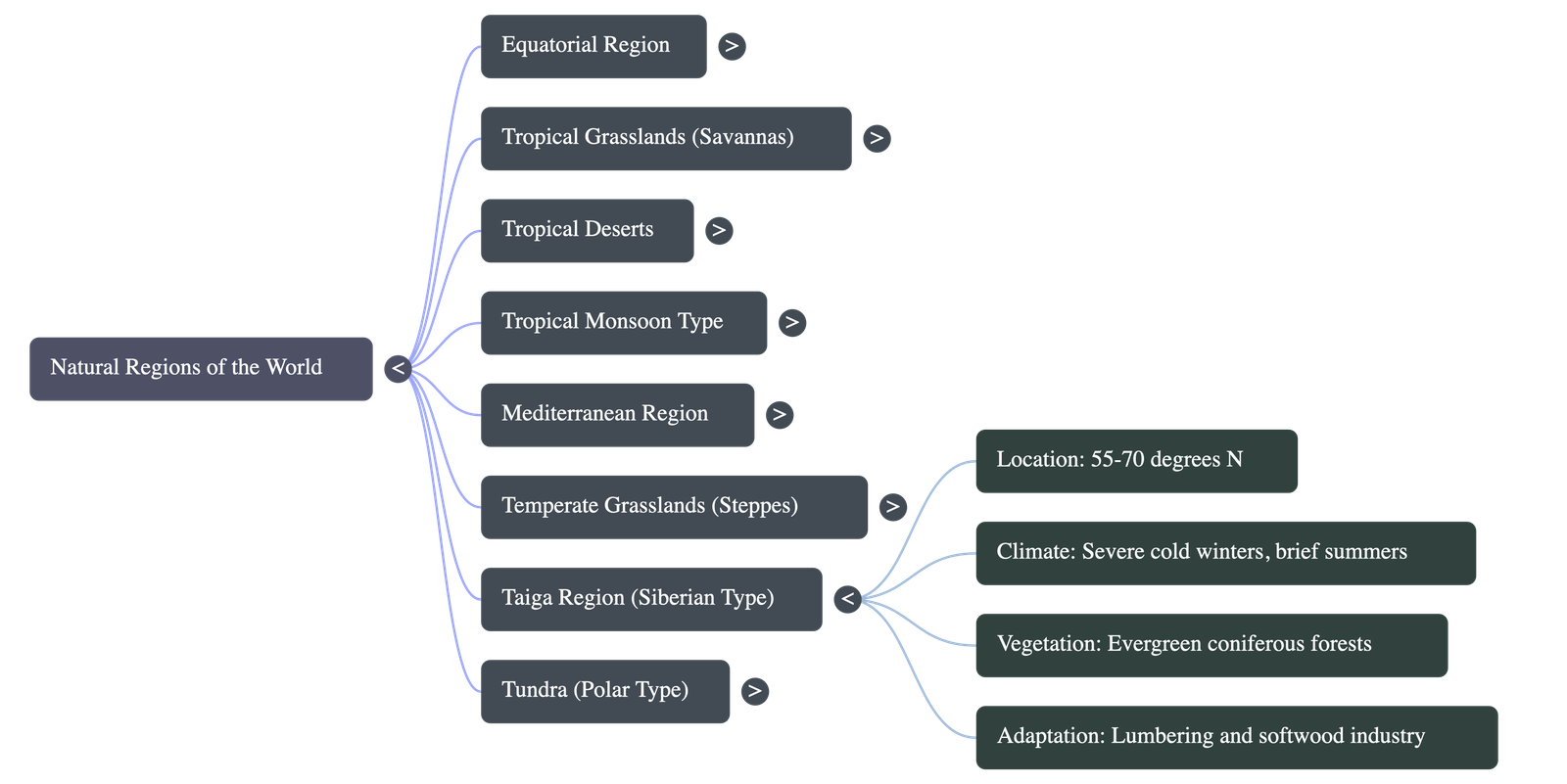
7. The Taiga Region (Cool Temperate Continental)
- Location: Lies between 55 to 70 degrees North, primarily stretching across Northern North America, Europe, and Asia (Siberia). Absent in the Southern Hemisphere due to a lack of landmass at these latitudes.
- Climate: Noted for severe, long winters with heavy snowfall and very brief, cool summers lasting only 3 to 4 months.
- Vegetation: Dominated by vast tracts of evergreen coniferous forests. The trees (pine, fir, spruce, cedar) are the richest global sources of softwood.
- Human Adaptation: Sparsely populated due to extreme cold. Agriculture is limited to sheltered valleys. The major economic activities revolve around lumbering for paper, pulp, and construction industries.
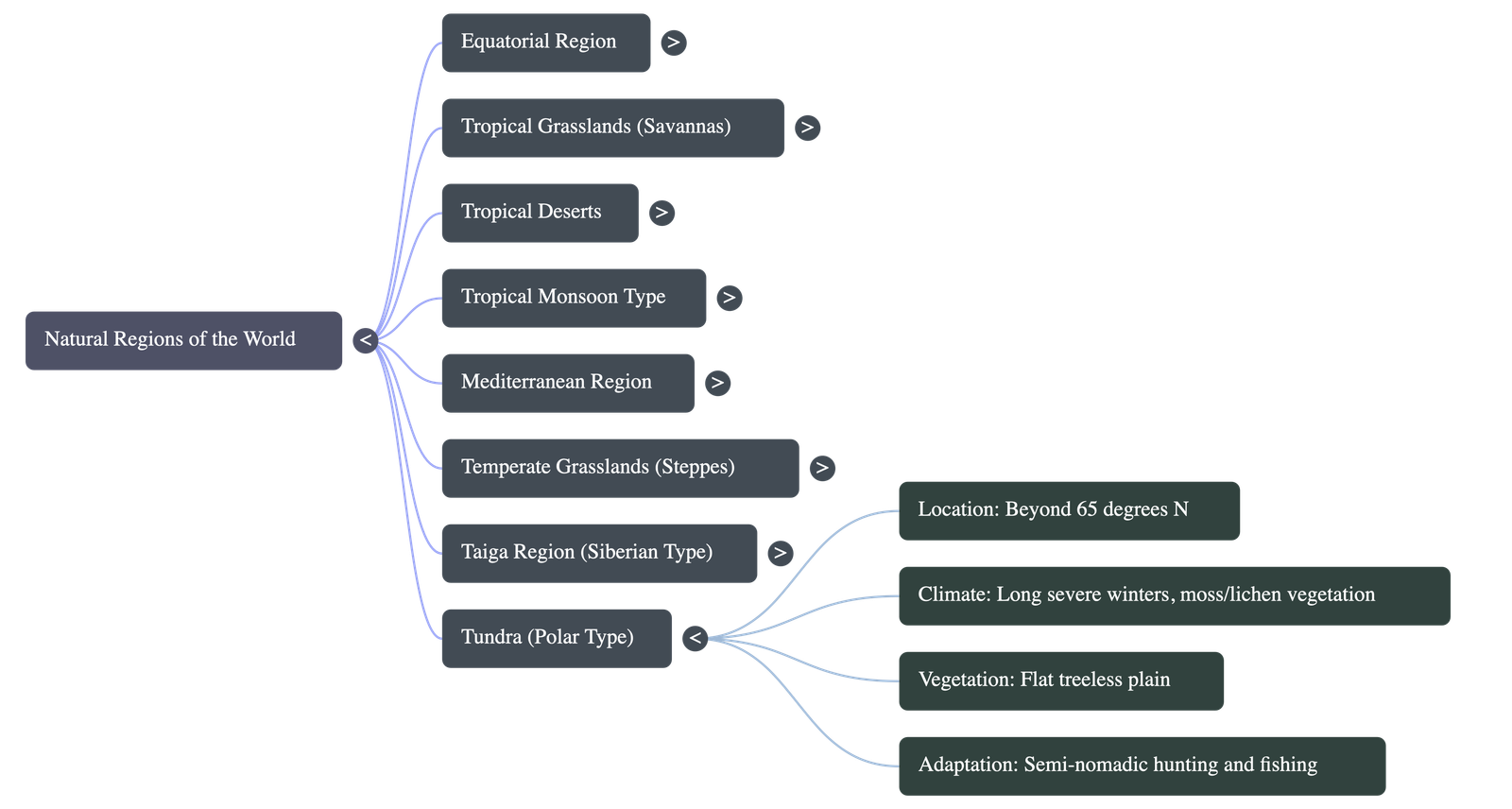
8. The Tundra (Arctic or Polar Type)
- Location: Found mostly north of the Arctic Circle (beyond 65 degrees North), encompassing areas like Greenland, Northern Canada, and Northern Siberia.
- Climate: Characterized by bitterly cold, long winters with months of continuous darkness, and extremely short, cool summers. Precipitation is mainly in the form of snow.
- Vegetation: Treeless plains. The harsh climate allows only hardy, short-growing plants like mosses, lichens, and sedges to survive during the brief summer thaw.
- Human Adaptation: Unsuitable for traditional agriculture. Inhabited by sparse populations of semi-nomadic indigenous people who rely on hunting (seals, walruses, polar bears) and reindeer herding for survival.
Do checkout all questions & answers of this chapter.
Quick Navigation:
| | | |
1 / 1
Quick Navigation:
| | | |