Quick Navigation:
| | | |
Earth's Structure
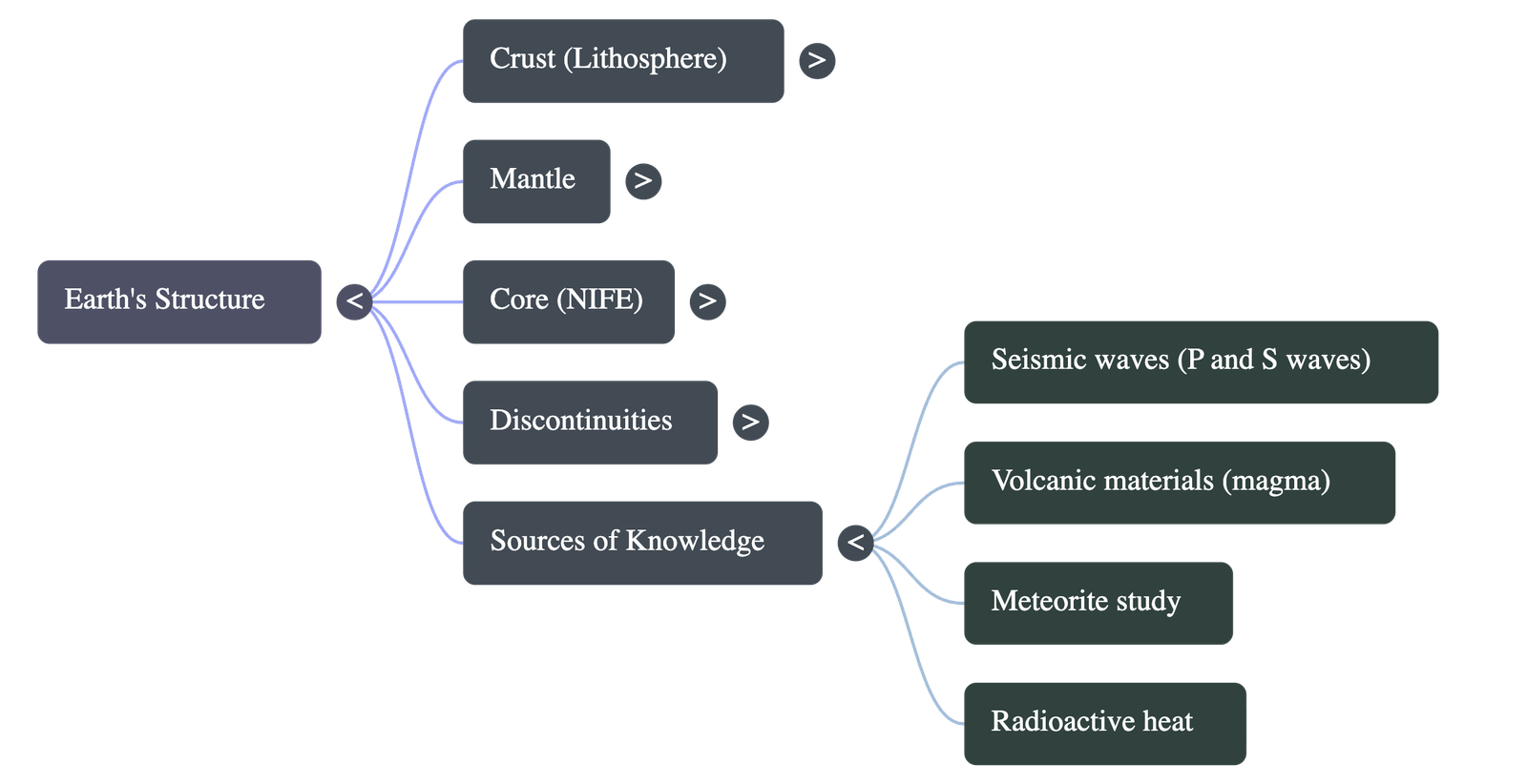
Sources of Information About the Interior
- Direct excavation of the earth's interior is impossible; thus, knowledge relies on scientific deductions.
- Seismic Waves: Instruments record earthquake waves to study interior density, pressure, and temperature. Primary waves (P-waves) reach the surface, while secondary waves (S-waves) cannot travel through liquids.
- Volcanic Eruptions: Magma thrown up from deep magma chambers helps scientists analyze internal materials.
- Meteorites: Earth is believed to be made of the same materials as meteorites that fall to the surface.
- Radioactivity: Internal heat generated by radioactive elements helps estimate the temperature inside the earth.
Chemical Composition
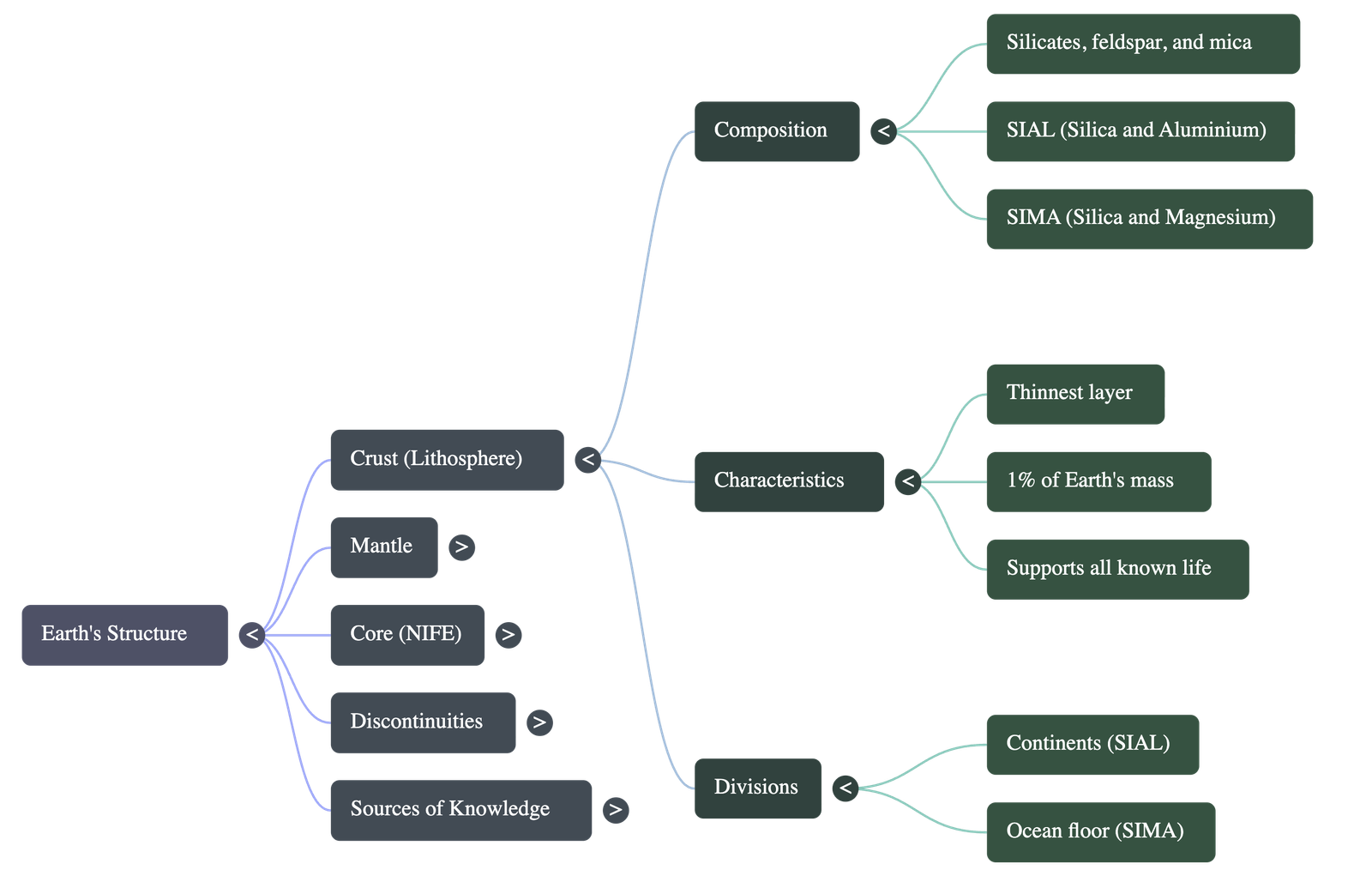
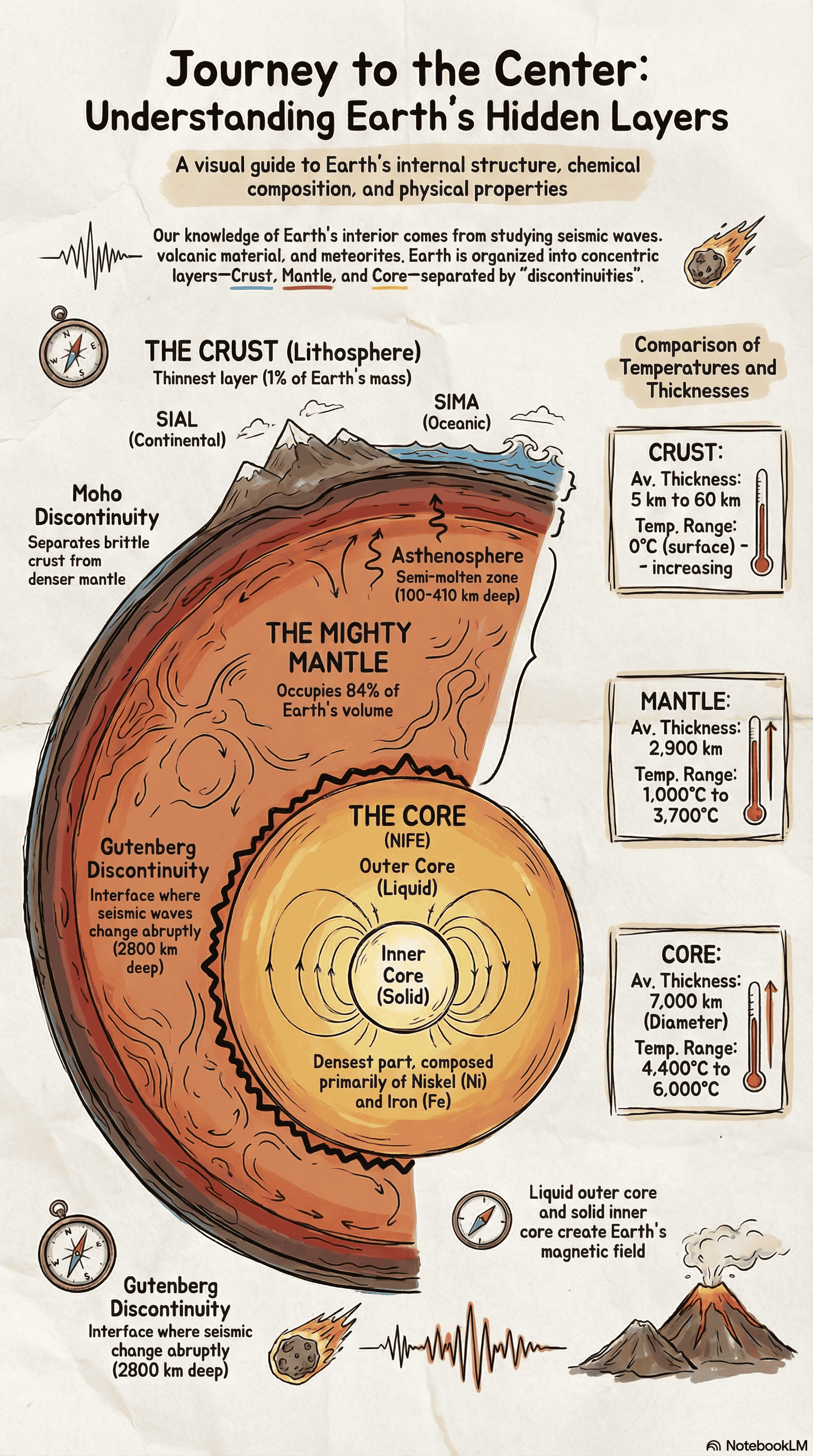
The outermost crust (Lithosphere) is the thinnest layer, made up of rocks rich in silicates, feldspar, and mica. It is divided into two broad divisions:
- SIAL: Named for Silica (Si) and Aluminium (Al). It has a lower density, forms the continents, and appears to float above the SIMA.
- SIMA: Named for Silica (Si) and Magnesium (Mg). It is denser and forms the ocean floor.
Internal Composition: The Three Layers
1. The Core
- The central, most inaccessible, and densest part of the earth.
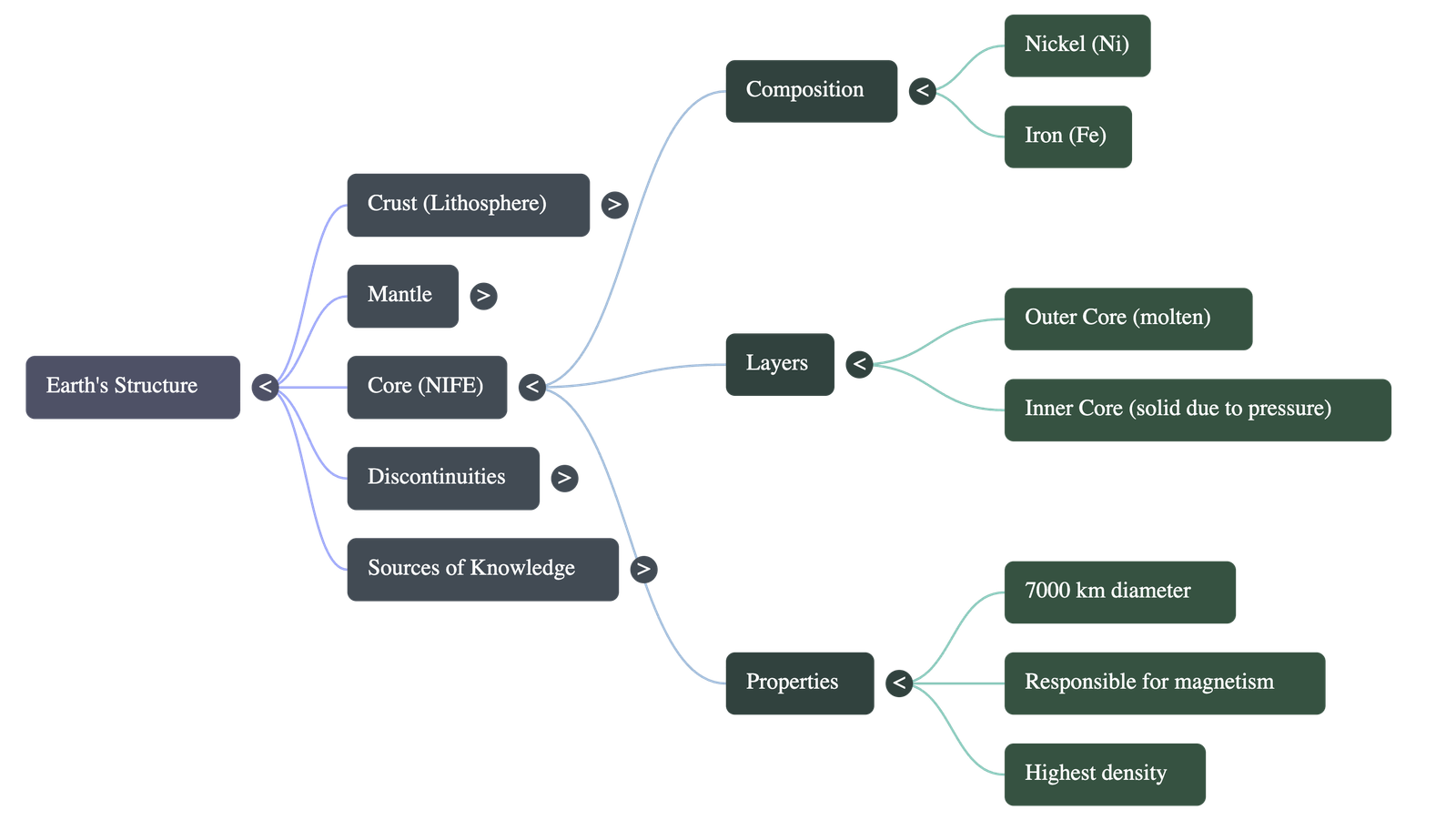
- Has a diameter of about 7,000 km. Temperatures range between 4,400°C and 6,000°C.
- Known as NIFE because it is heavily composed of Nickel (Ni) and Iron (Fe). This composition is responsible for the earth's magnetism, oriented toward the North and South Poles.
- Inner Core: Remains in a solid state due to extreme density and compressive pressure.
- Outer Core: Exists in a molten state (confirmed by the disappearance of S-waves in this region).
2. The Mantle
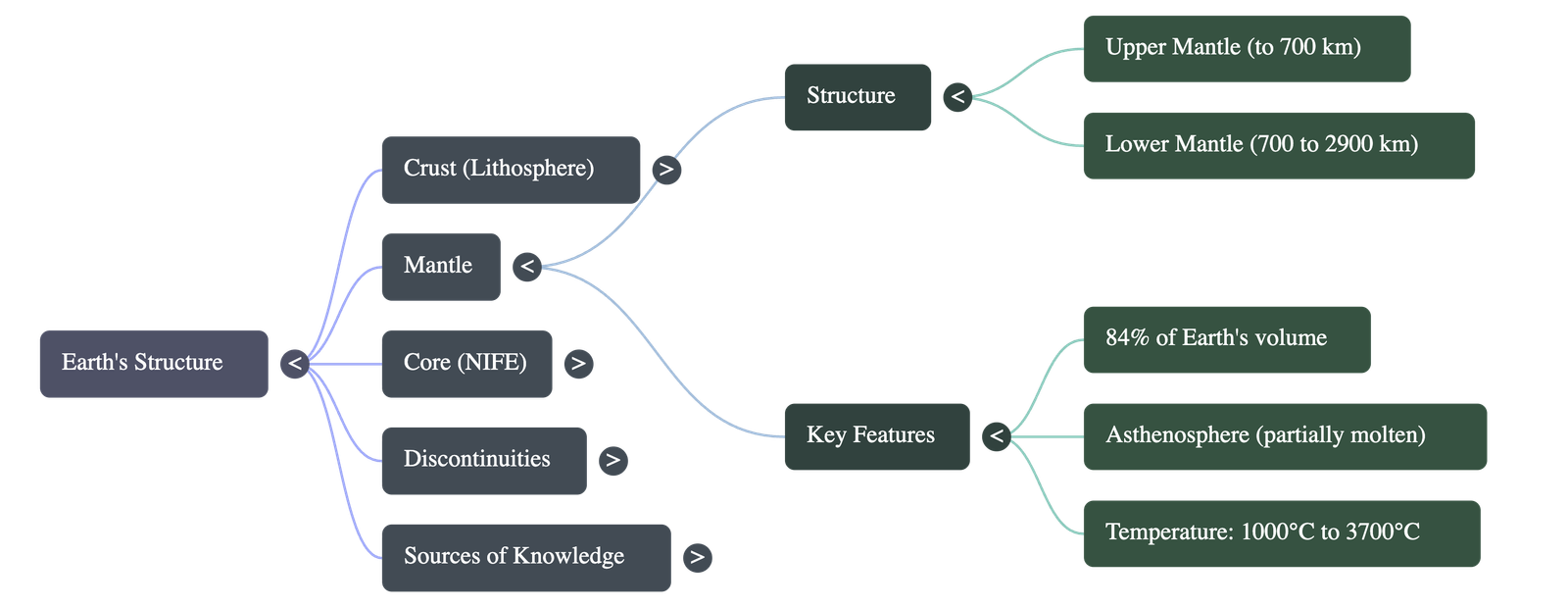
- Lies beneath the crust, making up 84% of the earth's total volume with an average thickness of 2,900 km.
- Temperatures vary widely, from 1,000°C to around 3,700°C.
- Upper Mantle: Extends down to 700 km, consisting of cooler, solid rocks. Contains the Asthenosphere (at 100-410 km depth), which is partially molten.
- Lower Mantle: Extends from 700 km to 2,900 km. It is hotter and denser but remains solid due to high pressure.
3. The Crust (Lithosphere)
- The term comes from "Lithos" (stones/rocks). It is a sphere of solid rocks that contains all known life in the universe.
- Accounts for only 1% of the earth's mass and is relatively very thin.
- Thickness varies: about 60 km below high mountains, but only 5-10 km below oceans.
- Temperature at the top of the oceanic crust is roughly 0°C but rises steadily with depth, alongside increases in weight and pressure.
- Highly fragile compared to the rest of the earth; it constantly undergoes structural changes driven by the forces of nature over millions of years (as explained by Continental Drift and Plate Tectonics).
Major Boundaries (Discontinuities)
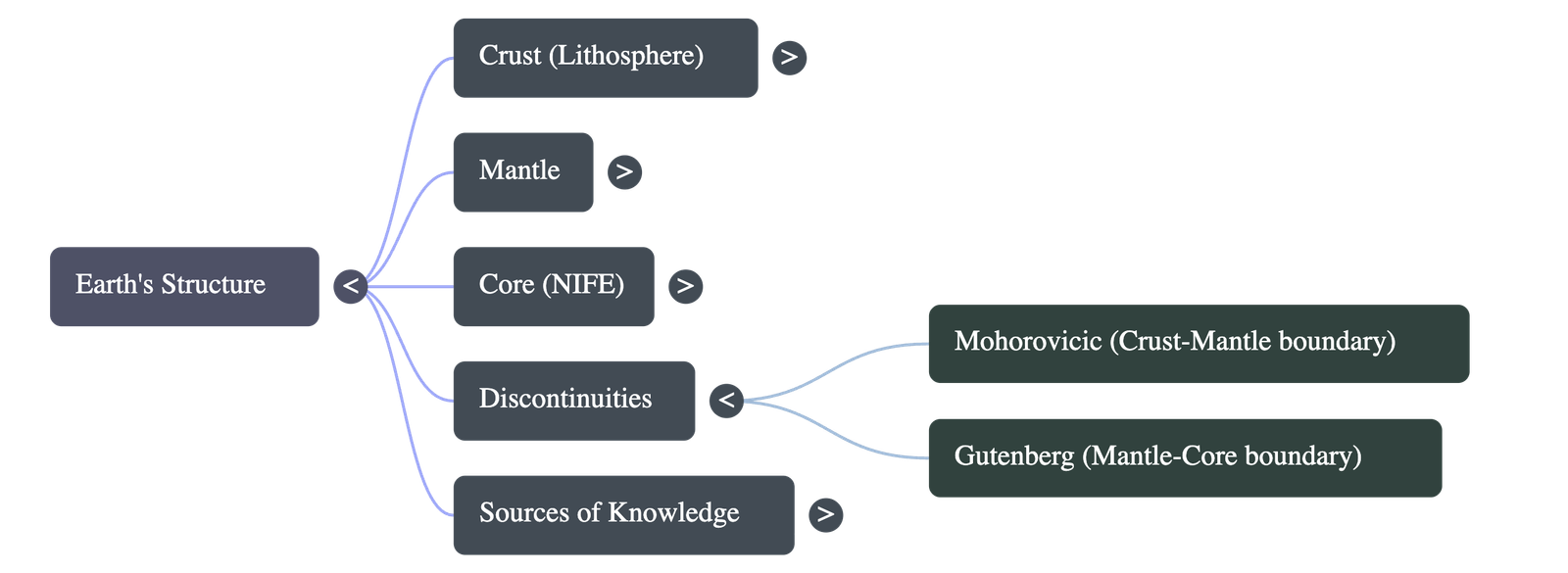
- Mohorovicic Discontinuity (Moho): Discovered by Yugoslavian scientist Andreaja Mohorovicic in 1909. It forms the boundary between the crust and the mantle. It varies in depth, found about 8 km beneath oceans and 32 km beneath continents, and shares characteristics of both adjoining layers.
- Gutenberg Discontinuity: The boundary dividing the mantle and the core. Beginning at a depth of 2,800 km, it marks a zone where there is an abrupt change in the speed and behavior of seismic waves.
Do checkout all questions & answers of this chapter.
Quick Navigation:
| | | |
1 / 1
Quick Navigation:
| | | |