Quick Navigation:
| | | |
Hydrosphere
1. Overview and Water Sources
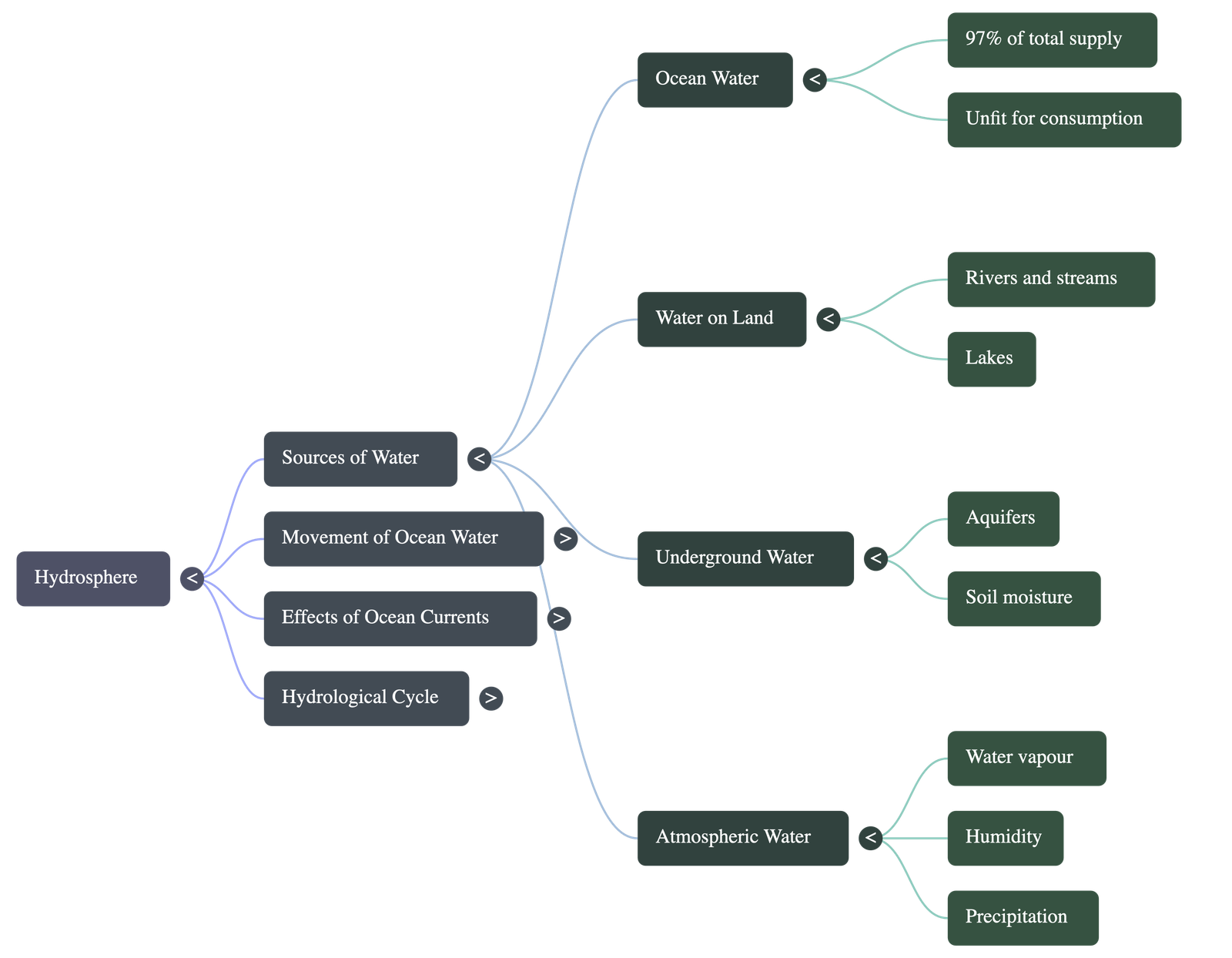
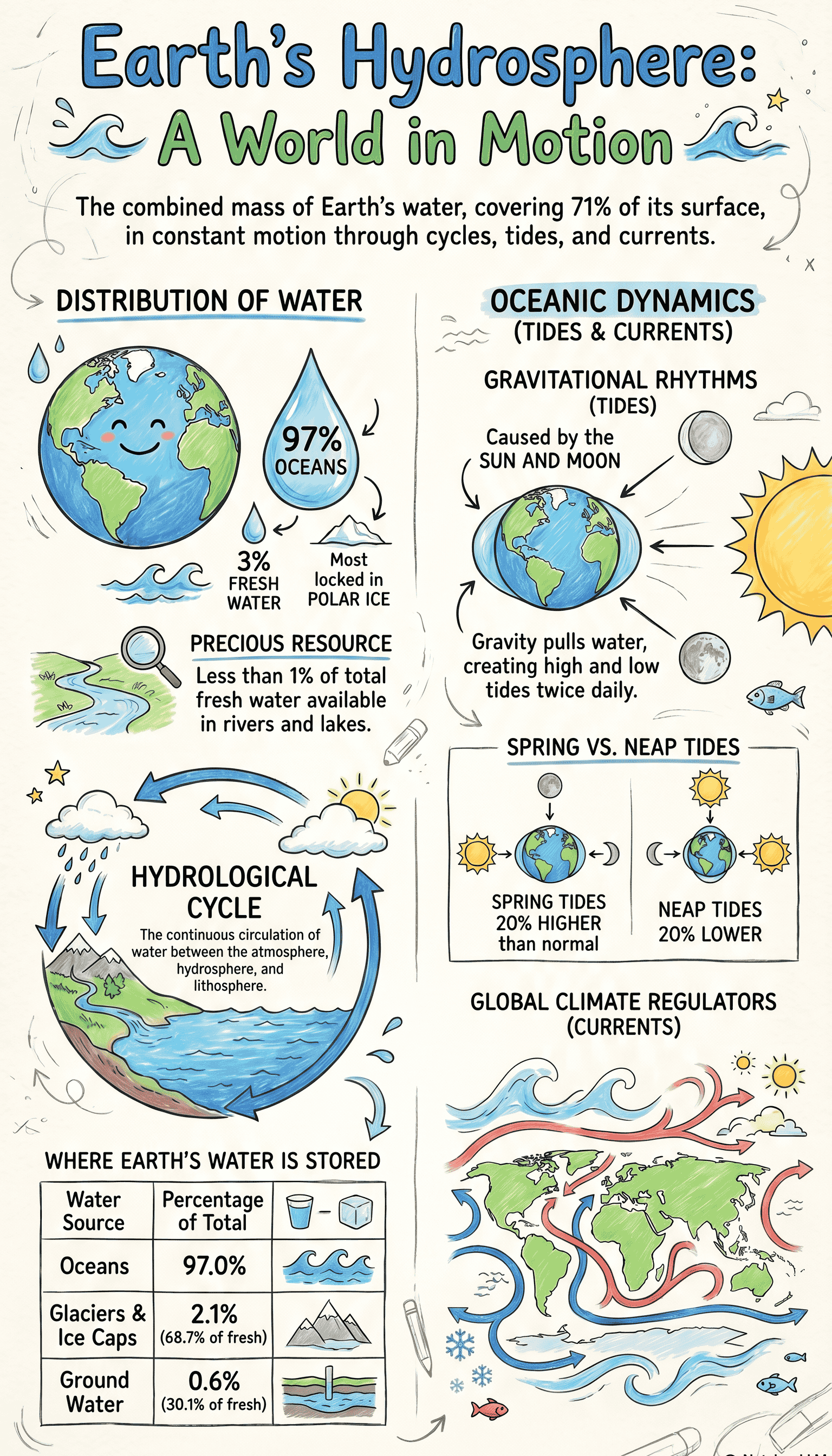
- Meaning: The hydrosphere encompasses the combined mass of all water found on Earth—in oceans, rivers, lakes, underground, and the atmosphere.
- Global Coverage: Approximately 71% of the Earth is covered by water, giving it a blue appearance from space.
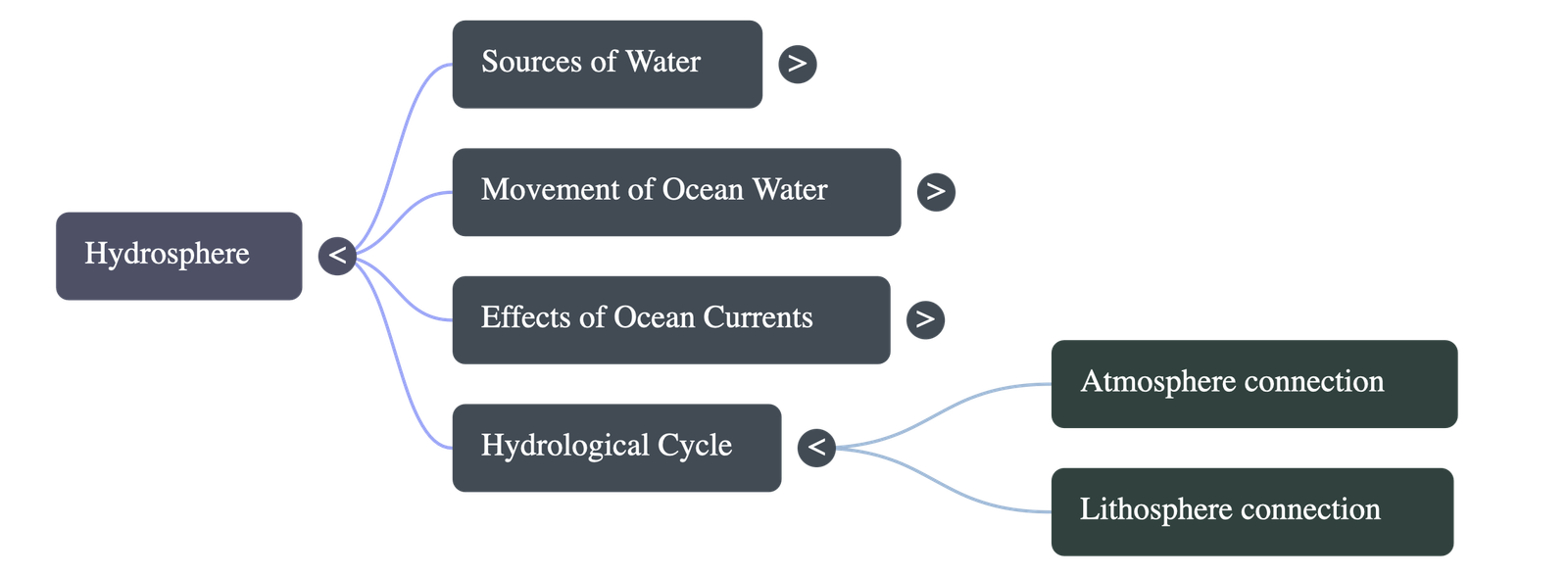
- Hydrological Cycle: The continuous movement of water around and through the Earth, connecting the atmosphere, lithosphere, and hydrosphere.
- Main Sources of Water:
- Ocean Water: Constitutes about 97% of Earth's water. It is unfit for human consumption due to high salinity.
- Water on Land: Formed by precipitation and seepage, flowing as rivers and streams towards the sea.
- Underground Water: Water that sinks into the soil, sub-soil, or bedrock, forming aquifers.
- Atmospheric Water: Present as vapor causing humidity; it condenses to form clouds, fog, rain, or snow.
2. Movements of Ocean Water
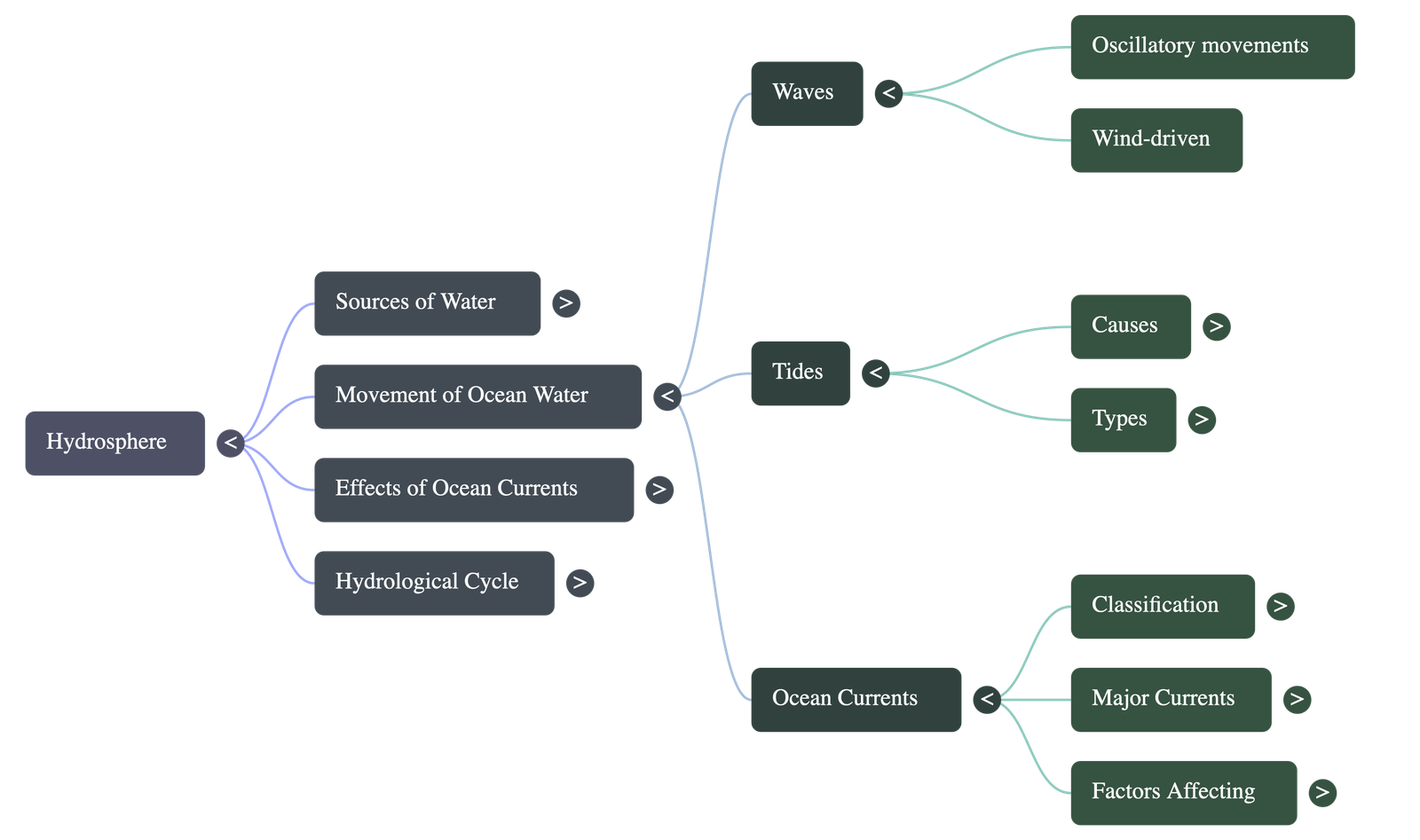
Ocean waters are constantly moving in three primary ways: waves, tides, and currents.
A. Waves
- Waves are oscillatory movements manifested by an alternate rise and fall of the sea surface.
- These ridge-like curves are primarily generated by winds blowing across the surface of the ocean.
B. Tides
- Definition: The rhythmic rise and fall of seawater driven by the gravitational forces of the sun and the moon.
- Key Terms:
- Tide / High Tide: The rise of seawater and its movement towards the coast.
- Ebb / Low Tide: The fall of seawater and its movement back towards the sea.
- Tidal Range: The difference in water level between high tide and low tide.
- Apogee & Perigee: Apogee is the farthest distance between the Earth and the Moon; Perigee is the nearest distance.
- Causes of Tides: The gravitational pull of the moon acts strongly on the Earth's facing side, pulling water outward. Simultaneously, the centrifugal force of the Earth causes a reactionary outward bulge of water on the opposite side.
- Periodicity: Every place generally experiences two high tides and two low tides within 24 hours. However, because the moon orbits the Earth while the Earth rotates, each day's tide is delayed by about 26 minutes (totaling a 52-minute delay over 24 hours).
- Types of Tides:
- Spring Tides: Exceptionally high tides that occur when the sun, moon, and Earth are in a straight line (during full moon and new moon). They are 20% higher than normal tides.
- Neap Tides: Lower tides that occur when the sun and moon are at a right angle to the Earth (during the 7th or 8th day of the fortnight). The opposing gravitational forces result in tides 20% lower than normal.
C. Ocean Currents
- Ocean currents are large masses of surface water circulating in regular, predictable patterns around the oceans.
- Classification by Temperature:
- Warm Currents: Flow from low latitudes (Equator) towards high latitudes (Poles), bringing warm water into cold areas.
- Cold Currents: Flow from high latitudes (Polar regions) towards low latitudes, bringing cold water into warm areas.
- Classification by Depth: Surface Currents (top 400m, making up 10% of ocean water) and Deep Water Currents (driven by density and gravity, making up 90%).
- Causes of Ocean Currents:
- Salinity: Denser, highly saline water sinks and flows beneath less saline water.
- Temperature: Warmer equatorial waters expand and move toward the poles, while cold polar waters sink and move toward the equator.
- Earth's Rotation (Coriolis Force): Causes moving water to deflect clockwise in the Northern Hemisphere and anti-clockwise in the Southern Hemisphere.
- Planetary Winds: Trade winds, Westerlies, and Monsoon winds physically push surface waters into currents.
- Land Masses: Continents obstruct and divert the flow of ocean currents.
3. Major Ocean Currents
- The Gulf Stream & North Atlantic Drift (Warm): Originates in the Gulf of Mexico, runs up the US east coast, and splits to warm the coasts of Western/Northern Europe, keeping European ports ice-free in winter.
- The Labrador Current (Cold): Flows south from the Arctic Ocean along Canada's east coast. It brings icebergs and creates heavy fog and rich fishing grounds when it collides with the warm Gulf Stream.
- The Kuroshio Current (Warm): Located in the western North Pacific (coast of Japan). It transports warm, tropical water northwards and sustains Japan's coral reefs. Also known as the Japan Current or "Black Stream".
- The Oyashio Current (Cold): Flows south from the Arctic into the western North Pacific. Extremely nutrient-rich, it creates some of the world's richest fishing grounds. When it meets the Kuroshio current, dense fogs form.
4. Effects of Ocean Currents
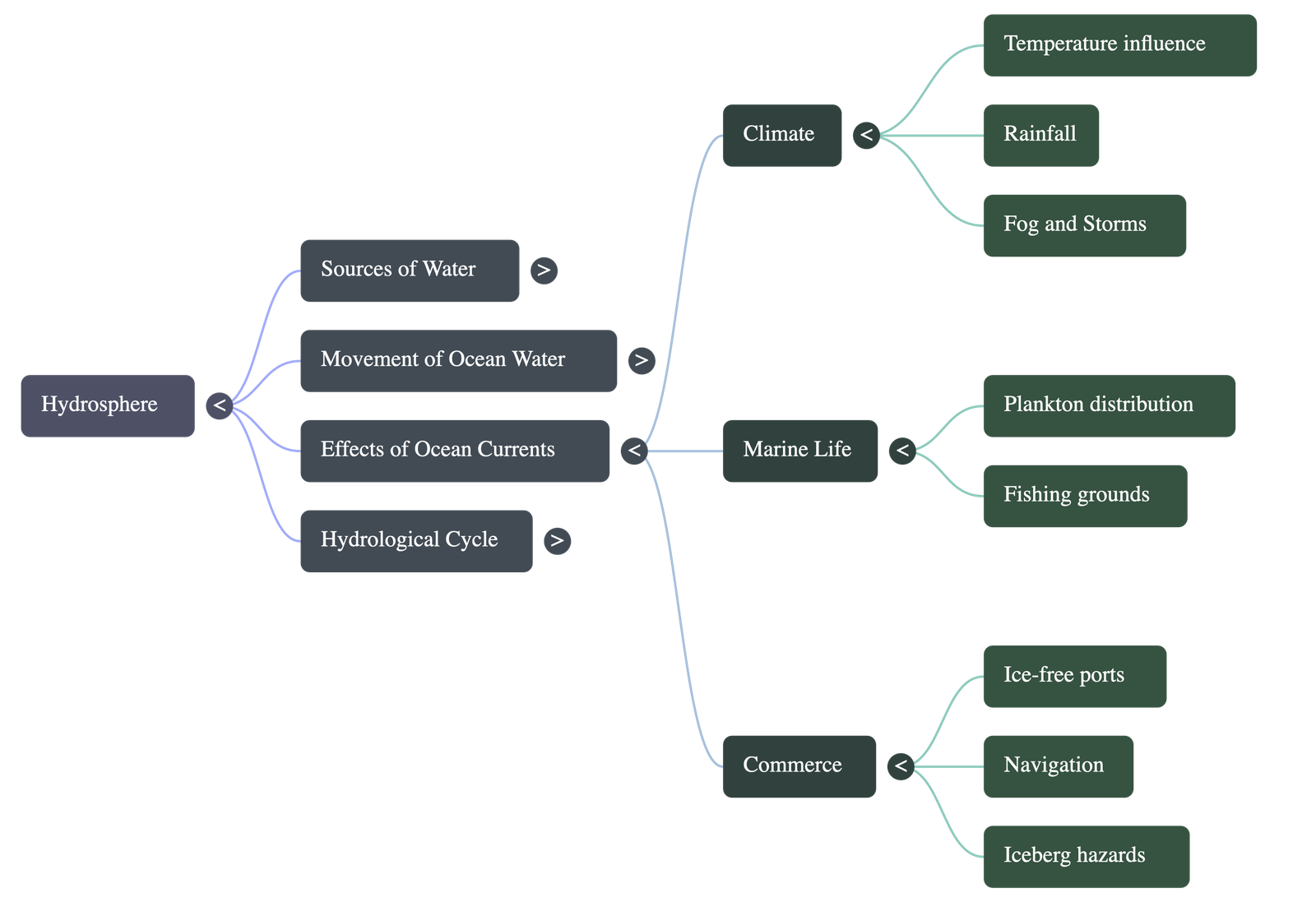
- Effect on Climate:
- Temperature: Warm currents raise the temperature of adjacent coasts (e.g., British Isles stay mild), while cold currents lower them (e.g., Labrador remains frozen for months).
- Rainfall: Winds over warm currents gather moisture, bringing rainfall to coastal areas. Conversely, cold currents discourage rainfall, contributing to coastal deserts like the Atacama and Kalahari.
- Fog: Extremely dense fogs form where cold and warm currents meet, making navigation difficult (e.g., Newfoundland and the coast of Japan).
- Violent Storms: Hurricanes and storms often trace the lines where contrasting warm and cold currents mix.
- Effect on Marine Organisms: Ocean currents move organic material, attracting massive amounts of microscopic plankton. These highly nutrient-rich zones become highly concentrated, prosperous fishing grounds.
- Effect on Commerce:
- Warm currents keep deep-north harbours (like Spitsbergen and Norwegian ports) unfrozen and open for trade year-round.
- Ocean current directions can either aid or hinder the movement and speed of sailing vessels.
- Cold currents bring dangerous icebergs into global shipping lanes, posing major threats to modern ships.
Do checkout all questions & answers of this chapter.
Quick Navigation:
| | | |
1 / 1
Quick Navigation:
| | | |