Quick Navigation:
| | | |
Atmospheric Pressure and Winds
1. Fundamentals of Atmospheric Pressure
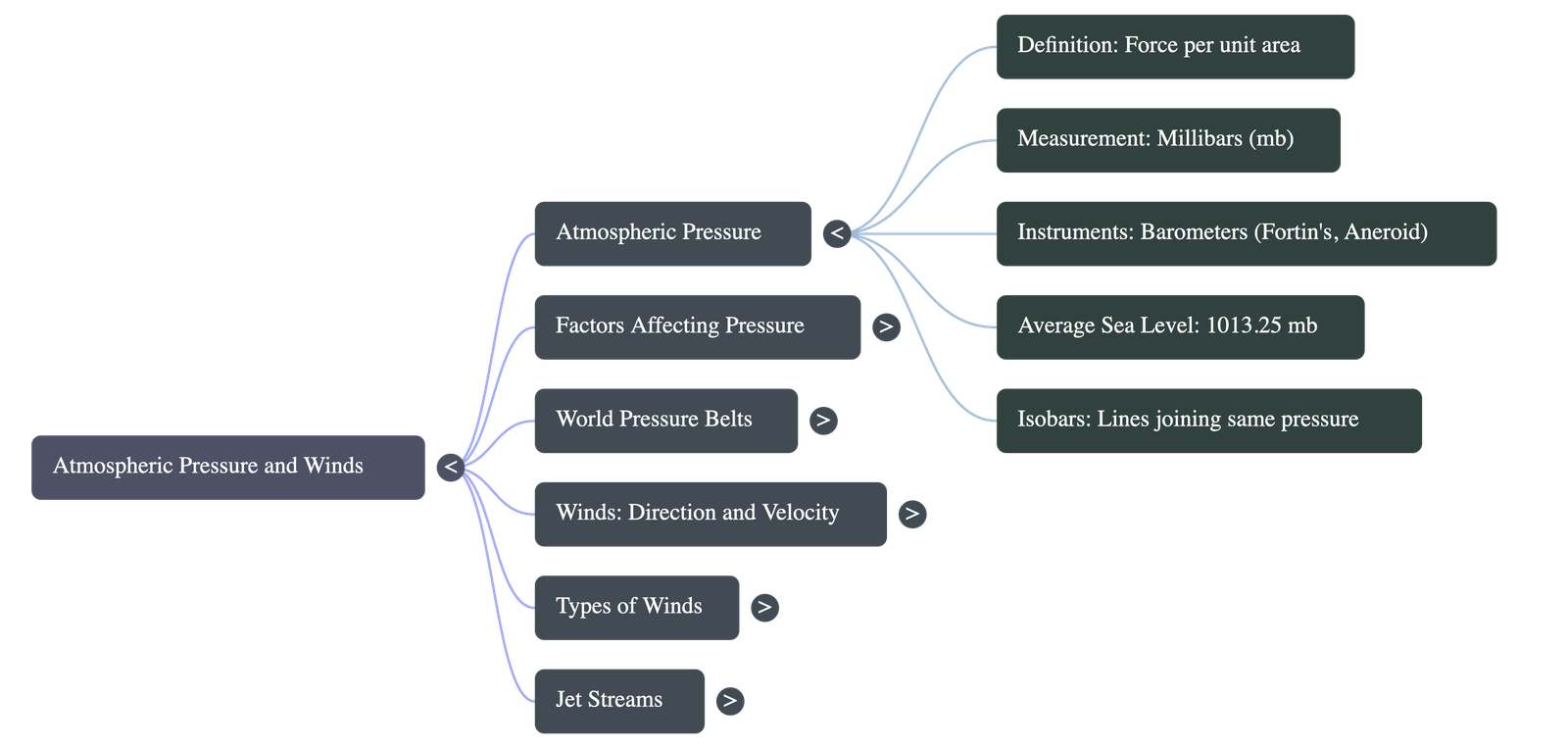
- Definition: Air has weight and exerts a force on the earth's surface, known as atmospheric pressure.
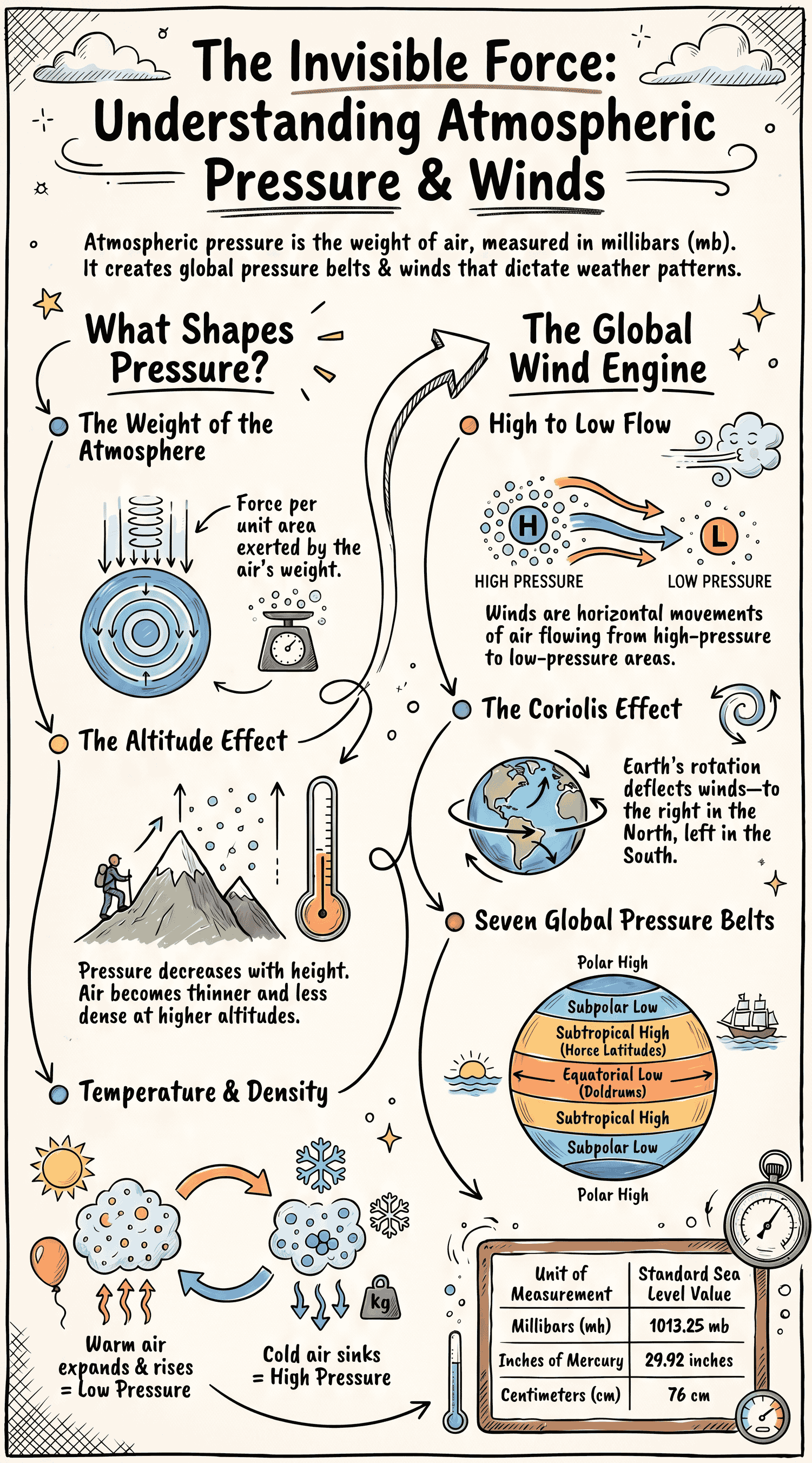
- Measurement: Pressure is measured in millibars (mb) using barometers (such as Fortin's Barometer and Aneroid Barometer). The average atmospheric pressure at sea level is 1013.25 mb.
- Isobars: Lines on weather maps that connect places experiencing the same barometric pressure.
- Pressure Gradient: The rate at which atmospheric pressure changes between two points on the earth's surface. Closely spaced isobars indicate a steep (strong) gradient, while widely spaced isobars indicate a gentle (weak) gradient.
2. Factors Affecting Atmospheric Pressure
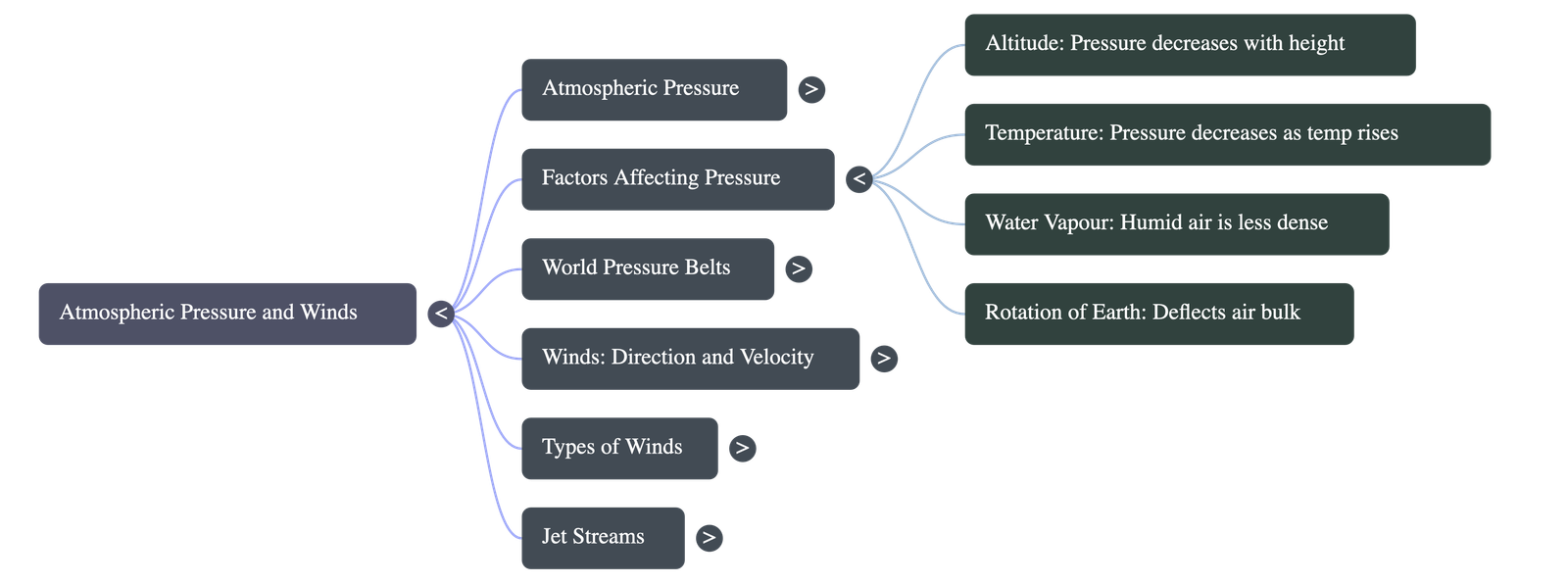
- Altitude: Pressure decreases with height because air becomes thinner and less dense at higher altitudes due to reduced gravitational pull.
- Temperature: Pressure decreases as temperature increases. Warm air expands, becomes less dense, and exerts less pressure, creating low-pressure zones. Cold air is dense and creates high-pressure zones.
- Water Vapour: Humid air is lighter and less dense than dry air, meaning it exerts less pressure.
- Rotation of the Earth: The earth's rotation generates centrifugal forces that push air away from the poles towards the equator, influencing pressure distribution.
3. World Pressure Belts
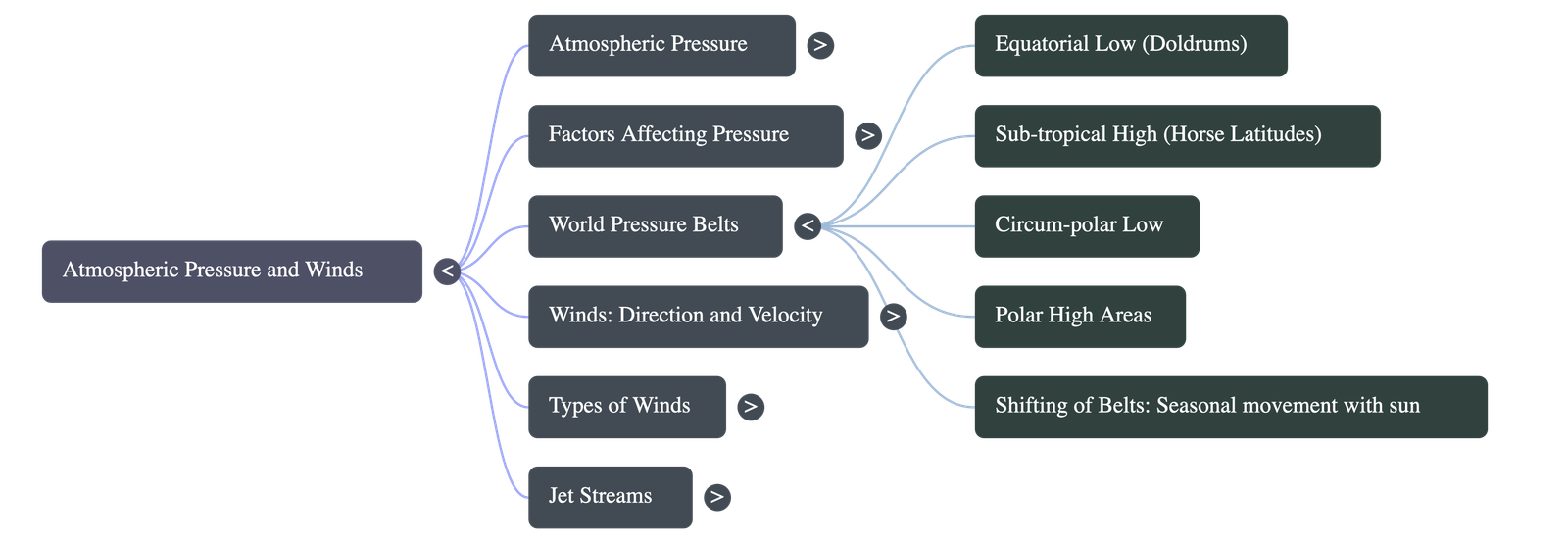
There are seven major pressure belts across the globe, formed by unequal heating and the earth's rotation:
- Equatorial Low Pressure Belt (Doldrums): Located between 0° to 5° North and South. Intense heating causes air to expand and rise, creating a zone of calm with virtually no breeze.
- Sub-tropical High Pressure Belts (Horse Latitudes): Located at about 30° North and South. Ascending equatorial air cools and descends here, creating high pressure.
- Circum-polar Low Pressure Belts: Located between 60° and 70° North and South. Created mainly by the earth's rotation and centrifugal forces pushing air away from the polar regions.
- Polar High Pressure Areas: Located at the poles (70° to 90° North and South). Extreme cold causes heavy air to sink, resulting in permanent high pressure.
- Shifting of Belts: Due to the earth's 23.5° inclination, pressure belts shift 5° northward during the Northern Hemisphere's summer and 5° southward during its winter, significantly affecting seasonal climates (e.g., Mediterranean climate).
4. Winds and Controlling Factors
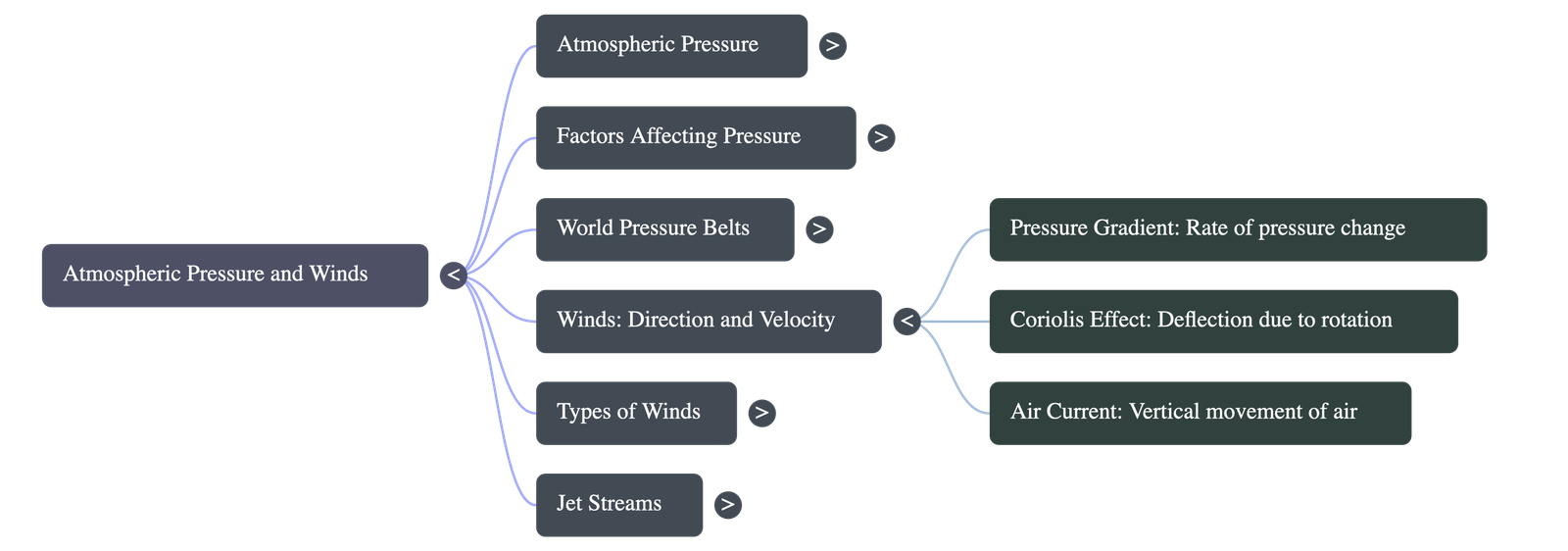
- Definition: Wind is the horizontal movement of air from high-pressure areas to low-pressure areas. Vertical movement is called an air current.
- Pressure Gradient: Determines wind speed. A steeper gradient results in faster winds.
- Coriolis Effect: Due to the earth's rotation, winds do not travel in straight lines. They are deflected to their right in the Northern Hemisphere and to their left in the Southern Hemisphere.
5. Types of Winds
A. Permanent (Planetary) Winds
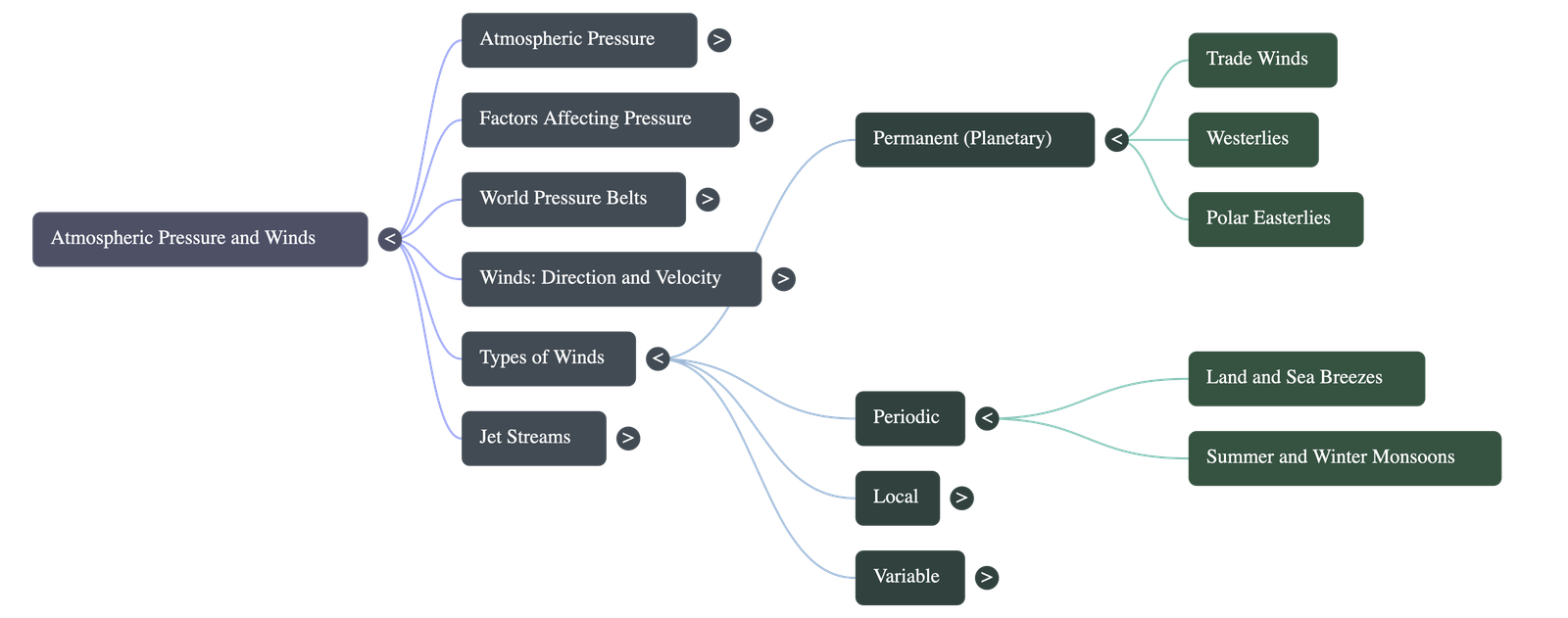
- Trade Winds: Blow from Sub-Tropical Highs to the Equatorial Low. Known as North-East Trades (Northern Hemisphere) and South-East Trades (Southern Hemisphere). They bring heavy rain to the eastern coasts of continents.
- Westerlies: Blow from Sub-Tropical Highs to Circum-polar Lows (between 35° and 60° latitudes). They bring rain to the western coasts of continents and are notoriously strong in the predominantly oceanic Southern Hemisphere.
- Polar Easterlies: Extremely cold winds that blow from the Polar Highs toward the Circum-polar Lows.
B. Periodic Winds
- Land and Sea Breezes: Driven by daily temperature differences. Sea breezes blow from cooler oceans to warmer land during the day. Land breezes blow from cooler land to warmer oceans at night.
- Monsoons: Seasonal winds mainly in South East Asia and Northern Australia. Summer Monsoons blow from sea to land, bringing heavy rains. Winter Monsoons blow from land to sea, bringing generally dry, cold weather.
C. Local Winds
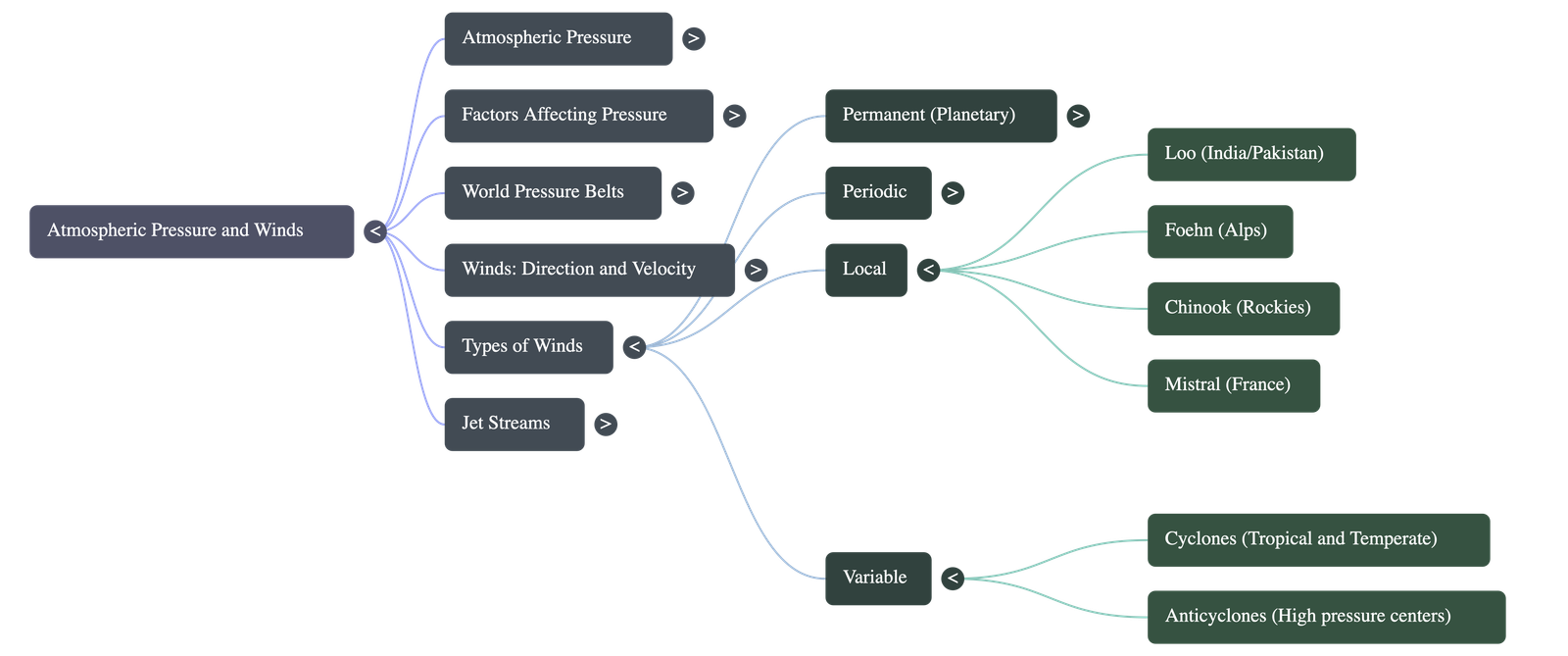
- Loo: A very hot and dry summer wind in northern India and Pakistan.
- Foehn and Chinook: Warm, dry winds that descend the leeward side of mountains (Alps and Rockies, respectively). They are known as "snow eaters" because they rapidly melt winter snow.
- Mistral: A bitterly cold winter wind blowing from the Alps down over France.
D. Variable Winds
- Cyclones: Intense low-pressure depressions with winds blowing inward (anti-clockwise in the North, clockwise in the South).
- Tropical Cyclones: Form over warm oceans, limited area, highly violent, travel east to west, and include a calm center known as the "eye" (e.g., Hurricanes, Typhoons, Tornadoes).
- Temperate Cyclones: Mid-latitudinal, form over land and sea, cover massive areas, travel west to east, and bring prolonged, light rainfall.
- Anticyclones: High-pressure centers with winds blowing gently outward (clockwise in the North, anti-clockwise in the South). Associated with fine, clear weather conditions.
6. Jet Streams
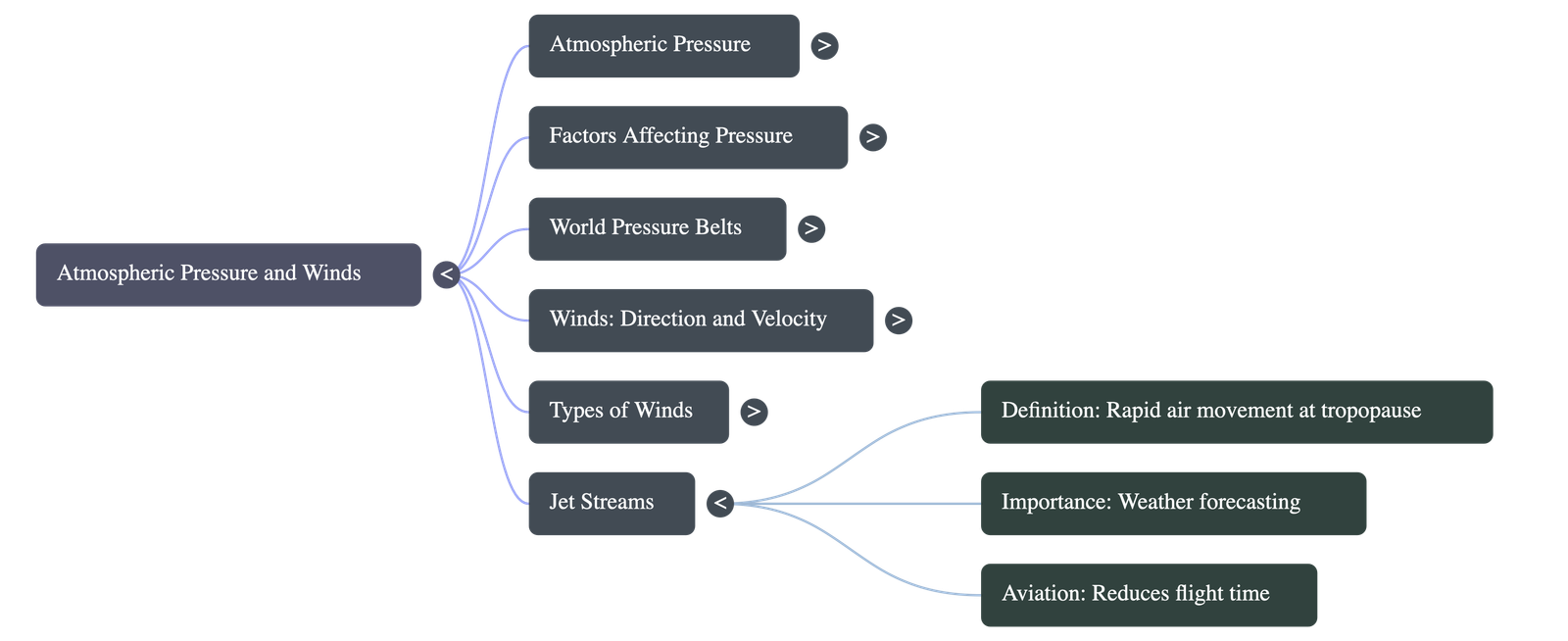
- Definition: Concentrated bands of extremely rapid air movement found at the tropopause (10-15 km above the earth's surface).
- Impact on Weather: They steer weather systems (like storms and fronts) across the globe, making them crucial for meteorological forecasting.
- Aviation Importance: Commercial airlines use jet streams to reduce flight times and save fuel when flying in the direction of the stream.
Do checkout all questions & answers of this chapter.
Quick Navigation:
| | | |
1 / 1
Quick Navigation:
| | | |