Quick Navigation:
| | | |
Denudation
1. Concept of Denudation
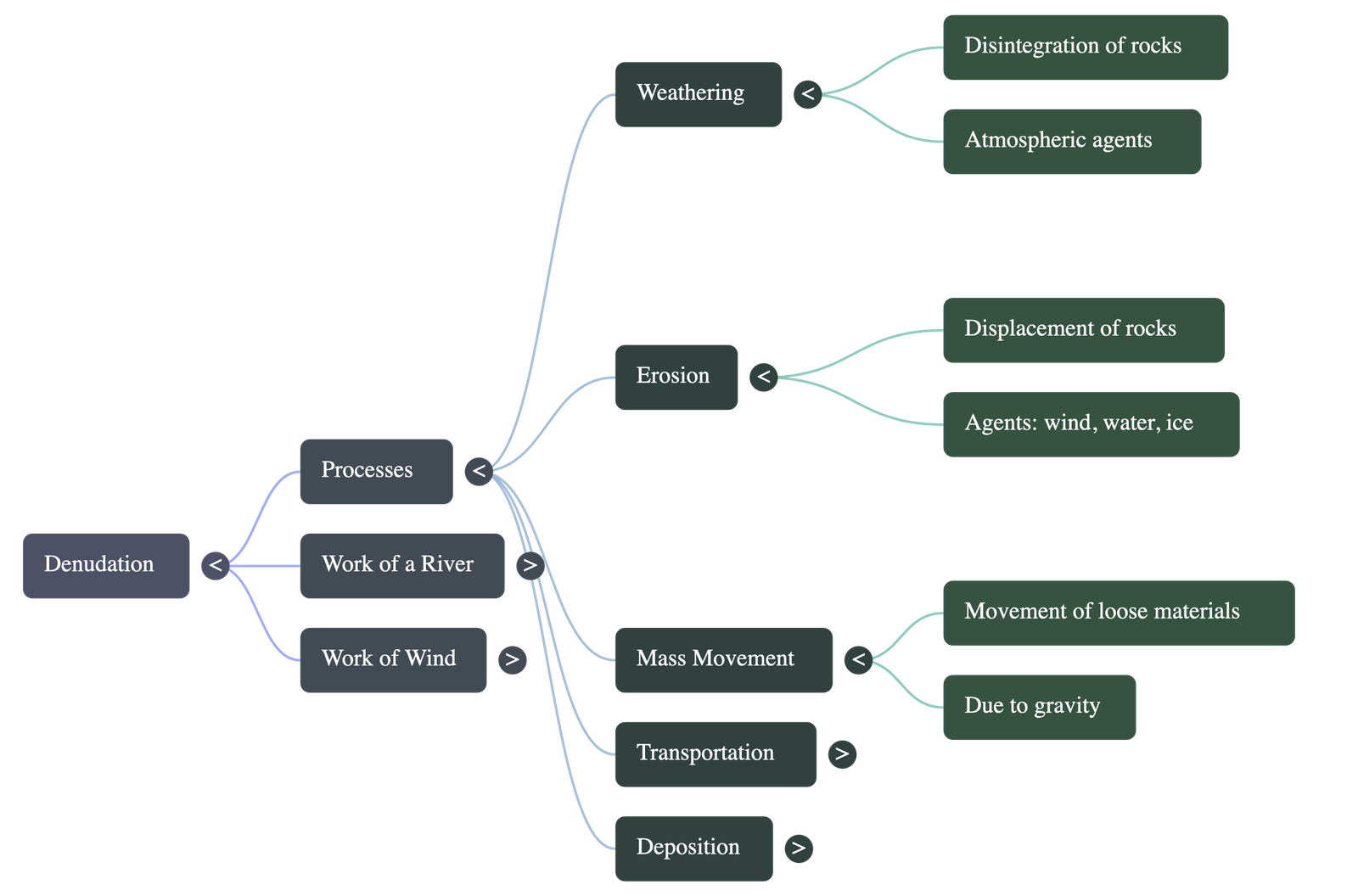
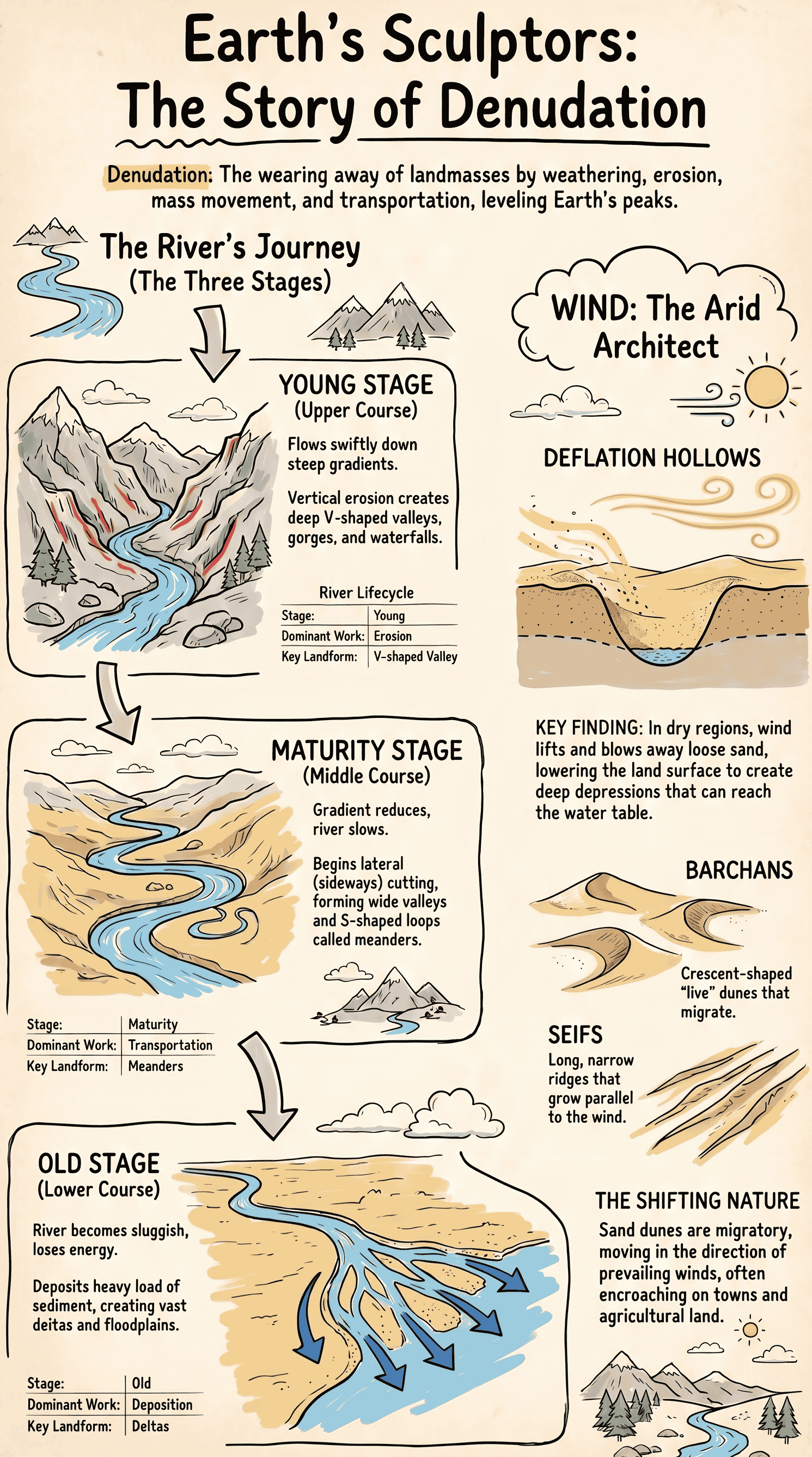
- Meaning: Denudation is the comprehensive process of breaking and removing rocks from the earth's surface. It continuously wears away landmasses, lowers the level of land, rounds exposed rock surfaces, and levels mountain peaks.
2. Core Processes Involved
- Weathering: The disintegration of rocks by atmospheric agents (like temperature, moisture, and precipitation) at or near the surface. It does not involve the movement of the broken materials.
- Erosion: The displacement of weathered rocks by active agents such as wind, water, or ice.
- Mass Wasting (Mass Movement): The large-scale downward movement of loose materials (rock-waste) along a slope, driven primarily by gravity. The steeper the slope, the faster the movement.
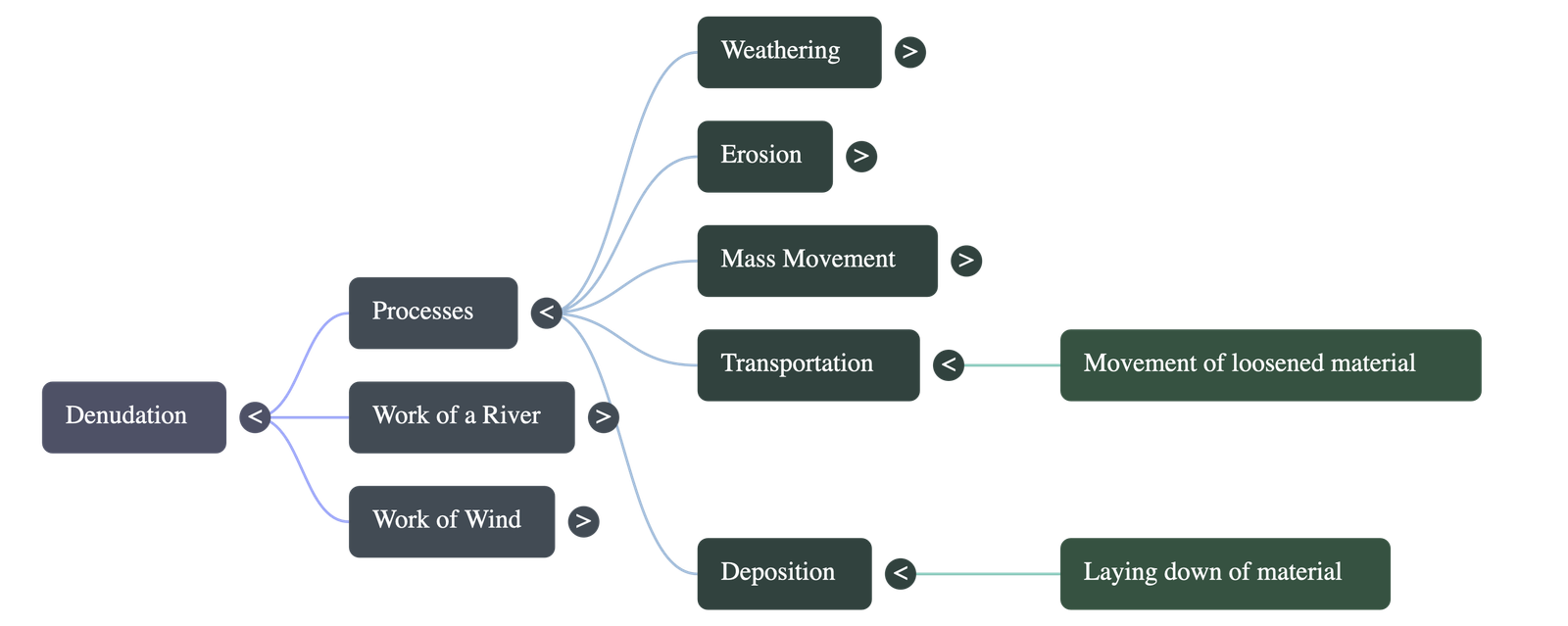
- Transportation: The movement of loosened, weathered, and eroded materials to a new location by agents like wind or water.
- Deposition: The process where transported materials are eventually laid down or settled by natural forces.
3. The Work of a River
- Rivers are considered the greatest agents of erosion, transportation, and deposition.
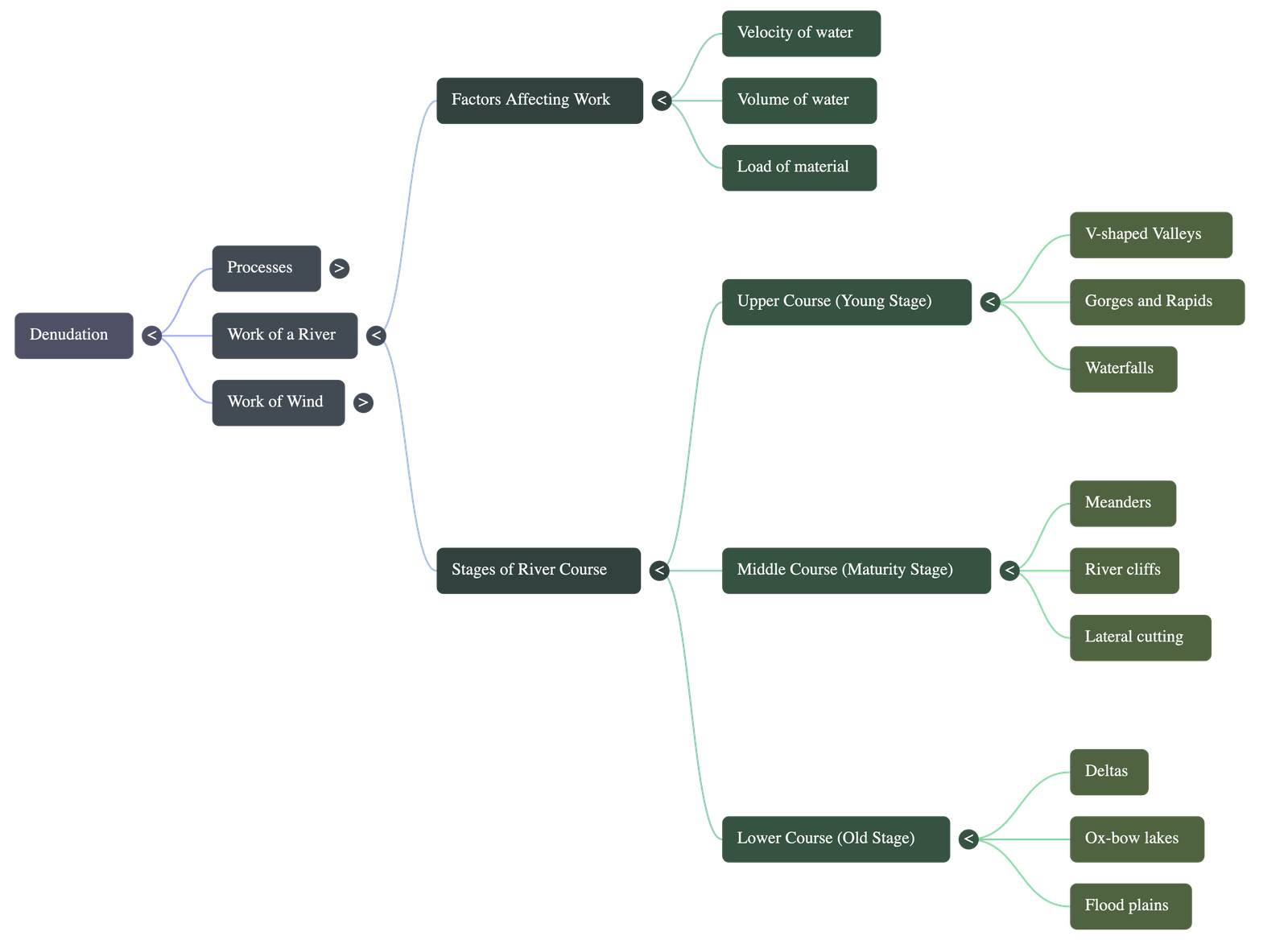
- Factors affecting a river's work:
- Velocity of Water: High velocity increases erosion and transportation; low velocity leads to deposition.
- Volume of Water: A larger volume translates to greater erosive and transporting power.
- Load: The physical materials transported by the river dictate the rate of deepening valleys and forming new landforms.
4. Course and Stages of a River
- Upper Course (Young Stage):
- Originates in mountainous areas (source) with steep gradients causing swift river flow.
- The dominant activity is vertical erosion (down-cutting).
- Landforms created: V-shaped valleys, gorges, waterfalls (plunging water creating plunge pools at the base), and rapids.
- Middle Course (Maturity Stage):
- The river enters the plains, slowing down as the gradient reduces.
- Lateral (sideways) cutting replaces vertical cutting, widening the river valley.
- Landforms created: Meanders (S-shaped curves in the river) and Oxbow lakes (formed when meanders become too sharp and the river cuts a straight path, isolating a curved body of water).
- Lower Course (Old Stage):
- The river flow becomes highly sluggish, losing its load-transporting capacity.
- The ideal stage for large-scale deposition.
- Landforms created: Deltas (triangular deposits of sediments at the river's mouth where it meets the sea) and flood plains. Deltas require a calm sheltered sea, high sediment supply, and reasonable river size.
5. The Work of Wind
- Wind is the primary agent of denudation in arid and desert regions where moisture and vegetation are lacking to hold the soil together.
- Actions of wind: Erosion, transportation (lifting and carrying sand grains), and deposition (dropping sediments when wind speed reduces).
- Landforms created by wind:
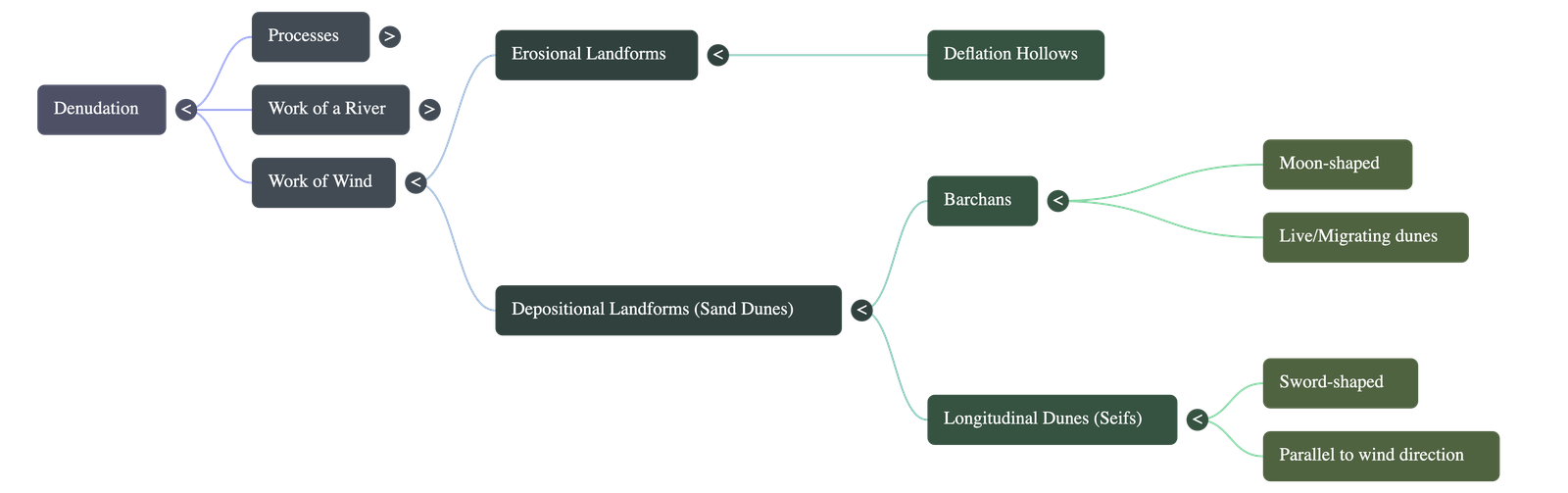
- Deflation Hollows: Deep depressions formed when wind lifts and blows away loose surface materials. (e.g., The Qattara Depression).
- Sand Dunes: Hills of accumulating sand that can be active (shifting) or inactive (fixed by vegetation).
- Barchans: Moon-shaped or crescent-shaped live dunes that advance before steady winds. Their windward side is convex and gentle, while the leeward side is steep and concave. They are a threat to human settlements as they can bury fertile land and oasis.
- Longitudinal Dunes (Seifs): Long, narrow, stationary sand-ridges that grow parallel to the prevailing wind direction, primarily found in the interior of vast deserts.
- Checking Dune Migration: The shifting of destructive sand dunes can be controlled by planting long-rooted trees and sand-holding grasses on the windward slope.
Do checkout all questions & answers of this chapter.
Quick Navigation:
| | | |
1 / 1
Quick Navigation:
| | | |