Quick Navigation:
| | | |
Humidity
Evaporation & Moisture
- • Moisture continuously cycles between the atmosphere and the earth, keeping the total volume of water in oceans and seas constant.
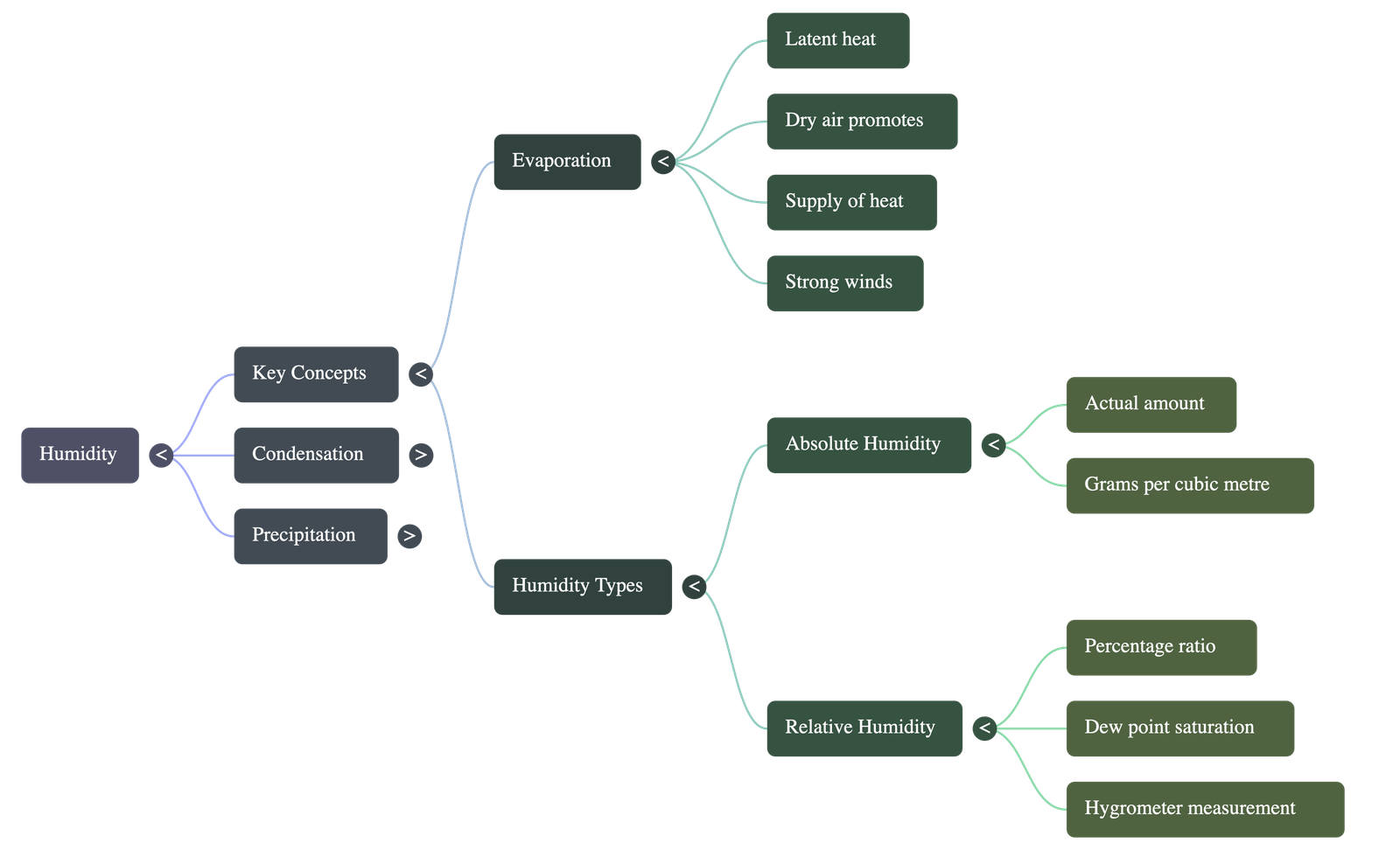
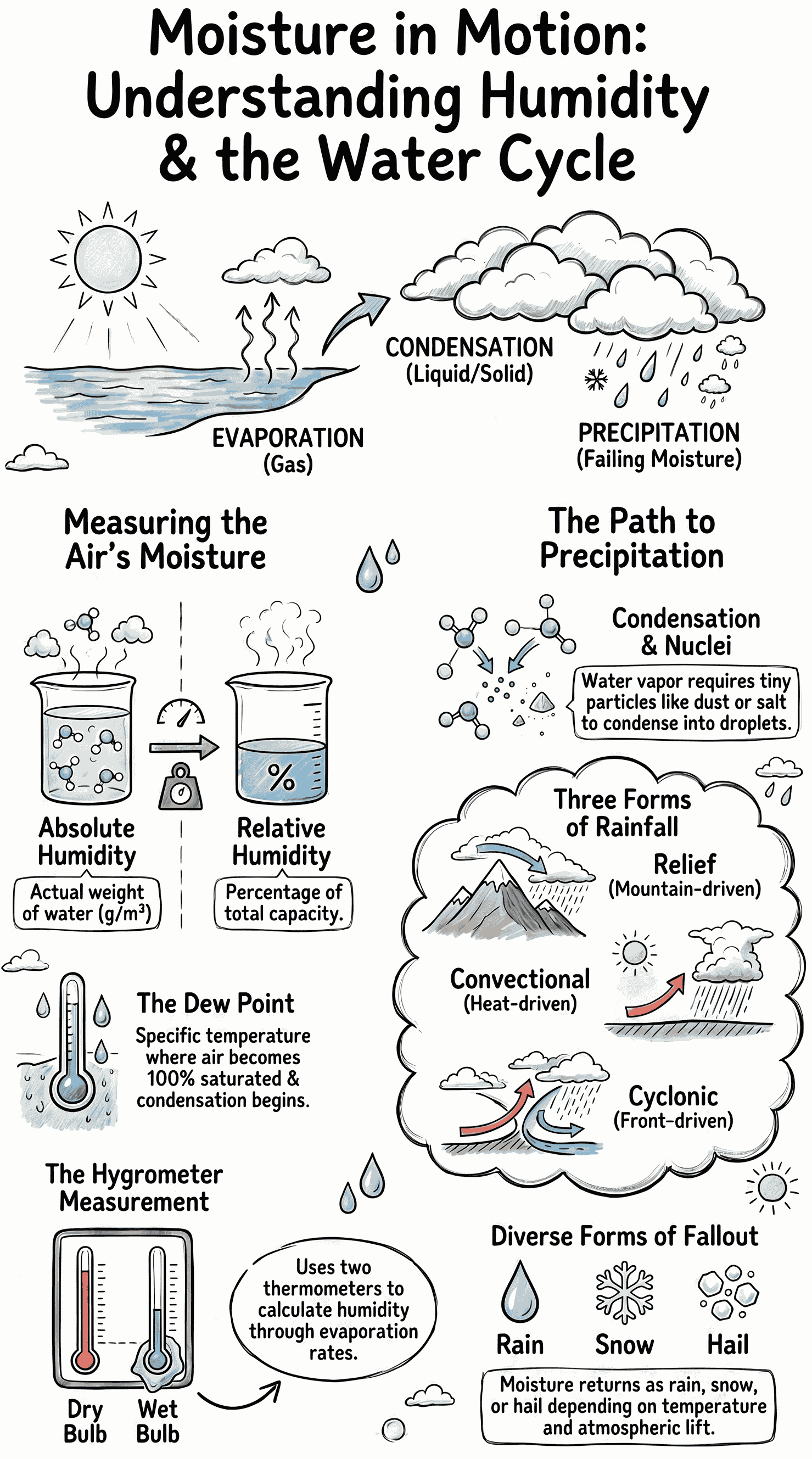
- • Evaporation is the transformation of liquid water into water vapour upon heating. This process requires energy, which is absorbed and stored as hidden latent heat.
- • The stored latent heat is released back into the atmosphere during condensation, which can cause a slight increase in air temperature.
- • Evaporation rates are increased by three primary factors: a supply of heat, dry air (which has a higher capacity to absorb moisture than humid air), and strong winds.
Understanding Humidity
- • Humidity refers to the amount of water vapour present in the atmosphere.
- • Absolute Humidity: The actual mass of water vapour held in a given volume of air, measured in grams per cubic metre (g/m³). It is rarely used in weather calculations because absolute humidity fluctuates as air rises and expands.
- • Relative Humidity (RH): Expressed as a percentage, it is the ratio of the actual amount of water vapour in the air to the maximum moisture capacity the air can hold at that specific temperature. It is the most essential metric for predicting precipitation, fog, or dew.
- • Dew Point: The temperature at which air becomes fully saturated with moisture, meaning its Relative Humidity reaches exactly 100%.
Measurement of Humidity
- • Humidity is measured using an instrument known as a Hygrometer (or a Dry and Wet Bulb Thermometer).
- • It features two thermometers. One bulb is left dry, while the other is wrapped in a wet cloth dipped in water.
- • As water evaporates from the wet cloth, it cools the bulb, causing it to show a lower temperature reading than the dry bulb. The temperature difference between the two thermometers helps determine the relative humidity.
- • If both thermometers show the exact same reading, it means no evaporation is occurring because the air is 100% saturated.
Condensation & Its Forms
- • Condensation is the opposite of evaporation. It is the process of water vapour converting back into water droplets or solid ice.
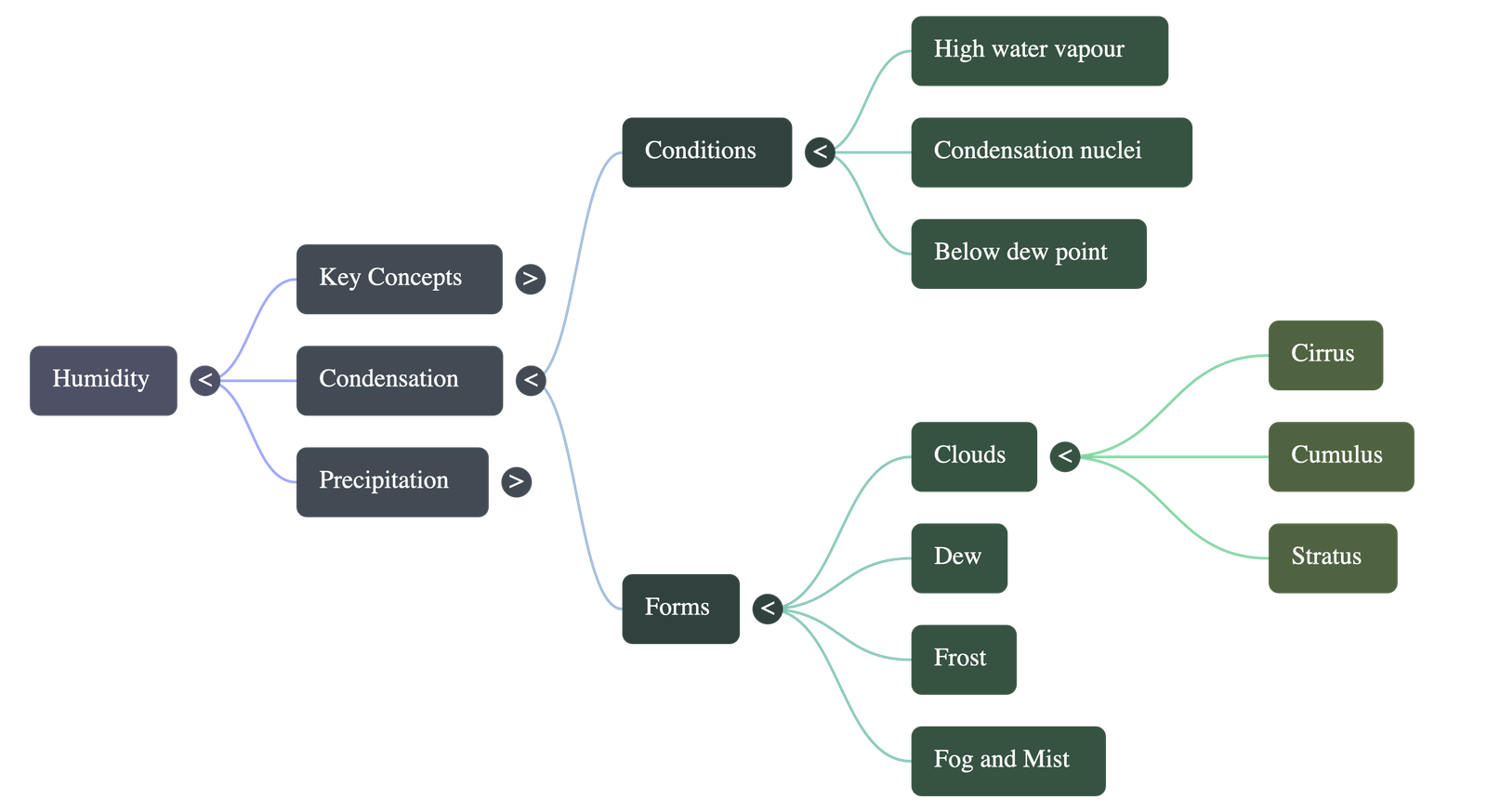
- • Three conditions are required for condensation: a high volume of water vapour, a temperature drop below the dew point, and the presence of condensation nuclei (microscopic particles of dust, smoke, or salt that act as a base for moisture to collect around).
- • Clouds: Formed by condensed droplets suspended high in the air. The main types are Cirrus (high-altitude, fleecy), Cumulus (dome-shaped, cauliflower-like, rain-bearing), and Stratus (flat, layered structures).
- • Dew: Tiny liquid droplets that form directly on cool ground surfaces when the air cools below the dew point, typically during winter nights.
- • Frost: Forms when condensation happens at or below the freezing point (0°C). Moisture turns directly into minute ice crystals on the ground, which can be highly damaging to crops and plants.
- • Fog and Mist: Water droplets suspended in the atmosphere very close to the earth's surface. Mist is lighter with visibility up to 2 kilometres, whereas fog is denser with visibility extending to less than one kilometre.
Precipitation & Rainfall Types
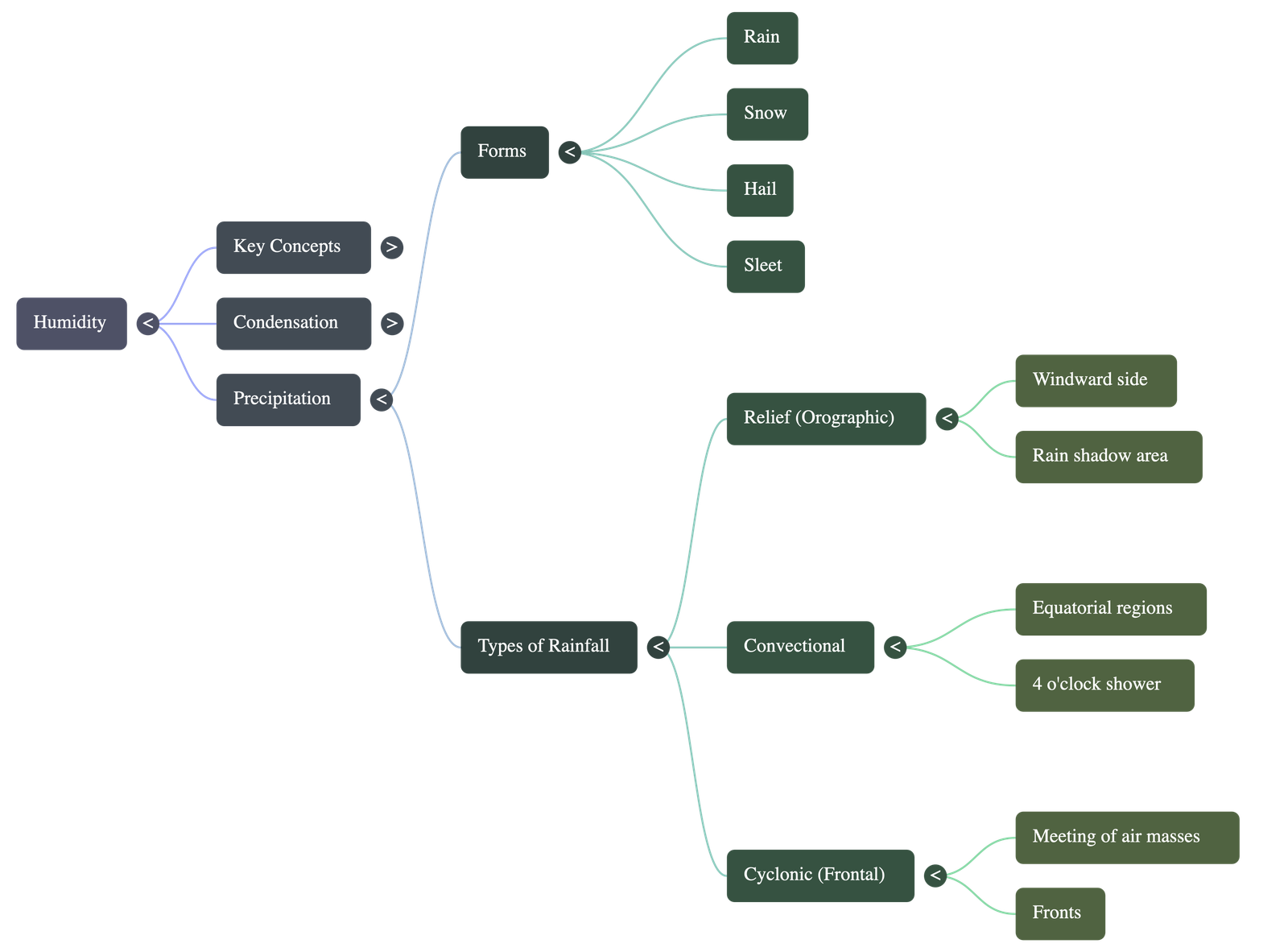
- • Precipitation is the process where condensed particles join together, become too heavy to float in the clouds, and fall to the ground. Common forms include Rain (or lighter drizzle), Snow (frozen water droplets), and Hail (solid ice formed by vertical air currents).
- • Relief (Orographic) Rainfall: Occurs when a mountain barrier forces warm, moist wind to ascend. The wind cools and condenses, causing heavy rain on the windward side. As the wind drops down the opposite leeward side, it warms and compresses, resulting in a dry area known as the "rain shadow."
- • Convectional Rainfall: Most common in Equatorial regions. Intense heat warms the air rapidly, creating rising convectional currents. This leads to the quick development of tall clouds and heavy daily downpours—often accompanied by thunder and lightning—typically occurring around 4 o'clock in the afternoon.
- • Cyclonic (Frontal) Rainfall: Happens when two distinct air masses (one warm, one cold) meet. The lighter, warm air climbs over the denser, cold air at a boundary called a "front." This convergence leads to massive downpours in tropical cyclones or days of steady drizzle in mid-latitude temperate depressions.
Do checkout all questions & answers of this chapter.
Quick Navigation:
| | | |
1 / 1
Quick Navigation:
| | | |