Quick Navigation:
| | | |
Rotation and Revolution
1. Introduction to Earth's Motions
- The earth possesses two distinct types of movement: Rotation (spinning on its own axis) and Revolution (moving around the sun in an elliptical orbit).
- These planetary motions dictate major environmental phenomena such as the cycle of day and night, seasonal changes, and the behavior of winds and ocean currents.
2. Rotation of the Earth
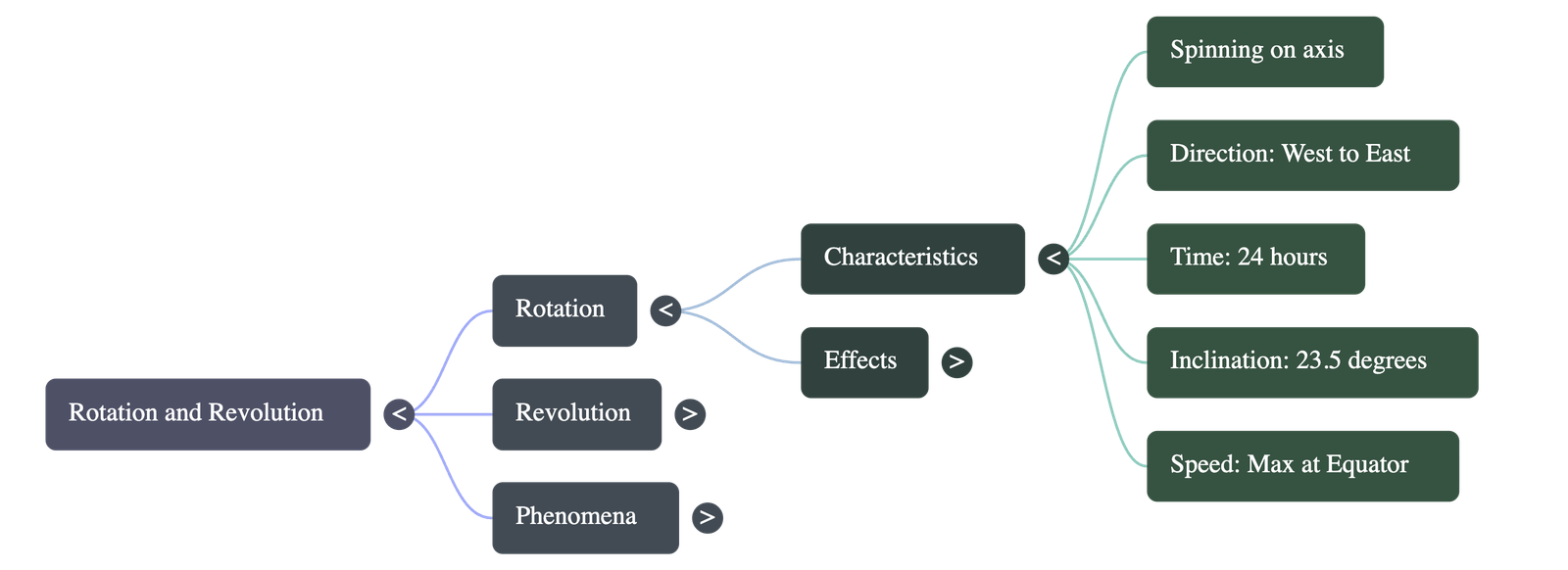
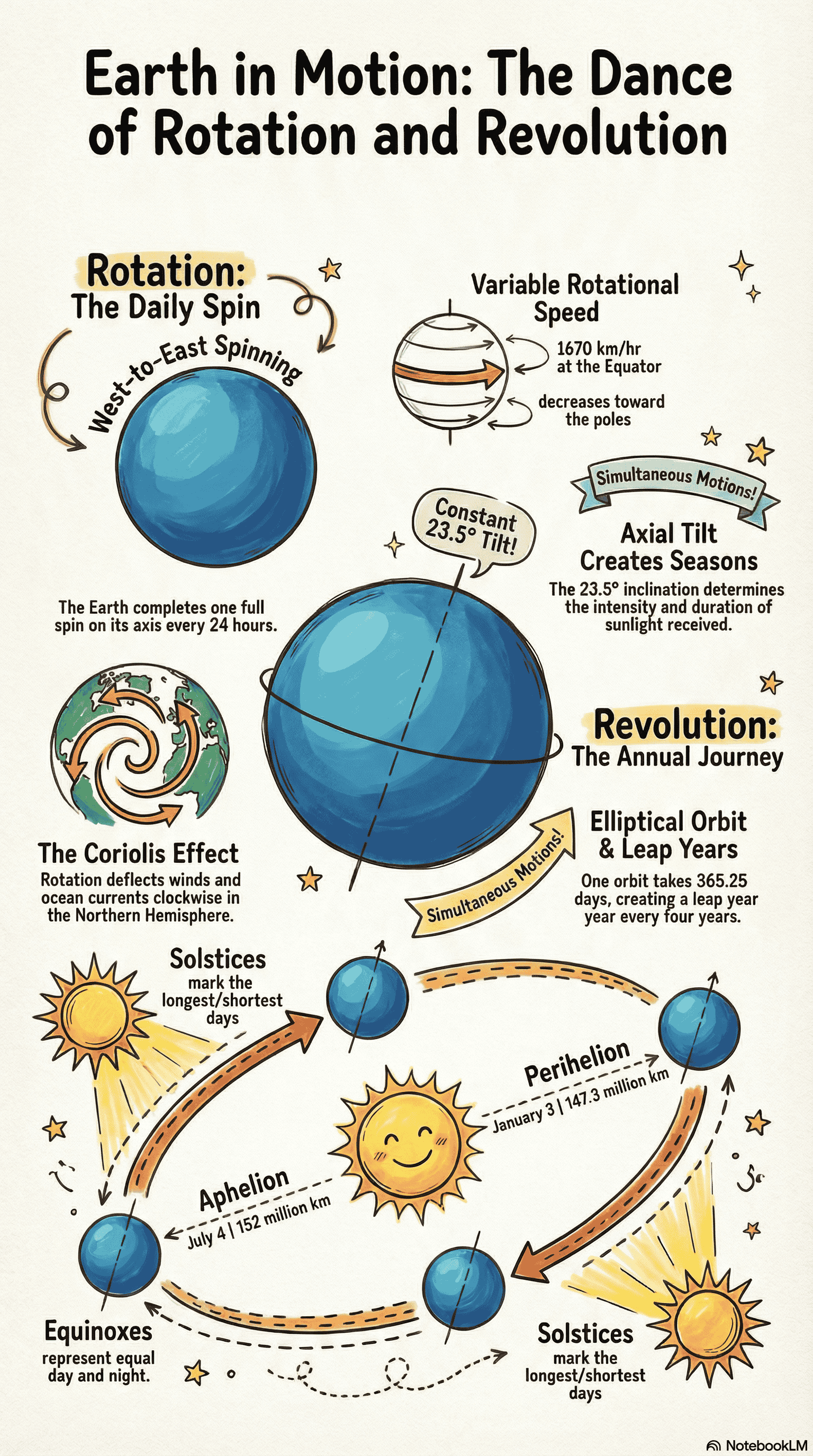
- Definition: Rotation is the continuous spinning of the earth from west to east on its imaginary axis, completing one full turn in approximately 24 hours.
- The Earth's Axis: This is an imaginary line running through the center of the earth, connecting the North and South Poles. It is perpetually tilted at an angle of 23½° from the vertical, which corresponds to an angle of 66½° relative to the plane of the earth's orbit.
Characteristics of Rotation
- Direction & Time: The earth rotates from west to east, completing a single rotation in exactly 23 hours, 56 minutes, and 4.09 seconds.
- Constant Inclination: The axis maintains its tilt in the same direction (pointing towards the Pole Star) as it travels around the sun.
- Varying Speed: The speed of rotation is fastest at the Equator (1670 km per hour) and gradually decreases to zero at the poles.
Effects of Rotation
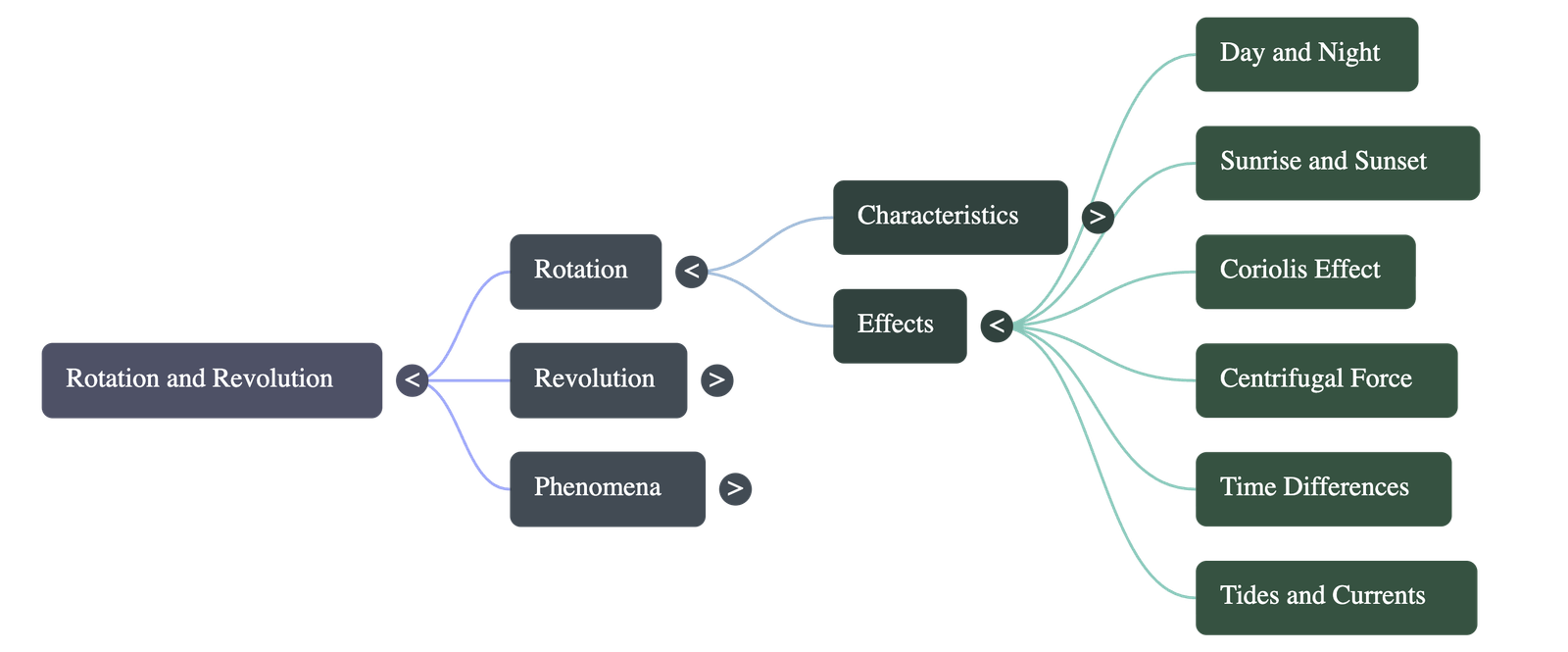
- Day and Night: It creates the alternating cycle of day and night as different parts of the earth face toward or away from the sun.
- Sunrise and Sunset: Because the earth moves west to east, parts of the planet progressively emerge from darkness into sunlight (sunrise) and later move away from the light (sunset).
- Coriolis Effect: A force generated by rotation that deflects moving objects (like winds and ocean currents) to the right in the Northern Hemisphere and to the left in the Southern Hemisphere.
- Apparent Celestial Movement: It creates the optical illusion that the sun, moon, and stars are moving across the sky from east to west.
- Centrifugal Force: The rotational speed creates an outward force that causes the earth to bulge at the equator and flatten at the poles.
- Time Differences: It establishes a time difference of 4 minutes for every degree of longitude across the globe.
- Temperature Regulation: The relatively short 24-hour cycle prevents extreme temperature variations between day and night.
3. Inclination of the Earth's Axis & Its Significance
- If the earth's axis were perfectly vertical, every place on earth would experience exactly equal lengths of day and night year-round.
- Because the axis is tilted, the duration of daylight and darkness varies based on latitude and the time of year.
- This tilt, when combined with the earth's revolution, is the fundamental reason behind the changing seasons.
4. Revolution of the Earth
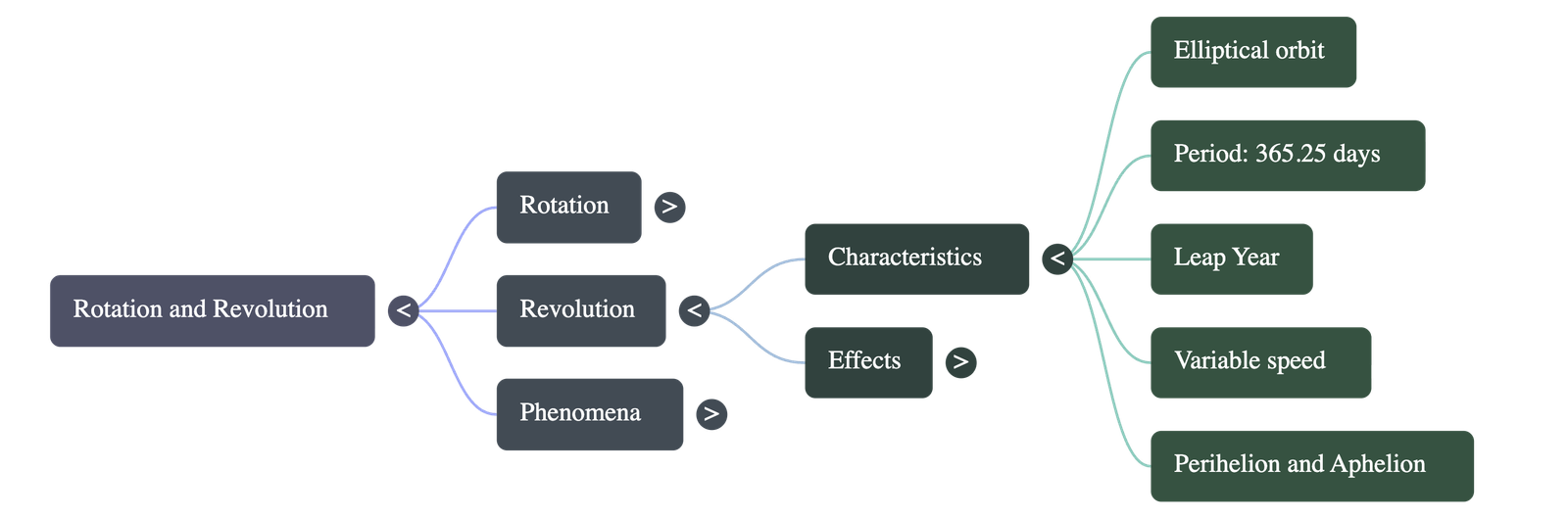
- Definition: Revolution is the earth's movement around the sun along an elliptical orbital path.
Characteristics of Revolution
- Speed: The earth travels at an average speed of 29.8 km per second (about 100,000 km per hour). The speed is not uniform; it increases slightly when the earth is closer to the sun due to stronger gravitational pull.
- Duration (The Leap Year): One complete revolution takes 365 days, 5 hours, 48 minutes, and 45.51 seconds. We consider a standard year to be 365 days. The leftover hours accumulate and are added as an extra day to February every 4 years, creating a Leap Year of 366 days.
Effects of Revolution
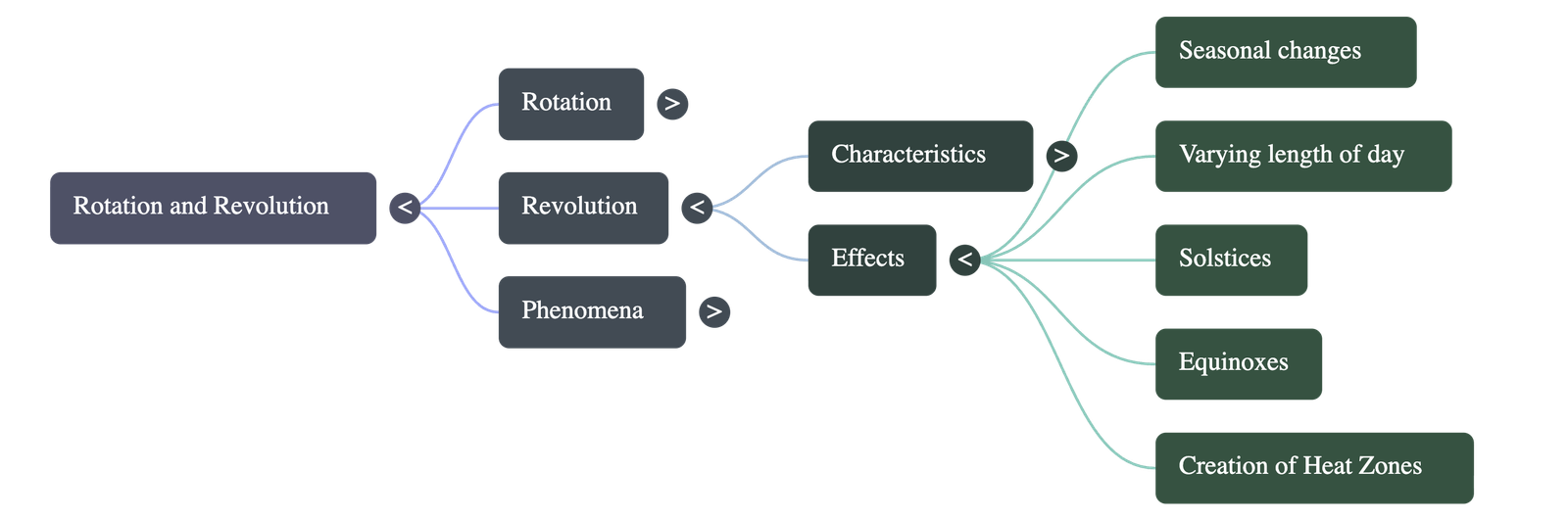
- Seasonal Changes: As the earth orbits, the angle of the sun's rays striking the surface changes. Direct vertical rays concentrate intense heat in a small area, while oblique rays spread less heat over a larger area, driving the annual cycle of changing weather.
- Perihelion and Aphelion: Because the orbit is elliptical, the distance to the sun fluctuates.
- Perihelion (around January 3): The earth is at its closest point to the sun.
- Aphelion (around July 4): The earth is at its farthest point from the sun.
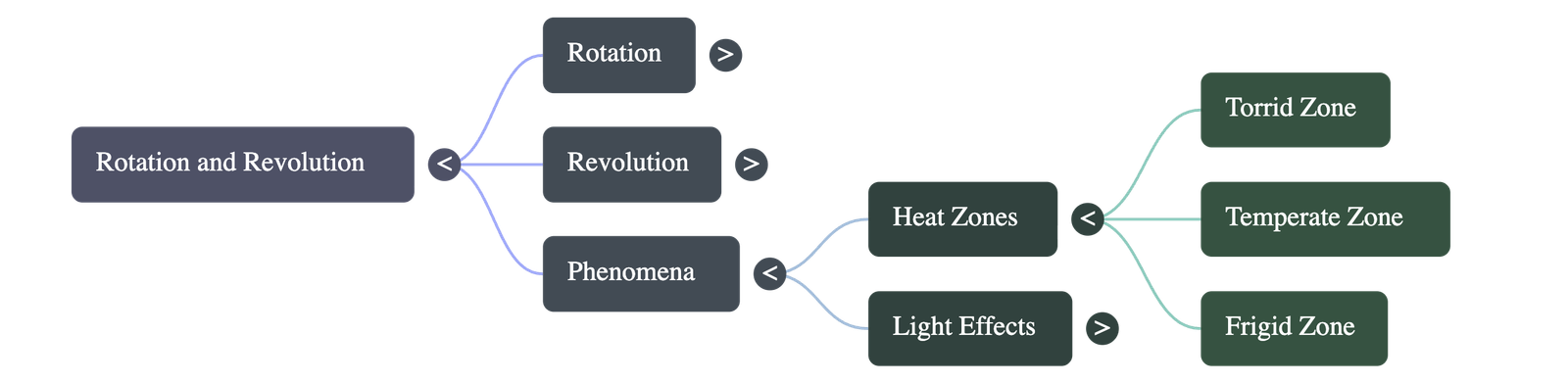
- Creation of Heat Zones: The earth's spherical shape and tilted revolution create distinct temperature zones:
- The Torrid Zone: Located between 23½° N and S latitudes. It receives direct vertical rays, resulting in a moderately warm climate year-round.
- The Temperate Zone: Located between 23½° and 66½° in both hemispheres. It receives oblique sun rays, leading to a moderate climate.
- The Frigid Zone: Located from 66½° to the poles in both hemispheres. Sun rays fall at extreme angles here, causing an extremely cold climate.
5. Solstices and Equinoxes
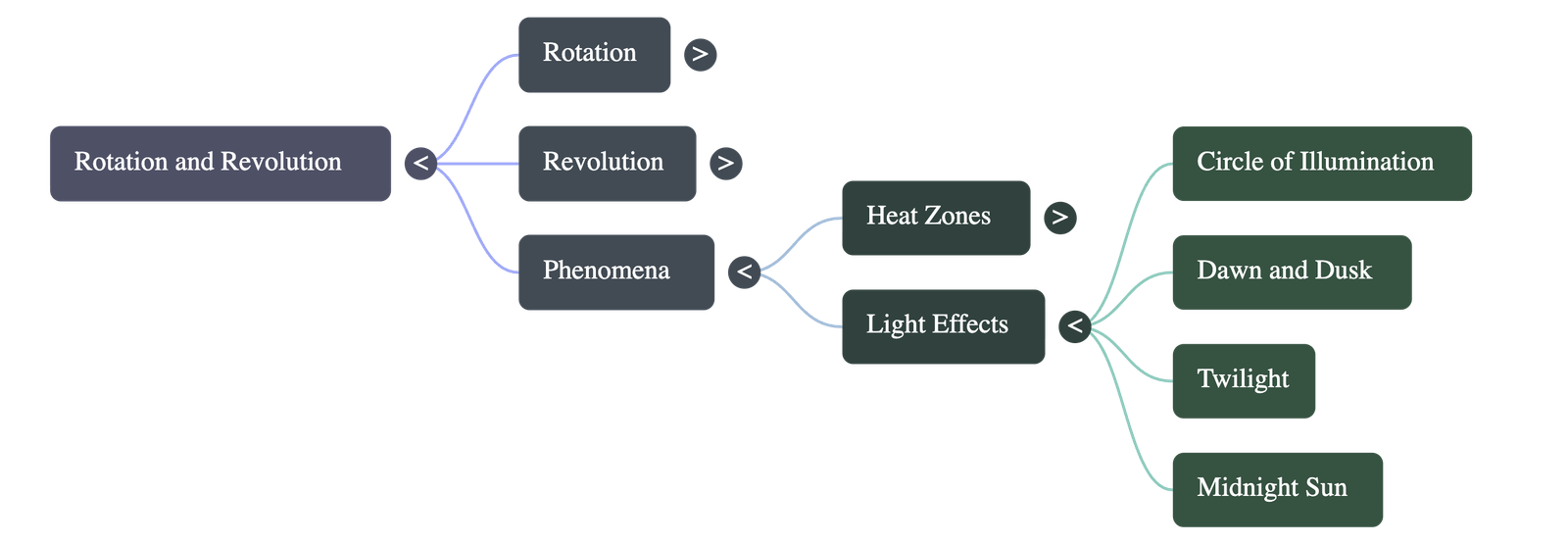
The circle of illumination is the dividing line that separates the lighted half of the earth facing the sun from the dark half.
Solstices
- Derived from Latin meaning 'sun' and 'to stand still', a solstice occurs when the sun reaches its highest or lowest point in the sky at noon.
- Summer Solstice (June 21): The North Pole is tilted directly toward the sun, placing the sun vertically over the Tropic of Cancer. The Northern Hemisphere experiences summer and its longest day, while the Southern Hemisphere experiences winter.
- Winter Solstice (December 22): The South Pole tilts toward the sun. The Northern Hemisphere experiences winter and its shortest day, while the Southern Hemisphere enjoys summer.
Equinoxes
- Derived from Latin meaning 'equal' and 'night', an equinox happens when the sun is positioned directly over the earth's Equator.
- Occurs twice a year: around March 21 (Spring/Vernal Equinox) and September 23 (Autumnal Equinox).
- During these dates, days and nights are of completely equal length everywhere across the globe.
6. Dawn and Dusk (Twilight)
- Dawn: The transitional time in the morning when the sun begins to cast diffused light into the sky before officially rising above the horizon.
- Dusk / Twilight: The period of diffused, refracted light that lingers between actual sunset and complete darkness.
- Because of the angle of the sun's path, the duration of twilight increases the further you move away from the Equator towards the poles.
Do checkout all questions & answers of this chapter.
Quick Navigation:
| | | |
1 / 1
Quick Navigation:
| | | |