Quick Navigation:
| | | | |
Quick Navigation:
| | | | |
Point-wise summary of the features and uses of modal auxiliaries:
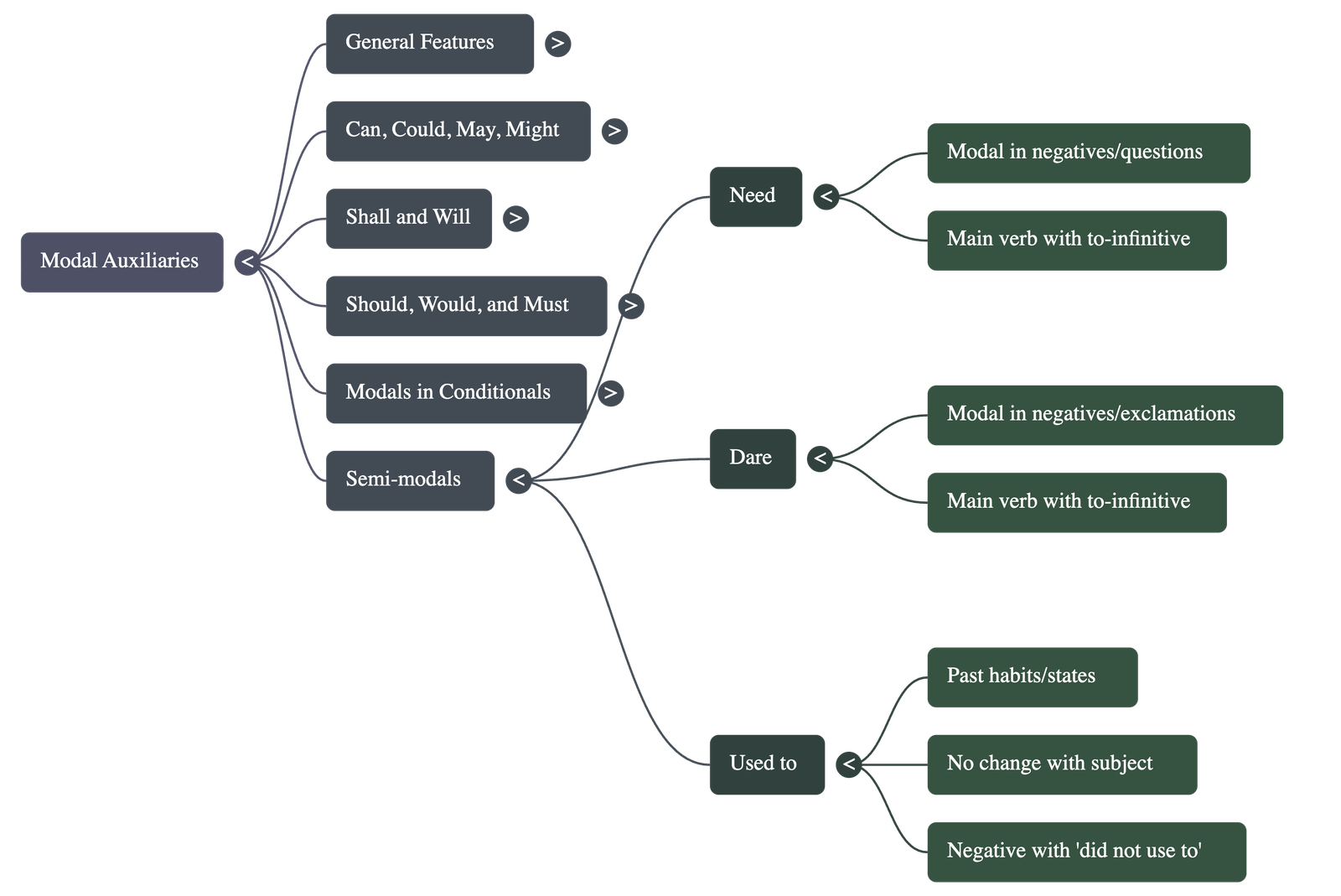
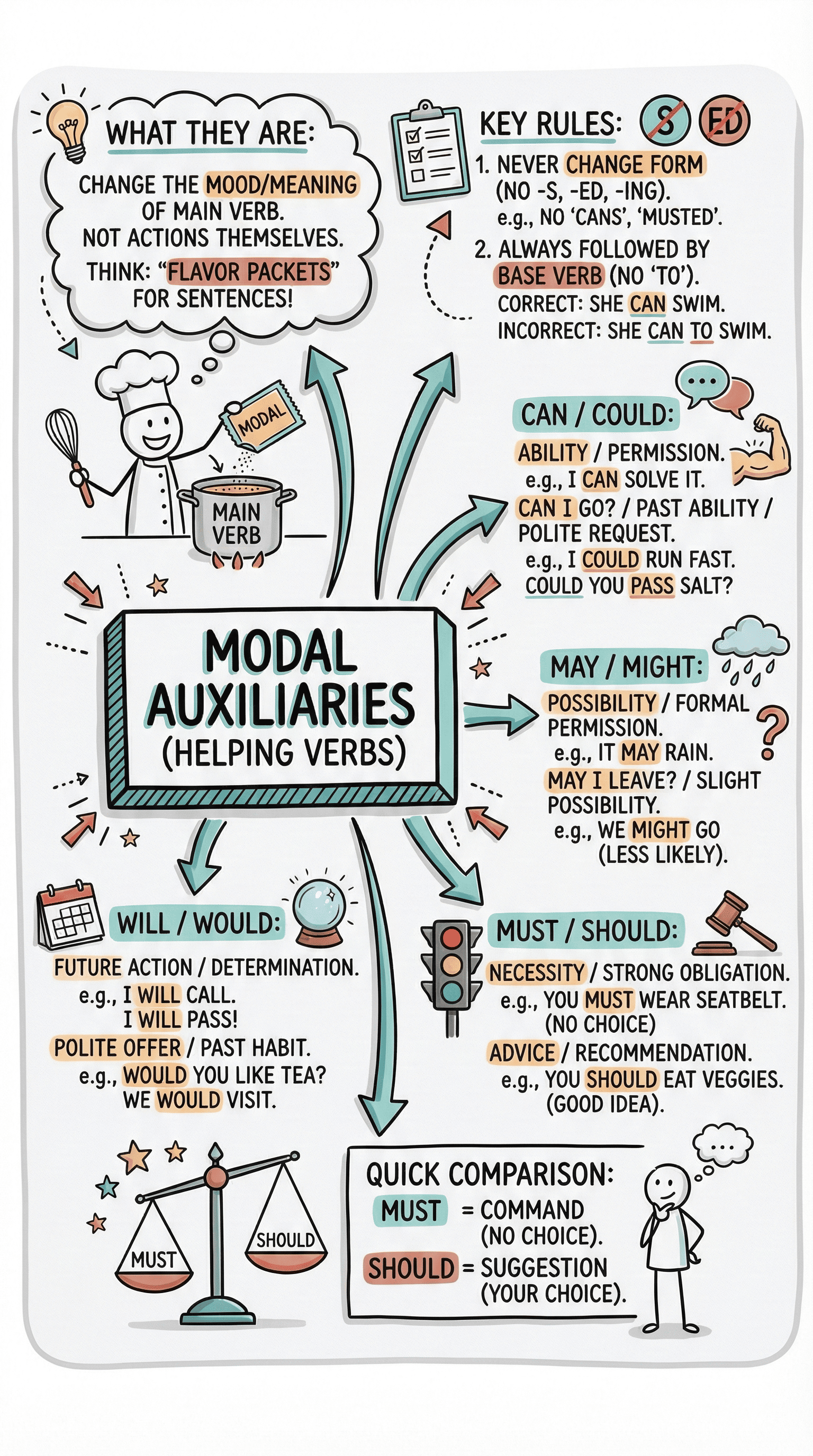
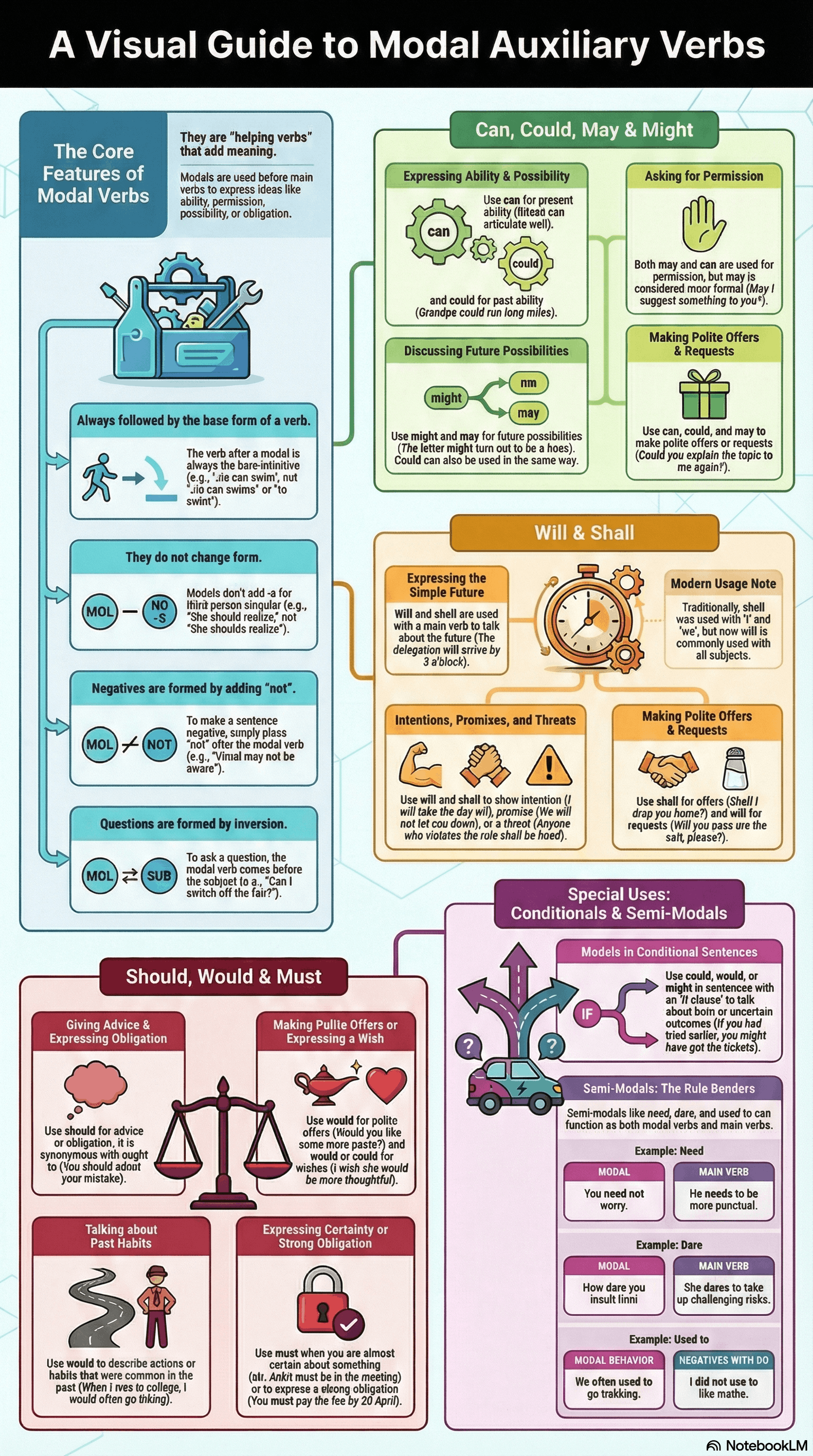
- Core Features of Modal Verbs: Modal verbs are helping verbs that must be used with a main verb in its base form (bare-infinitives). Unlike primary auxiliaries, they do not change according to the subject or number (e.g., no ‘-s’ for third-person singular) and they lack non-finite forms such as '-ing' or 'to-' infinitives.
- Sentence Structure: In a verb phrase, the modal verb always appears before any other auxiliary verb and the main verb. Negative sentences are formed by adding "not" directly after the modal, while questions are formed by placing the modal before the subject. Additionally, two modals cannot be used together in a single sequence.
- Usage of Can, Could, May, and Might:
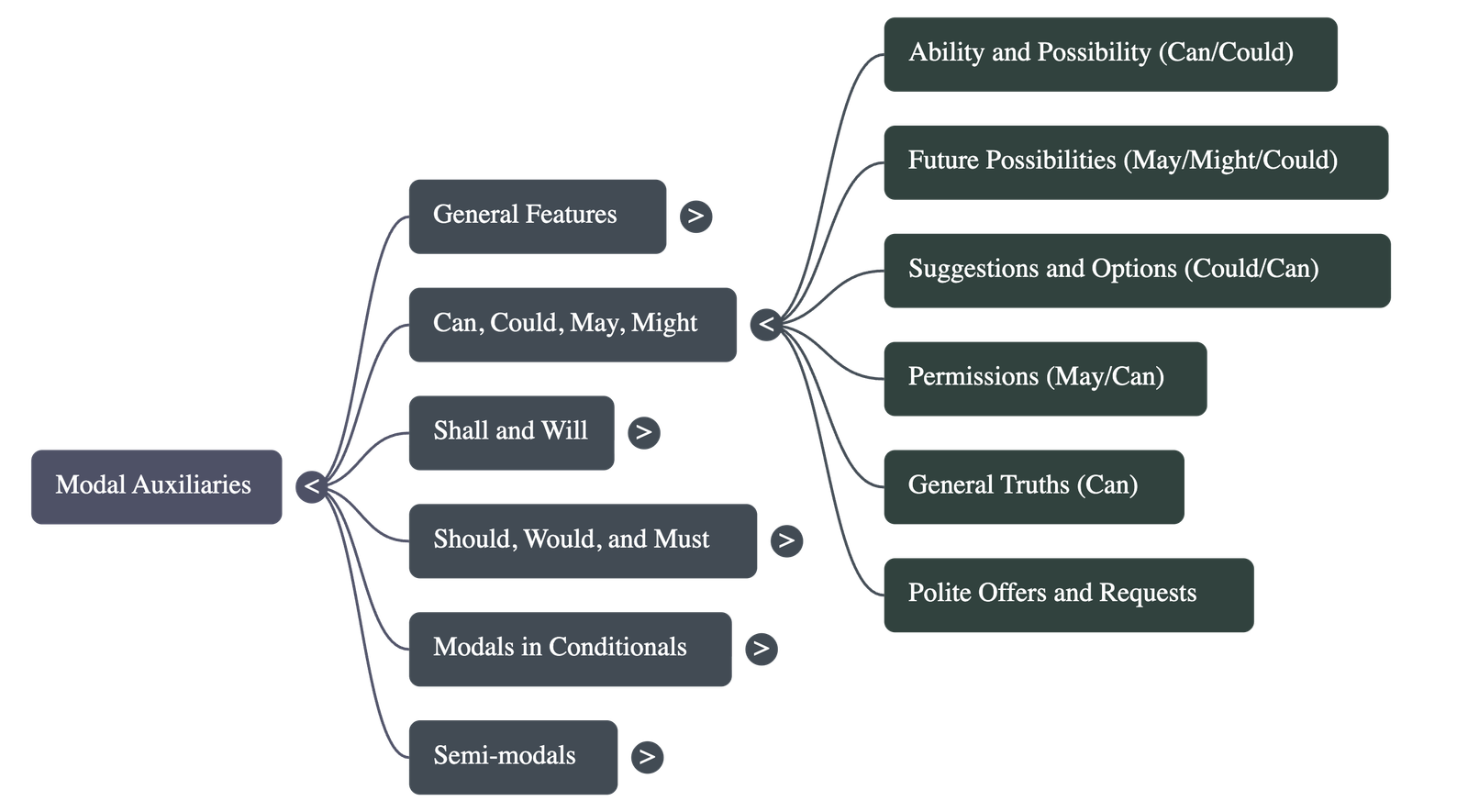
- Can is primarily used to express ability or possibility, and to ask for or give informal permission.
- May and Might are used to discuss future possibilities, with "may" being more formal than "can" when asking for permission.
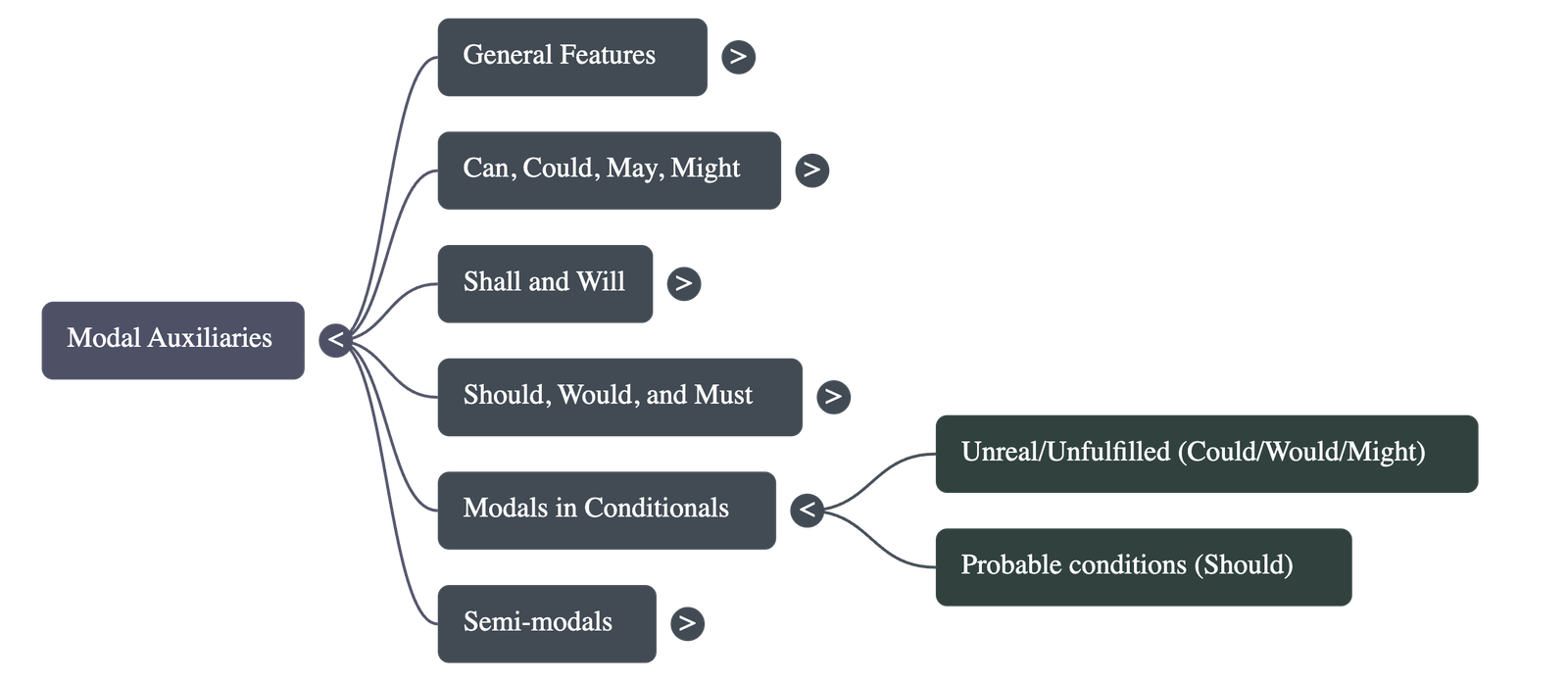
- Could can be used for suggestions, future possibilities, or to talk about unreal/unfulfilled situations in conditional sentences.
- All four are often used interchangeably to make polite offers or requests.
- Usage of Shall and Will:
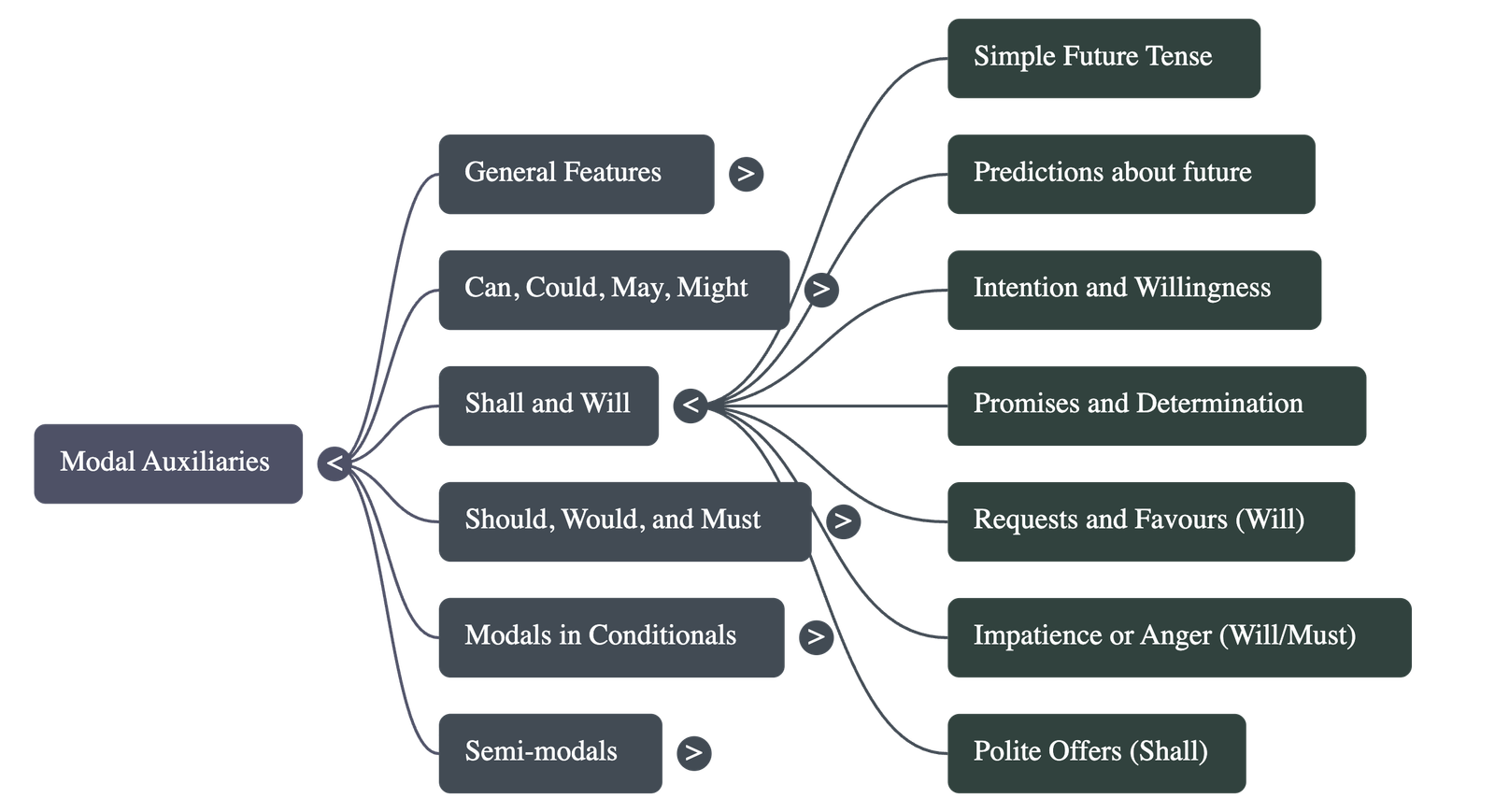
- While both form the simple future, contemporary English favors "will" for all subjects, whereas traditional grammar reserved "shall" for the first person.
- Will is used for predictions, expressing determination, making promises, or indicating impatience.
- Shall is frequently used in questions to ask about preferences or to make polite offers.
- Usage of Should, Would, and Must:
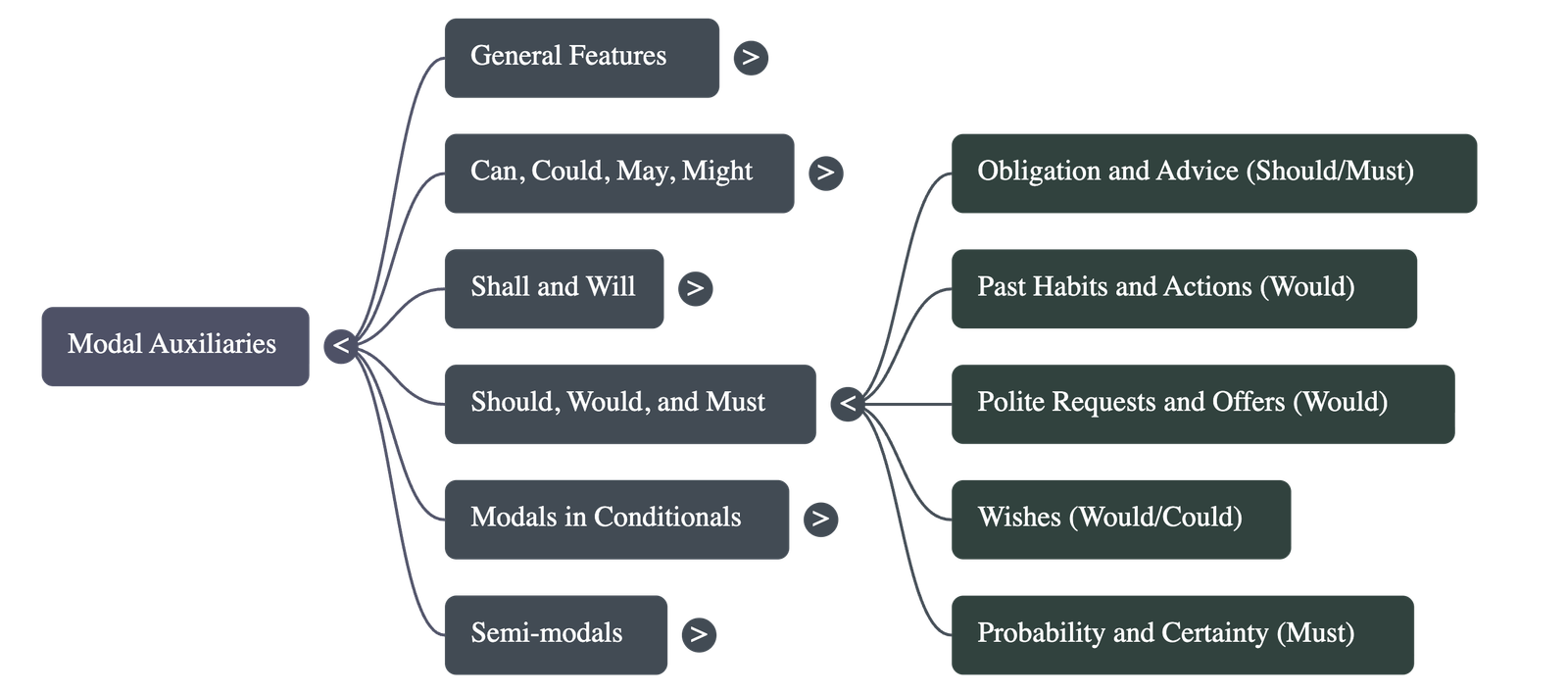
- Should is used for advice or obligation (similar to "ought to") and to ask for suggestions.
- Must expresses strong obligation or a high degree of certainty/probability.
- Would is used to describe past habits, express a wish, or make polite offers and requests.
- Semi-modals (Need, Dare, Used to): These are verbs that can function as both modal verbs and main verbs.
- As modals, they do not change with the subject and are often used in negatives and questions.
- As main verbs, they follow standard conjugation rules (like adding '-s' or '-ed') and are typically followed by a to-infinitive.
Analogy You can think of modal verbs as the "mood settings" on a camera. The main verb is the subject you are filming, but the modal verb changes the "lens" through which you see the action—shifting the scene from a simple statement of fact to one of possibility, necessity, or permission.
Do checkout all questions & answers of this chapter.
Quick Navigation:
| | | | |
1 / 1
Quick Navigation:
| | | | |