Quick Navigation:
| | | | |
Quick Navigation:
| | | | |
Linking Verbs and Subject Complement
A point-wise summary of the chapter Linking Verbs and Subject Complement:
1. Nature of Linking Verbs
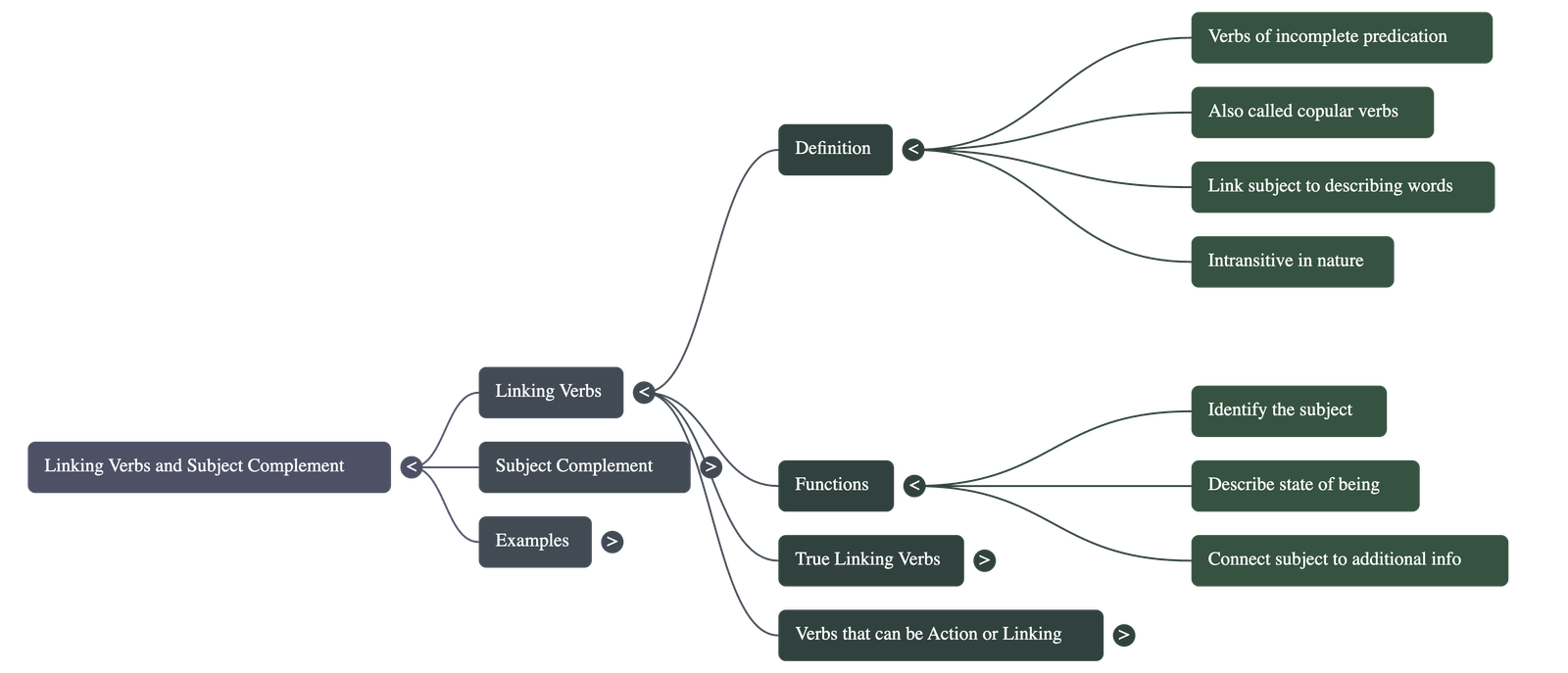
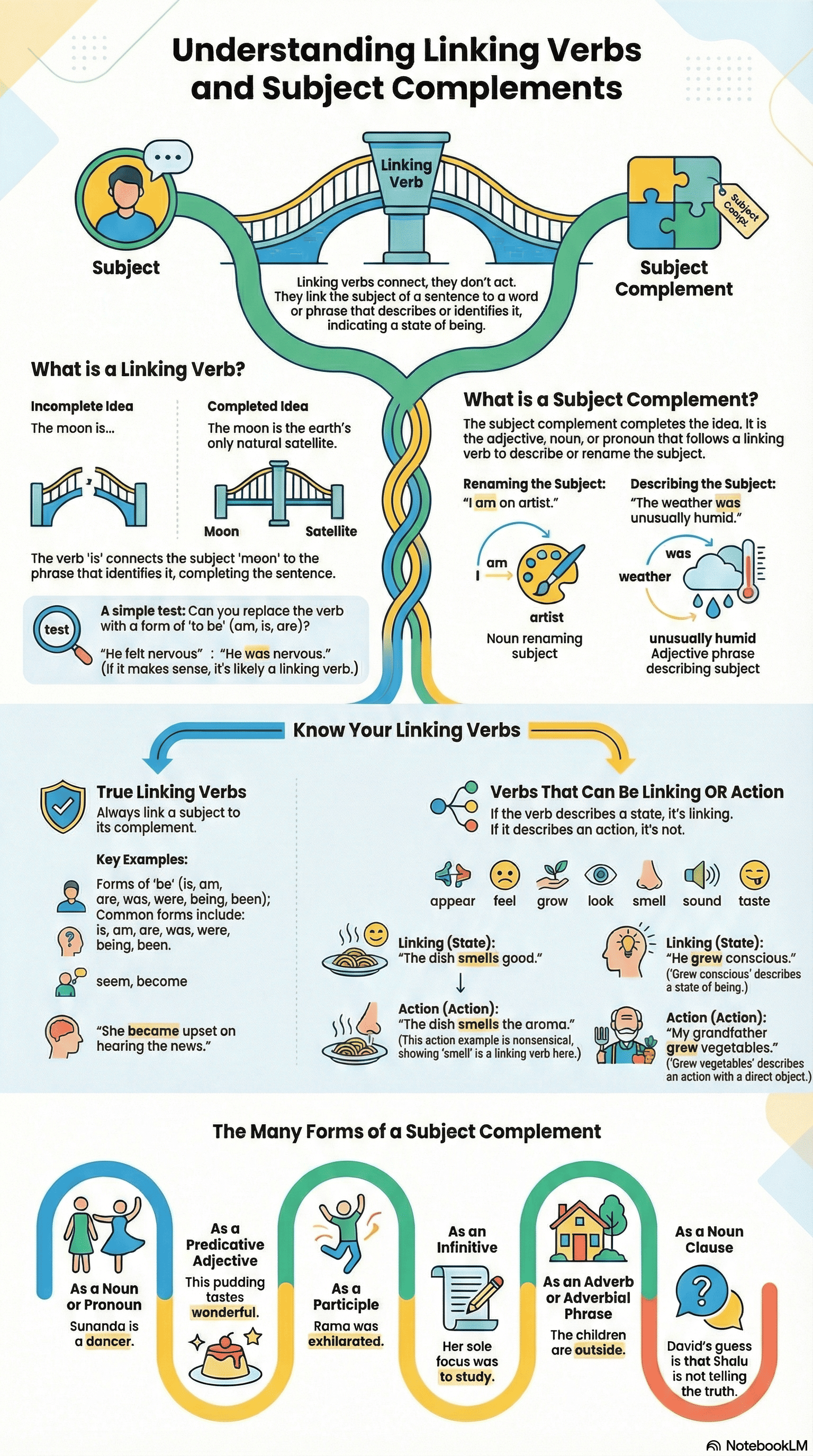
- Definition: Linking verbs, also known as copular verbs or verbs of incomplete predication, are used to link a subject to a word or phrase that describes or identifies it.
- Function: Unlike typical intransitive verbs that make complete sense on their own (e.g., "Ankita sleeps"), linking verbs require additional words to complete their predicates and make the sentence sense-worthy.
- Characteristics: Linking verbs are always intransitive and are always followed by a complement. They tell us what the subject is or what state the subject is in, rather than describing an action.
2. Types of Linking Verbs
- True Linking Verbs: These verbs always function as linking verbs and never describe an action. They include:
- Forms of be (is, am, are, was, were, being, been).
- Seem (seems, seemed).
- Become (becomes, became).
- Contextual Linking Verbs: Many verbs can function as either action (doing) verbs or linking verbs depending on how they are used in a sentence. This often includes verbs related to the five senses, such as appear, feel, grow, look, smell, sound, and taste.
- Example of Action: "Urmi looked at the painting" (an action performed by the subject).
- Example of Linking: "Urmi looked frightened" (describes the subject's state).
3. Identifying Linking Verbs (The Substitution Test)
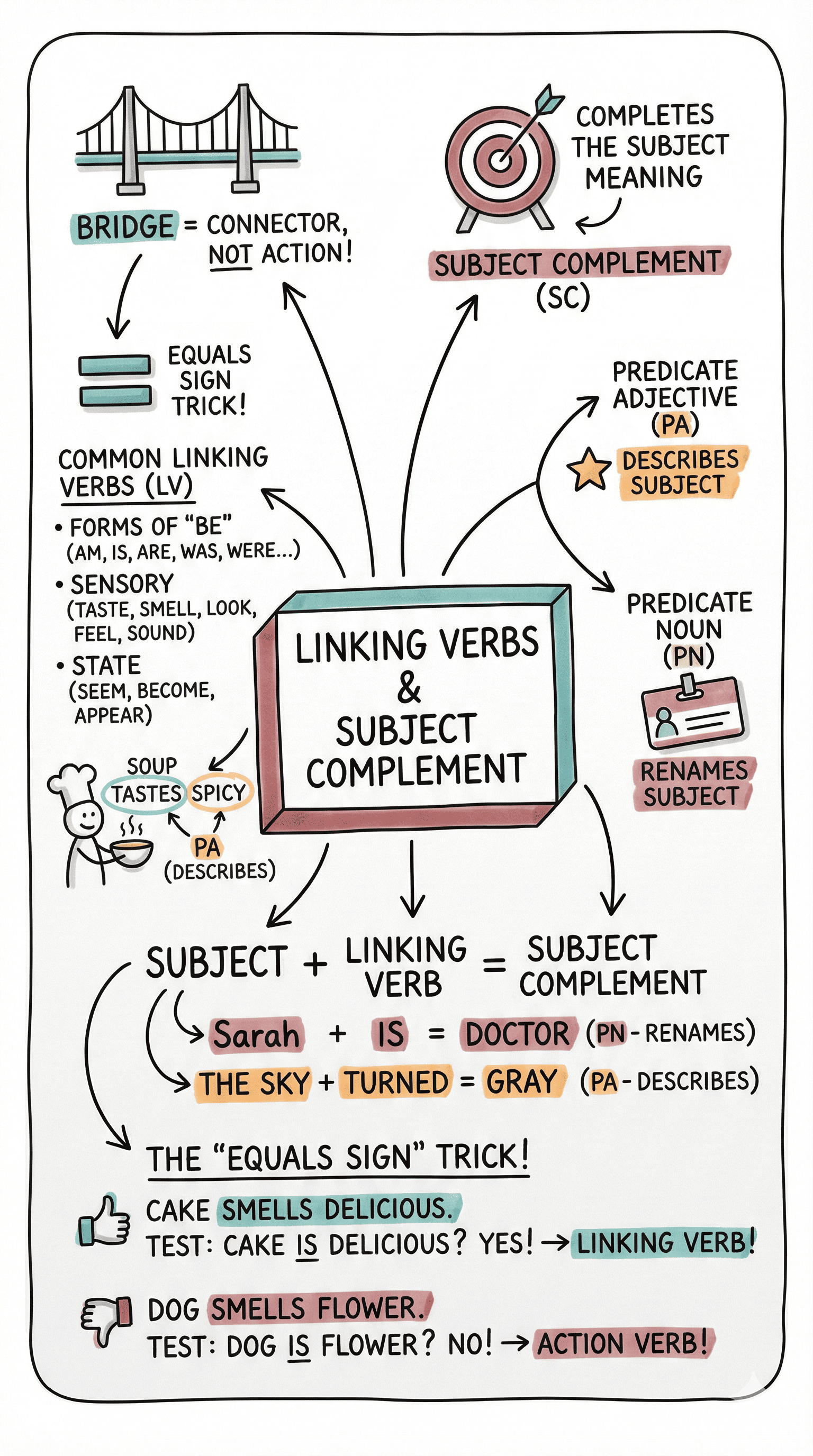
- To determine if a verb is a linking verb, you can try replacing it with a form of a "true" linking verb (like be).
- If the sentence still makes sense and describes the subject's state, it is likely a linking verb (e.g., "He felt nervous" becomes "He was nervous").
- If the replacement makes no sense, it is an action verb (e.g., "I grew flowers" does not make sense as "I became flowers").
- Note: In rare cases, such as the verb stayed, the substitution might make sense, but the verb is still considered an action verb if it describes an action rather than a state.
4. Subject Complements
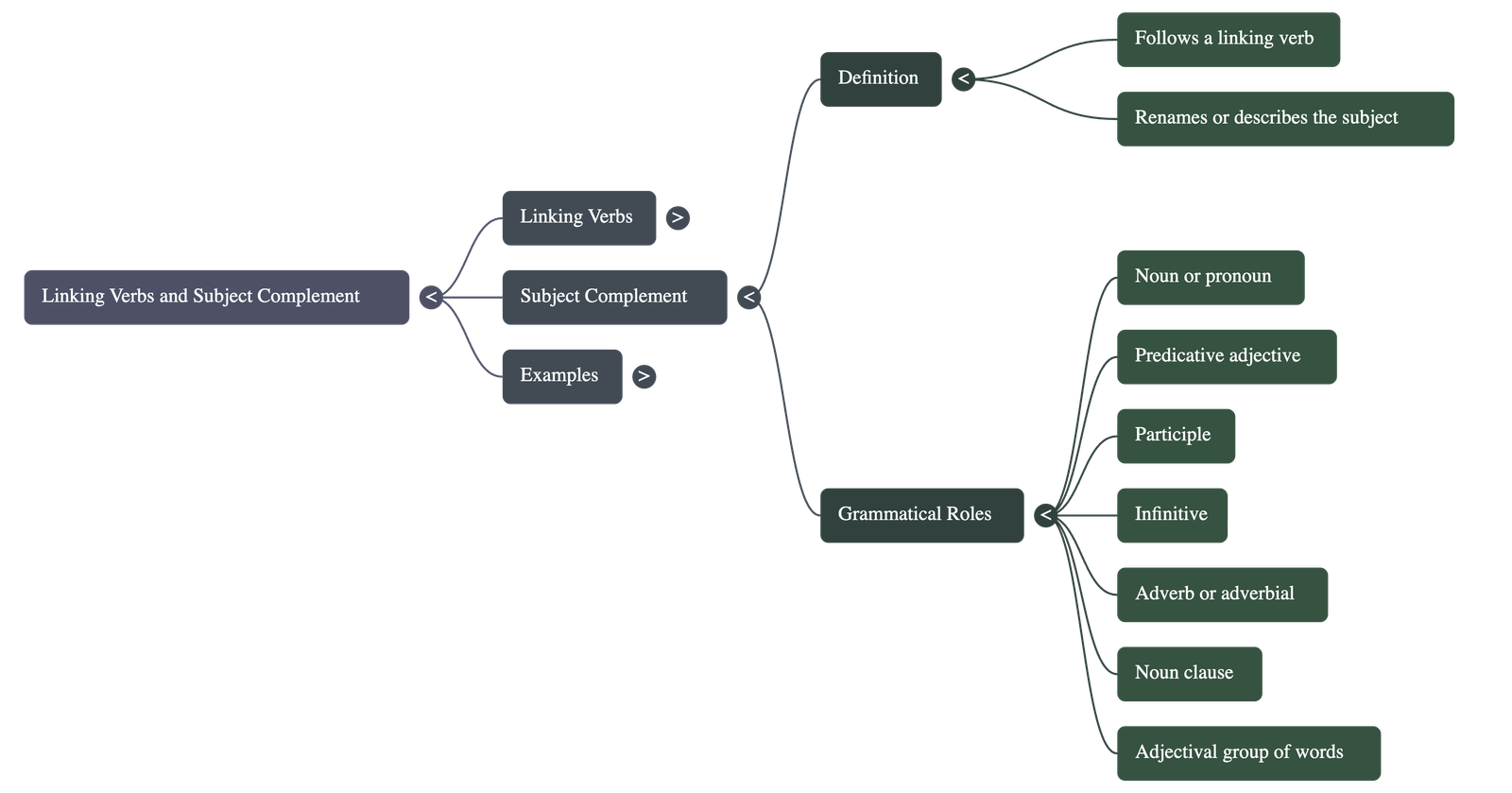
- Definition: A subject complement is the word or group of words that follows a linking verb to rename or describe the subject.
- Roles of a Subject Complement: A subject complement can take many grammatical forms, including:
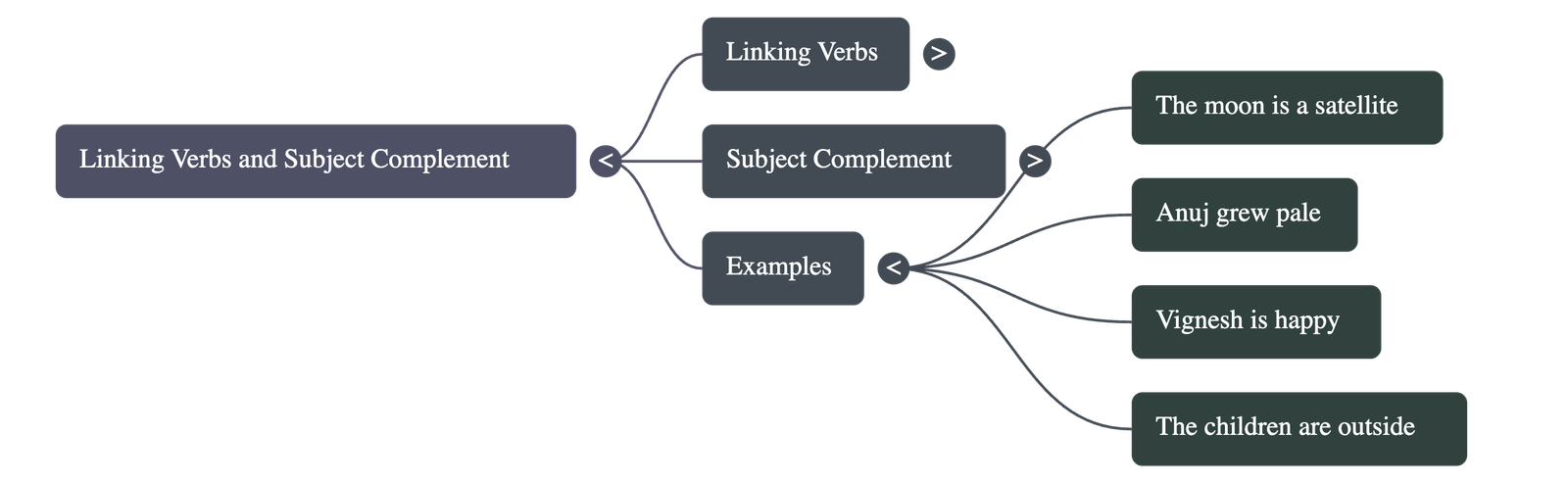
- Noun or Pronoun: Renames the subject (e.g., "Sunanda is a dancer").
- Predicative Adjective: Describes the subject (e.g., "The music was soothing").
- Participle: (e.g., "Rama was exhilarated").
- Infinitive: (e.g., "No one seemed to mind").
- Adjective Phrase: A group of words doing the work of an adjective (e.g., "The house was in bad shape").
- Adverb or Adverbial: (e.g., "She is outside").
- Noun Clause: (e.g., "My fear is that we might be proved wrong").
Analogy to Solidify Understanding: Think of a linking verb as an equals sign (=) in a math equation. It doesn't perform an action; it simply states that the subject on one side is the same as, or described by, the complement on the other side (e.g., "The sky is blue" acts like "Sky = blue").
Do checkout all questions & answers of this chapter.
Quick Navigation:
| | | | |
1 / 1
Quick Navigation:
| | | | |