Quick Navigation:
| | | | |
Quick Navigation:
| | | | |
Adverbs and Adverbials
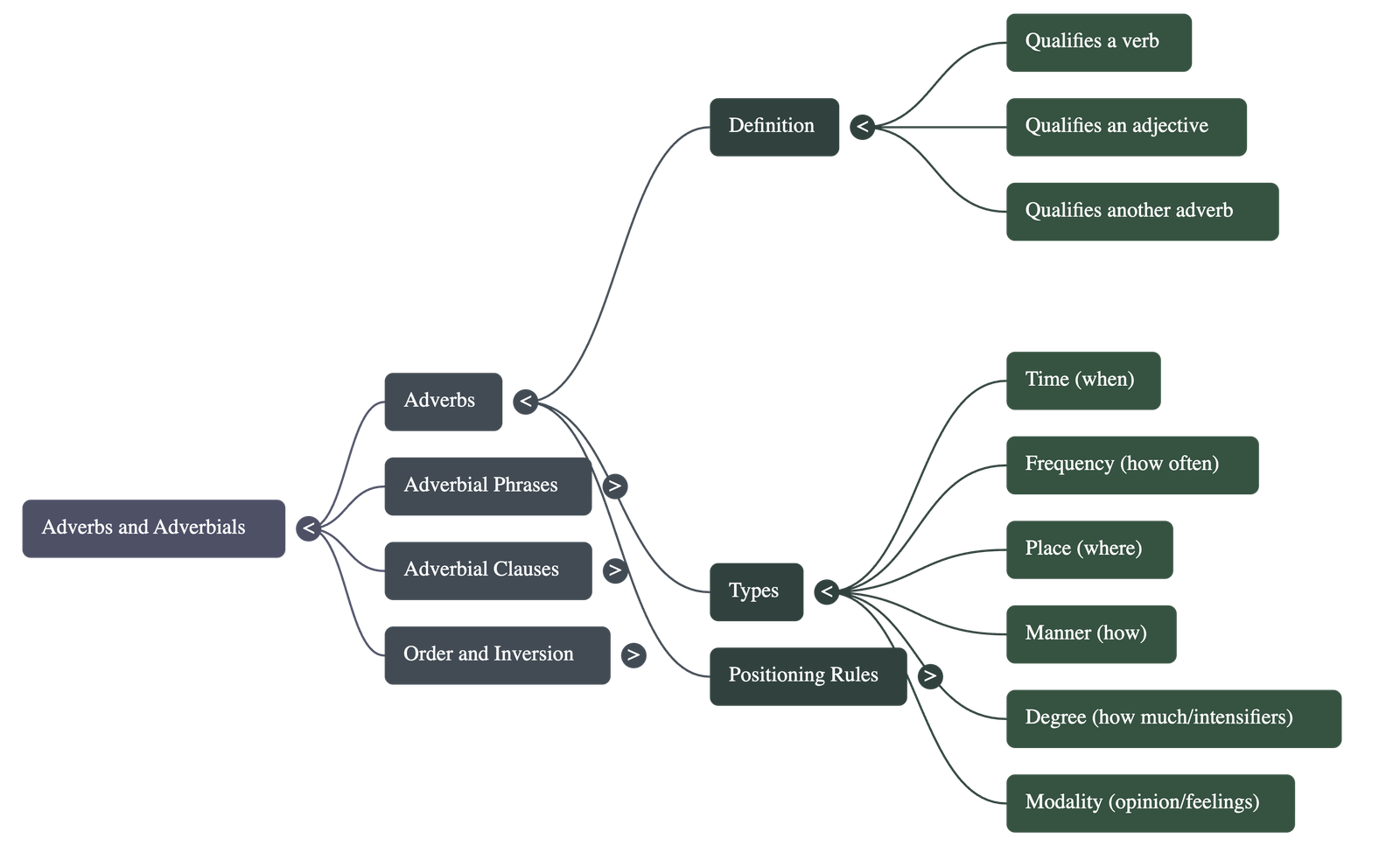
1. Definition and Function
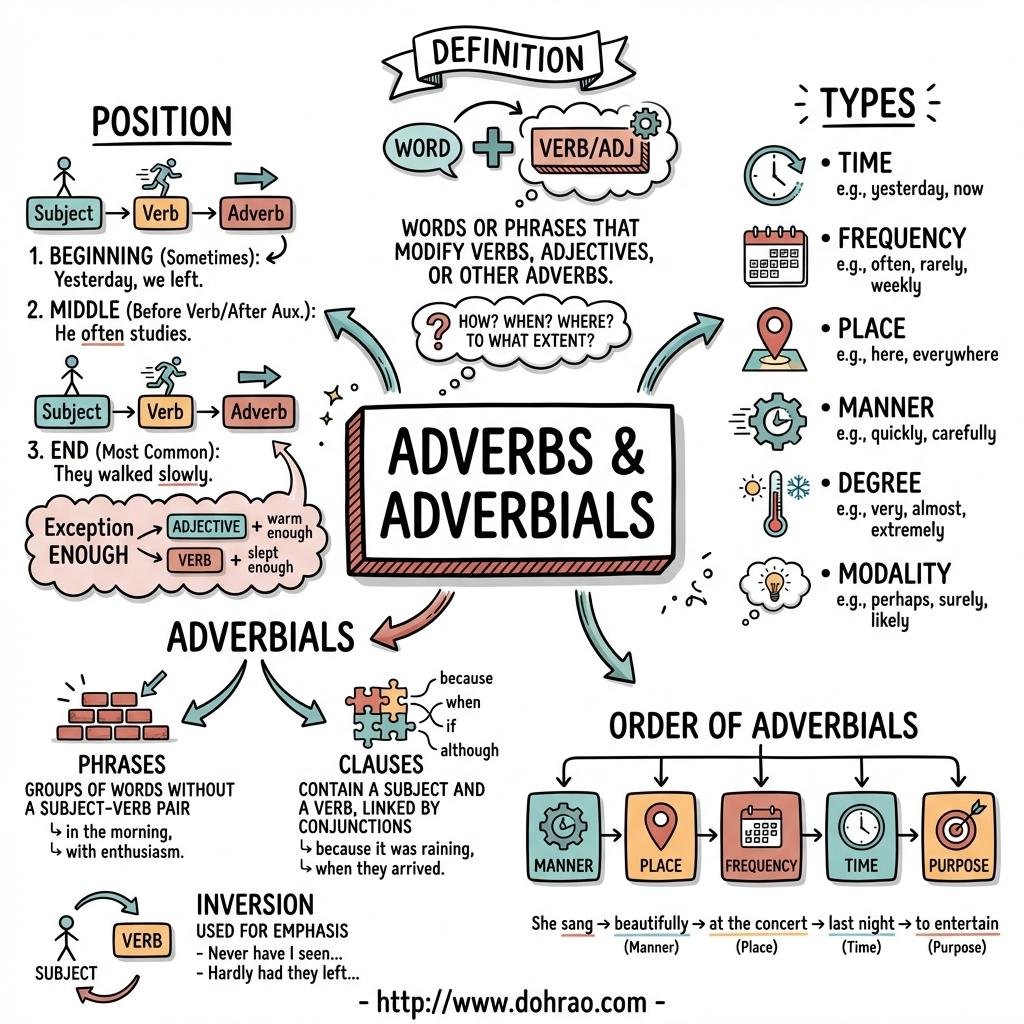
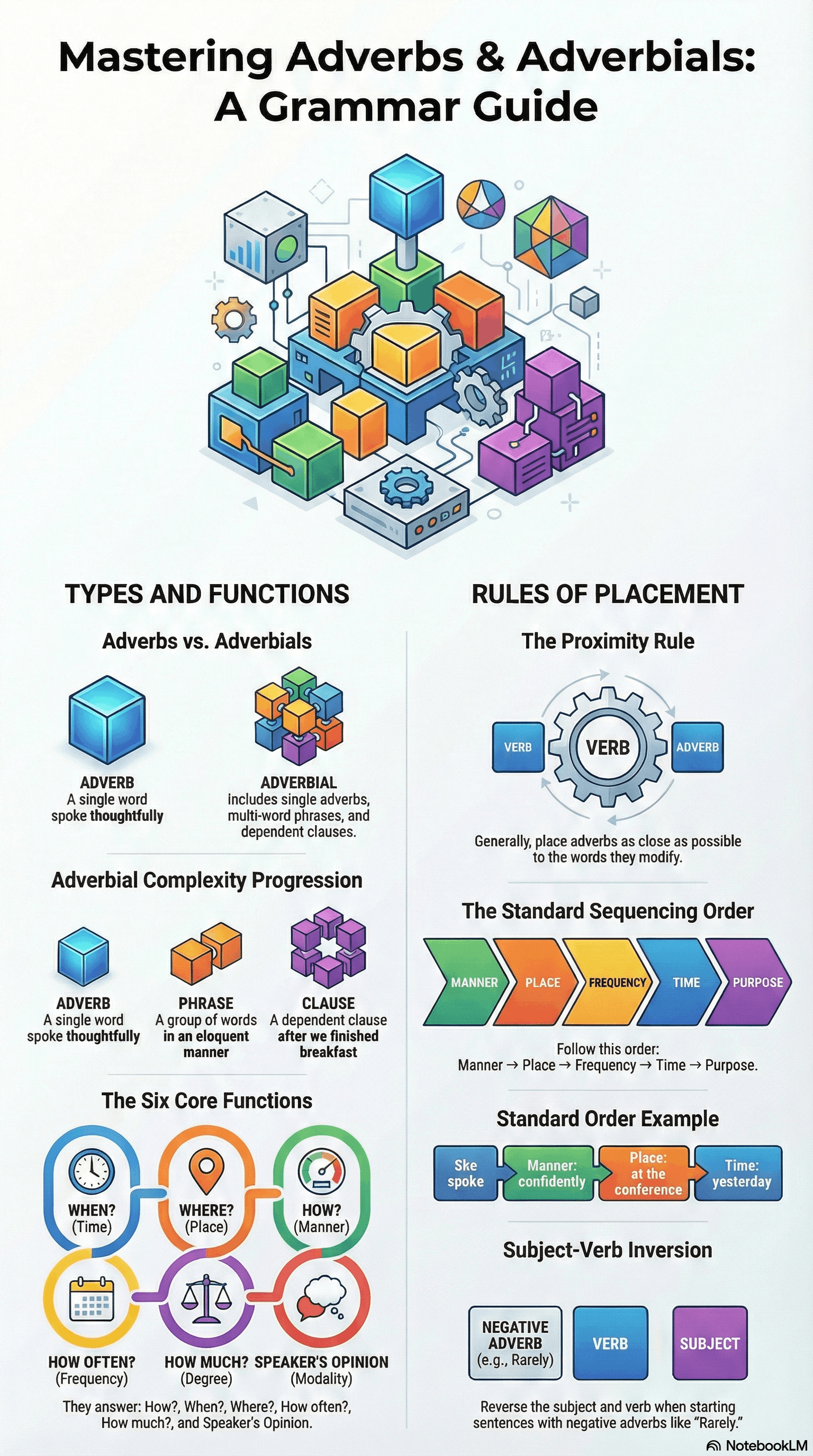
- Adverbs: Words that qualify a verb, an adjective, or another adverb.
- Sentence Modifiers: When placed at the beginning of a sentence, an adverb can modify the entire statement (e.g., "Luckily, I was carrying an umbrella").
- Versatility: Some adverbs can belong to more than one category depending on their context, such as being an adverb of manner in one sentence and an adverb of degree in another.
2. Classification of Adverbs
- Adverbs of Time: Indicate when an action occurs (e.g., recently, late).
- Adverbs of Frequency: Indicate how often an action occurs (e.g., seldom, often).
- Adverbs of Place: Indicate where an action occurs (e.g., everywhere, upstairs).
- Adverbs of Manner: Indicate how an action is performed (e.g., readily, well).
- Adverbs of Degree (Intensifiers): Indicate the extent or intensity (e.g., remarkably, somewhat).
- Adverbs of Modality: Express the speaker's opinion or feelings regarding the statement (e.g., possibly, obviously).
3. Position of Adverbs in Sentences
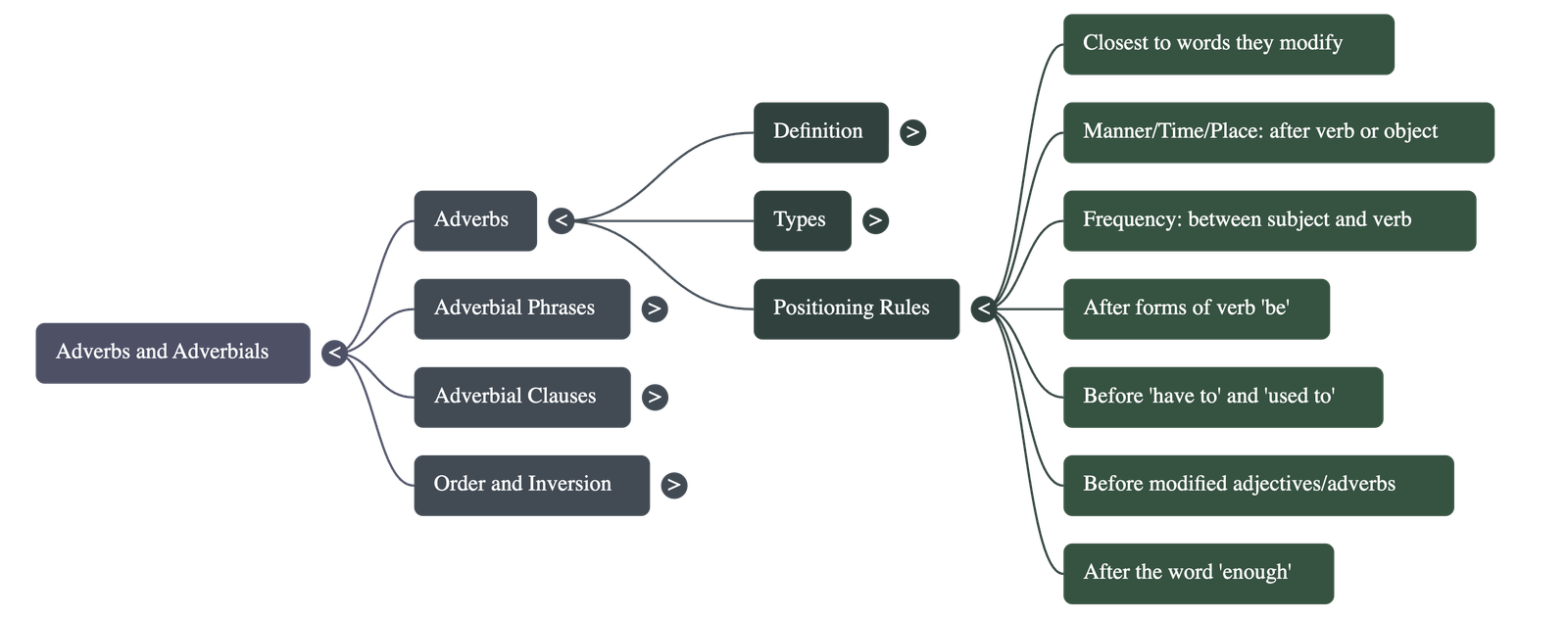
- General Proximity: Adverbs are typically placed as close as possible to the words they modify.
- Manner, Time, and Place: Usually positioned after the verb or after the object if one exists.
- Frequency: Typically placed between the subject and the verb, or between an auxiliary and the main verb. However, they follow the verb "be" and precede auxiliaries like "have to" and "used to."
- Adjective/Adverb Qualifiers: Usually placed before the word they are qualifying.
- The "Enough" Exception: The word "enough" is unique because it is always placed after the word it modifies.
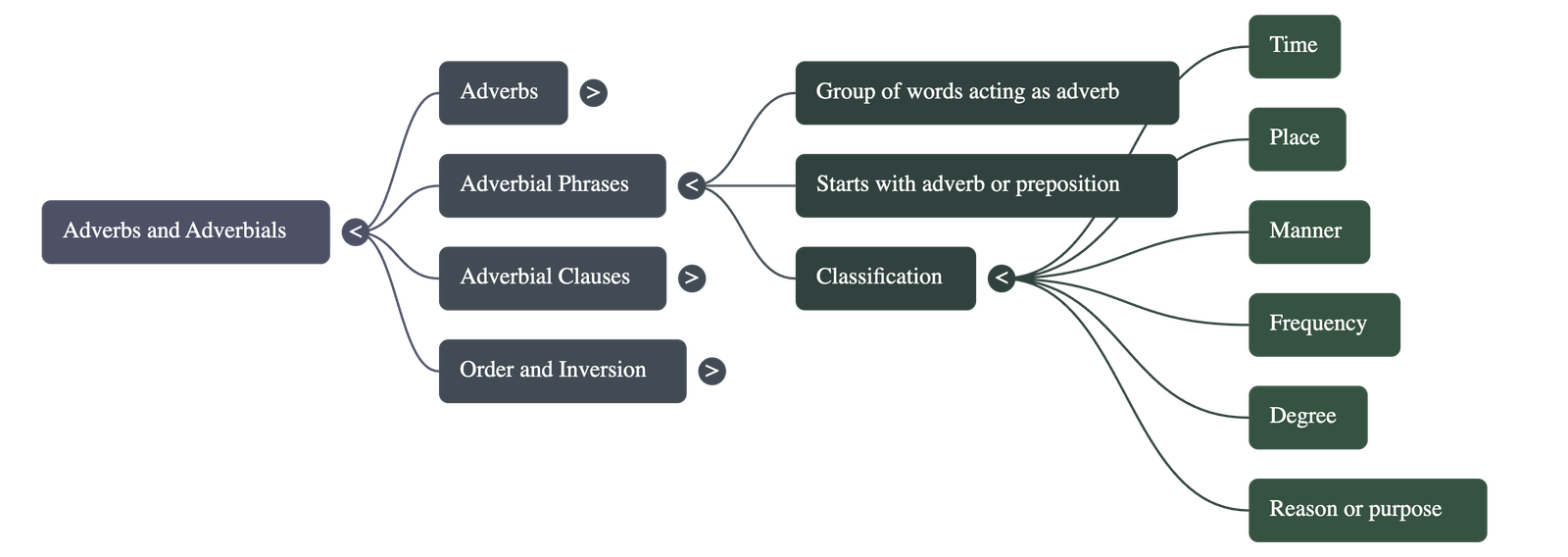
4. Adverbials and Adverbial Phrases
- Adverbials: A broad category encompassing adverbs, adverbial phrases, and adverbial clauses.
- Adverbial Phrases: Groups of words acting as an adverb, usually starting with a preposition or an adverb.
- Classification: Phrases are categorized similarly to adverbs: Time, Place, Manner, Frequency, Degree, and Reason or Purpose.
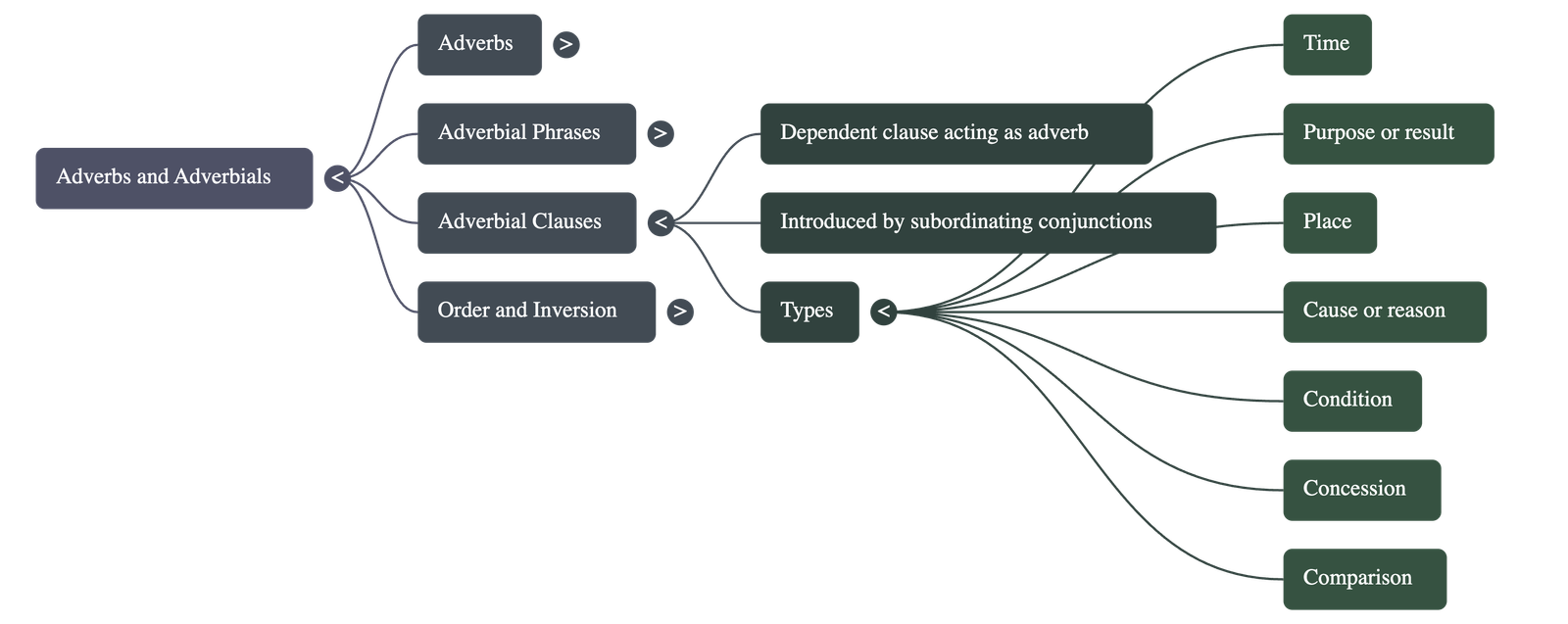
5. Adverbial Clauses
- Definition: A dependent clause that contains a subject and a predicate and performs the function of an adverb. It is introduced by a subordinating conjunction.
- Types of Clauses:
- Time: Introduced by when, before, after, since, etc.
- Purpose/Result: Introduced by so that, in order that, lest.
- Place: Introduced by where, wherever.
- Cause/Reason: Introduced by because, as, since.
- Condition: Introduced by if, unless, provided that.
- Concession: Shows contrast using although, even though.
- Comparison: Uses than or as...as.
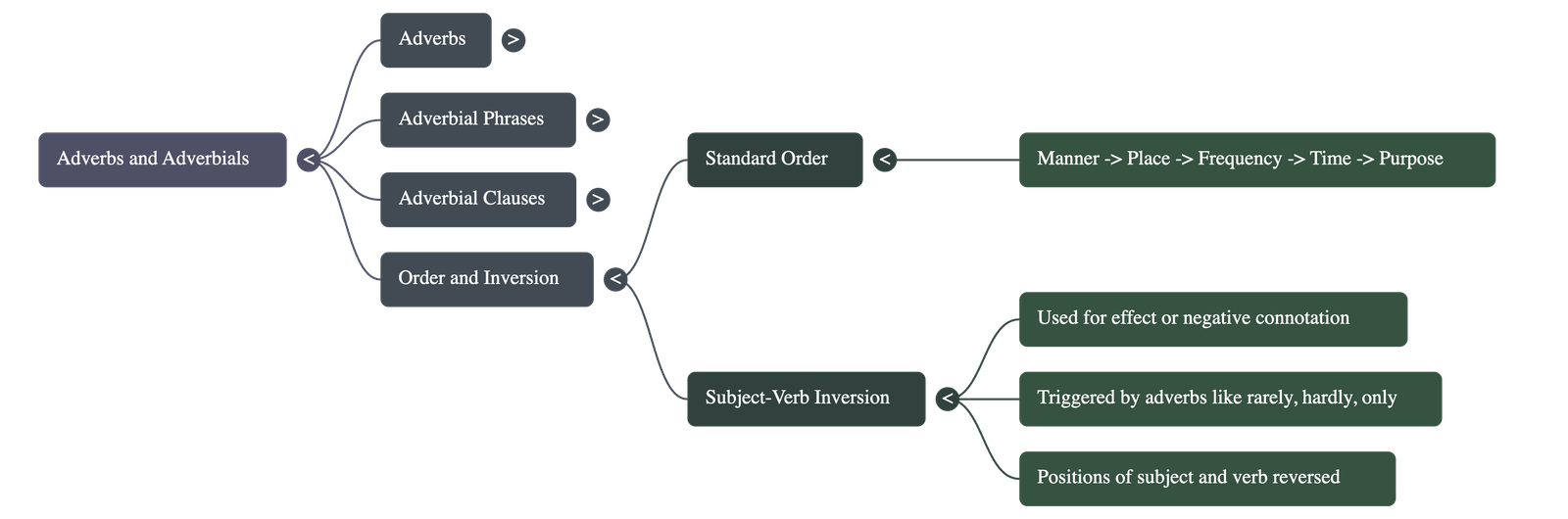
6. The Order of Adverbials
When multiple adverbials follow a verb, they generally follow a specific sequence:
Manner → Place → Frequency → Time → Purpose
7. Subject-Verb Inversion
- Emphasis: Adverbs can be moved to the beginning of a sentence for effect or to convey a negative connotation.
- The Rule: When adverbs like only, never, hardly, rarely, or seldom start a sentence, the positions of the subject and the verb are reversed (e.g., "Rarely do I eat out" instead of "I rarely eat out").
Do checkout all questions & answers of this chapter.
Quick Navigation:
| | | | |
1 / 1
Quick Navigation:
| | | | |