Quick Navigation:
| | | | |
Quick Navigation:
| | | | |
Vocabulary
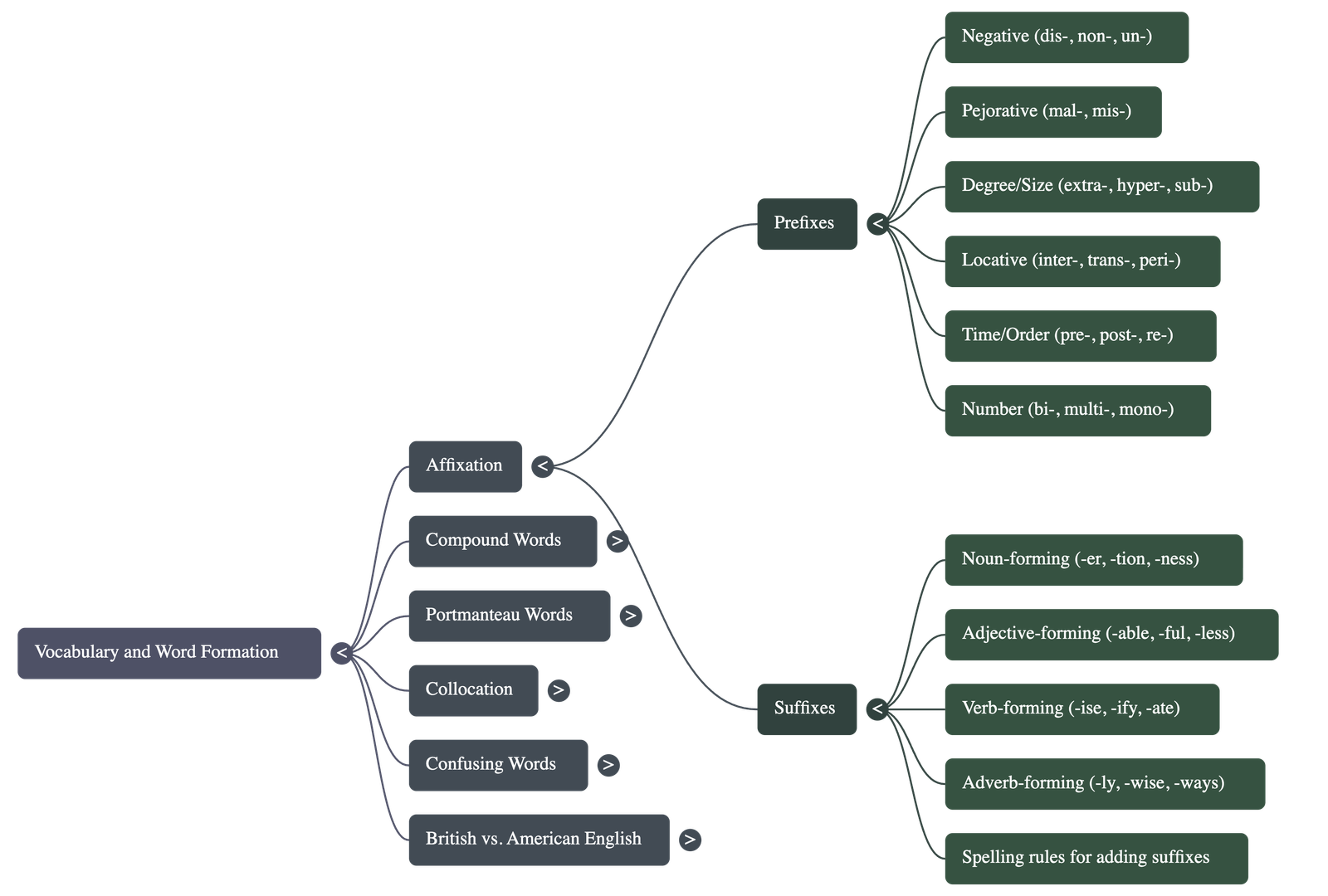
1. Affixation
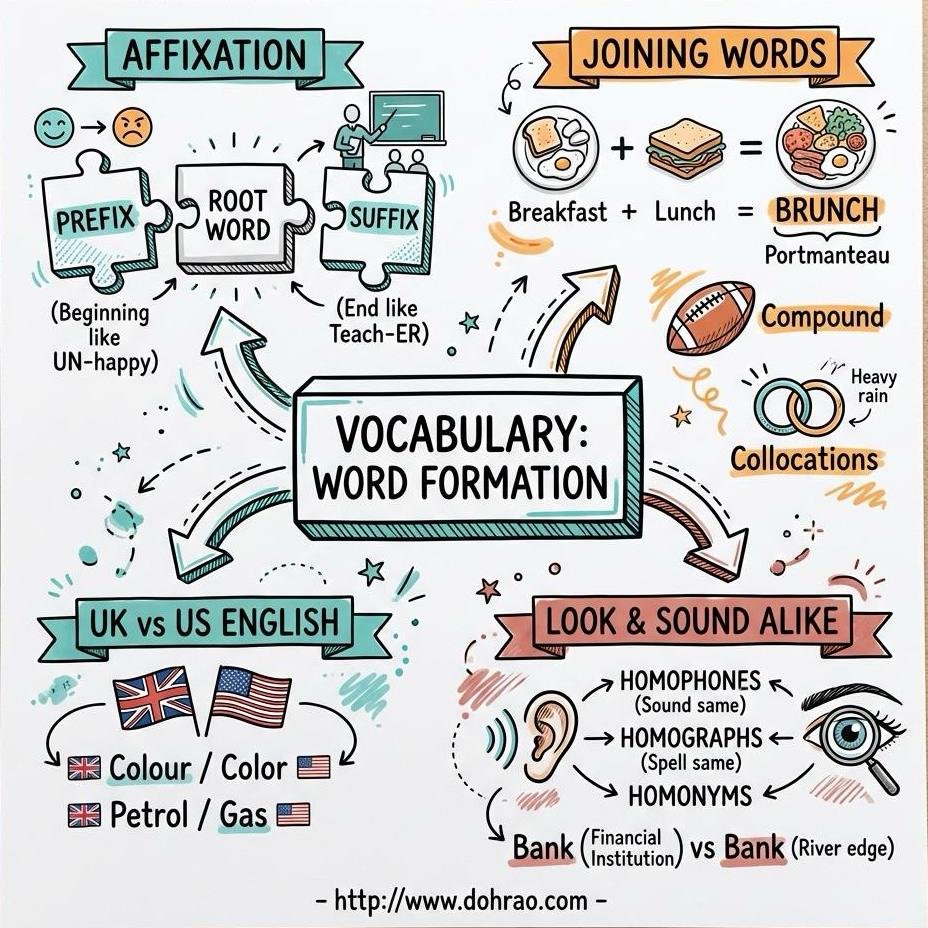
- Definition: The process of forming new words by adding affixes (prefixes or suffixes) to root words.
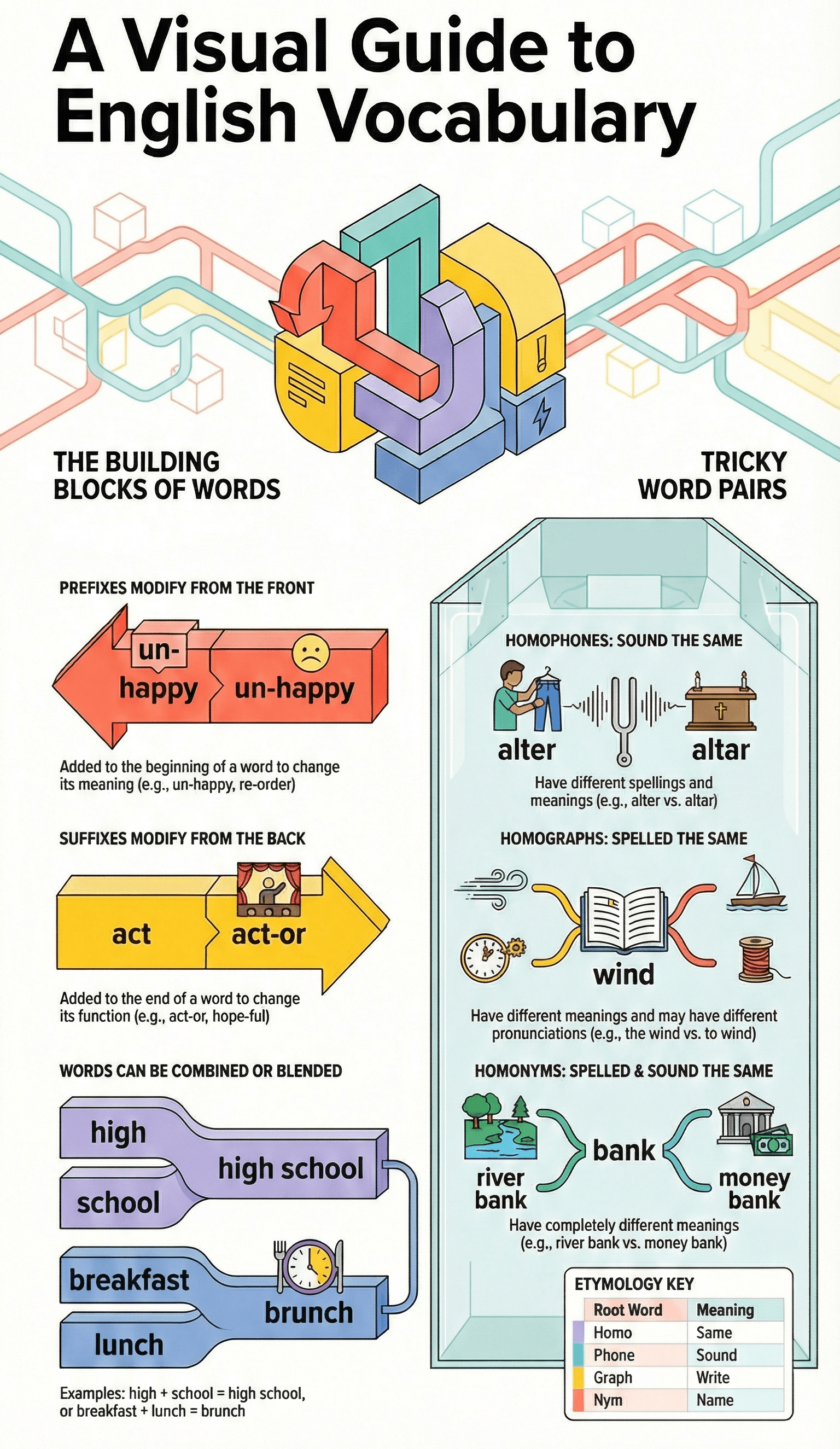
- Prefixes: Added to the beginning of a word to modify its meaning. Key categories include:
- Negative: (e.g., un-, non-, dis-) used to reverse or negate meanings.
- Pejorative: (e.g., mal-, mis-) implying something is wrong or bad.
- Degree or Size: (e.g., super-, ultra-, mini-) indicating extent.
- Locative: (e.g., inter-, trans-, sub-) suggesting place or direction.
- Time and Order: (e.g., pre-, post-, ex-) indicating sequence.
- Number: (e.g., uni-, bi-, multi-) denoting quantity.
- Suffixes: Added to the end of a word to change its meaning or grammatical function. They are used to create:
- Nouns: Using endings like -er, -tion, -ness, and -ment.
- Adjectives: Using endings like -able, -ful, -less, and -ive.
- Verbs: Using endings like -ise/-ize, -ify, and -en.
- Adverbs: Using endings like -ly, -wards, and -wise.
2. Compound and Portmanteau Words
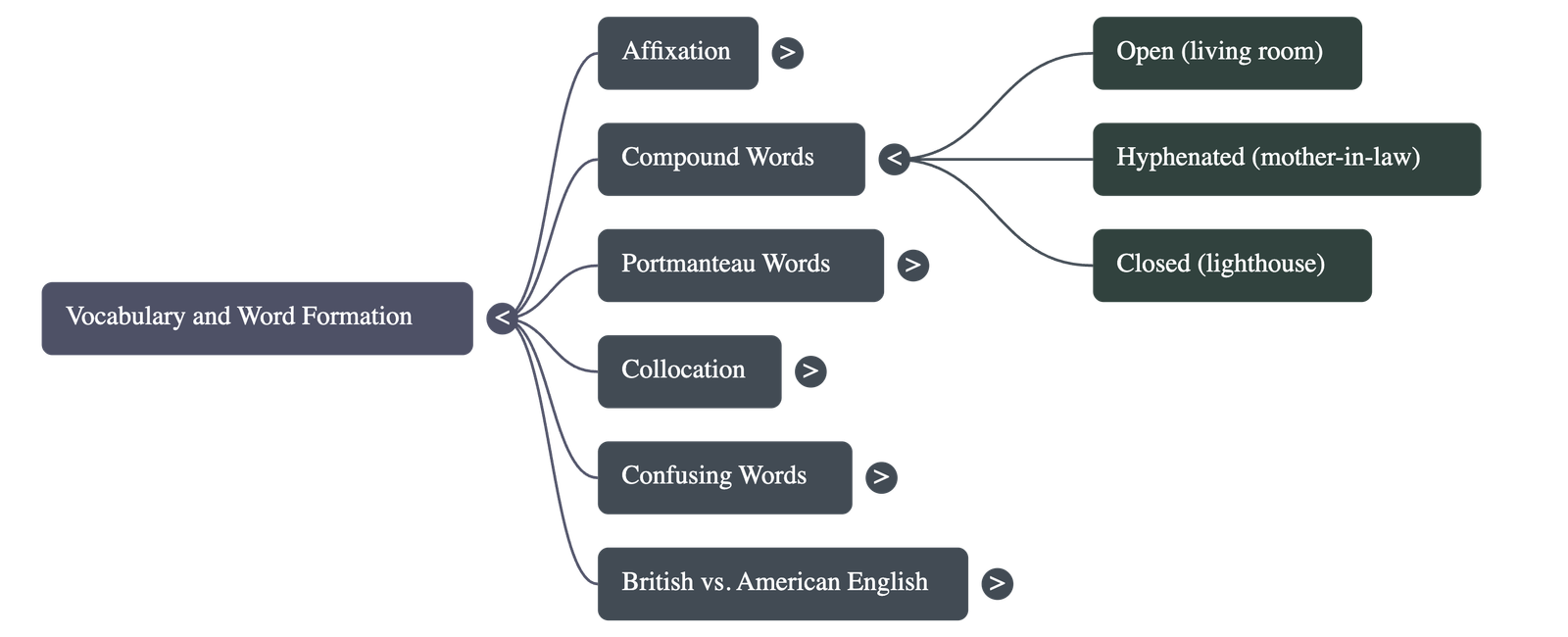
- Compound Words: Formed by linking two or more words to create a new meaning. They are classified as:
- Open: Written as separate words (e.g., ice cream).
- Hyphenated: Connected by a hyphen (e.g., mother-in-law).
- Closed: Written as a single word (e.g., grandmother).
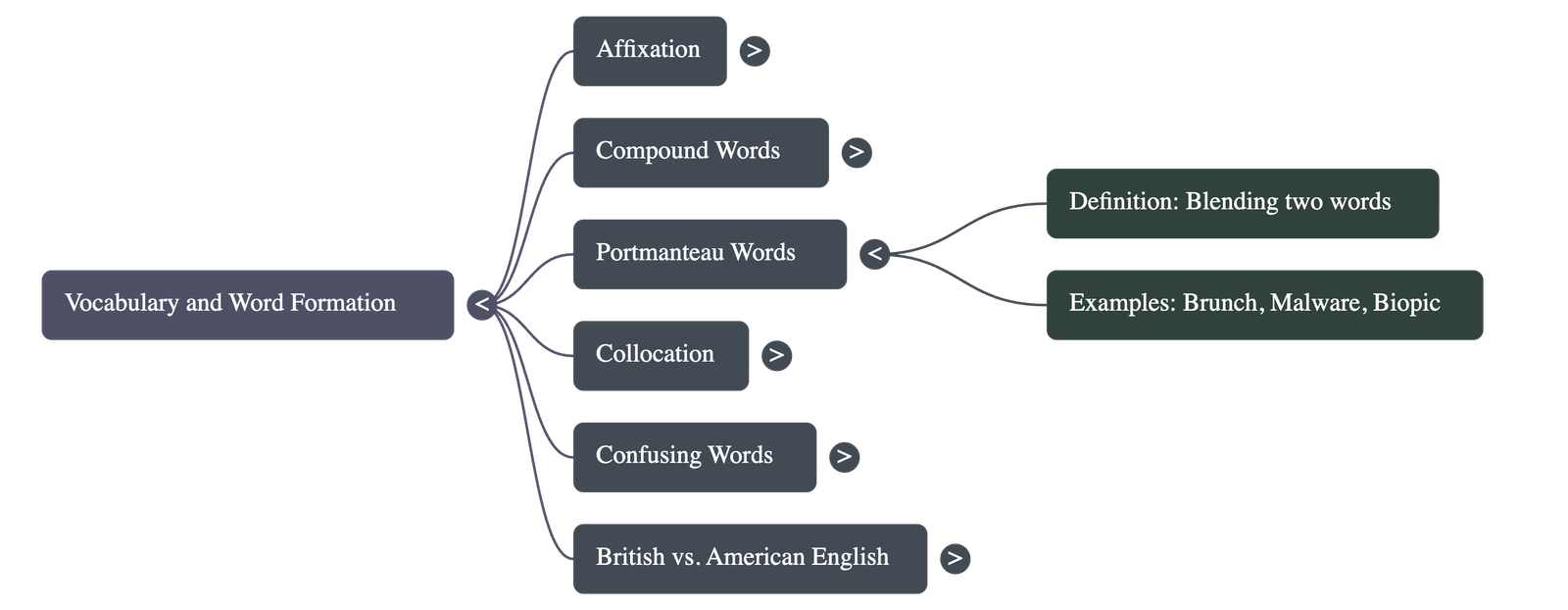
- Portmanteau Words: Also known as blends, these are created by joining two words while dropping some letters (e.g., brunch from breakfast + lunch).
3. Word Pairings and Relationships
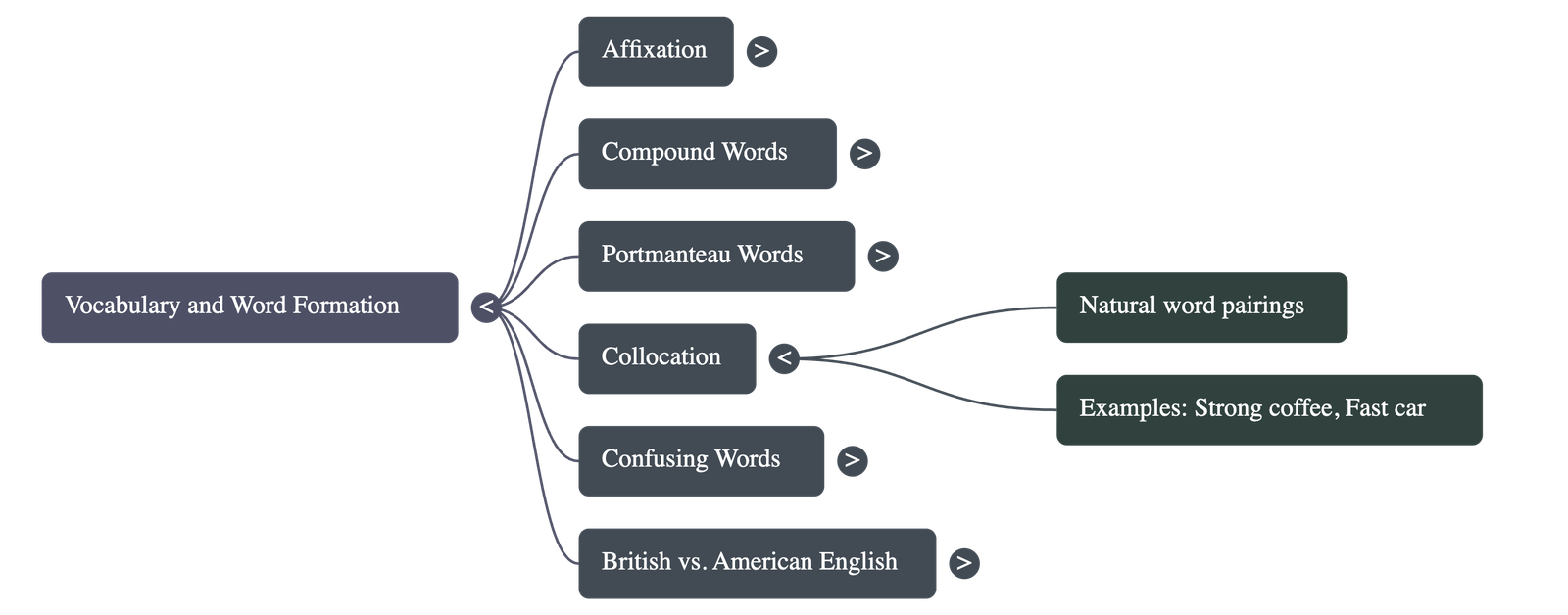
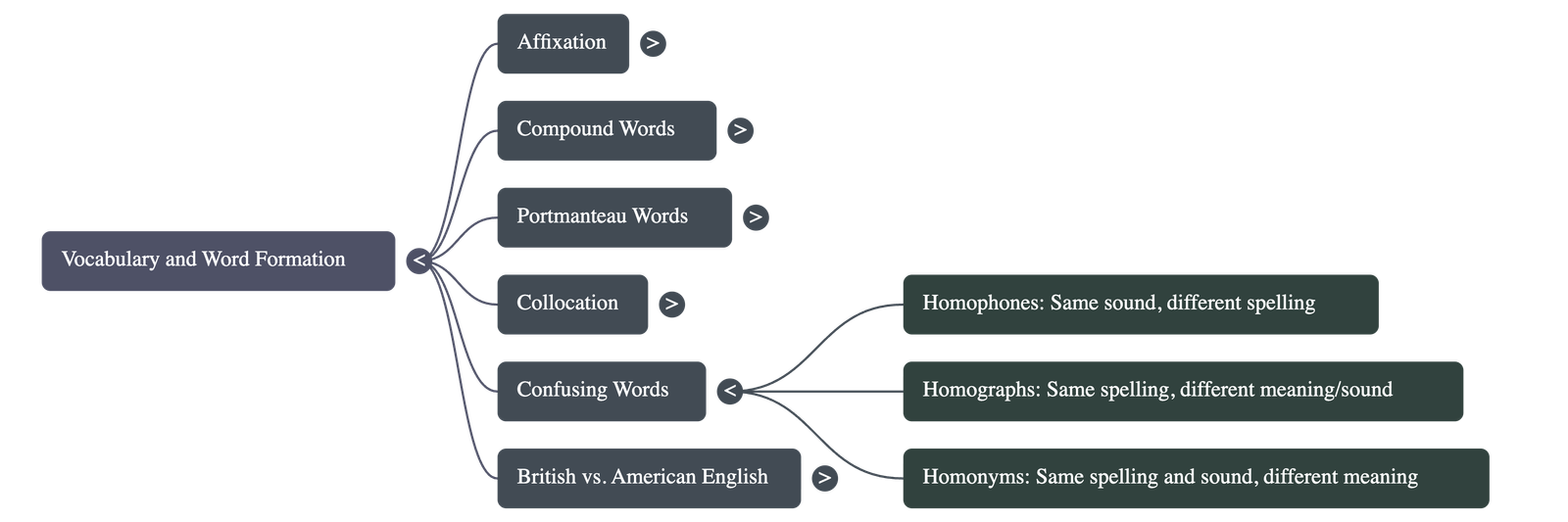
- Collocation: The natural combination of words that sound correct to native speakers, such as "fast food" or "heavy rain."
- Homophones: Words that have the same pronunciation but different spellings and meanings (e.g., altar and alter).
- Homographs: Words spelt the same but differing in meaning, origin, or pronunciation (e.g., wind /waɪnd/ to wrap vs. wind /wɪnd/ moving air).
- Homonyms: Words that are spelt and pronounced the same but have entirely different meanings (e.g., bank of a river vs. bank for money).
4. British and American English
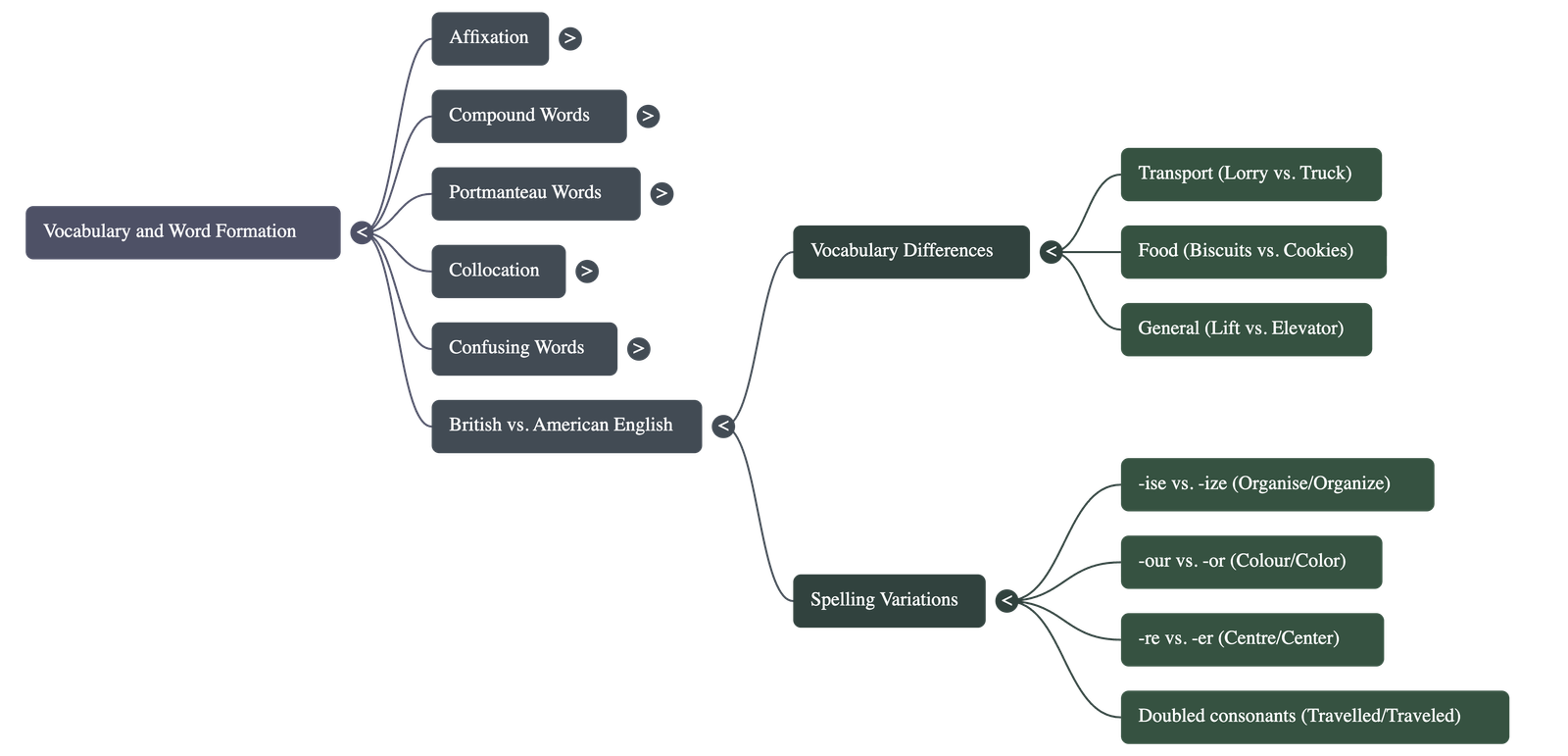
- Vocabulary Differences: Many common objects have different names (e.g., British lorry vs. American truck; chips vs. French fries).
- Spelling Variations:
- Words ending in -ise in British English often end in -ize in American English.
- British English often doubles consonants (e.g., travelled), whereas American English does not (e.g., traveled).
- The British -our ending (colour) changes to -or (color) in American English.
- British -re endings (centre) change to -er (center).
Do checkout all questions & answers of this chapter.
Quick Navigation:
| | | | |
1 / 1
Quick Navigation:
| | | | |