Quick Navigation:
| | | |
Pollination and Fertilization
1. Introduction to Pollination
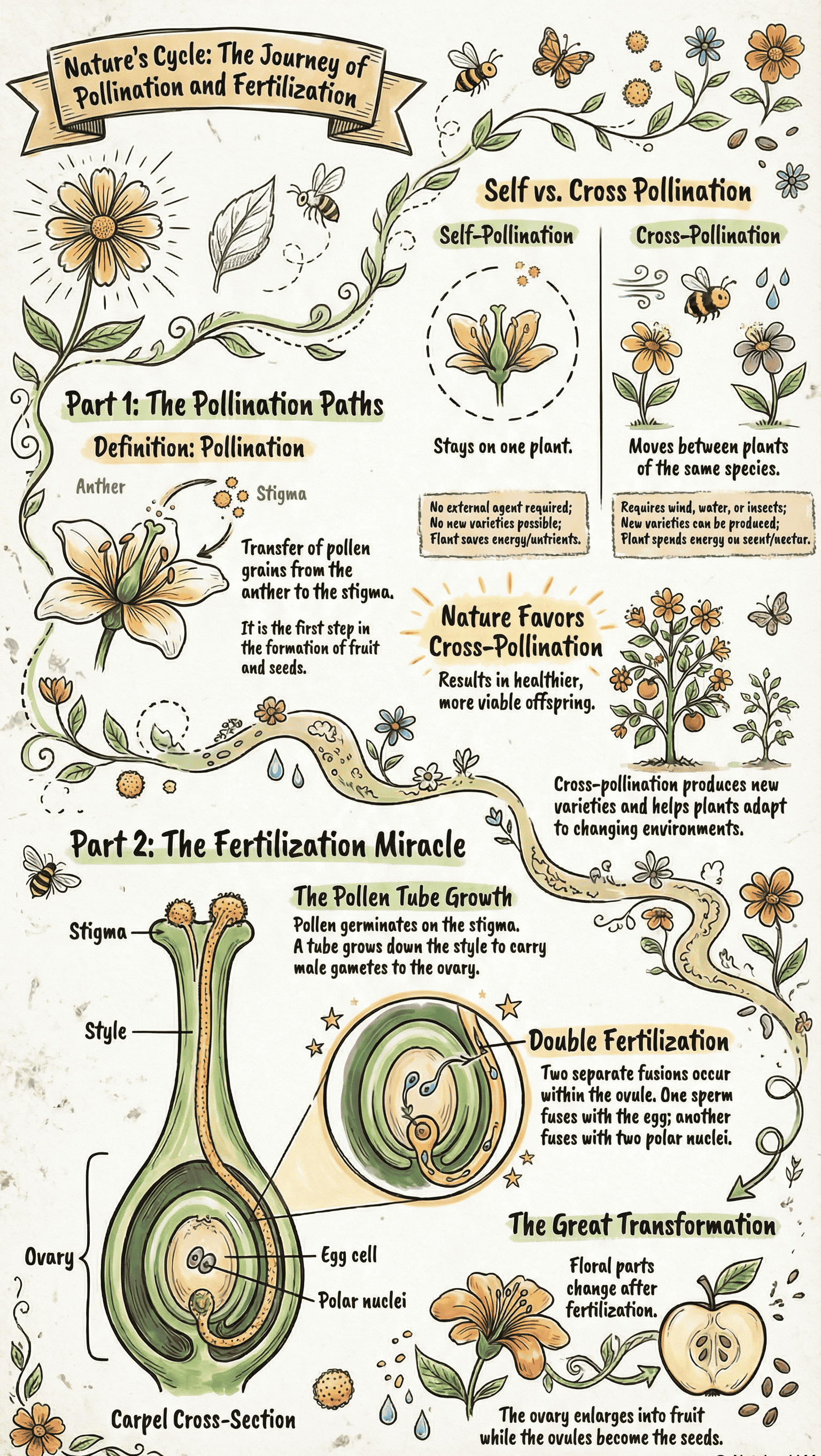
- Definition: Pollination is the process of transfer of pollen grains from the anther to the stigma.
- It is the first step in the formation of fruit and seeds and must occur between plants of the same species for successful reproduction.
- Three Principal Ways of Pollination:
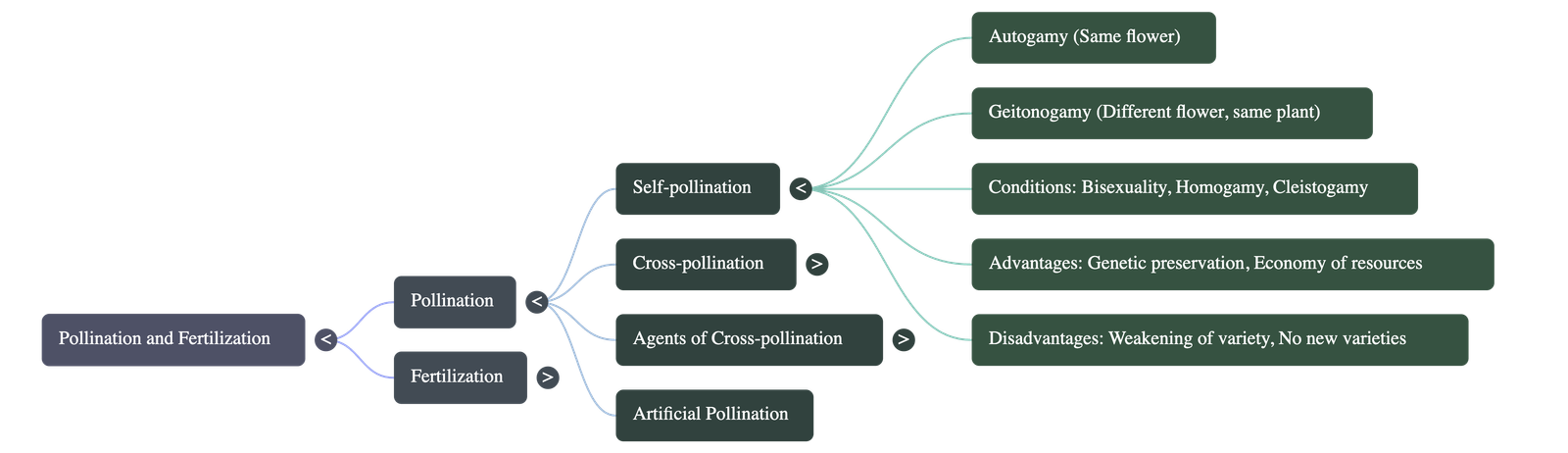
- Autogamy (Self-pollination): Pollen of the same flower falls on its own stigma.
- Geitonogamy: Pollen of another flower on the same plant falls on the stigma. It is considered self-pollination genetically.
- Allogamy (Cross-pollination): Pollen from a flower of one plant falls on the stigma of another plant of the same species.
2. Self-Pollination
- Cleistogamous Flowers: Certain bisexual flowers (like pea, pansy) do not open even at maturity, keeping reproductive structures hidden to ensure self-pollination.
- Conditions for Self-Pollination:
- Bisexuality: Flowers possess both male and female organs.
- Homogamy: The anther and stigma of a flower must mature at the exact same time.
- Advantages:
- Highly certain process in bisexual flowers with homogamy.
- Parental characters are preserved indefinitely.
- No wastage of pollen grains.
- Highly economical for the plant; flowers do not need to be large, showy, or produce scent and nectar.
- Disadvantages:
- Continuous self-pollination can weaken the variety, producing less vigorous offspring and poor-quality seeds.
- Defective characters cannot be eliminated.
- No new varieties are yielded due to the lack of genetic intermixing.
3. Cross-Pollination
- Chasmogamous Flowers: Large flowers with open petals and exposed reproductive structures that mainly undergo cross-pollination.
- Advantages:
- Offspring produced are much healthier.
- Seeds produced are abundant and viable.
- Allows for the production of entirely new varieties.
- Disadvantages:
- Uncertain as it relies on the availability of pollinating agents.
- High wastage of pollen grains as they must be produced in large quantities.
- Uneconomical for the plant, which must invest energy into growing large, colorful, scented, and nectar-producing flowers.
4. Nature Favours Cross-Pollination
The vast majority of flowering plants have evolved devices to ensure cross-pollination:
- Unisexuality: Flowers are exclusively male or female, sometimes borne on completely separate plants (e.g., papaya, palms).
- Dichogamy: Different timings of maturation for reproductive parts.
- Protandry: Anthers mature earlier than the stigma (e.g., sunflower, lady finger).
- Protogyny: Stigma matures earlier than anthers (e.g., custard apple, peepal).
- Self-sterility: Pollen fails to grow on the stigma of the same flower (e.g., orchids, ray florets of sunflower).
- Herkogamy: Mechanical or structural barriers prevent self-pollination, such as a hood covering the stigma (e.g., Pansy, Iris).
- Heterostyly: Stigma and anthers grow at drastically different heights (e.g., primrose).
5. Agents of Cross-Pollination
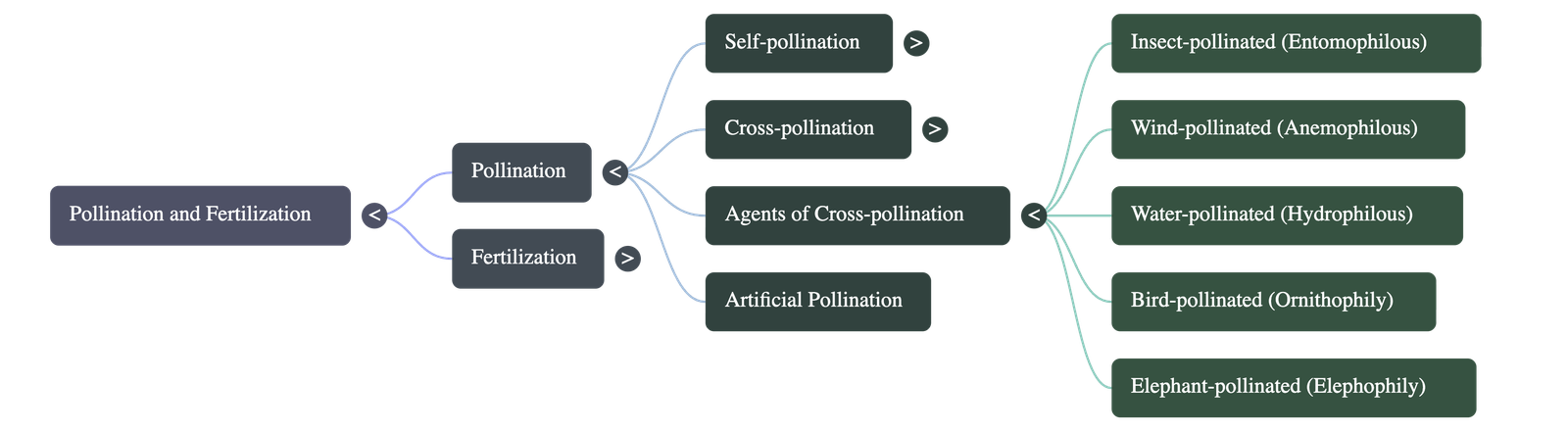
- Insect-Pollinated (Entomophilous): Flowers are large, brightly colored, emit scent, and produce nectar. Pollen grains and stigmas are generally sticky. Small flowers tend to group in conspicuous clusters (e.g., Dahlia, sweet pea).
- Wind-Pollinated (Anemophilous): Flowers are small, dull-colored, and lack scent/nectar. Stamens are long and hang outside the flower with loosely attached "versatile" anthers. They produce enormous amounts of light, dry, smooth pollen. Stigmas are feathery and hang out to trap pollen (e.g., Maize, grass, wheat).
- Water-Pollinated (Hydrophilous): Found in aquatic plants. Pollen specific gravity matches water. In some, male flowers detach and float to meet female flowers on the surface (e.g., Vallisneria).
- Other Agents: Birds (Ornithophily) like in Bignonia; Elephants (Elephophily) in the extremely large ground-level flowers of Rafflesia.
- Artificial Pollination: A practice by plant breeders involving emasculation (removing young anthers), bagging the flower, and manually dusting desired pollen to evolve new commercial varieties.
6. Fertilization in Flowering Plants
- Definition: Fertilization is the union or fusion of the nuclei of male and female gametes.
- The Pollen Grain: Features a double wall—an outer exine and an inner intine. It contains a tube nucleus and a generative nucleus. During pollen transfer, the generative nucleus divides into two male gametes (sperm nuclei).
- The Ovule: The inner part of the ovary destined to become the seed. It features protective coverings called integuments which leave a small opening called the micropyle. Inside sits the nucellus and the embryo sac.
- The Embryo Sac (7 cells):
- 3 cells at the micropylar end: one egg cell and two synergids.
- 3 antipodal cells at the opposite end.
- 1 large central cell containing two fused polar nuclei.
7. Germination of Pollen and Double Fertilization
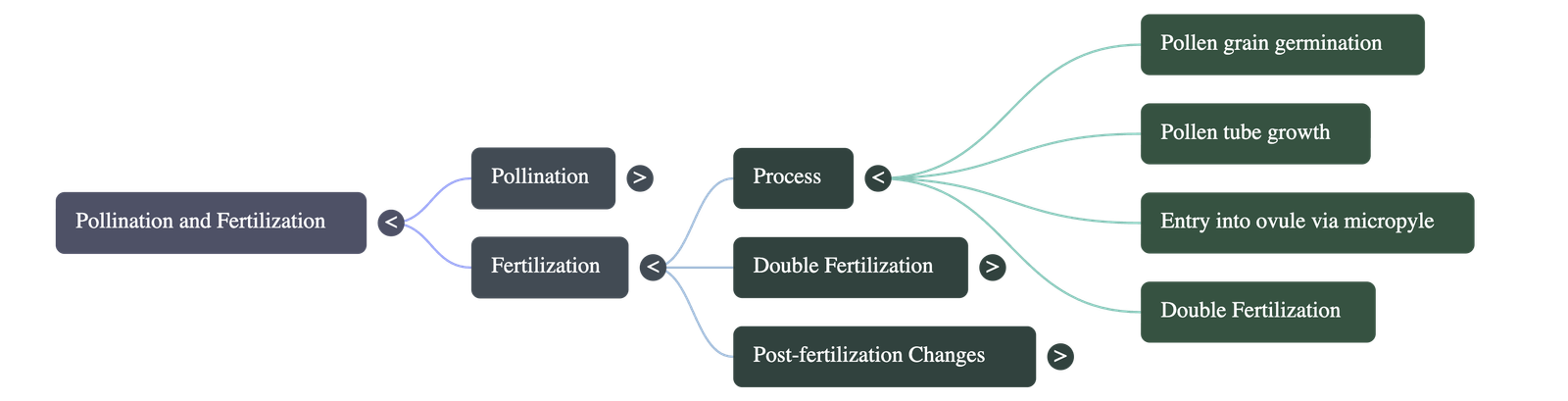
- Pollen Germination: Upon falling on a compatible stigma, sugary secretions stimulate the pollen. A pollen tube breaks through the exine, carrying the two sperm nuclei and the tube nucleus.
- Growth of Pollen Tube: Directed by the tube nucleus (which later disintegrates), the tube dissolves through the stigma and style using enzymes, reaches the ovary, and enters the ovule via the micropyle.
- Double Fertilization Process: The pollen tube enters a synergid and releases its two sperm nuclei.
- First Fertilization: One sperm nucleus fuses with the egg cell nucleus to form the zygote (which becomes the embryo).
- Second Fertilization (Triple Fusion): The other sperm nucleus moves to the central cell and fuses with the two polar nuclei to form the endosperm nucleus.
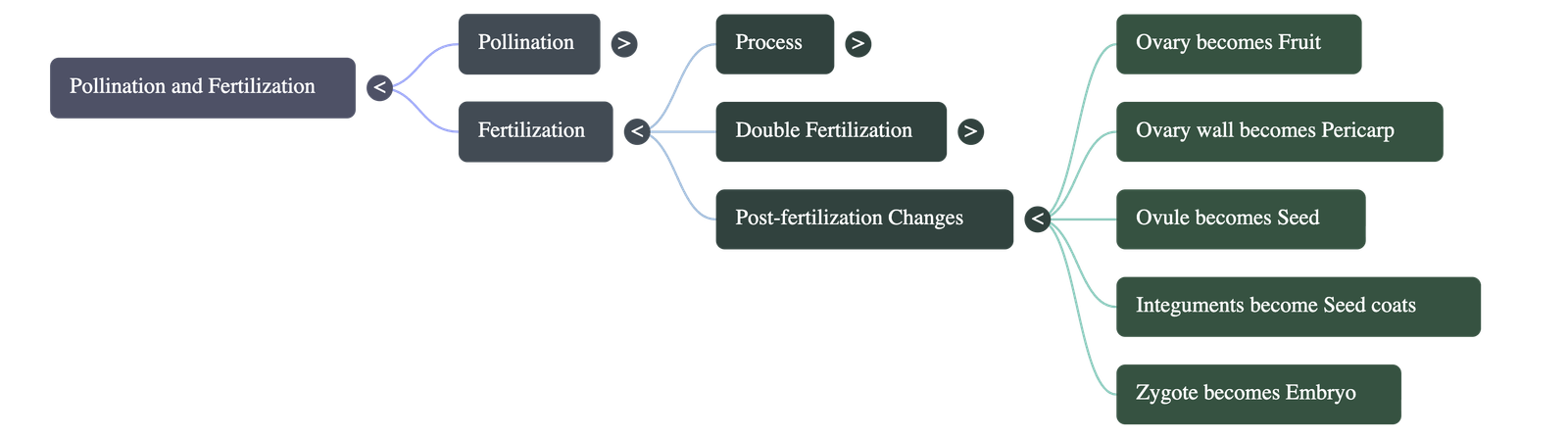
8. Fate of Floral Parts After Fertilization
Once fertilization is complete, the flower has served its purpose and structural changes occur:
- Petals, stamens, style, and stigma wither and generally fall off.
- The calyx usually falls off but may remain intact and dried (e.g., apple, guava) or persist as green attached leaves (e.g., brinjal).
- Ovary changes into the Fruit.
- Ovary wall changes into the Pericarp (fruit wall).
- Ovule(s) change into the Seed(s).
- Placenta becomes the Stalk of the seed.
- Outer integument becomes the Testa (outer seed coat).
- Inner integument becomes the Tegmen (inner seed coat).
Do checkout all questions & answers of this chapter.
Quick Navigation:
| | | |
1 / 1
Quick Navigation:
| | | |