Quick Navigation:
| | | |
Seeds - Structure and Germination
1. Basic Definitions
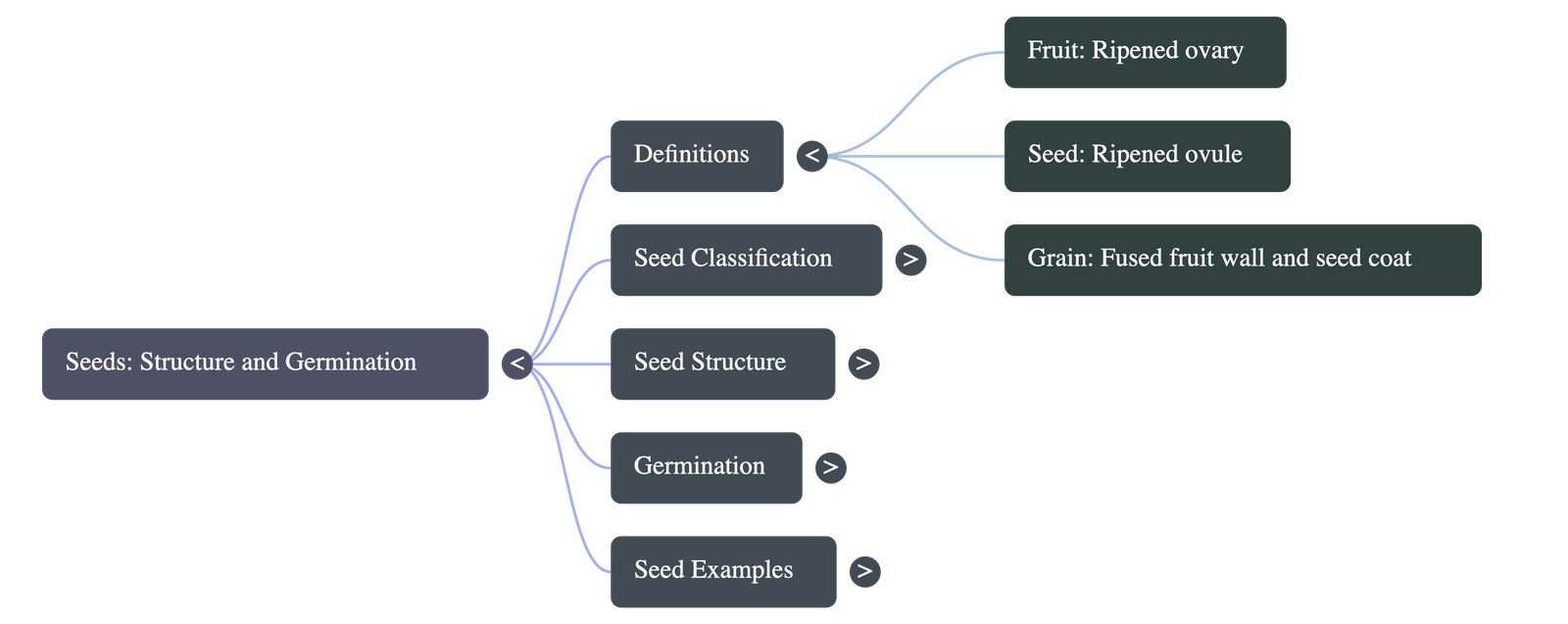
- Fruit: The enlarged, ripened ovary. The ovarian wall forms the fruit wall, which encloses the seeds, protects them, and aids in seed dispersal (e.g., mango, pea pod).
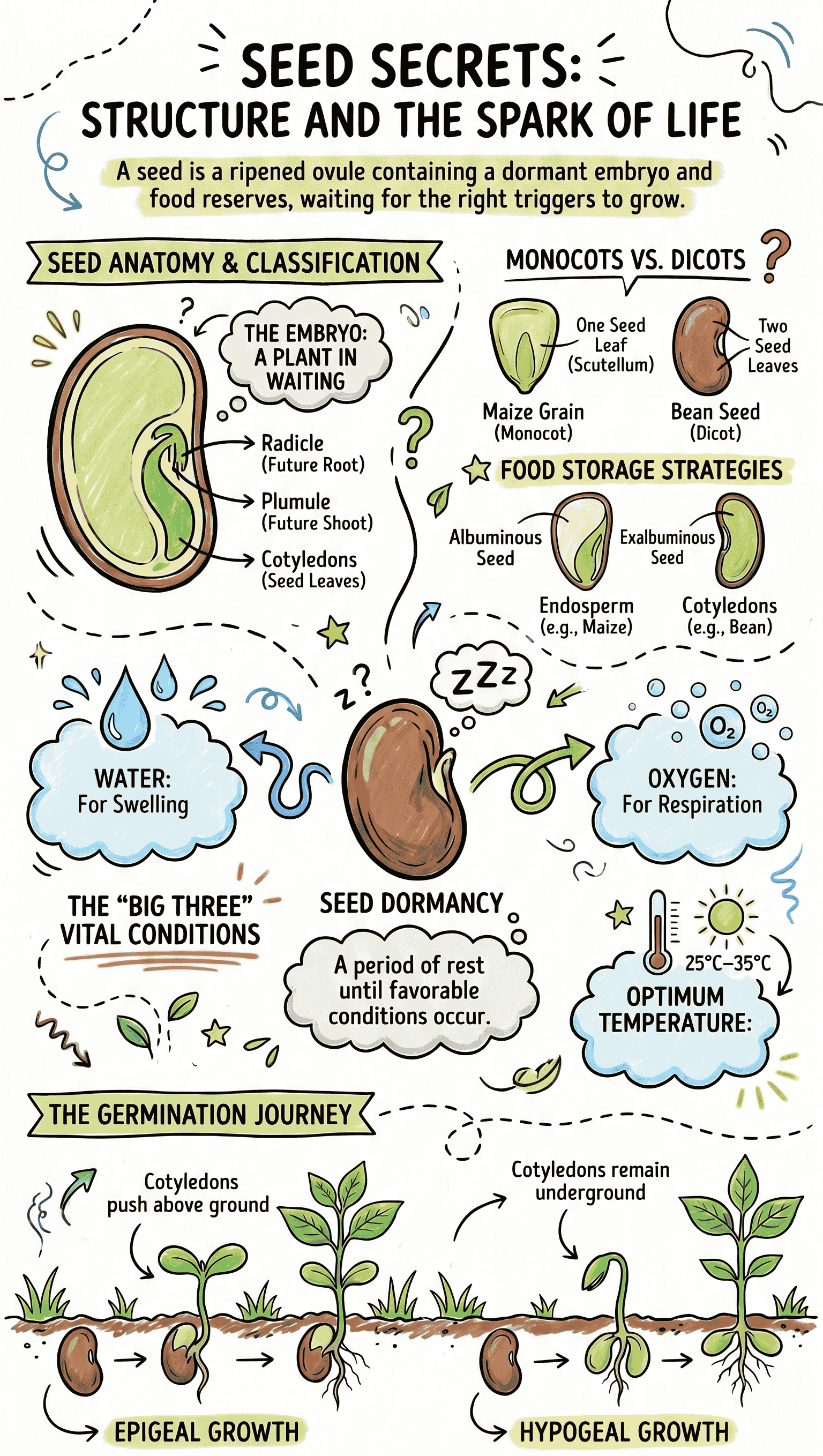
- Seed: A ripened ovule containing an embryo (a tiny living plant) protected by a seed coat. It often contains endosperm for nourishment and can remain dormant under unfavorable conditions for extended periods.
- Grain: A specific type of fruit where the fruit wall and the seed coat are completely fused together to form a protective layer (e.g., maize, wheat).
2. Classification of Seeds
- Based on Size: Ranging from barely visible (poppy, strawberry) to very large (mango, plum) and giant (coconut, double coconut).
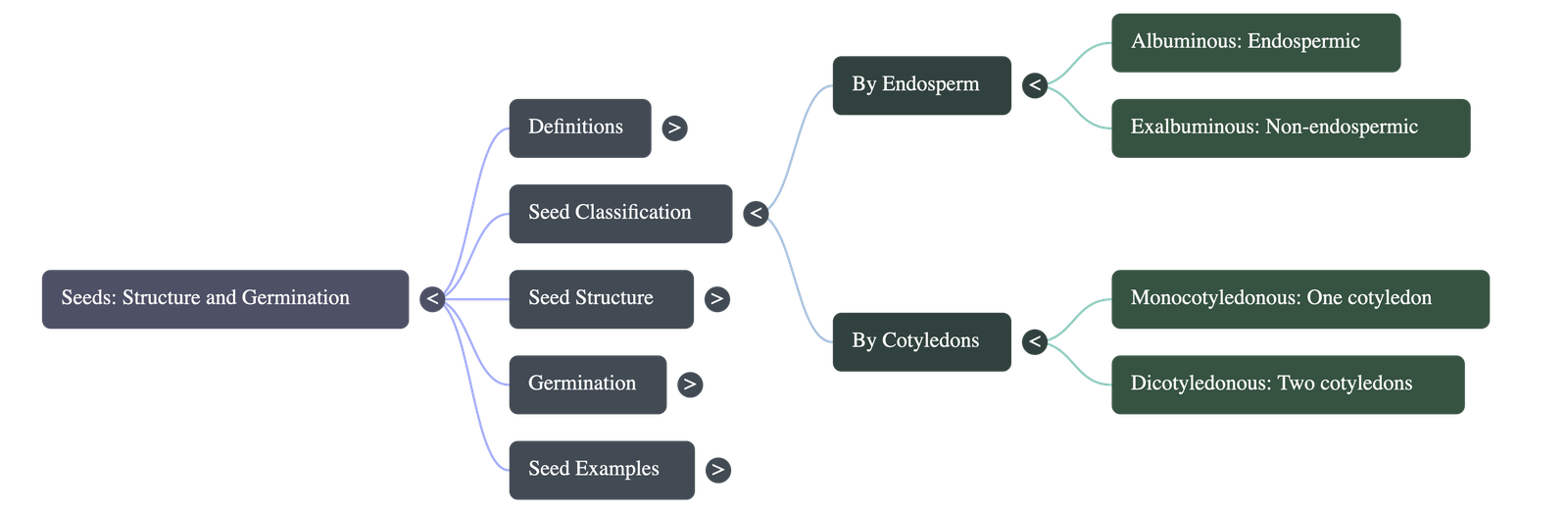
- Based on Endosperm:
- Albuminous (Endospermic): Cotyledons are thin, and endosperm persists to store food. Found in monocots (cereals, millets) and dicots (poppy, custard apple).
- Exalbuminous (Non-endospermic): Cotyledons become thick and fleshy to store food. Found in monocots (orchids) and dicots (gram, pea, mustard).
- Based on Cotyledons:
- Monocotyledonous: Contain a single cotyledon (e.g., maize, grasses).
- Dicotyledonous: Contain two cotyledons (e.g., pea, gram, bean).
3. Structure of Common Seeds
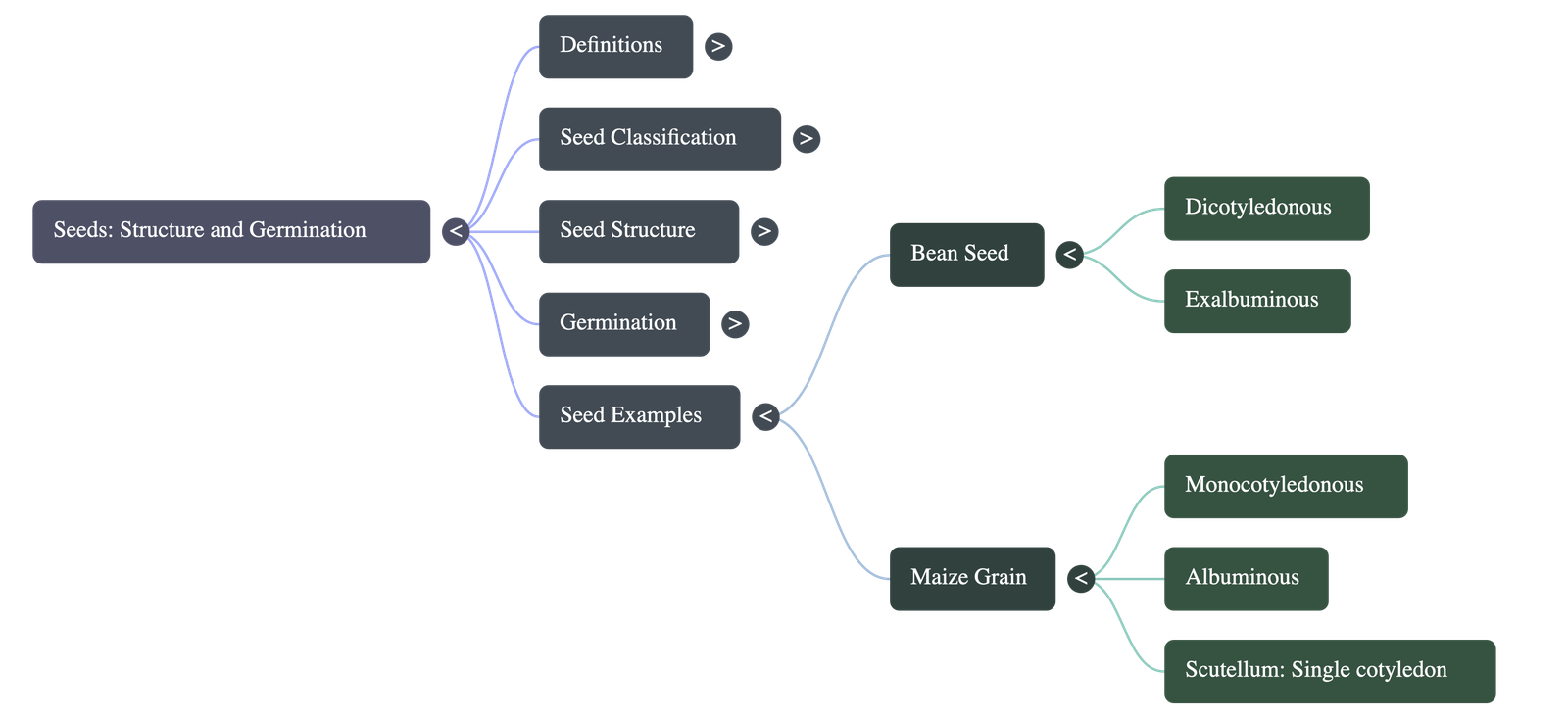
- The Bean Seed (Dicot):
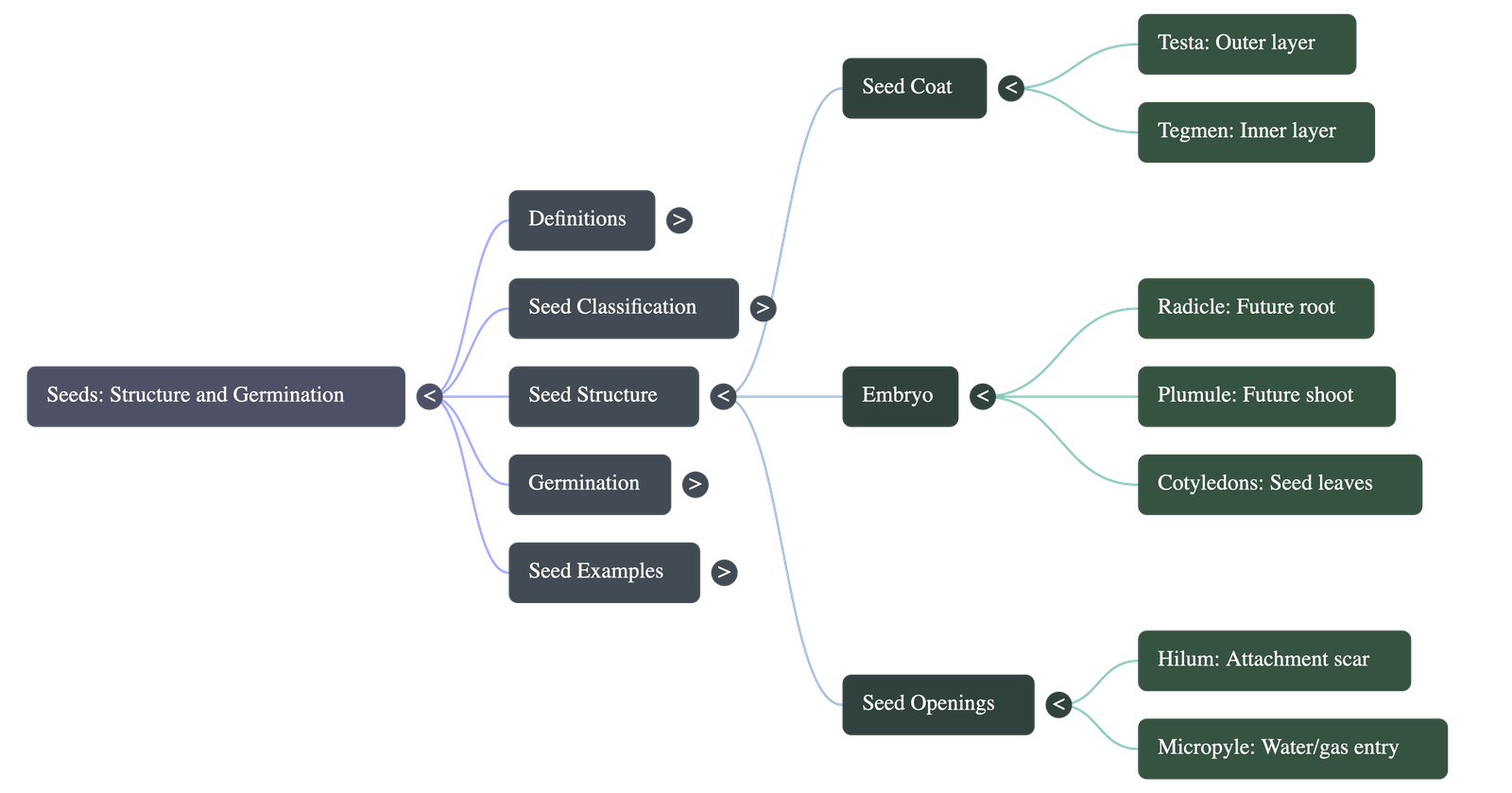
- Covered by a hard outer Testa (protects from injury/bacteria) and a thin inner Tegmen.
- Has a Hilum (a distinct oval scar marking the attachment to the ovary) and a tiny pore called a Micropyle (absorbs water and provides respiratory gases).
- The embryo contains two thick cotyledons, a Radicle (future root), and a Plumule (future shoot).
- The axis above the cotyledons is the Epicotyl, and below is the Hypocotyl.
- The Maize Grain (Monocot):
- Features a large endosperm rich in starch and a single cotyledon known as the Scutellum.
- The outermost endosperm layer is the protein-rich Aleurone layer.
- The radicle is protected by a sheath called the Coleorhiza, and the plumule is protected by the Coleoptile.
4. Germination and Necessary Conditions
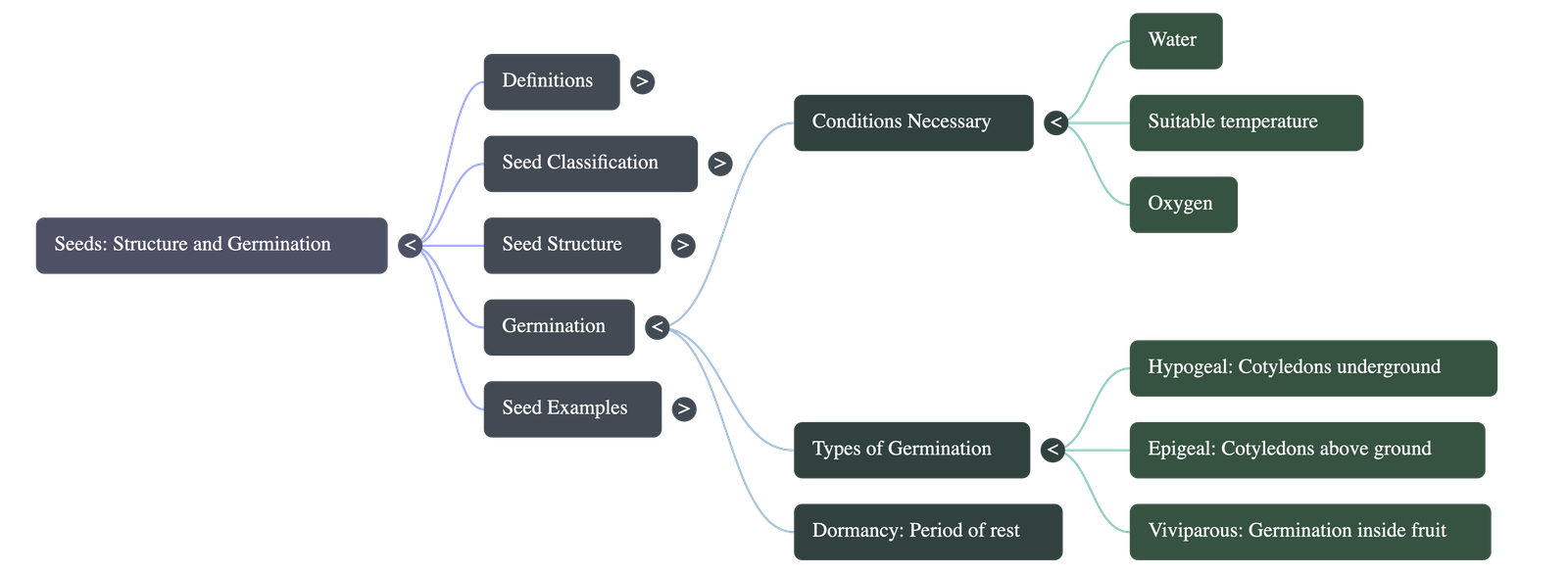
- Dormancy: A period of physiological rest where the embryo is inactive but alive.
- Germination: The process by which the dormant embryo awakens and grows into a seedling.
- Conditions required for germination:
- Water: Makes the seed swell, ruptures the seed coat, and enables enzymes to convert stored food into a usable dissolved form.
- Suitable Temperature: Needs an optimum warm temperature (usually 25°C to 35°C). Extreme heat destroys delicate tissues, while extreme cold inhibits growth.
- Oxygen: Necessary for rapid cell division and cell growth; provides energy through respiration.
- Note: Seeds sown too deep fail to germinate due to lack of oxygen and insufficient pushing force from the embryonic parts.
5. Types of Germination
- Hypogeal Germination: The epicotyl elongates faster, leaving the cotyledons underground. Examples include pea, gram, and maize.
- Epigeal Germination: The hypocotyl elongates faster, pushing the cotyledons above the ground to become the first green leaves. Examples include bean and castor.
- Viviparous Germination (Vivipary): A special mode where seeds germinate inside the fruit while it is still attached to the parent plant. The plant drops the developing seedling directly into the mud. Common in mangrove plants like Rhizophora and Sonneratia.
6. The Seedling
- A seedling is the stage of plant growth before it becomes completely independent of the food stored in the seed.
- Once established, its roots absorb water and minerals from the soil, and its leaves begin manufacturing food for the young plant to reach maturity.
Do checkout all questions & answers of this chapter.
Quick Navigation:
| | | |
1 / 1
Quick Navigation:
| | | |