Quick Navigation:
| | | |
Civics 2: Salient Features of the Constitution - I
A comprehensive summary designed for Class 9 students, covering the core principles, rights, and duties established by the Indian Constitution.
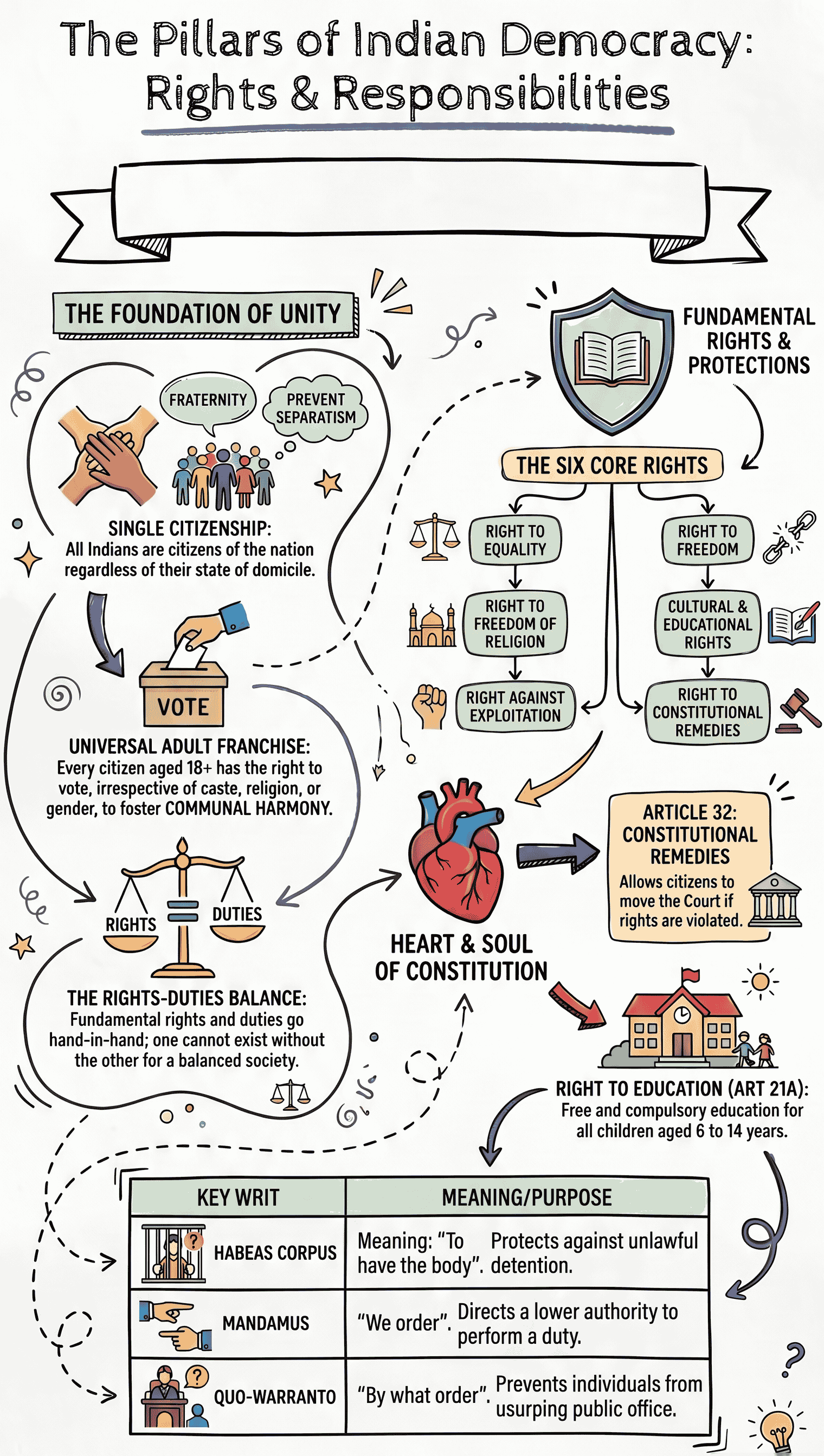
1. Single Citizenship
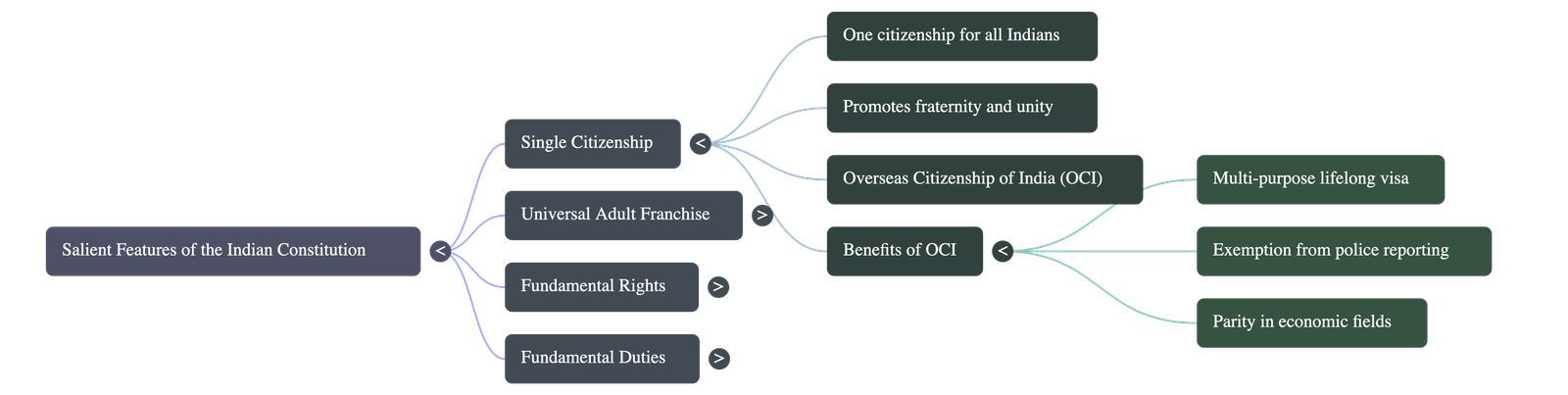
- The Indian Constitution provides a Single Citizenship for all its people.
- Unlike the USA, where a person is a citizen of both their state and the country, in India, a person is only a citizen of India, regardless of which state they are born or live in.
- This feature aims to ward off separatist tendencies and promote unity and a feeling of brotherhood (fraternity) among Indians.
- India does not allow dual citizenship. However, the government introduced the Overseas Citizenship of India (OCI) for Persons of Indian Origin migrating to other countries (except Pakistan and Bangladesh), granting them lifelong visas and other benefits, though it does not provide voting rights.
2. Universal Adult Franchise
- Every citizen who is 18 years of age and above has the right to vote.
- This right is given to everyone irrespective of their caste, colour, religion, gender, or educational qualifications.
- It replaced the British system of communal electorates with a joint electorate system to curb communal politics and foster harmony.
- Certain seats are reserved for Scheduled Castes and Scheduled Tribes to ensure fair representation.
3. Fundamental Rights (Part-III)
Fundamental rights are basic human rights essential for the all-round development of an individual. They protect citizens from unjust discrimination and arbitrary state actions.
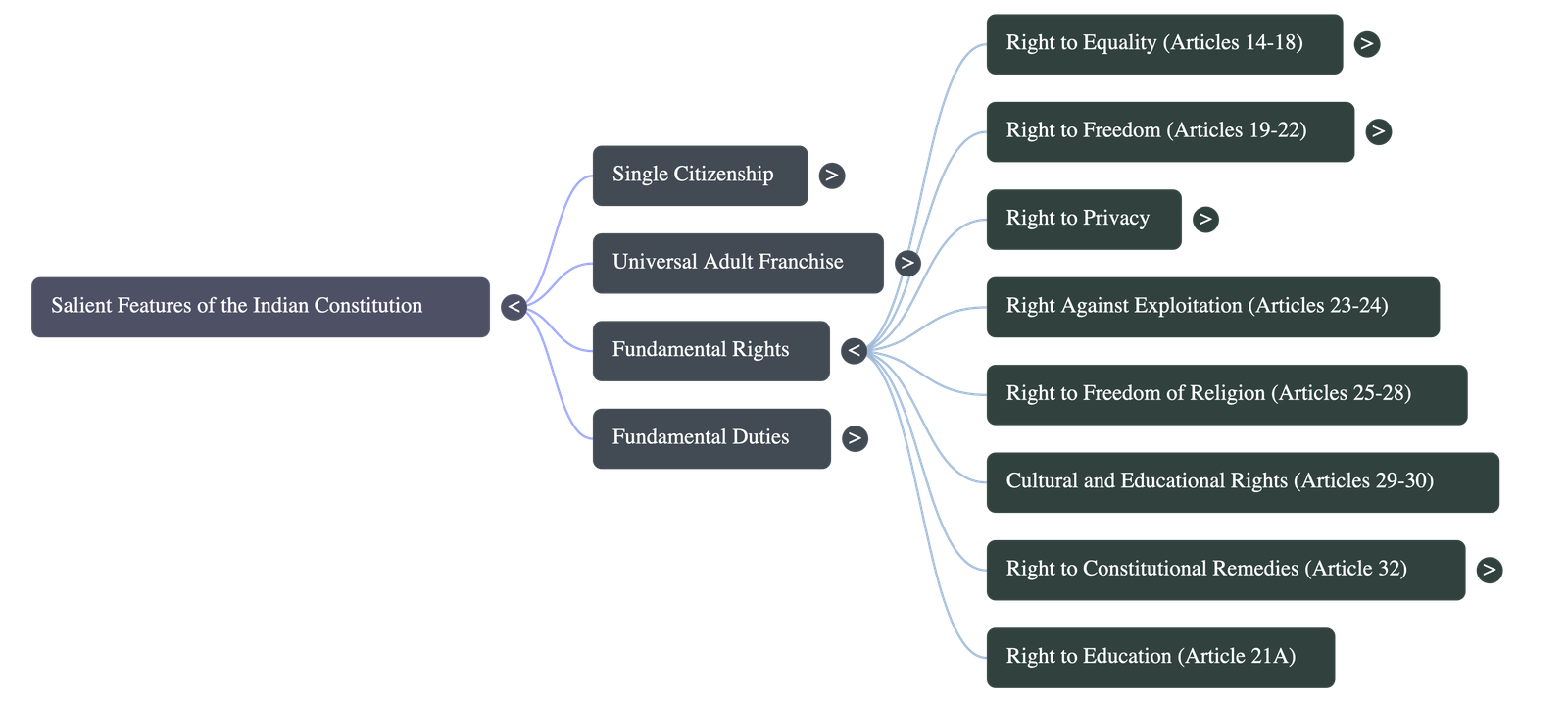
I. Right to Equality (Articles 14 to 18)
- Equality before Law: Everyone is equal before the law regardless of their background.
- Prohibition of Discrimination: No discrimination based on religion, race, caste, sex, or place of birth.
- Equality of Opportunity: Equal chances in matters of public employment.
- Abolition of Untouchability: Practicing untouchability in any form is a punishable offence.
- Abolition of Titles: Titles like Maharaja or Rai Bahadur are abolished to maintain equal status for all.
II. Right to Freedom (Articles 19 to 22)
- Guarantees six basic freedoms: Freedom of speech and expression, peaceful assembly, forming associations, free movement throughout India, residence in any part of India, and practicing any profession.
- Right to Information (RTI): An implied fundamental right under Freedom of Speech and Expression, empowering citizens to seek information from public authorities.
- Protection of Life and Personal Liberty: No one can be deprived of life and liberty without legal procedures. Includes the Right to Privacy.
- Protection against Arrest: Gives an arrested person the right to know the reason for arrest, consult a lawyer, and be presented before a magistrate within 24 hours.
III. Right Against Exploitation (Articles 23 & 24)
- Prohibits human trafficking, forced labour (begar), and the employment of children below 14 years in factories, mines, or hazardous jobs.
IV. Right to Freedom of Religion (Articles 25 to 28)
- Grants the freedom to follow, practice, and spread any religion of choice.
- Allows religious groups to manage their own religious affairs.
V. Cultural and Educational Rights (Articles 29 & 30)
- Protects the distinct language, script, and culture of minorities.
- Allows minorities to establish and administer their own educational institutions.
VI. Right to Constitutional Remedies (Article 32)
- Dr. B.R. Ambedkar called it the "heart and soul of the Constitution."
- It allows citizens to directly approach the Supreme Court or High Courts if their fundamental rights are violated.
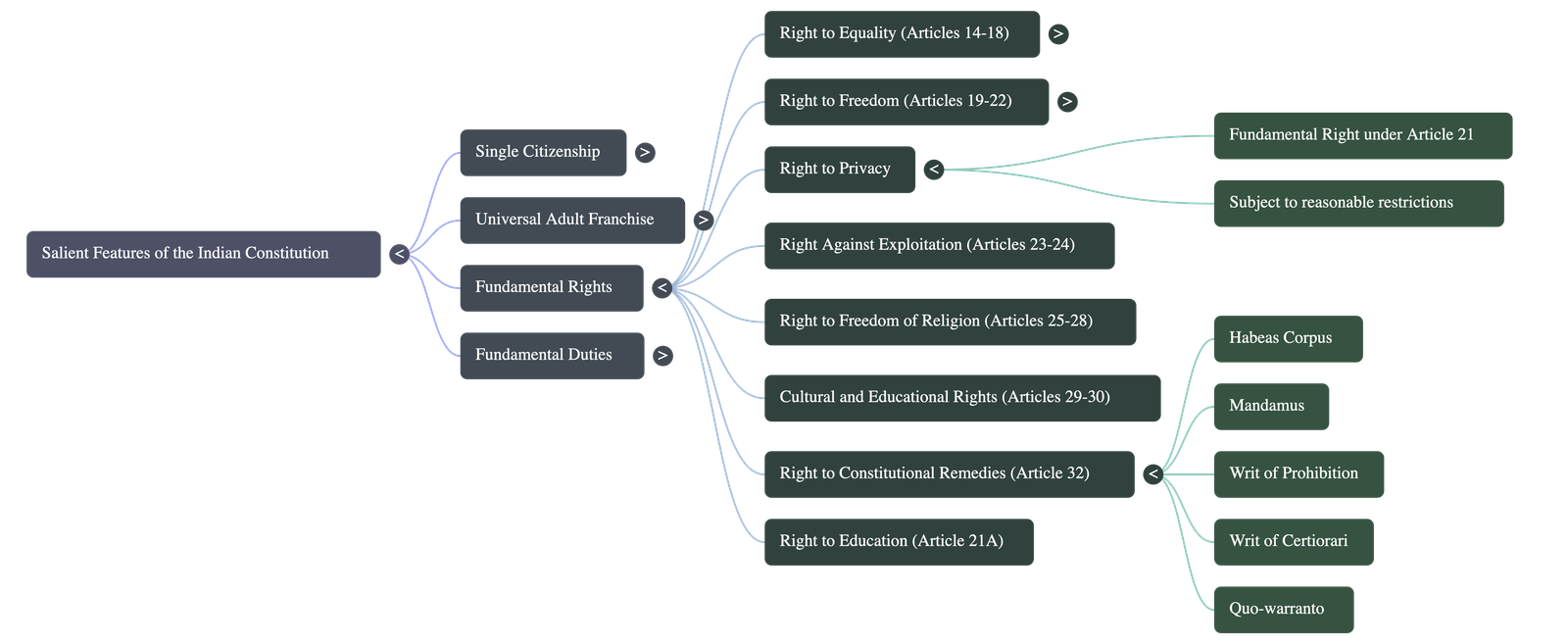
- Courts can issue Writs (formal written orders) to protect these rights. The five writs are: Habeas Corpus, Mandamus, Prohibition, Certiorari, and Quo-warranto.
VII. Right to Education (Article 21A)
- Makes education a fundamental right.
- The State must provide free and compulsory education to all children aged 6 to 14 years.
Important Notes on Rights:
- Right to Property is no longer a Fundamental Right. It was changed to a Legal Right by the 44th Amendment.
- Right to Privacy was declared a Fundamental Right by the Supreme Court in 2017, protecting personal data, choices, and dignity.
- Fundamental Rights are not absolute. They can be suspended during a National Emergency, and the government can impose reasonable restrictions for national security or public order.
4. Fundamental Duties (Part IV-A)
Rights and duties go hand-in-hand. The Fundamental Duties were added to the Constitution by the 42nd Amendment Act in 1976 (Article 51-A). Currently, there are 11 duties for citizens.
Key Duties Include:
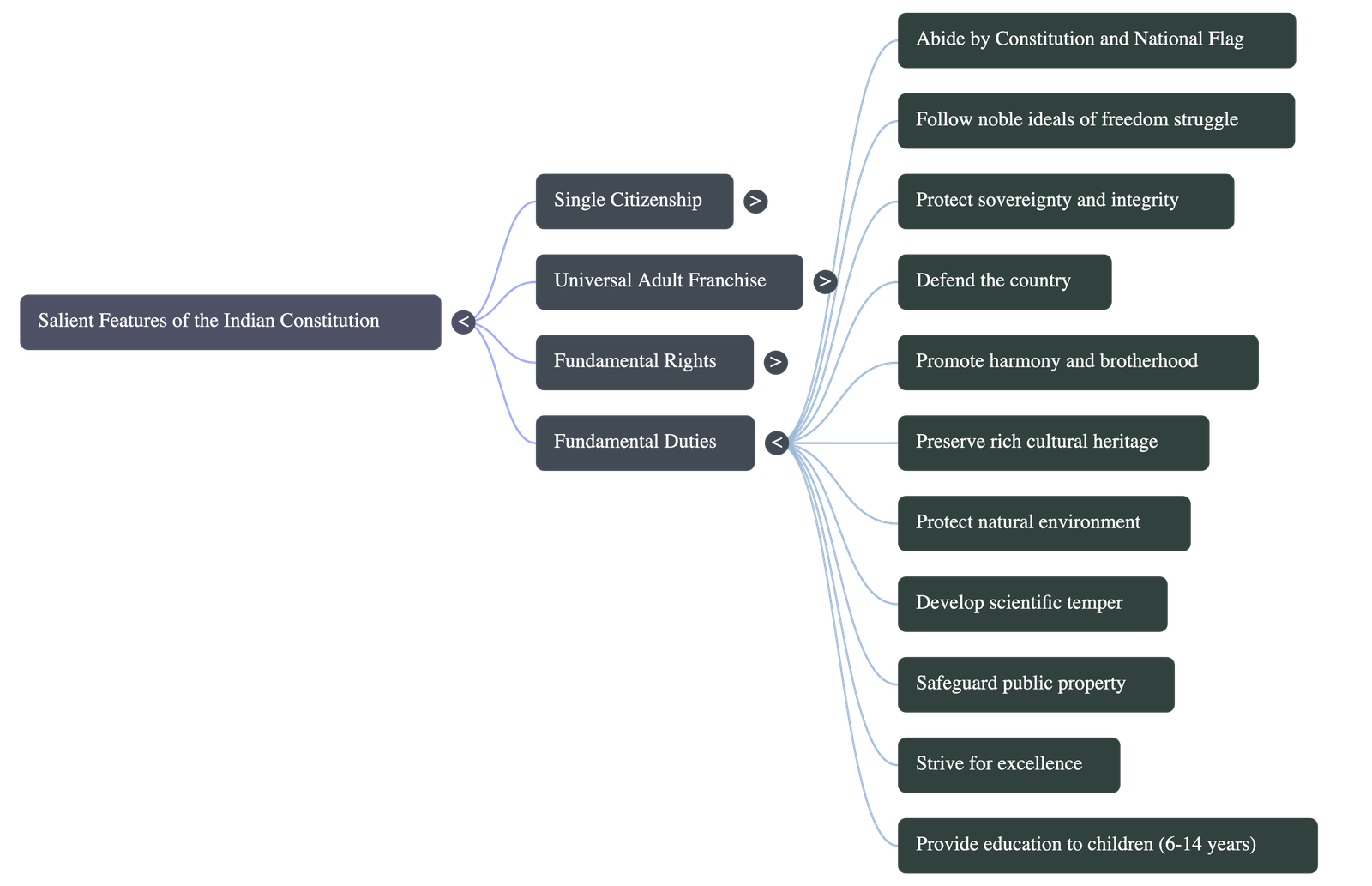
- To abide by the Constitution and respect its ideals, the National Flag, and the National Anthem.
- To uphold and protect the sovereignty, unity, and integrity of India.
- To defend the country and render national service when called upon.
- To promote harmony and the spirit of common brotherhood among all people of India.
- To value and preserve the rich heritage of our composite culture.
- To protect and improve the natural environment, including forests, lakes, and wildlife.
- To safeguard public property and abjure violence.
- Duty for Parents/Guardians: To provide educational opportunities for their child between the ages of 6 and 14 years (added by the 86th Amendment in 2002).
Do checkout all questions & answers of this chapter.
Quick Navigation:
| | | |
1 / 1
Quick Navigation:
| | | |