Quick Navigation:
| | | |
The Harappan Civilisation
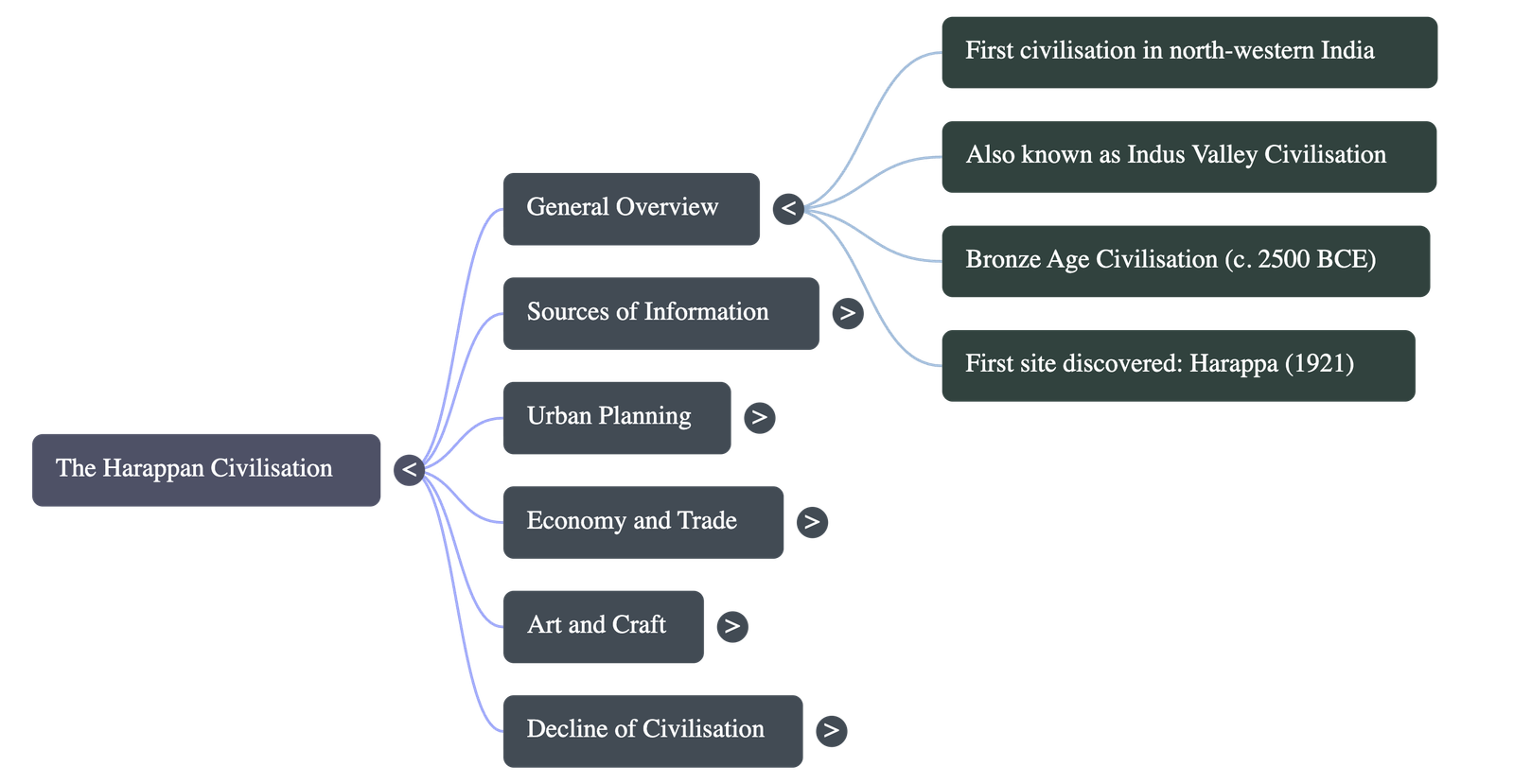
1. Introduction to the Bronze Age
- Evolution of Tools: Early humans transitioned from using solely stone tools to using both stone and copper, a period known as the Chalcolithic Period.
- The Bronze Age: The discovery of mixing copper with tin or zinc created Bronze, a harder and more durable alloy. This led to the growth of the first major civilisations around 2500 BCE, including the Harappan, Mesopotamian, Chinese, and Egyptian civilisations.
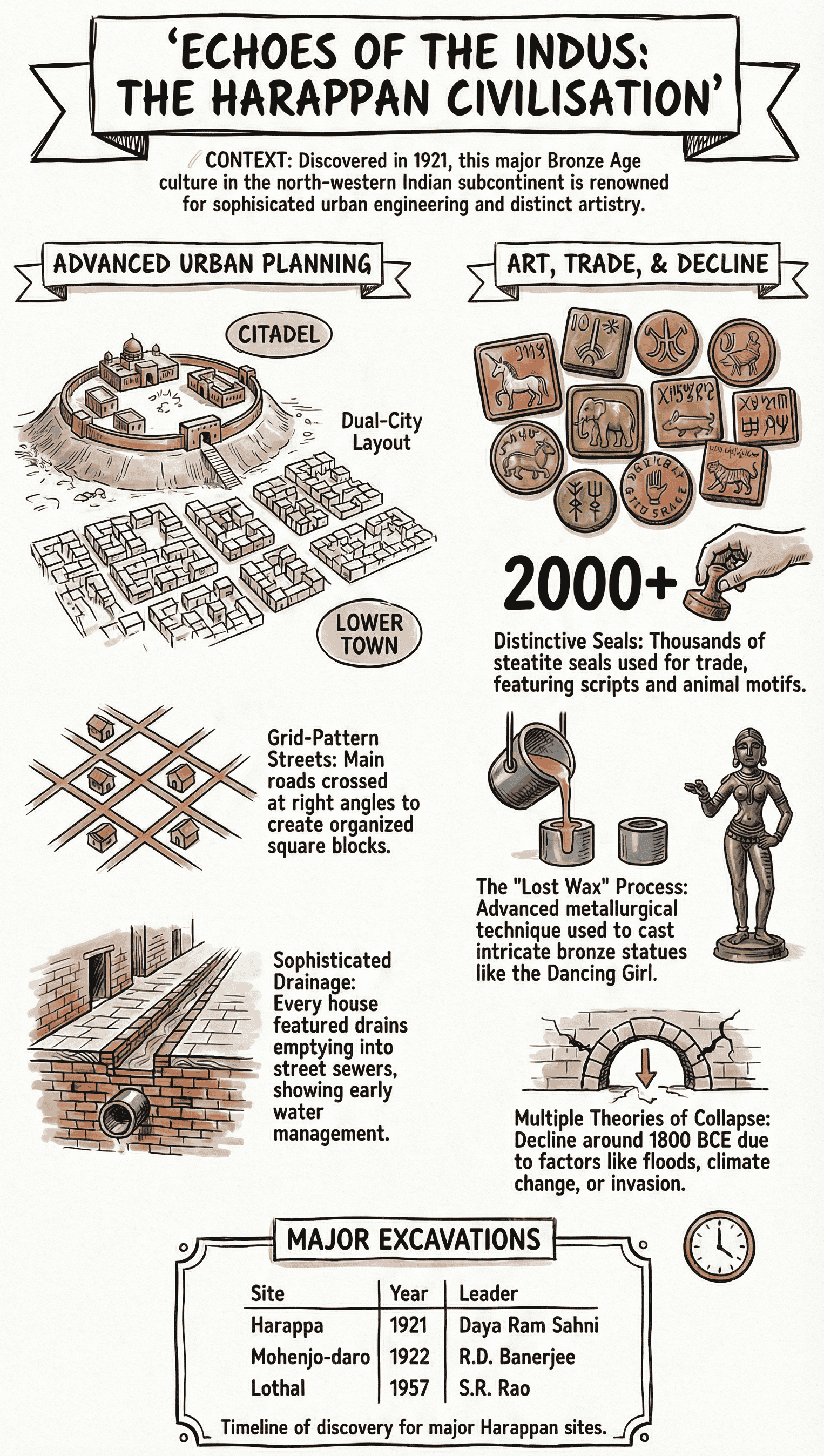
- Discovery: The Harappan Civilisation (also called the Indus Valley Civilisation) was discovered in 1921 at Harappa. This momentous discovery pushed the history of India back by at least a thousand years, placing it on par with ancient Egypt and Mesopotamia.
2. Major Archaeological Sources
Because the Harappan script remains undeciphered, knowledge of this civilisation is based entirely on archaeological remains.
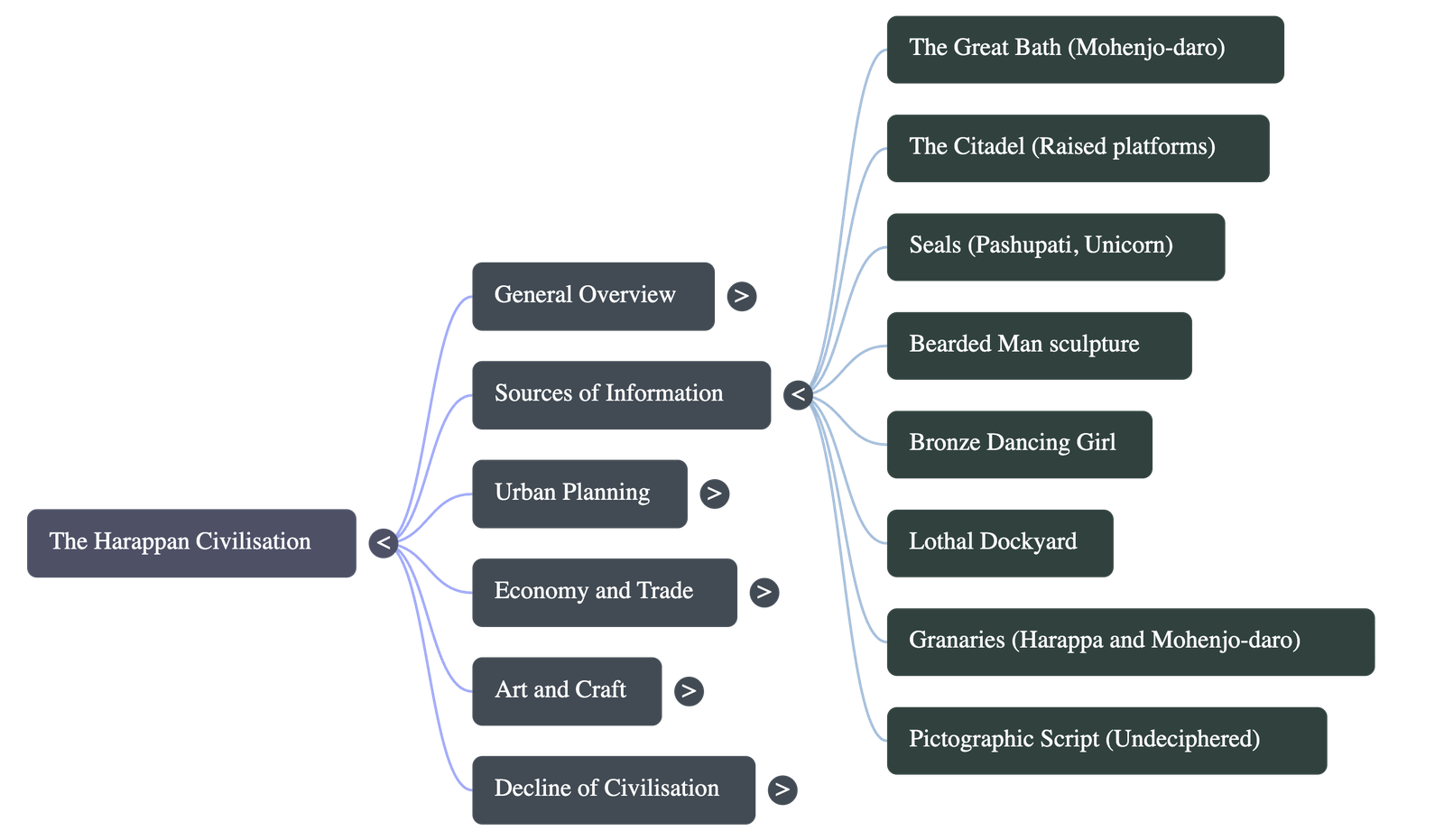
- The Great Bath: A massive watertight public tank found at Mohenjo-daro made of burnt bricks, bitumen, and gypsum. It features steps, corridors, and changing rooms, suggesting its use for religious or ritualistic ceremonial bathing.
- The Citadel: The raised, fortified area of the city built on mud-brick platforms. It housed the ruling class and important public buildings (like assembly halls and granaries), indicating elaborate urban planning and social classification.
- Seals: Over 2000 seals made of terracotta, steatite, and agate have been found. They feature animal motifs (like the Unicorn) and deities (like Pashupati/Shiva). They were primarily used by traders to stamp goods and sometimes worn as amulets.
- Sculptures:
- Bearded Man: A stone bust of a yogi or priest found at Mohenjo-daro, showcasing high artistic skill.
- Dancing Girl: A bronze masterpiece portraying a heavily bangled girl, showing advanced development in three-dimensional art.
- Dockyard (Lothal): The world's oldest known rectangular dockyard, built with baked bricks to withstand tidal flows. It proves the existence of overseas maritime trade and advanced hydraulic engineering.
- Granaries: Large storage structures with ventilation systems and threshing floors, built on raised platforms near rivers for easy transport of food grains.
- Script: A pictographic script with 375 to 400 signs. It was written from right to left, but remains undeciphered today.
3. Extent and Urban Planning
- Vast Extent: It was the largest ancient civilisation, covering approximately 1.3 million sq. km in a triangular shape, stretching from Baluchistan in the west to Western UP in the east, and from Jammu in the north to Gujarat/Narmada estuary in the south.
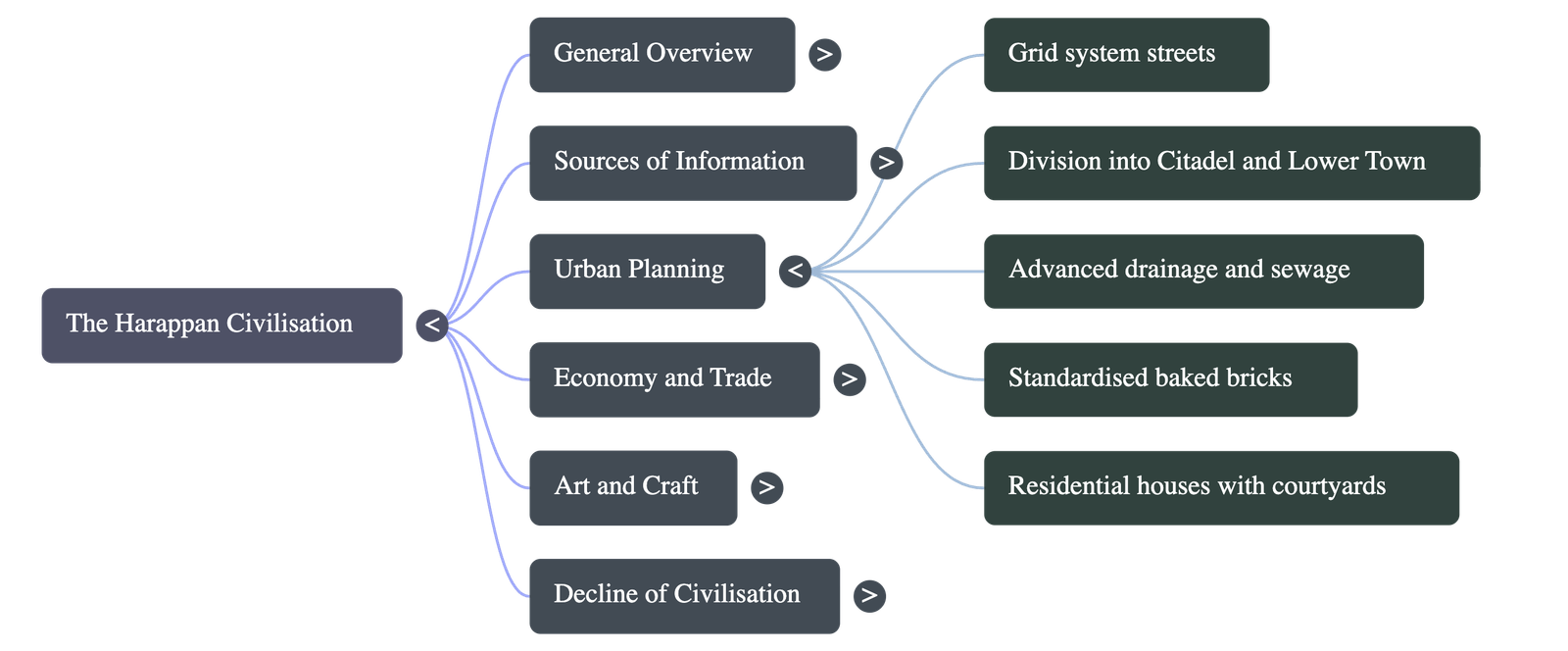
- Town Planning: Cities were strictly divided into two parts: the raised Citadel and the Lower Town (residential area).
- Grid Pattern: Unlike the circular patterns of Mesopotamia, Harappan streets followed a precise grid pattern. Main roads ran north-south or east-west, intersecting at right angles with rounded corners to allow carts to pass easily.
- Houses: Built on high mounds to protect against floods. They ranged from single rooms to twelve-room courtyard houses. Houses featured standardized baked bricks, private wells, and doors that opened into narrow side lanes, never onto the main roads.
- Sanitation: Exceptionally advanced indoor plumbing, covered street drains, and brick-lined sewage channels were common across major cities.
4. Economy, Trade, and Transport
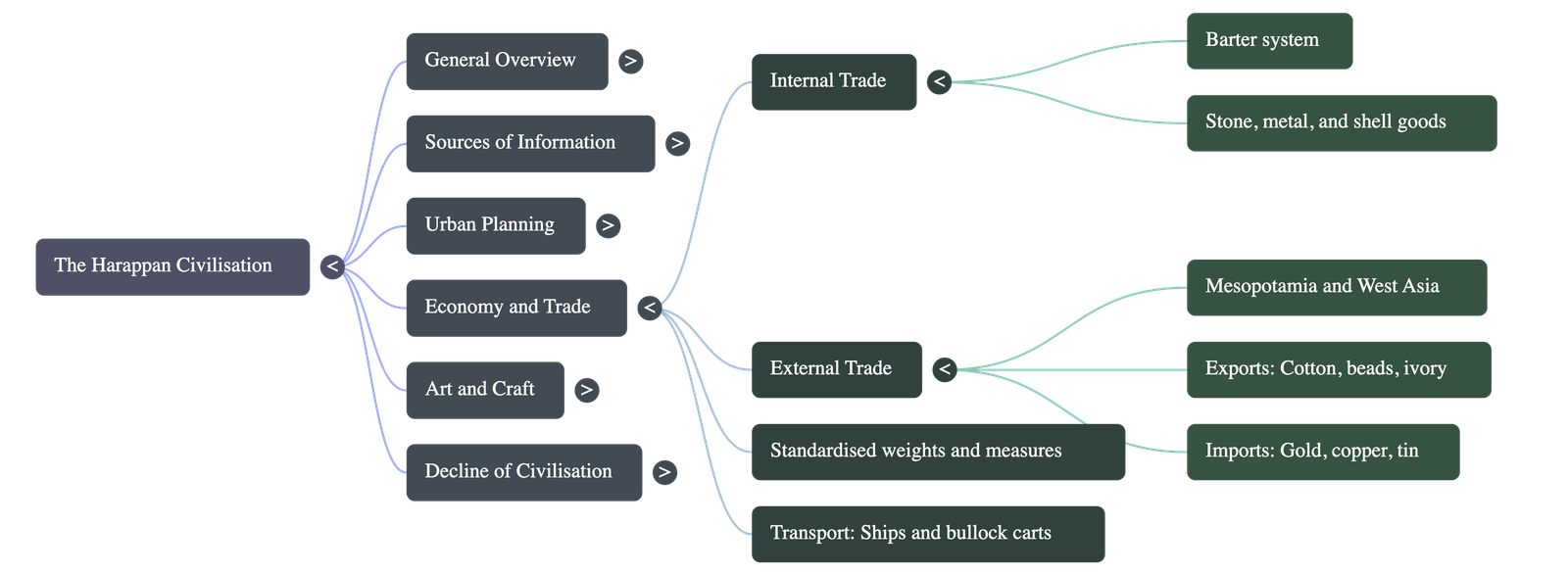
- Internal Trade: Extensive trade of stone, metal, and shell within the Indus zone. Exchanges were conducted through a barter system, as metallic money was not used.
- External Trade: Thriving commercial contacts with Mesopotamia and other West Asian regions. Mesopotamian records refer to the Indus region as Meluha (a land of seafarers). Trading outposts were even established in northern Afghanistan.
- Weights and Measures: A highly standardized system utilizing cubical stone weights. The basic unit of measurement was 16 (equivalent to 14 grams today).
- Transport: Use of boats and ships for river and sea transport. Inland travel was facilitated by bullock carts (ekka) driven by seated drivers.
5. Art, Craft, and Society
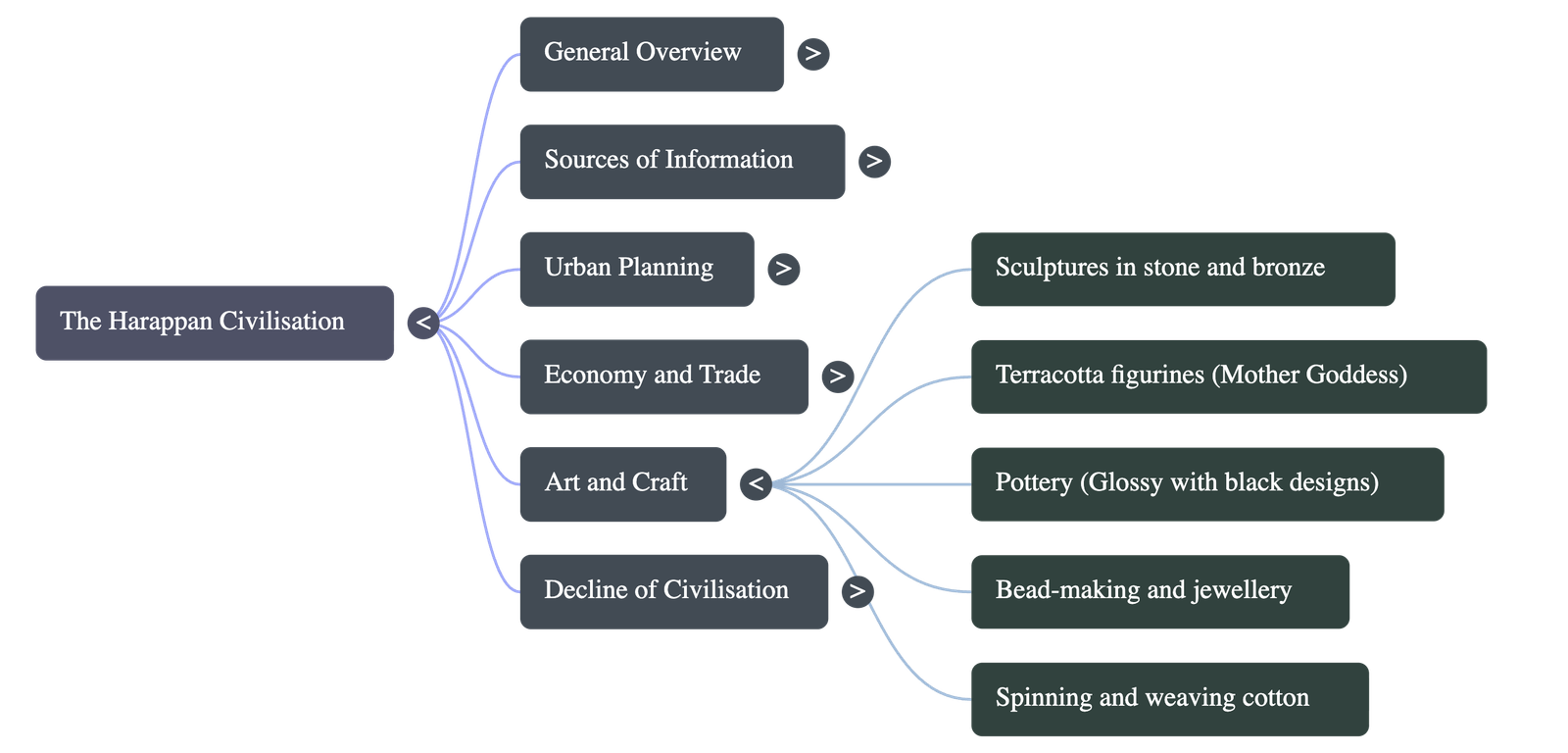
- Craftsmanship: Highly skilled in bead-making, seal-making, and boat-making. Bronze statues were crafted using the specialized lost wax process.
- Pottery: Produced glossy, shining earthenware decorated with distinctive black geometrical designs on a red background.
- Dress and Ornaments: People wore cotton dhotis, shawls, and cloaks, with evidence of stitched clothing. Both men and women wore elaborate jewelry made of gold, silver, ivory, and precious stones.
- Amusements: Entertainment included playing dice, hunting, fishing, and musical instruments like the drum and lyre. Children played with terracotta toys and whistles.
- Religious Beliefs: Worshipped Pashupati (an early form of Lord Shiva) and the Mother Goddess. They venerated sacred trees, animals, and employed amulets.
6. Decline and Heritage
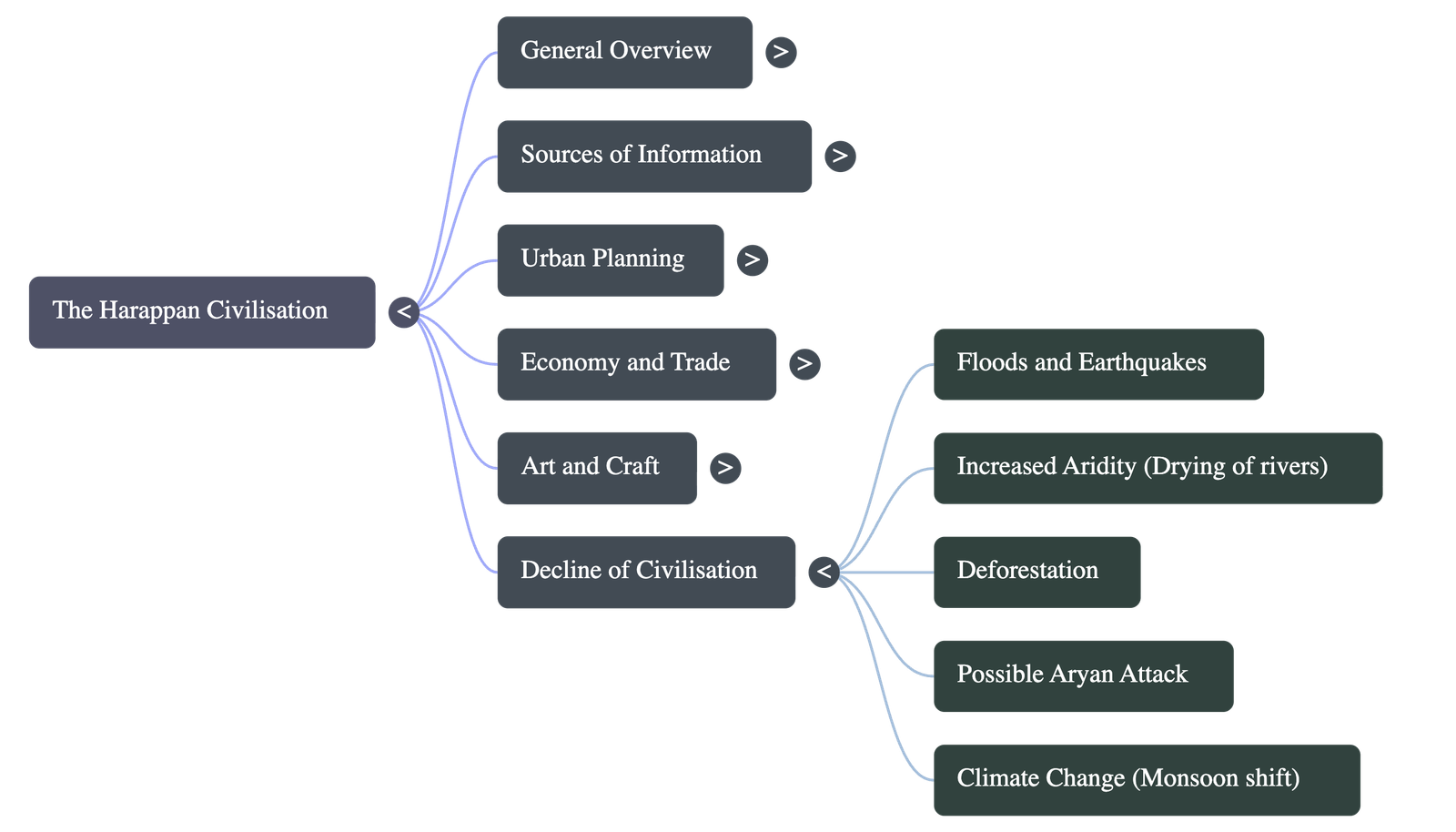
The civilisation began to decline around 1800 BCE. Historians suggest several potential causes:
- Floods and Earthquakes: Regular flooding of the Indus forced cities like Mohenjo-daro to be rebuilt multiple times. Earthquakes may have altered river courses.
- Increased Aridity & Climate Change: Tectonic shifts caused rivers like the Ghaggar to dry up. Recent studies indicate a shifting monsoon system led to prolonged droughts.
- Deforestation: Immense wood requirements for baking millions of bricks, smelting bronze, and making boats may have destroyed local ecologies.
- Attack: Some historians theorized that Aryan invasions destroyed the settlements, citing unburied skeletons found in the streets.
Legacy and Heritage:
The physical cities collapsed, but the culture did not entirely disappear. Their knowledge of baked bricks, bead-making, cotton cultivation, and deep-rooted religious practices (worship of Shiva and the Mother Goddess) were adopted by later civilisations and have continued in India to this day.
Do checkout all questions & answers of this chapter.
Quick Navigation:
| | | |
1 / 1
Quick Navigation:
| | | |