Quick Navigation:
| | | |
Medieval India (B) The Delhi Sultanate
Introduction & Background
- By the 10th and 11th centuries, North India was divided into numerous small, conflicting kingdoms without a powerful central government. This lack of unity allowed Turkish conquerors to easily win victories.
- The period from 1206 to 1526 is known as the period of the Delhi Sultanate.
- During this time, five different dynasties successively ruled from their capital at Delhi, and their rulers were called Sultans.
Historical Sources
- History of the Sultanate is reconstructed using official records, administrative manuals, biographies, chronicles, foreign travelers' accounts, and private correspondence.
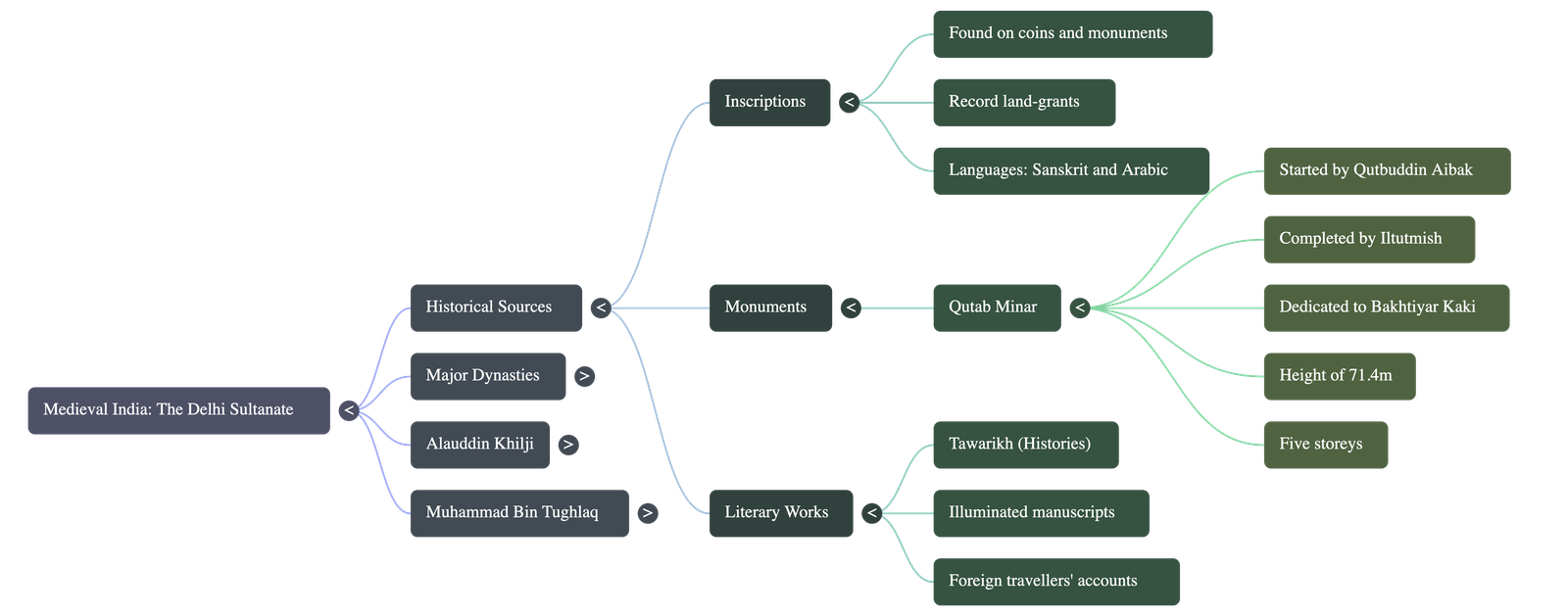
- Tawarikh ('Histories'): Written in Persian by learned men, these were often created as illuminated manuscripts decorated with gold and silver to highlight important words.
- Inscriptions: Found on coins, monuments, milestones, and tombstones. They record land grants, battles, and eulogies in Sanskrit, Arabic, or sometimes both.
Important Monuments: The Qutab Minar
Monuments built by the Sultans reveal cultural trends, socio-cultural outlooks, and living conditions of the time. The most significant is the Qutab Minar.
- Started by Qutbuddin Aibak and completed by Iltutmish. It was dedicated to the Sufi saint Qutbuddin Bakhtiyar Kaki.
- Originally completed with four storeys rising to 71.4 meters. After lightning damage in 1369, Feroz Shah Tughlaq repaired and raised its height, making it five storeys.
- It is a circular tower that tapers from a 13.8m diameter at the base to about 3m at the summit, featuring a circular stairway of 379 steps.
- Constructed using red sandstone, marble, and grey quartzite.
- Each storey is separated by projecting balconies cleverly designed to support the massive weight of the structure.
- Decorated with verses from the Holy Quran and intricate floral carvings.
The Dynasties of the Delhi Sultanate
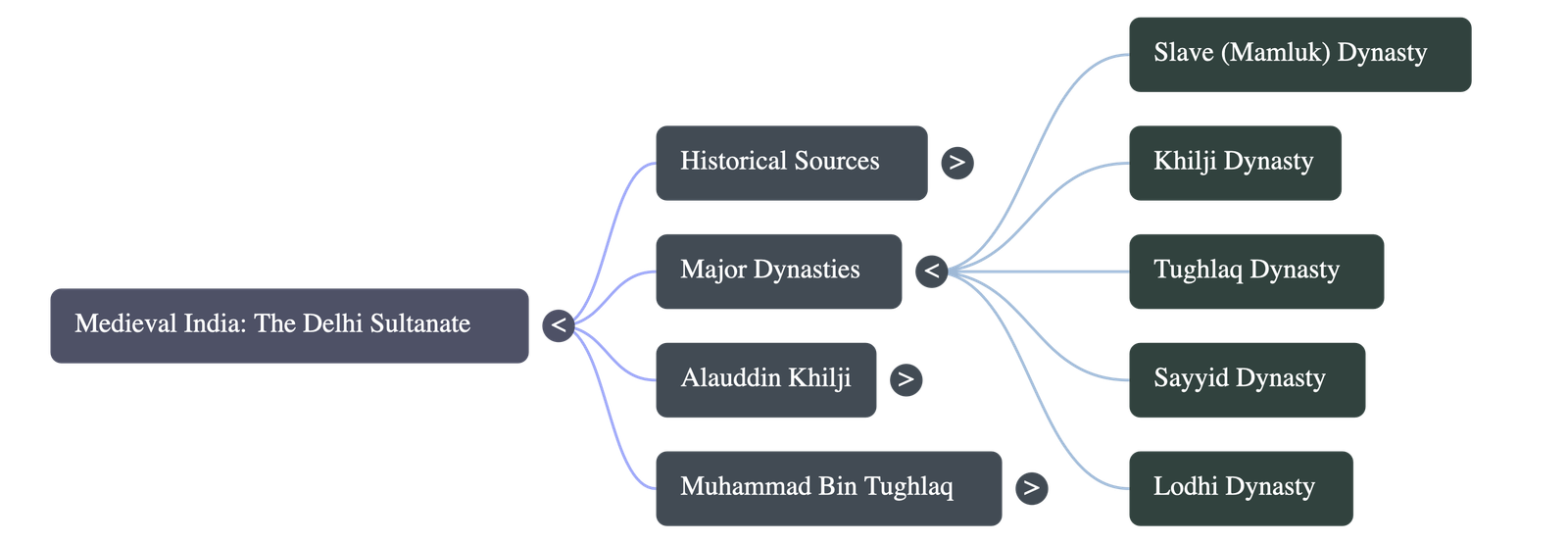
There were five successive ruling dynasties: the Slave, Khilji, Tughlaq, Sayyid, and Lodhi dynasties.
1. The Slave Dynasty
- Established after Muhammad Ghori defeated Prithviraj Chauhan at the Second Battle of Tarain in 1192.
- Ghori left his slave general, Qutbuddin Aibak, as viceroy, who became the founder of the Slave dynasty.
- Early rulers were called 'Mamluk' Sultans (an Arabic word meaning 'owned').
2. The Khilji Dynasty & Alauddin Khilji
- Founded by Jalaluddin Khilji in 1290, who was later murdered by his ambitious nephew, Alauddin Khilji.
- Alauddin had a strong army, crushed Mongol rebellions, and conquered most of northern India.
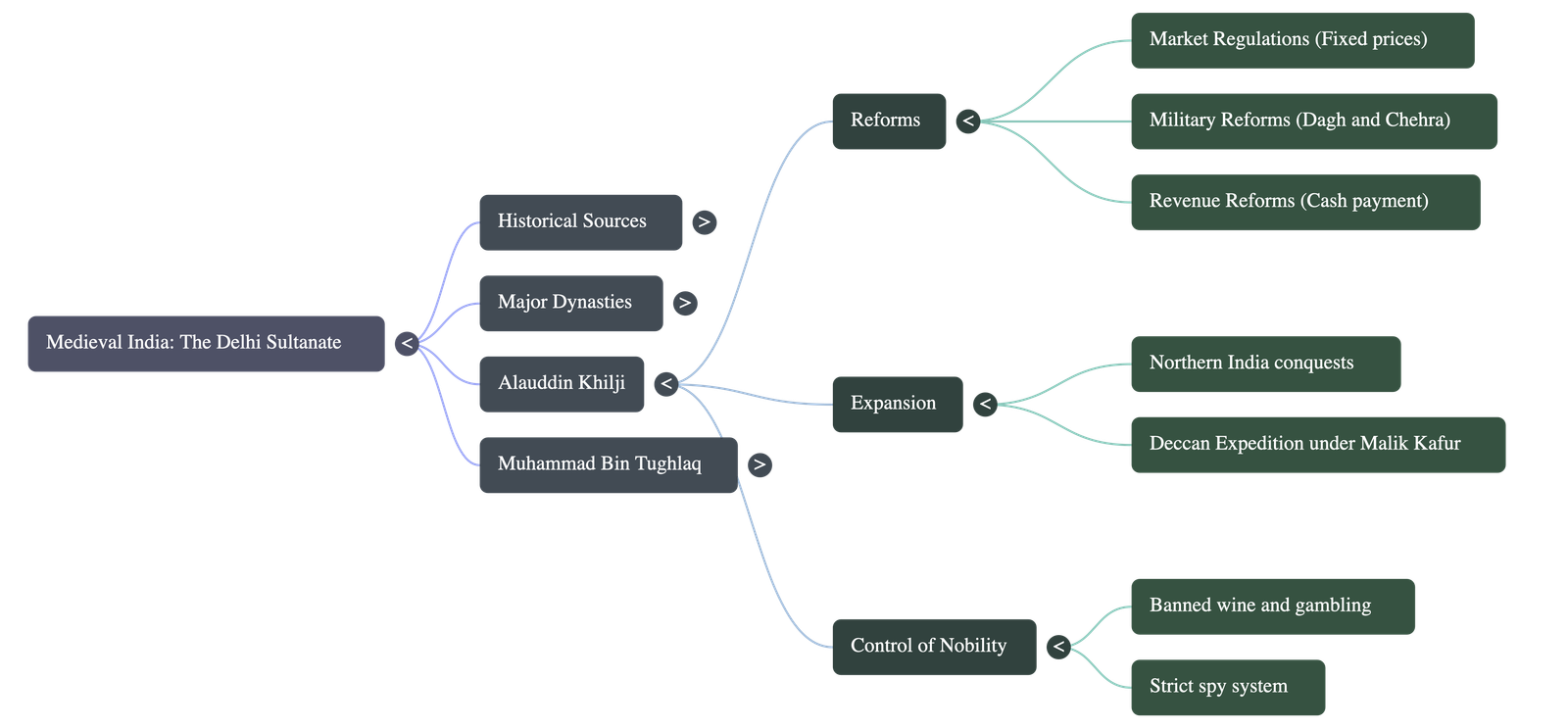
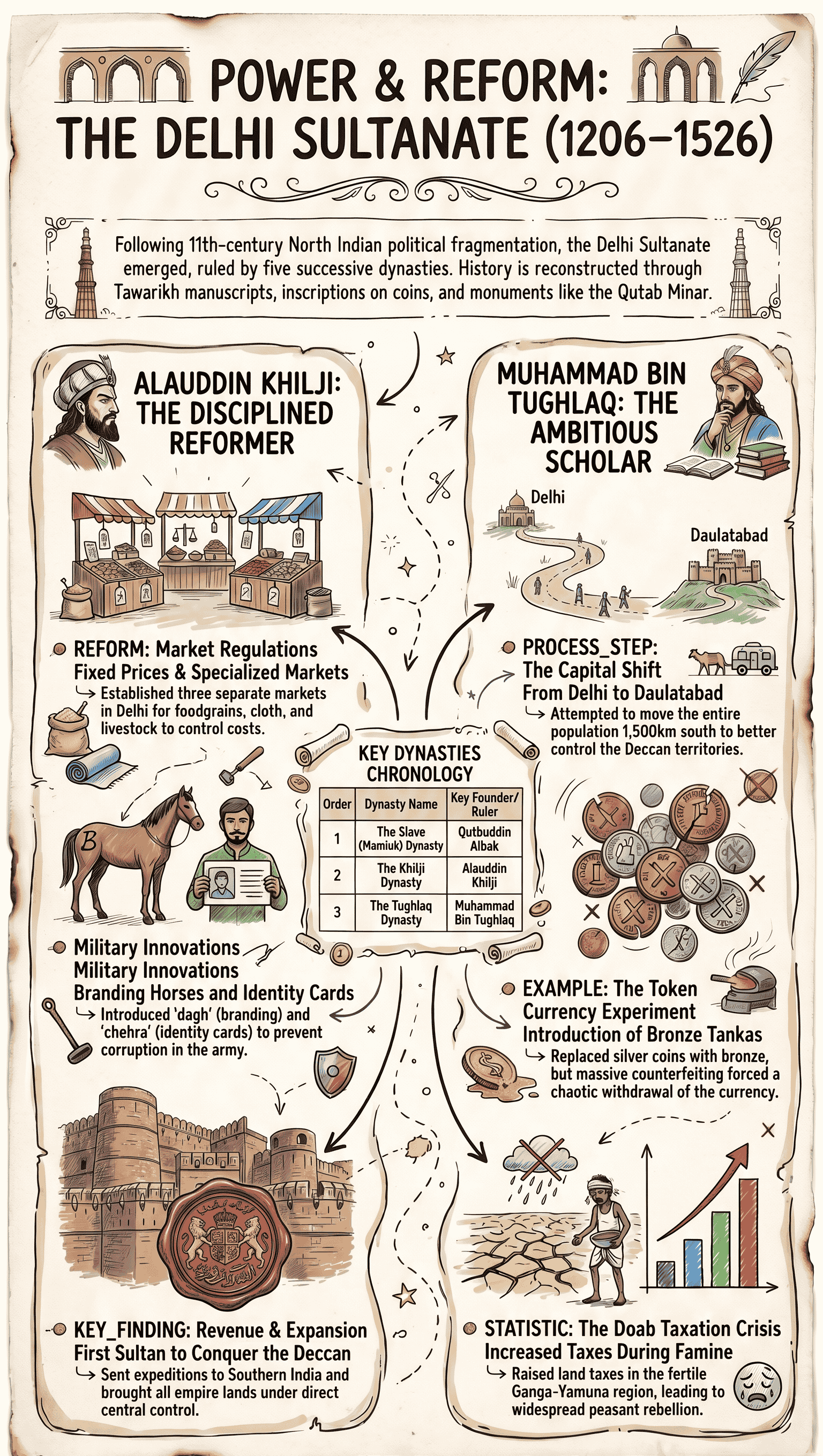
- Market Regulations: Alauddin fixed the cost of all commodities (food, cloth, cooking oil). He set up three specific markets in Delhi supervised by a market controller (shahna) and prescribed strict punishments for cheating.
- Deccan Expedition: Sent commander Malik Kafur to conquer kingdoms in the South (Deccan). He defeated them but did not annex the territories because they were too far to control. Instead, he forced them to pay annual tributes to maintain his massive army.
- Measures Against Nobility: To stop rebellions, Alauddin banned nobles from holding unapproved parties or forming marriage alliances. He banned wine, intoxicants, and gambling, and set up a highly efficient spy system.
- Military Reforms: First Delhi ruler to establish a permanent standing army paid in cash. He introduced horse branding (dagh) to stop the use of inferior horses and identity cards (chehra) for soldiers.
- Revenue Reforms: Brought empire land under direct control, strictly measured land to fix the state's share at 50%, and demanded taxes be paid in cash.
3. The Tughlaq Dynasty & Muhammad Bin Tughlaq
- Founded by Ghazi Malik (Ghiyas-ud-din Tughlaq) in 1320. His son, Jauna Khan, ascended the throne as Muhammad Bin Tughlaq.
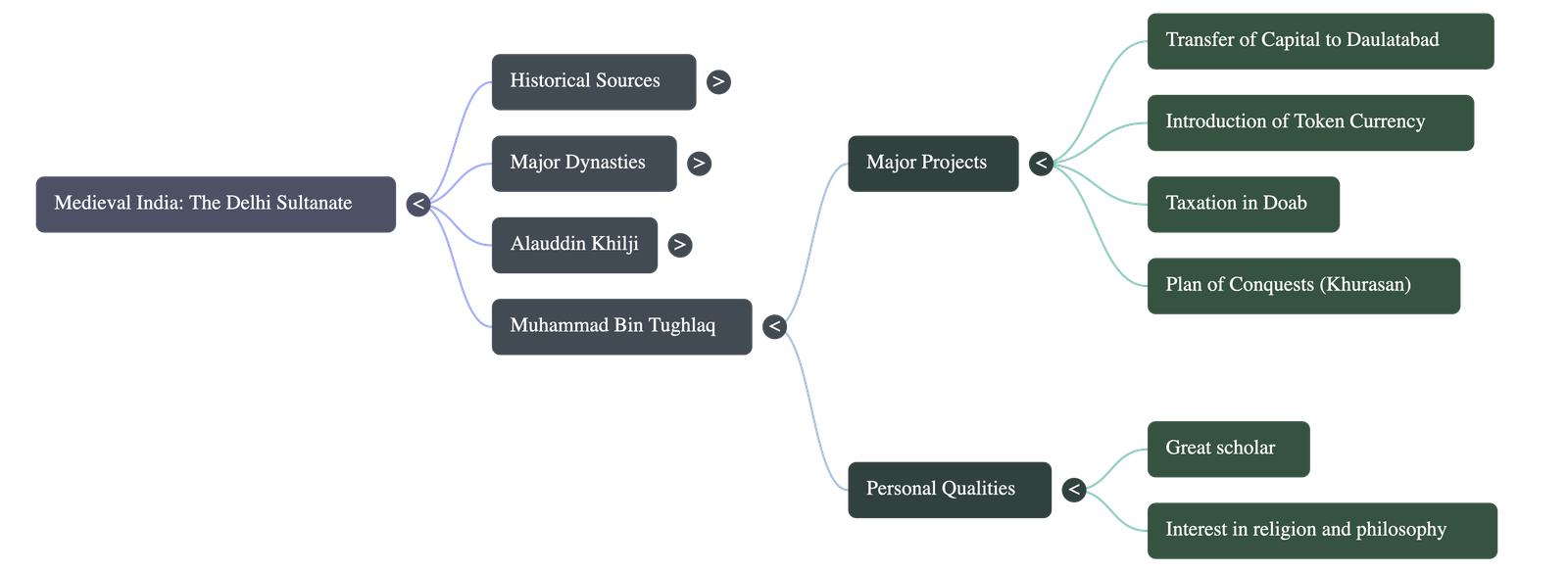
- Muhammad Bin Tughlaq was a brilliant scholar of religion, philosophy, mathematics, astronomy, and Persian literature, but is known for several controversial and failed administrative experiments.
- Transfer of Capital: Shifted the capital from Delhi to Devagiri (renamed Daulatabad) because it was centrally located, away from Mongol threats, and to escape a severe famine in Delhi. The forced migration caused immense suffering, and he eventually had to abandon the idea and move back to Delhi.
- Token Currency: Due to a shortage of silver, he introduced bronze "token currency" in place of silver coins. The experiment failed completely because people started making large-scale counterfeit coins at home, causing massive economic chaos. He had to withdraw the currency.
- Taxation in Doab: Increased land taxes in the fertile Ganga-Yamuna Doab region to fund his army. This happened during a terrible famine, causing peasants to rebel, abandon their lands, and flee to jungles. His later efforts to provide relief came too late to save people from starvation.
- Plan of Conquests: Dreamt of conquering the world, including regions like Khurasan, Persia, and Iraq. He gathered a huge army and paid them a full year's salary in advance. After a year, the project failed, forcing him to abandon the idea and disband his army.
Do checkout all questions & answers of this chapter.
Quick Navigation:
| | | |
1 / 1
Quick Navigation:
| | | |