Quick Navigation:
| | | |
Medieval India (C) The Mughal Empire
1. Background
- On the eve of Babur’s invasion in 1526, India lacked a powerful central authority and was ruled by breakaway kingdoms of the Delhi Sultanate.
- States like Bengal, Gujarat, Malwa, and Mewar were independent and constantly fighting, leading to insecurity until the Mughals established control.
2. Main Sources of Information
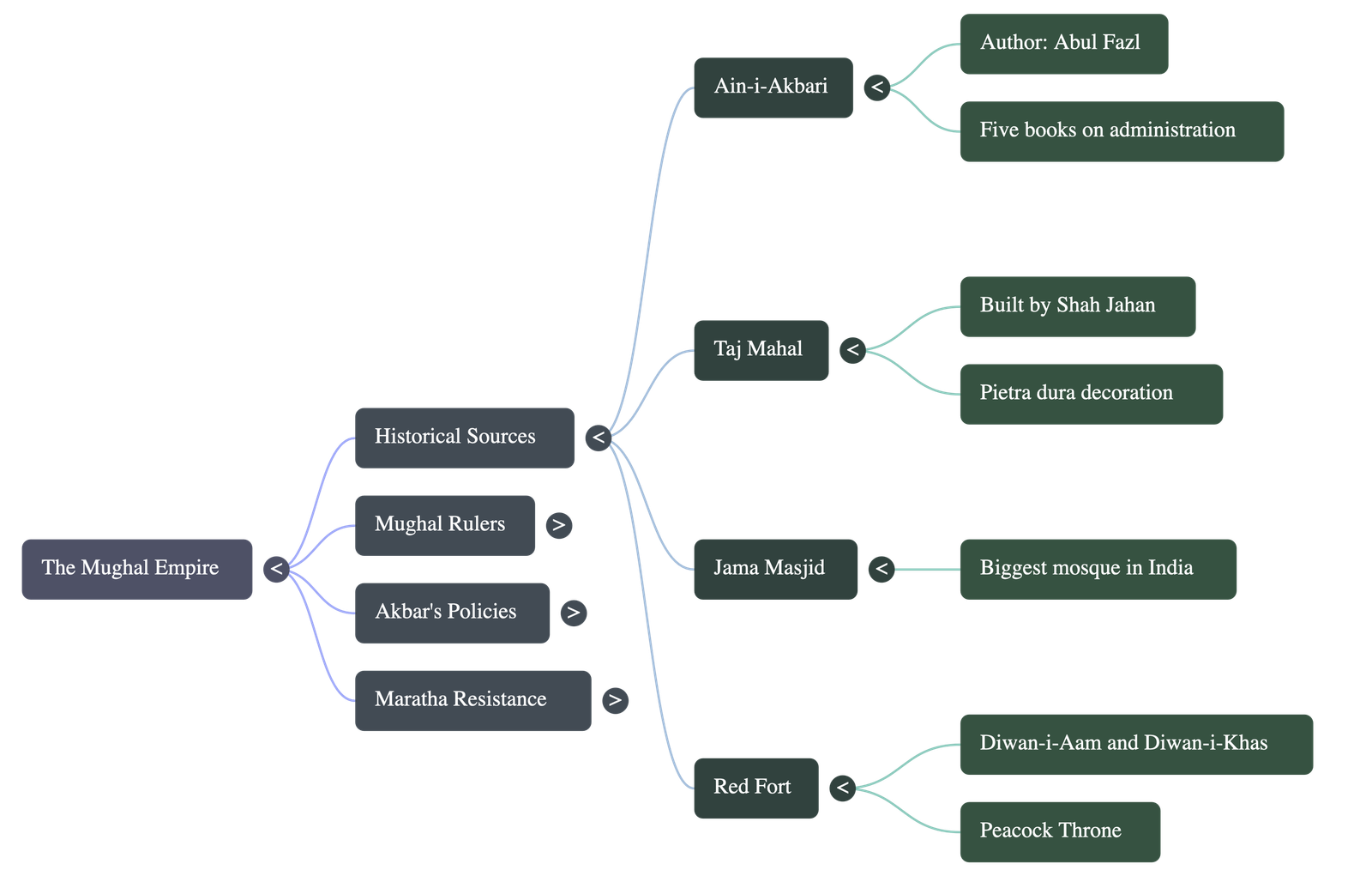
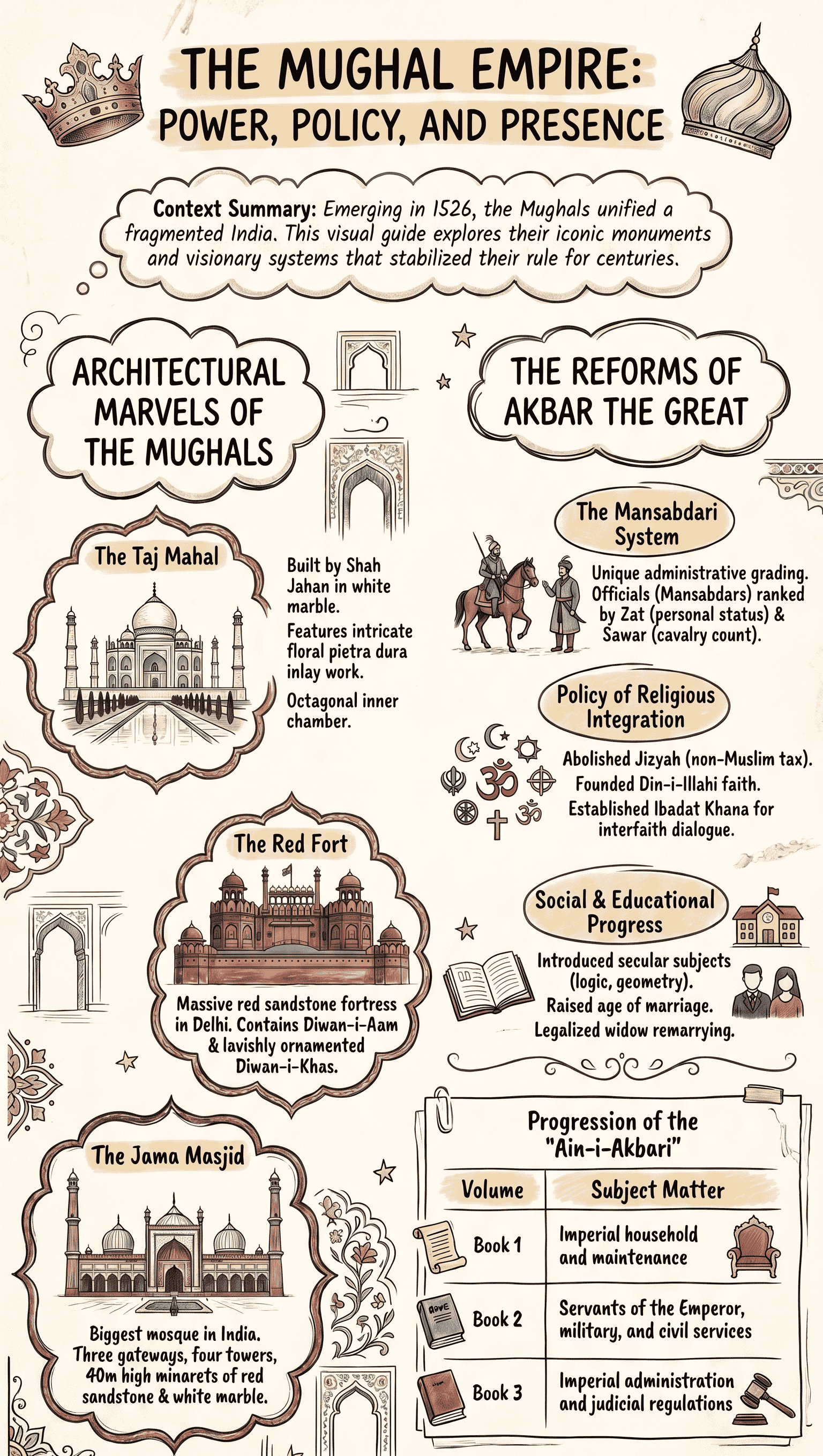
- Ain-i-Akbari: Written by Abul Fazl (one of Akbar's nine jewels). It is divided into five books covering the imperial household, military and civil services, administration and regulations, Hindu philosophy and customs, and the wise sayings of Akbar.
- The Taj Mahal: Built by Shah Jahan in Agra on the banks of the River Yamuna in memory of his wife Mumtaz Mahal. Made of pure white marble, it features an octagonal chamber, an inverted lotus-shaped dome, and floral decorations made of semi-precious stones (a method called pietra dura).
- The Jama Masjid: Built by Shah Jahan, it is the biggest mosque in India. Constructed with red sandstone and white marble, it has a massive courtyard, three gateways, four towers, and two high minarets.
- The Red Fort: Built by Shah Jahan in Delhi using red sandstone and marble. Key structures inside include the Diwan-i-Aam, Diwan-i-Khas (where the Peacock Throne was placed), and the Moti Masjid (added later by Aurangzeb).
3. Mughal Rulers & Consolidation
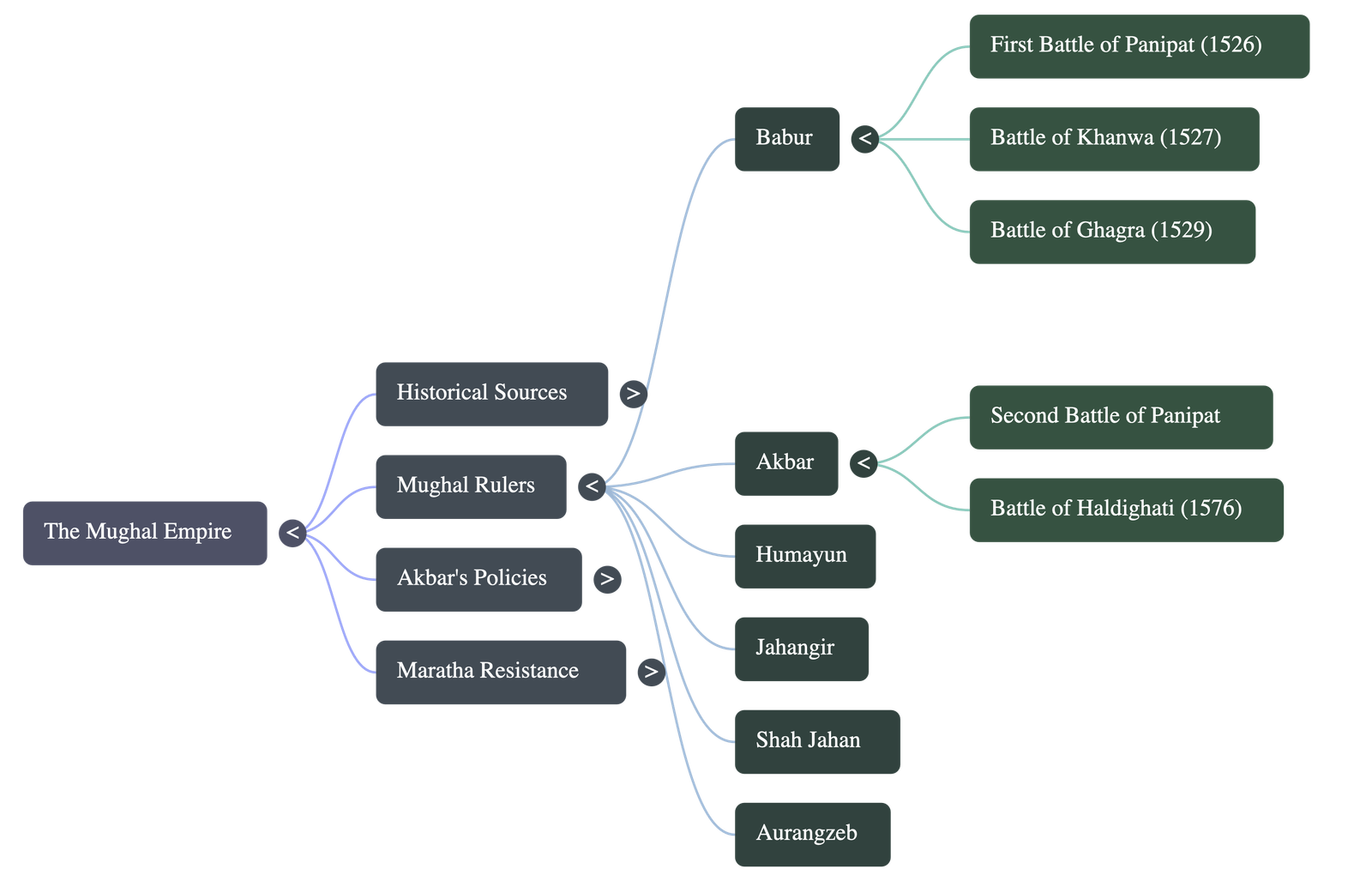
Babur
- Descendant of the Mongol ruler Timur, Babur established himself at Kabul before turning to India.
- He was invited by Daulat Khan Lodhi to oust Ibrahim Lodhi.
- First Battle of Panipat (1526): Babur defeated Ibrahim Lodhi and occupied Delhi and Agra.
- Battle of Khanwa (1527): Fiercely fought against Rana Sanga; Babur secured his position in the Delhi-Agra region.
- Battle of Ghagra (1529): Defeated combined Afghan and Bengal forces but died in 1530 before stabilizing the empire.
Akbar
- Ascended the throne at age thirteen, guided by his tutor, Bairam Khan.
- Second Battle of Panipat: Bairam Khan defeated Hemu, establishing Mughal authority in Delhi and Agra.
- Battle of Haldighati (1576): Fought between the Mughal army (led by Raja Man Singh) and Maharana Pratap of Mewar, who fought with matchless courage.
- By his death in 1605, Akbar’s empire stretched from Assam to Kabul, and Kashmir to the Deccan.
4. Akbar’s Policies and Reforms
Rajput Policy
- Entered into marriage alliances with Rajputs (e.g., married Harkha Bai, daughter of Bhara Mal).
- Gave full religious freedom to his Hindu wives and honoured their relatives with high nobility ranks, fostering a composite culture and ending centuries-old animosity.
Steps Towards Integration
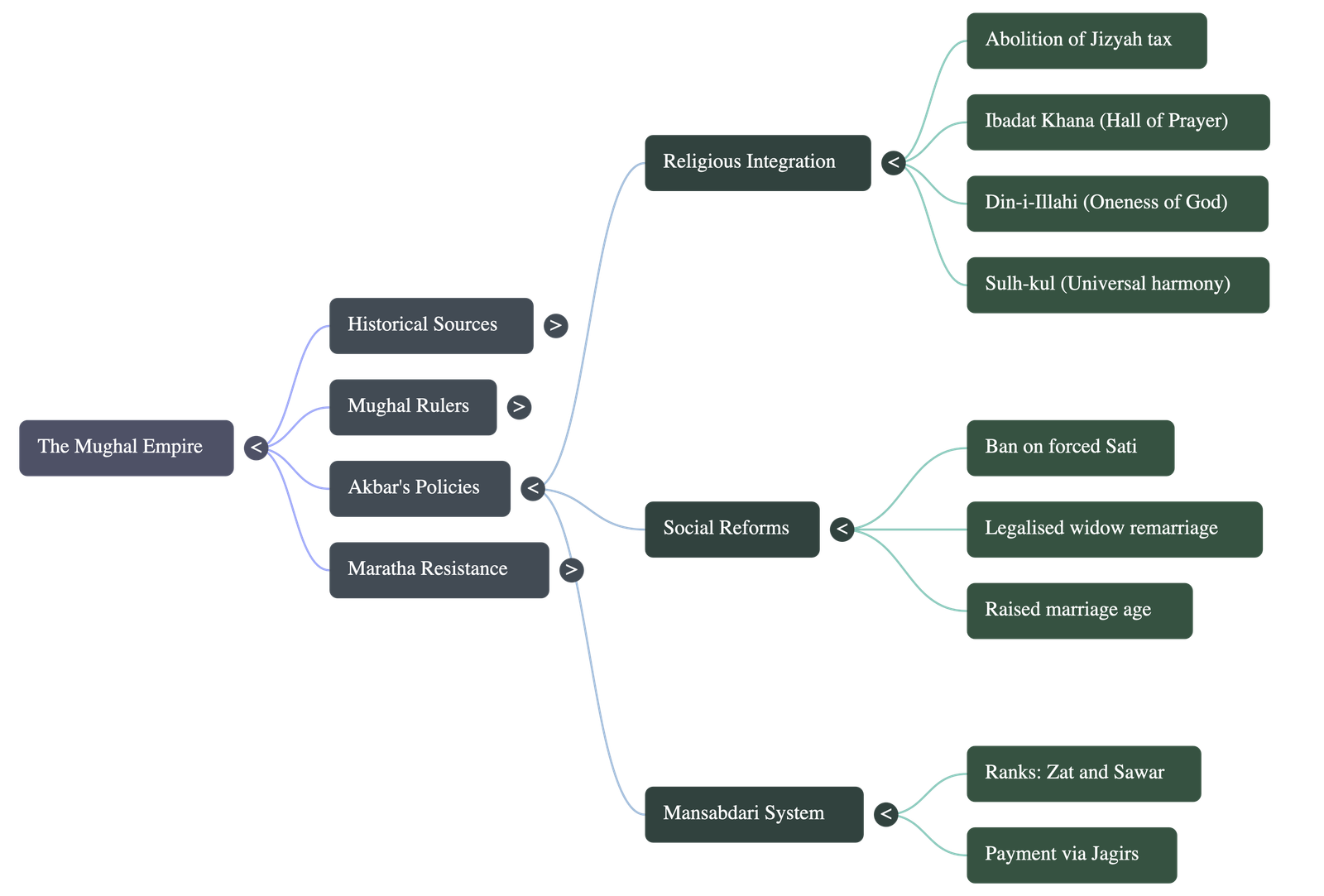
- Abolished the poll tax (jizyah) on non-Muslims and the pilgrim tax.
- Built the Ibadat Khana (Hall of Prayer) in 1575 at Fatehpur Sikri to discuss spiritual matters with scholars of all religions.
- Issued a 'Declaration' (Mahzar), making himself the supreme arbiter in religious matters.
- Promulgated a new faith, Din-i-Illahi, based on the oneness of God and universal harmony (Sulh-kul).
- Set up a translation department to translate works like the Mahabharata, Ramayana, and Bible into Persian.
Social and Educational Reforms
- Attempted to stop the forcible practice of Sati and legalized widow remarriage.
- Raised the marriage age to 14 for girls and 16 for boys.
- Discouraged polygamy.
- Revised the educational syllabus to include secular subjects like agriculture, mathematics, geometry, astronomy, and history.
5. The Mansabdari System
- A unique grading system introduced by Akbar for the administrative and military bureaucracy.
- Every officer was given a rank or position called a mansab.
- Ranks were divided into two numbers: Zat (determined personal status and salary) and Sawar (determined the number of cavalrymen the official had to maintain).
- Mansabdars received their salaries as revenue assignments called jagirs, which were collected by their servants.
6. Chhatrapati Shivaji Maharaj
- Born in 1630 to Shahaji Bhonsle and Jijabai; his mother’s teachings instilled pride and a sense of responsibility in him.
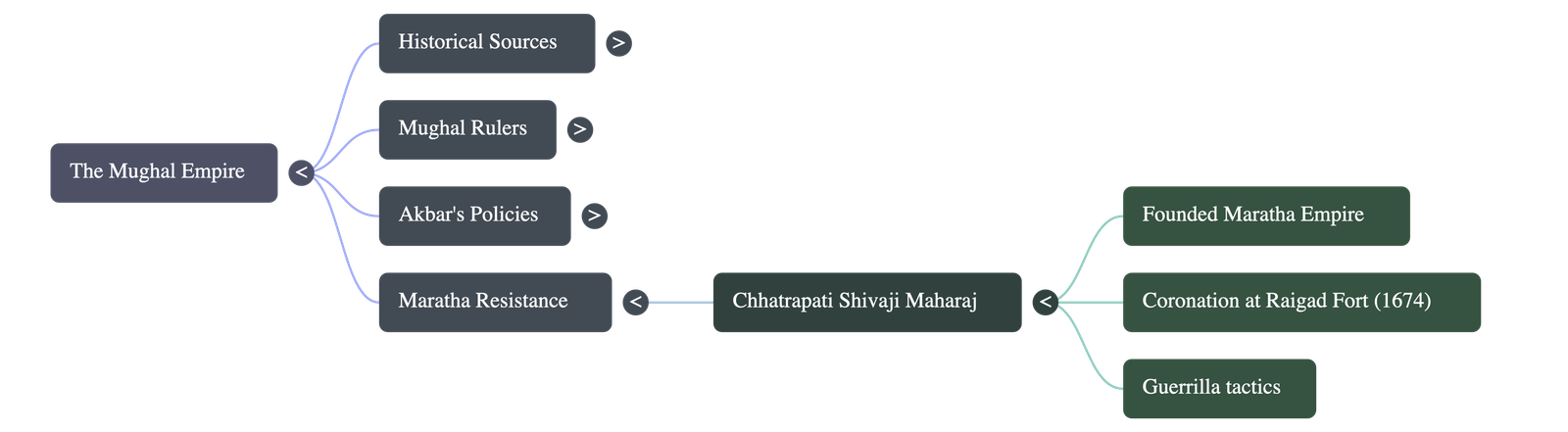
- Laid the foundation of the Maratha Empire in western India, striving for Swarajya (self-governance).
- Captured his first fort, Torna, at the age of 16.
- Defeated Afzal Khan (a general of the Sultan of Bijapur) in 1659.
- Was in constant conflict with the Mughal Empire; his daring escape from Aurangzeb's prison in Agra (1666) showcased his ingenuity.
- Coronation: Crowned as Chhatrapati on June 6, 1674, at Raigad fort, marking the formal establishment of a sovereign Maratha Empire.
- Administration: Known for progressive policies, a disciplined military, robust naval force to safeguard coastlines, efficient revenue reforms, and strict religious tolerance ensuring justice for all.
Do checkout all questions & answers of this chapter.
Quick Navigation:
| | | |
1 / 1
Quick Navigation:
| | | |