Quick Navigation:
| | | |
Civics 5: The State Legislatures
1. Introduction to State Legislatures
- India consists of 28 States and 8 Union Territories.
- Each State has its own law-making body known as the State Legislature, which comprises the Governor and the Legislative Assembly.
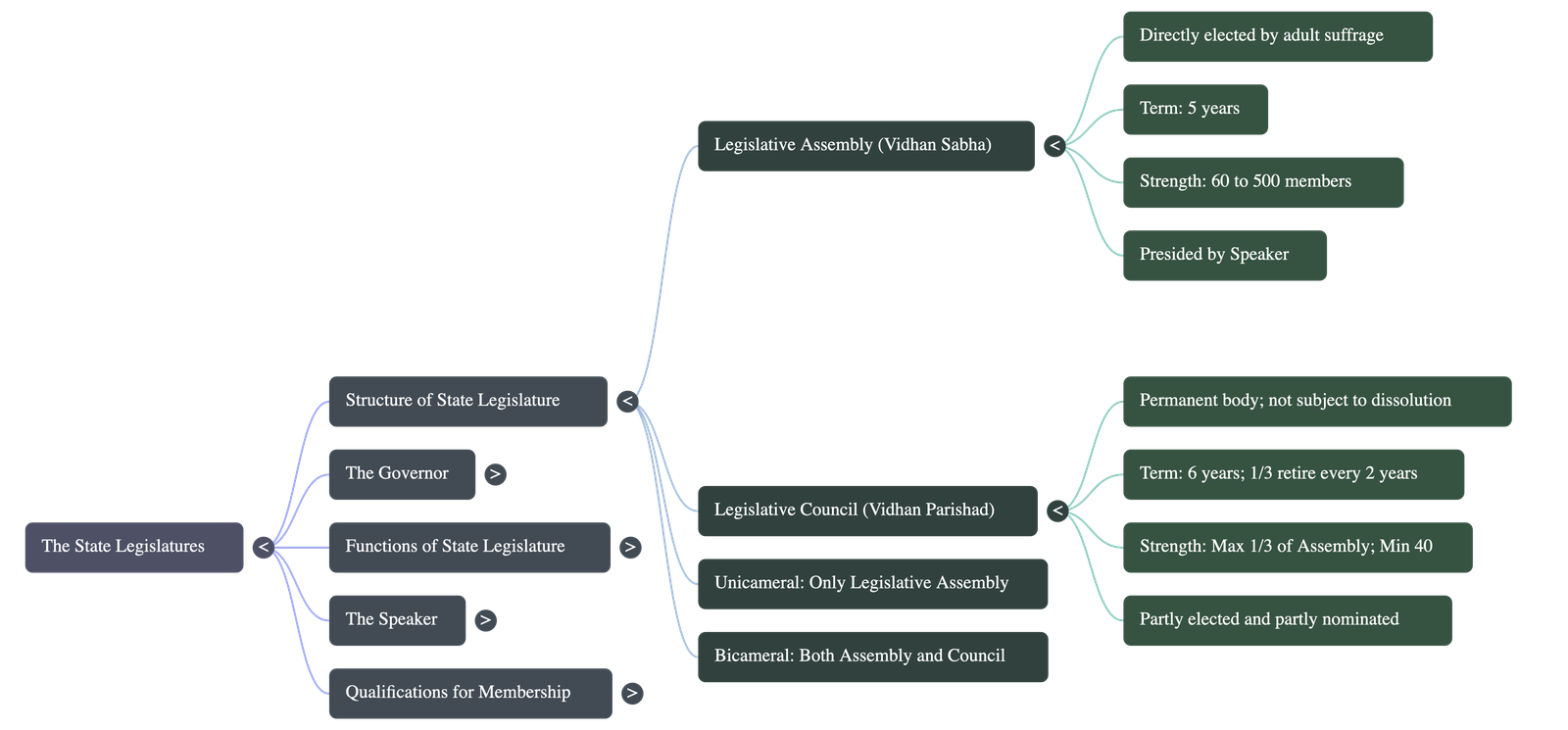
- Unicameral Legislature: A state with only one house, the Legislative Assembly (Vidhan Sabha).
- Bicameral Legislature: A state with two houses, the Legislative Assembly (Vidhan Sabha) and the Legislative Council (Vidhan Parishad).
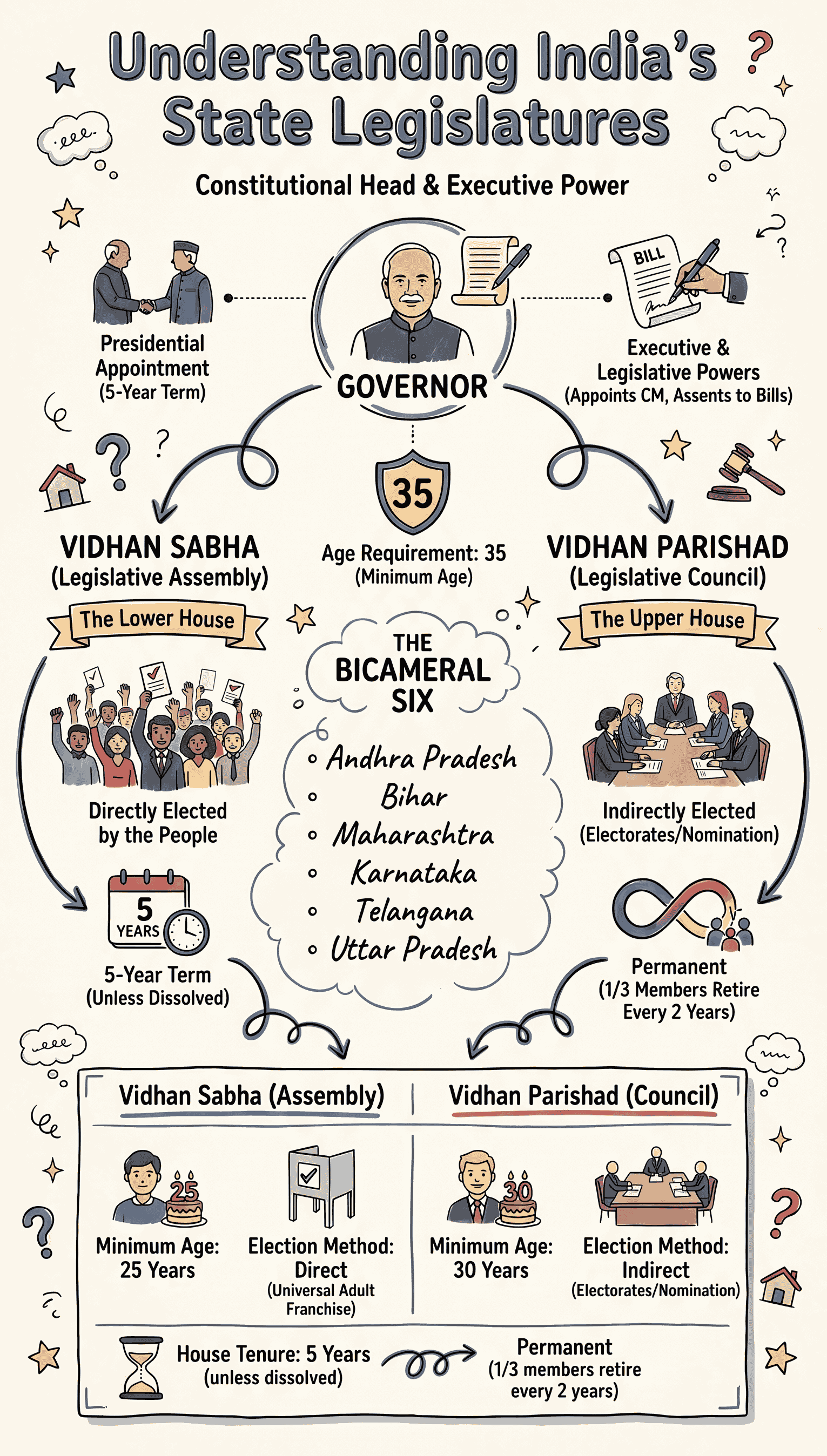
- Only six states in India have a bicameral legislature: Andhra Pradesh, Bihar, Maharashtra, Karnataka, Telangana, and Uttar Pradesh.
- The Legislative Assembly can pass a resolution (by special majority) to create or abolish a Legislative Council, which is then followed by an Act of Parliament.
2. The Governor of a State
The Governor is the constitutional head of the State, while real powers are exercised by the Chief Minister and the Council of Ministers.
- Appointment & Term: Appointed by the President of India on the advice of the Union Government. The standard term is 5 years.
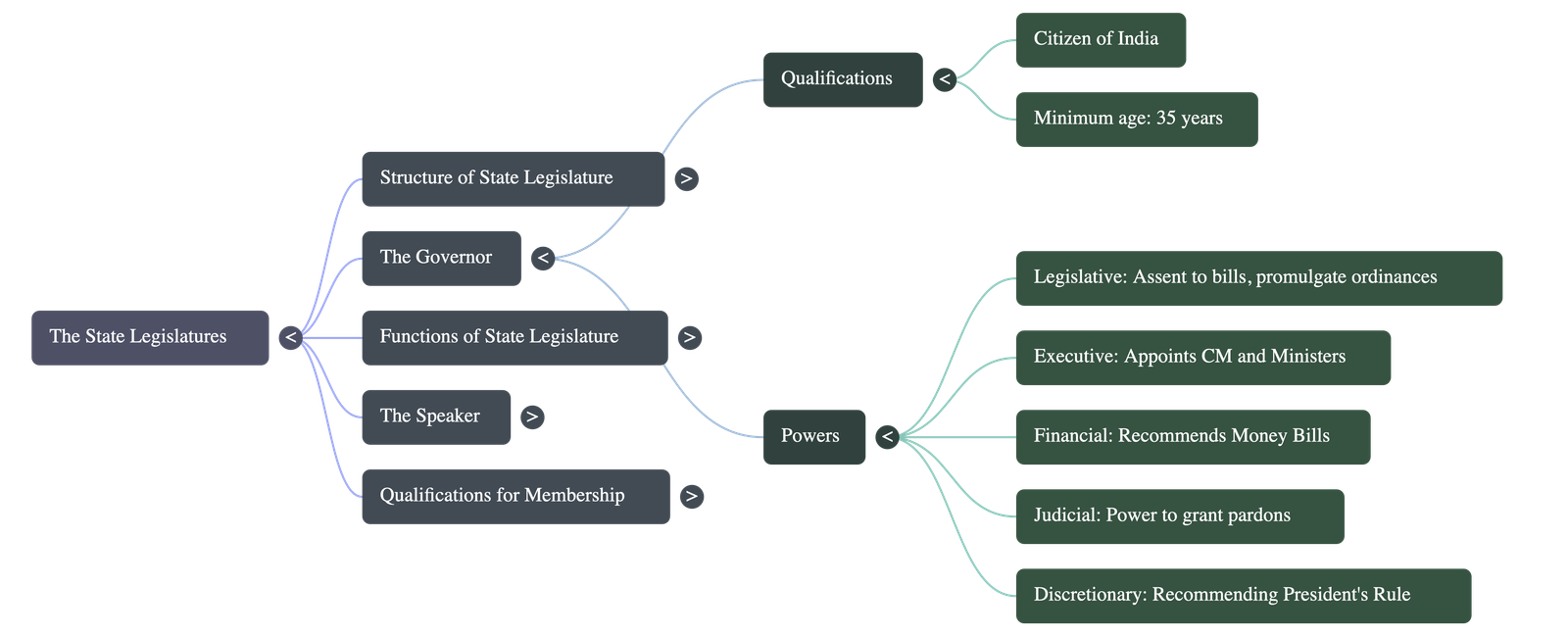
- Qualifications: Must be a citizen of India, at least 35 years old, not hold any office of profit, and not be a member of Parliament or State Legislature.
- Key Powers:
- Legislative: Summons sessions, addresses the legislature, gives assent to bills, and can issue ordinances when the legislature is not in session.
- Executive: Appoints the Chief Minister, other ministers, and high-ranking officials like the Advocate General and members of the State Public Service Commission.
- Financial: Recommends Money Bills, ensures the State Budget is laid before the legislature, and controls the State Contingency Fund.
- Judicial: Has the power to grant pardons and is consulted by the President when appointing High Court judges.
- Discretionary & Emergency: Can reserve bills for the President, decide the Chief Minister if no party has a clear majority, and recommend President's Rule if constitutional machinery breaks down.
3. Legislative Assembly (Vidhan Sabha)
This is the lower house, consisting of directly elected representatives.
- Composition: Maximum 500 members, minimum 60 members (exceptions exist for smaller states like Goa, Mizoram, and Sikkim). Elected through Universal Adult Franchise.
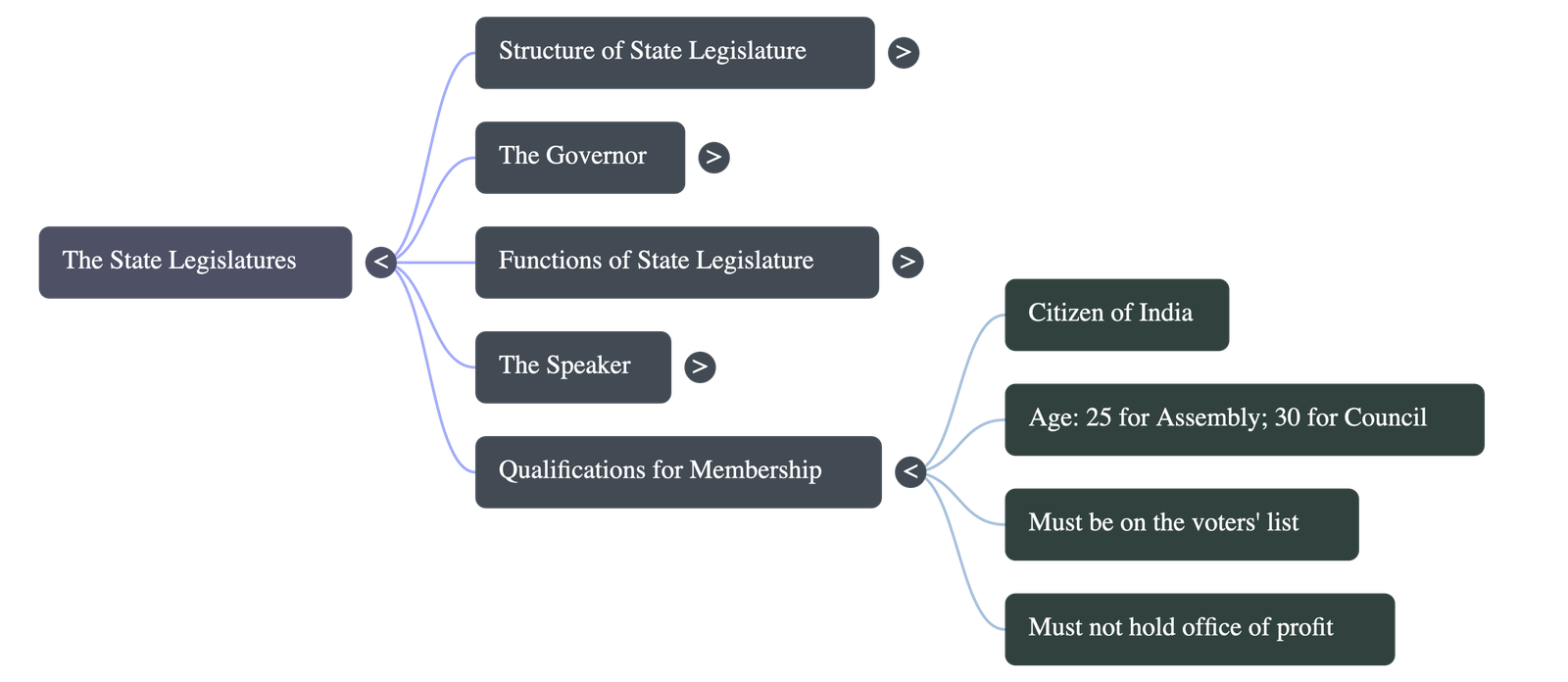
- Qualifications for Membership: Must be an Indian citizen, at least 25 years old, registered as a voter, of sound mind, and not an insolvent.
- Term: The normal term is 5 years. It can be dissolved earlier by the Governor or extended during an Emergency (up to one year at a time).
- Powers & Functions:
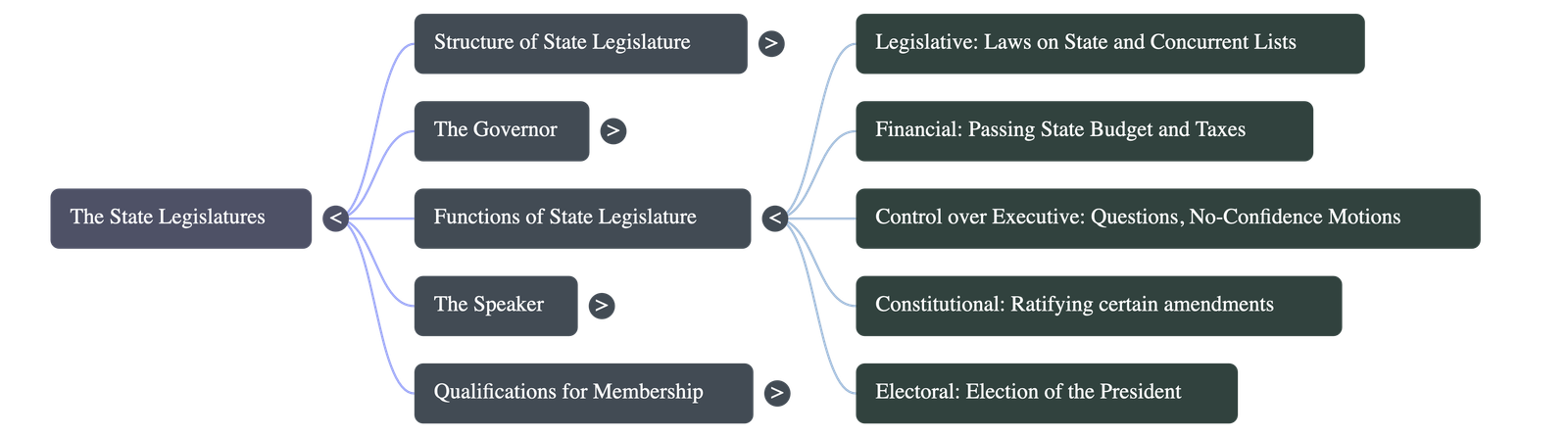
- Legislative: Makes laws on the State List and Concurrent List.
- Financial: Passes the State Budget and permits taxation. Money Bills can only originate here.
- Control over Executive: The Council of Ministers is collectively responsible to the Assembly. The Assembly exercises control through questions, adjournment motions, and No-Confidence motions.
- Constitutional & Electoral: Ratifies specific constitutional amendments and takes part in electing the President of India.
4. The Speaker of the Assembly
- Elected by the members of the Legislative Assembly from among themselves.
- Functions:
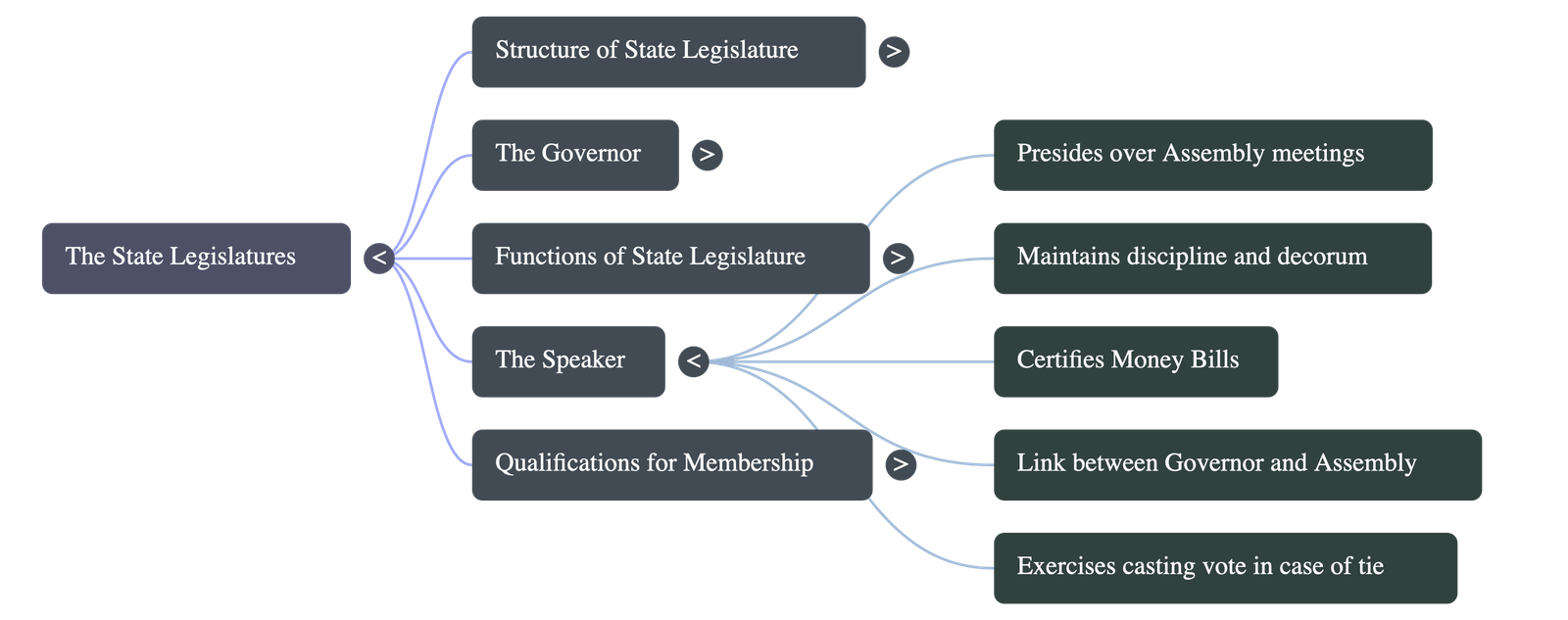
- Presides over meetings and maintains discipline and decorum in the House.
- Acts as a link between the Assembly and the Governor.
- Regulates proceedings, admits questions, and decides the agenda.
- Certifies whether a particular bill is a Money Bill.
- Takes disciplinary action and decides cases under the Anti-defection Law.
- If the Speaker is absent, the Deputy Speaker performs these duties.
5. State Legislative Council (Vidhan Parishad)
This is the upper, optional house of the state legislature.
- Composition: Maximum strength is one-third of the total members in the State's Legislative Assembly, and minimum is 40.
- Election Breakdown:
- 1/3 elected by local bodies (municipalities, district boards).
- 1/3 elected by members of the Legislative Assembly (MLAs).
- 1/12 elected by teachers (with at least 3 years standing).
- 1/12 elected by university graduates (with at least 3 years standing).
- 1/6 nominated by the Governor (experts in literature, science, art, social service).
- Qualifications: Same as the Assembly, but the minimum age is 30 years.
- Term: It is a Permanent House and cannot be dissolved. Each member serves a 6-year term, with one-third retiring every two years.
- Powers & Position: Much weaker than the Assembly. It only exercises formal control over the Executive. It can initiate ordinary bills, but can only delay a bill passed by the Assembly (for a maximum of 4 months in total). Money Bills cannot be introduced here; it can only delay a Money Bill by a maximum of 14 days.
Key Differences Between Unicameral and Bicameral: In a unicameral system, the Assembly is the only house and can be dissolved. In a bicameral system, the Council exists as a permanent body to prevent hasty legislation, though its existence depends entirely on the will of the Assembly.
Do checkout all questions & answers of this chapter.
Quick Navigation:
| | | |
1 / 1
Quick Navigation:
| | | |