Quick Navigation:
| | |
Pair of Linear Equations in Two Variables
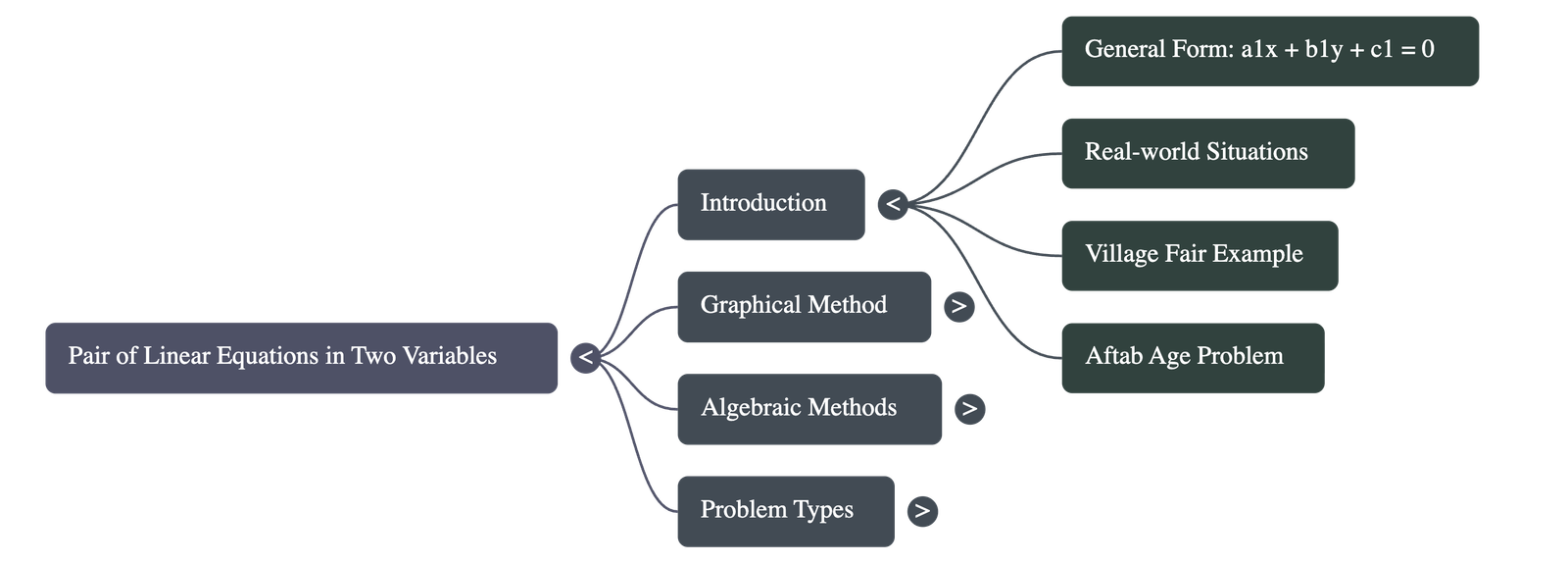
1. Introduction
- Many real-life situations can be represented mathematically using linear equations.
- A general form of a linear equation in two variables is ax + by + c = 0.
- Two linear equations in the same two variables taken together form a pair of linear equations in two variables.
- Geometrically, a linear equation in two variables represents a straight line. A pair of equations represents two lines on a plane.
2. Graphical Method of Solution
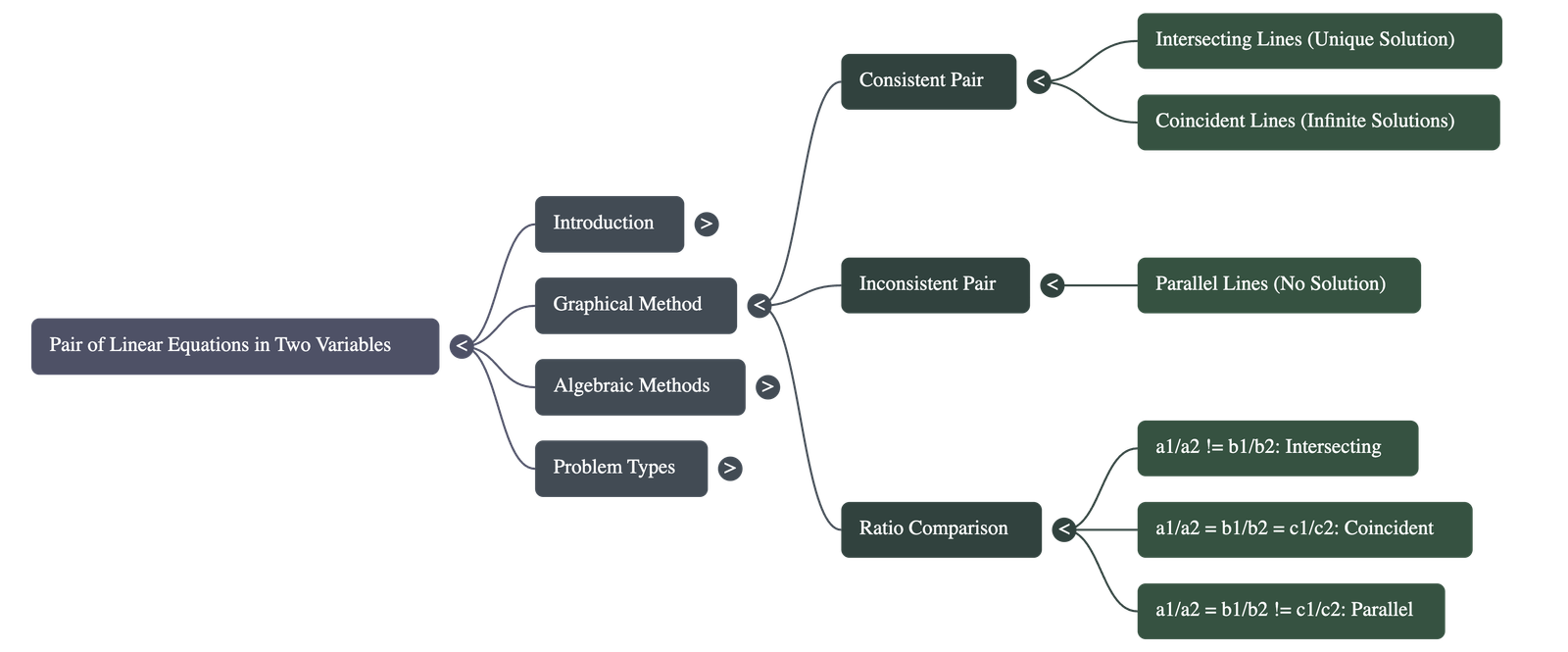
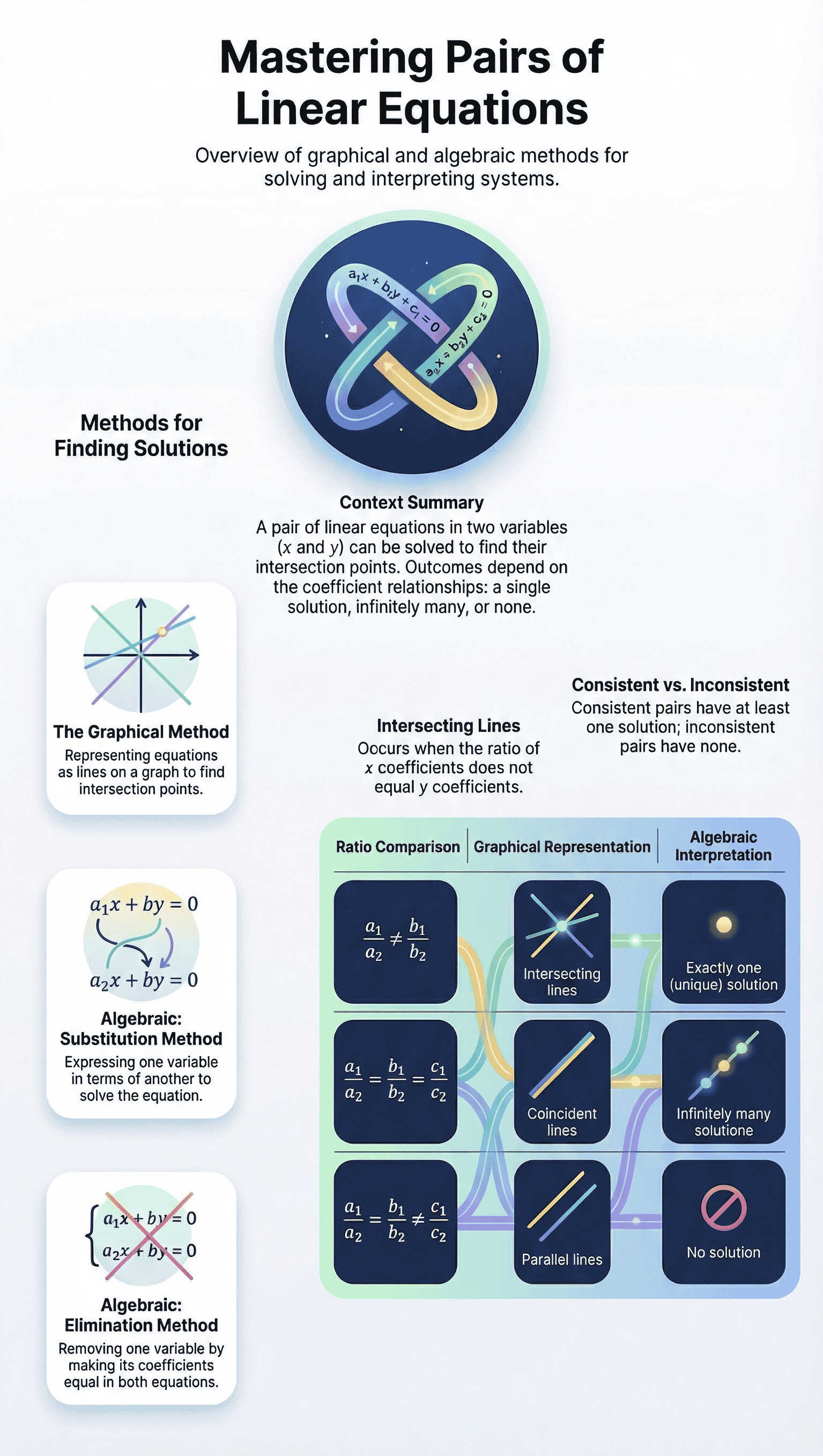
The behaviour of the two lines representing a pair of linear equations determines the nature of the solution:
-
Intersecting Lines (Consistent Pair):
If the lines intersect at a single point, the pair of equations has a unique solution. -
Coincident Lines (Dependent/Consistent Pair):
If the lines coincide (overlap completely), the equations have infinitely many solutions because every point on the line is a solution. -
Parallel Lines (Inconsistent Pair):
If the lines are parallel and never meet, the equations have no solution.
3. Algebraic Interpretation using Coefficients
For a pair of linear equations given by:
a1x + b1y + c1 = 0
a2x + b2y + c2 = 0
-
Condition for Unique Solution (Intersecting Lines):
a1 / a2 ≠ b1 / b2 -
Condition for Infinitely Many Solutions (Coincident Lines):
a1 / a2 = b1 / b2 = c1 / c2 -
Condition for No Solution (Parallel Lines):
a1 / a2 = b1 / b2 ≠ c1 / c2
4. Algebraic Methods of Solution
When graphical methods are imprecise (e.g., coordinates are non-integers), algebraic methods are used.
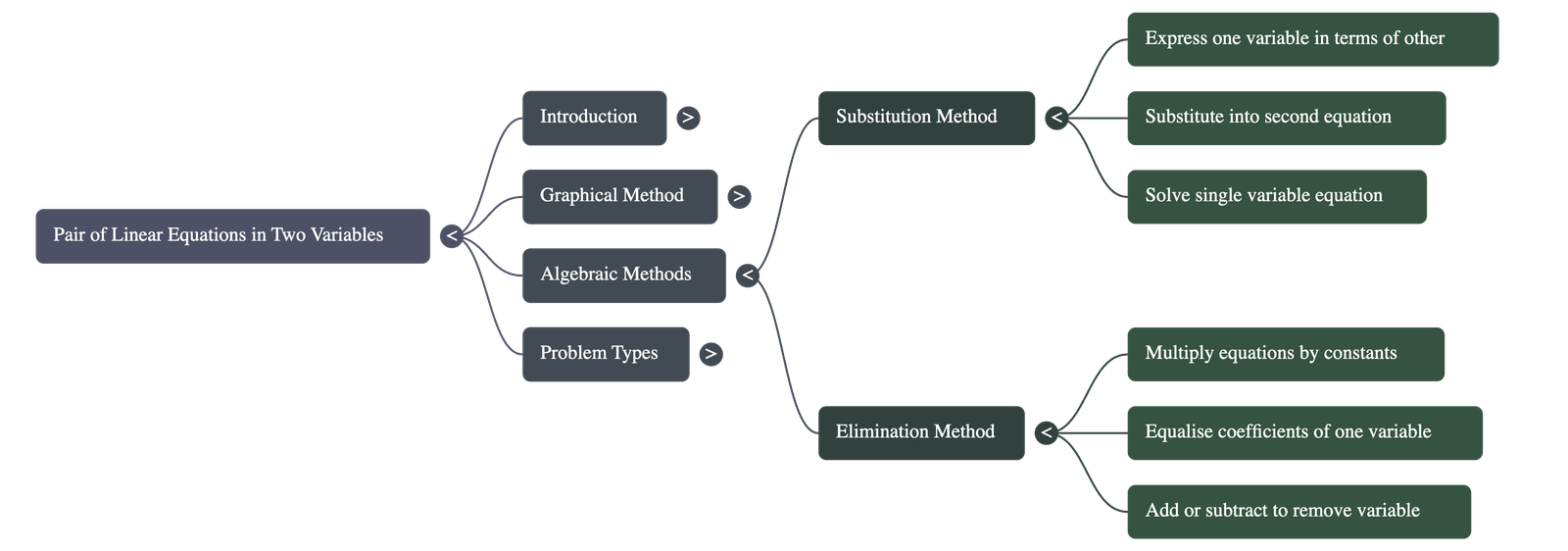
A. Substitution Method
- Step 1: Pick one equation and express one variable (say, y) in terms of the other variable (x).
- Step 2: Substitute this expression for y into the other equation. This reduces it to a linear equation in one variable.
- Step 3: Solve the resulting single-variable equation to find the value of x.
- Step 4: Substitute the value of x back into the equation from Step 1 to find the value of y.
- Note: If substitution leads to a true statement with no variables (e.g., 18=18), there are infinitely many solutions. If it leads to a false statement (e.g., 0=9), there is no solution.
B. Elimination Method
- Step 1: Multiply one or both equations by suitable constants to make the coefficients of one variable (either x or y) numerically equal.
- Step 2: Add or subtract the equations to eliminate that variable completely, resulting in an equation with a single variable.
- Step 3: Solve for the remaining variable.
- Step 4: Substitute the value found into either of the original equations to find the second variable.
5. Summary of Key Concepts
- A consistent pair of equations has at least one solution (either unique or infinite).
- An inconsistent pair of equations has no solution.
- A dependent pair of equations is always consistent and has infinitely many solutions.
- Equations that are not linear can sometimes be altered and reduced to a pair of linear equations to be solved.
Do checkout all questions & answers of this chapter.
Quick Navigation:
| | |
1 / 1
Quick Navigation:
| | |