Quick Navigation:
| | |
Polynomials
1. Introduction to Polynomials
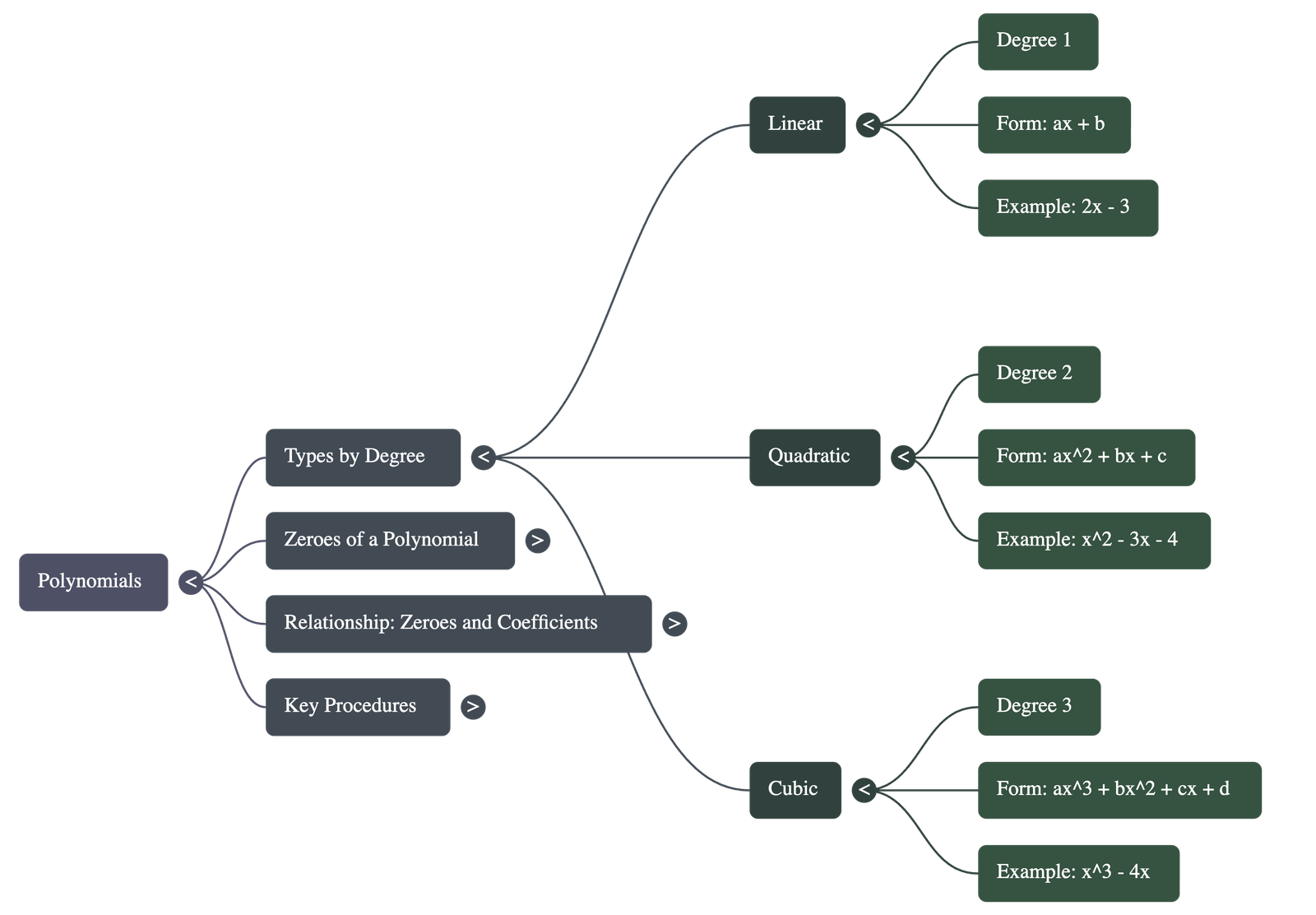
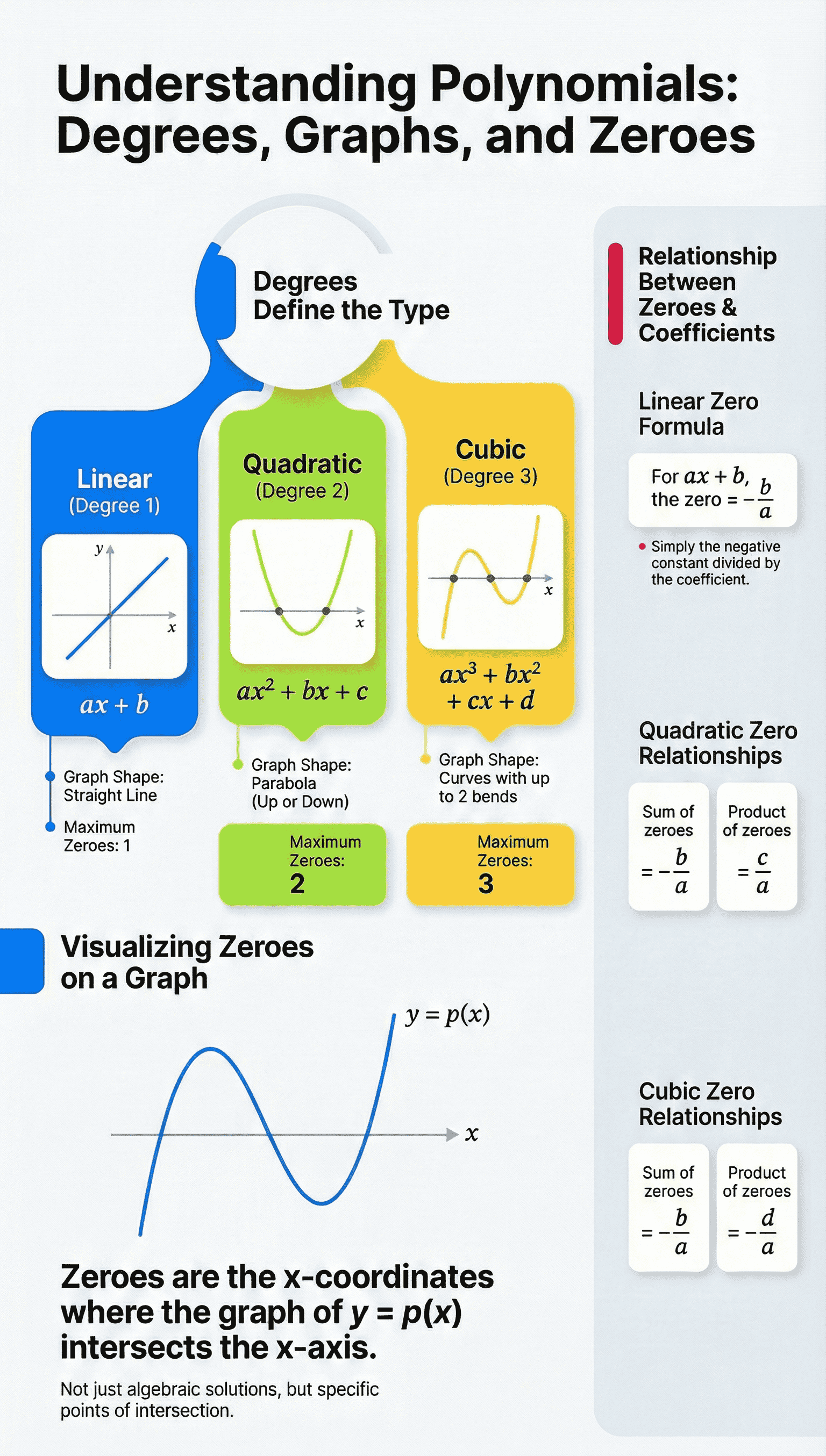
- Definition: If p(x) is a polynomial in x, the highest power of x in p(x) is called the degree of the polynomial.
-
Linear Polynomial: A polynomial of degree 1.
(General form: ax + b, where a ≠ 0) -
Quadratic Polynomial: A polynomial of degree 2. The word 'quadratic' comes from 'quadrate', meaning square.
(General form: ax² + bx + c, where a ≠ 0) -
Cubic Polynomial: A polynomial of degree 3.
(General form: ax³ + bx² + cx + d, where a ≠ 0)
2. Zeroes of a Polynomial
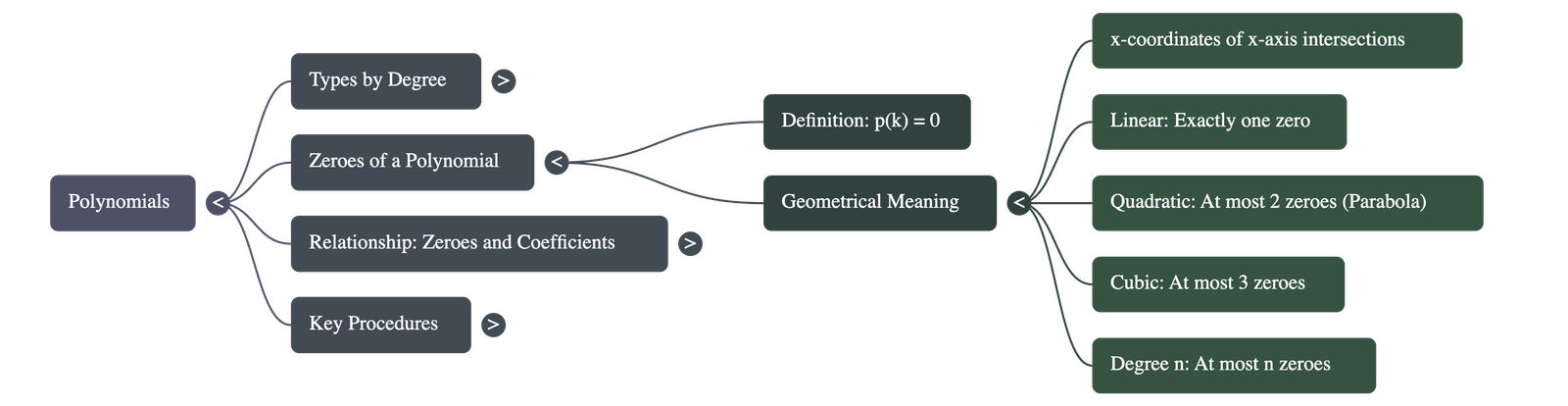
A real number k is said to be a zero of a polynomial p(x) if p(k) = 0.
- For a linear polynomial ax + b, the zero is -b/a.
- The zero of a linear polynomial is related to its coefficients:
Zero = -(Constant term) / (Coefficient of x).
3. Geometrical Meaning of Zeroes
The zeroes of a polynomial p(x) are geometrically the x-coordinates of the points where the graph of y = p(x) intersects the x-axis.
Linear Polynomials
- The graph of y = ax + b is a straight line.
- It intersects the x-axis at exactly one point.
- A linear polynomial has exactly one zero.
Quadratic Polynomials (Parabolas)
- The graph of y = ax² + bx + c is a curve called a parabola.
- It opens upwards if a > 0 and downwards if a < 0.
- The graph can intersect the x-axis in three ways:
- Two distinct points: The polynomial has two distinct zeroes.
- One point (touching): The two points coincide; the polynomial has two equal zeroes (effectively one zero).
- No points: The graph is strictly above or below the x-axis; the polynomial has no real zeroes.
- Conclusion: A quadratic polynomial has at most 2 zeroes.
Cubic Polynomials
- The graph can intersect the x-axis at most at 3 points.
- A cubic polynomial has at most 3 zeroes.
- General Rule: A polynomial p(x) of degree n has at most n zeroes.
Do checkout all questions & answers of this chapter.
Quick Navigation:
| | |
1 / 1
Quick Navigation:
| | |