Quick Navigation:
| | |
Coordinate Geometry
1. Introduction to Coordinate Geometry
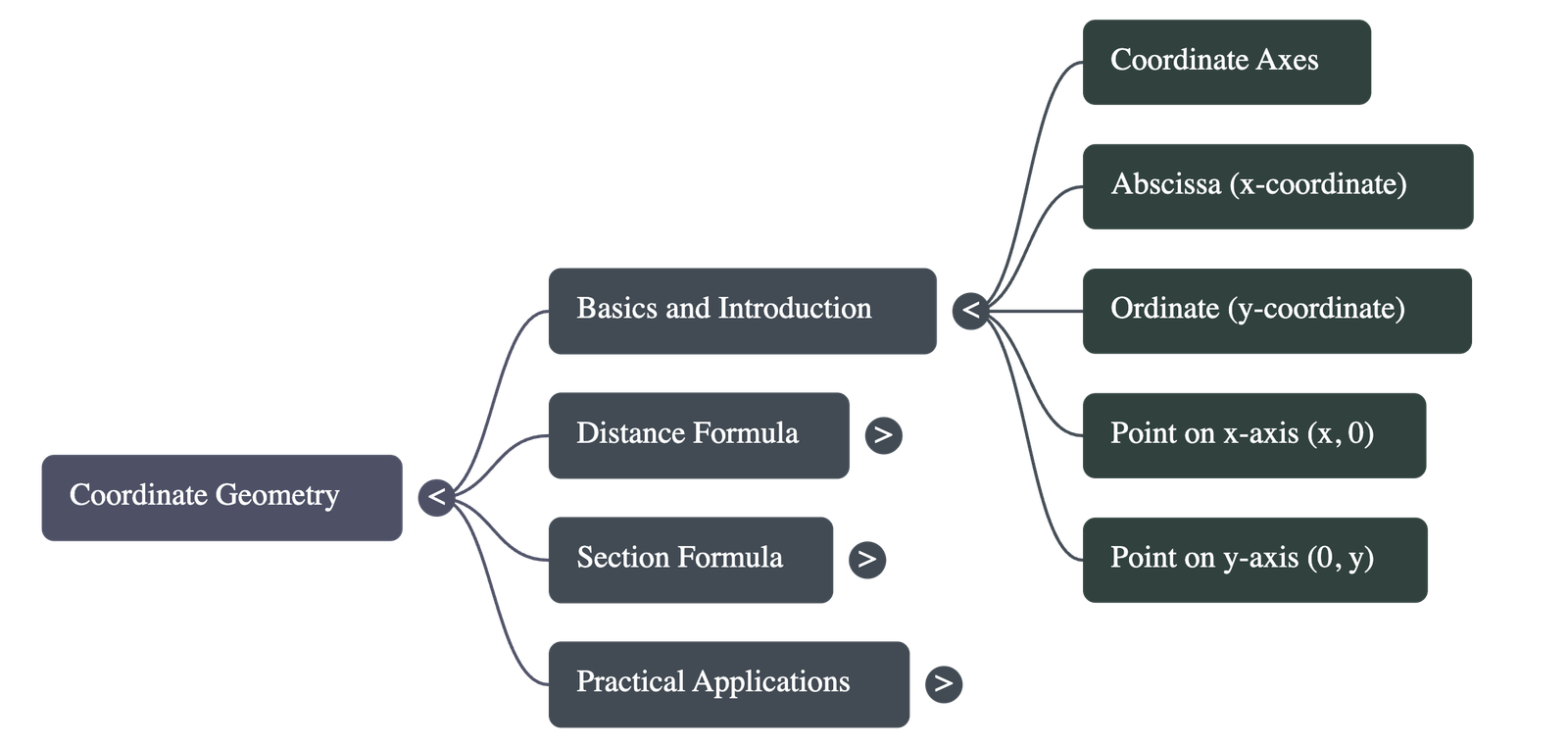
- Coordinate Axes: To locate a point on a plane, a pair of perpendicular axes is required.
- The distance of a point from the y-axis is called its x-coordinate or abscissa.
- The distance of a point from the x-axis is called its y-coordinate or ordinate.
- Point Formats:
- Coordinates of a point on the x-axis are of the form (x, 0).
- Coordinates of a point on the y-axis are of the form (0, y).
- Algebra and Geometry Connection: Coordinate geometry serves as an algebraic tool for studying geometry. It allows the study of geometry using algebra and the understanding of algebra through geometry.
- Linear equations (ax + by + c = 0) graphically represent straight lines.
- Quadratic equations (y = ax2 + bx + c) graphically represent parabolas.
2. Distance Formula
This formula is used to find the distance between any two given points on a plane.
The Formula:
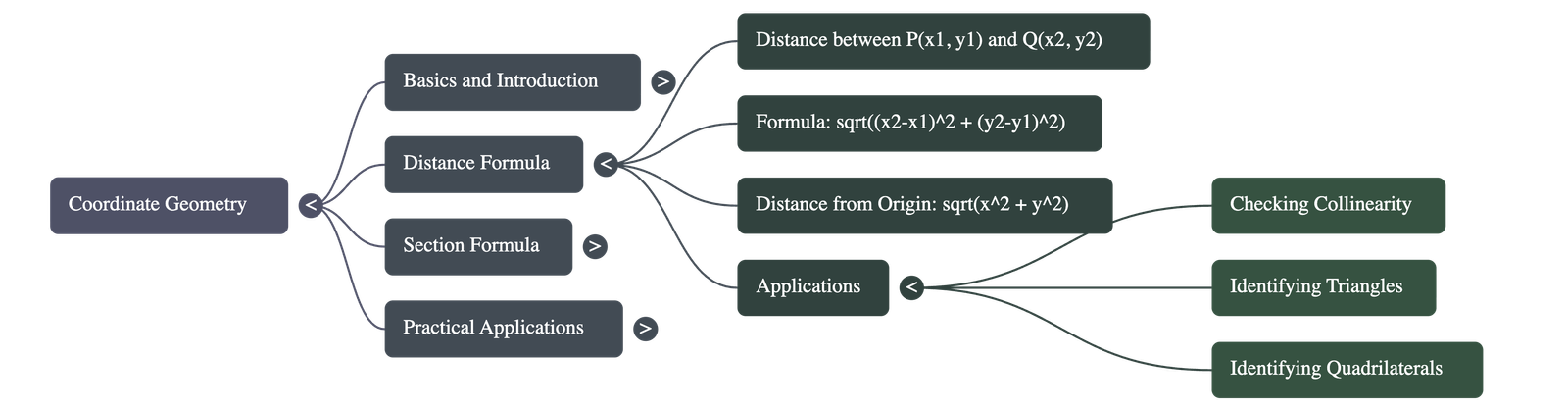
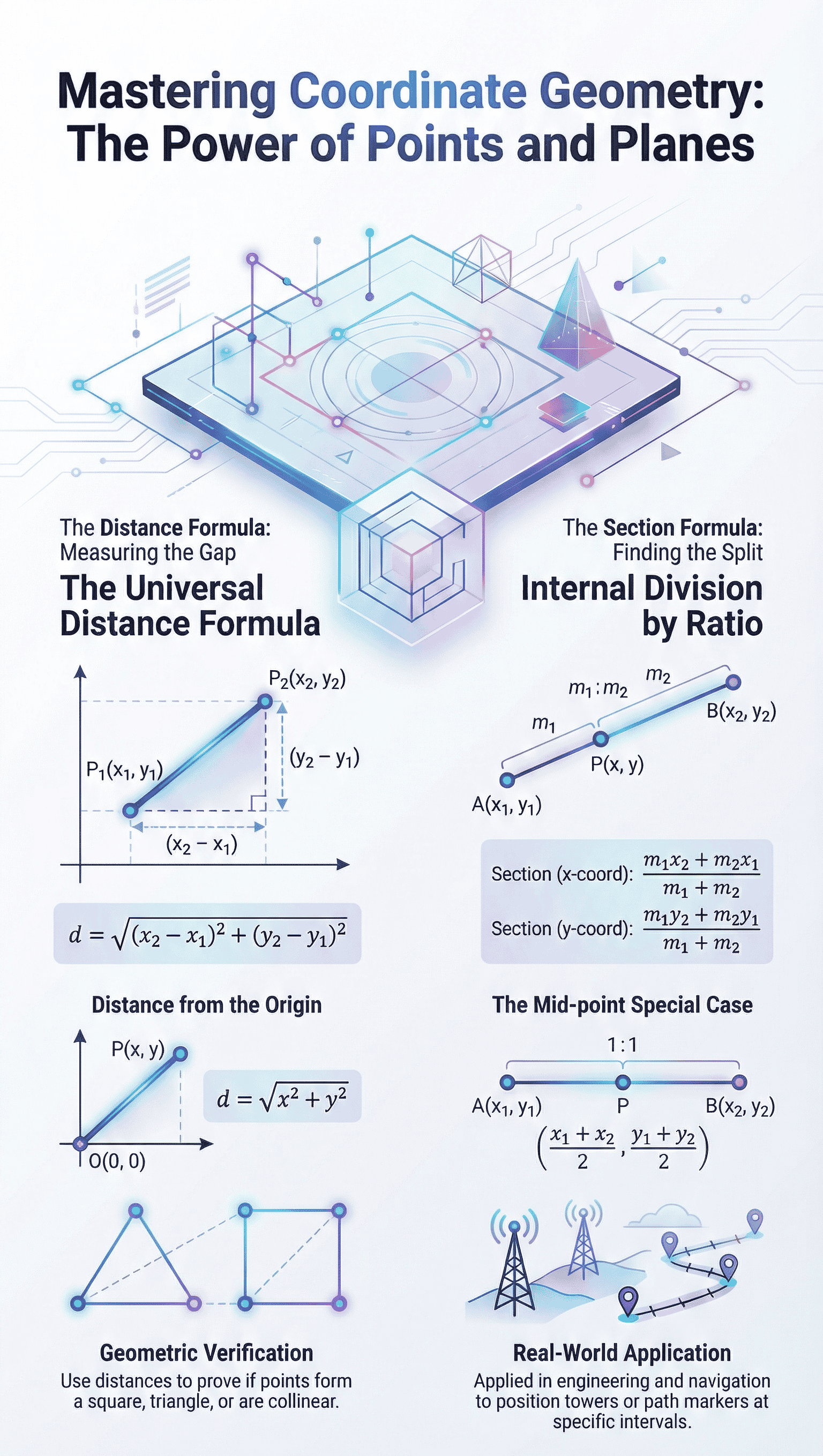
The distance between two points P(x1, y1) and Q(x2, y2) is given by:
PQ = √[ (x2 - x1)2 + (y2 - y1)2 ]
The distance between two points P(x1, y1) and Q(x2, y2) is given by:
PQ = √[ (x2 - x1)2 + (y2 - y1)2 ]
- Distance from Origin: The distance of a point P(x, y) from the origin O(0, 0) is simply:
OP = √(x2 + y2) - Properties: Since distance is a length, the result is always non-negative. We take only the positive square root.
- Applications of Distance Formula:
- Determining Triangles: By calculating the lengths of three sides, one can determine if a triangle is right-angled (using Pythagoras theorem), isosceles (two sides equal), or equilateral (all sides equal).
- Collinearity: Three points A, B, and C are collinear (lie on the same line) if the sum of two distances equals the third (e.g., AB + BC = AC).
- Quadrilaterals: It can verify shapes like squares (all sides equal, diagonals equal) or parallelograms (opposite sides equal).
- Equidistance: It helps find a point that is at an equal distance from two other points (finding the perpendicular bisector).
3. Section Formula
This formula is used to find the coordinates of a point that divides a line segment joining two points in a specific ratio.
The Formula:
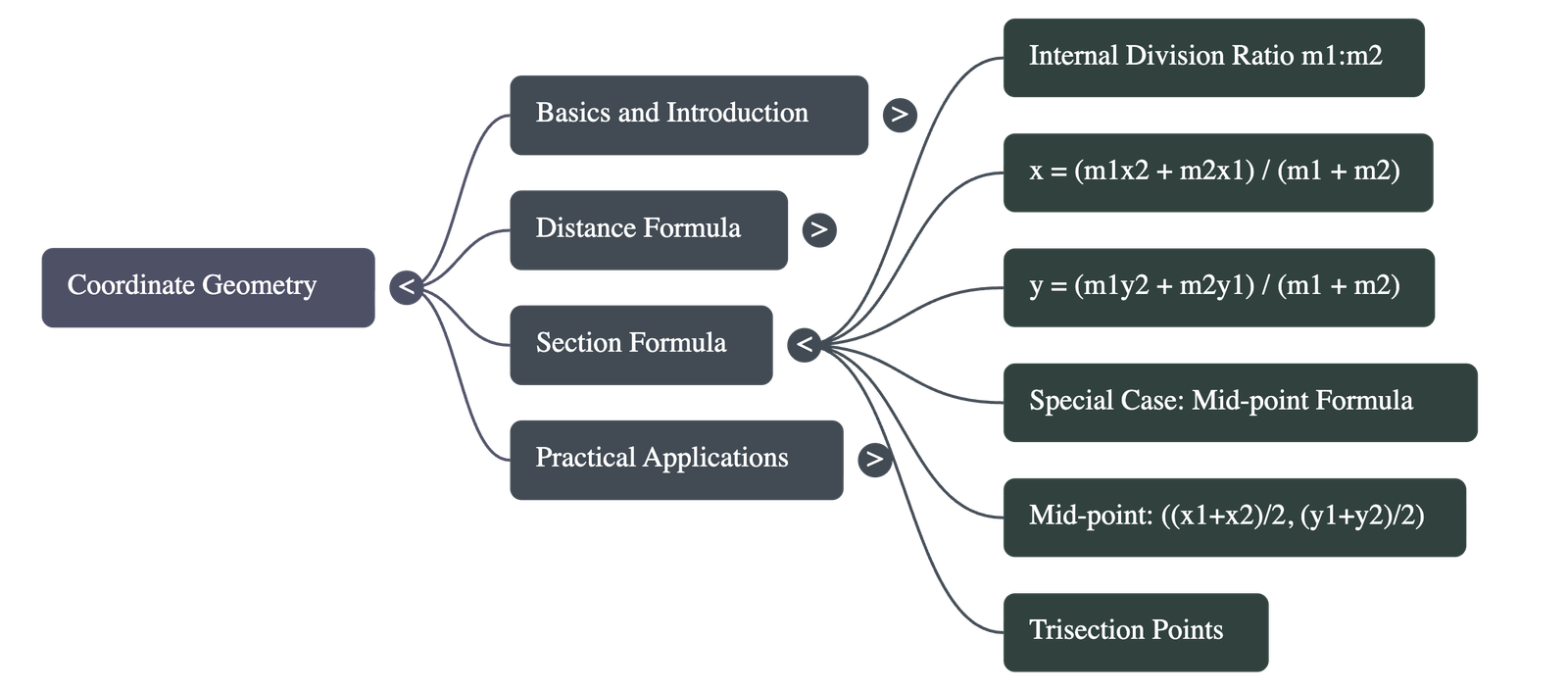
The coordinates of the point P(x, y) which divides the line segment joining points A(x1, y1) and B(x2, y2) internally in the ratio m1 : m2 are:
The coordinates of the point P(x, y) which divides the line segment joining points A(x1, y1) and B(x2, y2) internally in the ratio m1 : m2 are:
x = (m1x2 + m2x1) / (m1 + m2)
y = (m1y2 + m2y1) / (m1 + m2)
y = (m1y2 + m2y1) / (m1 + m2)
- Alternative Method (k : 1 Ratio):
If the ratio is unknown, it is often easier to assume the ratio is k : 1. The coordinates are then:
[ (kx2 + x1)/(k + 1) , (ky2 + y1)/(k + 1) ] - Mid-Point Formula (Special Case):
The mid-point of a line segment divides it in the ratio 1 : 1. The coordinates of the mid-point P of the segment joining A(x1, y1) and B(x2, y2) are:
( (x1 + x2)/2 , (y1 + y2)/2 ) - Applications of Section Formula:
- Trisection: Finding points that divide a line segment into three equal parts (ratios 1:2 and 2:1).
- Parallelograms: Finding a missing vertex of a parallelogram by using the property that diagonals bisect each other (i.e., they share the same mid-point).
- Finding Ratios: Determining the ratio in which a known point (or an axis) divides a line segment.
4. Chapter Summary Points
- Distance Formula: √[ (x2 - x1)2 + (y2 - y1)2 ]
- Distance from Origin: √(x2 + y2)
- Section Formula: Finds the point dividing a segment in ratio m1:m2.
- Mid-point Formula: Finds the center point between two coordinates.
- Geometric Verification: These algebraic tools allow for the precise verification of geometric figures (squares, rectangles, triangles) and properties (collinearity, parallelism) without physical measurement.
Do checkout all questions & answers of this chapter.
Quick Navigation:
| | |
1 / 1
Quick Navigation:
| | |