Quick Navigation:
| | | |
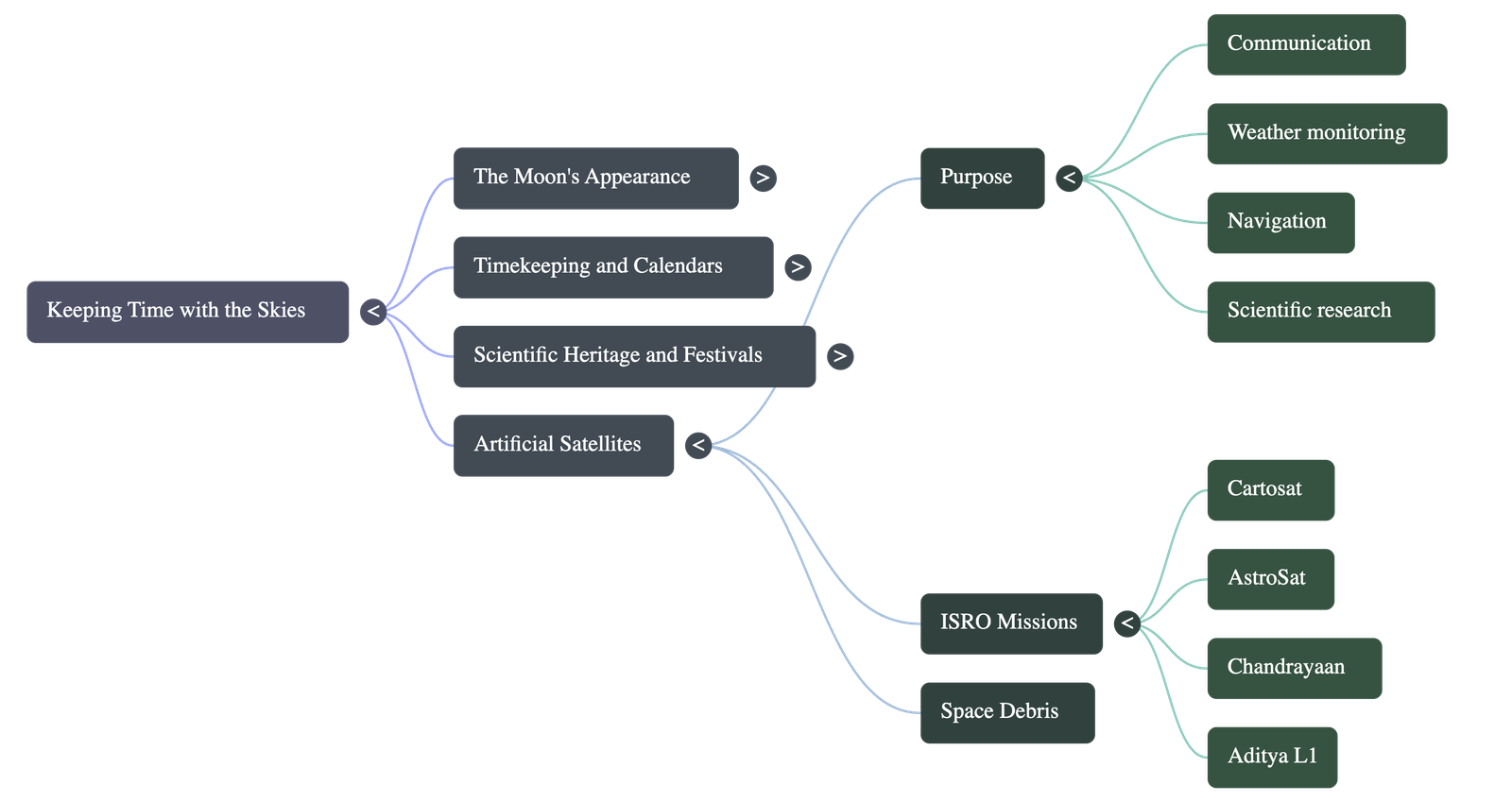
Keeping Time with the Skies
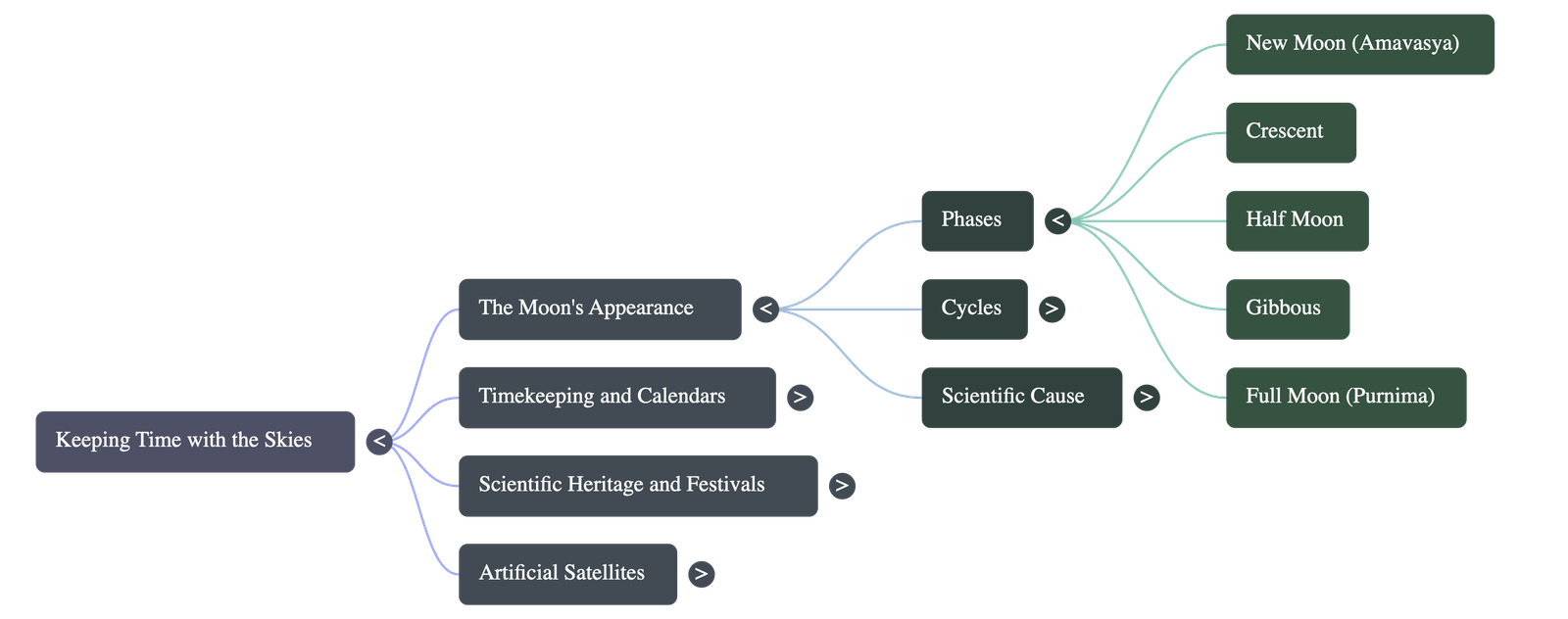
1. The Moon’s Changing Appearance (Phases of the Moon)
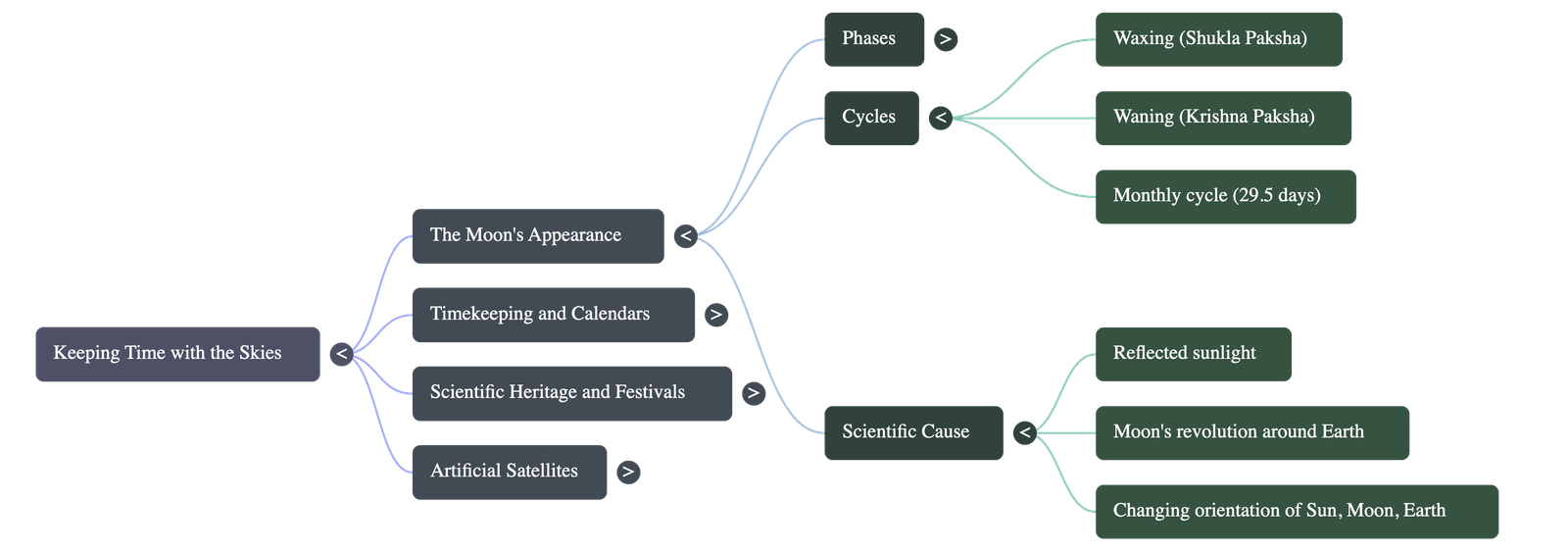
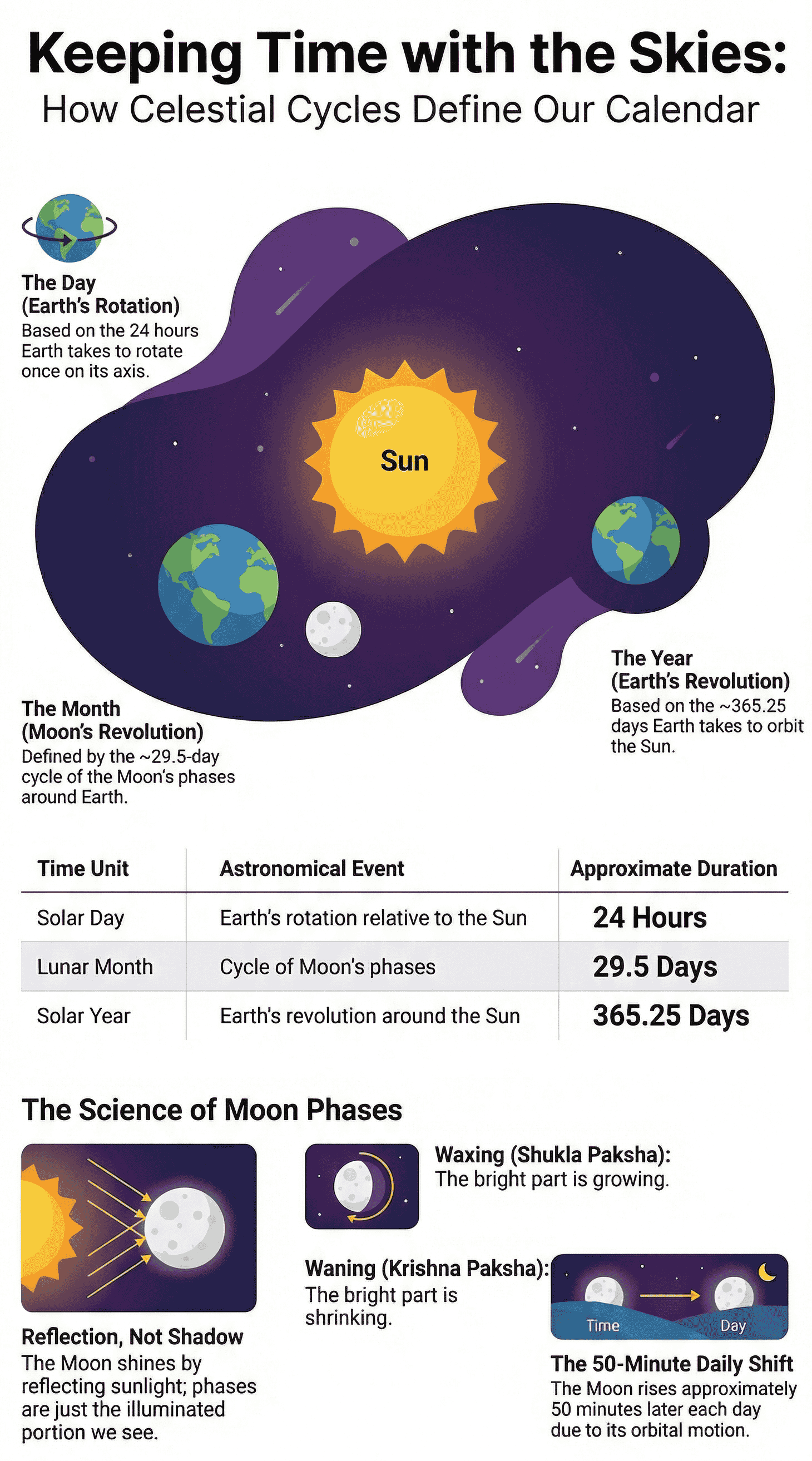
- The Moon does not emit its own light; it shines by reflecting sunlight. Only the half of the Moon facing the Sun is illuminated.
- As the Moon revolves around the Earth, the portion of the illuminated half visible from Earth changes, creating the phases of the Moon.
- Waxing Period (Shukla Paksha): The bright portion of the Moon grows over about two weeks, starting from the New Moon and ending at the Full Moon.
- Waning Period (Krishna Paksha): The bright portion shrinks over the next two weeks, moving from the Full Moon back to the New Moon.
- A complete cycle of Moon phases takes approximately 29.5 days (about one month).
- The Moon rises approximately 50 minutes later each day. This happens because as the Earth completes its 24-hour rotation, the Moon has moved further along its orbit, requiring the Earth to rotate a bit more to catch up.
- Earth's shadow does not cause the phases of the Moon. Earth's shadow falling on the Moon causes a lunar eclipse, which only occurs during a Full Moon.
2. The Evolution of Calendars
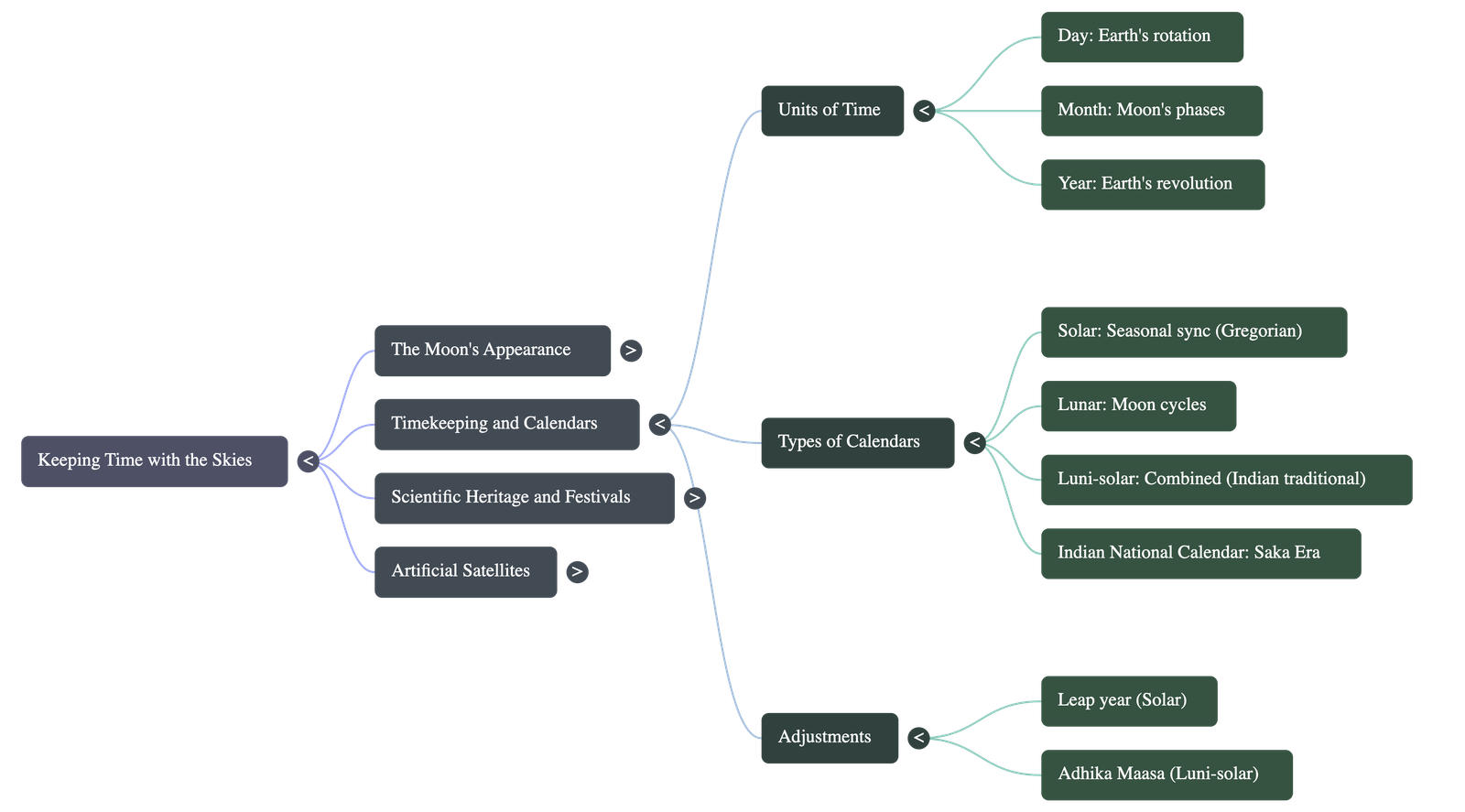
- Solar Day: Based on the Earth's rotation. It is the average time (~24 hours) the Sun takes to return to its highest point in the sky.
- Lunar Month: Based on the Moon's cycle of phases, lasting roughly 29.5 days.
- Solar Year: Based on the Earth's revolution around the Sun and the cycle of seasons, taking about 365.25 days.
- Lunar Calendars: Consist of 12 lunar months totaling about 354 days. Because they are shorter than a solar year, they drift out of sync with the Earth's seasons.
- Solar Calendars: Like the widely used Gregorian calendar, these maintain sync with the seasons by having 365 days and adding a leap day every four years.
- Luni-Solar Calendars: Used heavily in India, these track lunar months but add an extra intercalary month (Adhika Maasa) every 2–3 years to realign with the solar year and seasons.
- Indian National Calendar: Adopted by the Government of India in 1957, this is a unified solar calendar that begins on March 22 (Chaitra) and synchronizes leap years with the Gregorian calendar.
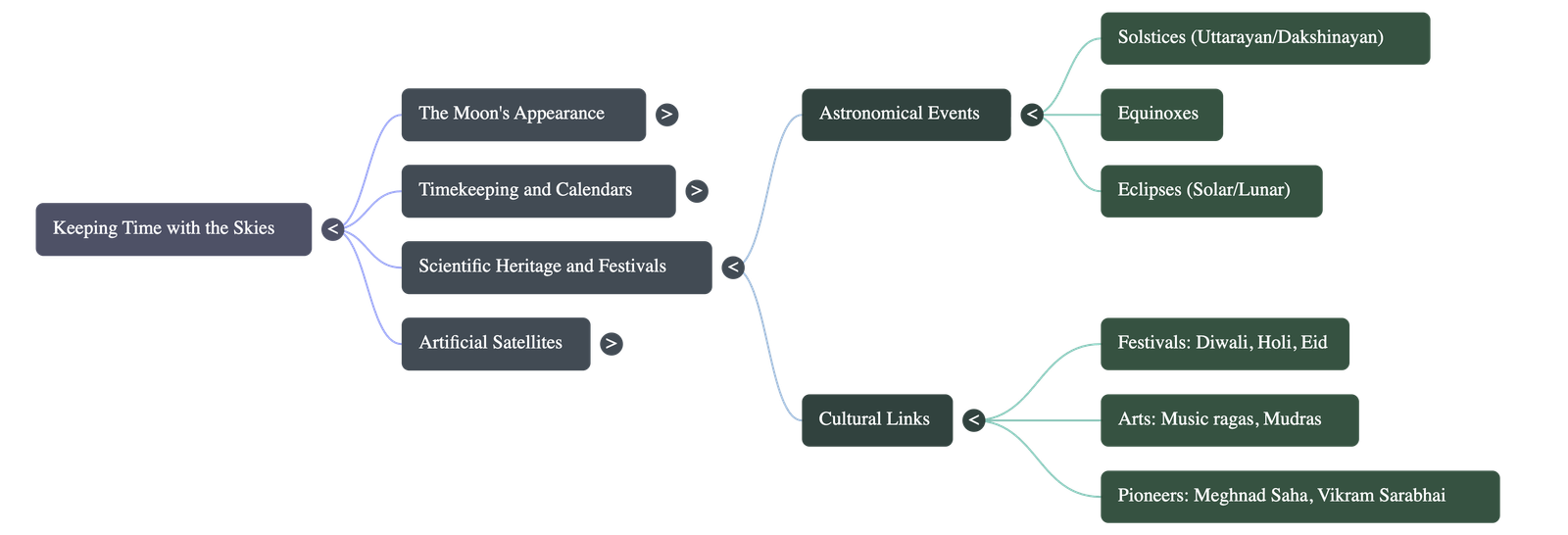
- Ancient Indian astronomers observed the Sun's apparent movement to track seasons: Uttarayan (northward movement from December to June) and Dakshinayan (southward movement from June to December).
3. Festivals and Astronomical Phenomena
- Many Indian festivals are directly tied to the phases of the Moon. For example, Diwali occurs on a New Moon, Holi on a Full Moon, and Eid-ul-Fitr is marked by the sighting of the crescent Moon.
- Festivals based on luni-solar calendars shift slightly each year on the Gregorian calendar, but they stay generally within the same season due to the corrective intercalary month.
- Festivals based on purely lunar calendars (like Eid-ul-Fitr) shift by about 11 days earlier each year, eventually cycling through all the seasons over time.
- Certain festivals (like Makar Sankranti, Pongal, Bihu, and Vaisakhi) follow a solar sidereal calendar. Their dates shift very slowly relative to the Gregorian calendar (about one day every 71 years) due to the slow wobble of the Earth's axis.
4. Artificial Satellites in Space
- While the Moon is Earth's natural satellite, humans have launched numerous artificial satellites that orbit the planet.
- Artificial satellites typically orbit about 800 km above the Earth's surface and take roughly 100 minutes to complete a single orbit.
- They are essential for modern life, providing communication, navigation, weather monitoring, disaster management, and scientific research.
- The Indian Space Research Organisation (ISRO) has launched many key missions, such as the Cartosat series for Earth mapping, AstroSat for observing celestial objects, Chandrayaan missions to the Moon, Aditya L1 to the Sun, and Mangalyaan to Mars.
- After their useful life, artificial satellites and rocket parts become space debris (or space junk), which crowds Earth's orbit and poses collision risks to working satellites.
Do checkout all questions & answers of this chapter.
Quick Navigation:
| | | |
1 / 1
Quick Navigation:
| | | |