Quick Navigation:
| | | |
The Muslim League
A Comprehensive Section-by-Section Study Guide
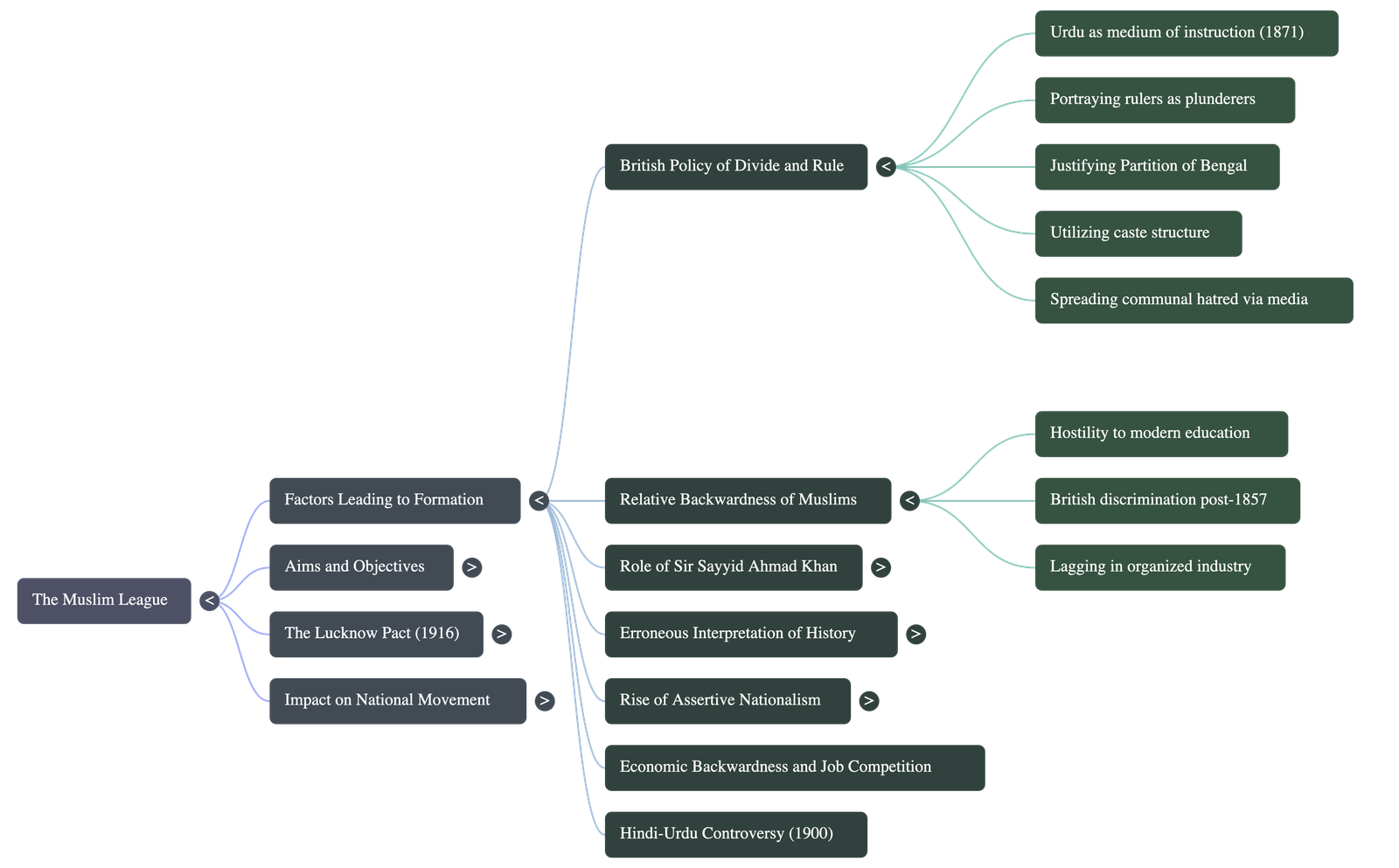
1. The British Policy of 'Divide and Rule'
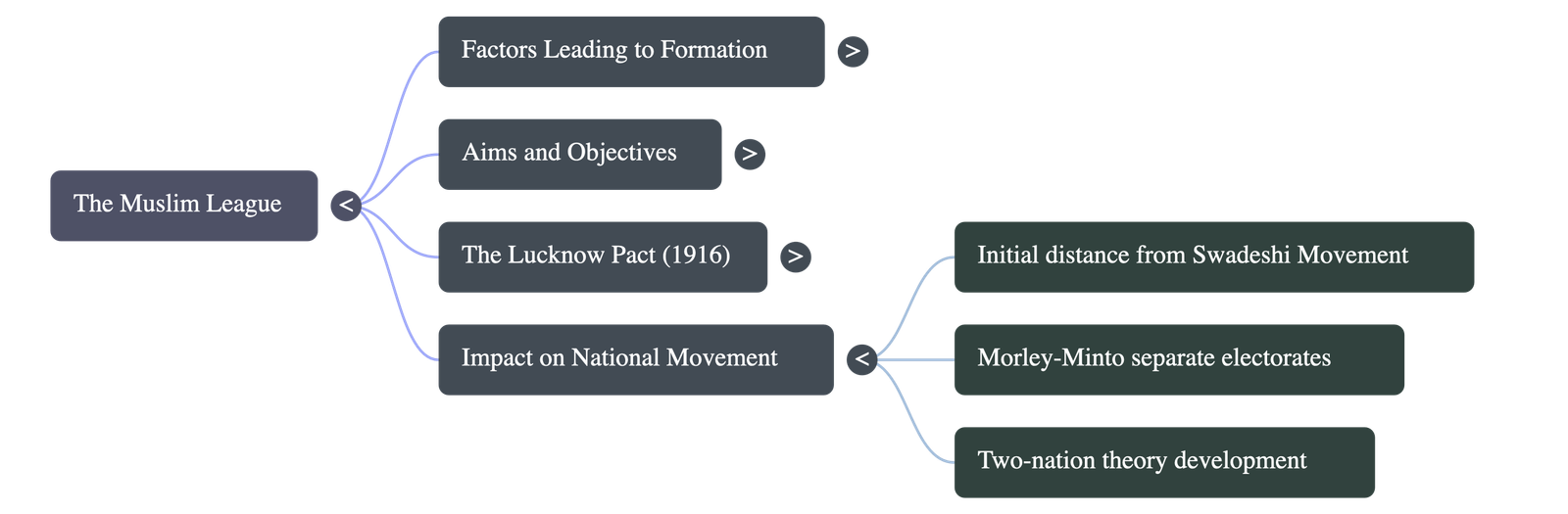
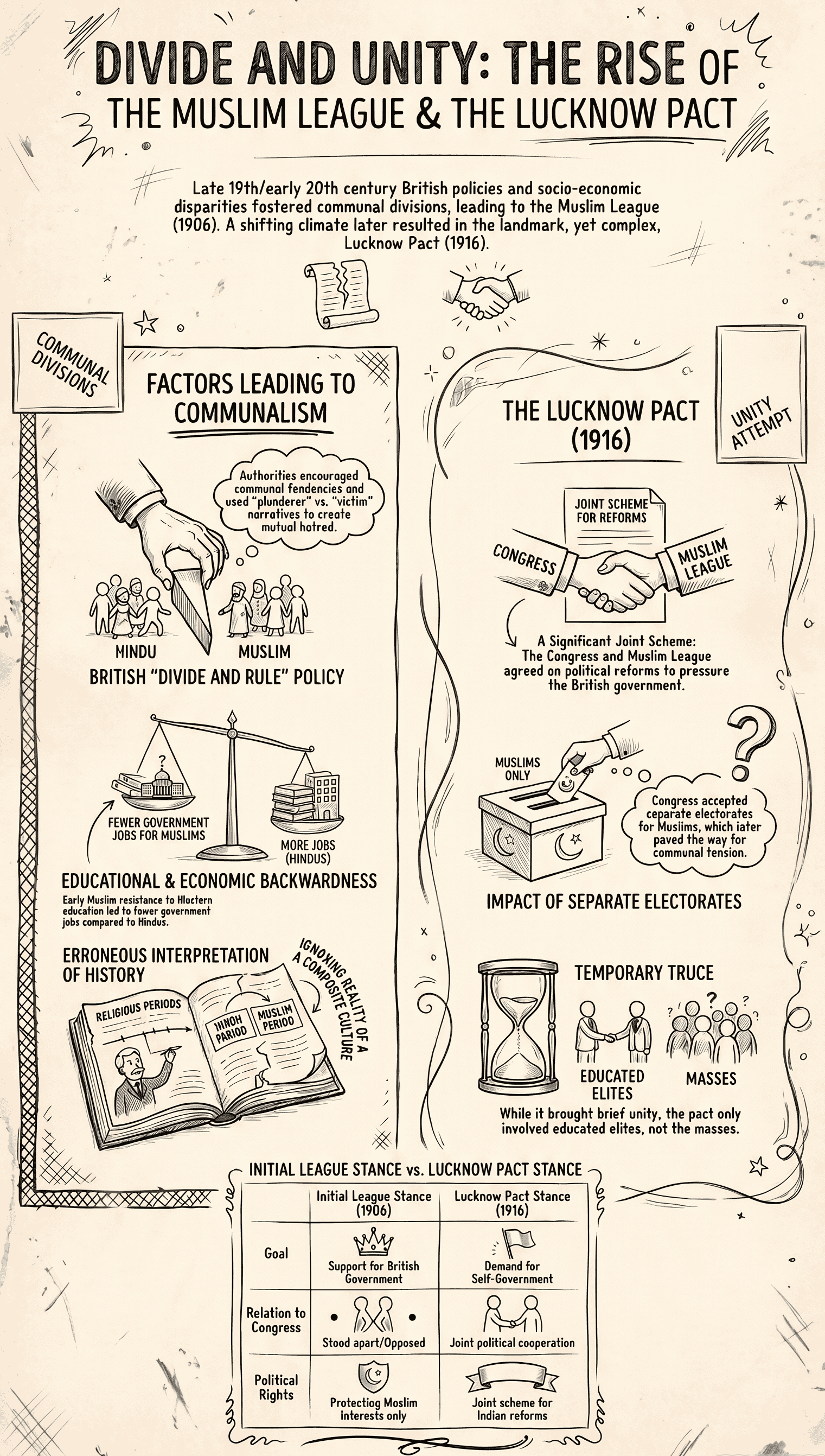
To prevent united national feelings, the British actively encouraged communal and separatist tendencies in Indian politics through various methods:
- ■ Educational Policies: In 1871, Lord Mayo's government made Urdu the medium of instruction for Muslims in primary/secondary schools and increased government aid to Muslim-run institutions.
- ■ Creating Animosity: They intentionally created hatred by portraying Muslim rulers as plunderers and Hindu rulers as cruel kings.
- ■ Partition of Bengal: Justified the partition by convincing Muslims it would create a new Muslim-majority province to protect their interests from Hindus.
- ■ Caste and Community Divisions: Exploited caste structures to turn lower castes against higher castes. Treated Hindus, Muslims, and Sikhs as completely separate communities.
- ■ Spreading Hatred: Actively spread communal bias through the press, posters, literature, and public platforms.
2. Relative Backwardness of the Muslim Community
- ● Initial Anti-British Stance: Upper-class Muslims (zamindars and aristocrats) were initially hostile to modern Western education, keeping the number of English-educated Muslims very small.
- ● British Discrimination: Post-1857, the British held Muslims responsible for the Uprising and systematically discriminated against them in civil and military recruitment.
- ● Industrial and Educational Lag: The community lagged behind in organized industry. They also avoided Western education out of pride in their own traditional culture.
- ● Job Disadvantage: Since Western education was essential for government jobs, Hindus (who adopted it) advanced, while Muslims were left at a severe disadvantage, making it easy for the British to incite jealousy.
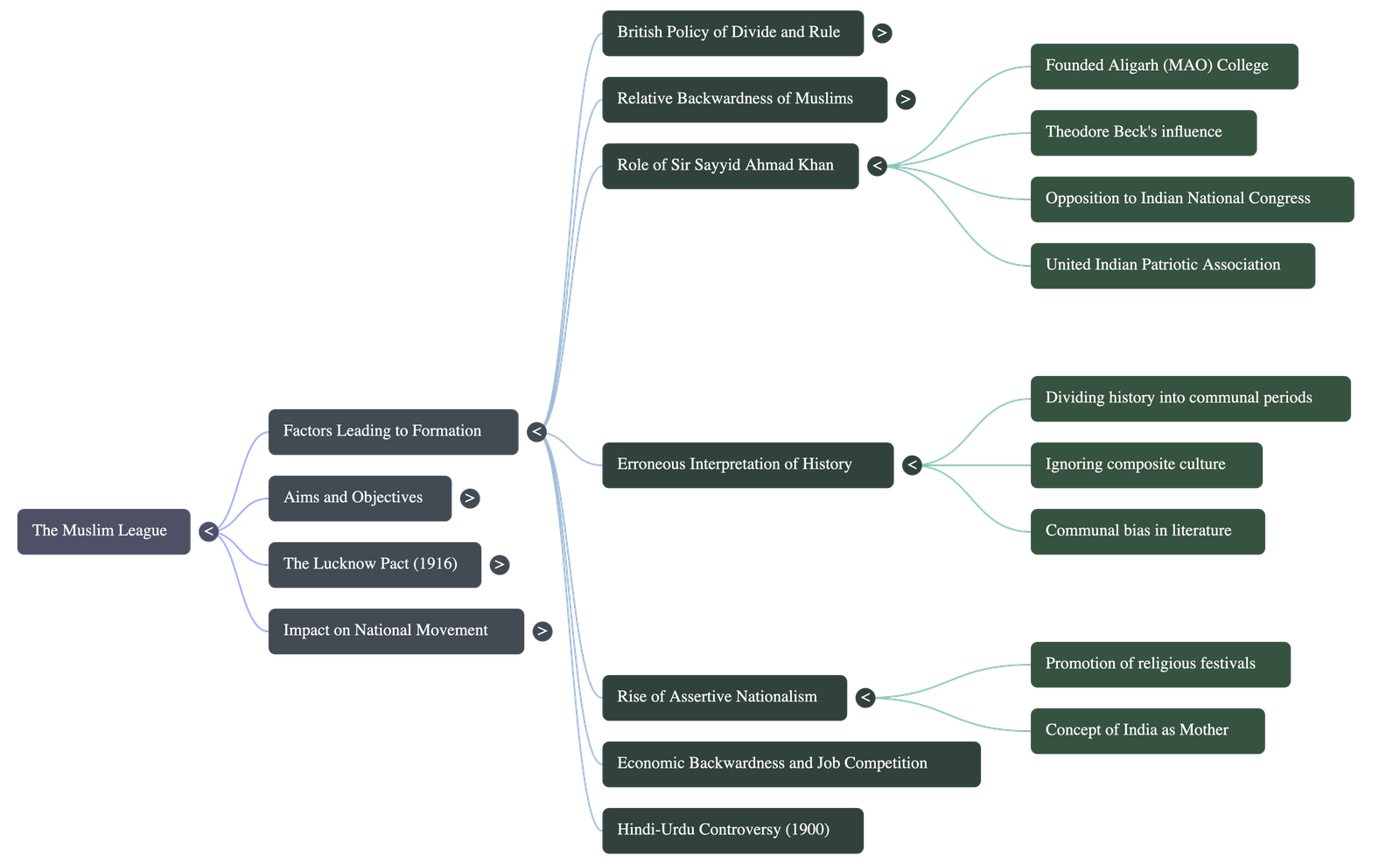
3. Role of Sir Sayyid Ahmad Khan
- ✔ Early Secular Views: Initially a great educationist and reformer who viewed Hindus and Muslims as one nation (Quam). He founded the Mohammedan Anglo-Oriental (MAO) College at Aligarh with both Hindu and Muslim patrons.
- ✔ Shift in Ideology: Influenced by Mr. Theodore Beck (the British Principal of MAO College), he changed his stance in the 1880s, declaring that Hindu and Muslim political interests were completely different.
- ✔ Opposition to Congress: He strongly opposed the Indian National Congress upon its founding. In 1888, he formed the United Indian Patriotic Association (supported by Mr. Beck) specifically to counter the Congress.
- ✔ Pro-British Stance: He argued that British rule was necessary to protect Muslims from Hindu domination, urging educated Muslims to remain loyal to the British in exchange for government jobs and favors.
4. Other Factors Contributing to Communalism
Erroneous Interpretation of History:
- → British historians wrongly divided Indian history into "Hindu" and "Muslim" periods.
- → Muslim rulers were labeled as foreign invaders, ignoring India's composite culture and regional diversities.
- → Communal historians glorified the ancient period while downplaying the contributions of the medieval (Mughal) period to Indian art, economy, and culture.
Rise of Assertive Nationalism:
- → Certain actions by Assertive Nationalists unintentionally alienated some Muslims. Examples include Tilak's promotion of Shivaji and Ganapati festivals, Aurobindo's concept of India as a mother, and taking dips in the Ganga during the anti-Partition agitation.
Economic Backwardness:
- → British colonial policies ruined industrial development, leading to acute unemployment. Fierce competition for few government jobs led to demands for reservations based on religion, fueling communal rivalry.
The Hindi-Urdu Controversy (1900):
- → In the United Provinces (UP), Urdu was the court language. In 1900, the Government instructed that Hindi (in Devanagari script) be used alongside Urdu for petitions and official announcements. This deeply worsened relations between the two communities.
5. Formation and Objectives of the Muslim League
Formation: The All India Muslim League was officially established on December 30, 1906, at Dacca, under the Presidentship of Nawab Salimullah.
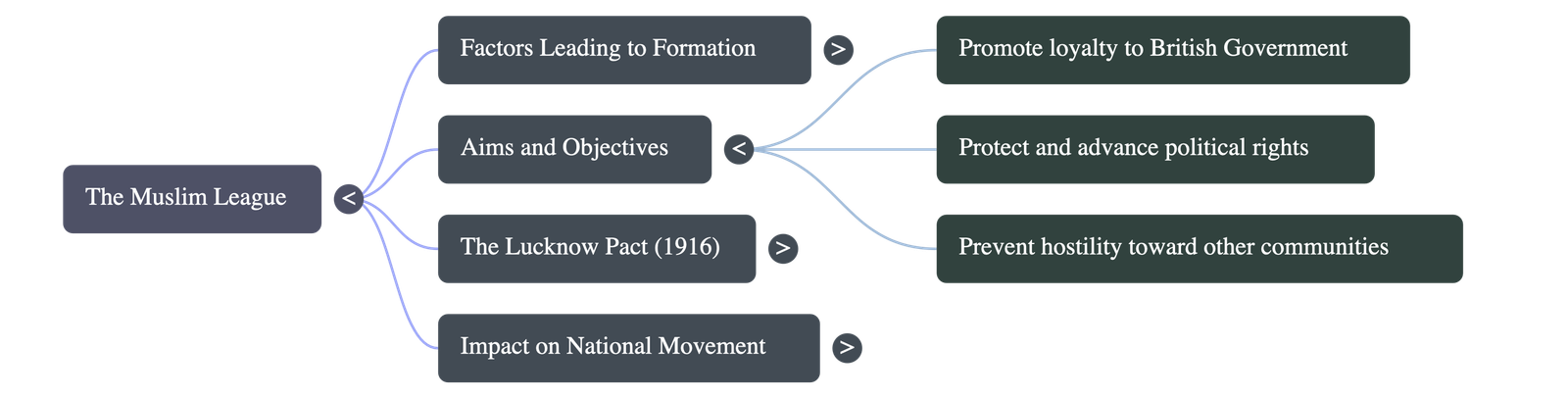
Aims and Objectives:
- ♦ To promote loyalty and support for the British government among Muslims.
- ♦ To protect and advance the political rights and interests of Muslims in India.
- ♦ To present the needs and aspirations of the Muslims to the government mildly.
- ♦ To prevent hostility between Indian Muslims and other communities.
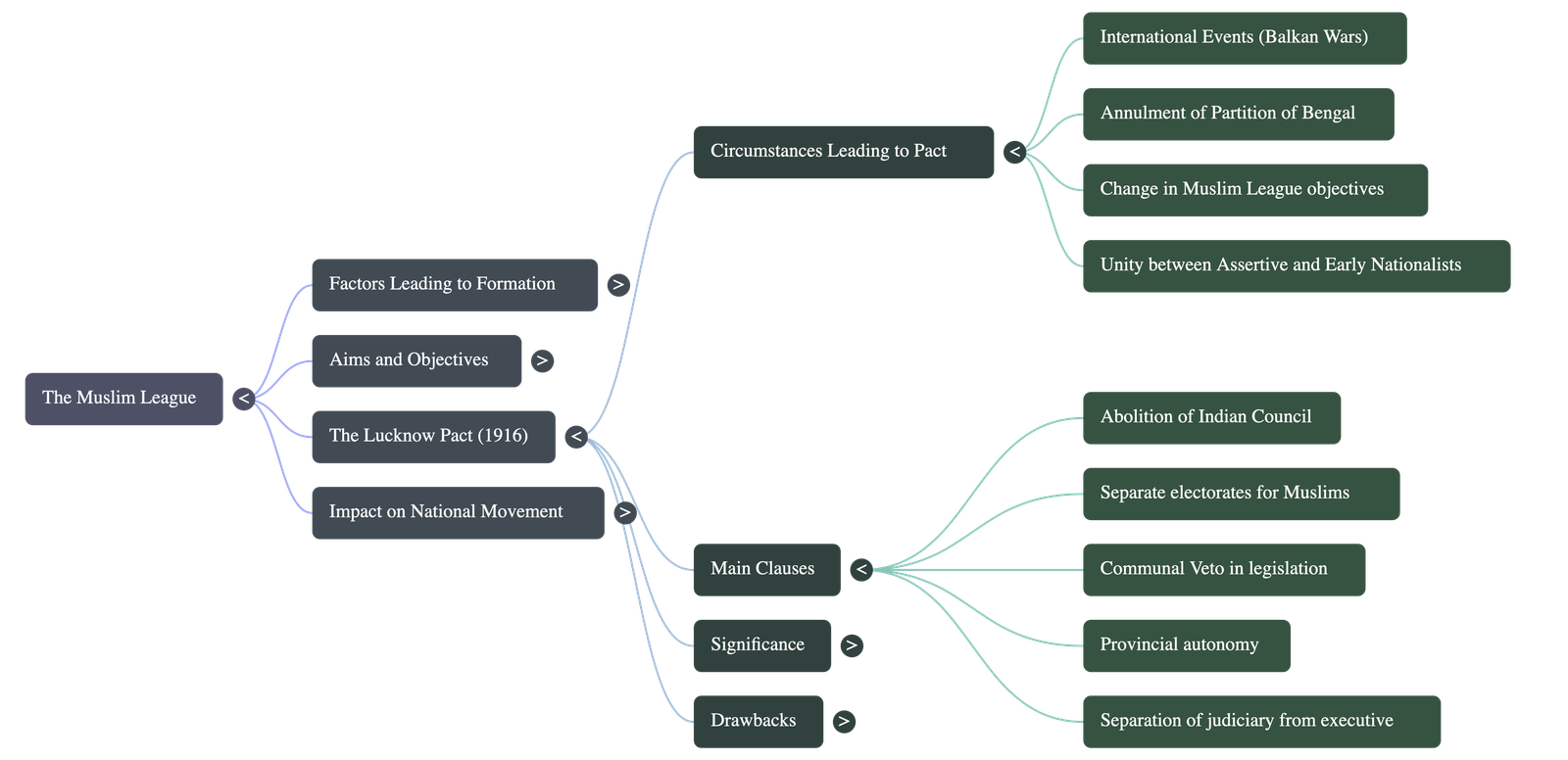
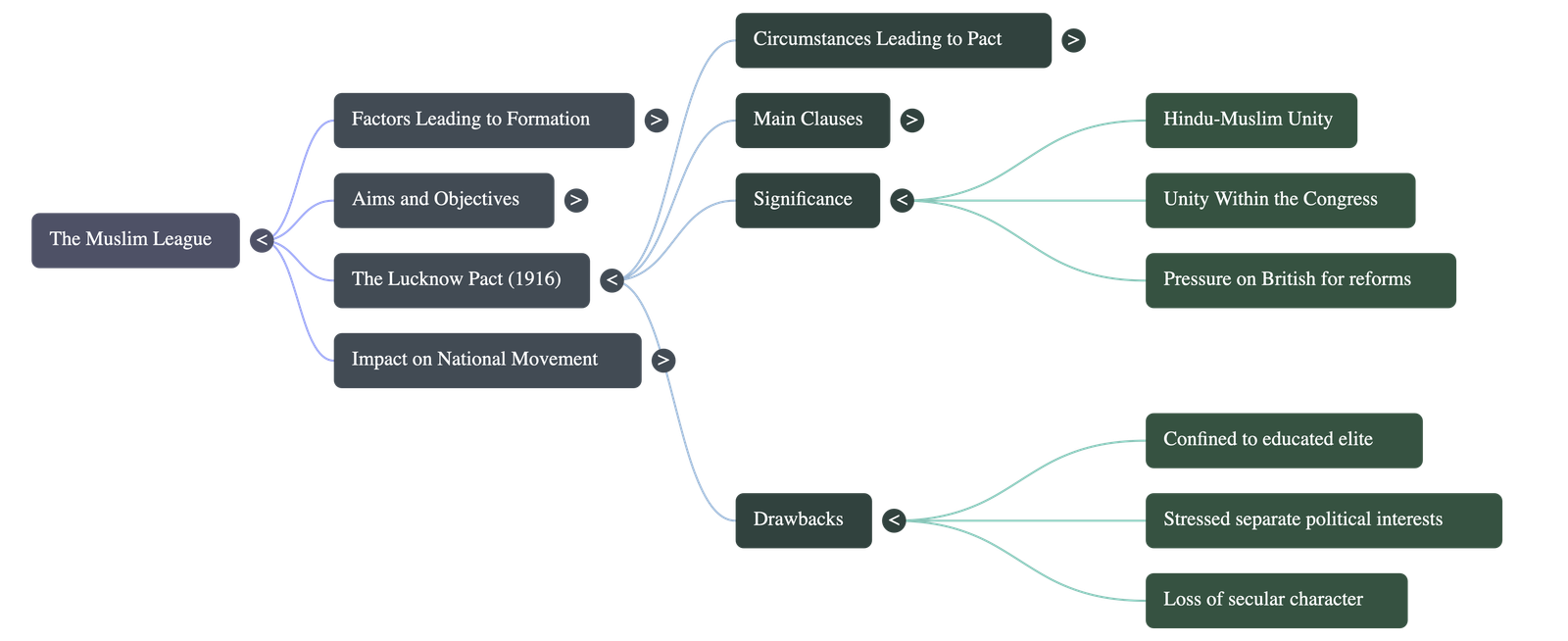
6. Circumstances Leading to the Lucknow Pact (1916)
The Lucknow Pact was a joint scheme of political reforms agreed upon by both the Indian National Congress and the Muslim League. Several events brought them together:
- ► International Events (WWI & Turkey): During WWI and the Balkan Wars (1912-13), Britain fought against Turkey. The Sultan of Turkey was regarded as the Caliph (religious head of Muslims). British hostility towards Turkey created strong anti-British and pro-Caliph sentiments among Indian Muslims, drawing them closer to the Congress.
- ► Annulment of Partition of Bengal (1911): The British cancelled the partition, which severely disappointed the Muslims who felt betrayed.
- ► Rise of Nationalist Muslims: Younger leaders like Maulana Abul Kalam Azad and the Ali Brothers rejected loyalist politics and influenced the League to adopt self-government as a goal, aligning their objectives with the Congress.
- ► Congress Reunion: A compromise was reached between the Assertive Nationalists and Early Nationalists within the Congress, strengthening the national movement.
7. Clauses of the Lucknow Pact
- Abolition of the Indian Council.
- Enlargement of the Provincial and Central Legislative Councils.
- Separate Electorates: Congress officially accepted the concept of separate electorates for Muslims.
- Adequate representation for minorities in elected bodies.
- Autonomy to the Provinces: Provinces were to be autonomous in their respective spheres.
- Viceroy's Executive Council: Half of the members of the Viceroy's Executive Council were to be Indians.
- Communal Veto: No Legislative Council could proceed with a Bill affecting a specific community if three-fourths (75%) of the members of that community opposed it.
- Separation of Judiciary: Executive officers were not to hold judicial powers, separating the judiciary from the executive.
Do checkout all questions & answers of this chapter.
Quick Navigation:
| | | |
1 / 1
Quick Navigation:
| | | |