Quick Navigation:
| | | |
The Quit India Movement
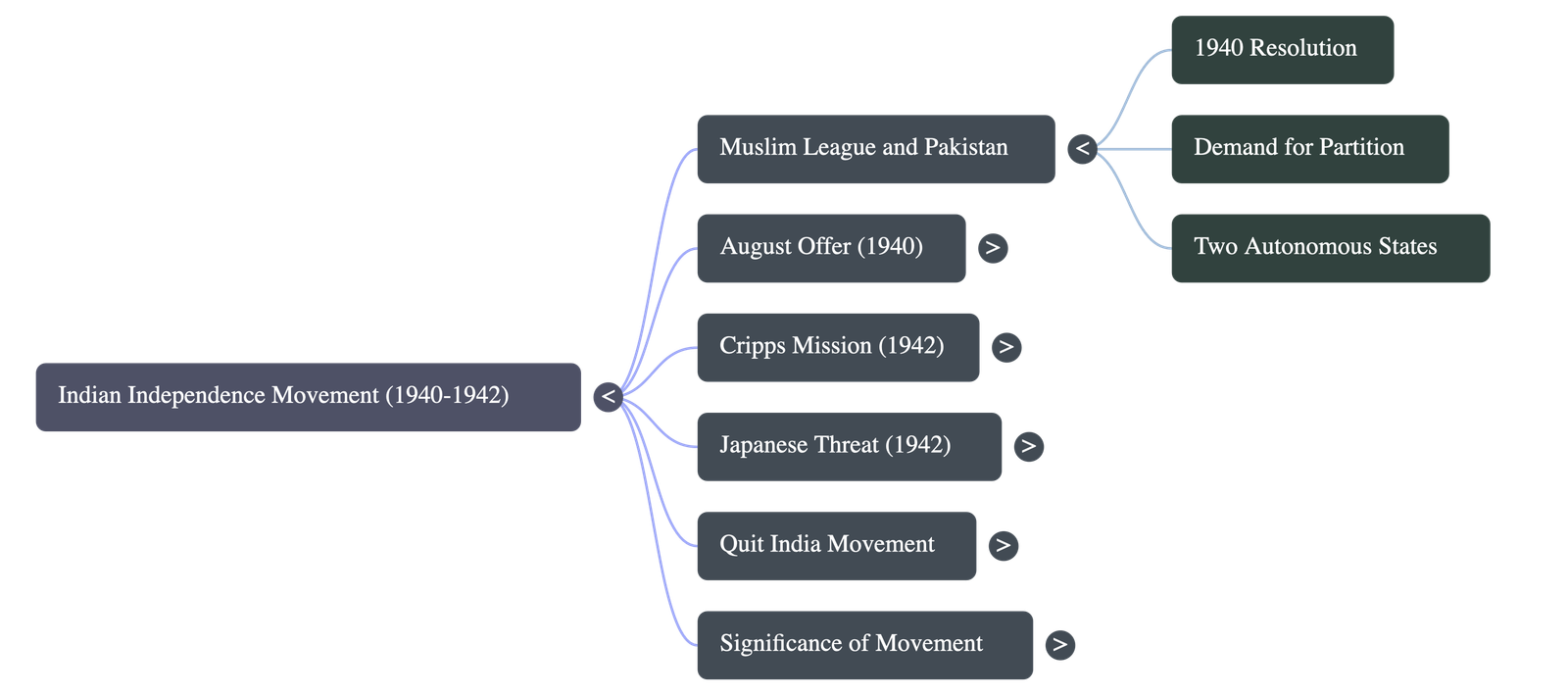
1. Background: Changing Attitudes and Demand for Pakistan
- Resignation of Congress Ministries: In October-November 1939, the Congress Ministries resigned because the Viceroy declared India at war with Germany without consulting Indian leaders. The Muslim League celebrated this resignation as a 'day of deliverance and thanks-giving.'
- Change in Muslim League's Stance: After the 1937 elections, the Muslim League and M.A. Jinnah claimed that Muslims could not expect justice from the Congress.
- The Demand for Pakistan (1940): The Muslim League passed a resolution demanding the partition of India into two autonomous states, proposing a separate state called Pakistan.
- Origin of the Name: The word 'Pakistan' was derived from the provinces of Punjab, Afghan (North-West Frontier Province), Kashmir, Sind, and Baluchistan.
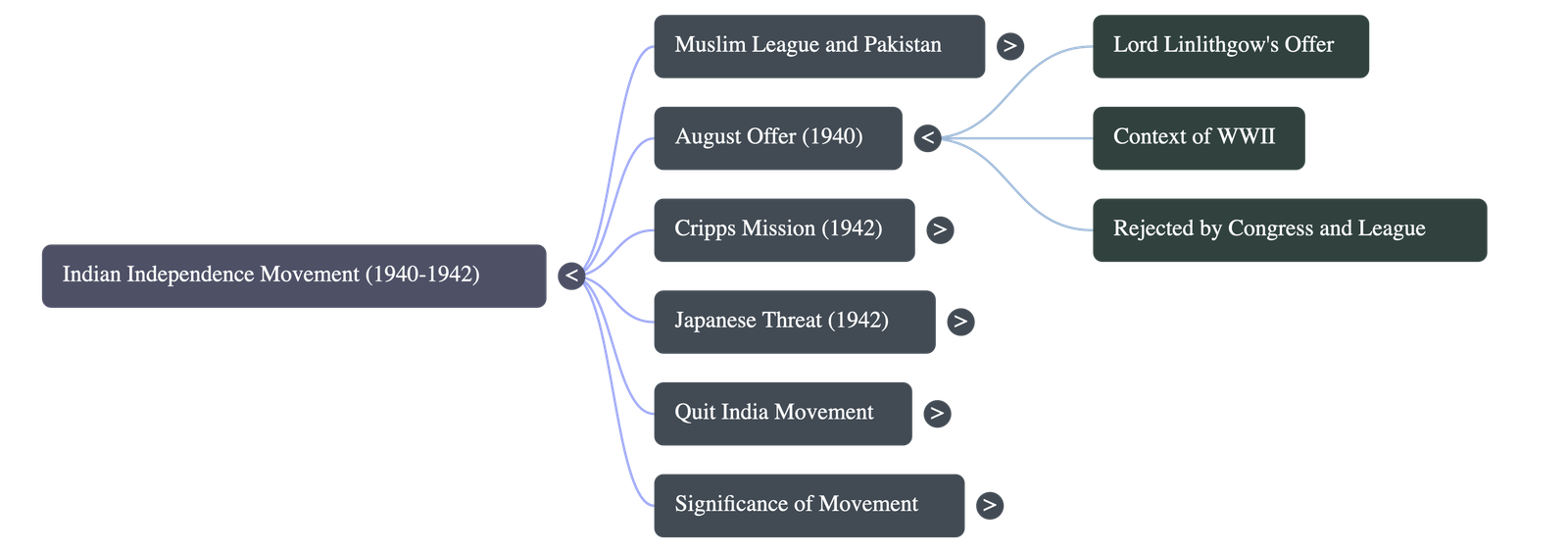
2. The August Offer (1940)
- International Pressure: With Winston Churchill becoming Prime Minister and the war situation worsening in Europe (like the fall of France), the British were forced to seek a settlement with the Congress.
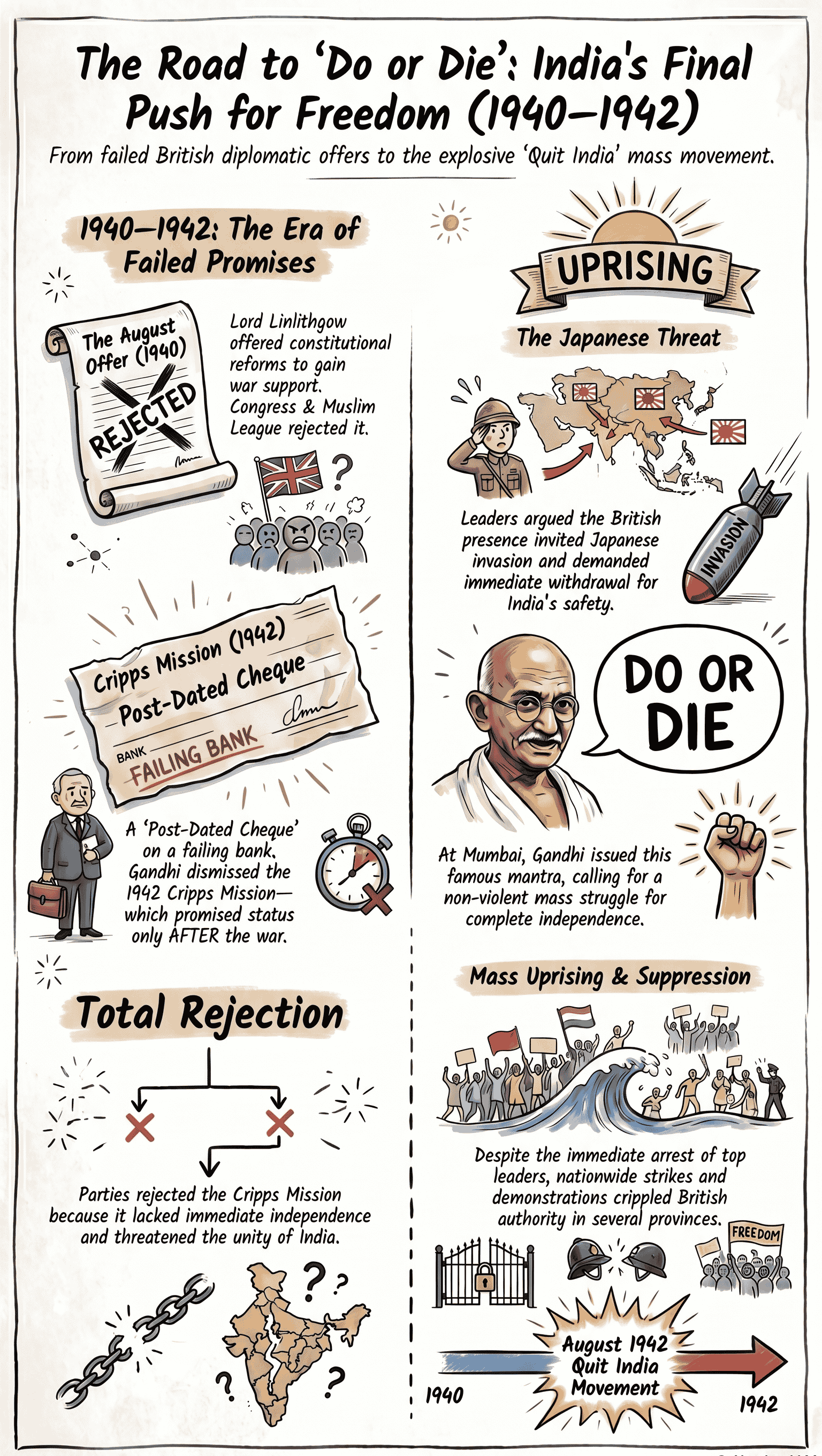
- The Proposal: On August 8, 1940, the Viceroy, Lord Linlithgow, made a new offer known as the 'August Offer'.
- Rejection by Congress: The Congress rejected the offer completely because Gandhiji maintained that India did not seek independence out of British ruin.
- Rejection by Muslim League: The League did not accept it because it did not give a clear assurance for the establishment of Pakistan, even though the British assured that no constitution would be adopted without minority agreement.
3. The Cripps Mission (1942)
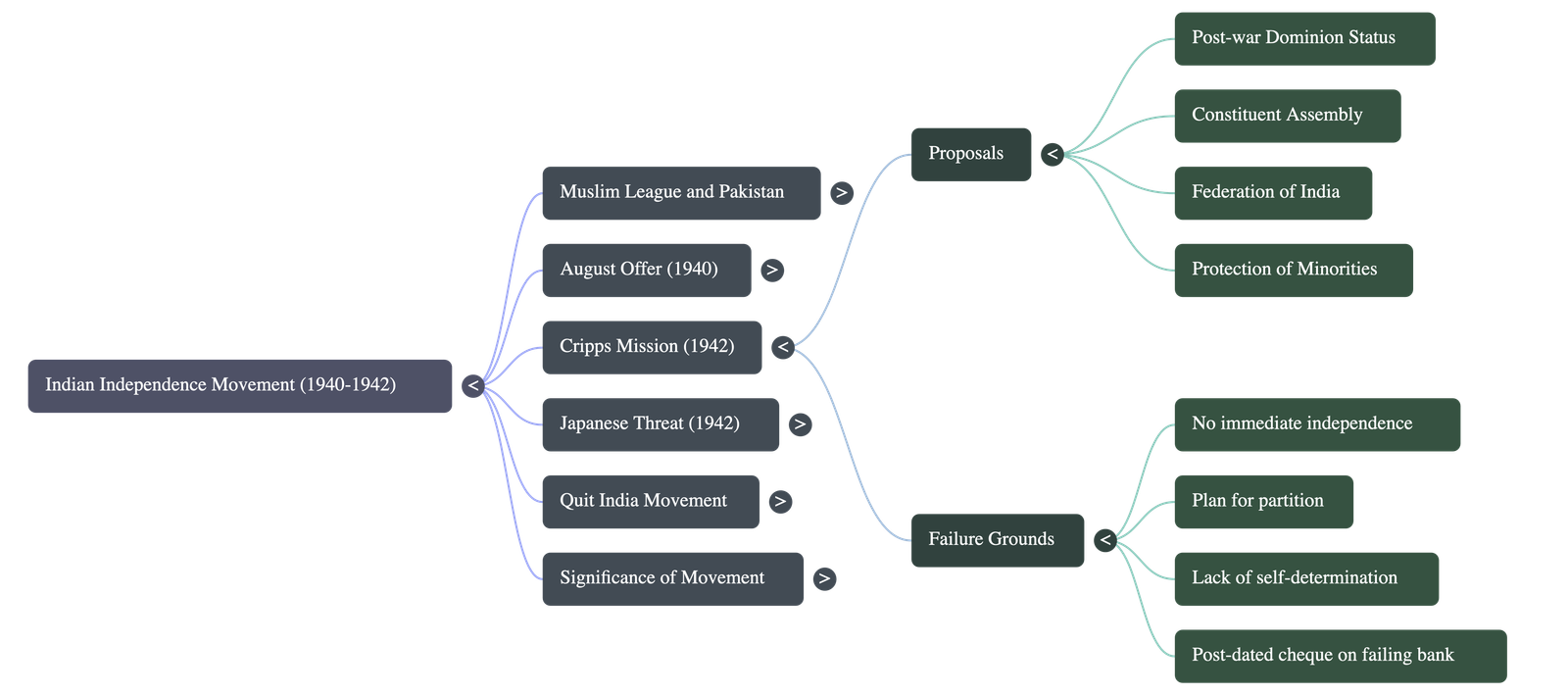
With the Japanese army rapidly advancing towards India, Churchill sent Sir Stafford Cripps to India in March 1942 to break the political deadlock. The Cripps Mission proposed the following Constitutional reforms:
- India would be given Dominion Status after the War, with freedom to remain in the British Commonwealth or secede.
- A Constituent Assembly would be set up to draft a new Constitution, consisting of elected members from the Lower House and nominated representatives from Princely States.
- There would be a federation of British India and Indian States. Any province not prepared to accept the Constitution could obtain separate Dominion Status.
- Provinces would be free to join the Indian Union or formulate their own separate Constitutions.
- An undertaking would be negotiated covering the complete transfer of responsibilities.
- Provisions would be made for the protection of racial and religious minorities.
- During the war, the Viceroy would retain his power and remain responsible for the defence of the country.
4. Failure of the Cripps Mission
Almost all parties rejected the proposals for the following reasons:
- It did not promise independence in the near future.
- The plan indirectly involved partitioning the country.
- Muslim League: Opposed a single union and rejected it because it did not explicitly accept Pakistan or grant self-determination to Muslims.
- Hindu Mahasabha: Rejected it fearing the partition of the country.
- Minorities: Sikhs, Anglo-Indians, and Indian Christians opposed it due to a lack of sufficient safeguards.
- Princely States: The people had no right to send their representatives; they were to be selected by the rulers.
- Congress Response: Opposed the principle of non-accession of provinces. Mahatma Gandhi famously called the proposals a 'post-dated cheque on a failing bank'.
- Congress insisted on the immediate formation of a National Government with full responsibility, including Defence.
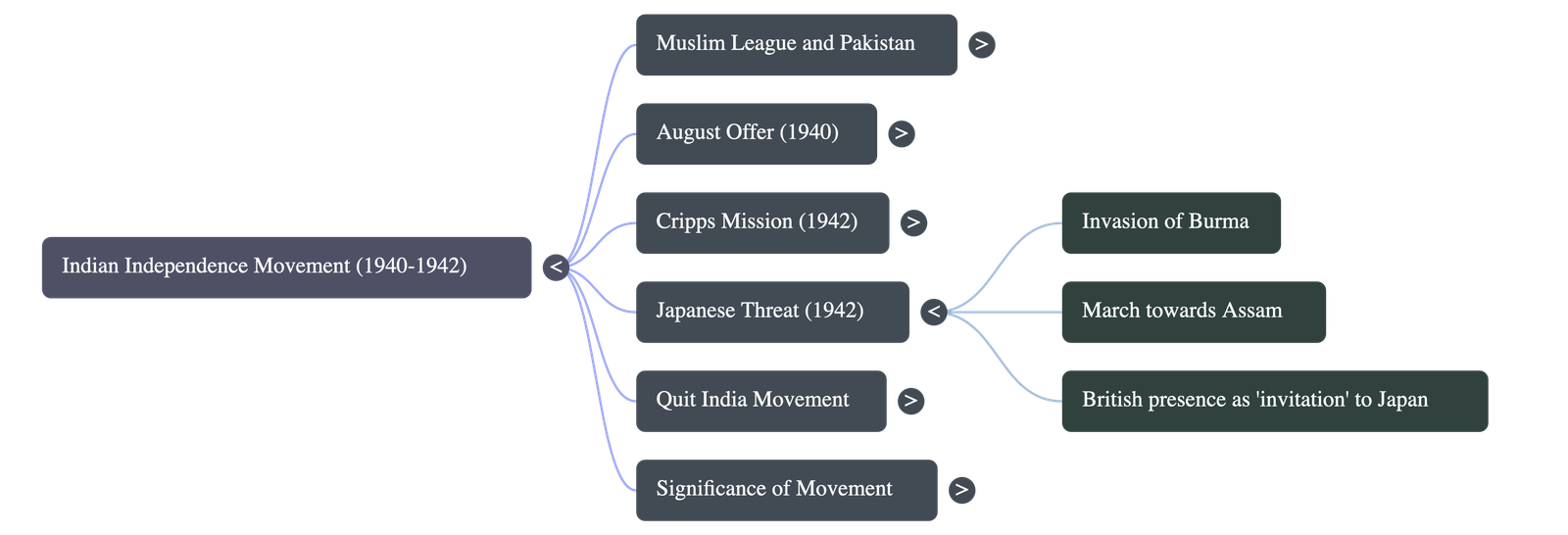
5. The Japanese Threat
- The War situation was discouraging. The Japanese Army had attacked Burma and was marching towards Assam.
- Gandhiji felt that the presence of the British in India was an invitation for Japan to invade. He stated that Britain's withdrawal would remove the bait.
- Indian leaders wanted to save their country, leading Gandhiji to ask the British to "leave India in God's hands."
6. Quit India Resolution and the Mass Movement
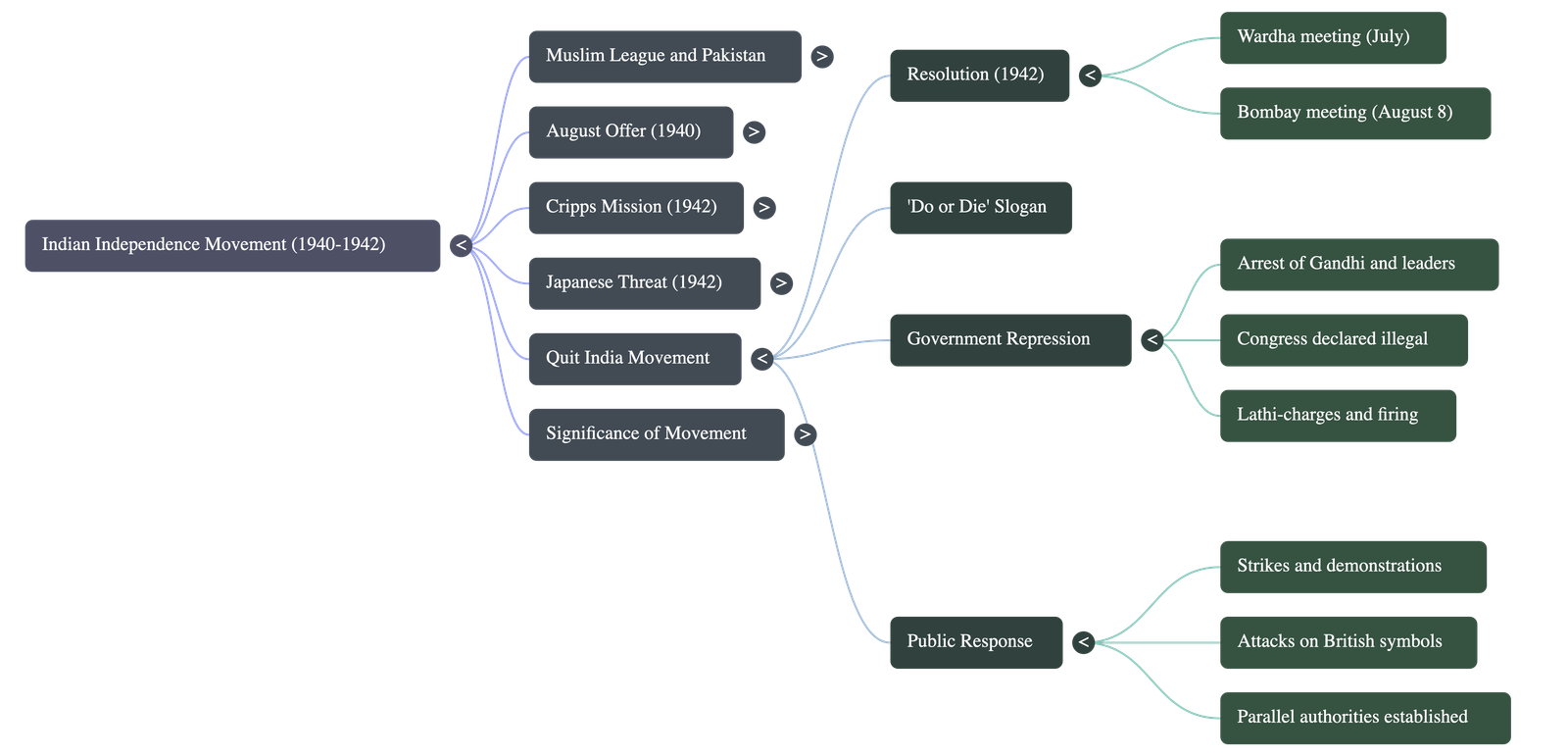
- Wardha Session (July 1942): The Congress Working Committee adopted the Quit India Resolution stating, 'British rule in India must end immediately.'
- Bombay Session (August 8, 1942): The All-India Congress Committee passed the resolution and proposed a non-violent mass struggle under Gandhiji's leadership.
- "Do or Die": Gandhiji delivered a powerful speech, giving the nation the mantra to "Do or Die" to achieve complete independence.
- Government Crackdown (August 9, 1942): Before the movement could officially begin, the British arrested Gandhiji and other top leaders early in the morning and declared the Congress an illegal organization.
- The Uprising: The arrests triggered massive nationwide strikes and demonstrations. People were lathi-charged and fired upon.
- Attack on British Symbols: The public attacked police stations, post offices, and railway stations. National flags were hoisted on public buildings.
- Temporary Collapse of Rule: British authority practically disappeared in parts of Uttar Pradesh, Bihar, West Bengal, Odisha, Andhra Pradesh, Tamil Nadu, and Maharashtra.
7. The Significance of the Quit India Movement
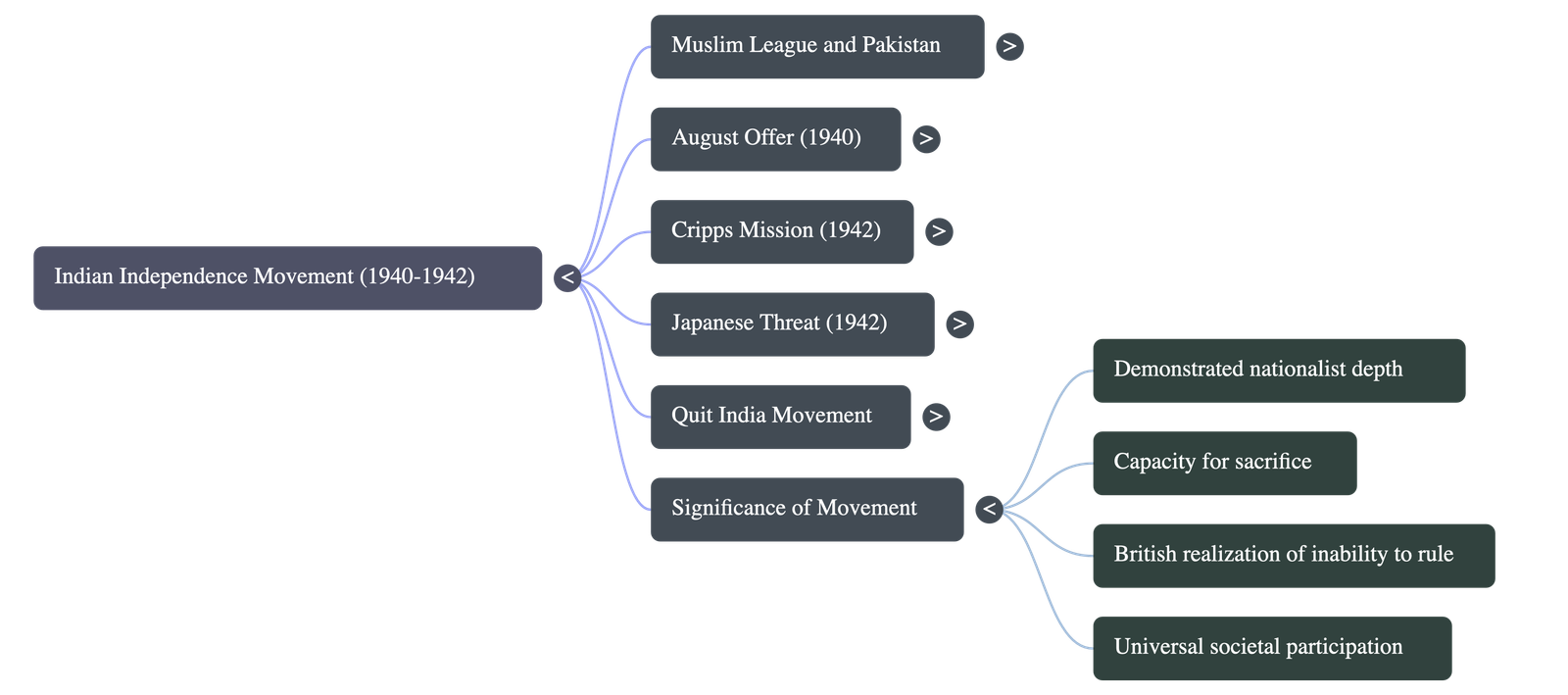
- Despite being ruthlessly crushed by the British government, it successfully demonstrated the immense depth of nationalist feeling in India.
- It showcased the extraordinary capacity of Indians for struggle and sacrifice.
- It made it completely clear to the British authorities that they would no longer find it possible to rule India against the wishes of its people.
- It was a true mass movement because people from all sections of society enthusiastically participated.
Study hard, Class 10! Make sure you memorize the reasons for the failure of the Cripps Mission and the true significance of the Quit India movement, as these are very important for your board exams.
Do checkout all questions & answers of this chapter.
Quick Navigation:
| | | |
1 / 1
Quick Navigation:
| | | |