Quick Navigation:
| | | |
The First World War
Introduction: A Turning Point in World History
- In 1914, a massive war began in Europe that eventually engulfed almost the entire world, including Asia, Africa, and the Pacific.
- It was uniquely fought on a worldwide scale and deeply affected civilian populations, making it different from any previous wars.
- Because of its unprecedented spread, terrible impact, new methods of destruction, and total nature, it came to be known as the First World War.
Causes of the First World War
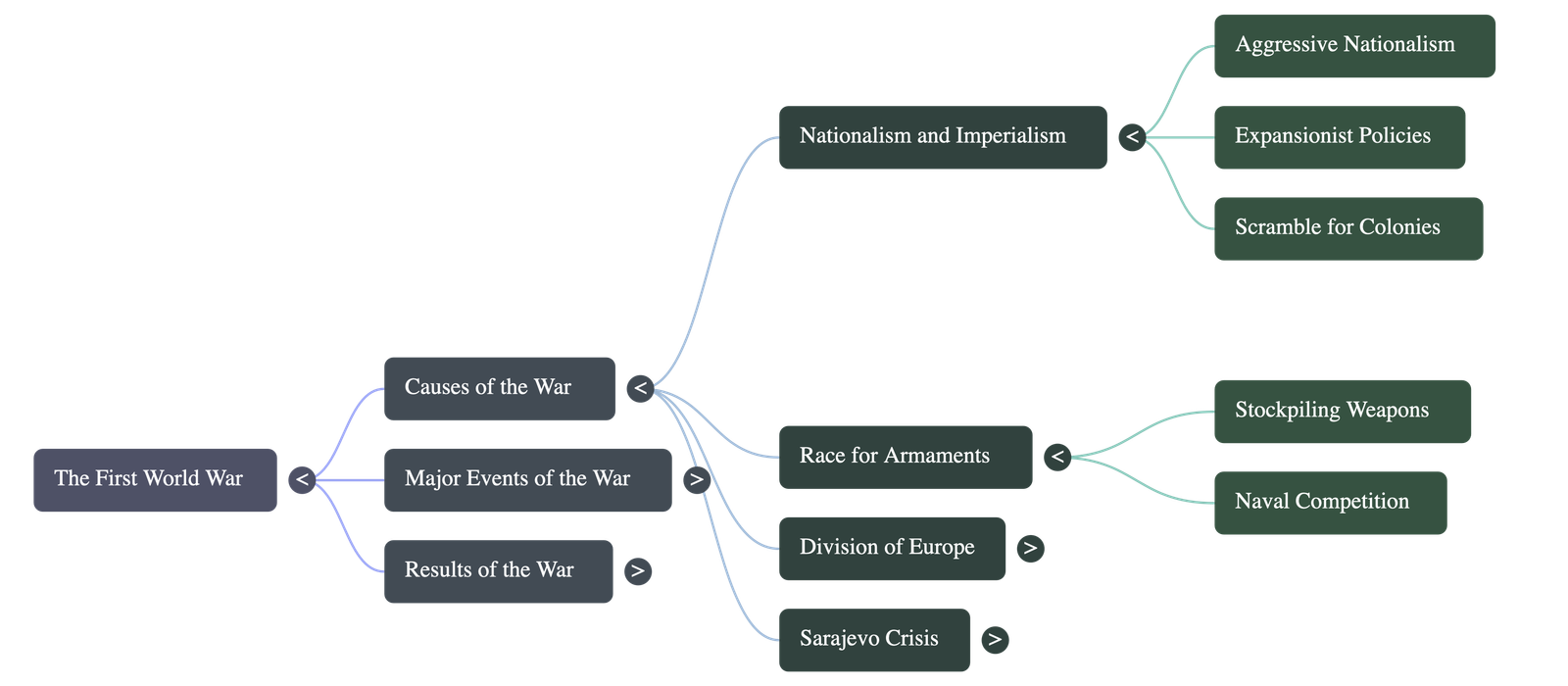
1. Nationalism and Imperialism
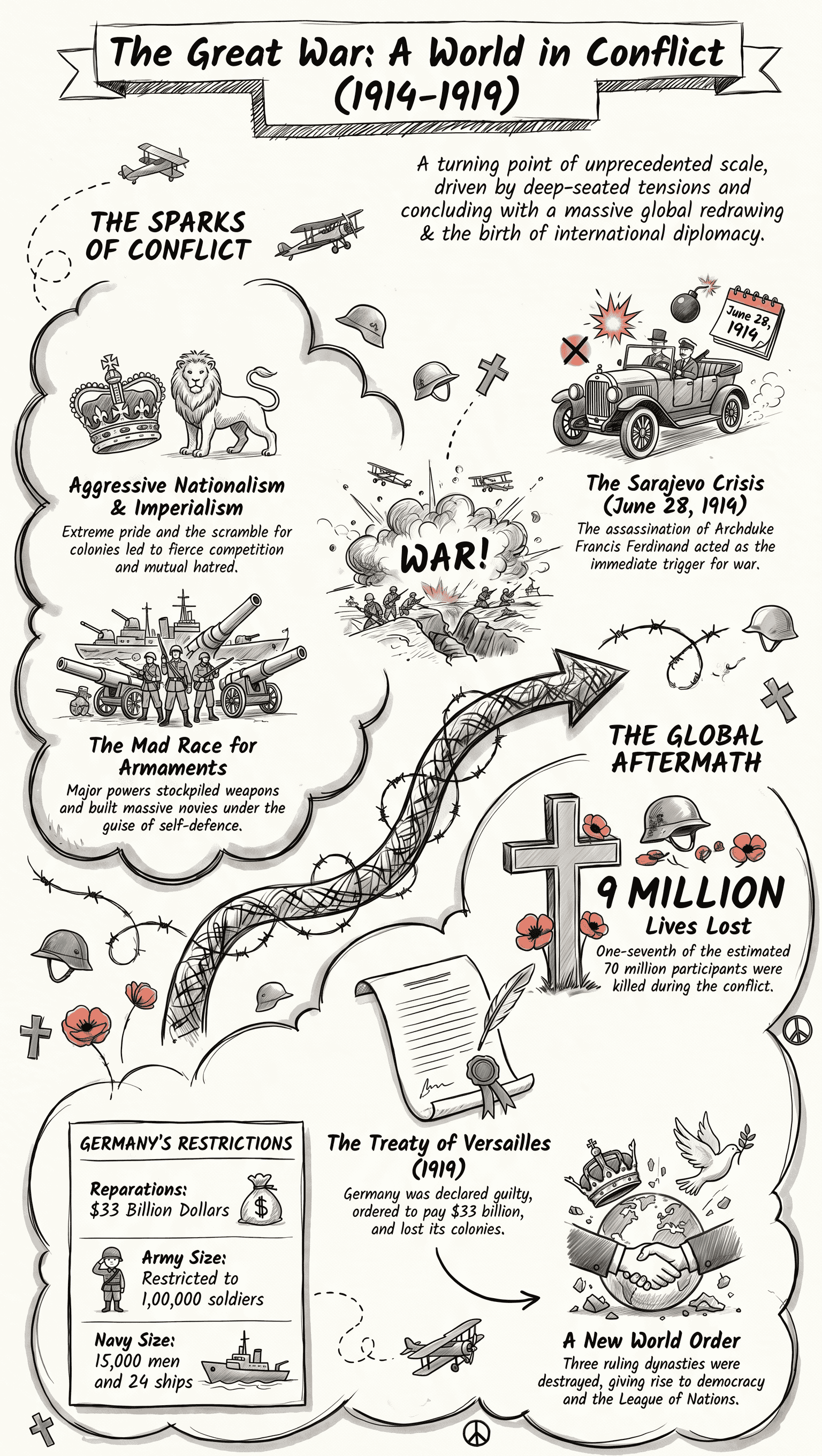
- Aggressive Nationalism: Nationalism (a sense of unity) turned into extreme pride in the late 19th century. It meant loving one's own country while hating others.
- Examples: France wanted Alsace and Lorraine back from Germany; Italy wanted Trentino and Trieste from Austria; Serbians and Slavs in the Balkans wanted a united greater Balkan State.
- Rise of Imperialism: This aggressive pride led to imperialism, where powerful nations conquered other countries for political control, raw materials, cheap labor, and trade markets.
- By the end of the 19th century, England and France had huge empires. New powers like Germany, Italy, Russia, and Japan scrambled to acquire their own colonies, leading to fierce economic competition, international tension, and mutual hatred.
2. Race for Armaments
- Following the Franco-Prussian War (1870), major powers began aggressively stockpiling weapons in the name of self-defense.
- Germany began building a massive navy to rival Britain. They built the Imperator in 1912 (the largest ship in the world at the time) and deepened the Kiel Canal for battleships.
- This fierce military competition filled Europe with fear and convinced leaders that militarism was the only way to solve international problems.
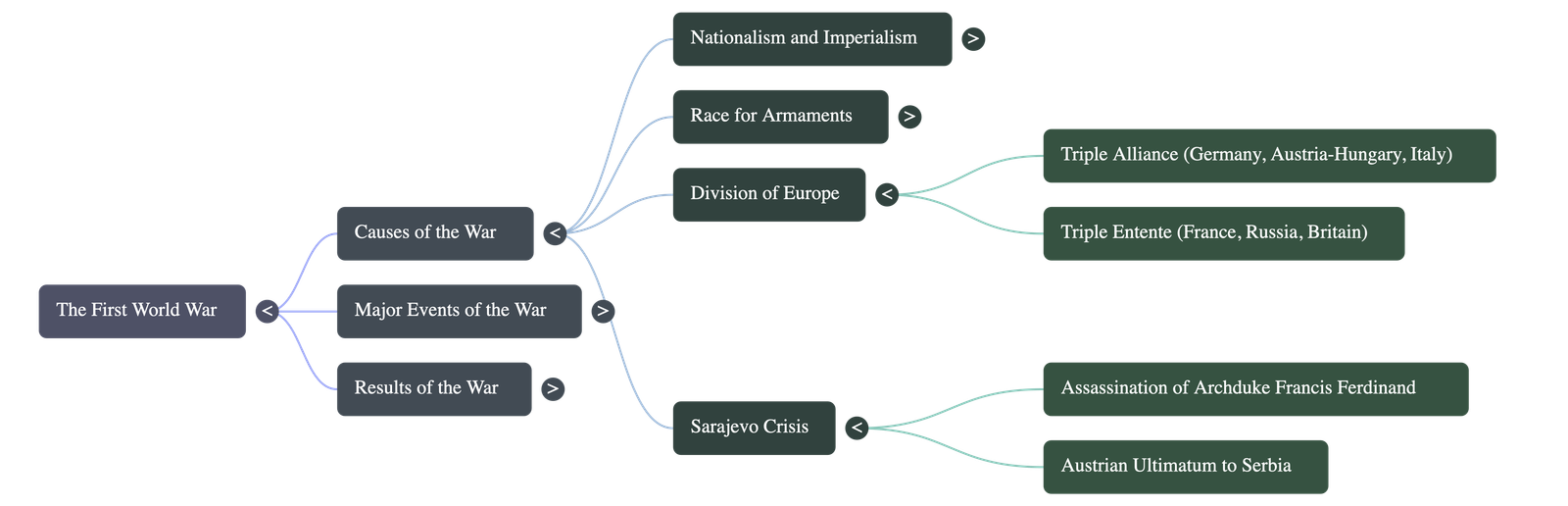
3. Division of Europe into Two Hostile Groups
- Europe divided into two main camps: Single Nation-States (France, Holland, Germany) and Imperial States (Austria-Hungarian Empire, Russian Empire).
- Triple Alliance (1882): Germany, Austria-Hungary, and Italy.
- Triple Entente (1907): Britain, Russia, and France formed an alliance to counter the Triple Alliance.
- These rival alliances turned Europe into two hostile camps where suspicion and tension eventually erupted into open war.
4. Sarajevo Crisis (Immediate Cause)
- On June 28, 1914, Archduke Francis Ferdinand (heir to the throne of Austria-Hungary) was assassinated in Sarajevo, Bosnia.
- The assassination was carried out by the 'Black Hand' (or 'Union of Death'), a secret society of extremist Serbian nationalists.
- Austria served an 11-point ultimatum to Serbia on July 23. Serbia accepted most demands but refused the ones that threatened its sovereignty.
- As a result, Austria declared war on Serbia on July 28, 1914. Subsequently, Germany declared war on Russia and France, and Britain declared war on Germany, formally starting the First World War.
Events of the World War
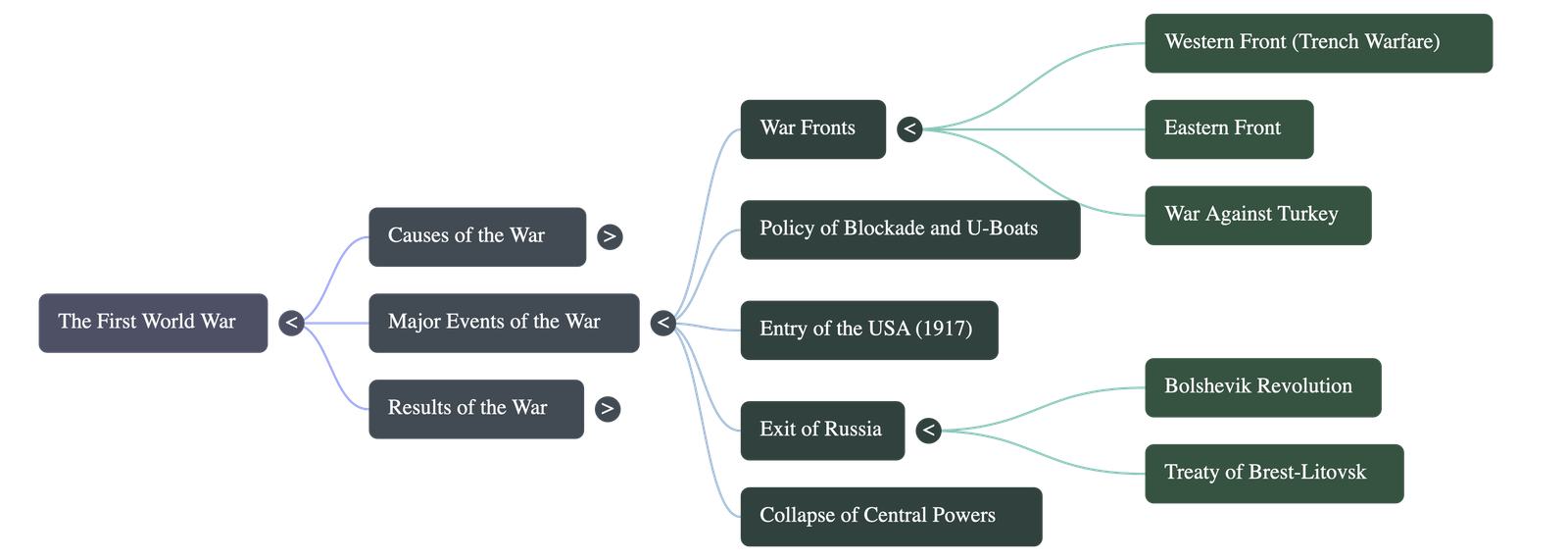
- The Opposing Sides: Britain, France, Russia, and their allies were called the Allied Powers. Germany, Austria, and their allies were called the Central Powers.
- The Fronts & Warfare: The war was fought on multiple fronts (Western, Eastern, Middle East, and at sea). It introduced deadly Trench Warfare, where soldiers lived in mud, facing rats, cold, disease, and poison gas.
- Policy of Blockade: Both sides tried to starve each other by blockading goods. Germany heavily used U-boats (submarines) to sink British and Allied ships.
- Entry of the USA (1917): In 1915, a German U-boat sank the British ship Lusitania, killing 128 Americans. Because of this, and fearing economic losses if Germany won, the USA declared war on Germany on April 6, 1917.
- Exit of Russia: After heavy losses and the October Revolution of 1917, Russia under Lenin's Bolsheviks withdrew from the war, signing the Treaty of Brest-Litovsk with Germany in March 1918.
- End of the War: The Allies launched a massive offensive in July 1918. The Central powers collapsed, the German Emperor fled to Holland, and Germany signed an armistice on November 11, 1918. Around 9 million people died during the war.
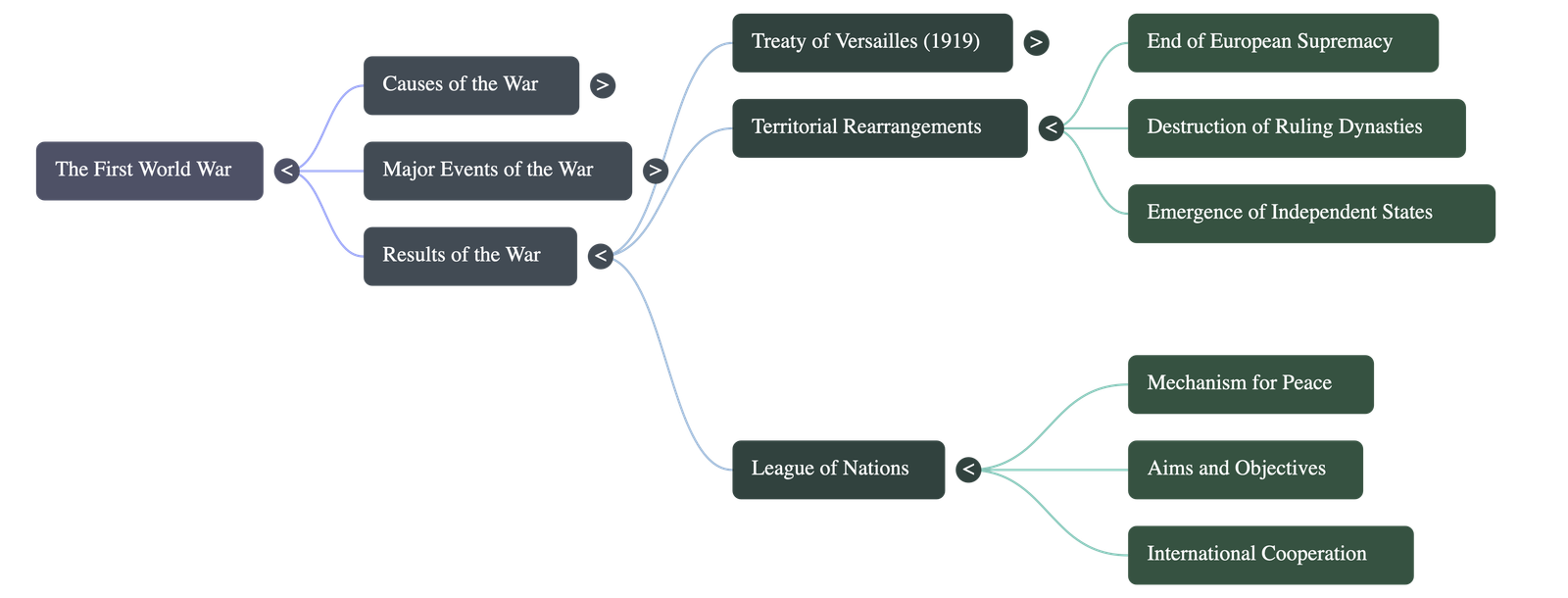
Results of the War
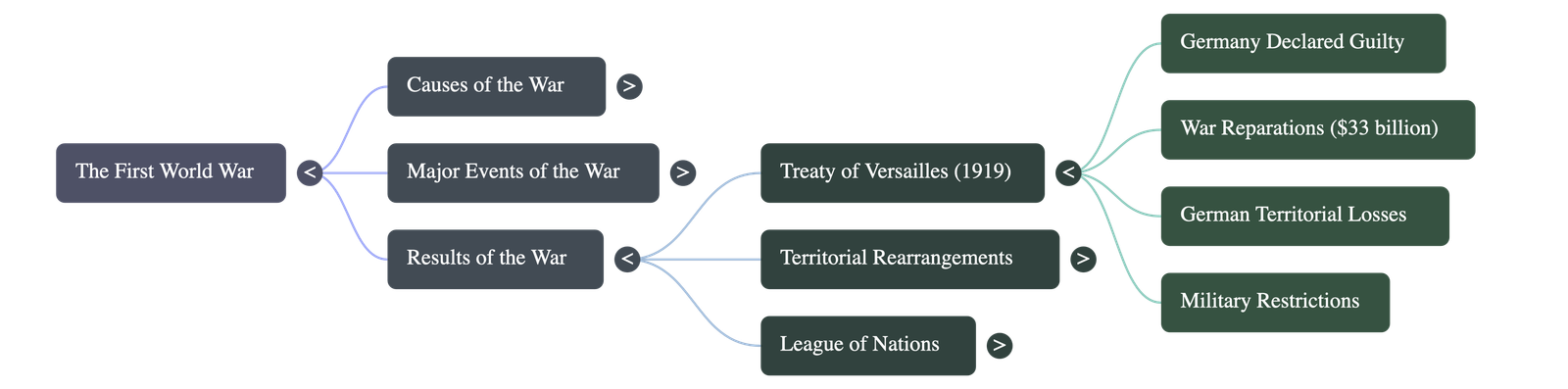
1. The Treaty of Versailles (June 28, 1919)
- Signed at the Paris Peace Conference, primarily dictated by Woodrow Wilson (USA), Lloyd George (Britain), and George Clemenceau (France). Defeated nations and Russia were excluded.
- Key Terms IMPOSED on Germany:
- Declared completely guilty for starting the war.
- Forced to pay massive reparations fixed at 33 billion dollars.
- The rich Rhine Valley was demilitarized.
- Lost Alsace-Lorraine to France, Eupen-Malmedy to Belgium, and Schleswig to Denmark.
- The coal-rich Saar region was given to France for 15 years.
- Lost all overseas colonies in Africa and the Pacific to the victorious Allies.
- The German military was severely reduced: Army limited to 1,00,000 men, Navy to 15,000 men. Air force and submarines were strictly banned.
2. Territorial Rearrangements
- The war ended European global supremacy, and the United States emerged as the new world power.
- Three massive ruling dynasties were destroyed: the Romanovs in Russia, the Hohenzollerns in Germany, and the Hapsburgs in Austria-Hungary. The Ottoman Empire in Turkey also ended.
- New independent nations emerged, such as Czechoslovakia, Yugoslavia, Finland, Estonia, Latvia, and Lithuania.
3. Formation of the League of Nations
- The immense horrors of the war convinced world leaders they needed a global mechanism to prevent future wars and ensure peace.
- This led to the creation of the League of Nations in 1920, born out of US President Woodrow Wilson's "Fourteen Points."
Aims and Objectives of the League of Nations
- All member states were strictly prohibited from entering into any secret treaties and alliances.
- Members were instructed not to maintain huge armies, warships, or destructive armaments.
- All states had to respect the independence and territorial integrity of each other.
- Nations were required to refer their mutual disputes to the League of Nations for a peaceful settlement rather than going to war.
- Members had to take collective military or economic action against any State that tried to disturb world peace.
- Beyond politics, the League was supposed to promote cultural, social, and economic cooperation globally.
- Why it failed: The USA never joined, Germany and the Soviet Union were initially excluded, and it failed to stop the rise of dictatorships in Italy and Germany. It officially collapsed when Hitler invaded Poland in 1939, starting World War II.
End of Chapter Summary. Best of luck with your ICSE Class 10 History preparation!
Do checkout all questions & answers of this chapter.
Quick Navigation:
| | | |
1 / 1
Quick Navigation:
| | | |