Quick Navigation:
| | | |
The Second World War
Hello Students! As your History teacher, I have prepared this comprehensive, point-wise summary of "The Second World War" to help you master the chapter for your ICSE Class 10 board exams. Read through these carefully, as they cover every single section from your textbook in detail.
1. Introduction
- The harsh peace treaties of the First World War sowed the seeds for the Second World War.
- It was not merely a continuation of the First World War; the causes and characteristics were much deeper.
- The destruction caused by this war surpassed all previous conflicts, bringing the world to the brink of total annihilation.
2. Causes of World War II
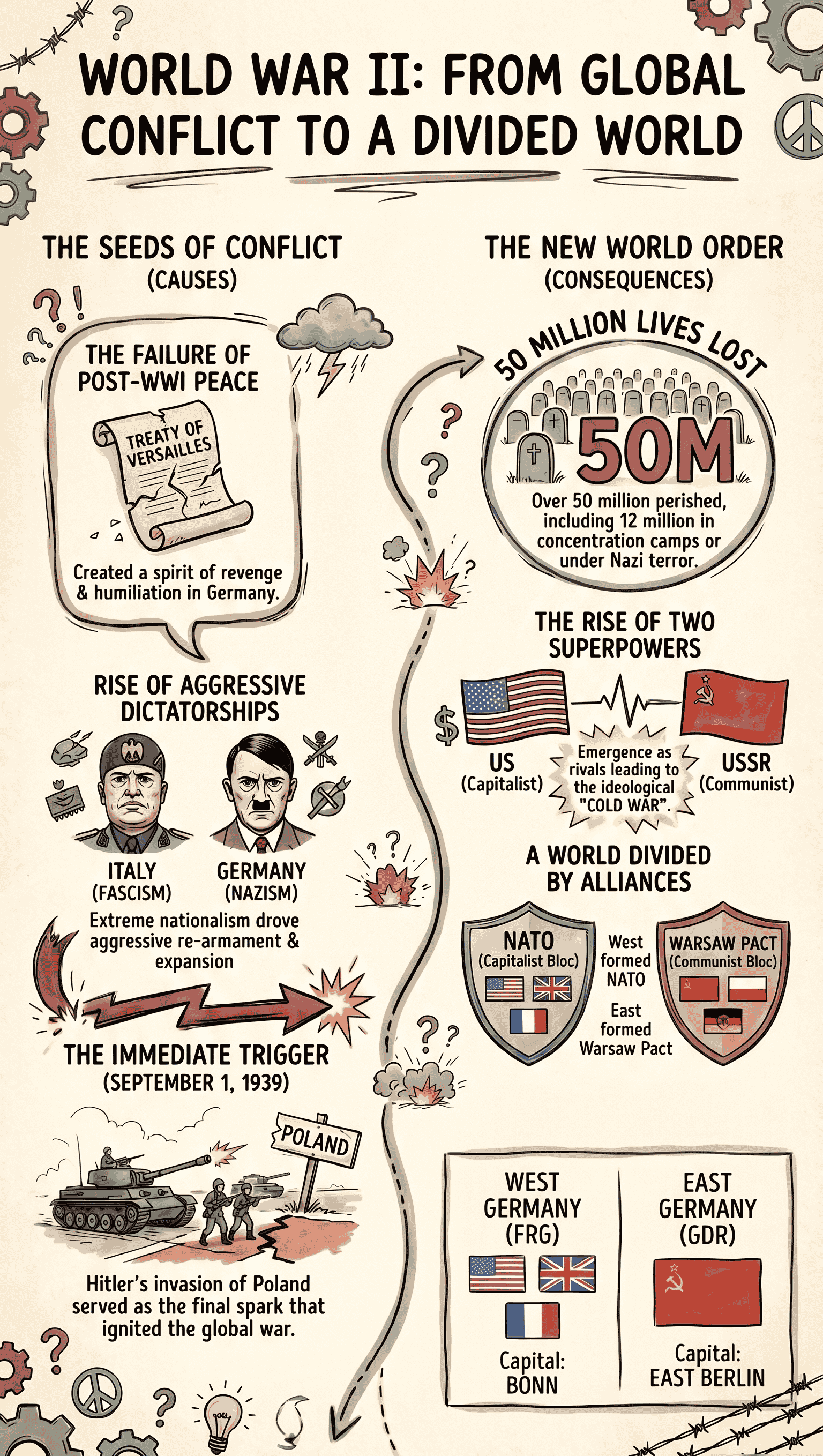
Although Germany's invasion of Poland was the immediate trigger, the real causes were varied and deeply rooted:
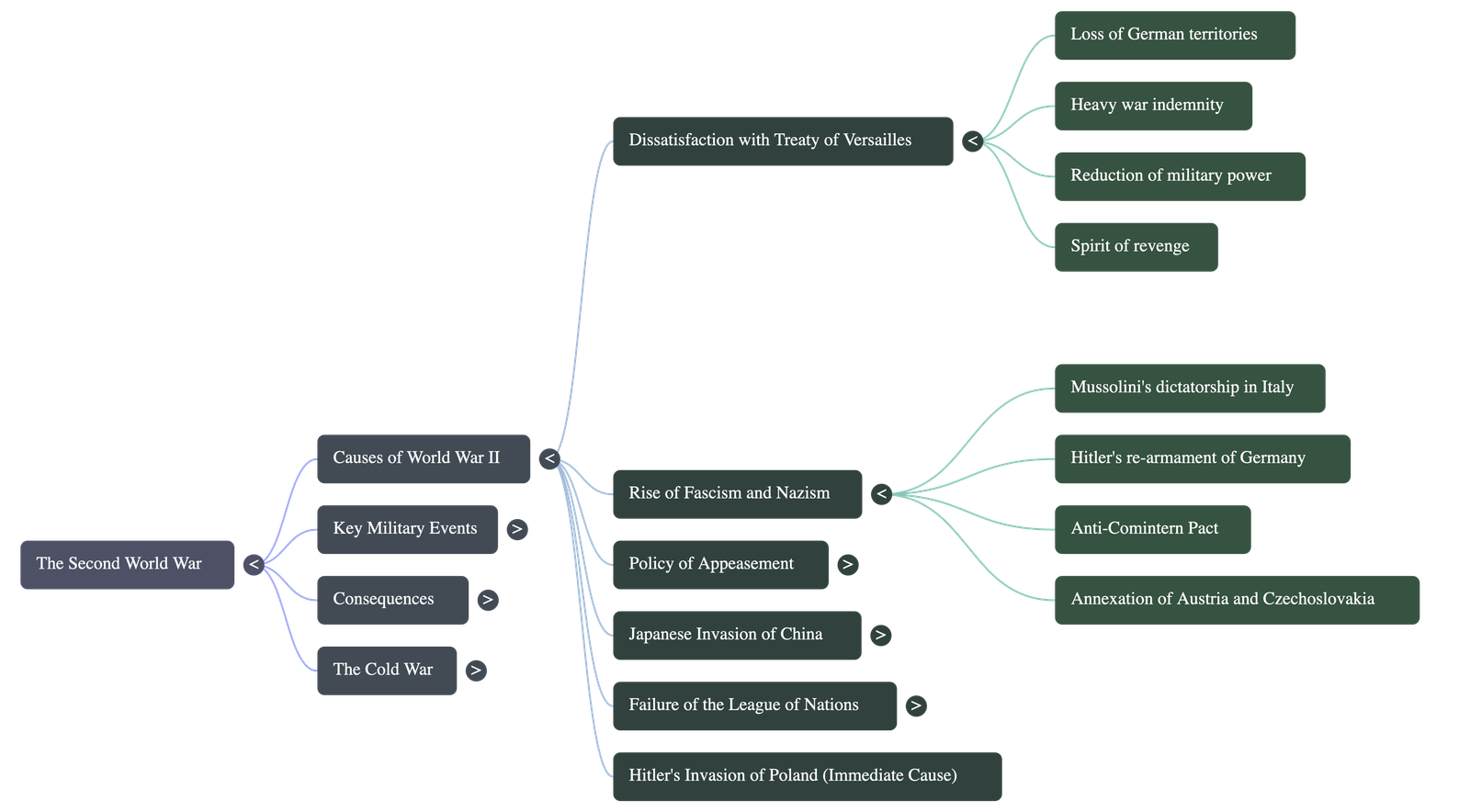
I. Dissatisfaction with the Treaty of Versailles
- The treaty created more problems than it solved, as it was based on a spirit of revenge against Germany.
- Germany was divided to benefit Poland, burdened with huge, unpayable war indemnities, and her military power was strictly reduced.
- All German colonies were forcibly confiscated.
- This extreme humiliation gave rise to a strong spirit of revenge, making Germany look for an opportunity to break free from the harsh treaty through aggressive policies.
II. Rise of Fascism and Nazism
- Extreme nationalism emerged in Italy (Fascism under Mussolini) and Germany (Nazism under Hitler).
- Italy: Mussolini established a dictatorship, opposed the Treaty of Versailles, and sought to revive the glory of the Old Roman Empire. He demonstrated imperialistic designs by attacking Abyssinia.
- Germany: Hitler wanted to re-establish German prestige. He openly flouted the military clauses of the Versailles Treaty and declared re-armament.
- Hitler annexed Austria and dismembered Czechoslovakia.
- Italy and Germany formed a ten-year alliance in 1939, driving the world towards another global war.
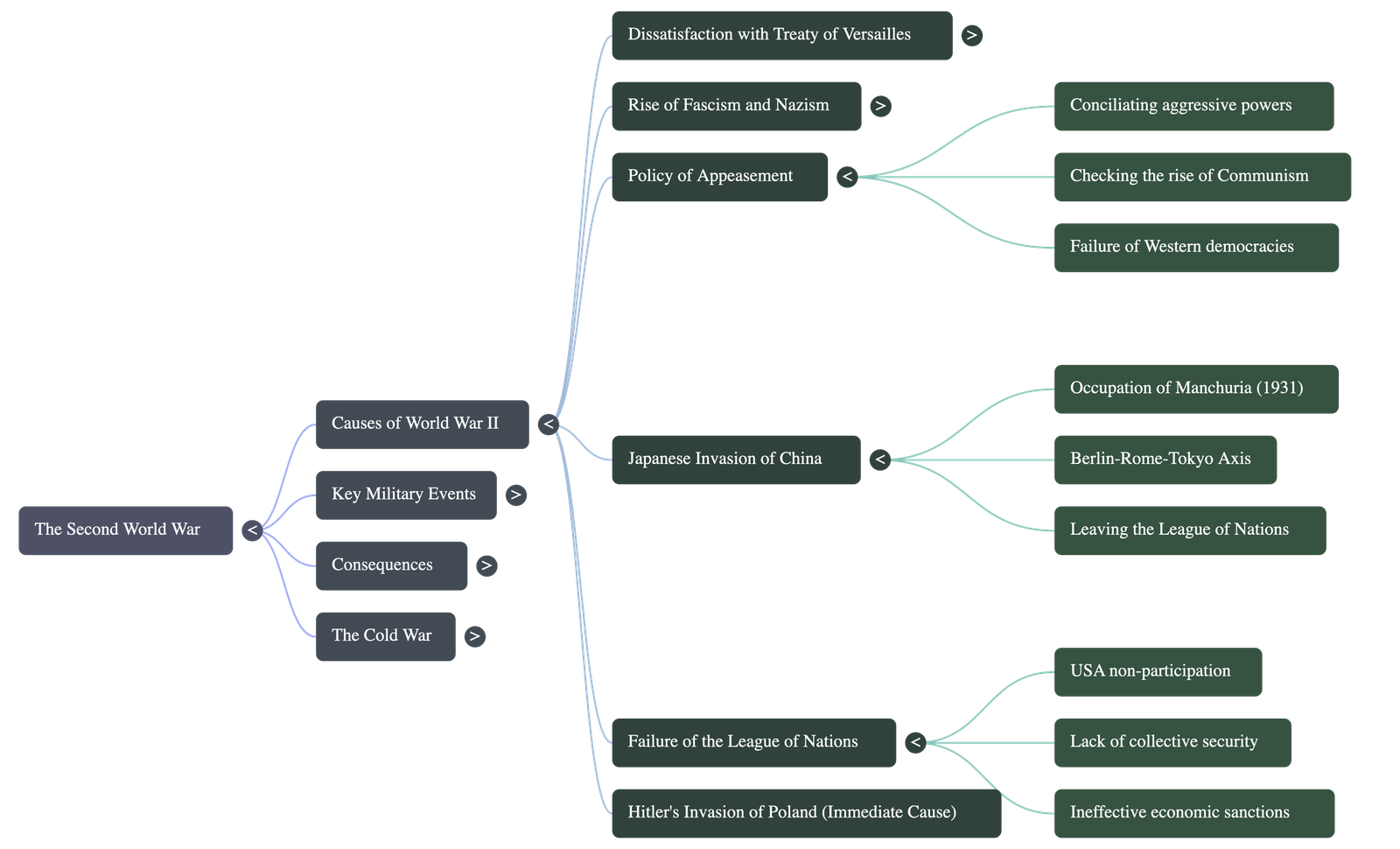
III. Policy of Appeasement
- Appeasement means accepting the hostile demands of an aggressive nation to gain peace.
- Britain and France followed this policy towards Germany and Italy because they felt the dictators had genuine grievances regarding the humiliating Treaty of Versailles.
- Western powers also wanted to use Germany and Italy as a shield to check the rising tide of Communism and Russian Bolshevism.
- Due to this policy, Germany was allowed to rearm, re-militarise the Rhineland, and capture Austria and Czechoslovakia without facing immediate opposition.
IV. Japanese Invasion of China
- Japan's ambitions to dominate the Far East rose significantly after the First World War.
- In 1931, Japan invaded and occupied Manchuria, setting up a government there despite opposition from the League of Nations.
- Japan started an undeclared war against China. The League of Nations failed to declare sanctions against Japan.
- In 1933, Japan left the League of Nations and began occupying British and American properties in China.
- Britain and France appeased Japan, hoping it would weaken China, making war inevitable in the East.
V. Failure of the League of Nations
- Created after WWI to prevent future wars, the League suffered a fatal early blow when the USA refused to join.
- The League succeeded in small disputes but failed entirely against major determined aggressors (e.g., Japan in Manchuria, Italy in Ethiopia).
- Its coercive machinery was inadequate, and member states refused to apply economic sanctions because it hurt their own economies.
- Countries lost faith in the League and started entering into mutual political and military alliances instead.
VI. Hitler's Invasion of Poland (Immediate Cause)
- By the Treaty of Versailles, Germany had been divided into two parts to give Poland a land-route to the sea, along with the Port of Danzig.
- Hitler wanted to regain these lost territories.
- On September 1, 1939, German armies marched into Poland.
- In response, Britain and France declared war on Germany on September 3, 1939, marking the official beginning of the Second World War.
3. Key Events of the War (Brief Mentions)
Attack on Pearl Harbour
- On December 7, 1941, Japan launched a surprise aerial attack on the US naval base at Pearl Harbour in Hawaii.
- The attack destroyed major US battleships and aircraft, killing over 3,000 people.
- This forced the USA to abandon its neutrality and officially join the war on the side of the Allies on December 8, 1941.
Bombing of Hiroshima and Nagasaki
- In 1945, desperate Japanese forces used 'kamikaze' (suicide) pilots to crash explosive-laden planes into American ships, making a land invasion of Japan seem too costly.
- The US had developed the world's most powerful weapon—the atomic bomb.
- On August 6, 1945, the first atomic bomb was dropped on the Japanese city of Hiroshima, killing thousands instantly.
- When Japan still refused to surrender, a second bomb was dropped on Nagasaki on August 9, 1945.
- Japan finally surrendered unconditionally on August 15, 1945. The formal surrender document was signed on September 2, 1945 (V-J Day), bringing the war to an end.
4. Consequences of the Second World War
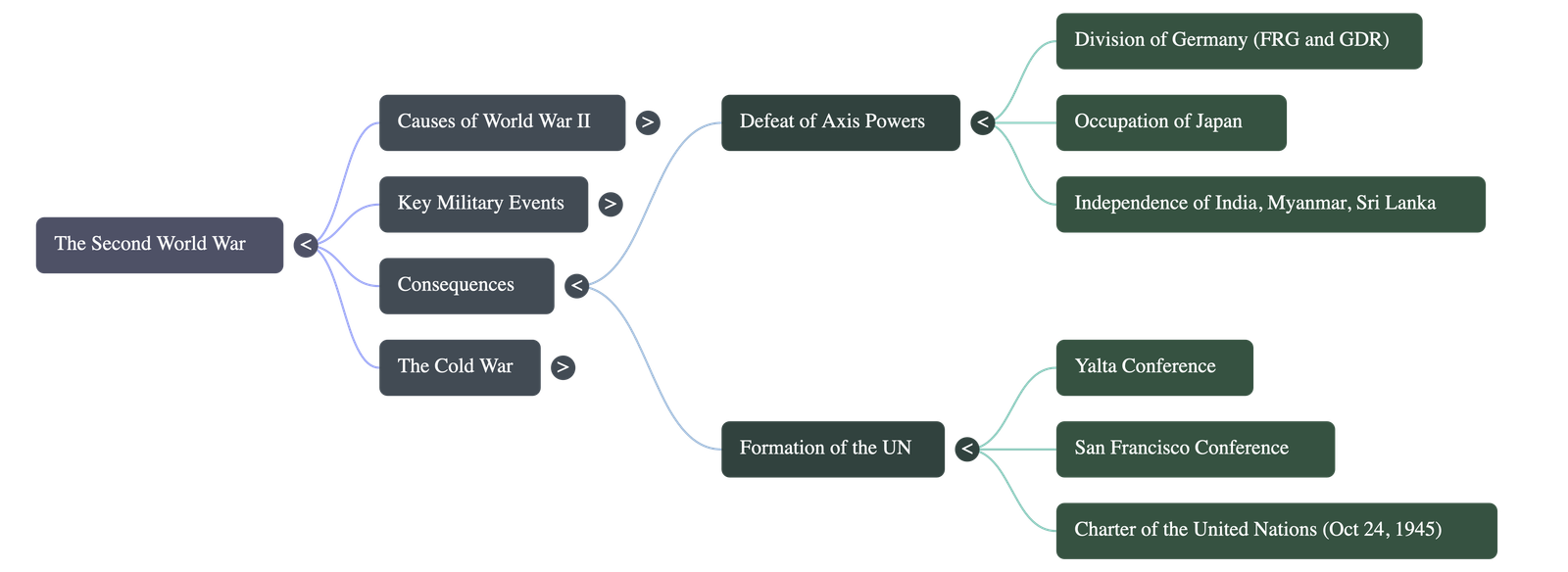
I. Defeat of the Axis Powers
- The Allied forces successfully defeated the Axis powers (Germany, Italy, and Japan).
- Division of Germany: Germany was divided into zones administered by the conquering forces:
- West Germany (Federal Republic of Germany - FRG): Administered by the UK, France, and the US with Bonn as its capital. It followed capitalist ideology.
- East Germany (German Democratic Republic - GDR): Administered by the Soviet Union with East Berlin as its capital. It fell under communist ideology.
- Status of Japan and Italy: They became very weak. Japan was occupied by the American army until 1952. Emperor Hirohito was left on the throne merely as a constitutional monarch, and Japan lost all lands acquired since 1895.
II. Formation of the United Nations (UN)
- The catastrophic horrors of the war and the failure of the League of Nations prompted world leaders to create a more robust international peacekeeping body.
- At the Yalta Conference (February 1945), the "Big Three"—Roosevelt (USA), Churchill (Britain), and Stalin (USSR)—resolved to convene a conference of all nations.
- This led to the establishment of the United Nations Organisation on October 24, 1945, at the San Francisco conference.
III. The Cold War
- After the war, the USA and the Soviet Union emerged as the two leading global superpowers.
- The wartime alliance between the USA and the USSR quickly broke down due to ideological differences and mutual suspicion.
- This led to a state of extreme political tension known as the 'Cold War', where both sides tried to strengthen themselves and weaken the other without engaging in direct, armed conflict.
5. The Cold War (Meaning & Alliances)
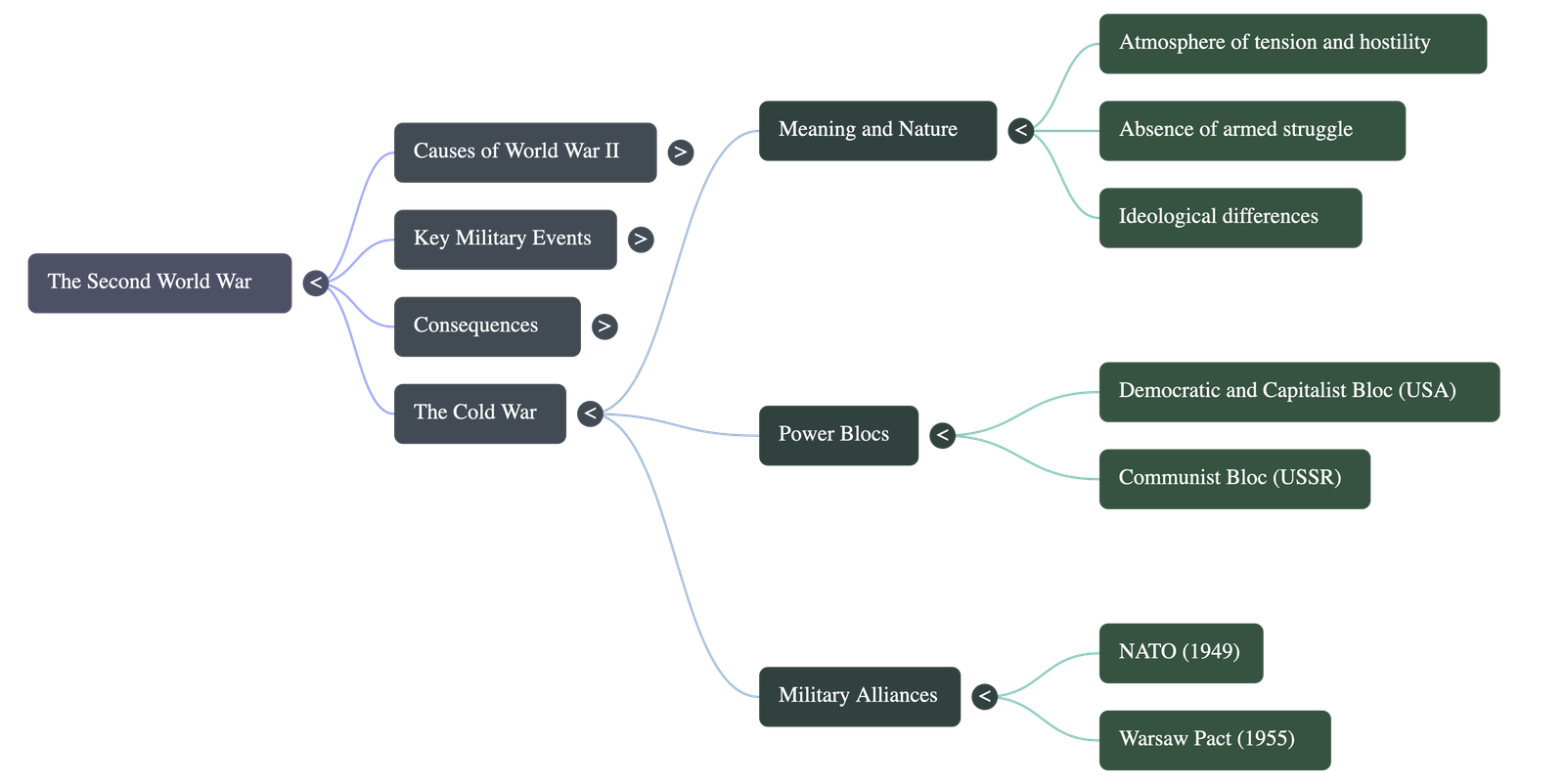
Meaning of Cold War
- The Cold War is defined as an atmosphere where there is no armed struggle, but the rival powers maintain peaceful diplomatic relations mixed with deep hostility.
- Key Characteristics: Bitter state of tension, absence of direct armed conflict, extreme ideological hatred and political distrust, and a climate that is neither true peace nor full-scale war.
Division of the World into Two Power Blocs
- 1. The Democratic and Capitalist Bloc (Western Bloc): Led by the USA. Comprised countries like Britain, France, Belgium, Italy, Canada, etc. They believed in liberal parliamentary democracy, individual liberty, and Capitalism. They viewed Communism as a grave threat to world peace and freedom.
- 2. The Communist Bloc (Eastern Bloc): Led by the USSR. Based on Marxist theory and Communism. Comprised countries like Poland, Hungary, Romania, Bulgaria, and Czechoslovakia. They considered Western-style democracy a farce that only served the rich, aiming to spread Communism globally.
Military Alliances
To secure their positions, both blocs formed rival sets of military alliances, worsening the global tension:
- NATO (North Atlantic Treaty Organisation):
- Formed in April 1949, led by the USA.
- Created by a treaty signed by 12 original members (including Belgium, Canada, France, UK, USA, etc.) at Washington.
- Objective: To defend the peace, security, and independence of countries on the Atlantic coast.
- Core Principle: Collective security. The treaty stated that an "armed attack against one or more of its members shall be considered an attack against them all."
- Warsaw Pact:
- Formed on May 14, 1955, led by the USSR.
- It was a direct response and challenge to American-sponsored NATO, particularly triggered when West Germany was admitted into NATO.
- Signed by communist countries like Albania, Bulgaria, Hungary, East Germany, Poland, Romania, USSR, and Czechoslovakia.
- Signatories promised to defend each other against outside attacks and set up a joint military command under the USSR. (It formally became non-existent in July 1991).
Study hard and review these notes thoroughly. Let me know if you have any questions before the next test!
Do checkout all questions & answers of this chapter.
Quick Navigation:
| | | |
1 / 1
Quick Navigation:
| | | |