Quick Navigation:
| | | |
Major Agencies of the United Nations
The United Nations (UN) operates through several specialised agencies to promote social and economic development across the globe. Each agency has a specific worldwide agenda. Let's look at the three most important agencies in detail.
1. United Nations Children's Fund (UNICEF)
Formation and Structure
- Created by the UN General Assembly during its first session in 1946.
- Original Purpose: To help fulfill the emergency needs of children in post-war Europe.
- Expansion: In 1950, its programme was extended to provide long-range benefits to children of all developing countries.
- Governance: Managed by a 36-member Executive Board that reviews activities, policies, country programmes, and budgets.
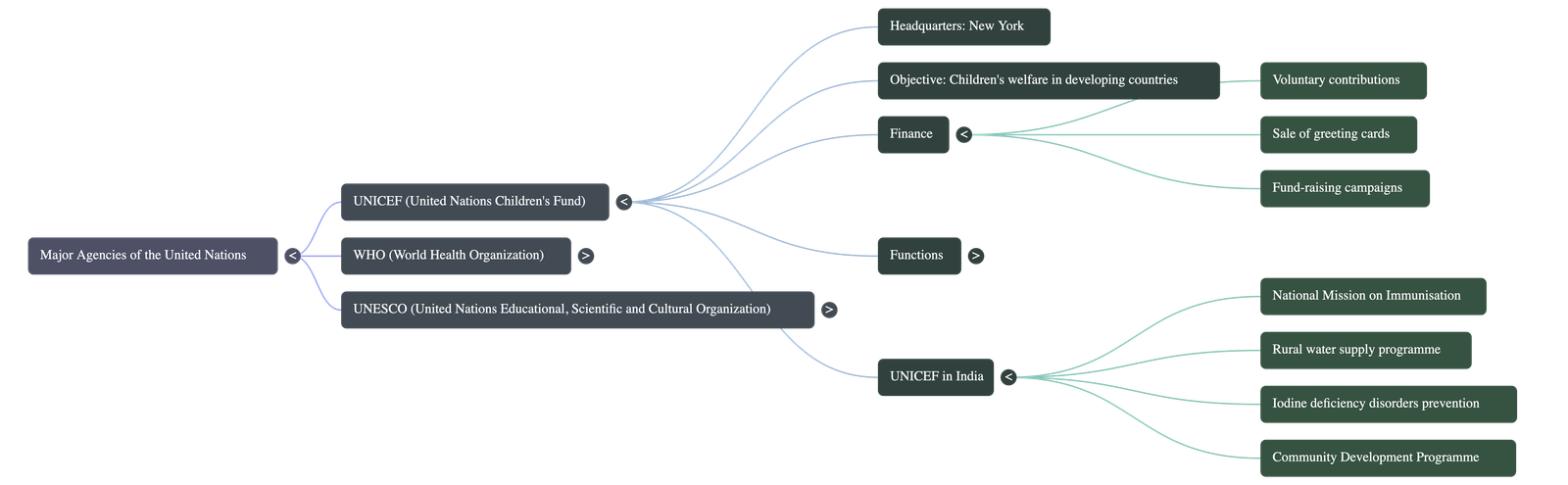
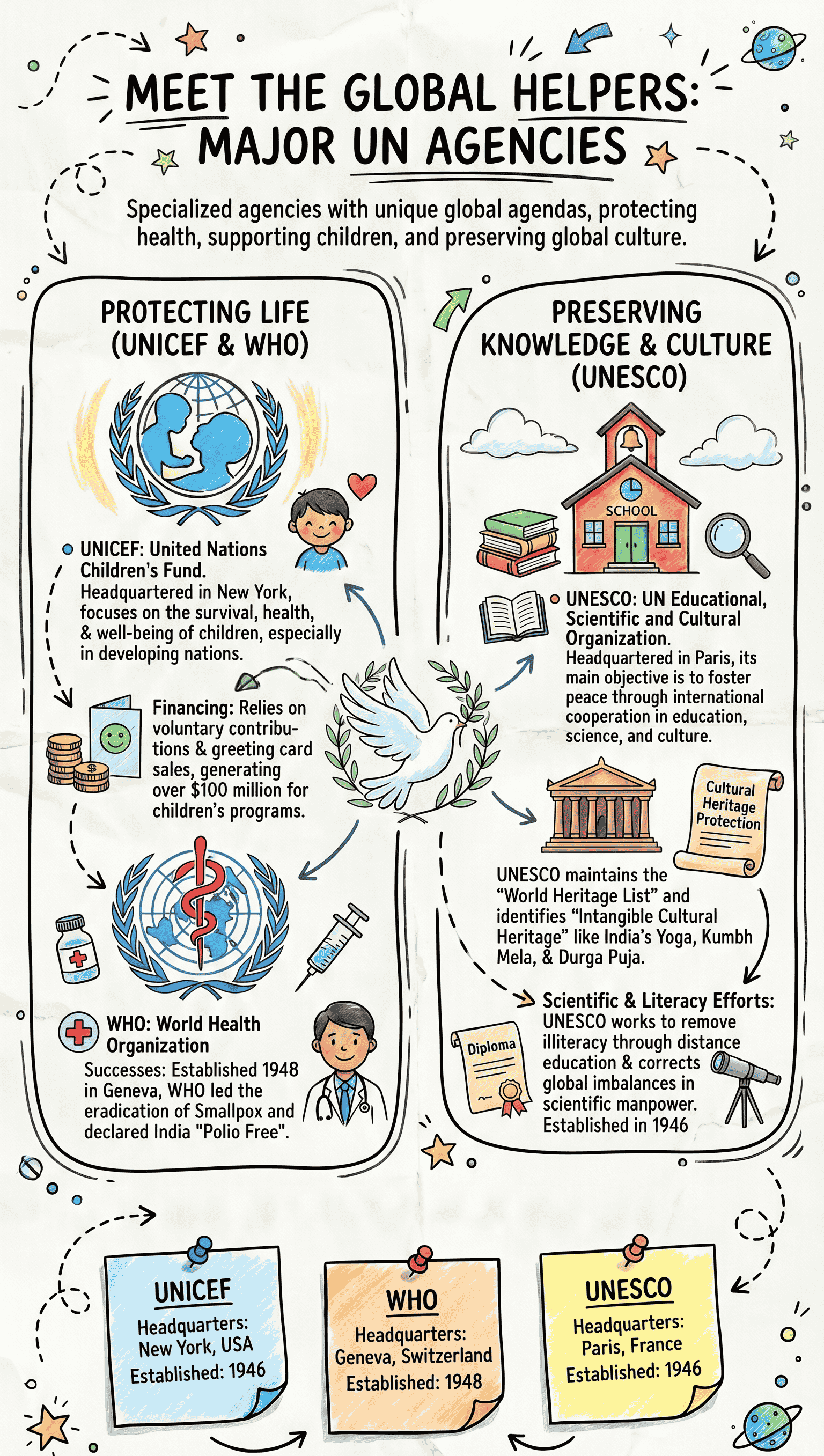
- Headquarters: New York, USA. It has more than 200 offices in developing countries.
Finance and Objectives
- Funding: Depends entirely on voluntary contributions from governments, private agencies, and fund-raising campaigns (like the worldwide sale of UNICEF greeting cards, which generates over $100 million).
- Resource Allocation: Almost all resources are diverted to the poorest developing countries, with the largest share going to children up to the age of five.
- Main Objective: To look after children's welfare in developing countries by providing low-cost, community-based services in maternal and child health, nutrition, and immunisation.
Key Functions
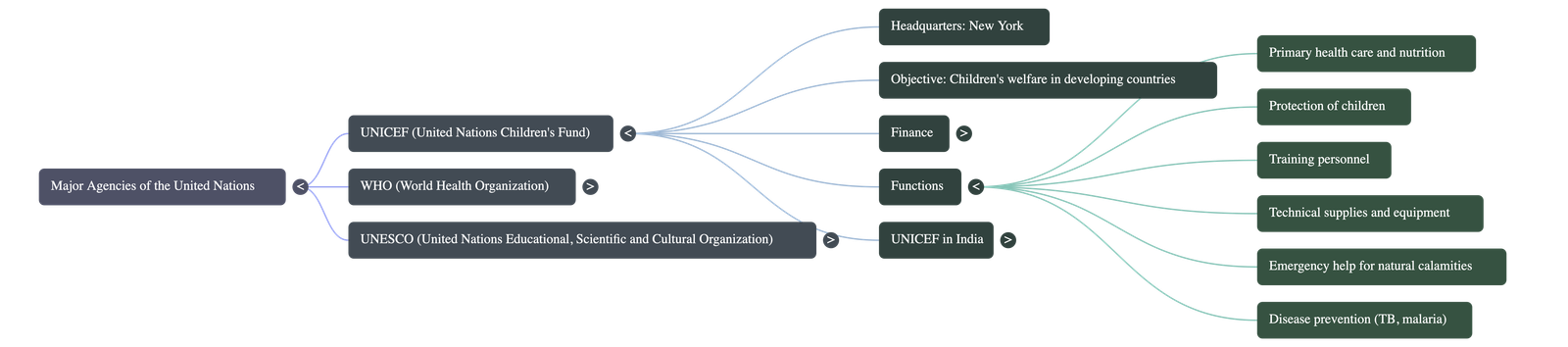
- Protects the survival, health, and well-being of children in cooperation with individuals, civic groups, and governments.
- Provides funds to train personnel, including health/sanitation workers, teachers, and nutritionists.
- Supplies technical equipment ranging from paper for textbooks and medicines to pipes and pumps for bringing clean water to villages.
- Assists governments in extending community-based services in health, nutrition, clean water, and sanitation.
- Provides emergency help to mothers and children during natural calamities and civil strife.
- Makes efforts to prevent diseases like tuberculosis (T.B.), malaria, and eye diseases.
- Speaks on behalf of children globally and upholds the Convention on the Rights of the Child.
- Awards: Awarded the Nobel Prize for Peace in 1965 and the Indira Gandhi Prize for Peace in 1989.
UNICEF Programmes in India
- Collaborative Missions: The Indian government launched the National Mission on Immunisation, the National Mission for Drinking Water, and the National Literacy Mission in collaboration with UNICEF.
- Education: Works closely with the Government, 17 State Governments, and civil society to ensure inclusive and equitable quality education for all children.
- Community Health: Assisted in the Community Development Programme in rural areas aimed at maternal and child health.
- Disease & Nutrition: Supported the production of Oral Rehydration Therapy (ORT) to reduce infant mortality from diarrhoeal diseases. Promoted iodised salt since the 1990s to prevent iodine deficiency.
- Clean Water: Partnered with India in the accelerated rural water supply programme.
- Rights & Equality: Seeks to protect the rights of women and children by reducing social inequalities based on gender, caste, ethnicity, or region.
2. World Health Organization (WHO)
Formation and Structure
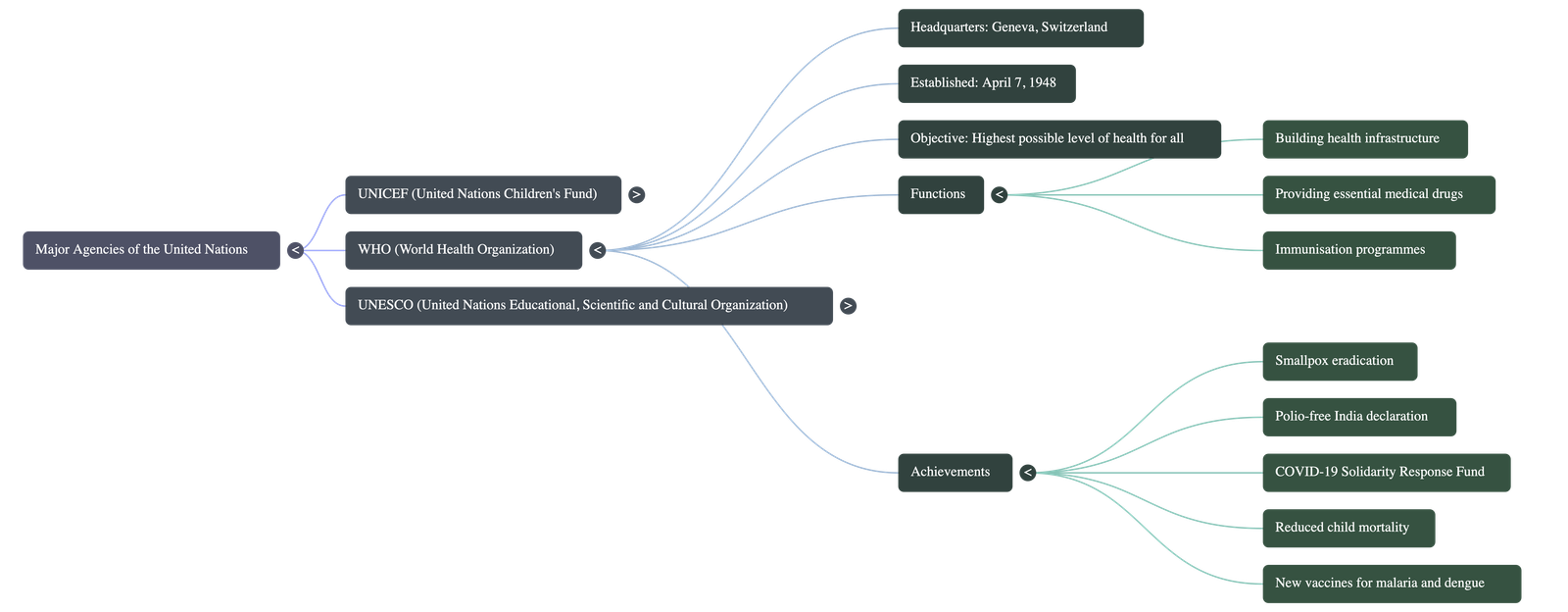
- Established on April 7, 1948. This date is now celebrated globally as World Health Day.
- Headquarters: Geneva, Switzerland.
- Definition of Health: Defined in WHO's Constitution as a state of complete physical, mental, and social well-being, and not merely the absence of disease or infirmity.
- Main Objective: The attainment of the highest possible level of health by all people.
Key Functions
- Helps countries improve their health systems by building up infrastructure, manpower, and institutions.
- Provides important drugs needed for medical care.
- Launches programmes to immunise children against major diseases.
Major Achievements (According to World Health Statistics 2023)
- Disease Eradication: Smallpox has been completely eradicated globally. India was successfully declared a 'Polio Free' country. Malaria has been eliminated in Azerbaijan and Tajikistan, and Hepatitis C is nearly eliminated in Egypt.
- COVID-19 Response: Raised over $200 million through its Solidarity Response Fund to combat the crisis.
- Disaster Relief: Helped people globally during earthquakes, floods, wildfires, and droughts.
- Vaccines & Prevention: Recommended new vaccines for malaria, dengue, and meningitis. Made strong progress on HPV vaccination to eliminate cervical cancer.
- Global Health Improvements: Smoking rates have fallen globally. Child mortality (under five) dropped from 90 to 46 deaths per 1000 live births. 1.3 million fewer new HIV cases reported from 2001 to 2013.
- Mental Health: Brought community mental health services to 50 million people since 2019.
- India Initiative: India launched an initiative to place 75 million people with hypertension or diabetes on standard care.
3. United Nations Educational, Scientific and Cultural Organization (UNESCO)
Formation and Structure
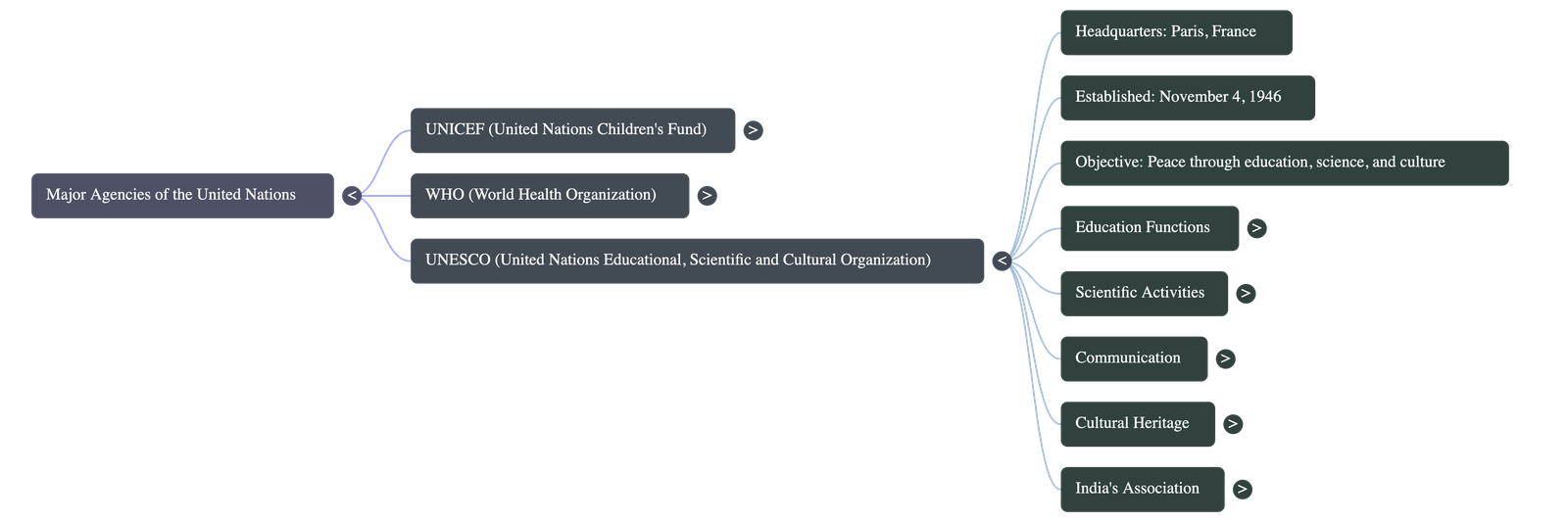
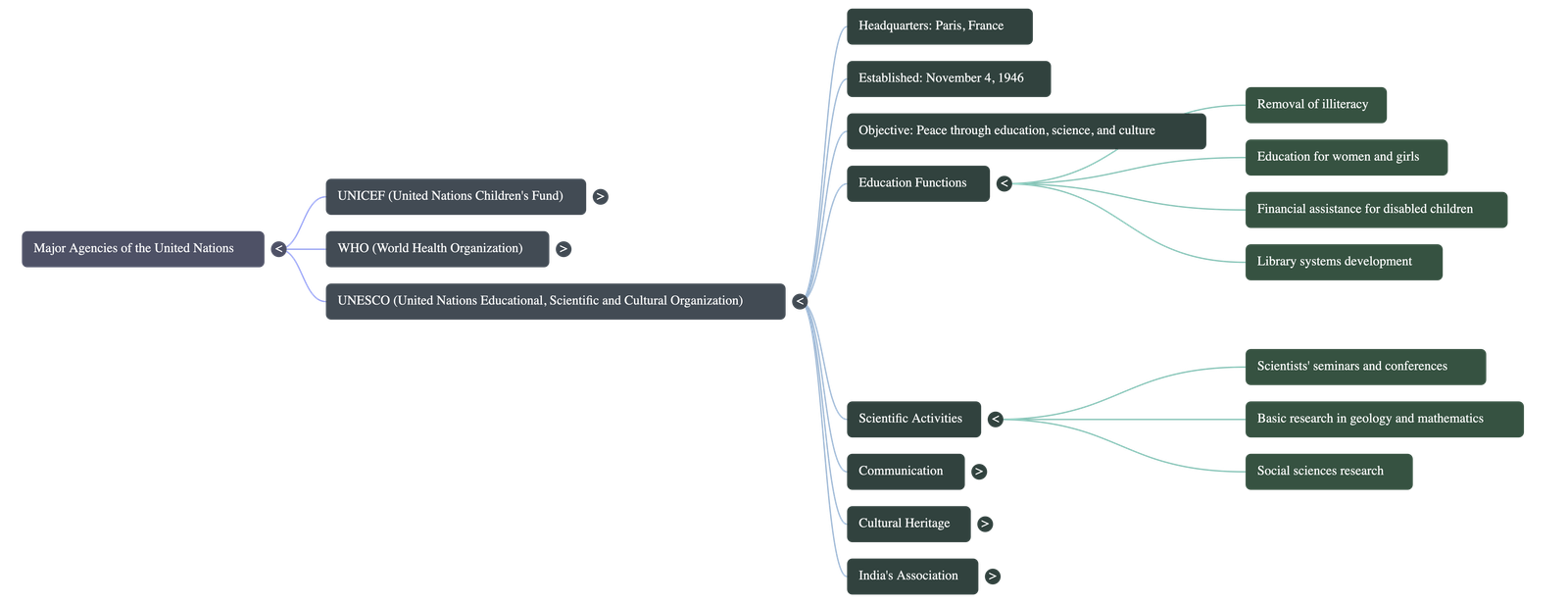
- Established on November 4, 1946.
- Headquarters: Paris, France.
- Main Objective: To contribute to peace and security in the world by fostering cooperation among nations through education, science, and cultural development.
Functions in Education
- Aims to remove illiteracy by encouraging adult education, distance education, and the open school system.
- Lays special emphasis on the education of women and girls, and provides financial assistance for disabled children.
- Provides grants and fellowships to teachers/scholars and helps organize library systems. (e.g., The Delhi Public Library was established in 1951 with UNESCO's financial assistance).
- Organizes international and national book fairs and festivals.
- Encourages science education by providing regional training centres and promotes education as an instrument for international understanding.
Scientific Activities
- Organizes seminars/conferences for scientists globally and circulates information through its official monthly magazine, 'Courier' (available in Hindi and Tamil in India).
- Promotes basic research in fields like geology, mathematics, physics, and oceanography, financing engineering and technology schemes in developing countries.
- Helps correct the imbalance in scientific manpower, as 90% of trained manpower is currently concentrated in industrialised countries.
- Encourages social science studies to combat discrimination, improve women's status, and help youth solve problems.
Communication
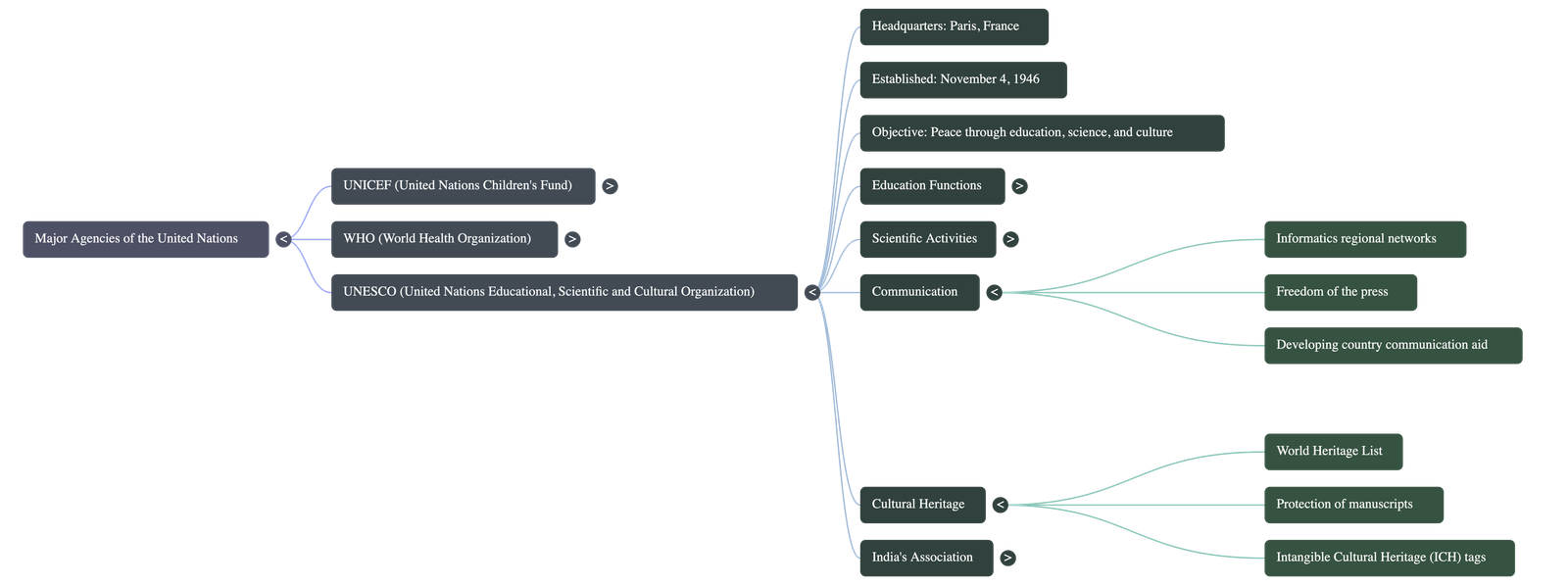
- Develops communication networks for information dissemination.
- Sets up regional networks and trains technicians in both hardware and software aspects of informatics.
- Improves the quality of the press, films, and video services.
- Assists developing countries in expanding their communication capabilities.
- Upholds the freedom of the press and the independence of the media.
Preservation of Cultural Heritage
- World Heritage List: Provides technical advice, assistance, and funds to preserve monuments and works of art. Identifies global monuments/sites to be protected.
- Manuscripts: Aims to protect the world's inheritance of rare books, works of art, and manuscripts.
- Intangible Cultural Heritage (ICH): Gives ICH tags to recognize cultural practices, oral traditions, rituals, and festive events passed down through generations.
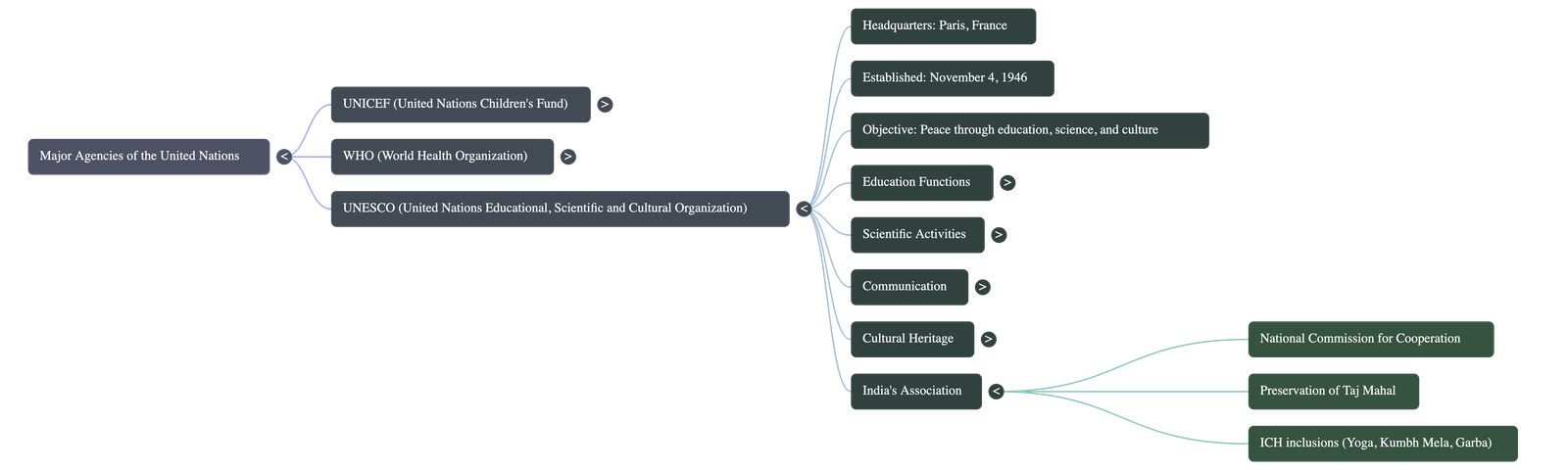
Examples in India: Sankirtana (Manipur), Durga Puja (Kolkata), Kumbh Mela, Yoga, Vedic Chanting, Ramlila, and the recent addition of Garba of Gujarat in 2023. - Encourages artistic creations in fine arts and literature, and pays attention to cultural development through films.
- Provides travel grants to writers and artists (e.g., "Mutual Appreciation of Eastern and Western Cultural Values") to promote peace and cultural exchange.
India's Association with UNESCO
- India has been a member since UNESCO's inception in 1946.
- In 1949, India set up a National Commission for Cooperation with UNESCO, consisting of five Sub-Commissions (Education, Natural Sciences, Social Sciences, Culture, and Communication).
- UNESCO provides expertise and funds for the protection of Indian historical monuments like the Taj Mahal.
- In July 2022, India was elected to the Intergovernmental Committee for the 2003 Convention on the Safeguarding of Intangible Cultural Heritage for a four-year period, allowing India to play a major global role in cultural preservation.
Do checkout all questions & answers of this chapter.
Quick Navigation:
| | | |
1 / 1
Quick Navigation:
| | | |