Mahatma Gandhi and the National Movement
1. Early Life and Initial Struggles
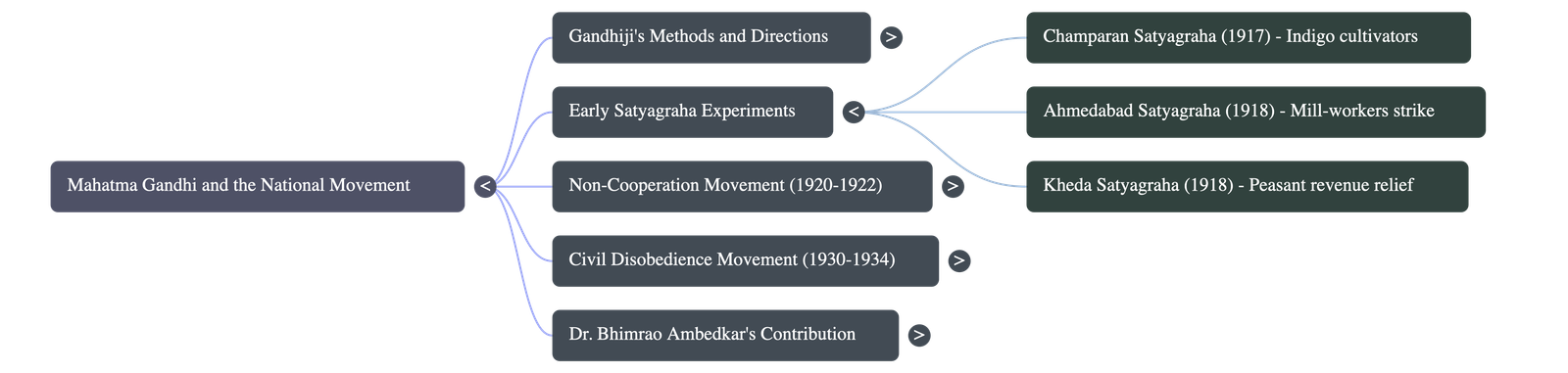
Mahatma Gandhi began his fight for justice in South Africa (1893-1914) against racist authorities, where he developed the technique of Satyagraha. He returned to India in January 1915 and led three major early movements:
- Champaran Satyagraha (1917): His first great experiment in India. Indigo farmers in Bihar were heavily exploited by European planters under the tinkathia system. Gandhiji's peaceful defiance led to an inquiry and brought relief to the cultivators.
- Ahmedabad Satyagraha (1918): Gandhiji led mill-workers on strike against mill-owners for higher wages. He undertook his first hunger strike here, forcing the owners to grant a 35% wage increase.
- Kheda Satyagraha (1918): Crops failed in Gujarat, but the government demanded land revenue. Gandhiji guided peasants to peacefully refuse payment until a settlement was reached. Sardar Vallabhbhai Patel became his follower during this struggle.
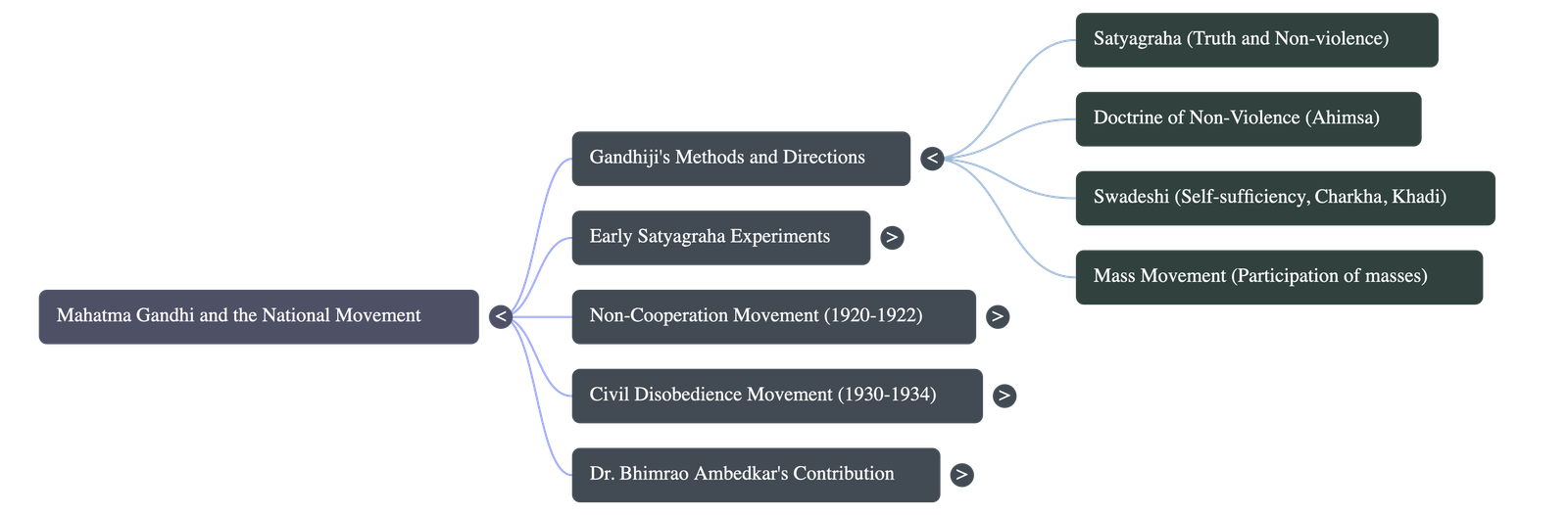
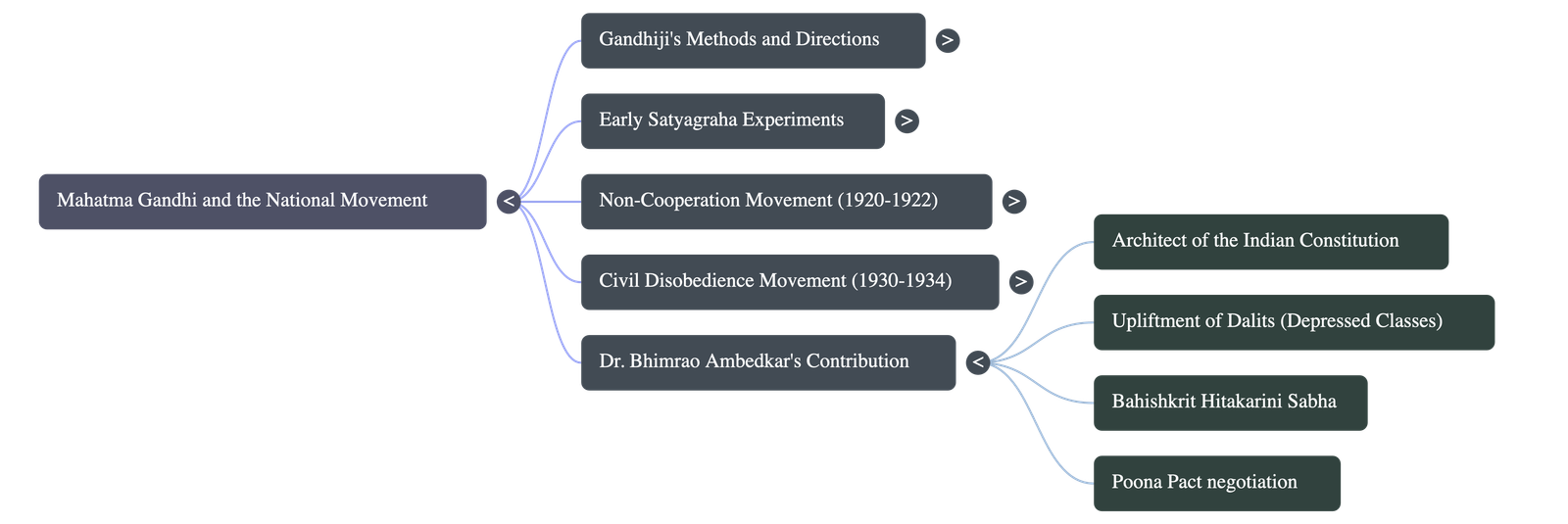
2. Gandhiji's Methods and Directions
Gandhiji directed the freedom struggle using distinct moral and peaceful principles:
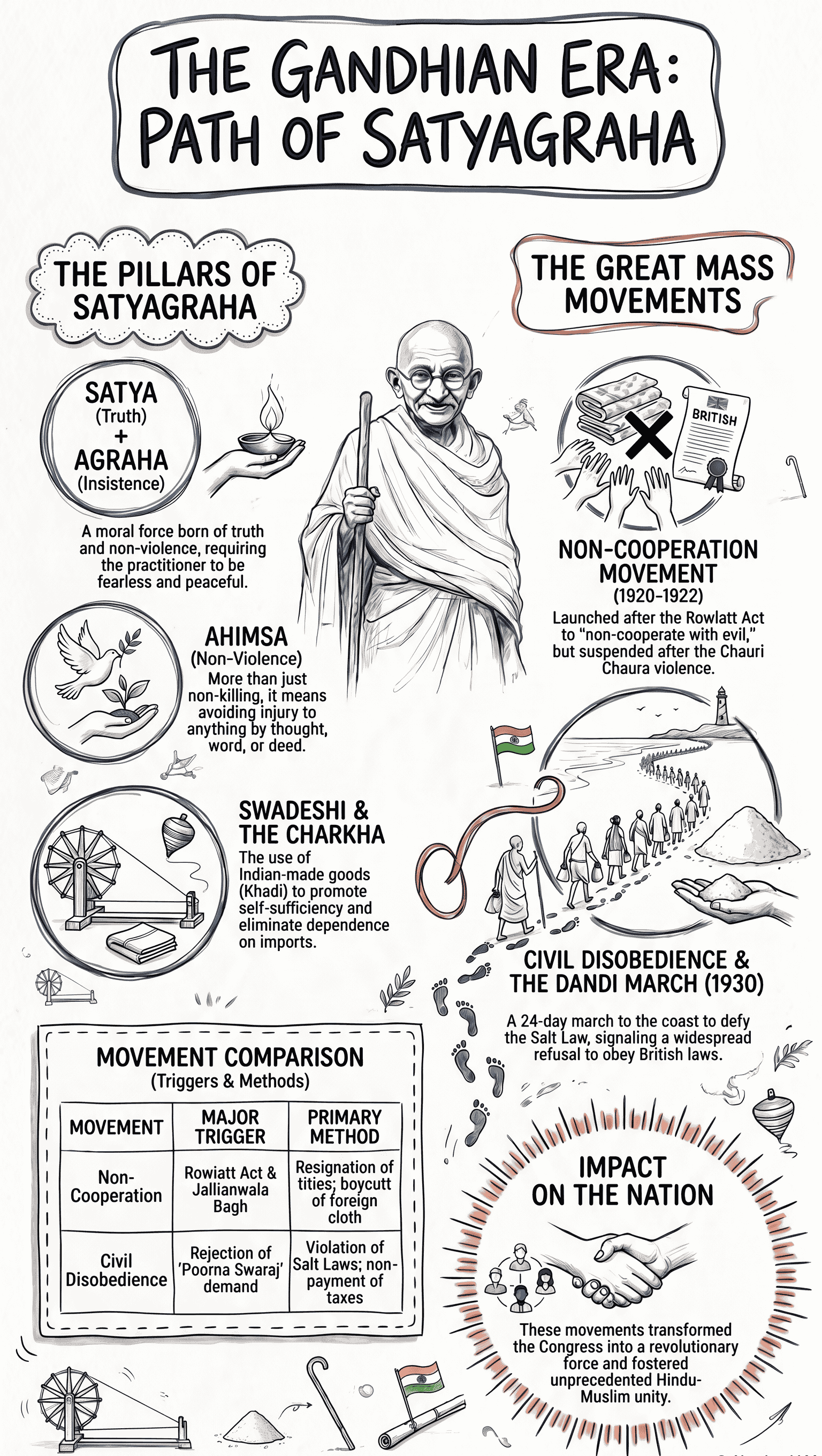
- Satyagraha: Derived from Sanskrit (Satya = truth, Agraha = insistence). It is a moral force based on truth and non-violence. It means fearless resistance without hatred towards the wrongdoer.
- Doctrine of Non-Violence (Ahimsa): Avoiding injury by thought, word, or deed. It is an active, positive force requiring sympathy and benevolence.
- Swadeshi: Using items produced in one's own country to make India self-sufficient and eliminate dependence on imported goods. He emphasized manual labour, the Charkha (spinning wheel), and Khadi.
- Mass Movement: Uniting Indians of all religions, regions, and social classes to actively participate in the freedom struggle.
3. The Non-Cooperation Movement (1920-1922)
This movement was a peaceful rebellion aimed at refusing all cooperation with the British government.
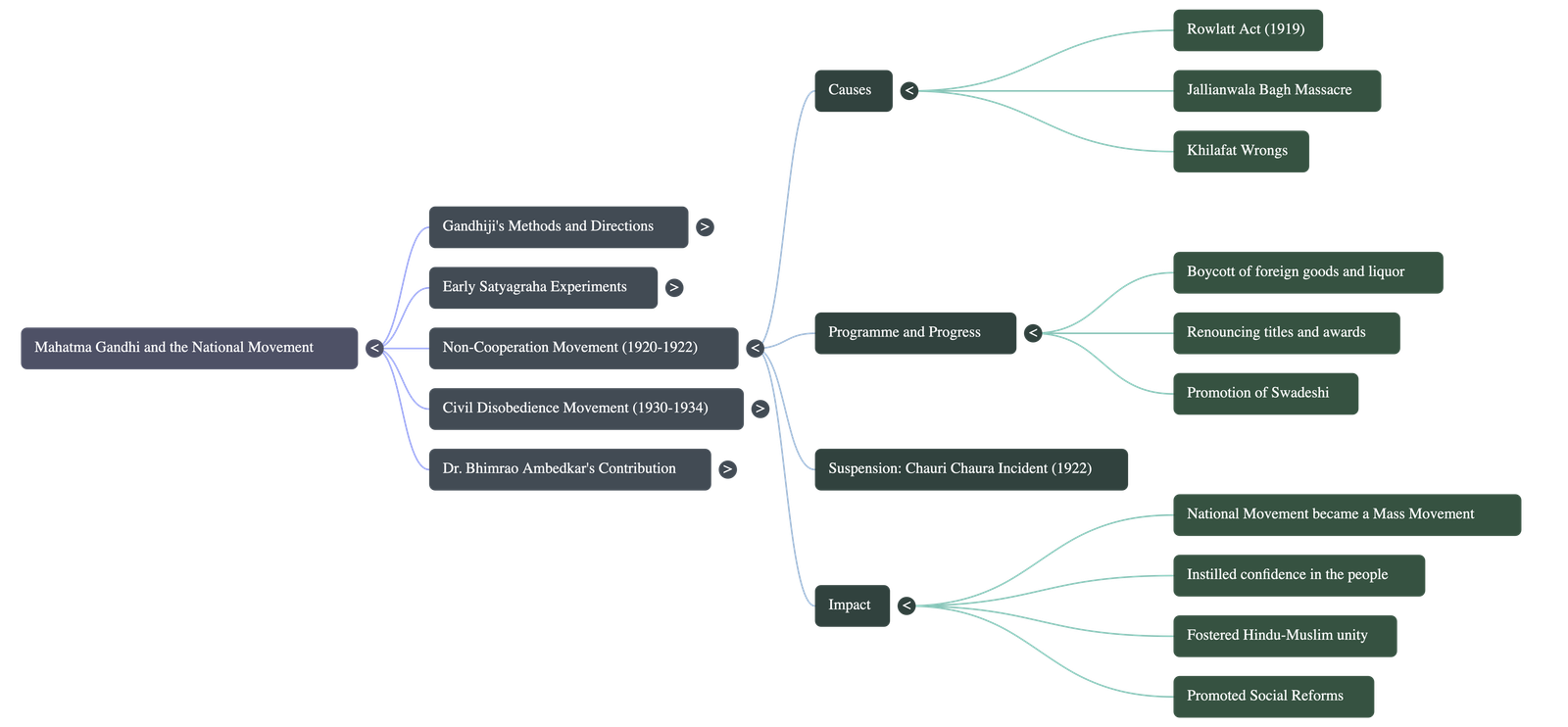
Causes of the Movement:
- The Rowlatt Act (1919): Allowed the British to imprison Indians without trial, hold trials in seclusion, and suspend Habeas Corpus. It led to nationwide strikes.
- Jallianwala Bagh Tragedy (April 13, 1919): General Dyer ordered brutal firing on an unarmed crowd in Amritsar, shocking the nation.
- The Khilafat Movement: Launched by Muslims to protest injustices against the Caliph of Turkey. Gandhiji merged this with Non-Cooperation to build Hindu-Muslim unity.
Events and Progress:
- Rabindranath Tagore and others surrendered their British titles and medals.
- Foreign goods were boycotted, and foreign cloth was burnt in public.
- Students left government schools, and lawyers boycotted courts.
- The Prince of Wales' visit to India in 1921 was met with a nationwide boycott.
Suspension: The Chauri Chaura Incident
- On February 5, 1922, a peaceful procession of 3,000 peasants in Chauri Chaura (UP) was fired upon by the police.
- The infuriated mob set the police station on fire, killing 22 policemen.
- Deeply hurt by this violence, Gandhiji suspended the movement on February 12, 1922. Leaders like Subhas Chandra Bose and Motilal Nehru heavily criticized this decision.
Impact of the Non-Cooperation Movement:
- It transformed the National Movement into a true Mass Movement involving peasants, workers, and women.
- It instilled tremendous self-confidence and a desire for freedom among the masses.
- The Indian National Congress became a revolutionary organization capable of action.
- Fostered strong Hindu-Muslim unity.
- Promoted social reforms like the removal of untouchability and popularization of Khadi.
- Spread the message of Nationalism to every village.
- Popularised the ultimate goal of "Swaraj" (Self-rule).
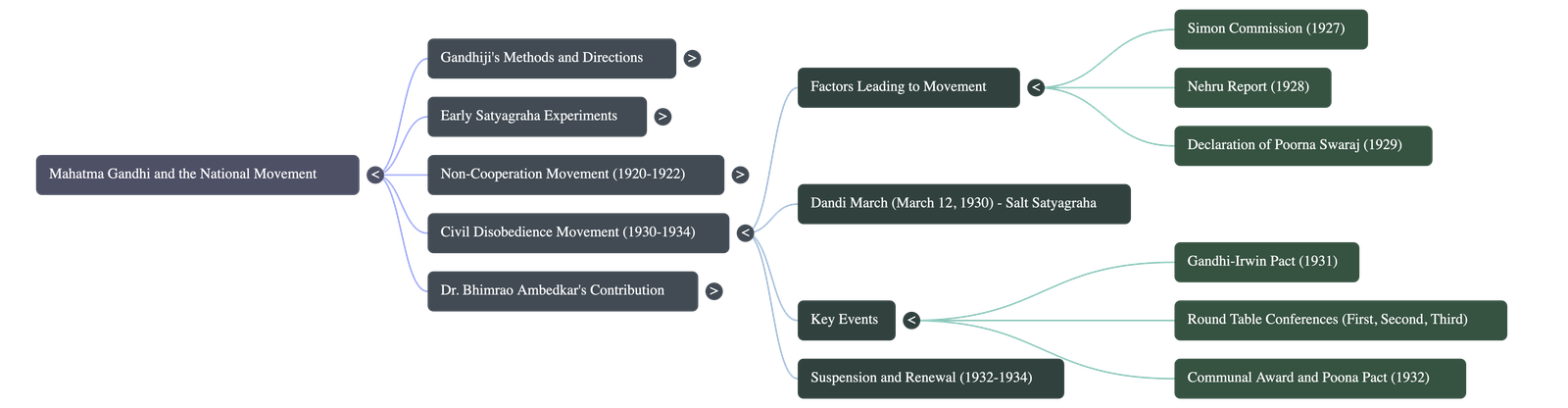
4. Factors Leading to the Civil Disobedience Movement
- Simon Commission (1927): Appointed by the British to investigate constitutional reforms, it had exactly zero Indian members. It was seen as a deliberate insult and was met with strikes and slogans of "Simon Go Back." Lala Lajpat Rai lost his life due to police lathi charges during protests.
- Nehru Report (1928): Drafted by Motilal Nehru to challenge the British claim that Indians couldn't frame a constitution. It demanded Dominion Status, joint electorates, linguistic provinces, and 19 Fundamental Rights.
- Declaration of Poorna Swaraj (1929): Since the British ignored the Nehru Report, Congress held its historic Lahore Session under Jawaharlal Nehru. They declared Poorna Swaraj (Complete Independence) as their only goal. On Jan 26, 1930, Independence Day was observed, which is why India's Republic Day is now celebrated on January 26.
5. Civil Disobedience Movement (1930-1934)
Unlike Non-Cooperation, which meant not helping the British, Civil Disobedience meant actively and openly breaking specific British laws.
The Dandi March (The Salt Satyagraha):
- Began on March 12, 1930, from Sabarmati Ashram.
- Gandhiji chose to attack the Salt Tax because it affected all sections of society, especially the poor.
- He reached the Gujarat coast at Dandi on April 6, 1930, and officially broke the law by picking up a handful of sea salt.
Progress & Repression:
- The movement spread like wildfire: defiance of forest laws, non-payment of taxes, and boycotting foreign goods.
- Led by Khan Abdul Ghaffar Khan ("Frontier Gandhi") and his 'Red Shirts', Pathans joined the movement in the North-West. In the East, 13-year-old Rani Gaidinliu led a revolt.
- The Government unleashed brutal repression: lathi charges, firing, and the arrest of over 90,000 Indians, including Gandhiji and Congress leaders.
6. Round Table Conferences & The Poona Pact
- First Round Table Conference (1930-31): Held in London. Boycotted by Congress. The British realized no decisions could be made without Congress participation.
- Gandhi-Irwin Pact (March 1931): An agreement where the British agreed to release non-violent political prisoners, return confiscated properties, and allow salt-making near coasts. In return, Gandhiji suspended the Civil Disobedience Movement and agreed to attend the Second Round Table Conference.
- Second Round Table Conference (1931): Gandhiji attended as the sole Congress representative. The talks failed because the British refused to grant immediate independence and instead focused on dividing Indians by offering 'separate electorates' for minorities and depressed classes.
- The Communal Award & Poona Pact (1932): The British announced separate electorates for depressed classes. Gandhiji saw this as a plot to divide Hindu society and began a fast unto death. Dr. B.R. Ambedkar and Gandhiji eventually signed the Poona Pact, agreeing to joint electorates but drastically increasing the reserved seats for depressed classes (from 71 to 148).
Following the failure of the Round Table conferences and intense British repression, the Civil Disobedience Movement was temporarily renewed but ultimately withdrawn in 1934.
7. Dr. Bhimrao Ambedkar's Contribution
Dr. B.R. Ambedkar (Babasaheb) is famously known as the Chief Architect of the Indian Constitution.
- Struggle Against Caste: Despite facing extreme discrimination as a child, he became a highly educated economist and jurist. He dedicated his life to eradicating untouchability and fighting for Dalit rights.
- Key Organizations & Media: He formed the Bahishkrit Hitakarini Sabha to promote education among depressed classes and launched periodicals like Mook Nayak, Bahishkrit Bharat, and Equality Janta.
- Nation Building: Appointed as Independent India's first Law Minister and Chairman of the Constitution Drafting Committee.
- Later Life: In 1956, to promote equality, he converted to Buddhism along with 5 lakh followers. He was posthumously awarded the Bharat Ratna.
Study well for your Class 10 History Exams! Let me know if you need any topic explained further.
Do checkout all questions & answers of this chapter.